Chapter 23 – Futures, Swaps, and Risk Management
23-1
CHAPTER 23: FUTURES, SWAPS, AND RISK MANAGEMENT
PROBLEM SETS
1. In formulating a hedge position, a stock’s beta and a bond’s duration are used
similarly to determine the expected percentage gain or loss in the value of the
underlying asset for a given change in market conditions. Then, in each of these
markets, the expected percentage change in value is used to calculate the expected
dollar change in value of the stock or bond portfolios, respectively. Finally, the dollar
2. One of the considerations that would enter into the hedging strategy for a U.S.
exporting firm with outstanding bills to its customers denominated in foreign
currency is whether the U.S. firm also has outstanding payables denominated in the
Chapter 23 – Futures, Swaps, and Risk Management
23-2
position in the foreign currency futures. In general, if the U.S. firm incurs expenses
in the same foreign currency, then the firm would take a short position in the
3. The hedge will be much more effective for the gold-producing firm. Prices for distant
maturity oil futures contracts have surprisingly low correlation with current prices
because convenience yields and storage costs for oil can change dramatically over
time. When near-term oil prices fall, there may be little or no change in longer-term
4. Municipal bond yields, which are below T-bond yields (tax-exempt status), are
expected to close in on Treasury yields. Because yields and prices are inversely
Chapter 23 – Futures, Swaps, and Risk Management
23-3
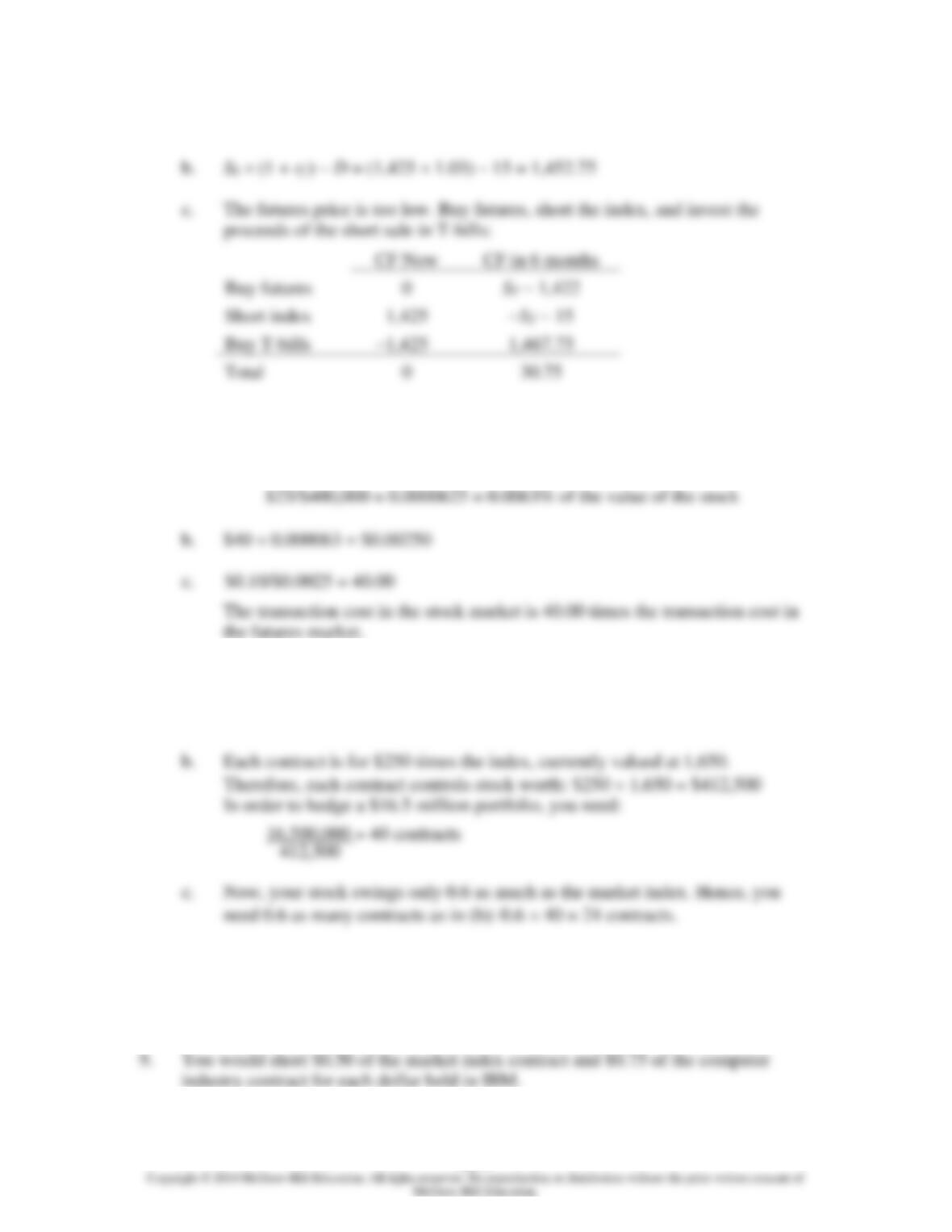
5. a. S0 (1 + rM ) − D = (1,425 1.06) – 15 = 1,495.50
6. a. The value of the underlying stock is:
$250 1,600 = $400,000
7. a. You should be short the index futures contracts. If the stock value falls, you
need futures profits to offset the loss.
8. If the beta of the portfolio were 1.0, she would sell $1 million of the index. Because
beta is 1.25, she should sell $1.25 million of the index.
Chapter 23 – Futures, Swaps, and Risk Management
23-4
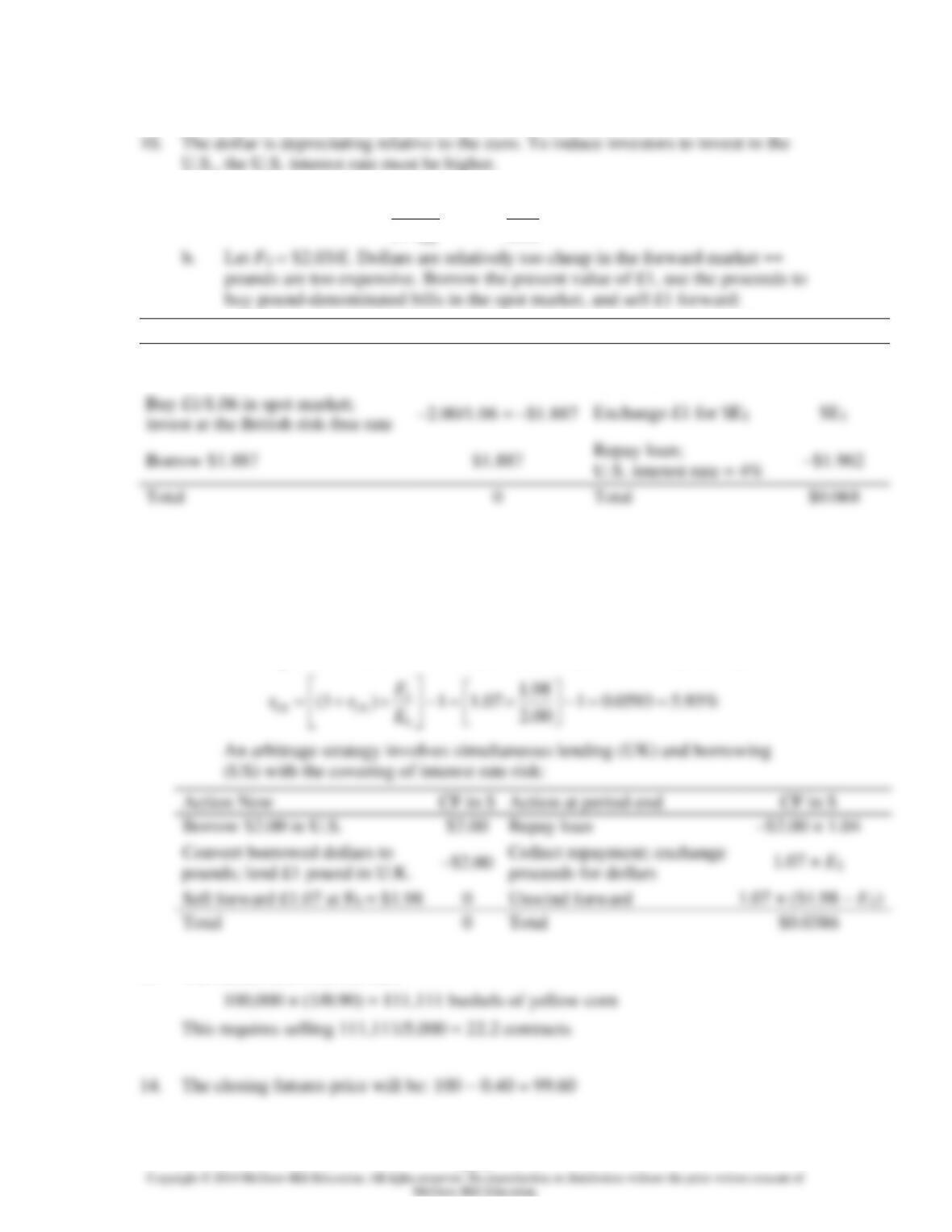
11. a. From parity:
US
00
11.04
2.00 1.962
1 1.06
r
FE r
+
= = =
+
Action Now
CF in $
Action at period-end
CF in $
Sell £1 forward for $2.03
0
Collect $2.03,
deliver £1
$2.03 – $E1
12. a. Lend in the U.K.
b. Borrow in the U.S.
c. Lending in the U.S. offers a 4% rate of return. Lending in the U.K. and
covering interest rate risk with futures or forwards offers a rate of return of
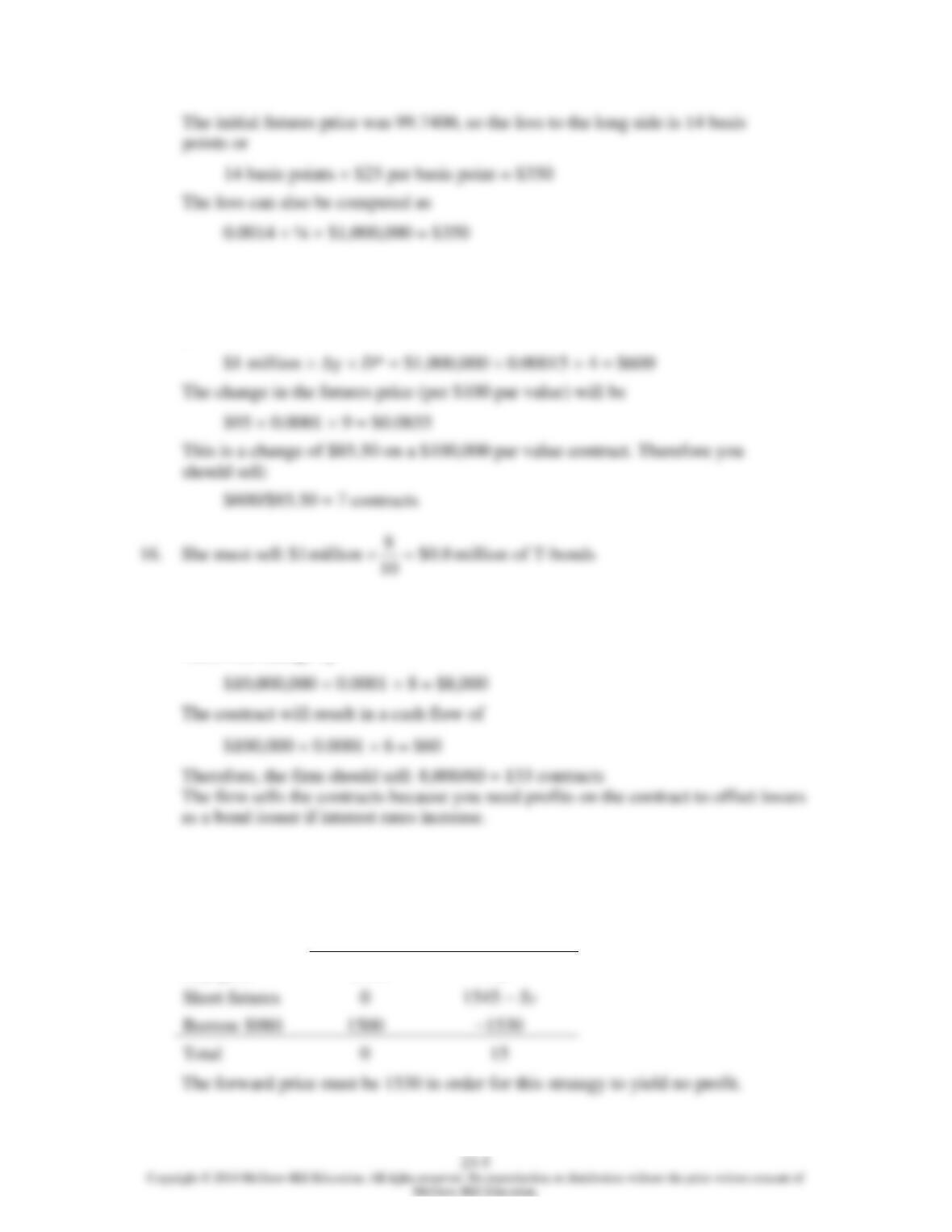
13. The farmer must sell forward
Chapter 23 – Futures, Swaps, and Risk Management
15. Suppose the yield on your portfolio increases by 1.5 basis points. Then the yield
on the T-bond contract is likely to increase by 1 basis point. The loss on your
portfolio will be
17. If yield changes on the bond and the contracts are each 1 basis point, then the bond
value will change by
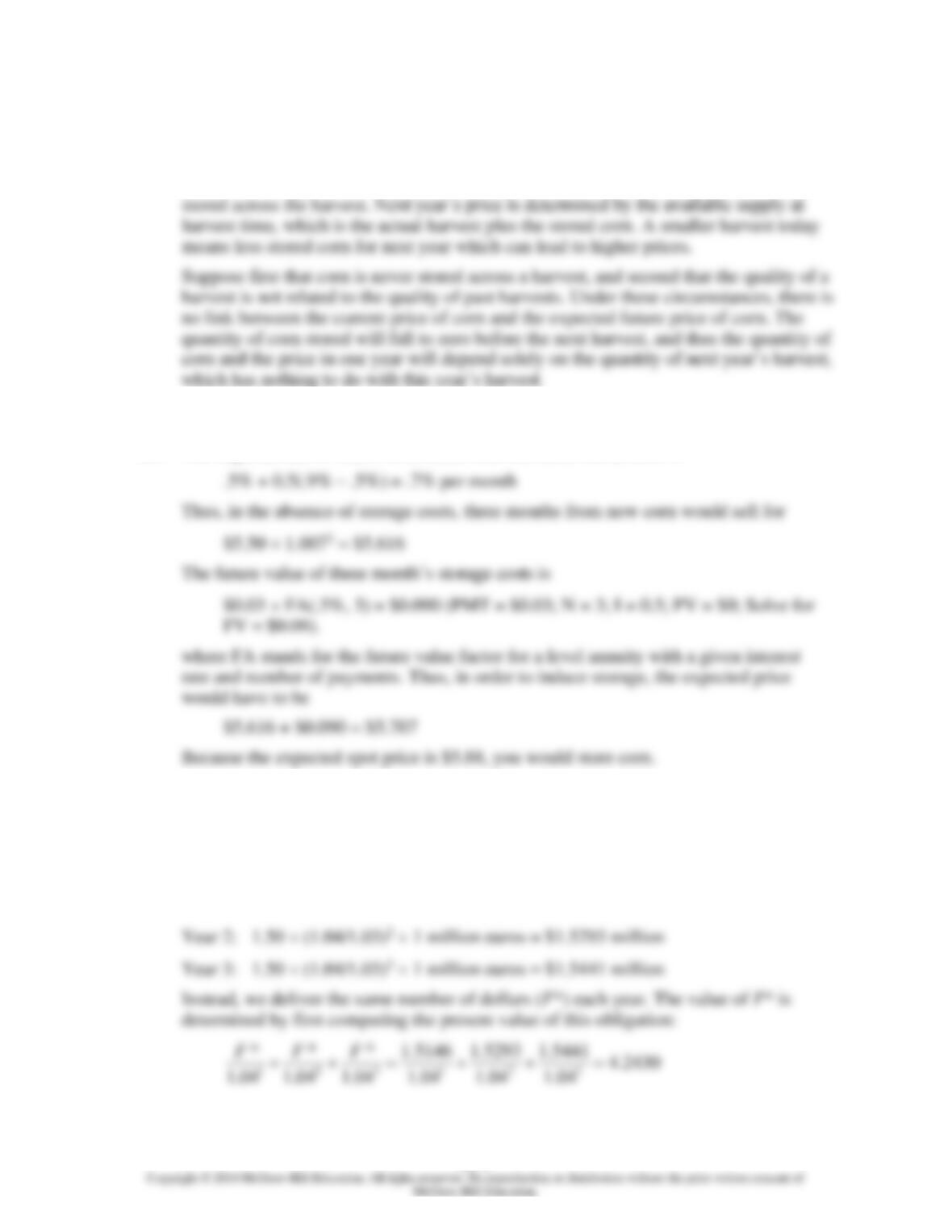
18. F0 = S0(l + rf )T = 1500 1.02 = 1530
If F0 = 1545, you could earn arbitrage profits as follows:
CF Now
CF in 1 year
Buy gold
−1500
ST
Short futures
Borrow $980
Total
Chapter 23 – Futures, Swaps, and Risk Management
23-6
19. If a poor harvest today indicates a worse than average harvest in future years, then the
futures prices will rise in response to today’s harvest, although presumably the two-year
price will change by less than the one-year price. The same reasoning holds if corn is
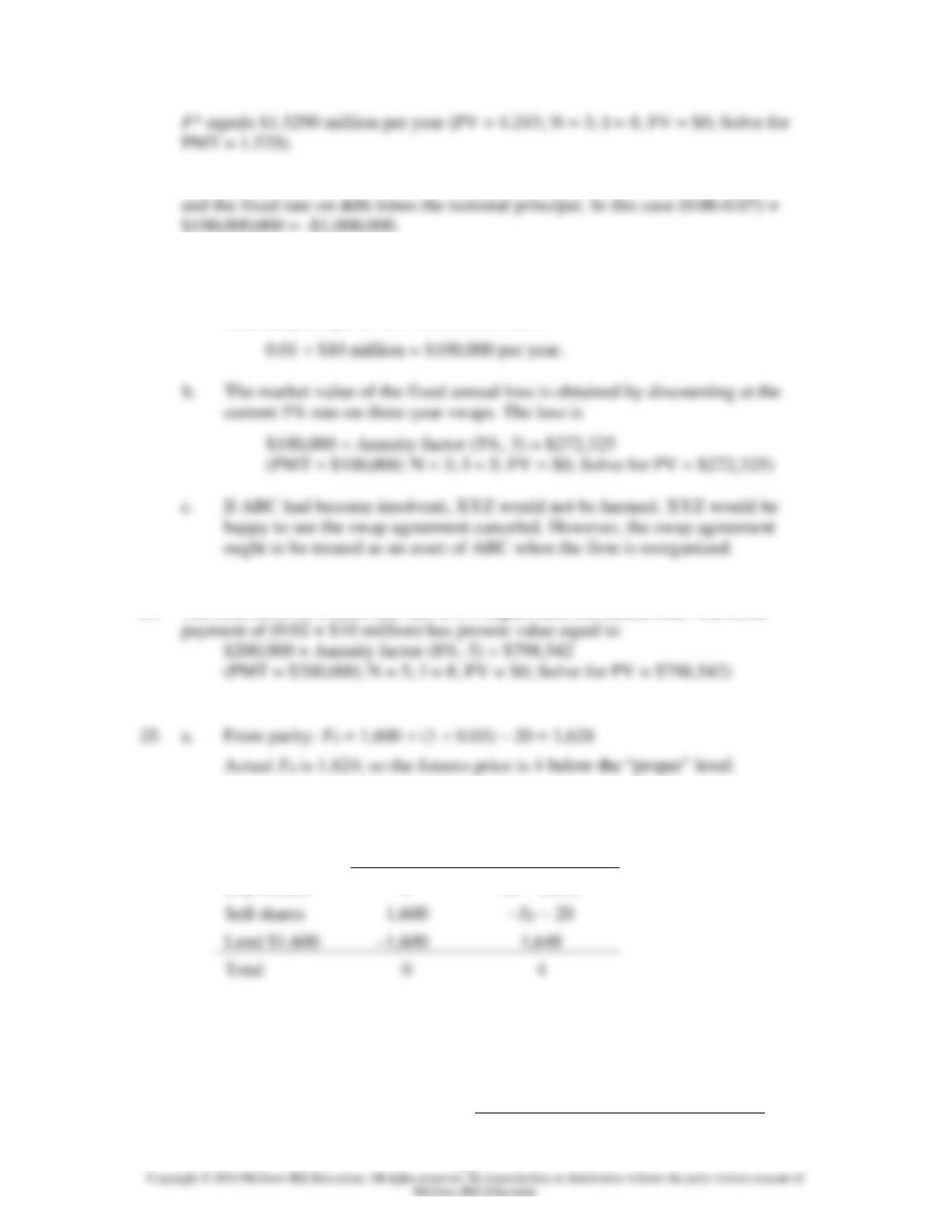
20. The required rate of return on an asset with the same risk as corn is
21. If the exchange of currencies were structured as three separate forward contracts,
the forward prices would be determined as follows:
Forward exchange rate $1 million euros = Dollars to be delivered
Year 1: 1.50 (1.04/1.03) 1 million euros = $1.5146 million
Chapter 23 – Futures, Swaps, and Risk Management
23-7
22. The firm’s overall cost of the fund will equal the spread between the LIBOR rate
23. a. The swap rate moved in favor of firm ABC. ABC should have received 1%
more per year than it could receive in the current swap market. Based on
notional principal of $10 million, the loss is
24. The firm receives a fixed rate that is 2% higher than the market rate. The extra
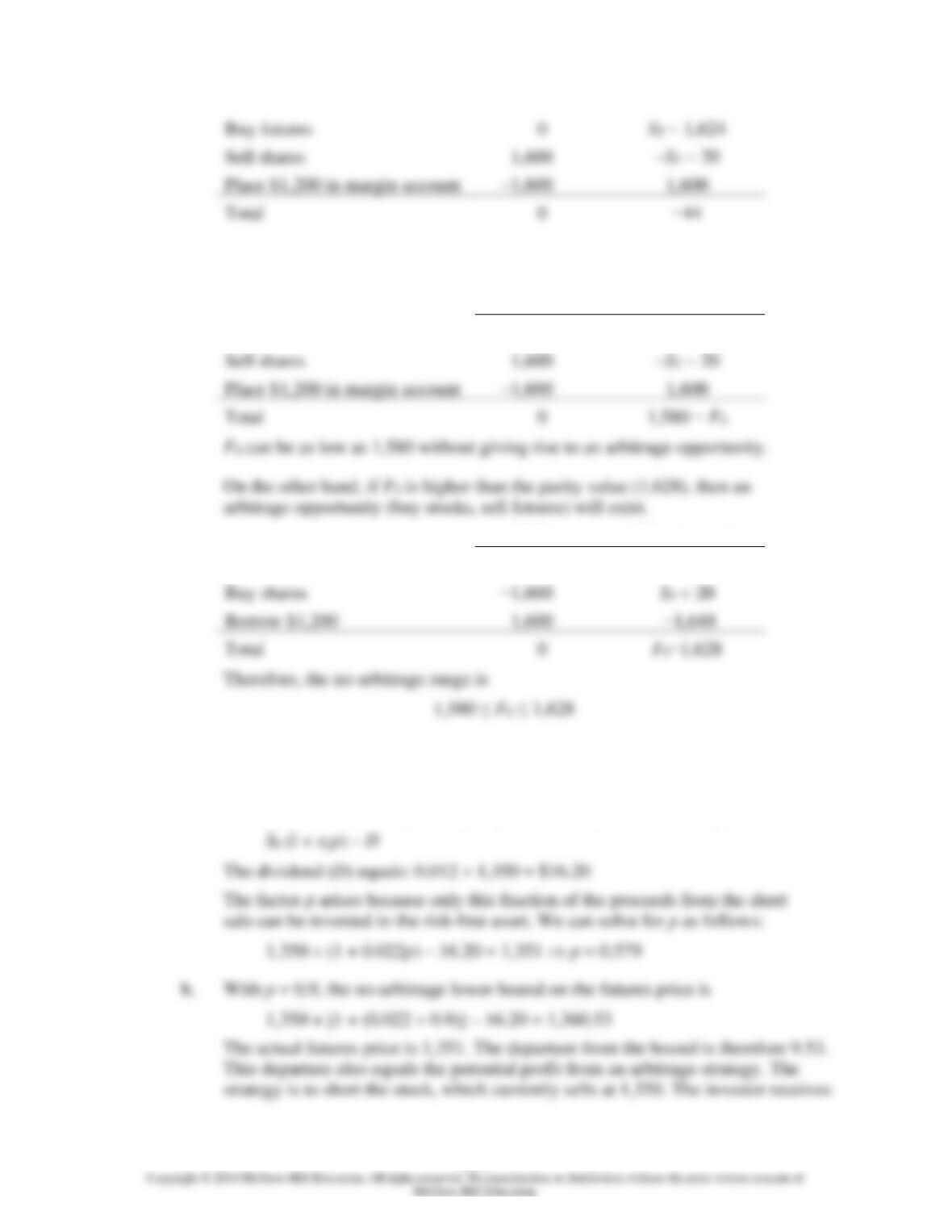
b. Buy the relatively cheap futures, sell the relatively expensive stock and lend
the proceeds of the short sale:
CF Now
CF in 6 months
Buy futures
0
ST − 1,624
Sell shares
Lend $1,600
Total
0
c. If you do not receive interest on the proceeds of the short sales, then the $1,600
you receive will not be invested but will simply be returned to you. The
proceeds from the strategy in part (b) are now negative: an arbitrage opportunity
no longer exists.
CF Now
CF in 6 months
Chapter 23 – Futures, Swaps, and Risk Management
23-8
Buy futures
0
Sell shares
Place $1,200 in margin account
Total
0
d. If we call the original futures price F0, then the proceeds from the long-
futures, short-stock strategy are
CF Now
CF in 6 months
Buy futures
0
ST − F0
Sell shares
Place $1,200 in margin account
Total
0
CF Now
CF in 6 months
Sell futures
0
F0 − ST
Buy shares
ST + 20
Borrow $1,200
−1,648
Total
0
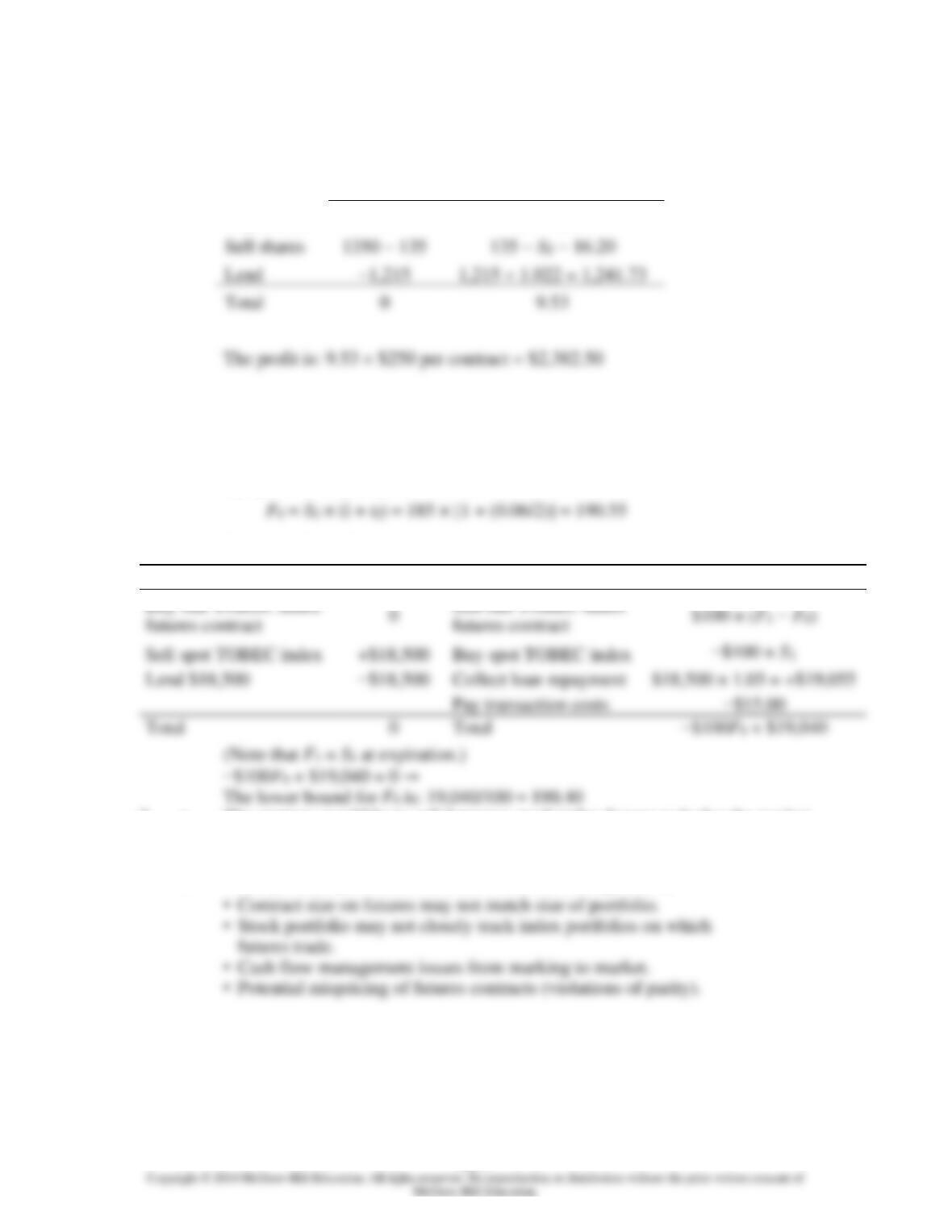
26. a. Call p the fraction of proceeds from the short sale to which we have access.
Ignoring transaction costs, the lower bound on the futures price that precludes
arbitrage is the following usual parity value (except for the factor p):
Chapter 23 – Futures, Swaps, and Risk Management
23-9
90% of the proceeds (1,215) and the remainder (135) remains in the margin
account until the short position is covered in six months. The investor buys
futures and lends 1,215:
CF Now
CF in 6 months
Buy futures
0
ST − 1,351
Sell shares
Lend
Total
0
CFA PROBLEMS
1. a. By spot-futures parity:
b. The lower bound is based on the reverse cash-and-carry strategy.
Action Now
CF in $
Action at period-end
CF in $
2. a. The strategy would be to sell Japanese stock index futures to hedge the market
risk of Japanese stocks, and to sell yen futures to hedge the currency exposure.
b. Some possible practical difficulties with this strategy include
3. a. The hedged investment involves converting the $1 million to foreign
currency, investing in that country, and selling forward the foreign currency in
order to lock in the dollar value of the investment. Because the interest rates
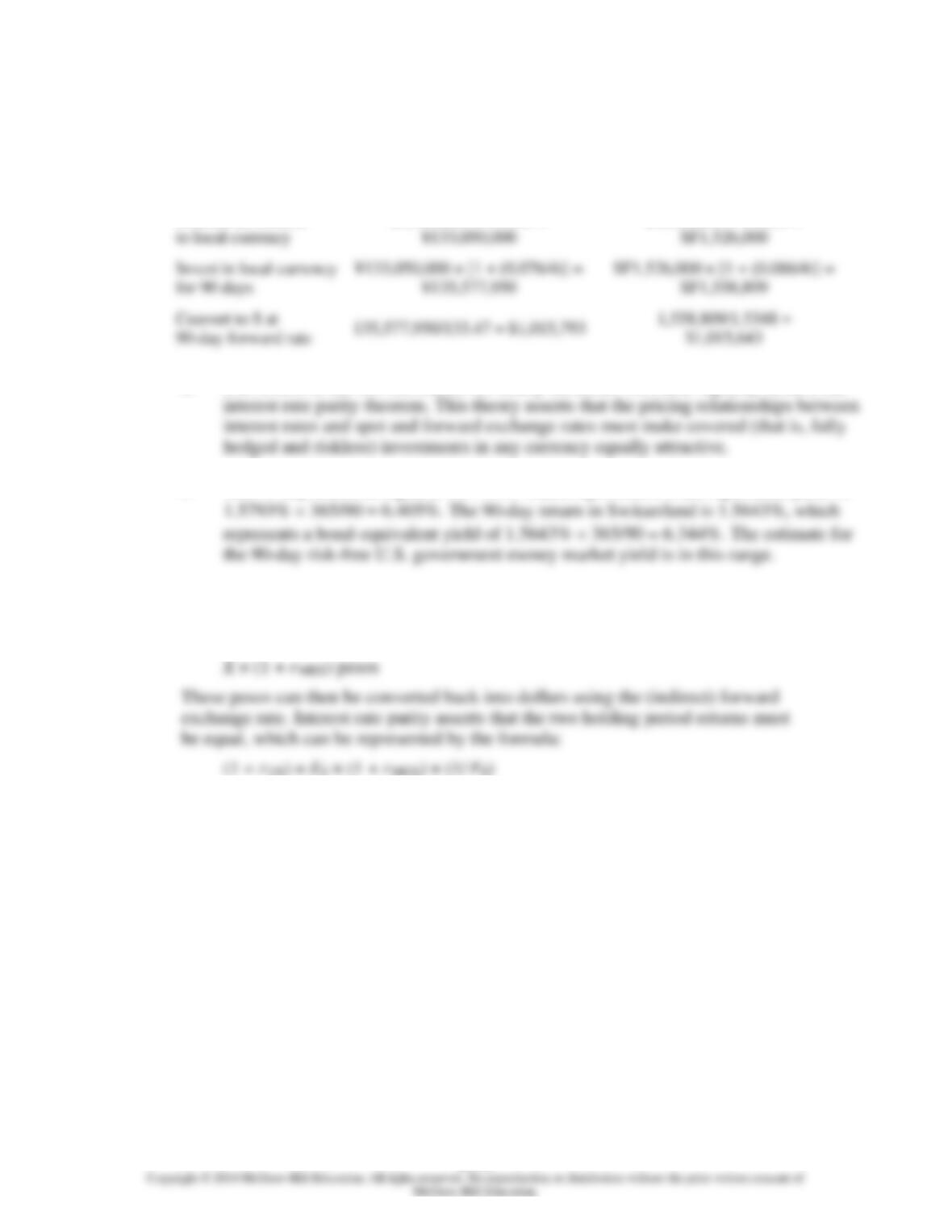
Chapter 23 – Futures, Swaps, and Risk Management
23–10
are for 90-day periods, we assume they are quoted as bond equivalent yields,
annualized using simple interest. Therefore, to express rates on a per quarter
basis, we divide these rates by 4:
Japanese government
Swiss government
Convert $1 million
$1,000,000 × 133.05 =
$1,000,000 × 1.5260 =
b. The results in the two currencies are nearly identical. This near-equality reflects the
c. The 90-day return in Japan is 1.5793%, which represents a bond-equivalent yield of
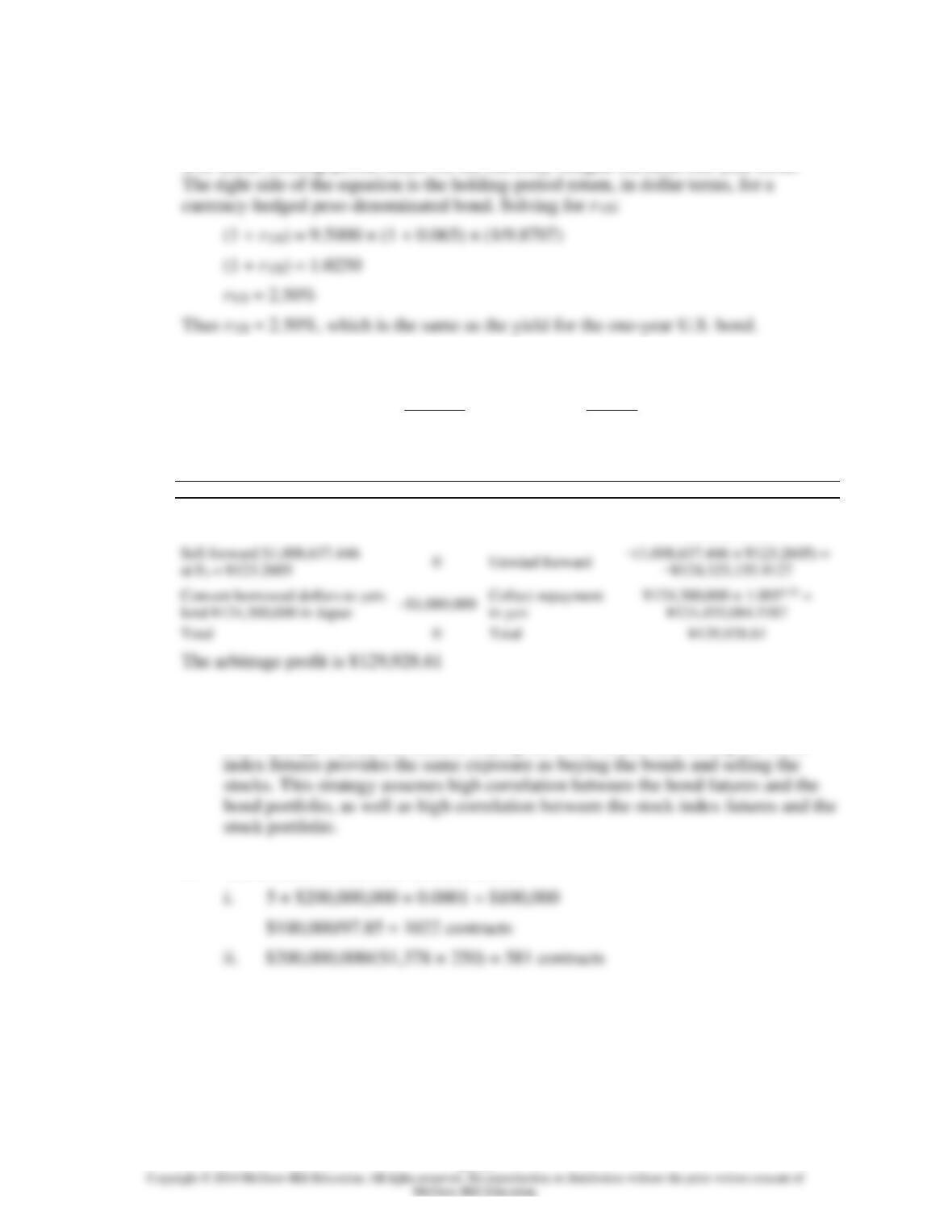
4. The investor can buy X amount of pesos at the (indirect) spot exchange rate and invest the
pesos in the Mexican bond market. Then, in one year, the investor will have
Chapter 23 – Futures, Swaps, and Risk Management
23–11
The left side of the equation represents the holding-period return for a U.S. dollar-
denominated bond. If interest rate parity holds, then this term also corresponds to the
U.S. dollar holding-period return for the currency-hedged Mexican one-year bond.
5. a. From parity:
0.5 0.5
00
11.0010
124.30 122.06453
1 1.0380
Japan
US
r
FE r
+
= = =
+
b.
Action Now
CF in $
Action at Period-
end
CF in ¥
Borrow $1,000,000 in U.S.
$1,000,000
Repay loan
−($1,000,000 × 1.0350.25 ) =
−$1,008,637.446
6. a. Delsing should sell stock index futures contracts and buy bond futures contracts.
This strategy is justified because buying the bond futures and selling the stock
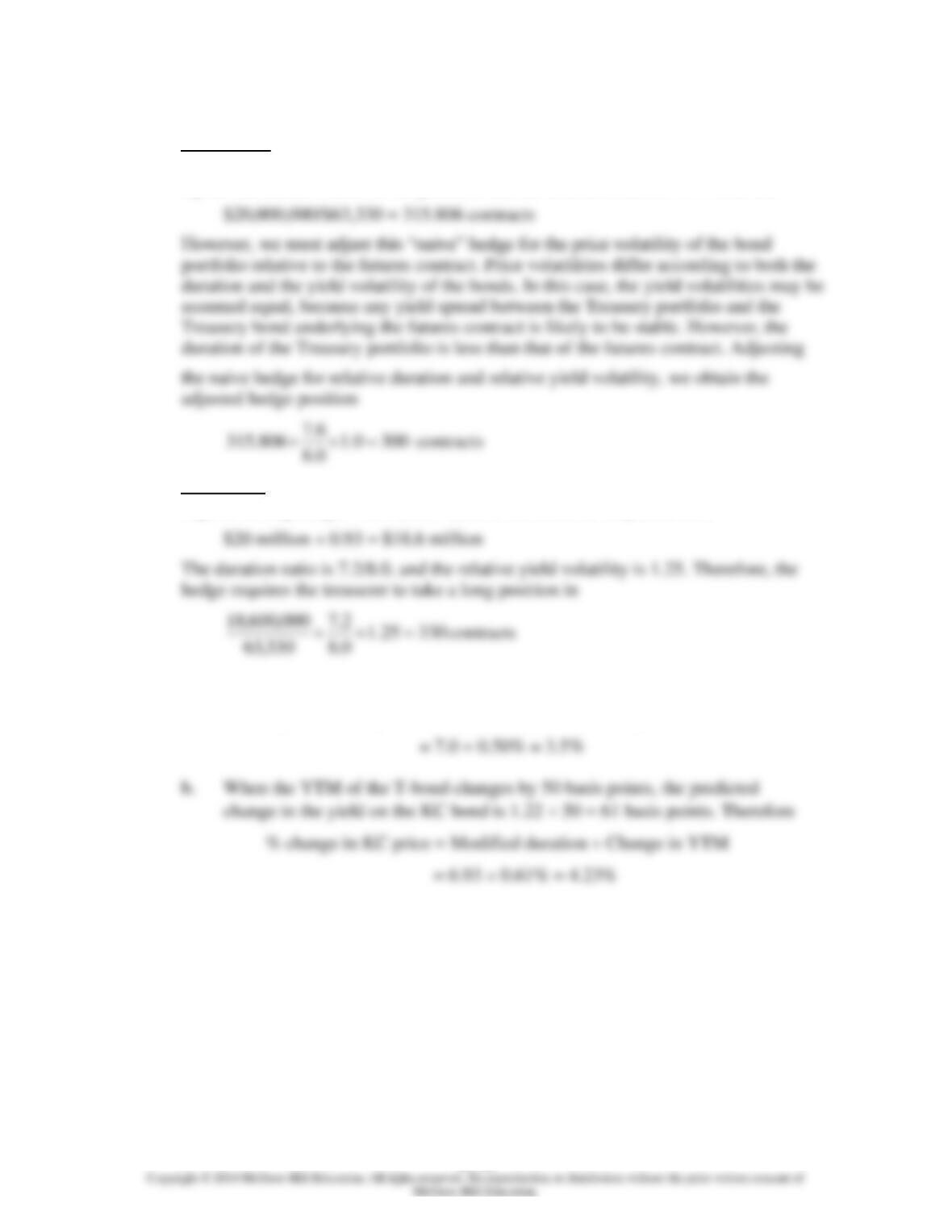
b. The number of contracts in each case is:
Chapter 23 – Futures, Swaps, and Risk Management
23–12
7. Situation A. The market value of the portfolio to be hedged is $20 million. The
market value of the bonds controlled by one futures contract is $63,330. If we were to
equate the market values of the portfolio and the futures contract, we would sell
Situation B. Here, the treasurer seeks to hedge the purchase price of the bonds; this
requires a long hedge. The market value of the bonds to be purchased is
8. a. % change in T-bond price = Modified duration Change in YTM