Chapter 22 – Futures Markets
CHAPTER 22: FUTURES MARKETS
PROBLEM SETS
1. There is little hedging or speculative demand for cement futures, since cement prices
are fairly stable and predictable. The trading activity necessary to support the futures
2. The ability to buy on margin is one advantage of futures. Another is the ease with which
3. Short selling results in an immediate cash inflow, whereas the short futures
position does not:
4. a. False. For any given level of the stock index, the futures price will be lower
when the dividend yield is higher. This follows from spot-futures parity:
5. The futures price is the agreed-upon price for deferred delivery of the asset. If that
6. Because long positions equal short positions, futures trading must entail a
“canceling out” of bets on the asset. Moreover, no cash is exchanged at the
Chapter 22 – Futures Markets
22-2
7. a. The closing futures price for the March contract was 1,491.80, which has a
dollar value of:
8. a. F0 = S0(1 + rf ) = $150 × 1.03 = $154.50
9. a. Take a short position in T-bond futures, to offset interest rate risk. If rates
increase, the loss on the bond will be offset to some extent by gains on the
futures.
10. F0 = S0 × (l + rf – d) = 1,400 × (1 + 0.03 – 0.02) = 1,414
11. The put-call parity relation states that: But spot-futures parity tells us that:
Chapter 22 – Futures Markets
22-3
12. According to the parity relation, the proper price for December futures is:
13. a. 120 × 1.06 = $127.20
14. a. The initial futures price is F0 = 1300 × (1 + 0.005 – 0.002)12 = $1,347.58
In one month, the futures price will be:
15. The treasurer would like to buy the bonds today but cannot. As a proxy for this
purchase, T-bond futures contracts can be purchased. If rates do in fact fall, the
16. The parity value of F is: 1,550 × (1 + 0.04 – 0.01) = 1,597
The actual futures price is 1,550, too low by 47.
17. a. Futures prices are determined from the spreadsheet as follows:
Spot Futures Parity and Time Spreads
Chapter 22 – Futures Markets
Spot price
1,500
Income yield (%)
1.5
Futures prices versus maturity
Interest rate (%)
3.0
Today’s date
Spot price
Maturity date 1
Futures 1
Maturity date 2
Futures 2
Maturity date 3
Futures 3
Time to maturity 1
Time to maturity 2
Time to maturity 3
b. The spreadsheet demonstrates that the futures prices now decrease with
increased income yield:
Spot Futures Parity and Time Spreads
Spot price
1,500
Income yield (%)
4.0
Futures prices versus maturity
Interest rate (%)
3.0
Today’s date
Spot price
Maturity date 1
Futures 1
Maturity date 2
Futures 2
Maturity date 3
Futures 3
Time to maturity 1
Time to maturity 2
Time to maturity 3
18. a. The current yield for Treasury bonds (coupon divided by price) plays the role of
the dividend yield.
b. When the yield curve is upward sloping, the current yield exceeds the short
22-5
19. a.
Cash Flows
Action
Now
T1
T2
Long futures with maturity T1
0
P1 – F( T1)
0
Short futures with maturity T2
0
Buy asset at T1, sell at T2
0
CFA PROBLEMS
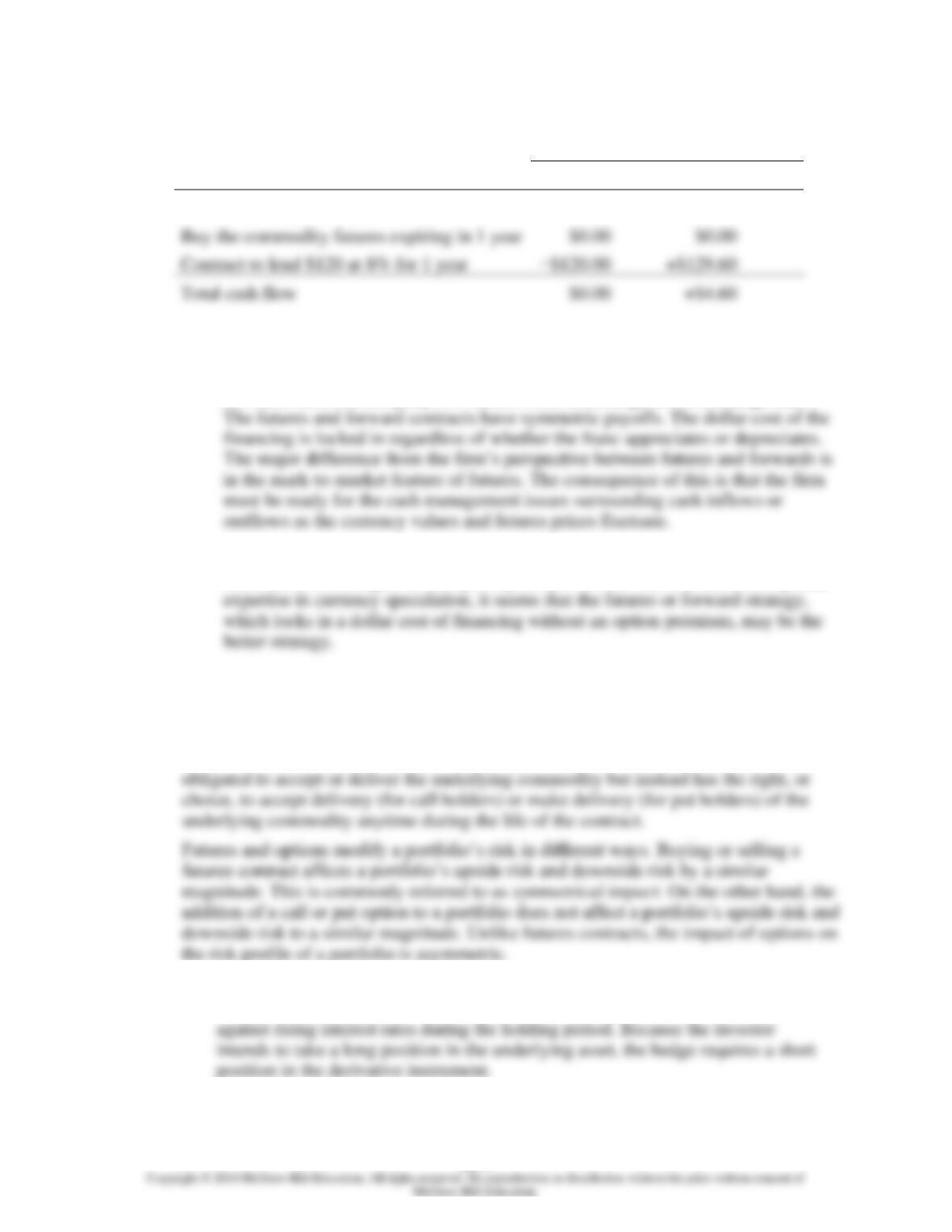
1. a. The strategy that would take advantage of the arbitrage opportunity is a “reverse
cash and carry.” A reverse cash and carry opportunity results when the following
relationship does not hold true:
Chapter 22 – Futures Markets
22-6
b.
Cash Flows
Action
Now
One year from now
Sell the spot commodity short
+$120.00
−$125.00
Buy the commodity futures expiring in 1 year
Contract to lend $120 at 8% for 1 year
Total cash flow
2. a. The call option is distinguished by its asymmetric payoff. If the Swiss franc
rises in value, then the company can buy francs for a given number of dollars
to service its debt and thereby put a cap on the dollar cost of its financing. If
the franc falls, the company will benefit from the change in the exchange rate.
b. The call option gives the company the ability to benefit from depreciation in the
franc but at a cost equal to the option premium. Unless the firm has some special
3. The important distinction between a futures contract and an options contract is that the
futures contract is an obligation. When an investor purchases or sells a futures contract,
the investor has an obligation to either accept or deliver, respectively, the underlying
commodity on the expiration date. In contrast, the buyer of an option contract is not
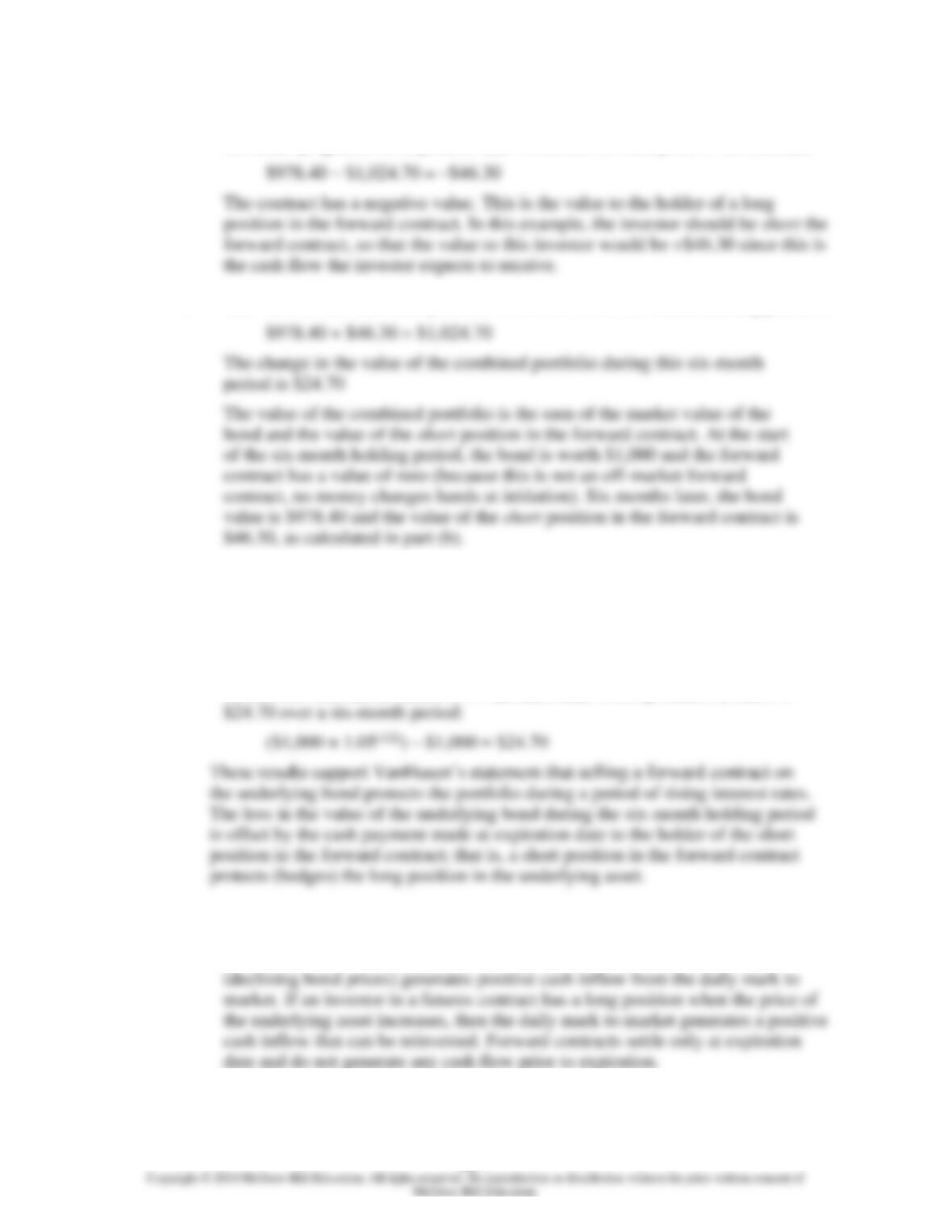
4. a. The investor should sell the forward contract to protect the value of the bond
Chapter 22 – Futures Markets
22-7
b. The value of the forward contract on expiration date is equal to the spot price of
the underlying asset on expiration date minus the forward price of the contract:
c. The value of the combined portfolio at the end of the six-month holding period is:
The fact that the combined value of the long position in the bond and the short
position in the forward contract at the forward contract’s maturity date is
equal to the forward price on the forward contract at its initiation date is not a
coincidence. By taking a long position in the underlying asset and a short
position in the forward contract, the investor has created a fully hedged (and
hence risk-free) position and should earn the risk-free rate of return. The six-
month risk-free rate of return is 5% (annualized), which produces a return of
5. a. Accurate. Futures contracts are marked to the market daily. Holding a short
position on a bond futures contract during a period of rising interest rates

Chapter 22 – Futures Markets
22-8
b. Inaccurate. According to the cost-of-carry model, the futures contract price is
adjusted upward by the cost of carry for the underlying asset. Bonds (and other