
index was 4.05; however, it will change over time. The fund, in the aggregate, will seek to maintain
a weighted average credit rating of A- or better, based on the weighted average credit quality of
the fund’s portfolio securities.
The fund may continue to hold an investment in its core portfolio that is downgraded to below
investment grade after purchase. If such rating downgrades cause high yield exposure to exceed
Discuss in detail the strategy of this fund.
This fund is following a core strategy. With a core/satellite strategy there is a blending of an
indexed strategy (to create a low-risk core portfolio) and an active strategy (to create
a specialized higher risk tolerant satellite portfolio). Basically, this strategy involves building
a blended portfolio using an indexed and active strategy. The core component is a low-risk
portfolio constructed using one of the indexing strategies. The benchmark for the core portfolio
The core component provides broad market exposure and therefore captures systematic market
risk or what is commonly referred to as a “beta.” In contrast, an active return (commonly referred
to as “alpha”) is sought in the actively managed satellite portfolio. The advantage cited for the
core strategy is that it provides a cost-efficient means for controlling portfolio risk relative to
a benchmark. This relative risk is referred to as tracking error.

©2013 Pearson Education
486
This satellite allocation may be implemented into 100% equity allocations and/or allocations that
blend with fixed-income or non-equity positions.
9. What are the limitations of using duration and convexity measures in active portfolio
strategies?
Recall that duration is just a first approximation of the change in price resulting from a change in
interest rates while convexity provides a second approximation. Below we discuss the limitation
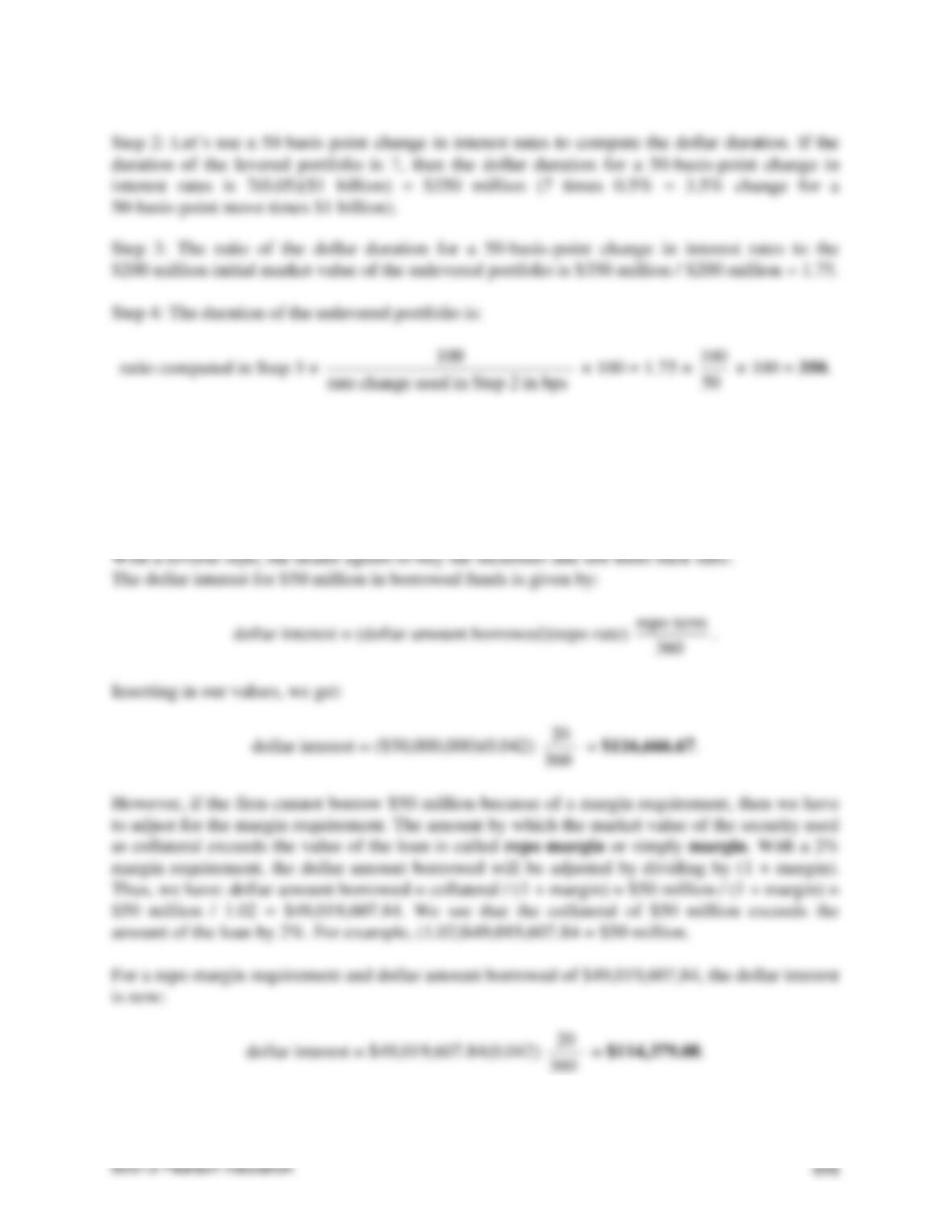
involved in using the measures of duration and convexity to estimate how portfolio values will
be affected when interest rates change.
There are several limitations to achieve a change in a portfolio’s duration. First, the client may
limit the degree to which the duration of the managed portfolio is permitted to diverge from that
of the benchmark index. Second, research does not support the notion that an active strategy can
profit from the ability to forecast the direction of future interest rates. The academic literature
argues that interest rates cannot be forecasted so that risk-adjusted excess returns can be realized
consistently. It is doubtful whether betting on future interest rates will provide a consistently
superior return.
An additional limitation is that knowing duration and convexity is not always enough to insure
that an active strategy will succeed even if managers are correct in their assessment about
changes in interest rates. For example, suppose that a portfolio manager has a choice of investing
in the bullet portfolio or the barbell portfolio. Which one should be chosen if the manager knows
the following?
©2013 Pearson Education
487
the two portfolios do not have the same dollar convexity. However, even the benefit of the
greater convexity depends on how much yields change.
In closing, the key point here is that looking at measures such as yield (yield to maturity or some
type of portfolio yield measure), duration, or convexity reveals little about performance over
some investment horizon, because performance depends on the magnitude of the change in
yields and how the yield curve shifts. Therefore, when a manager wants to position a portfolio
based on expectations as to how the yield curve will shift, it is imperative to perform total return
analysis. For example, in a steepening yield curve environment, it is often stated that a bullet
portfolio would be better than a barbell portfolio. However, it is not always the case that a bullet
portfolio would outperform a barbell portfolio. Whether the bullet portfolio outperforms the
barbell depends on how much the yield curve steepens.
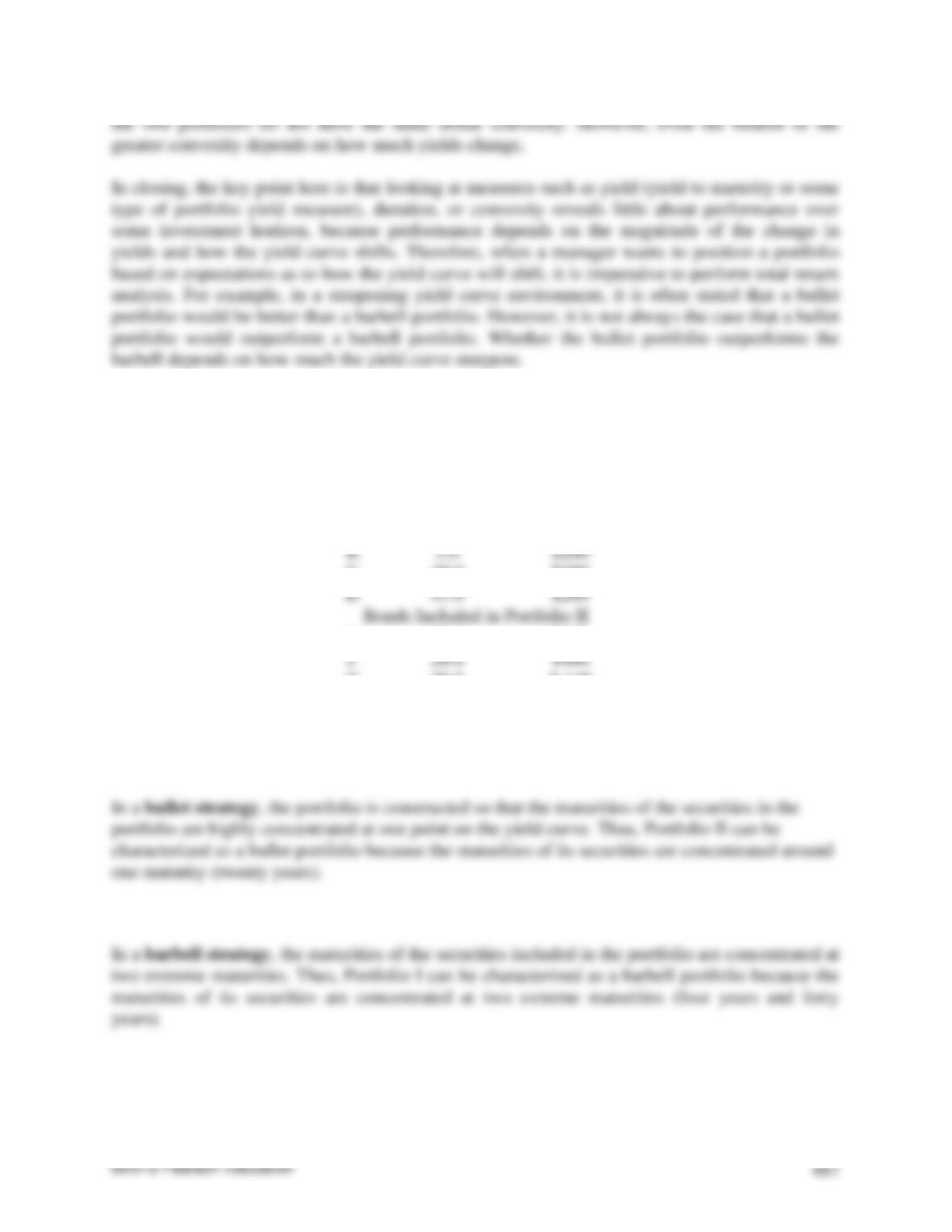
10. Next are two portfolios with a market value of $1000 million. The bonds in both
portfolios are trading at par value. The dollar duration of the two portfolios is the same.
Issue
Years to
Maturity
Par Value
(in millions)
Bonds Included in Portfolio I
A
4.0
$240
B
5.0
$260
C
40.0
$300
D
41.0
$200
Bonds Included in Portfolio II
E
19.4
$400
F
20.0
$460
G
20.2
$ 140
Answer the below questions.
(a) Which portfolio can be characterized as a bullet portfolio?
(b) Which portfolio can be characterized as a barbell portfolio?
(c) Suppose the two portfolios have the same dollar duration; explain whether their
performance will be the same if interest rates change.

Even if the yield curve shifts in a parallel fashion due to changes in interest rates, two portfolios
with the same dollar duration will not give the same performance if they have differences in
(d) If they will not perform the same, how would you go about determining which would
perform best assuming that you have a six-month investment horizon?
To determine which portfolio would have the superior performance, we would want to look at
the total return for the six-month investment horizon given expectations about change in yields
and how the yield curve will shift.
11. Answer the below questions.
(a) Explain why you agree or disagree with the following statement: “It is always better to
have a portfolio with more convexity than one with less convexity.”
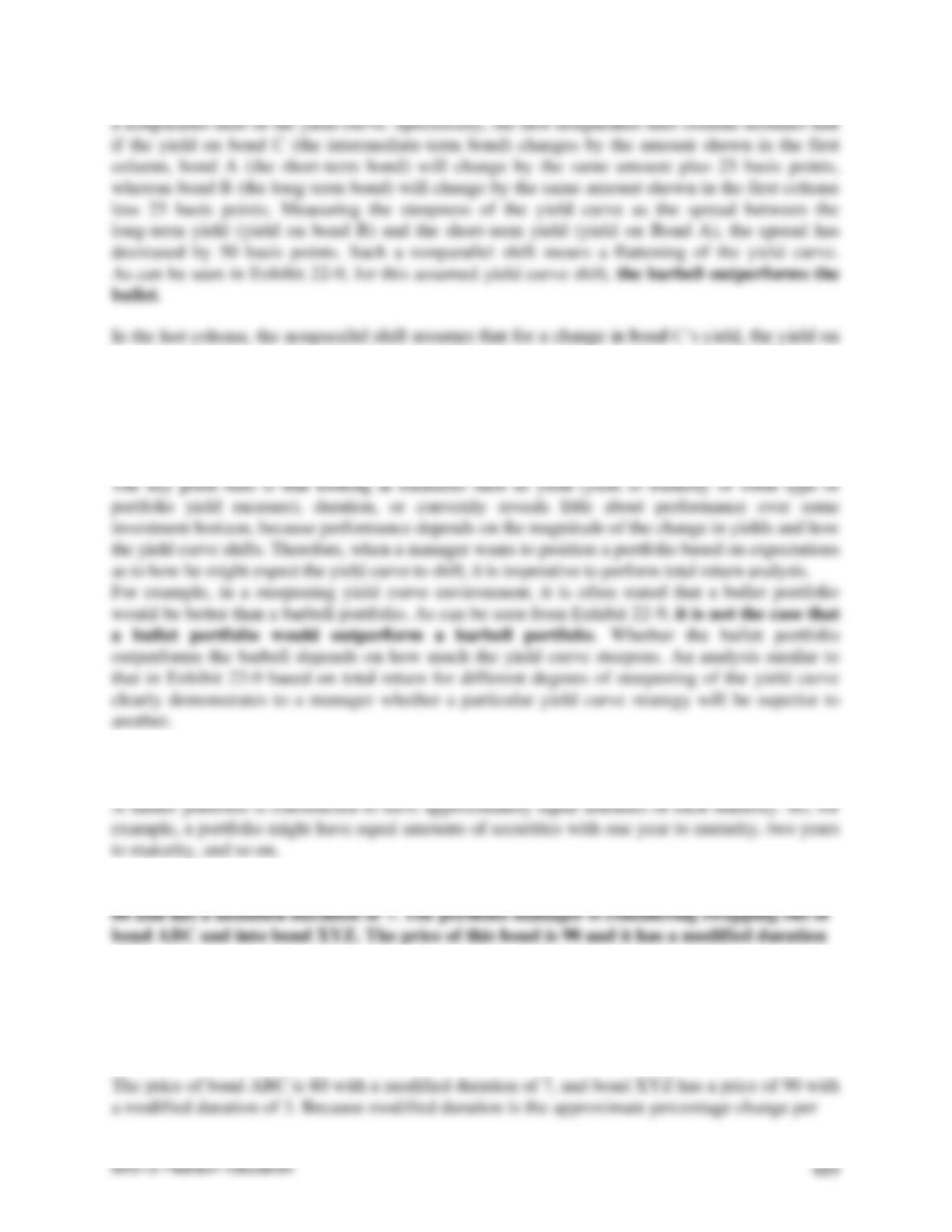
It is not always better to have a portfolio with more convexity than one with less convexity. This
is illustrated if one examines the portfolios associated with Exhibit 22-9. Although with all other
(b) Explain why you agree or disagree with the following statement: “A bullet portfolio will
always outperform a barbell portfolio with the same dollar duration if the yield curve
steepens.”
One would disagree with the statement that a bullet portfolio will always outperform a barbell
portfolio with the same dollar duration if the yield curve steepens.” This is because the
©2013 Pearson Education
489
a nonparallel shift of the yield curve. Specifically, the first nonparallel shift column assumes that
if the yield on bond C (the intermediate-term bond) changes by the amount shown in the first
column, bond A (the short-term bond) will change by the same amount plus 25 basis points,
whereas bond B (the long-term bond) will change by the same amount shown in the first column
less 25 basis points. Measuring the steepness of the yield curve as the spread between the
long-term yield (yield on bond B) and the short-term yield (yield on Bond A), the spread has
decreased by 50 basis points. Such a nonparallel shift means a flattening of the yield curve.
As can be seen in Exhibit 22-9, for this assumed yield curve shift, the barbell outperforms the
bullet.
In the last column, the nonparallel shift assumes that for a change in bond C’s yield, the yield on
bond A will change by the same amount less 25 basis points, whereas that on bond B will change
by the same amount plus 25 points: Thus the spread between the long-term yield and the
short-term yield has increased by 50 basis points, and the yield curve has steepened. In this case
the bullet portfolio outperforms the barbell portfolio as long as the yield on bond C does not
rise by more than 250 basis points or fall by more than 325 basis points.
12. What is a laddered portfolio?
13. A portfolio manager owns $10 million par value of bond ABC. The bond is trading at
of 3.
Answer the below questions.
(a) What is the dollar duration of bond ABC per 100-basis-point change in yield?
©2013 Pearson Education
490
100-basis-point change in yield, a 100-basis-point change in yield for bond ABC would change
its price by about 7%. Based on a price of 80, its price will change by about 0.07(80) = $5.6 per
$80 of market value. Thus, for bond ABC, its dollar duration for a 100-basis-point change in
yield is $5.6 per $80 of market value.
[Similarly, for bond XYZ, its dollar duration for a 100-basis-point change in yield per $90 of
market value can be determined. In this case it is 0.03 (100) = $3.00. So if bonds ABC and XYZ
are being considered as alternative investments in a strategy other than one based on anticipating
interest-rate movements, the amount of each bond in the strategy should be such that they will
both have the same dollar duration.]
(b) What is the dollar duration for the $10 million position of bond ABC?
(c) How much in market value of bond XYZ should be purchased so that the dollar
duration of bond XYZ will be approximately the same as that for bond ABC?
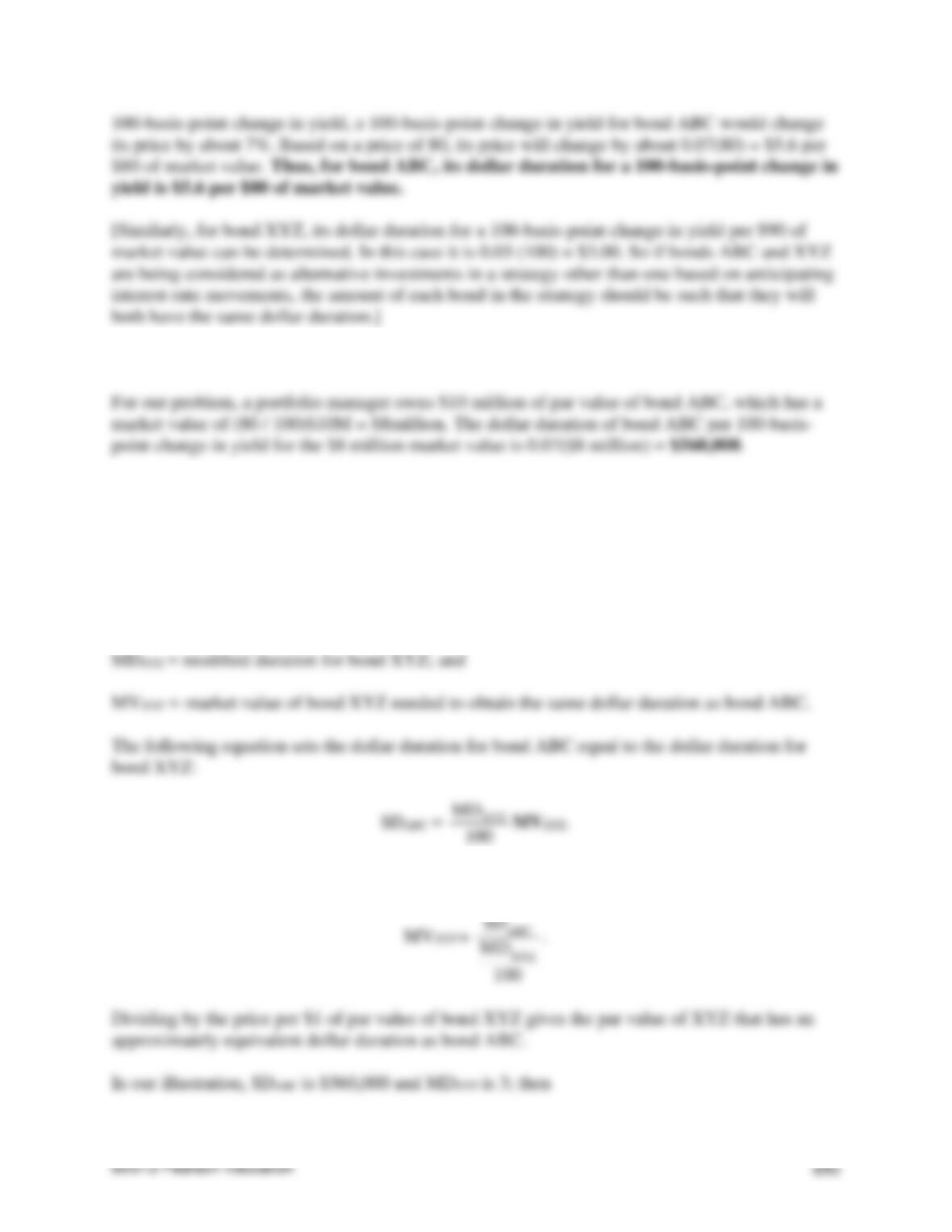
Mathematically, this problem can be expressed as follows: Let
$DABC = dollar duration per 100-basis-point change in yield for bond ABC for the market value
of bond ABC held;
100
Solving for MVXYZ yields:
ABC
$D

©2013 Pearson Education
491
MVXYZ =
100
3
000,560$
= $18,666,666.6667.
Thus, the market value of bond XYZ that should be purchased (so that the dollar duration of
bond XYZ will be approximately the same as that for bond ABC) will be $18,666,667.
(d) How much in par value of bond XYZ should be purchased so that the dollar duration of
bond XYZ will be approximately the same as that for bond ABC?
The market value of bond XYZ is 90 per $100 of par value, so the price per $1 of par value is
0.9. Dividing MVXYZ (which is $$18,666,667) by 0.9 indicates that the par value of bond XYZ
that should be purchased. We have:
9.0
667,666,18$
= $20,740,740.74
14. Explain why in implementing a yield spread strategy it is necessary to keep the dollar
duration constant.
When comparing positions that have the same dollar duration, it is critical to assess yield spread
strategies. Failure to adjust a portfolio repositioning based on some expected change in yield
spread so as to hold the dollar duration the same means that the outcome of the portfolio will be
15. The excerpt that follows is taken from an article titled “Smith Plans to Shorten,” which
appeared in the January 27, 1992, issue of BondWeek, p. 6:
“When the economy begins to rebound and interest rates start to move up, Smith
Affiliated Capital will swap 30-year Treasuries for 10-year Treasuries and those with
What type of portfolio strategy is Smith Affiliated Capital pursuing?
Smith appears to be following an interest-rate expectation strategy. A manager who believes that
he or she can accurately forecast the future level of interest rates will alter the portfolio’s
sensitivity to interest-rate changes. As duration is a measure of interest-rate sensitivity, this

©2013 Pearson Education
492
the duration of the managed portfolio is permitted to diverge from that of the benchmark index
may be limited by the client.
If we can assume the remaining maturities or the same, it appears that Smith is following a
substitution swap strategy. A swap in which a money manager exchanges one bond for another
bond that is similar in terms of coupon, maturity, and credit quality, but offers a higher yield, is
called a substitution swap. This swap depends on a capital market imperfection. Such situations
sometimes exist in the bond market owing to temporary market imbalances and the fragmented
nature of the non-Treasury bond market. The risk the money manager faces in making a
substitution swap is that the bond purchased may not be truly identical to the bond for which it is
exchanged. Moreover, typically, bonds will have similar but not identical maturities and coupon.
This could lead to differences in the convexity of the two bonds, and any yield spread may
reflect the cost of convexity.
16. The following excerpt is taken from an article titled “MERUS to Boost Corporates,”
which appeared in the January 27, 1992, issue of BondWeek, p.6:
MERUS Capital Management will increase the allocation to corporates in its $790
million long investment-grade fixed-income portfolio by $39.5 million over the next six
What types of active portfolio strategies is MERUS Capital Management pursuing?
MERUS is increasing corporates in it long investment-grade fixed-income portfolio in the next
months to one year. They are focusing upon investment-grade securities because they expect the
spread will tighten and some issues will be given higher ratings thus increasing their value.
Consequently, now is the time to lock in a higher spread as well as investing in investment-grade
securities that will be strengthened by a robust economy.

©2013 Pearson Education
493
capacity to service their contractual debt obligations. Yield spreads between Treasury and federal
agency securities will vary depending on investor expectations about the prospects that an
implicit government guarantee will be honored.
17. This excerpt comes from an article titled “Eagle Eyes High–Coupon Callable Corporates”
in the January 20, 1992, issue of BondWeek, p. 7:
“If the bond market rallies further, Eagle Asset Management may take profits, trading $8
million of seven-to 10-year Treasuries for high-coupon single-A industrials that are
callable in two to four years according to Joseph Blanton, Senior V.P. He thinks a further
rally is unlikely, however.
What types of active portfolio strategies are being pursued by Eagle Asset Management?
Blanton may take profits by trading seven-to 10-year Treasuries for high-coupon single-A
industrials that are callable in two to four years because the market rally will fade. This means
Blanton believes the spread will stop decreasing and may even increase making these securities
less desirable. By buying callable bonds, it is implied that interest rates may increase. Blanton
has already sold some seven-to 10 year Treasuries to buy high-coupon single-A nonbank
financial credits implying that he further believes interest rates will increase. In anticipation of

Additionally, Blanton is engaged in a strategy that involves changing his portfolio’s duration.
A money manager who believes that he or she can accurately forecast the future level of interest
rates will alter the portfolio’s sensitivity to interest-rate changes. As duration is a measure of
interest-rate sensitivity, this involves increasing a portfolio’s duration if interest rates are
expected to fall and reducing duration if interest rates are expected to rise. For those managers
18. The following excerpt is taken from an article titled “W.R. Lazard Buys Triple Bs,”
which appeared in the November 18, 1991, issue of BondWeek, p. 7:
“W.R. Lazard & Co. is buying some corporate bonds rated triple B that it believes will be
upgraded and some single A’s that the market perceives as risky but Lazard does not,
What types of active portfolio strategies are being followed by W.R. Lazard & Co.?
Schultz wants to capitalize on what he believes are underpriced bonds rated triple B’s and single
A’s. Thus, Schultz appears to be using a credit spread strategy.
Credit or quality spreads change because of expected changes in economic prospects. Credit
spreads between Treasury and non-Treasury issues widen in a declining or contracting economy
19. In an article titled “Signet to Add Pass–Throughs,” which appeared in the October 14,
1991, issue of BondWeek. p. 5, it was reported that Christian Goetz, assistant vice president
of Signet Asset Management, “expects current coupons to outperform premium
pass-throughs as the Fed lowers rates because mortgage holders will refinance premium
mortgages.” If Goetz pursues a strategy based on this, what type of active strategy is it?

Goetz appears to be pursuing an active strategy that relies on forecasts of future interest-rate
levels. Future interest rates, for instance, affect the value of options embedded in callable bonds
and the value of prepayment options embedded in mortgage-backed securities. Callable
corporate and municipal bonds with coupon rates above the expected future interest rate will
20. The following excerpt comes from an article titled “Securities Counselors Eyes Cutting
Duration” in the February 17, 1992, issue of BondWeek, p. 5:
“Securities Counselors of Iowa will shorten the 5.3 year duration on its $250 million
fixed-income portfolio once it is convinced interest rates are moving up and the economy
is improving … It will shorten by holding in cash equivalents the proceeds from the sale
Answer the below questions.
(a) Why would Securities Counselors want to shorten duration if it believes that interest
rates will rise?
(b) How does the purchase of cash equivalents and short-maturity high-grade utilities
accomplish the goal of shortening the duration?
(c) What risk is Securities Counselors indicating in the last sentence of the excerpt that it is
seeking to avoid by not buying corporate bonds?

©2013 Pearson Education
496
A hostile takeover can involve retiring holdings making the duration very short. The risk is the
unexpected nature of the takeover that would cause a portfolio manager to rearrange their
portfolio and perhaps have to invest in securities that do not pay as high a rate of return.
21. The next excerpt is taken from an article titled “Wood Struthers to Add High-Grade
Corporates,” which appeared in the February 17, 1992, issue of BondWeek, p. 5:
Wood Struthers & Winthrop is poised to add a wide range of high-grade corporates to
its $600 million fixed-income portfolio … It will increase its 25% corporate allocation
to about 30% after the economy shows signs of improving …It will sell Treasuries and
agencies of undetermined maturities to make the purchase … Its duration is 4 1/2
−
5
years and is not expected to change significantly …
Comment on this portfolio strategy.
As the economy improves, there will be less risk. This implies that corporate fixed-income
investments may be upgraded. The upgrade will increase the value of these securities. If Wood
Struthers & Winthrop (WS&W) increases its corporate allocation it will be in a position to
22. Explain how a rating transition matrix can be used as a starting point in assessing how
a manager may want to allocate funds to the different credit sectors of the corporate bond
market.
A rating transition matrix can be a starting point because it provides a framework for how the
23. What is the risk associated with the use of leverage?
A portfolio manager can create leverage by borrowing funds in order to acquire a position in the
market that is greater than if only cash were invested. The funds available to invest without
borrowing are referred to as the “equity. The basic principle in using leverage is that a manager
24. Suppose that the initial value of an unlevered portfolio of Treasury securities is $200
million and the duration is 7. Suppose further that the manager can borrow $800 million
and invest it in the identical Treasury securities so that the levered portfolio has a value of
$1 billion. What is the duration of this levered portfolio?
The portfolio has a market value of $200 million and the manager invests the proceeds in a bond
with a duration of 7. This means that the manager would expect that for a 100-basis-point change
in interest rates, the portfolio’s value would change by approximately (7 / 100)$200 = $14
million. For this unlevered fund, the duration of the portfolio is 7.
Thus, the duration for the portfolio is $70 million per $200 million or $35 per each $100
rendering a duration of 35 because a duration of 35 will change the portfolio’s equity value of
$200 million by 35% or $70 million for a 100-basis-point change in rates.
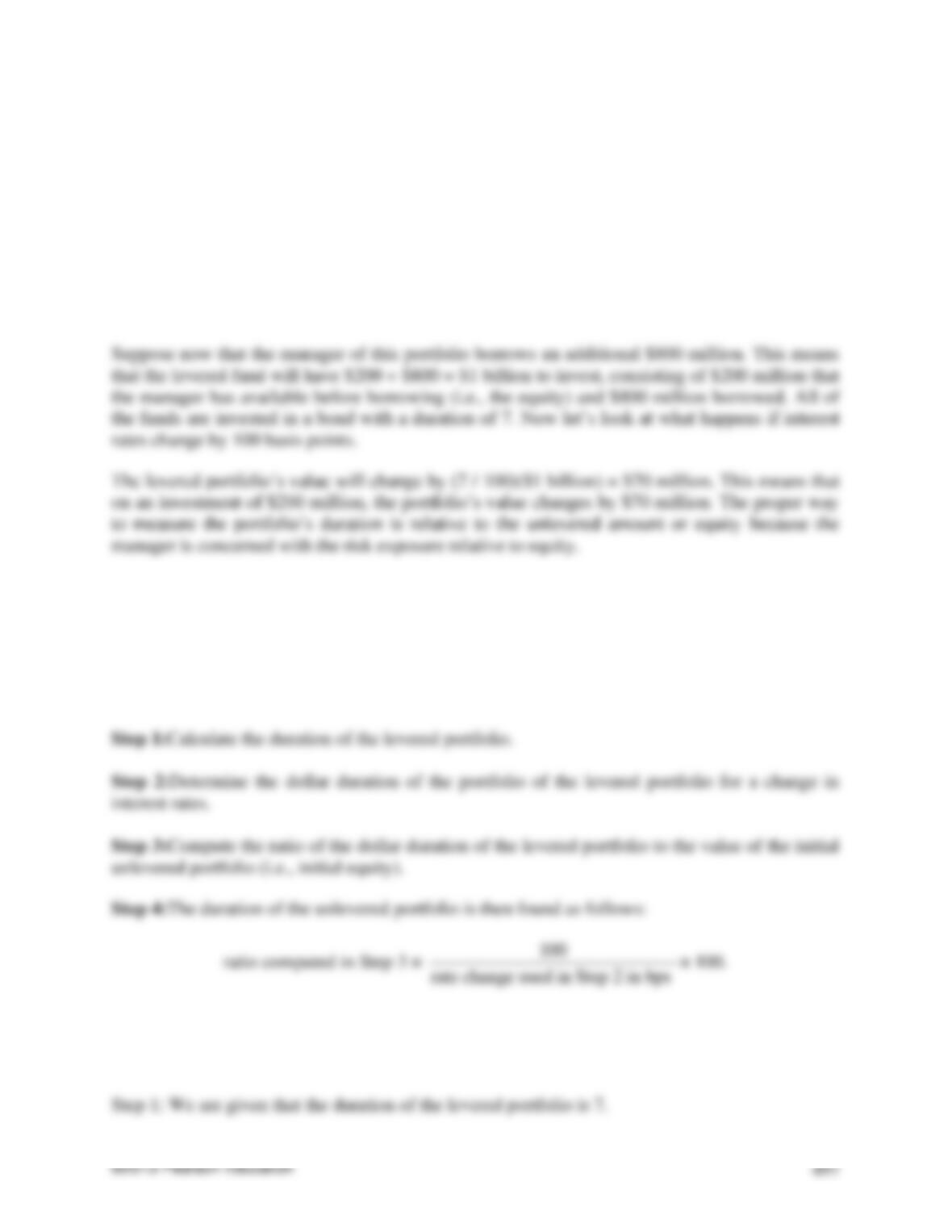
In general, the procedure for calculating the duration of a portfolio that uses leverage is as
follows:
rate change used in Step 2 in bps
To illustrate the procedure for our problem, the initial value of the unlevered portfolio is $200
million and the leveraged portfolio is $200 million equity plus $800 million borrowed =
$1 billion.
©2013 Pearson Education
498
Step 2: Let’s use a 50 basis point change in interest rates to compute the dollar duration. If the
duration of the levered portfolio is 7, then the dollar duration for a 50-basis-point change in
interest rates is 7(0.05)($1 billion) = $350 million (7 times 0.5% = 3.5% change for a
50-basis-point move times $1 billion).
Step 3: The ratio of the dollar duration for a 50-basis-point change in interest rates to the
$200 million initial market value of the unlevered portfolio is $350 million / $200 million = 1.75.
Step 4: The duration of the unlevered portfolio is:
ratio computed in Step 3 ×
100
rate change used in Step 2 in bps
× 100 = 1.75 ×
100
50
× 100 = 350.
25. Suppose a manager wants to borrow $50 million of a Treasury security that it plans to
purchase and hold for 20 days. The manager can enter into a reverse repo agreement with
a dealer firm that would provide financing at a 4.2% repo rate and a 2% margin
requirement. What is the dollar interest cost that the manager will have to pay for the
borrowed funds?
360
26. Two trustees of a pension fund are discussing repurchase agreements. Trustee A told

Trustee B that she feels it is a safe short-term investment for the fund. Trustee B told
Trustee A that repurchase agreements are highly speculative vehicles because they are
leveraged instruments. You’ve been called in by the trustees to clarify the investment
characteristics of repurchase agreements. What would you say to the trustees?
First, one could define a repurchase agreement or repo by stating that a repo is the sale of
a security with a commitment by the seller to buy the same security back from the purchaser at
a specified price at a designated future date. One could emphasize that a repo is a collateralized
loan, where the collateral is the security sold and subsequently repurchased. From the customer’s
perspective, one could positively point out that the repo market offers an attractive yield on
a short-term secured transaction that is highly liquid.
27. Suppose that a manager buys an adjustable-rate pass-through security backed by
Freddie Mac or Fannie Mae, two government-sponsored enterprises. Suppose that the
coupon rate is reset monthly based on the following coupon formula:
one-month LIBOR + 80 basis points
with a cap of 9% (i.e., maximum coupon rate of 9%).
Suppose that the manager can use these securities in a repo transaction in which (1) a repo
margin of 5% is required, (2) the term of the repo is one month, and (3) the repo rate is

one-month LIBOR plus 10 basis points. Also assume that the manager wishes to invest $1
million of his client’s funds in these securities. The manager can purchase $20 million in
par value of these securities because only $1 million is required. The amount borrowed
would be $19 million. Thus the manager realizes a spread of 70 basis points on the $19
million borrowed because LIBOR plus 80 basis points is earned in interest each month
(coupon rate) and LIBOR plus 10 basis points is paid each month (repo rate).
What are the risks associated with this strategy?
The return earned must be commensurate with the risk undertaken to determine if the strategy is
viable. First, there is a cap on the adjustable-rate pass-through security that may cause problems
and negate the current spread of 70 basis points.
Second, there is a credit risk involved for both parties in repo transaction. For example, if the
dealer cannot repurchase the securities, the customer may keep the collateral. If interest rates on
the securities increase subsequent to the repo transaction, however, the market value of the
securities will decline, and the customer will own securities with a market value less than the
amount it lent to the dealer. If the market value of the security rises instead, the dealer will be
concerned with the return of the collateral, which then has a market value higher than the loan.
28. Why is there credit risk in a repo transaction?
Despite the fact that there may be high-quality collateral underlying a repo transaction, both
parties to the transaction are exposed to credit risk. Why does credit risk occur in a repo
transaction? To answer this question, consider the example in the text in which the dealer uses