Problem 21-7
Reconsider the determination of the hedge ratio in the two-state model where we showed that
one-third share of stock would hedge one option. The possible end-of-year stock prices, uS0= $120
(up state) anddS0= $90 (down state).
1.What would be the hedge ratio for each of the following exercise prices: $120, $110, $100,
Data price
strike 50 45
sigma 0.2 50
pv(ex) $48.54 pv(ex) $48.54 pv(ex) $48.54
s/ex $0.93 s/ex $1.03 s/ex $1.13
sigmasqrt(t
0.2
sigmasqrt(t
0.2
sigmasqrt(t
0.2
log (s/ex) -0.0758 log (s/ex) 0.029559 log (s/ex) 0.124869
d -0.27901 d 0.247794 d 0.724345
d2 -0.47901 d2 0.047794 d2 0.524345
N(d) 0.390119 N(d) 0.597853 N(d) 0.765573
N(d2) 0.315966 N(d2) 0.51906 N(d2) 0.699981
Problem 21-8
Consider a 1-year option with exercise price $50, on a stock with annual standard deviation 20%.
The T-bill rate is 3% per year.
Find N(d1) for stock prices $45, $50, and $55. (Do not round intermediate calculations. Round your
Data
S100
X110
r 0.1
u130
d80
call/put cost 30
t=1 payoff
Problem 21-9
Data: S0= 100; X= 110; 1 + r= 1.10. The two possibilities for STare 130 and 80.
a.The range of Sis 50 while that of Pis 30 across the two states. What is the hedge ratio of the put?(Round your answer to 2 decimal places.
Negative amount should be indicated by a minus sign.)
Data
S100
X110
80 130
shares 160 260
calls 0 -100
Problem 21-10
Data: S0= 100; X= 110; 1 + r= 1.10. The two possibilities for STare 130 and 80.
1.The range of Sis 50 while that of Cis 20 across the two states. What is the hedge ratio of the call?(Round your answer to 2 decimal
places.
2.Calculate the value of a call option on the stock with an exercise price of 110. (Do not use continuous compounding to calculate the
present value of Xin this example because we are using a two-state model here, not a continuous-time Black-Scholes model.) (Round
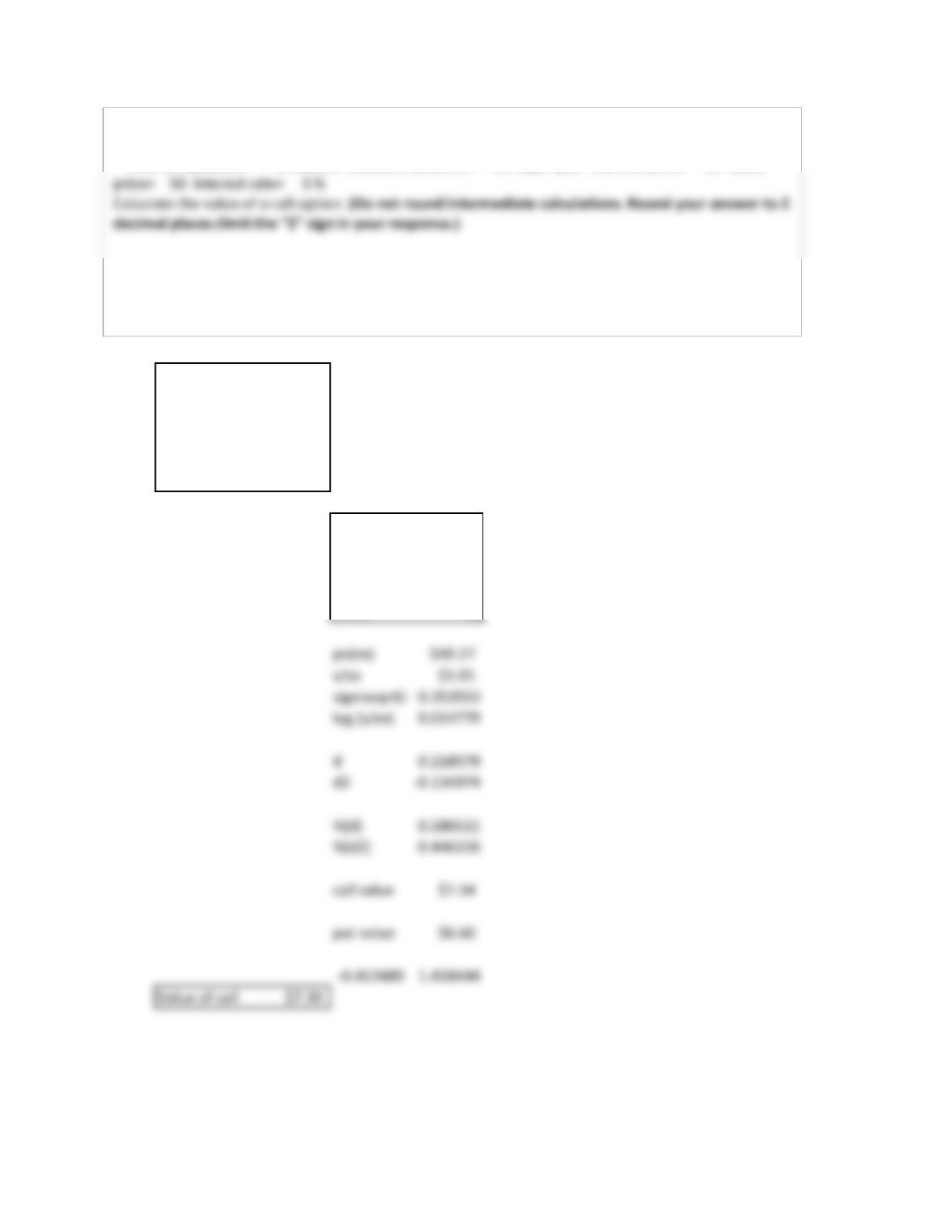
Data
t 0.5
sigma 0.5
X50
So 50
r 0.03
price $50.00
sigma 0.5
t 0.5
r 0.03
strike 50
Problem 21-11
Use the Black-Scholes formula for the following stock:
Time to expiration= 6 months Standard deviation= 50 % per year Exercise price= 50 Stock
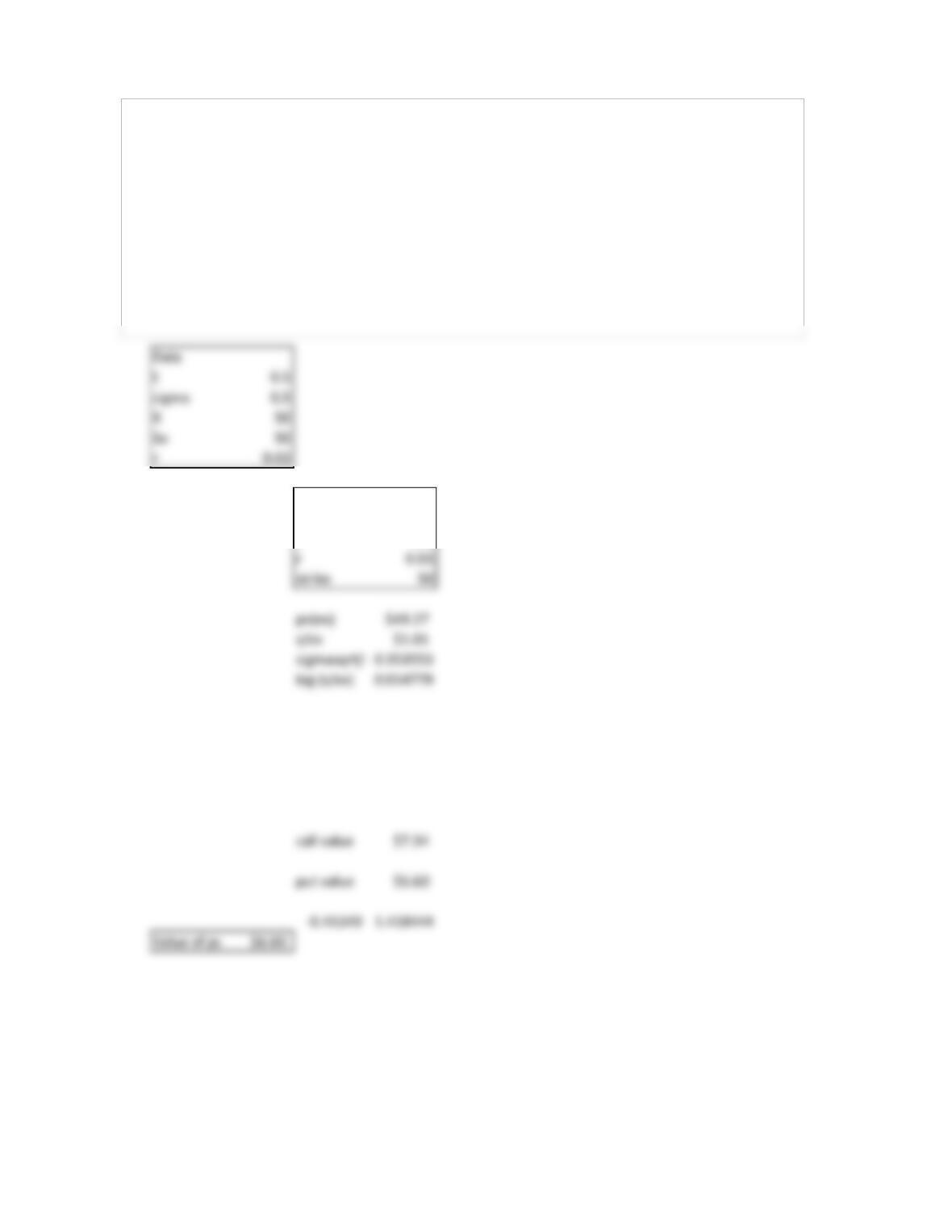
price $50.00
sigma 0.5
t 0.5
d 0.218579
d2 -0.13497
N(d) 0.586511
N(d2) 0.446316
Problem 21-12
Use the Black-Scholes formula for the following stock:
Time to expiration= 6 months Standard deviation= 50 % per year Exercise price= $50 Stock
price= $50 Interest rate= 3 %
Calculate the value of a put option. (Round your answer to 2 decimal places. Omit the “$” sign in your
response.)
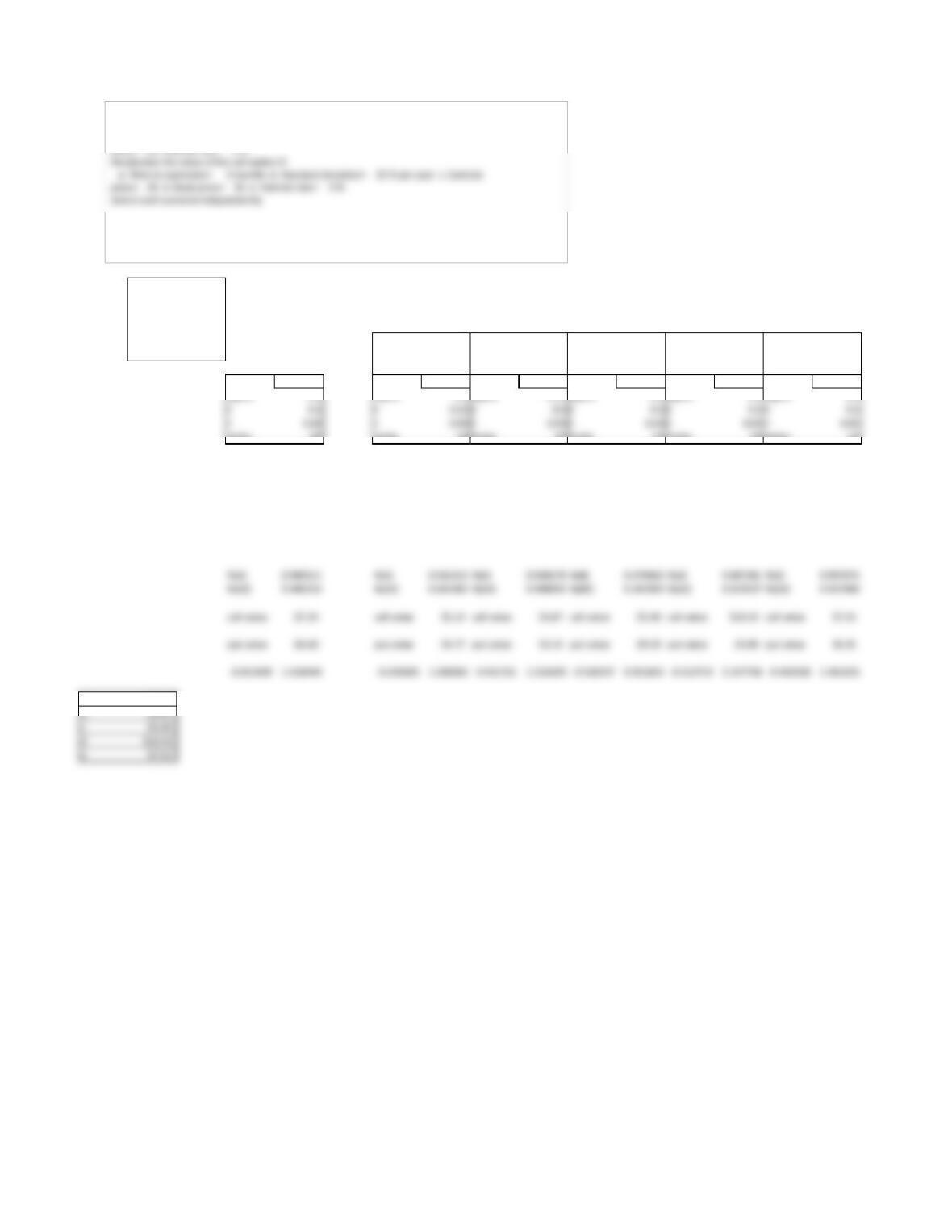
Data
t 0.5
sigma 0.5
X50
So 50 a b c d e
r 0.03 t 3 sigma 0.25 X 55 So 55 r 0.05
t 0.25
price $50.00 price $50.00 price $50.00 price $50.00 price $55.00 price $50.00
sigma 0.5 sigma 0.5 sigma 0.25 sigma 0.5 sigma 0.5 sigma 0.5
strike 50 strike 50 strike 50 strike 55 strike 50 strike 50
pv(ex) $49.27 pv(ex) $49.63 pv(ex) $49.27 pv(ex) $54.19 pv(ex) $49.27 pv(ex) $48.80
s/ex $1.01 s/ex $1.01 s/ex $1.01 s/ex $0.92 s/ex $1.12 s/ex $1.02
sigmasqrt(t
0.353553
sigmasqrt(t
0.25
sigmasqrt(t
0.176777
sigmasqrt(t
0.353553
sigmasqrt(t
0.353553
sigmasqrt(t
0.353553
log (s/ex) 0.014779 log (s/ex) 0.00739 log (s/ex) 0.014779 log (s/ex) -0.080531 log (s/ex) 0.11009 log (s/ex) 0.024395
d 0.218579 d 0.154559 d 0.171993 d -0.050999 d 0.488157 d 0.245776
d2 -0.134974 d2 -0.095441 d2 -0.004783 d2 -0.404552 d2 0.134604 d2 -0.107777
a $5.14
Problem 21-13
Use the Black-Scholes formula for the following stock:
Time to expiration= 6 months Standard deviation= 50 % per year Exercise price= 50 Stock
price= 50 Interest rate= 3 %
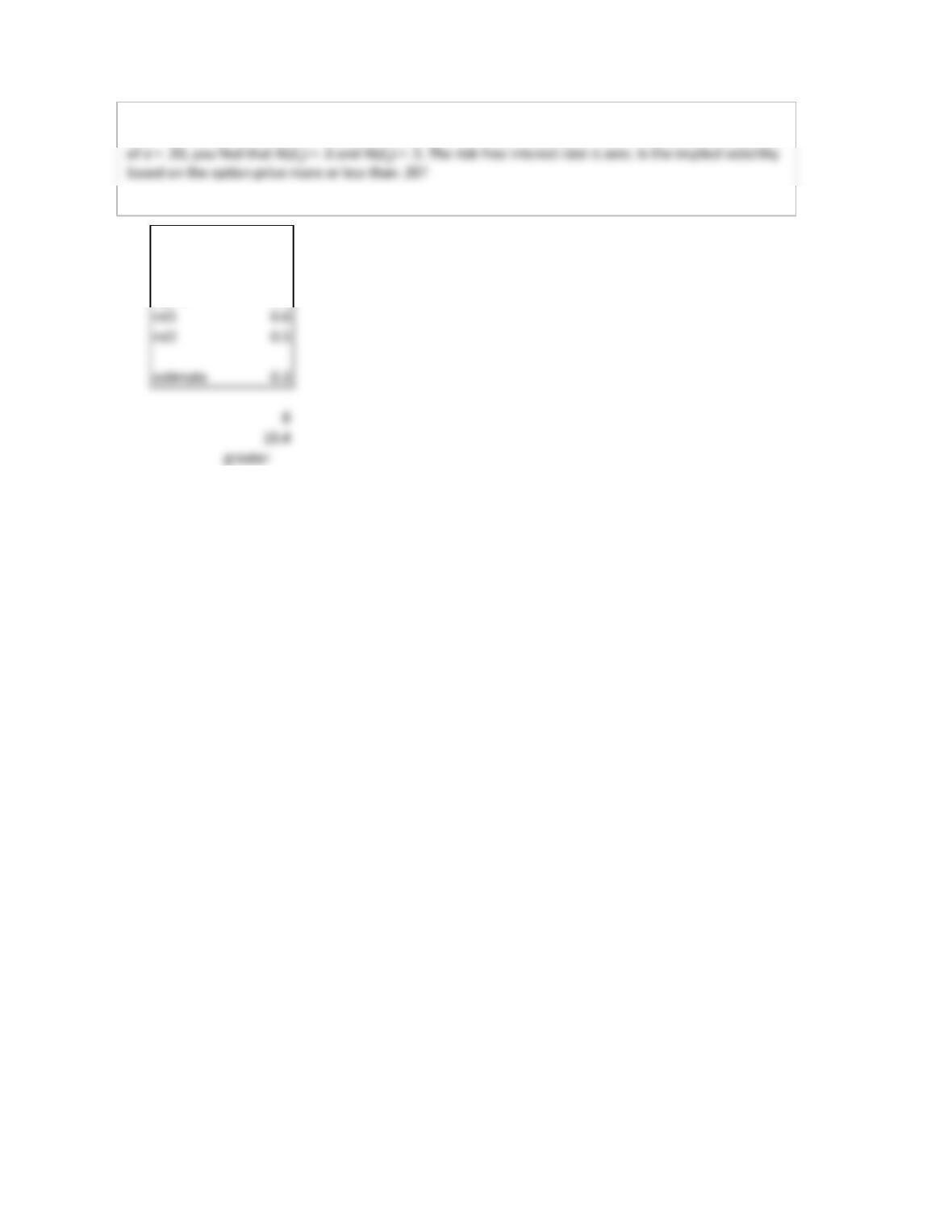
X50
S55
C10
sigma 0.3
Problem 21-14
A call option with X= $50 on a stock currently priced at S
= $55 is selling for $10. Using a volatility estimate
Problem 21-18
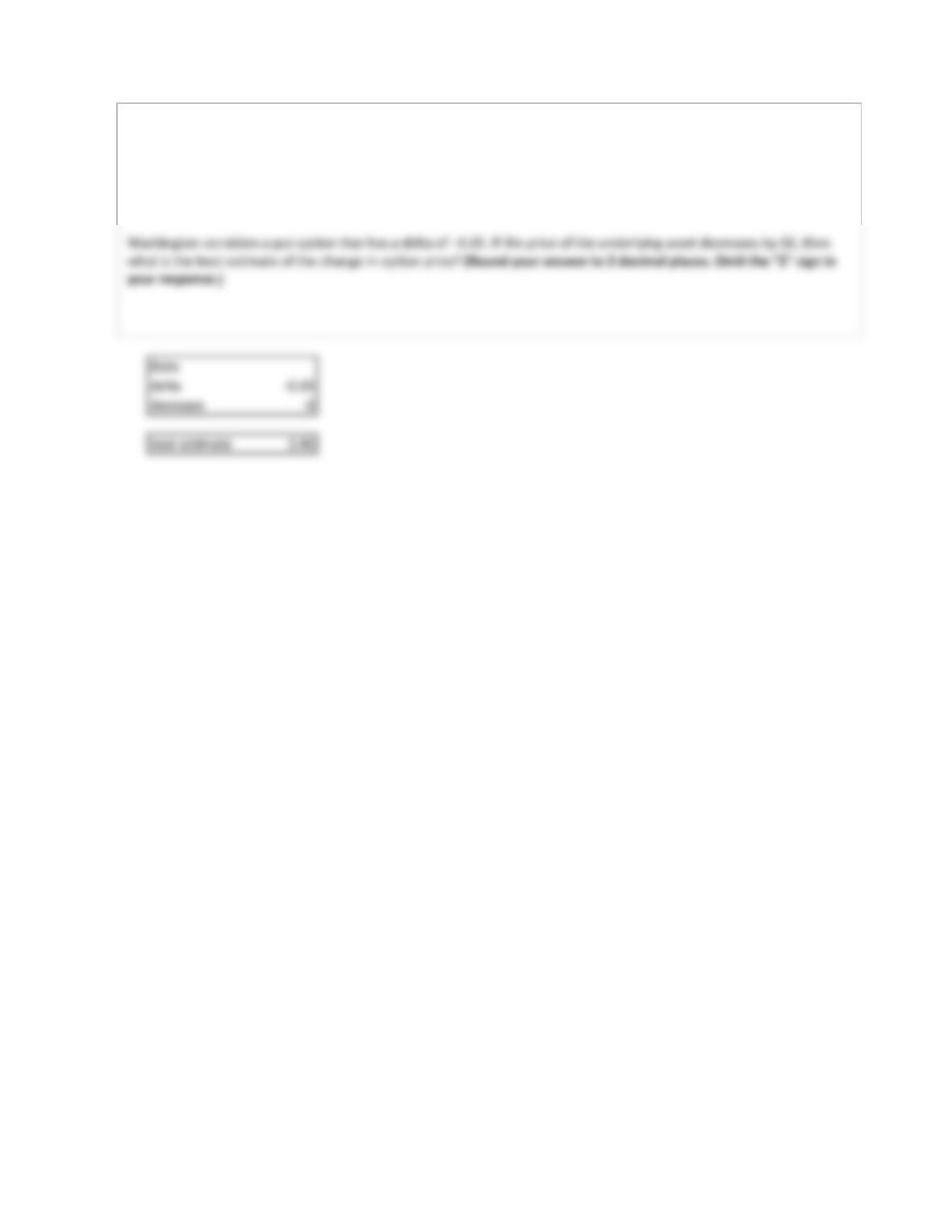
Mark Washington, CFA, is an analyst with BIC. One year ago, BIC analysts predicted that the U.S. equity market would
most likely experience a slight downturn and suggested delta-hedging the BIC portfolio. As predicted, the U.S. equity
markets did indeed experience a downturn of approximately 4% over a 12-month period. However, portfolio
performance for BIC was disappointing, lagging its peer group by nearly 10%. Washington has been told to review the
options strategy to determine why the hedged portfolio did not perform as expected.
Problem 21-19
Mark Washington, CFA, is an analyst with BIC. One year ago, BIC analysts predicted that the U.S. equity market would most
likely experience a slight downturn and suggested delta-hedging the BIC portfolio. As predicted, the U.S. equity markets did
indeed experience a downturn of approximately 4% over a 12-month period. However, portfolio performance for BIC was
disappointing, lagging its peer group by nearly 10%. Washington has been told to review the options strategy to determine why
the hedged portfolio did not perform as expected.
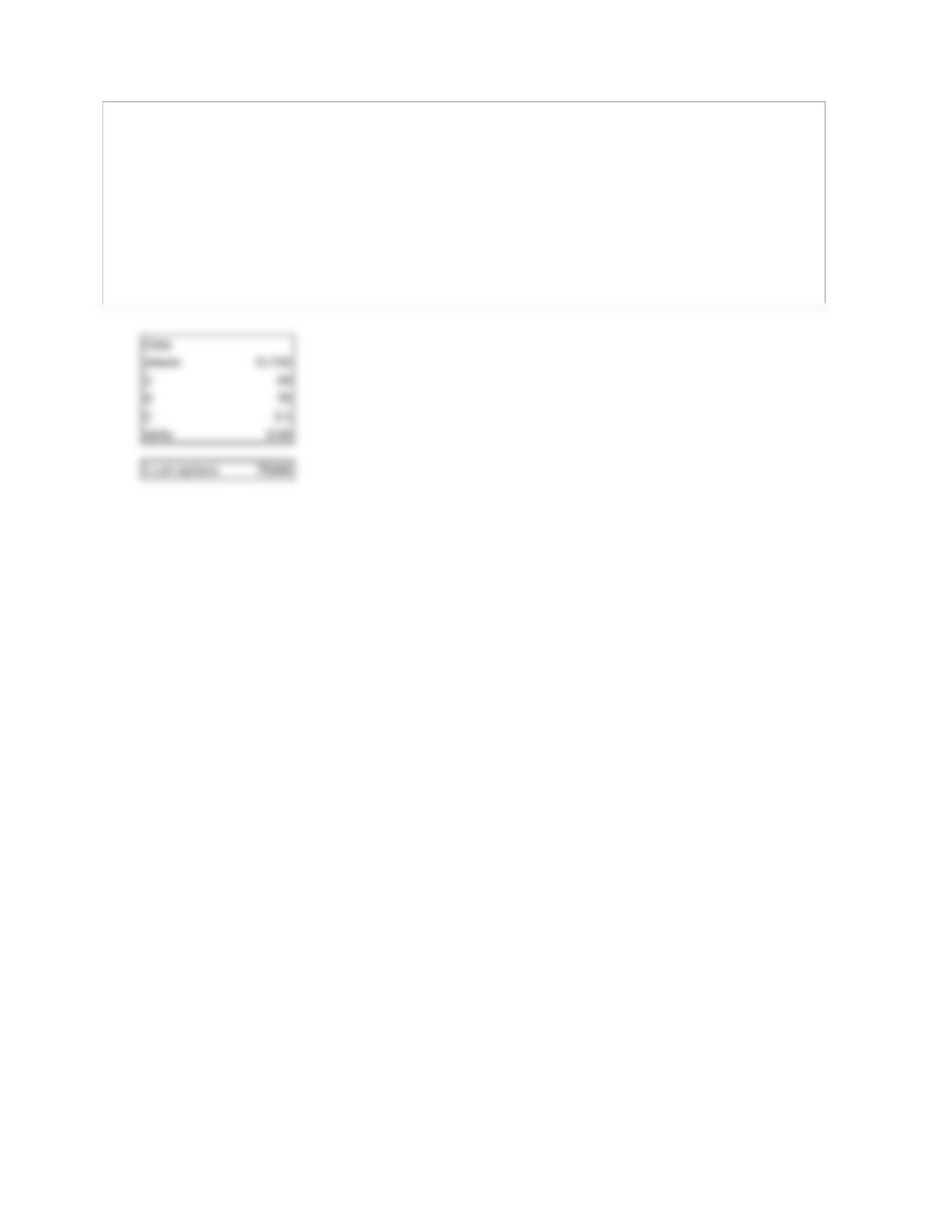
BIC owns 51,750 shares of Smith & Oates. The shares are currently priced at $69. A call option on Smith & Oates with a strike
price of $70 is selling at $3.50 and has a delta of 0.69. What is the number of call options necessary to create a delta-neutral
hedge?
Problem 21-27
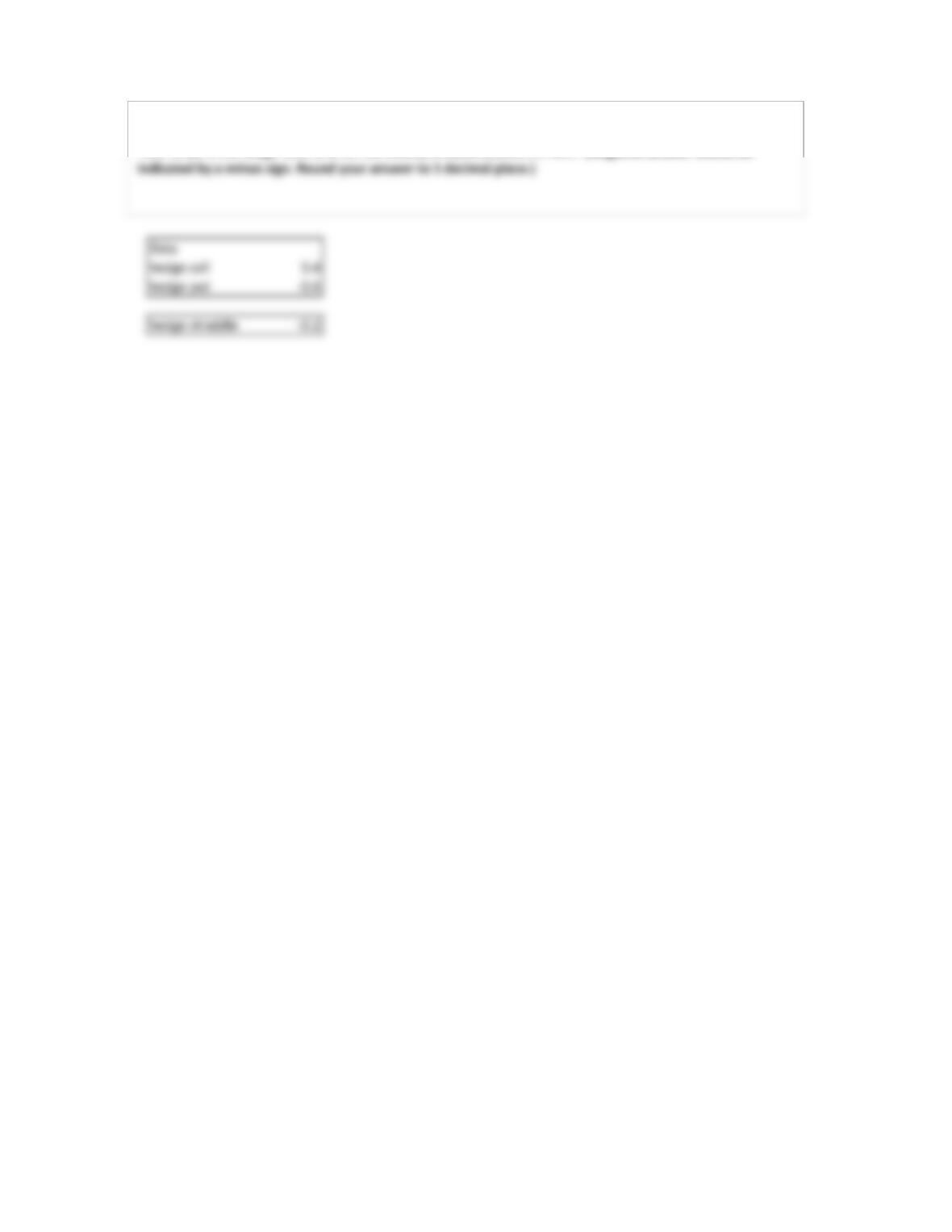
The hedge ratio of an at-the-money call option on IBM is 0.4. The hedge ratio of an at-the-money put option is
−0.6. What is the hedge ratio of an at-the-money straddle position on IBM? (Negative answer should be
Data
S50
t 6 months
Problem 21-29
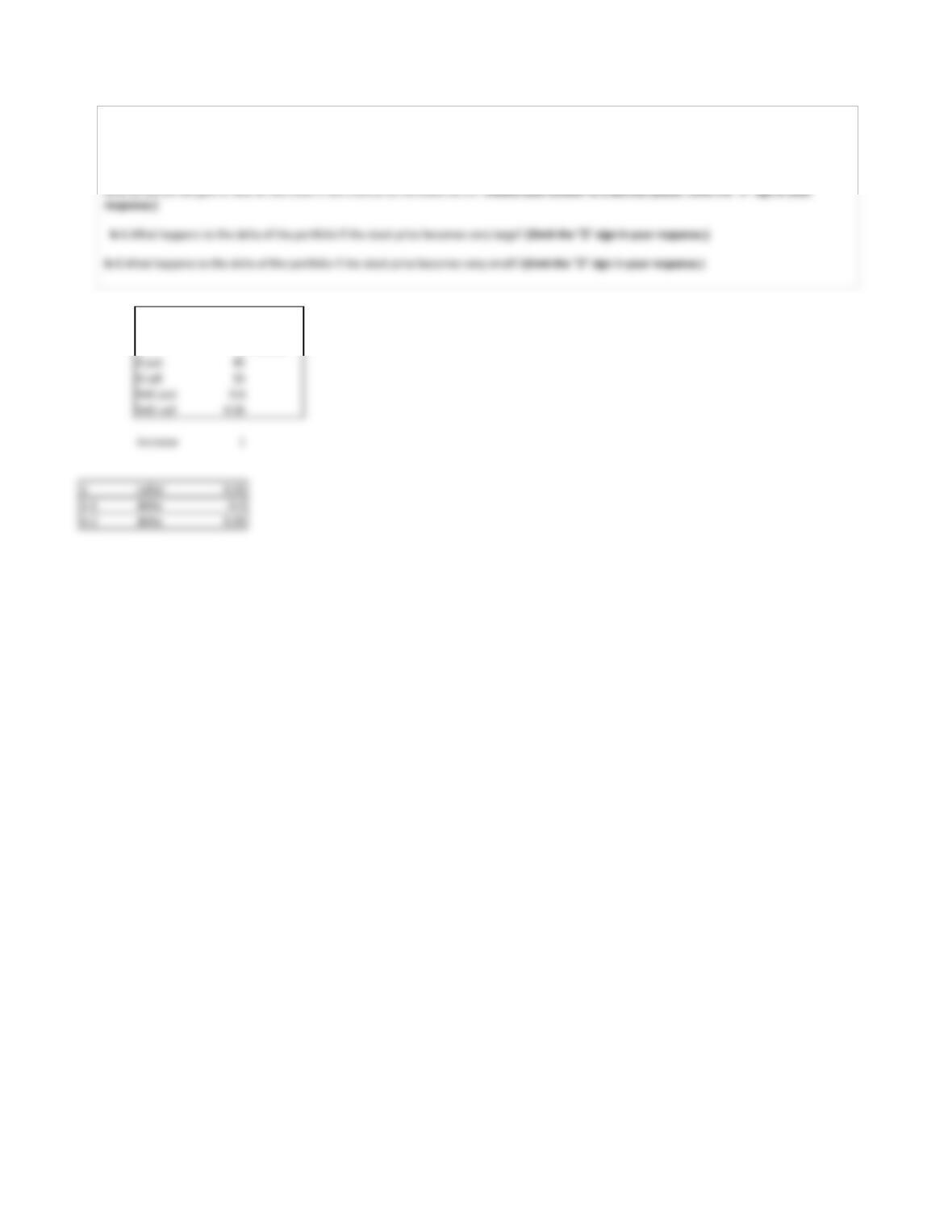
A collar is established by buying a share of stock for $50, buying a 6-month put option with exercise price $45, and writing a 6-month call option with
exercise price $55. On the basis of the volatility of the stock, you calculate that for a strike price of $45 and expiration of 6 months, N(d1) = 0.60, whereas
for the exercise price of $55, N(d1) = 0.35.