Chapter 21 – Option Valuation
CHAPTER 21: OPTION VALUATION
PROBLEM SETS
1. The value of a put option also increases with the volatility of the stock. We see this from
the put-call parity theorem as follows:
2. A $1 increase in a call option’s exercise price would lead to a decrease in the option’s
3. Holding firm-specific risk constant, higher beta implies higher total stock volatility.
5. A call option with a high exercise price has a lower hedge ratio. This call option is less
6. a. Put A must be written on the stock with the lower price. Otherwise, given the
lower volatility of Stock A, Put A would sell for less than Put B.
b. Put B must be written on the stock with the lower price. This would explain its
7.
Exercise
Price
Hedge
Ratio
120
0/30 = 0.000
110
10/30 = 0.333
100
20/30 = 0.667
90
30/30 = 1.000
As the option becomes more in the money, the hedge ratio increases to a maximum of
1.0.
8.
S
d1
N(d1)
45
-0.0268
0.4893
50
0.5000
0.6915
55
0.9766
0.8356
9. a. uS 0 = 130 Pu = 0
Chapter 21 – Option Valuation
10. The hedge ratio for the call is:
5
2
80130
020
dSuS
CC
H
00
du =
−
−
=
−
−
=
Riskless
Portfolio
S = 80
S = 130
Buy 2 shares
160
260
Write 5 calls
0
-100
Total
160
160
Present value = $160/1.10 = $145.455
The value of the portfolio is: $145.455
Does P = C + PV(X) – S?
11. d1 = 0.3182 N(d1) = 0.6248
12. P = $5.69
13. a. C falls to $5.5541
b. C falls to $4.7911
21-5
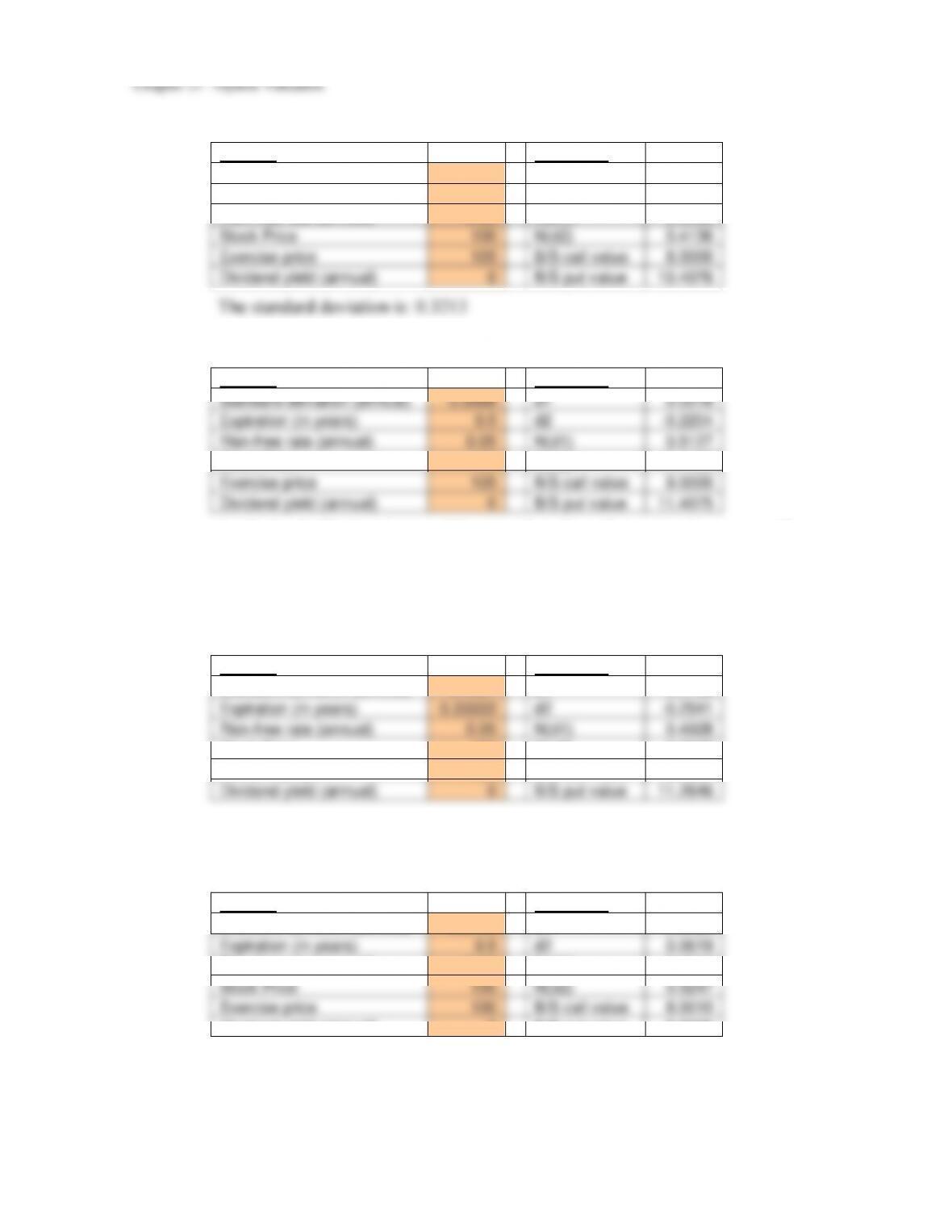
22. a. The spreadsheet appears as follows:
INPUTS
OUTPUTS
Standard deviation (annual)
0.3213
d1
0.0089
Expiration (in years)
0.5
d2
-0.2183
Risk-free rate (annual)
0.05
N(d1)
0.5036
Stock Price
100
N(d2)
0.4136
Exercise price
105
B/S call value
8.0000
Dividend yield (annual)
0
B/S put value
10.4076
The standard deviation is: 0.3213
b. The spreadsheet below shows the standard deviation has increased to: 0.3568
INPUTS
OUTPUTS
Standard deviation (annual)
0.3568
d1
0.0318
Expiration (in years)
0.5
d2
-0.2204
Risk-free rate (annual)
0.05
N(d1)
0.5127
Stock Price
100
N(d2)
0.4128
Exercise price
105
B/S call value
9.0000
Dividend yield (annual)
0
B/S put value
11.4075
Implied volatility has increased because the value of an option increases with
greater volatility.
c. Implied volatility increases to 0.4087 when expiration decreases to four months.
The shorter expiration decreases the value of the option; therefore, in order for the
option price to remain unchanged at $8, implied volatility must increase.
INPUTS
OUTPUTS
Standard deviation (annual)
0.4087
d1
-0.0182
Expiration (in years)
0.33333
d2
-0.2541
Risk-free rate (annual)
0.05
N(d1)
0.4928
Stock Price
100
N(d2)
0.3997
Exercise price
105
B/S call value
8.0001
Dividend yield (annual)
0
B/S put value
11.2646
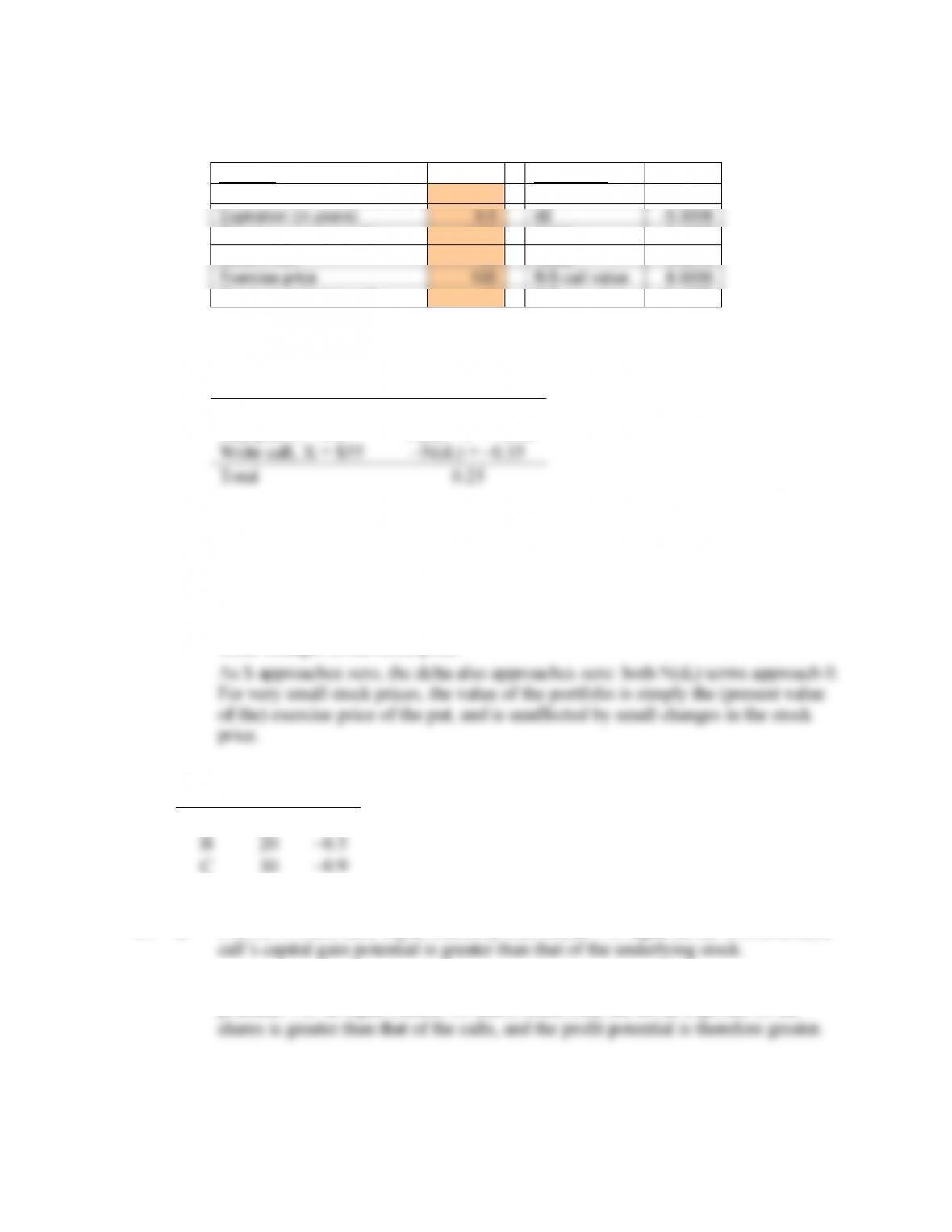
d. Implied volatility decreases to 0.2406 when exercise price decreases to $100. The
decrease in exercise price increases the value of the call, so that, in order to the
option price to remain at $8, implied volatility decreases.
INPUTS
OUTPUTS
Standard deviation (annual)
0.2406
d1
0.2320
Expiration (in years)
0.5
d2
0.0619
Risk-free rate (annual)
0.05
N(d1)
0.5917
Stock Price
100
N(d2)
0.5247
Exercise price
100
B/S call value
8.0010
Dividend yield (annual)
0
B/S put value
5.5320
Chapter 21 – Option Valuation
21-6
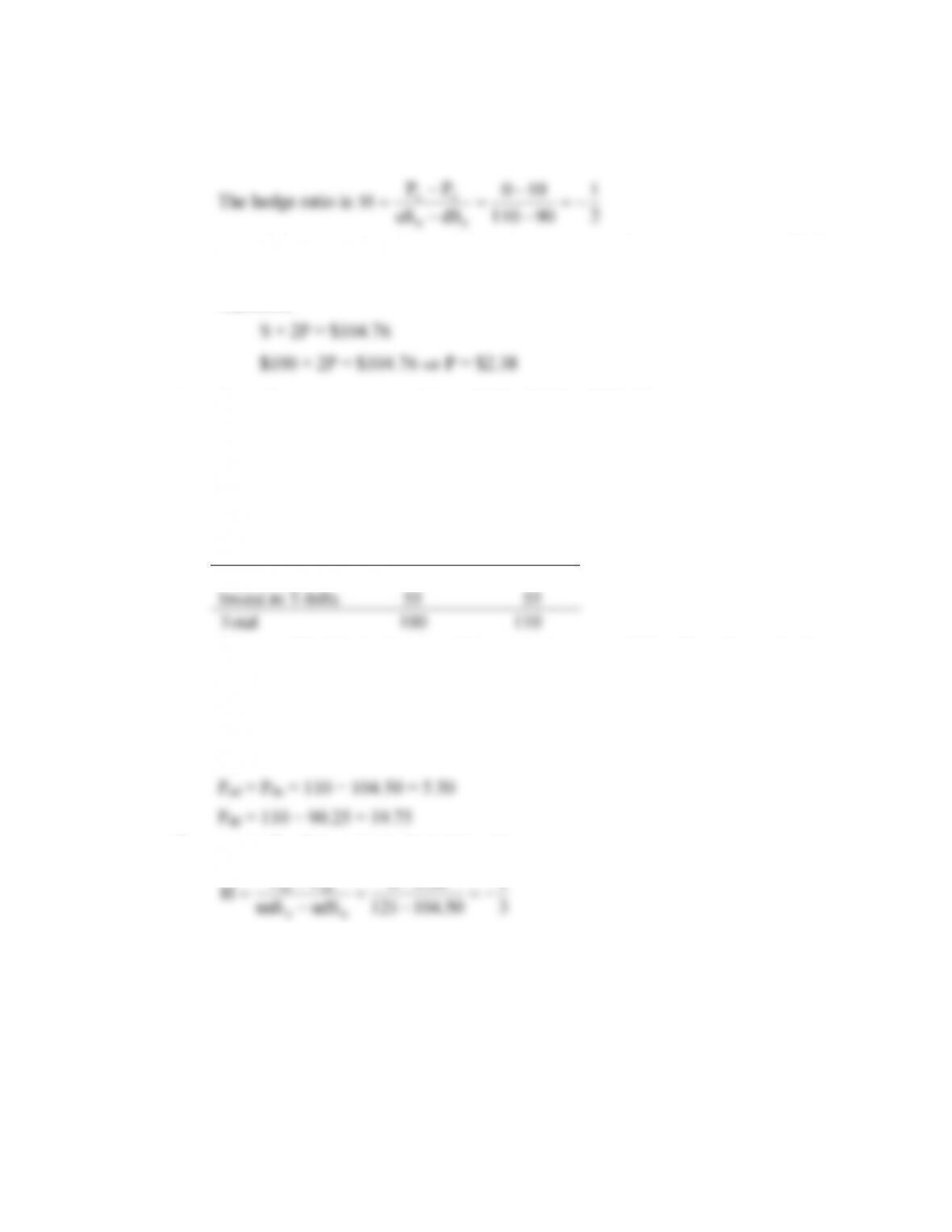
e. The decrease in stock price decreases the value of the call. In order for the option
price to remain at $8, implied volatility increases.
INPUTS
OUTPUTS
Standard deviation (annual)
0.3566
d1
-0.0484
Expiration (in years)
0.5
d2
-0.3006
Risk-free rate (annual)
0.05
N(d1)
0.4807
Stock Price
98
N(d2)
0.3819
Exercise price
105
B/S call value
8.0000
Dividend yield (annual)
0
B/S put value
12.4075
23. a. The delta of the collar is calculated as follows:
Position
Delta
Buy stock
1.0
Buy put, X = $45
N(d1) – 1 = –0.40
Write call, X = $55
–N(d1) = –0.35
Total
0.25
If the stock price increases by $1, then the value of the collar increases by $0.25.
The stock will be worth $1 more, the loss on the purchased put will be $0.40, and
the call written represents a liability that increases by $0.35.
b. If S becomes very large, then the delta of the collar approaches zero. Both N(d1)
terms approach 1. Intuitively, for very large stock prices, the value of the portfolio
is simply the (present value of the) exercise price of the call, and is unaffected by
small changes in the stock price.
24.
Put
X
Delta
A
10
−0.1
B
20
−0.5
C
30
−0.9
25. a. Choice A: Calls have higher elasticity than shares. For equal dollar investments, a
b. Choice B: Calls have hedge ratios less than 1.0, so the shares have higher profit
potential. For an equal number of shares controlled, the dollar exposure of the
Chapter 21 – Option Valuation
21-7
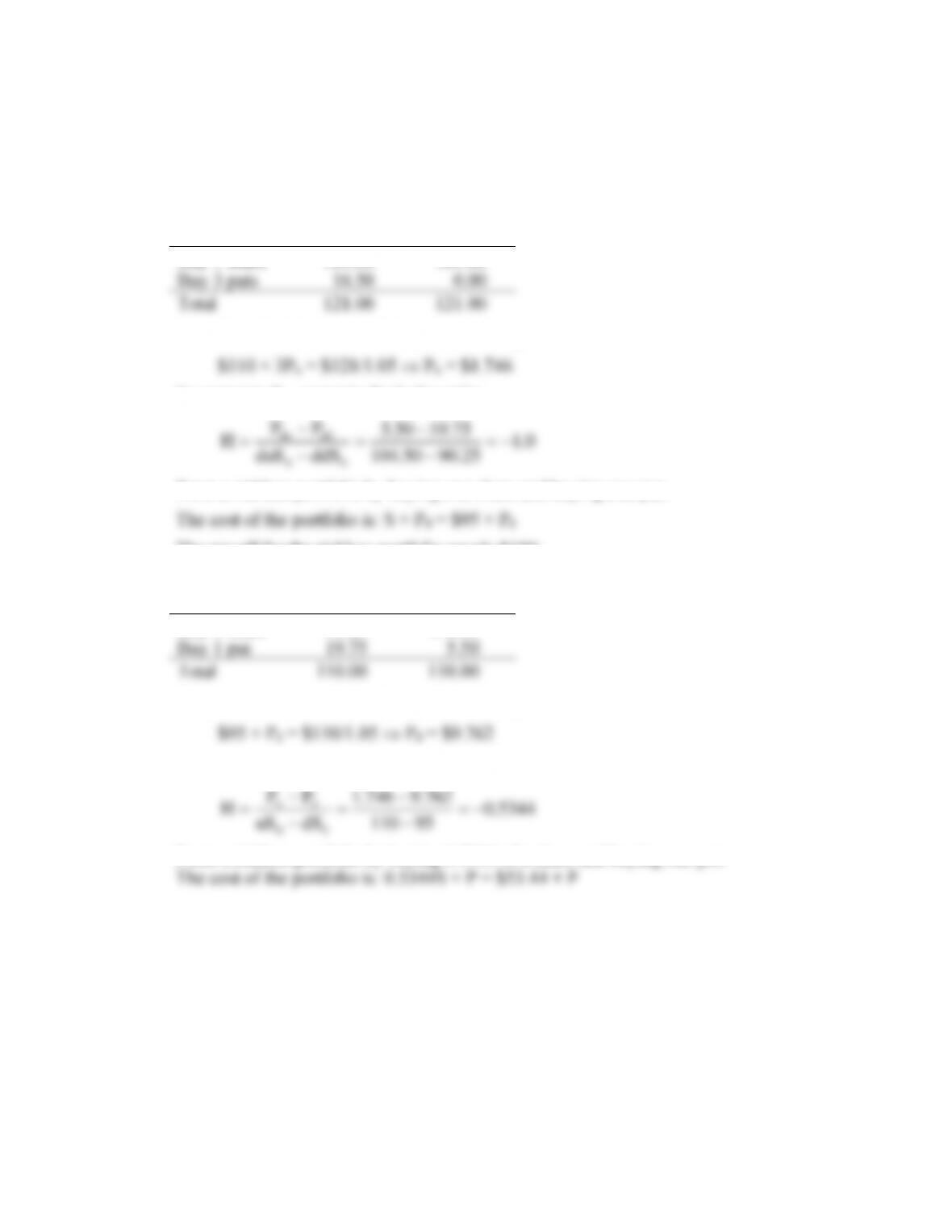
26. a. uS 0 = 110 Pu = 0
dS 0 = 90 Pd = 10
2
1
90110
100
dSuS
PP
00
du −=
−
−
−
−
A portfolio comprised of one share and two puts provides a guaranteed payoff of
$110, with present value: $110/1.05 = $104.76
Therefore:
b. Cost of protective put portfolio = $100 + $2.38 = $102.38
c. Our goal is a portfolio with the same exposure to the stock as the hypothetical
protective put portfolio. Since the put’s hedge ratio is –0.5, the portfolio consists
of (1 – 0.5) = 0.5 shares of stock, which costs $50, and the remaining funds
($52.38) invested in T-bills, earning 5% interest.
Portfolio
S = 90
S = 110
Buy 0.5 shares
45
55
Invest in T-bills
55
55
Total
100
110
This payoff is identical to that of the protective put portfolio. Thus, the stock plus
bills strategy replicates both the cost and payoff of the protective put.
27. The put values in the second period are:
Puu = 0
To compute Pu , first compute the hedge ratio:
3
1
50.104121
50.50
udSuuS
PP
H
00
uduu −=
−
−
=
−
−
=
Chapter 21 – Option Valuation
21-8
Form a riskless portfolio by buying one share of stock and buying three puts.
The cost of the portfolio is: S + 3Pu = $110 + 3Pu
The payoff for the riskless portfolio equals $121:
Riskless
Portfolio
S = 104.50
S = 121
Buy 1 share
104.50
121.00
Buy 3 puts
16.50
0.00
Total
121.00
121.00
Therefore, find the value of the put by solving:
To compute Pd , compute the hedge ratio:
0.1
25.9050.104
75.1950.5
ddSduS
PP
H
00
dddu −=
−
−
=
−
−
=
Form a riskless portfolio by buying one share and buying one put.
The payoff for the riskless portfolio equals $110:
Riskless
Portfolio
S = 90.25
S = 104.50
Buy 1 share
90.25
104.50
Buy 1 put
19.75
5.50
Total
110.00
110.00
Therefore, find the value of the put by solving:
To compute P, compute the hedge ratio:
5344.0
95110
762.9746.1
dSuS
PP
H
00
du −=
−
−
=
−
−
=
Form a riskless portfolio by buying 0.5344 of a share and buying one put.
Chapter 21 – Option Valuation
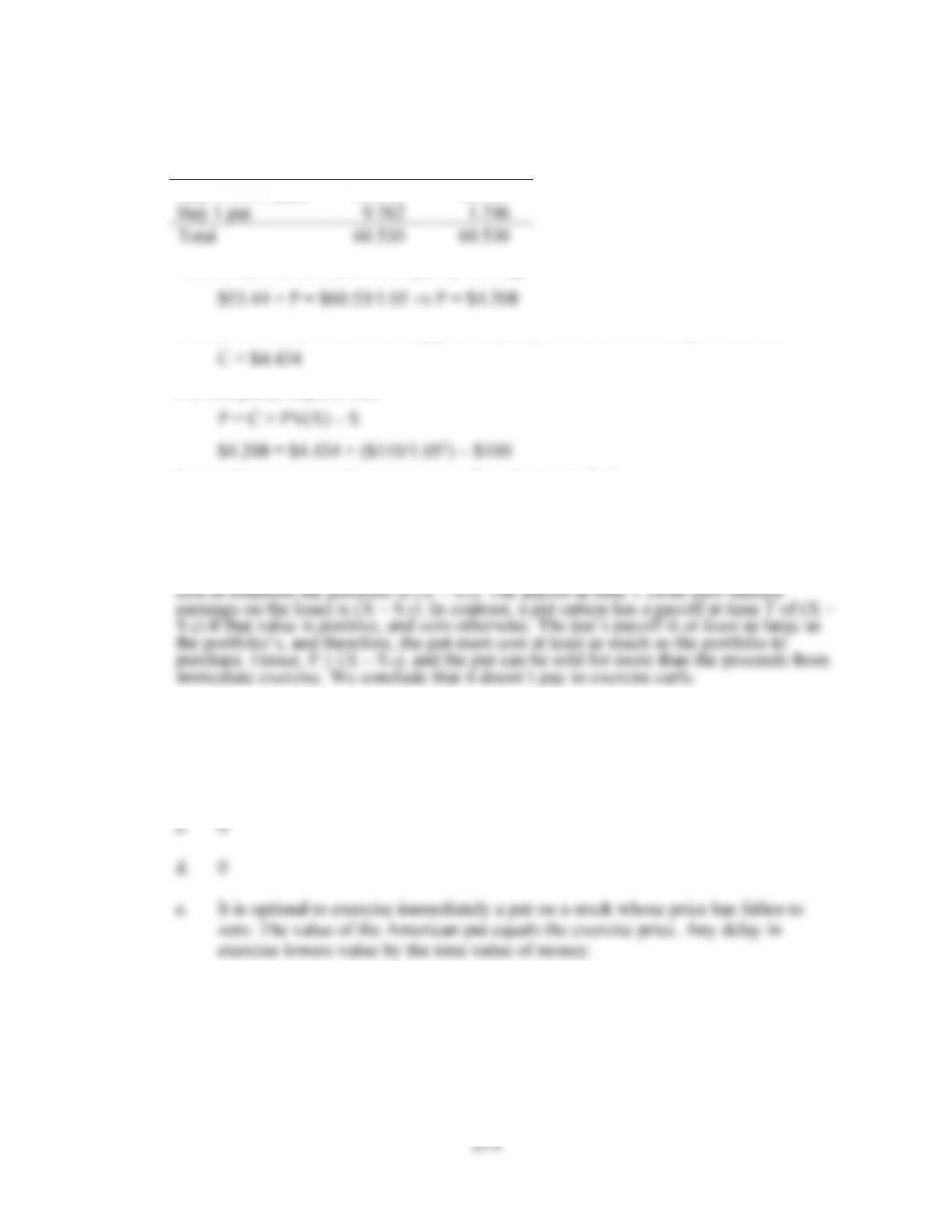
The payoff for the riskless portfolio equals $60.53:
Riskless Portfolio
S = 95
S = 110
Buy 0.5344 share
50.768
58.784
Buy 1 put
9.762
1.746
Total
60.530
60.530
Therefore, find the value of the put by solving:
Finally, we verify this result using put-call parity. Recall from Example 21.1 that:
Put-call parity requires that:
Except for minor rounding error, put-call parity is satisfied.
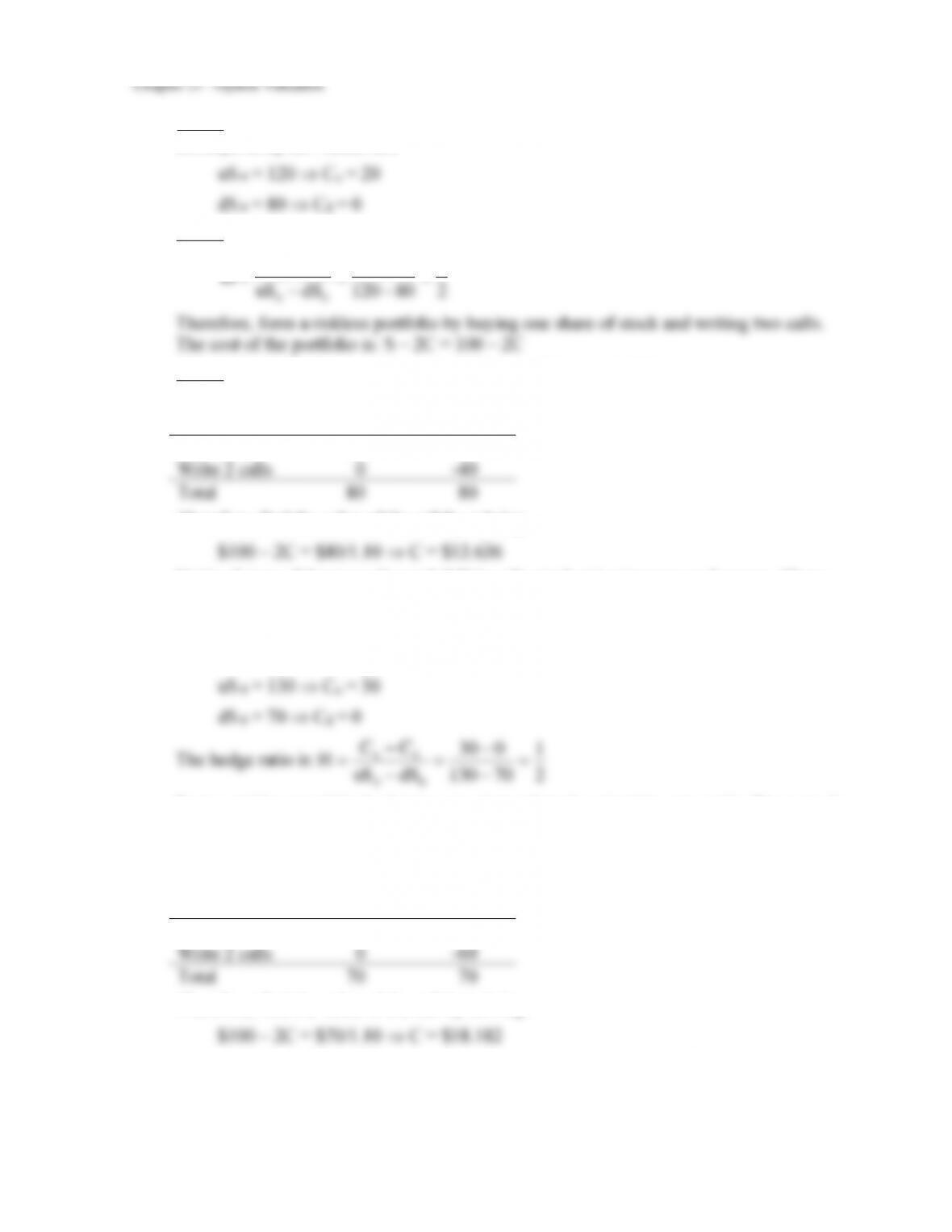
28. If r = 0, then one should never exercise a put early. There is no “time value cost” to
waiting to exercise, but there is a “volatility benefit” from waiting. To show this more
rigorously, consider the following portfolio: lend $X and short one share of stock. The
29. a. Xe−rT
b. X
21–10
30. Step 1: Calculate the option values at expiration. The two possible stock prices and the
corresponding call values are:
Step 2: Calculate the hedge ratio.
2
1
80120
020
dSuS
CC
H
00
du =
−
−
=
−
−
=
Therefore, form a riskless portfolio by buying one share of stock and writing two calls.
The cost of the portfolio is: S – 2C = 100 – 2C
Step 3: Show that the payoff for the riskless portfolio equals $80:
Riskless
Portfolio
S = 80
S = 120
Buy 1 share
80
120
Write 2 calls
0
-40
Total
80
80
Therefore, find the value of the call by solving:
Notice that we did not use the probabilities of a stock price increase or decrease. These
are not needed to value the call option.
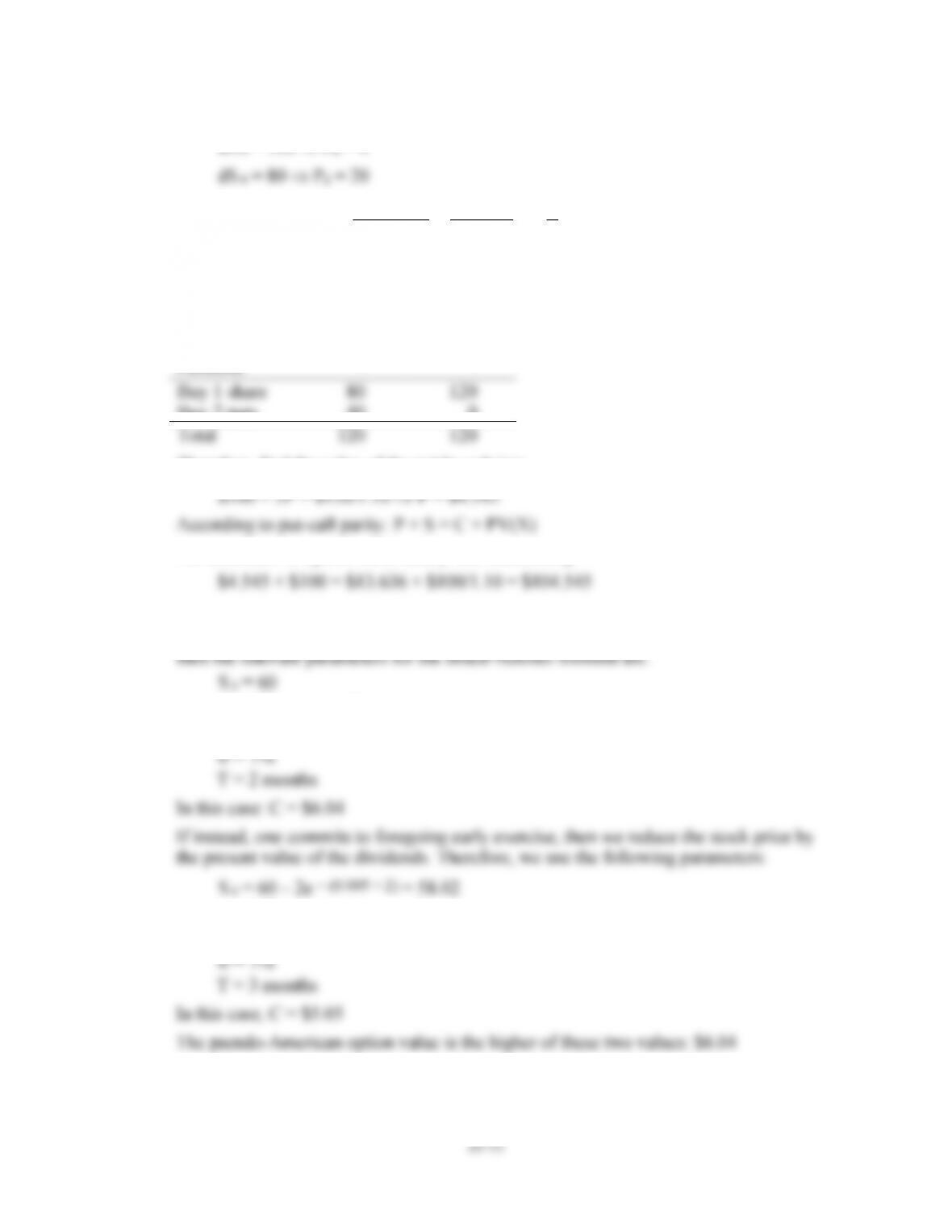
31. The two possible stock prices and the corresponding call values are:
2
70130
dSuS
00
−
−
Form a riskless portfolio by buying one share of stock and writing two calls. The cost of
the portfolio is: S – 2C = 100 – 2C
The payoff for the riskless portfolio equals $70:
Riskless
Portfolio
S = 70
S = 130
Buy 1 share
70
130
Write 2 calls
0
-60
Total
70
70
Therefore, find the value of the call by solving:
Here, the value of the call is greater than the value in the lower-volatility scenario.
Chapter 21 – Option Valuation
32. The two possible stock prices and the corresponding put values are:
uS 0 = 120 Pu = 0
The hedge ratio is:
2
1
80120
200
dSuS
PP
H
00
du −=
−
−
=
−
−
=
Form a riskless portfolio by buying one share of stock and buying two puts. The cost of
the portfolio is: S + 2P = 100 + 2P
The payoff for the riskless portfolio equals $120:
Riskless
Portfolio
S = 80
S = 120
Buy 1 share
80
120
Buy 2 puts
40
0
Total
120
120
Therefore, find the value of the put by solving:
Our estimates of option value satisfy this relationship:
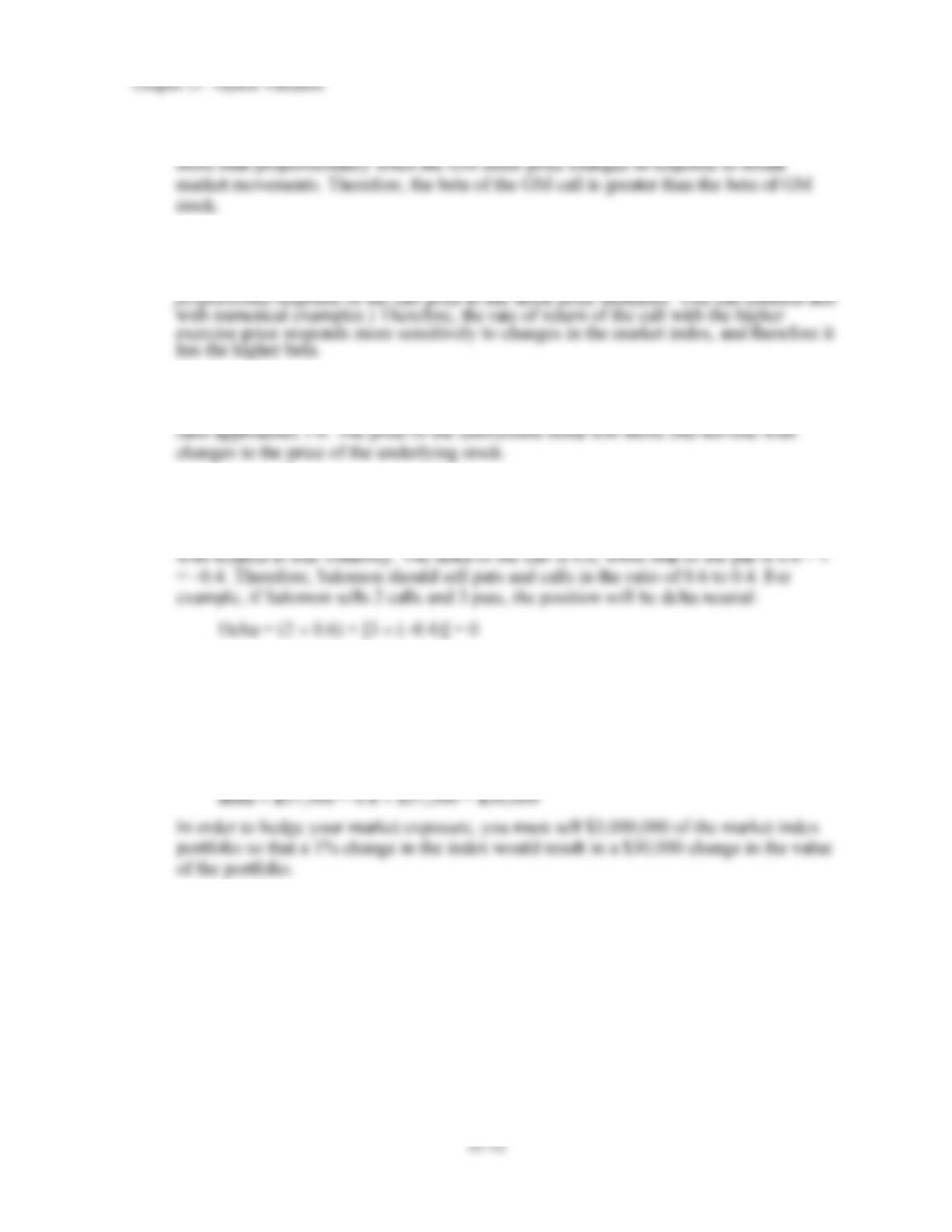
33. If we assume that the only possible exercise date is just prior to the ex-dividend date,
r = 0.5% per month
X = 55
r = 0.5% per month
X = 55
21–13
39. S = 100; current value of portfolio
r = 0.05; risk-free rate
a. Using the Black-Scholes formula, we find that:
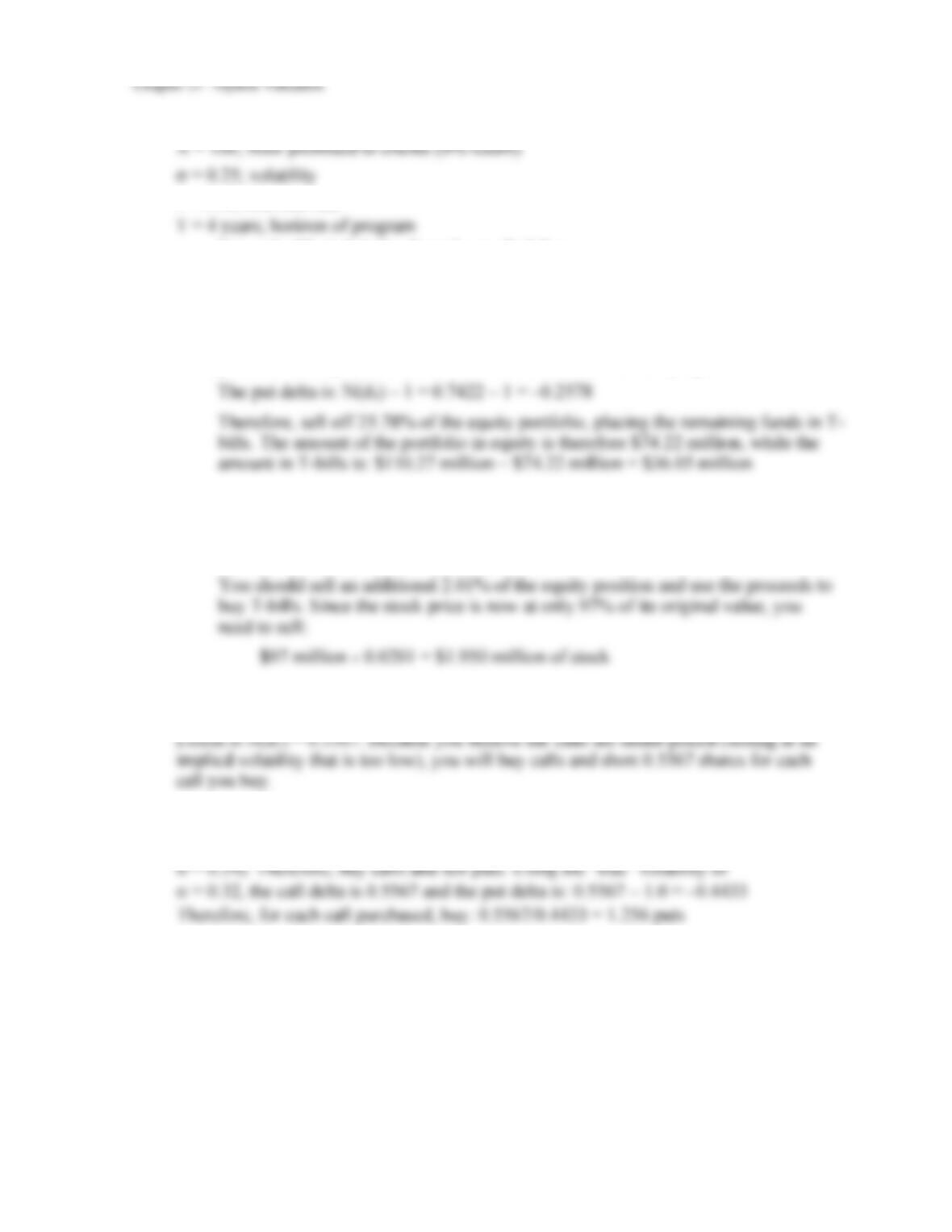
d1 = 0.65, N(d1) = 0.7422, d 2 = 0.15, N(d 2) = 0.5596
Put value = $10.27
Therefore, total funds to be managed equals $110.27 million: $100 million
portfolio value plus the $10.27 million fee for the insurance program.
b. At the new portfolio value, the put delta becomes: –0.2779
This means that you must reduce the delta of the portfolio by:
0.2779 – 0.2578 = 0.0201
40. Using the true volatility (32%) and time to expiration T = 0.25 years, the hedge ratio for
41. The calls are cheap (implied = 0.30) and the puts are expensive (implied
Chapter 21 – Option Valuation
21–14
42. a. To calculate the hedge ratio, suppose that the market index increases by 1%. Then
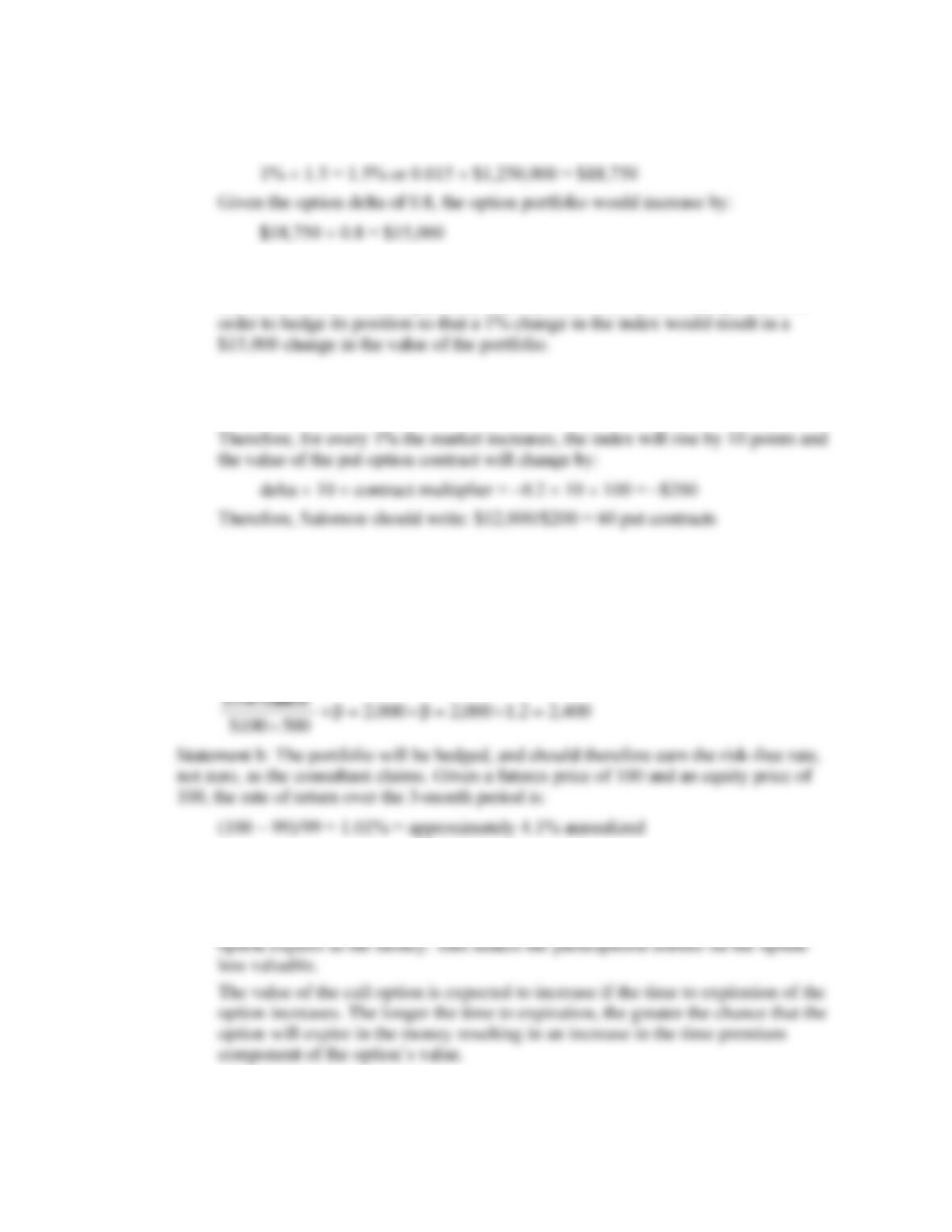
the stock portfolio would be expected to increase by:
Salomon’s liability from writing these options would increase by the same
amount. The market index portfolio would increase in value by 1%. Therefore,
Salomon Brothers should purchase $1,500,000 of the market index portfolio in
b. The delta of a put option is:
0.8 – 1 = –0.2
CFA PROBLEMS
1. Statement a: The hedge ratio (determining the number of futures contracts to sell) ought
to be adjusted by the beta of the equity portfolio, which is 1.20. The correct hedge ratio
would be:
million 100$ ===
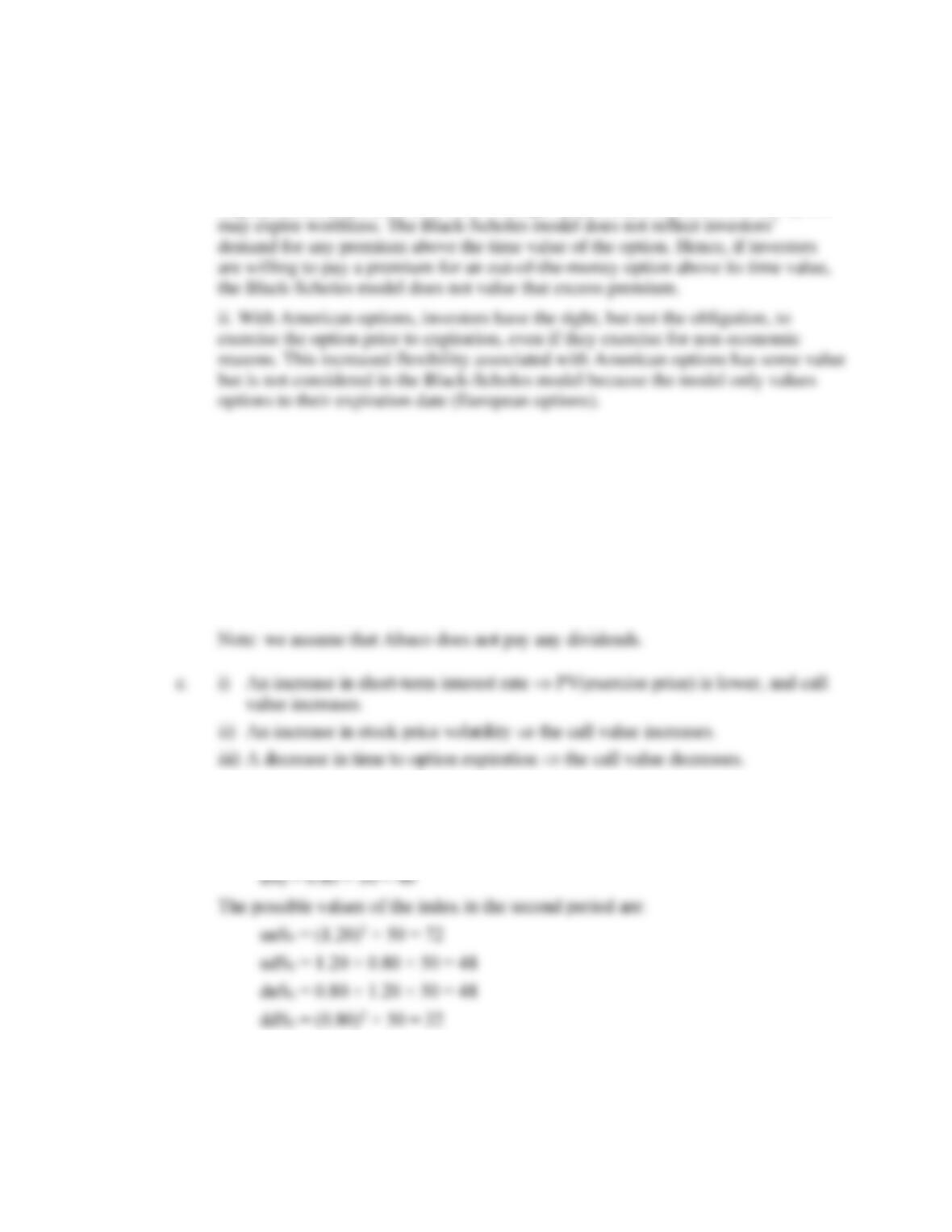
2. a. The value of the call option is expected to decrease if the volatility of the
underlying stock price decreases. The less volatile the underlying stock price, the
less the chance of extreme price movements and the lower the probability that the
Chapter 21 – Option Valuation
21–15
b. i. When European options are out of the money, investors are essentially saying
that they are willing to pay a premium for the right, but not the obligation, to buy
or sell the underlying asset. The out-of-the-money option has no intrinsic value,
but, since options require little capital (just the premium paid) to obtain a relatively
large potential payoff, investors are willing to pay that premium even if the option
3. a. American options should cost more (have a higher premium). American options
give the investor greater flexibility than European options since the investor can
choose whether to exercise early. When the stock pays a dividend, the option to
exercise a call early can be valuable. But regardless of the dividend, a European
option (put or call) never sells for more than an otherwise-identical American
option.
b. C = S0 + P − PV(X) = $43 + $4 − $45/1.055 = $4.346
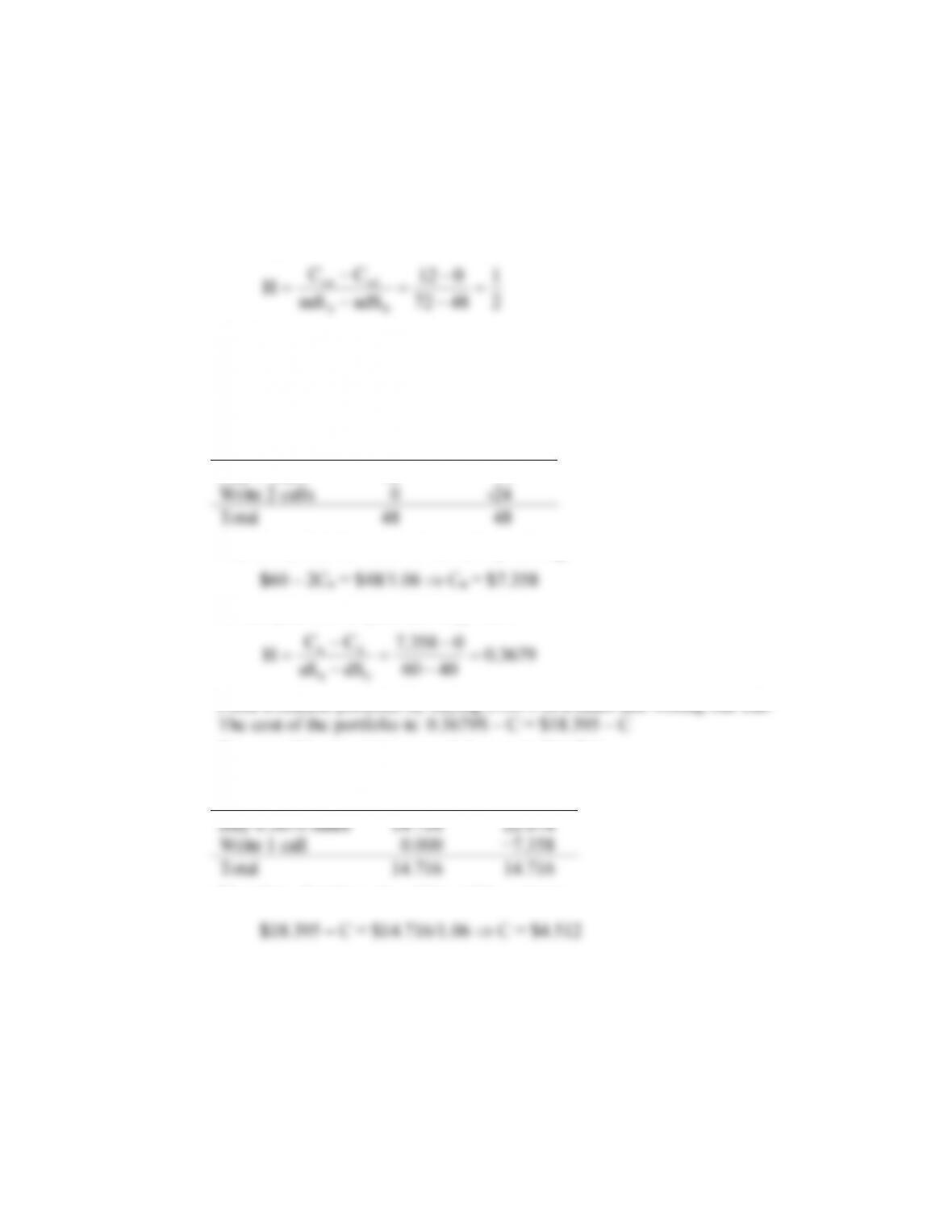
4. a. The two possible values of the index in the first period are:
uS0 = 1.20 × 50 = 60
Chapter 21 – Option Valuation
21–16
b. The call values in the second period are:
Cuu = 72 − 60 = 12
Cud = Cdu = Cdd = 0
Since Cud = Cdu = 0, then Cd = 0.
To compute Cu , first compute the hedge ratio:
2
1
4872
012
udSuuS
CC
H
00
uduu =
−
−
=
−
−
=
Form a riskless portfolio by buying one share of stock and writing two calls.
The cost of the portfolio is: S – 2Cu = $60 – 2Cu
The payoff for the riskless portfolio equals $48:
Riskless
Portfolio
S = 48
S = 72
Buy 1 share
48
72
Write 2 calls
0
-24
Total
48
48
Therefore, find the value of the call by solving:
To compute C, compute the hedge ratio:
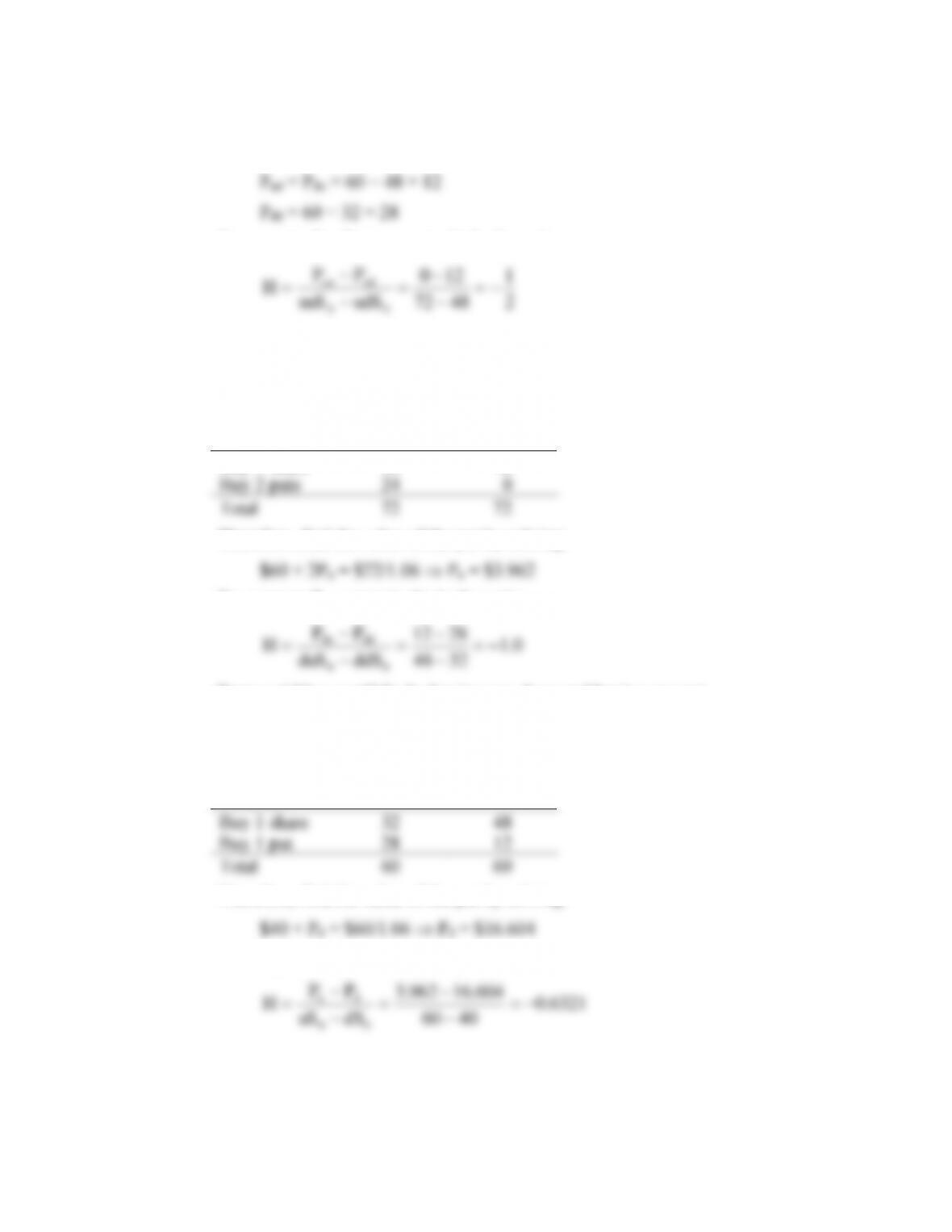
3679.0
4060
0358.7
dSuS
CC
H
00
du =
−
−
=
−
−
=
Form a riskless portfolio by buying 0.3679 of a share and writing one call.
The payoff for the riskless portfolio equals $14.716:
Riskless Portfolio
S = 40
S = 60
Buy 0.3679 share
14.716
22.074
Write 1 call
0.000
−7.358
Total
14.716
14.716
Therefore, find the value of the call by solving:
Chapter 21 – Option Valuation
21–17
c. The put values in the second period are:
Puu = 0
To compute Pu , first compute the hedge ratio:
2
1
4872
120
udSuuS
PP
H
00
uduu −=
−
−
=
−
−
=
Form a riskless portfolio by buying one share of stock and buying two puts.
The cost of the portfolio is: S + 2Pu = $60 + 2Pu
The payoff for the riskless portfolio equals $72:
Riskless
Portfolio
S = 48
S = 72
Buy 1 share
48
72
Buy 2 puts
24
0
Total
72
72
Therefore, find the value of the put by solving:
To compute Pd , compute the hedge ratio:
0.1
3248
2812
ddSduS
PP
H
00
dddu −=
−
−
=
−
−
=
Form a riskless portfolio by buying one share and buying one put.
The cost of the portfolio is: S + Pd = $40 + Pd
The payoff for the riskless portfolio equals $60:
Riskless
Portfolio
S = 32
S = 48
Buy 1 share
32
48
Buy 1 put
28
12
Total
60
60
Therefore, find the value of the put by solving:
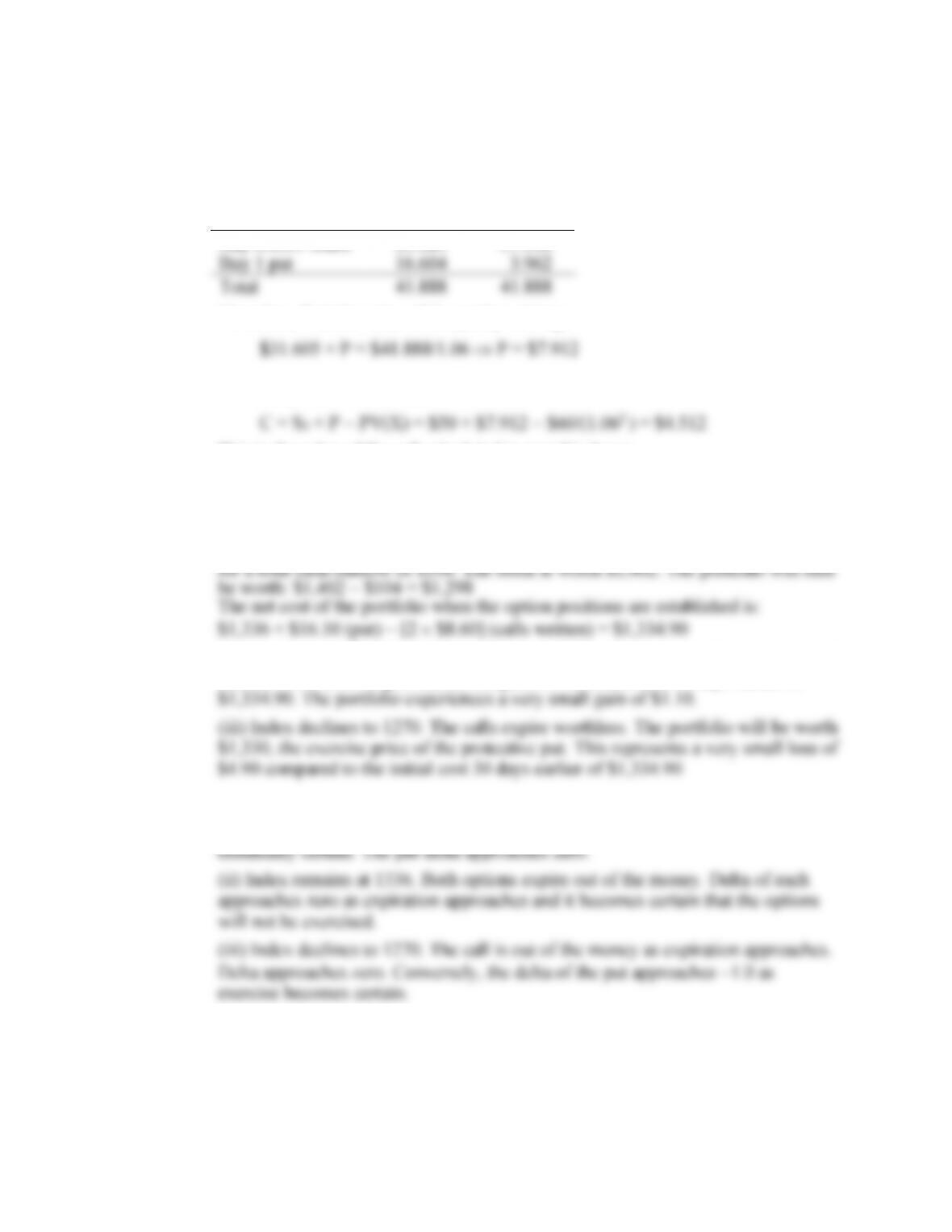
To compute P, compute the hedge ratio:
6321.0
4060
604.16962.3
dSuS
PP
H
00
du −=
−
−
=
−
−
=
Chapter 21 – Option Valuation
21–18
Form a riskless portfolio by buying 0.6321 of a share and buying one put.
The cost of the portfolio is: 0.6321S + P = $31.605 + P
The payoff for the riskless portfolio equals $41.888:
Riskless Portfolio
S = 40
S = 60
Buy 0.6321 share
25.284
37.926
Buy 1 put
16.604
3.962
Total
41.888
41.888
Therefore, find the value of the put by solving:
d. According to put-call-parity:
This is the value of the call calculated in part (b) above.
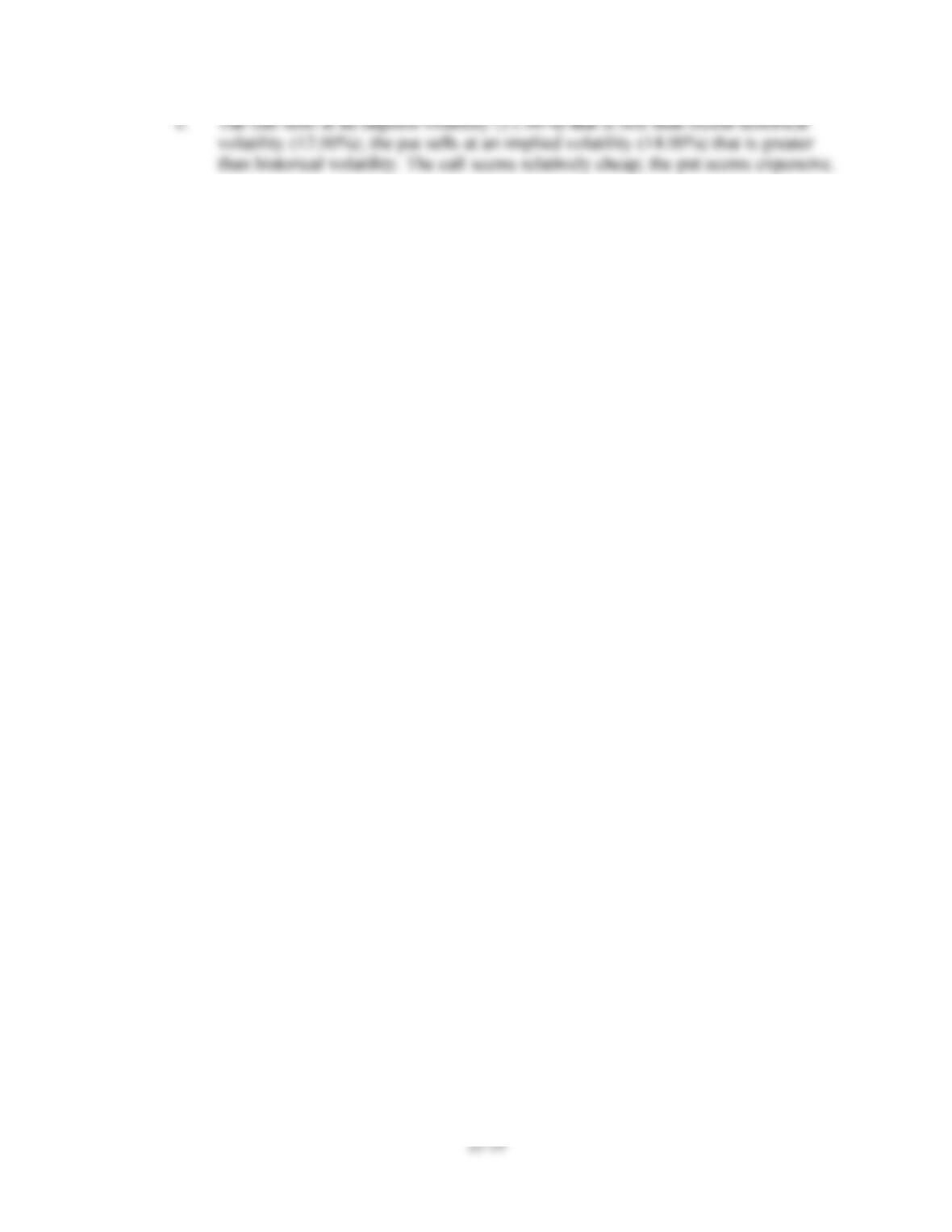
5. a. (i) Index increases to 1402. The combined portfolio will suffer a loss. The written
calls expire in the money; the protective put purchased expires worthless. Let’s
analyze the outcome on a per-share basis. The payout for each call option is $52,
(ii) Index remains at 1336. Both options expire out of the money. The portfolio will
thus be worth $1,336 (per share), compared to an initial cost 30 days earlier of
b. (i) Index increases to 1402. The delta of the call approaches 1.0 as the stock goes deep
into the money, while expiration of the call approaches and exercise becomes
Chapter 21 – Option Valuation
21–19
c. The call sells at an implied volatility (11.00%) that is less than recent historical
volatility (12.00%); the put sells at an implied volatility (14.00%) that is greater
than historical volatility. The call seems relatively cheap; the put seems expensive.