Chapter 21: International Financial Management
Chapter 21
International Financial Management
Discussion Questions
21-1.
What risks does a foreign affiliate of a multinational firm face in today’s
business world?
In addition to the normal risks that a domestic firm faces (such as the risk
associated with maintaining sales and market share, the financial risk of
too much leverage, and so on), the foreign affiliate of a multinational firm is
exposed to foreign exchange risk and political risk.
21-2.
What allegations are sometimes made against foreign affiliates of multinational
firms and against the multinational firms themselves?
Some countries have charged that foreign affiliates subverted their governments
and caused instability for their currencies in international money and foreign
exchange markets. The less developed countries (LDCs) have, at times, alleged
that foreign business firms exploit their labor with low wages. The multinational
companies are also under constant criticism in their home countries. The home
country’s labor unions charge the MNCs with exporting jobs, capital, and
technology to foreign nations, while avoiding their fair share of taxes. In spite of all
these criticisms, the multinational companies have managed to survive and prosper.
21-3.
List the factors that affect the value of a currency in foreign exchange markets.
Factors affecting the value of a currency are inflation, interest rates, balance
of payments, and government policies. Other factors that have an influence
include the stock market, gold prices, demand for oil, political turmoil, and
labor strikes. All of the above factors will not affect each currency in the same
way at any given point in time.
Chapter 21: International Financial Management
Chapter 21
Problems
1. Spot and forward rates (LO21-2) The Wall Street Journal reported the following spot and
forward rates for the Swiss franc ($/SF):
Spot ……………………………………..
$0.8202
30-day forward ……………………..
$0.8244
90-day forward ……………………..
$0.8295
180-day forward ……………………
$0.8343
a. Was the Swiss franc selling at a discount or premium in the forward market?
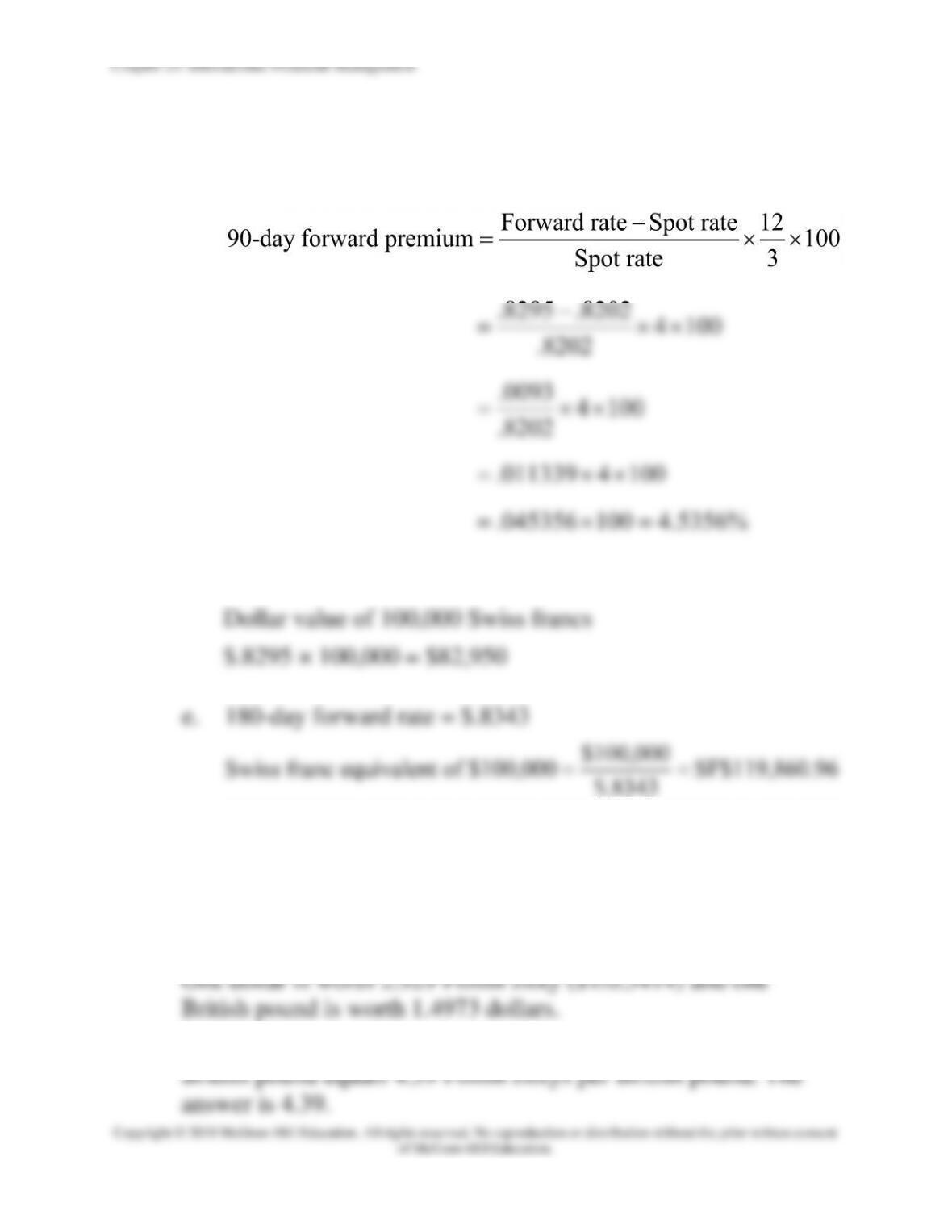
b. What was the 30-day forward premium (or discount)?
c. What was the 90-day forward premium (or discount)?
d. Suppose you executed a 90-day forward contract to exchange 100,000 Swiss francs into
U.S. dollars. How many dollars would you get 90 days hence?
e. Assume a Swiss bank entered into a 180-day forward contract with Bankers Trust to
buy $100,000. How many francs will the Swiss bank deliver in six months to get the
U.S. dollars?
21–1. Solution:
a. The Swiss franc was selling at a premium above the spot
rate.
Chapter 21: International Financial Management
a. Initial investment 150 × $50 = $7,500
Value after one year 150 × $54 = $8,100
7. Hedging exchange rate risk (LO21-3) You are the vice president of finance for Exploratory
Resources, headquartered in Houston, Texas. In January 20X1, your firm’s Canadian
subsidiary obtained a six-month loan of 150,000 Canadian dollars from a bank in Houston to
finance the acquisition of a titanium mine in the province of Quebec. The loan will also be
repaid in Canadian dollars. At the time of the loan, the spot exchange rate was U.S.
$.8995/Canadian dollar and the Canadian currency was selling at a discount in the forward
market. The June 20X1 contract (face value = C$150,000 per contract) was quoted at U.S.
$0.8930/Canadian dollar.
a. Explain how the Houston bank could lose on this transaction assuming no hedging.
b. If the bank does hedge with the forward contract, what is the maximum amount it can
lose?
Chapter 21: International Financial Management
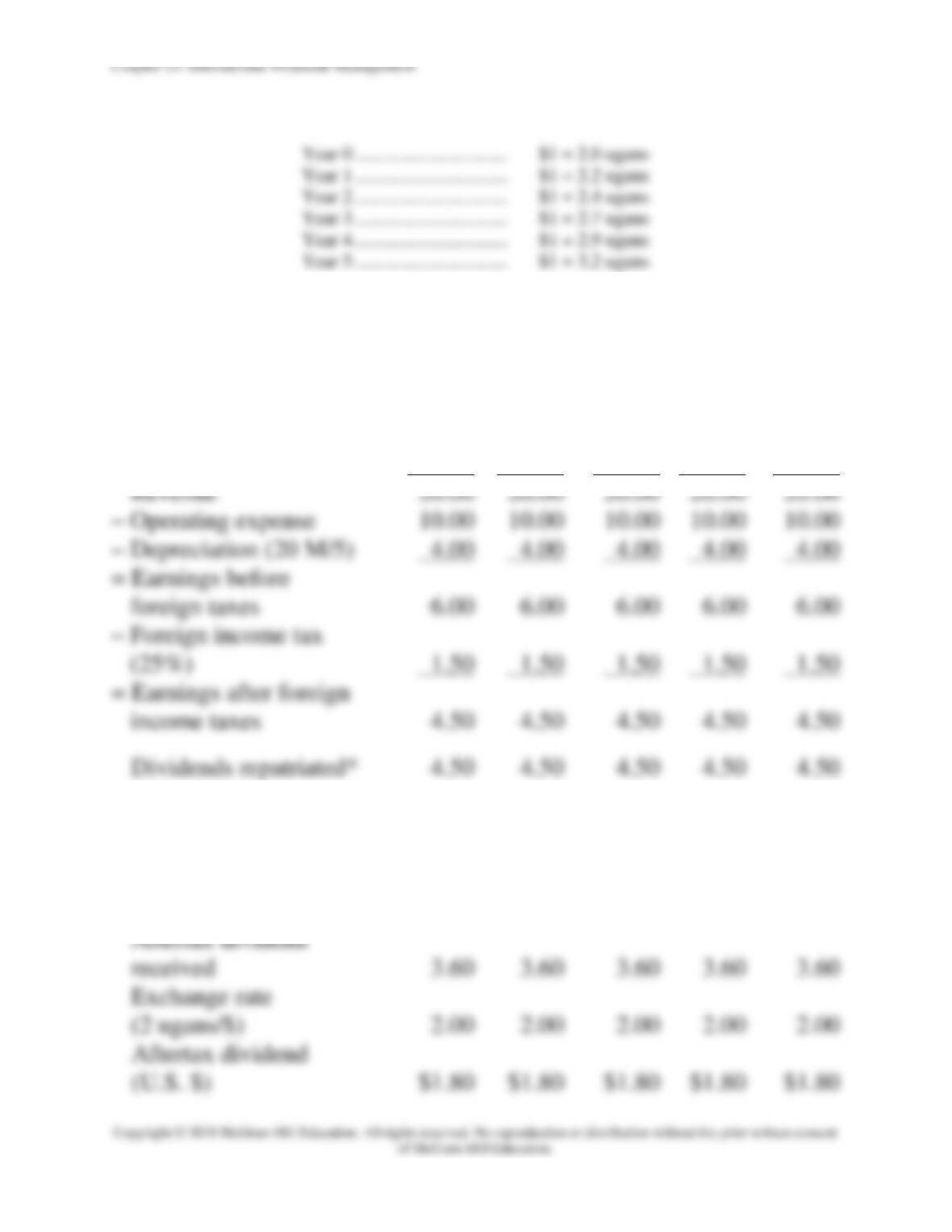
PV of depreciation
The PV of all the cash inflows equals
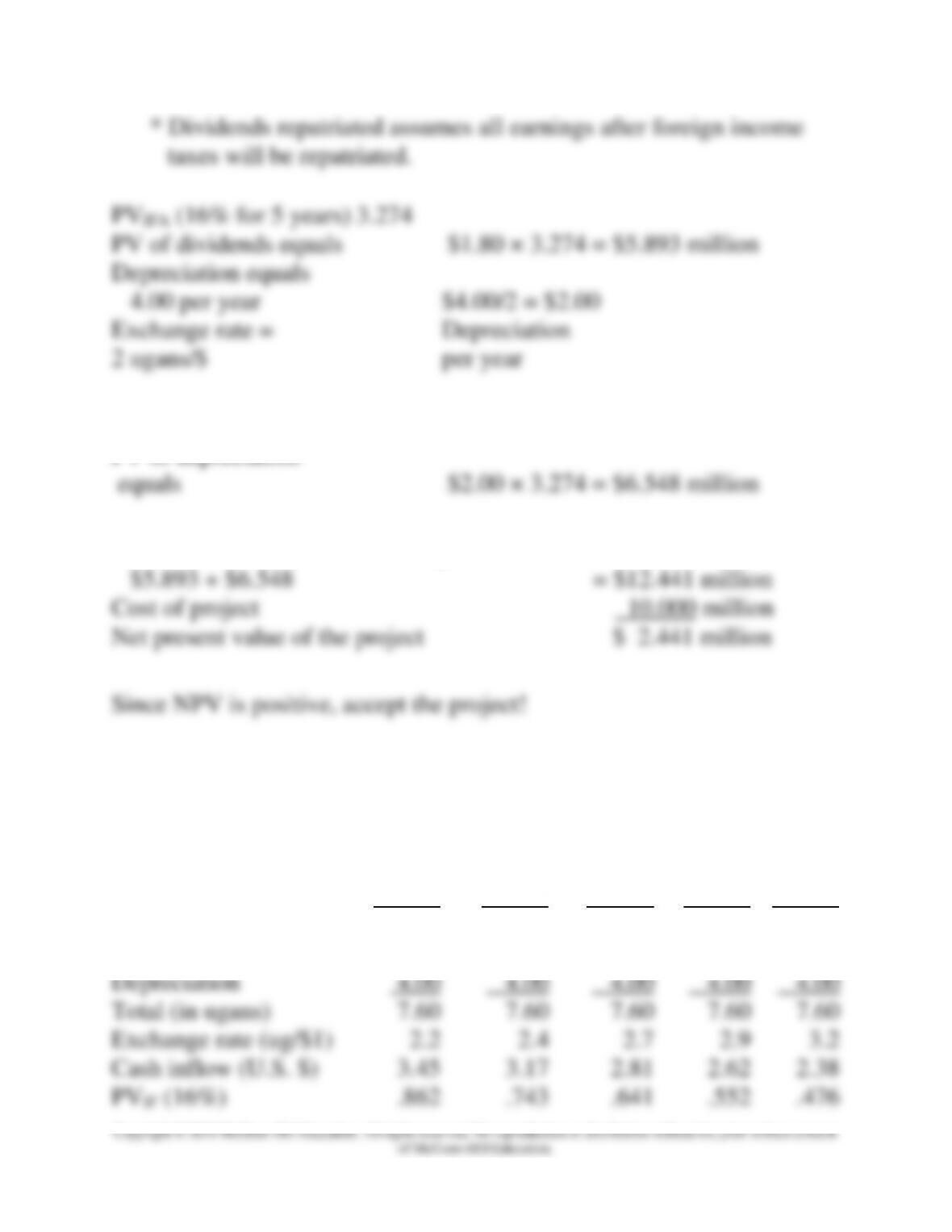
b. The change in foreign exchange values must be applied to both
aftertax dividends received (in ugans) and depreciation (in ugans).
(in millions)
Year 1
Year 2
Year 3
Year 4
Year 5
Aftertax dividend
received
3.60
3.60
3.60
3.60
3.60
Depreciation
4.00
4.00
4.00
4.00
4.00
Total (in ugans)
7.60
7.60
7.60
7.60
7.60
Exchange rate (ug/$1)
2.2
2.4
2.7
2.9
3.2
Cash inflow (U.S. $)
3.45
3.17
2.81
2.62
2.38
PVIF (16%)
.862
.743
.641
.552
.476