
Inca, Inc.
Case 21
Capital Budgeting with Risk
Purpose: The student goes through the statistical procedure of determining risk for investments. Though
one investment alternative provides the higher net present value, is also has a much higher coefficient of
variation and the student must take this into consideration in describing his or her results. The case is
then expanded into six alternatives for which the student is asked to select the lowest risk option.
Relation to Text: This case should follow Chapter 13.
Complexity: This case is straightforward and should require 30-45 minutes to solve.
Solutions
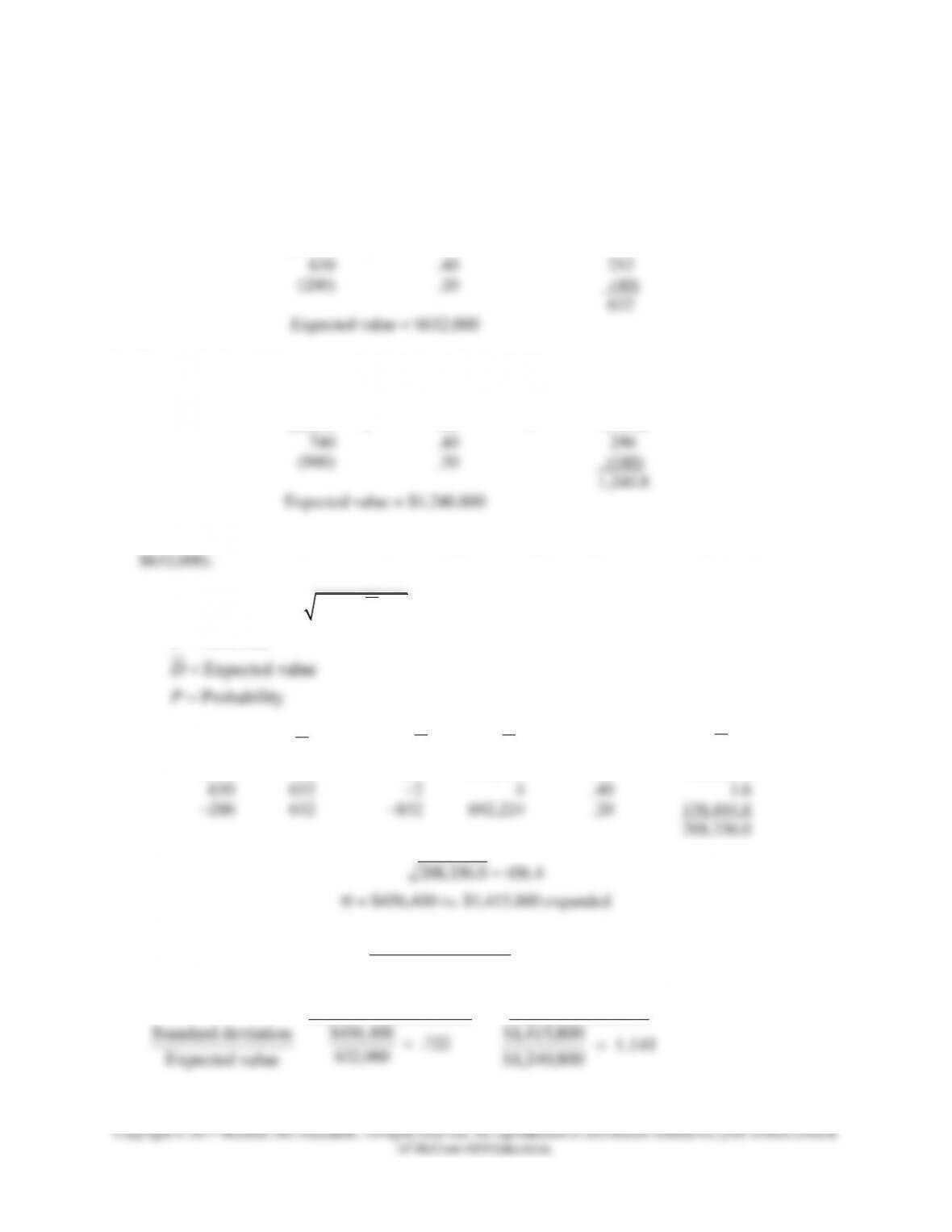
1. Expected value of the net present value (standard)
Outcome
Probability
Expected Value
$1,050
x
.40
=
420
630
.40
252
(200)
.20
(40)
632
Expected value = $632,000
2. Expected value of the net present value (expanded)
Outcome
Probability
Expected Value
$2,812
x
.40
=
1,124.8
740
.40
296
(900)
.20
(180)
1,240.8
Expected value = $1,240,800
3. The expanded size restaurant alternative clearly has the higher net present value. ($1,240,800 vs.
2
4. Standard deviation ( )
Outcome
Expected value
Probability
D D P
D
D
P
= −
=
=
=
D
–
D
=
()DD−
2
()DD−
x
P
=
2
()D D P−
1,050
632
418
174,724
.40
69,889.6
630
632
–2
4
.40
1.6
–200
632
–832
692,224
.20
138,444.8
208,336.0
4.4560.336,208 =
= $456,400 vs. $1,415,800 expanded
Standard deviation
5. Coefficient of variation ( ) Expected value
V=
Standard size restaurant
Expanded restaurant
Standard deviation
Expected value
722.
000,632
400,456$ =
141.1
800,240,1$
800,415,1$ =
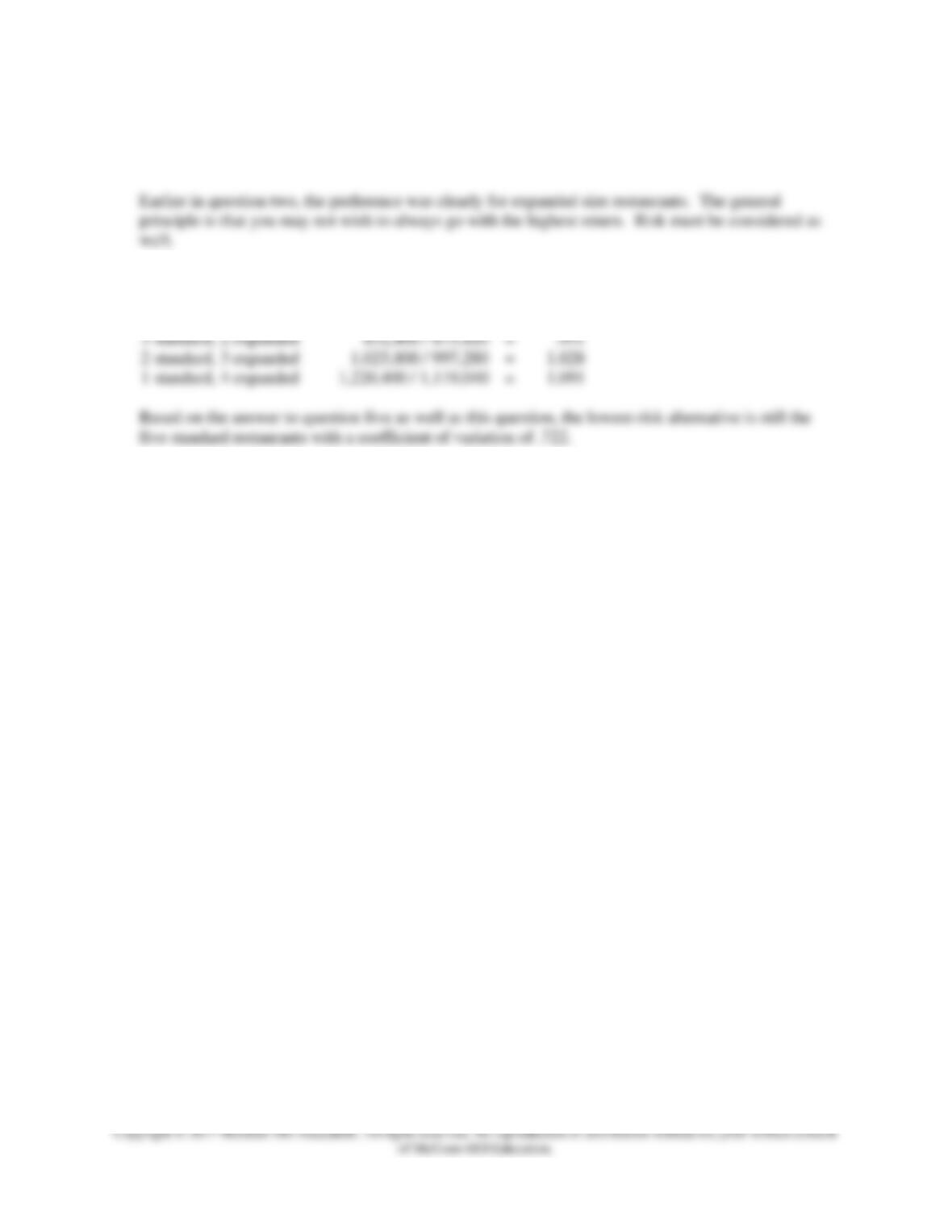
6. Based on the coefficient of variation, the standard size restaurant is much less risky (.722 versus
1.141).
7. Coefficient of variation
4 standard, 1 expanded
$ 641,630 / 753,760
=
.851
3 standard, 2 expanded
832,460 / 875,420
=
.951
2 standard, 3 expanded
1,025,800 / 997,280
=
1.028
1 standard, 4 expanded
1,220,400 / 1,119,040
=
1.091
Based on the answer to question five as well as this question, the lowest-risk alternative is still the
five standard restaurants with a coefficient of variation of .722.