Chapter 20 – Options Markets: Introduction
20-1
CHAPTER 20: OPTIONS MARKETS: INTRODUCTION
PROBLEM SETS
1. Options provide numerous opportunities to modify the risk profile of a portfolio.
The simplest example of an option strategy that increases risk is investing in an ‘all
options’ portfolio of at the money options (as illustrated in the text). The leverage
2. Buying a put option on an existing portfolio provides portfolio insurance, which is
protection against a decline in the value of the portfolio. In the event of a decline in
3. An investor who writes a call on an existing portfolio takes a covered call position.
If, at expiration, the value of the portfolio exceeds the exercise price of the call, the
4. An option is out of the money when exercise of the option would be unprofitable. A
call option is out of the money when the market price of the underlying stock is less
than the exercise price of the option. If the stock price is substantially less than the
Chapter 20 – Options Markets: Introduction
A call is in the money when the market price of the stock is greater than the
5.
Cost
Payoff
Profit
a.
b.
Put option, X = $190.00
3.00
0.00
-3.00
c.
Call option, X = $195.00
3.65
0.00
-3.65
d.
Put option, X = $195.00
5.00
0.00
-5.00
e.
Call option, X = $200.00
1.61
0.00
-1.61
Put option, X = $200.00
8.09
5.00
-3.09
Call option, X = $190.00
$6.75
$5.00
-$1.75
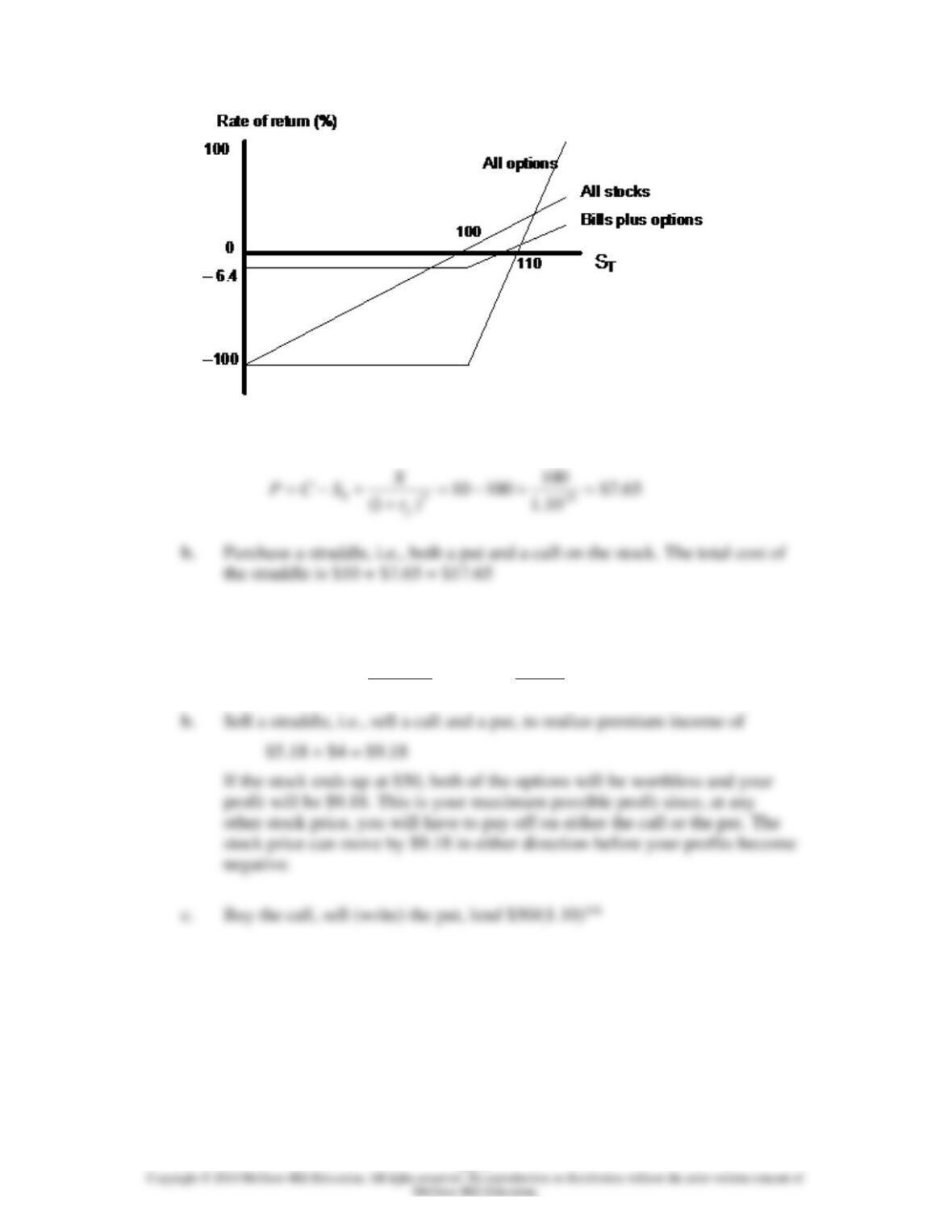
6. In terms of dollar returns, based on a $10,000 investment:
Price of Stock 6 Months from Now
Stock Price
$ 80
$ 100
$ 110
$ 120
All stocks (100 shares)
10,000
11,000
12,000
Bills + 100 options
10,360
11,360
Price of Stock 6 Months from Now
Stock Price
$80
$100
All stocks (100 shares)
All options (1,000 options)
Bills + 100 options
Chapter 20 – Options Markets: Introduction
20-3
7. a. From put-call parity:
8. a. From put-call parity:
0.25
50
4 50 $5.18
(1 ) 1.10
T
f
X
C P S r
= + − = + − =
+
Chapter 20 – Options Markets: Introduction
20-4
The payoff is as follows:
Position
Immediate CF
CF in 3 months
S T ≤ X
S T > X
0
9. a. i. A long straddle produces gains if prices move up or down and limited losses
if prices do not move. A short straddle produces significant losses if prices move
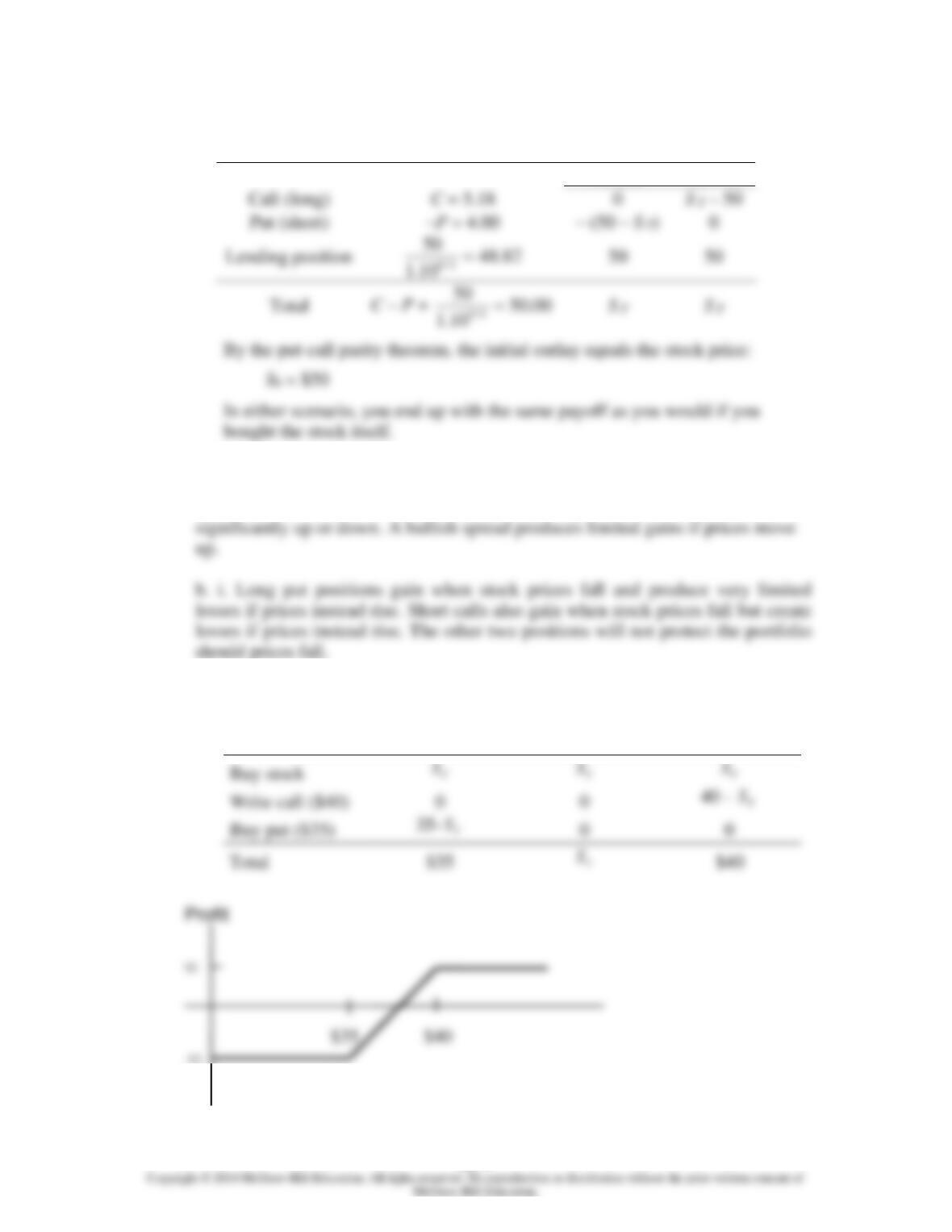
10. Note that the price of the put equals the revenue from writing the call, net initial
cash outlays = $38.00
Position
T
S
< 35
35
T
S
T
S
T
S
T
S
T
S
Buy put ($35)
T
S
T
S
40
40 <
T
S
Chapter 20 – Options Markets: Introduction
20-5
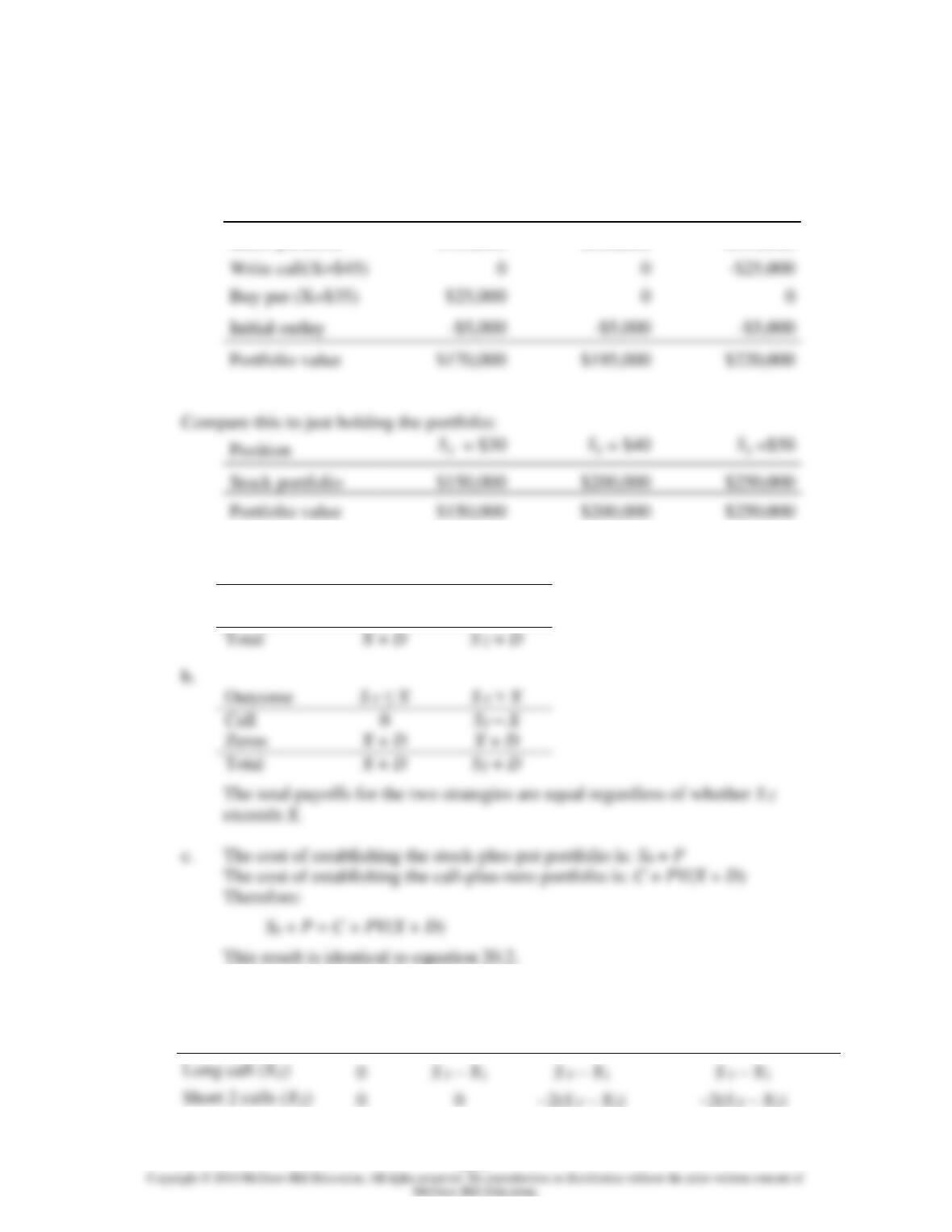
11. Answers may vary. For $5,000 initial outlay, buy 5,000 puts, write 5,000 calls:
Position
T
S
= $30
T
S
Write call(X=$45)
Buy put (X=$35)
Initial outlay
Portfolio value
$170,000
$195,000
$220,000
Position
T
S
= $30
T
S
= $40
X2X2XX2
T
S
=$50
Stock portfolio
$150,000
$200,000
$250,000
Portfolio value
$150,000
$200,000
$250,000
= $40
X2X2XX2
T
S
=$50
Stock portfolio
$150,000
$200,000
$250,000
12. a.
Outcome
S T ≤ X
S T > X
Stock
S T + D
S T + D
Put
X – S T
0
Total
S T + D
Outcome
S T ≤ X
S T > X
Call
0
Zeros
Total
ST + D
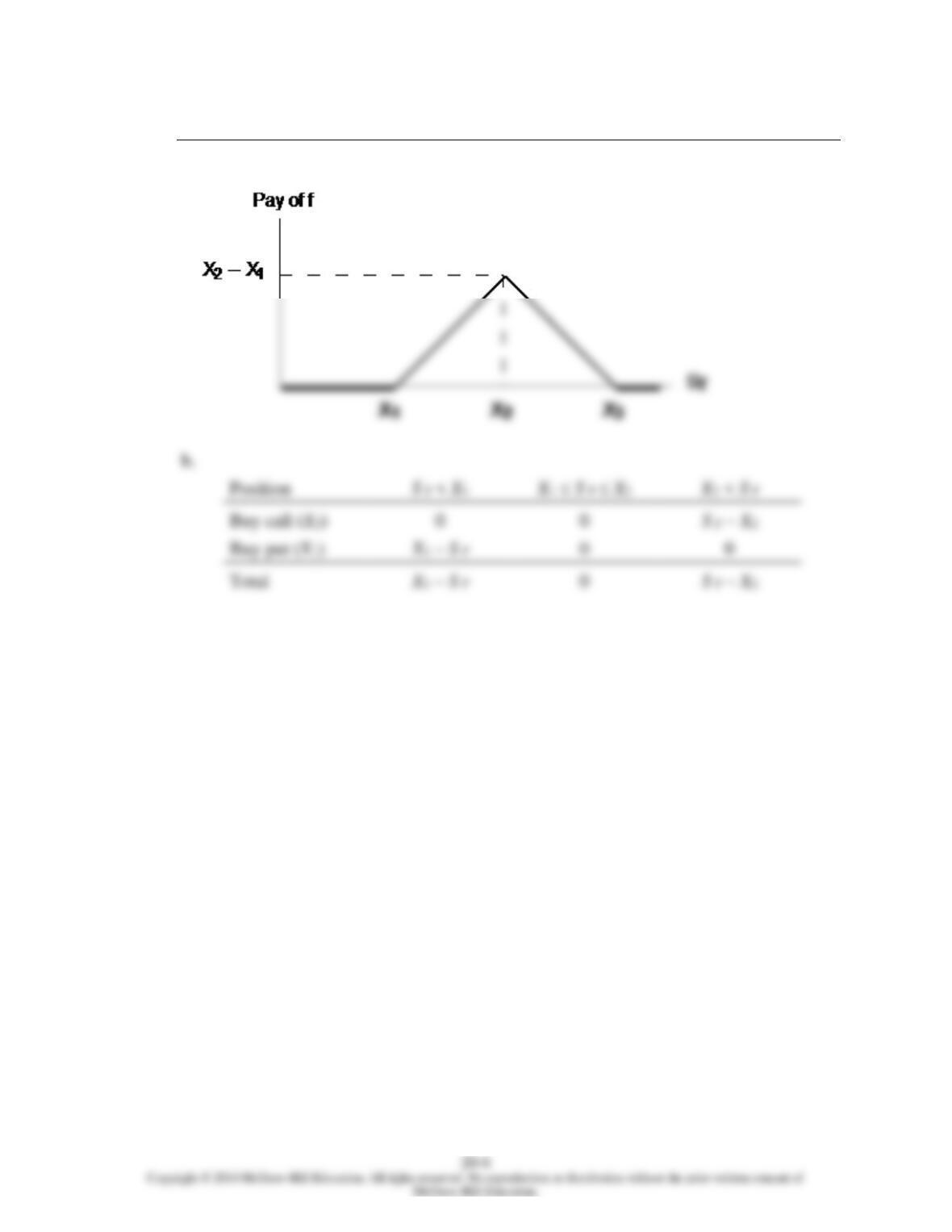
13. a.
Position
S T < X1
X1 S T X2
X2 < S T X3
X3 < S T
Chapter 20 – Options Markets: Introduction
Long call (X3)
0
0
0
S T – X3
Total
0
S T – X1
2X2 – X1 – S T
(X2 –X1) – (X3 –X2) = 0
Buy call (X2)
Total
Chapter 20 – Options Markets: Introduction
20-7
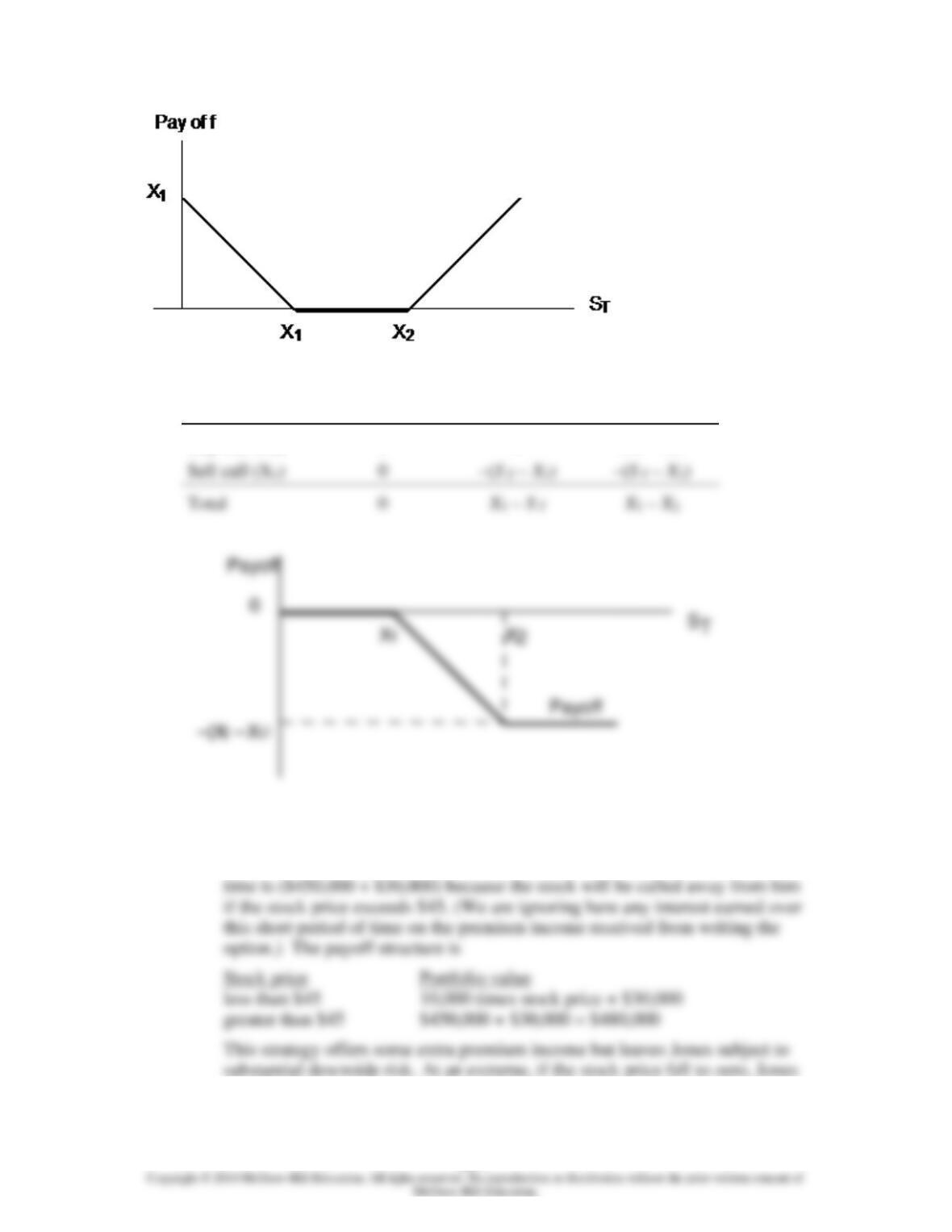
14.
Position
S T < X1
X1 S T X2
XX2
X2 < S T
Buy call (X2)
0
0
S T – X2
Total
0
X1 – S T
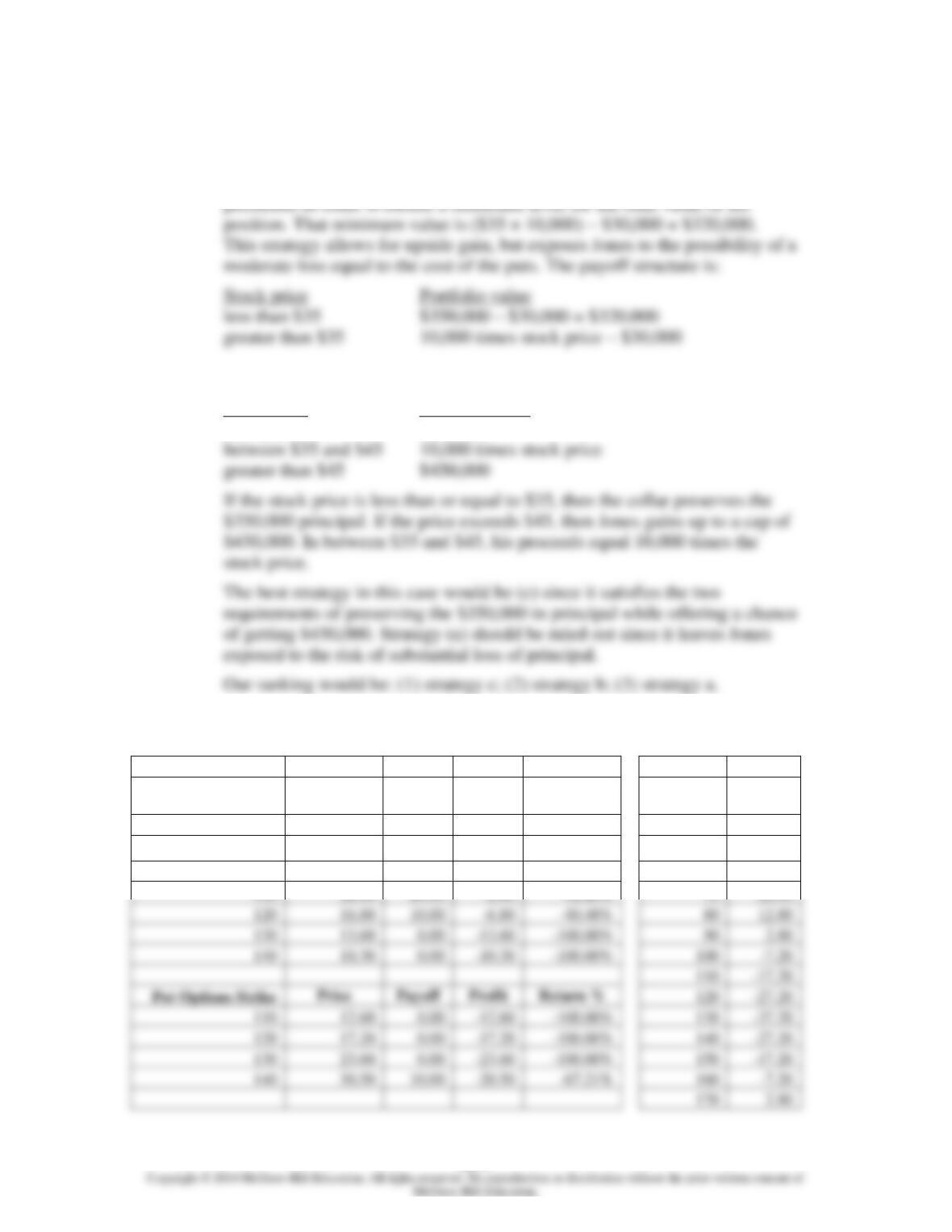
15. a. By writing covered call options, Jones receives premium income of $30,000.
If, in January, the price of the stock is less than or equal to $45, then Jones
will have his stock plus the premium income. But the most he can have at that
Chapter 20 – Options Markets: Introduction
20-8
would be left with only $30,000. This strategy also puts a cap on the final
value at $480,000, but this is more than sufficient to purchase the house.
b. By buying put options with a $35 strike price, Jones will be paying $30,000 in
c. The net cost of the collar is zero. The value of the portfolio will be as follows:
Stock price Portfolio value
less than $35 $350,000
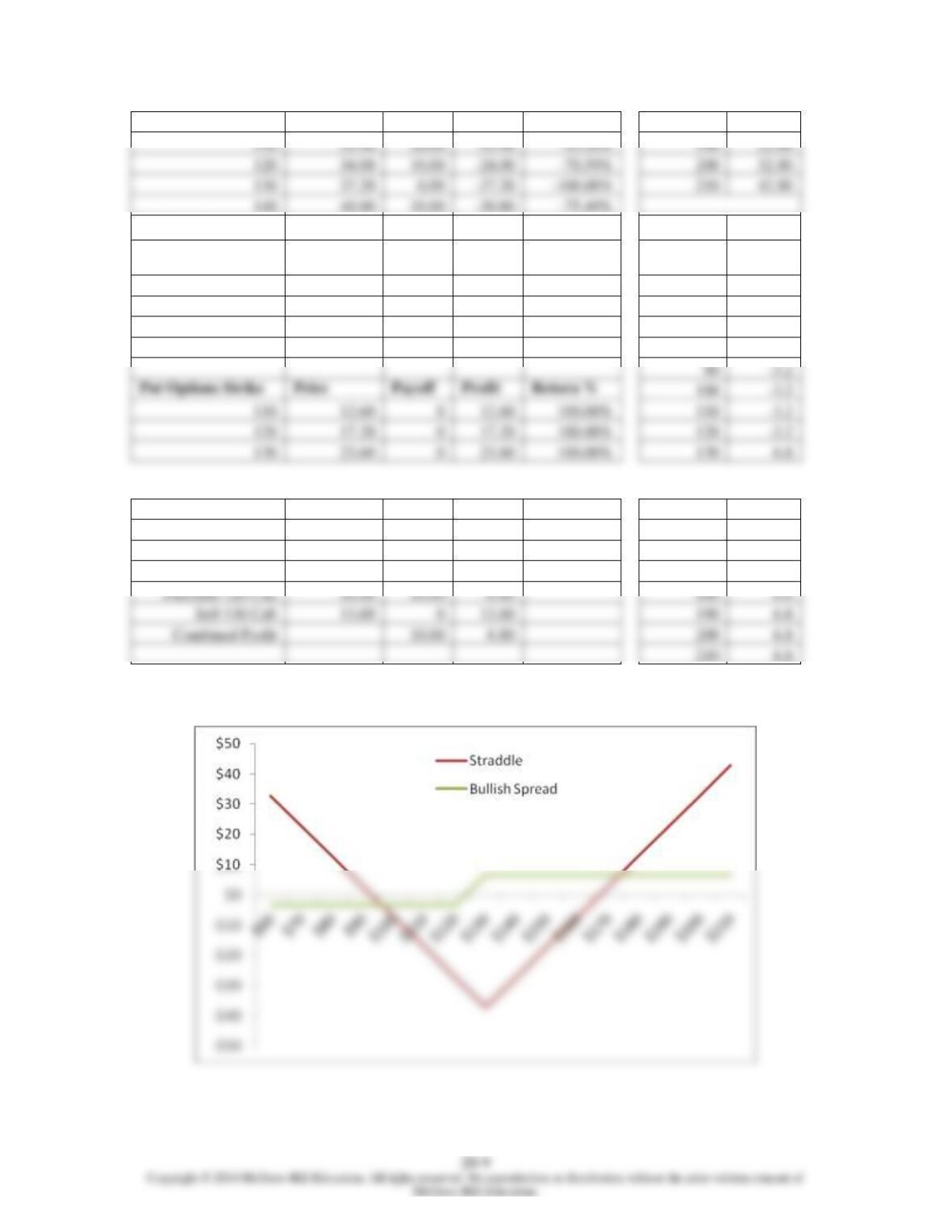
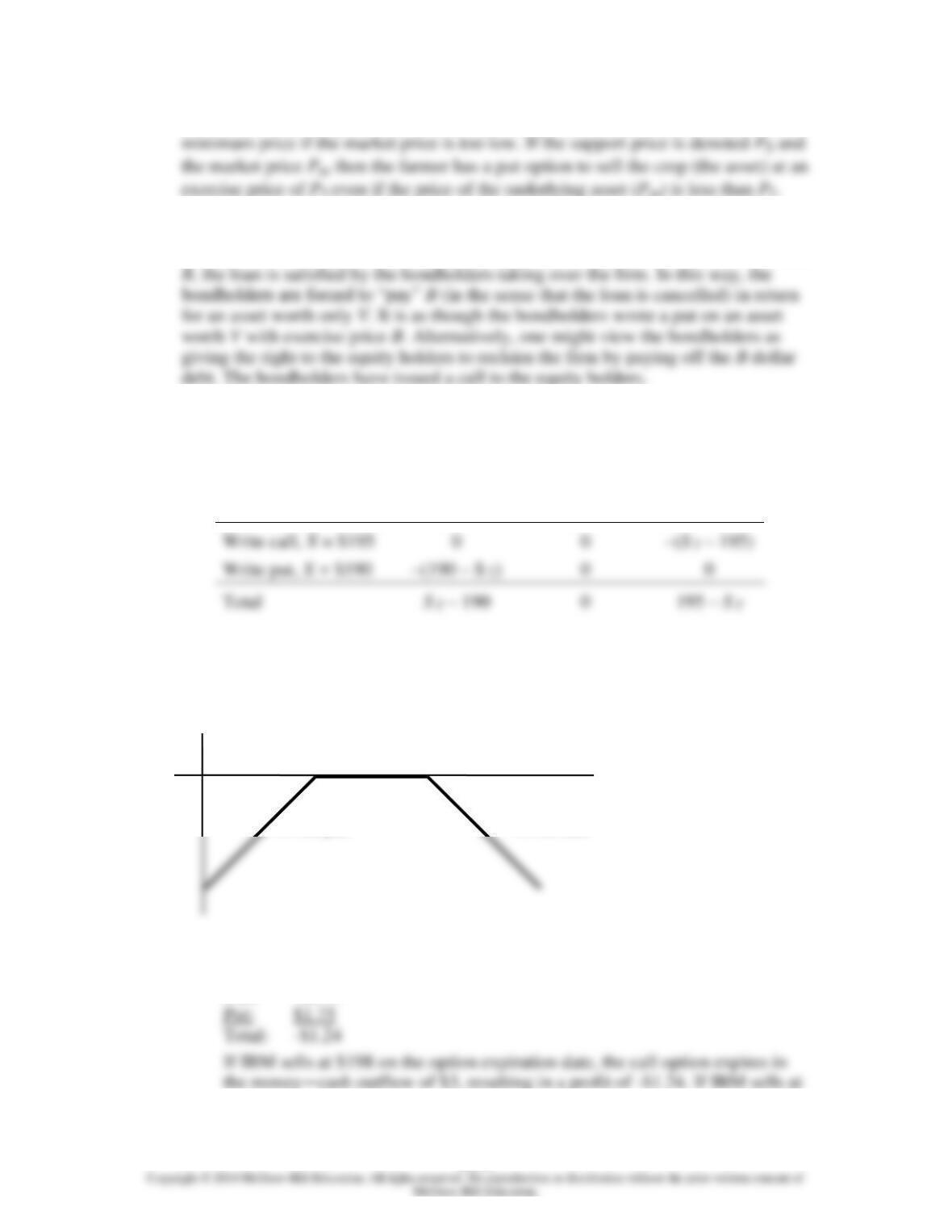
16. Using Excel, with Profit Diagram on next page.
Stock Prices
Beginning Market
Price
116.5
Price
Profit
Ending Market Price
130
Ending
Straddle
Buying Options:
50
42.80
Call Options Strike
Price
Payoff
Profit
Return %
60
32.80
110
22.80
20.00
-2.80
-12.28%
70
22.80
120
16.80
10.00
-6.80
-40.48%
80
12.80
130
13.60
90
110
12.60
120
17.20
130
23.60
140
30.50
10.00
-67.21%
Chapter 20 – Options Markets: Introduction
Straddle
Price
Payoff
Profit
Return %
180
12.80
110
35.40
20.00
190
120
34.00
10.00
200
130
37.20
0.00
210
140
40.80
10.00
Selling Options:
Ending
Bullish
Call Options Strike
Price
Payoff
Profit
Return %
Stock
Price
Spread
110
22.80
–20
2.80
12.28%
50
-3.2
120
16.80
–10
6.80
40.48%
60
-3.2
130
13.60
0
13.60
100.00%
70
-3.2
140
10.30
0
10.30
100.00%
80
-3.2
90
-3.2
Put Options Strike
Price
Payoff
Profit
Return %
100
-3.2
110
12.60
0
12.60
100.00%
110
-3.2
120
17.20
0
17.20
100.00%
120
-3.2
130
23.60
0
23.60
100.00%
130
6.8
140
30.50
10
40.50
132.79%
140
6.8
150
6.8
Money Spread
Price
Payoff
Profit
160
6.8
Bullish Spread
170
6.8
16.80
10.00
180
6.8
13.60
190
6.8
Combined Profit
10.00
6.80
200
6.8
210
6.8
Profit diagram for problem 16:
Chapter 20 – Options Markets: Introduction
20–10
17. The farmer has the option to sell the crop to the government for a guaranteed
18. The bondholders have, in effect, made a loan that requires repayment of B dollars,
where B is the face value of bonds. If, however, the value of the firm (V) is less than
19. The manager receives a bonus if the stock price exceeds a certain value and
receives nothing otherwise. This is the same as the payoff to a call option.
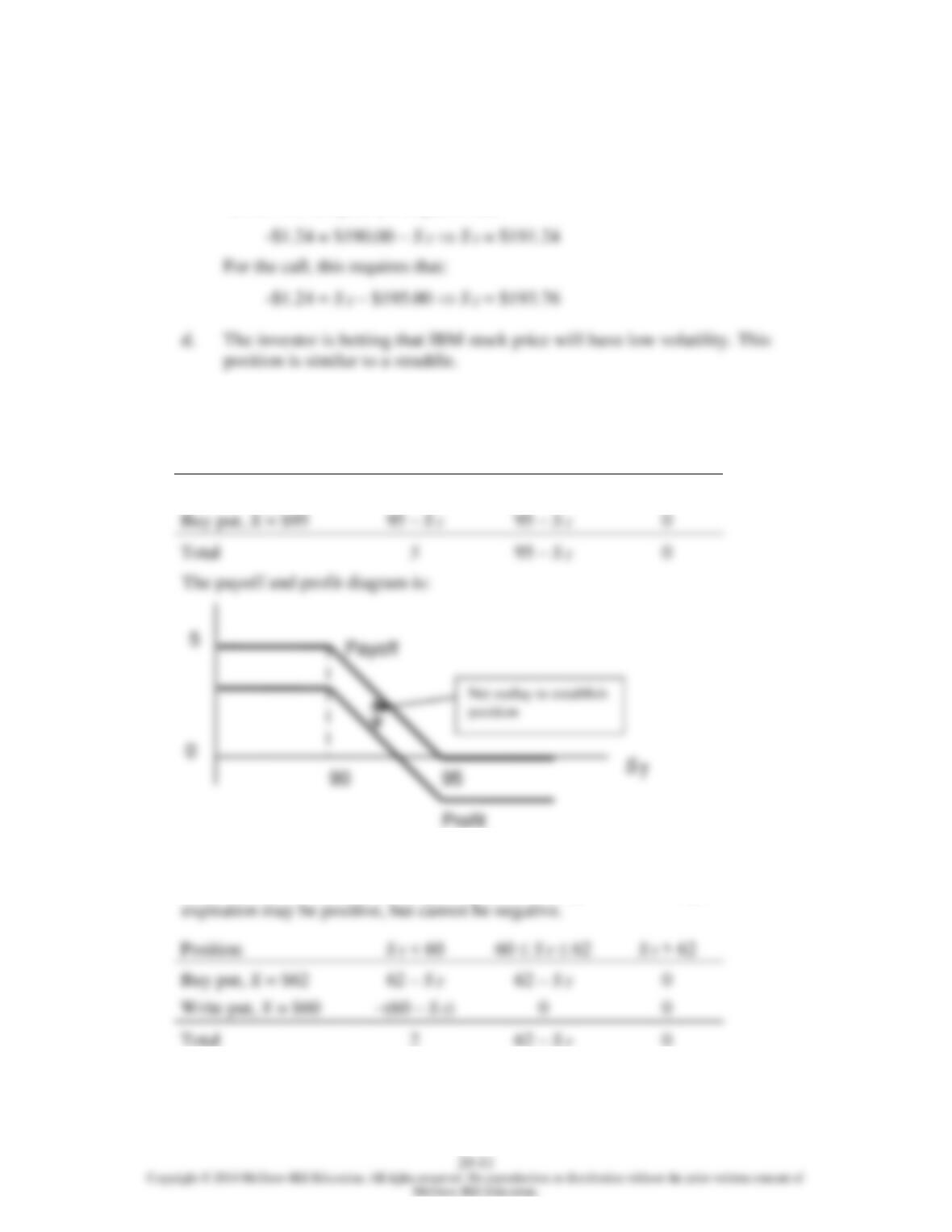
20. a.
Position
S T < 190
190 S T 195
S T > 195
S
T
190
195
Payoff
Write call
Write put
b. Proceeds from writing options:
Call: -$2.99
Chapter 20 – Options Markets: Introduction
$208 on the option expiration date, the call written results in a cash outflow of
$10 at expiration and an overall profit of: -$1.24 – $10.00 = -$11.24
c. You break even when either the put or the call results in a cash outflow of
-$1.24. For the put, this requires that:
21. The put with the higher exercise price must cost more. Therefore, the net outlay to
establish the portfolio is positive.
Position
S T < 90
90 S T 95
S T > 95
Write put, X = $90
–(90 – S T)
0
0
Total
0
Buy put, X = $62
0
Total
0
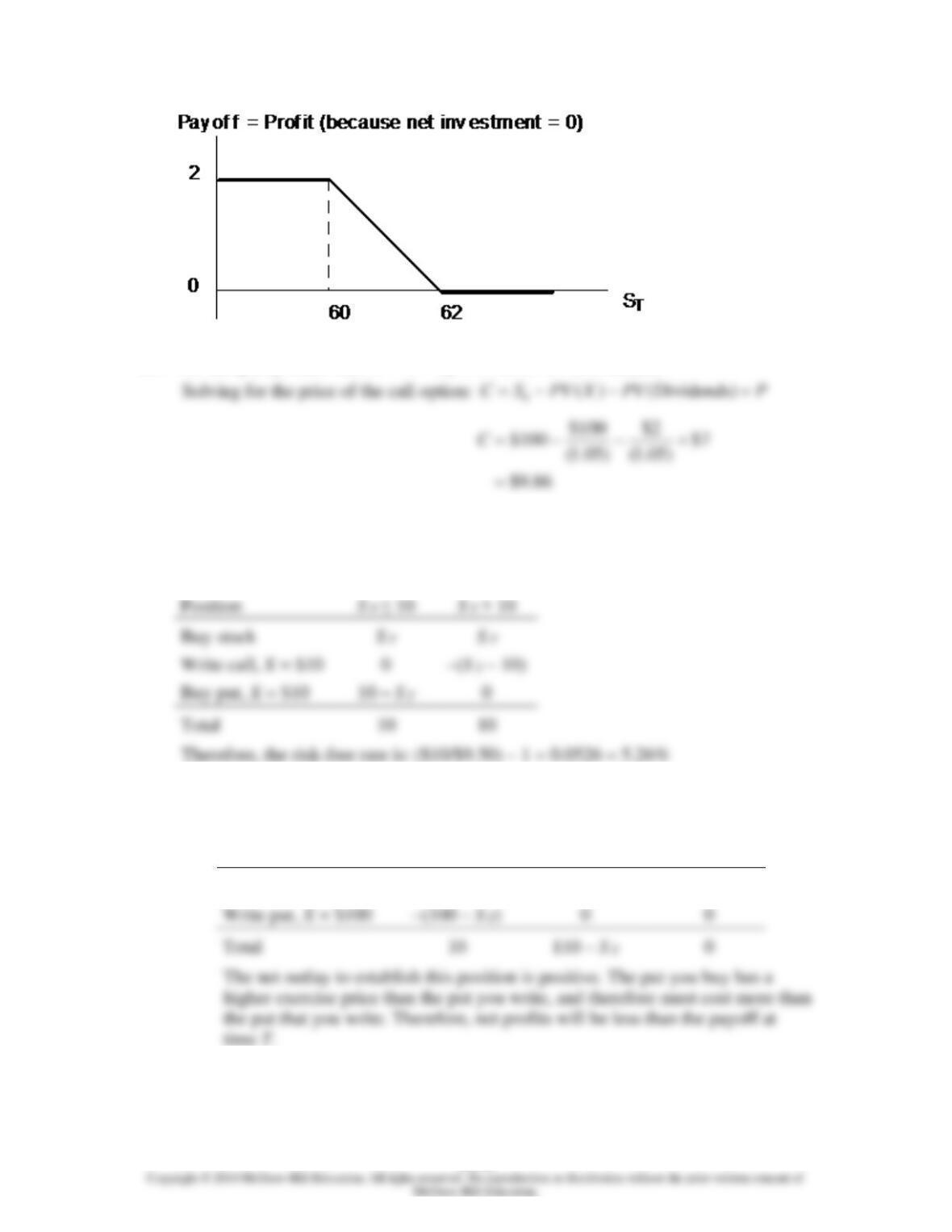
22. Buy the X = 62 put (which should cost more but does not) and write the X = 60 put.
Since the options have the same price, your net outlay is zero. Your proceeds at
Chapter 20 – Options Markets: Introduction
20–12
23. Put-call parity states that:
0( ) (Dividends)P C S PV X PV= − + +
24. The following payoff table shows that the portfolio is riskless with time-T value
equal to $10:
Position
Buy stock
Write call, X = $10
Total
25. a., b.
Position
S T < 100
100 S T 110
S T > 110
Buy put, X = $110
110 – S T
110 – S T
0
Total
10
110 – S T
0
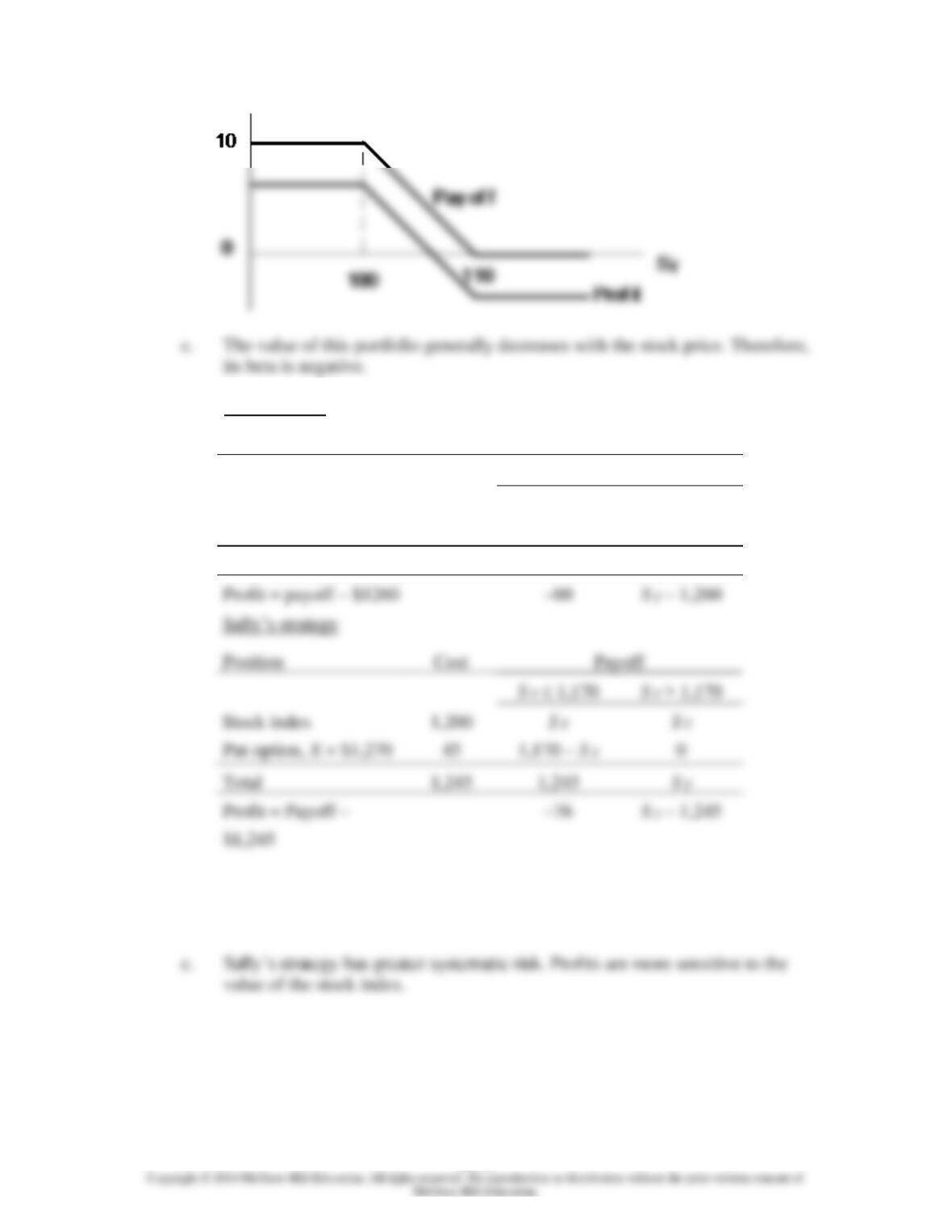
Chapter 20 – Options Markets: Introduction
20–13
26. a. Joe’s strategy
Position
Cost
Payoff
S T 1,200
S T > 1,200
Stock index
1,200
S T
S T
Put option, X = $1200
60
1,200 – S T
0
Total
-1,260
1,200
S T
Profit = payoff – $1260
Position
Cost
Payoff
S T 1,170
S T > 1,170
Stock index
S T
S T
Put option, X = $1,270
45
1,170 – S T
0
Total
1,245
S T
$1,245
b. Sally does better when the stock price is high, but worse when the stock price
is low.
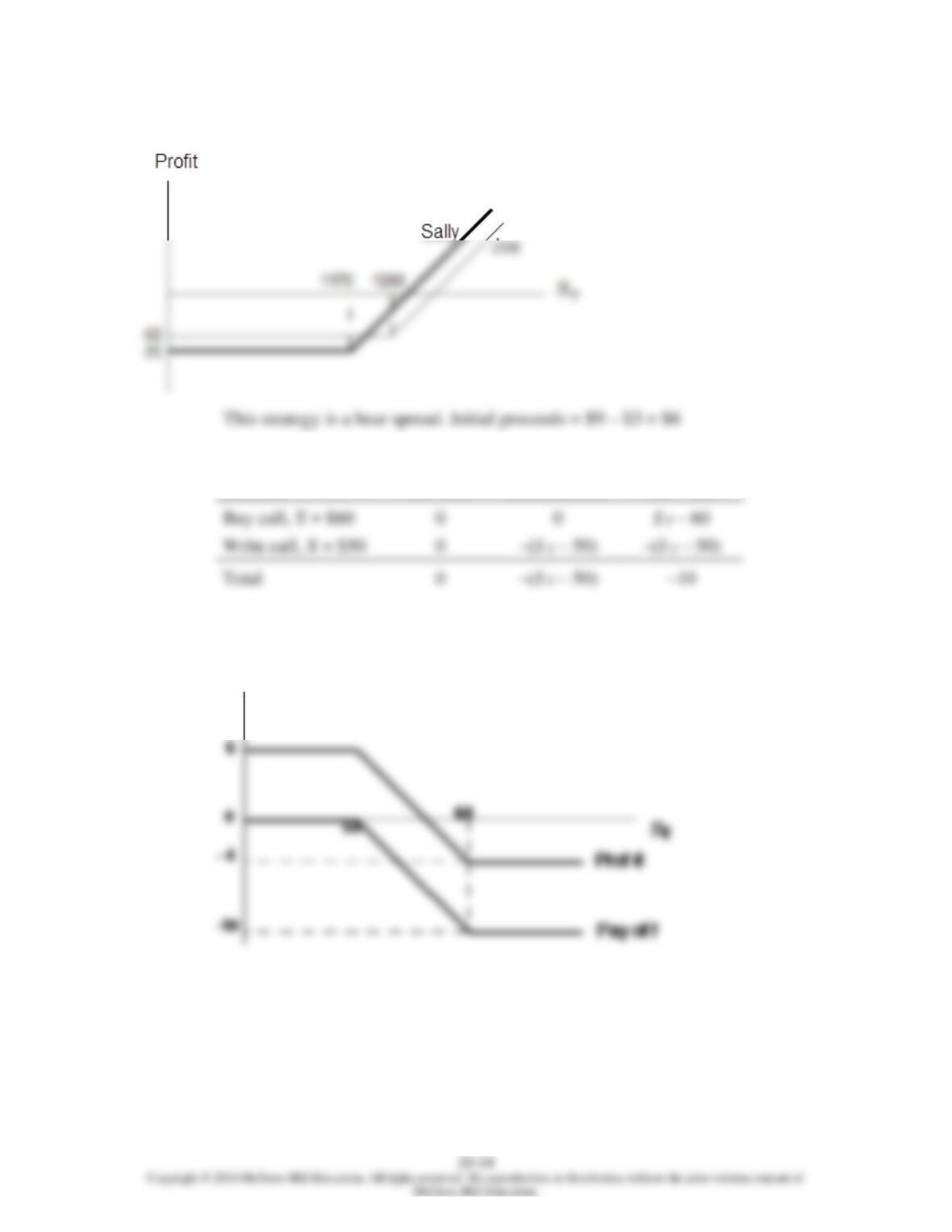
Chapter 20 – Options Markets: Introduction
27. a., b. (See graph)
The payoff is either negative or zero:
Position
S T < 50
50 S T 60
S T > 60
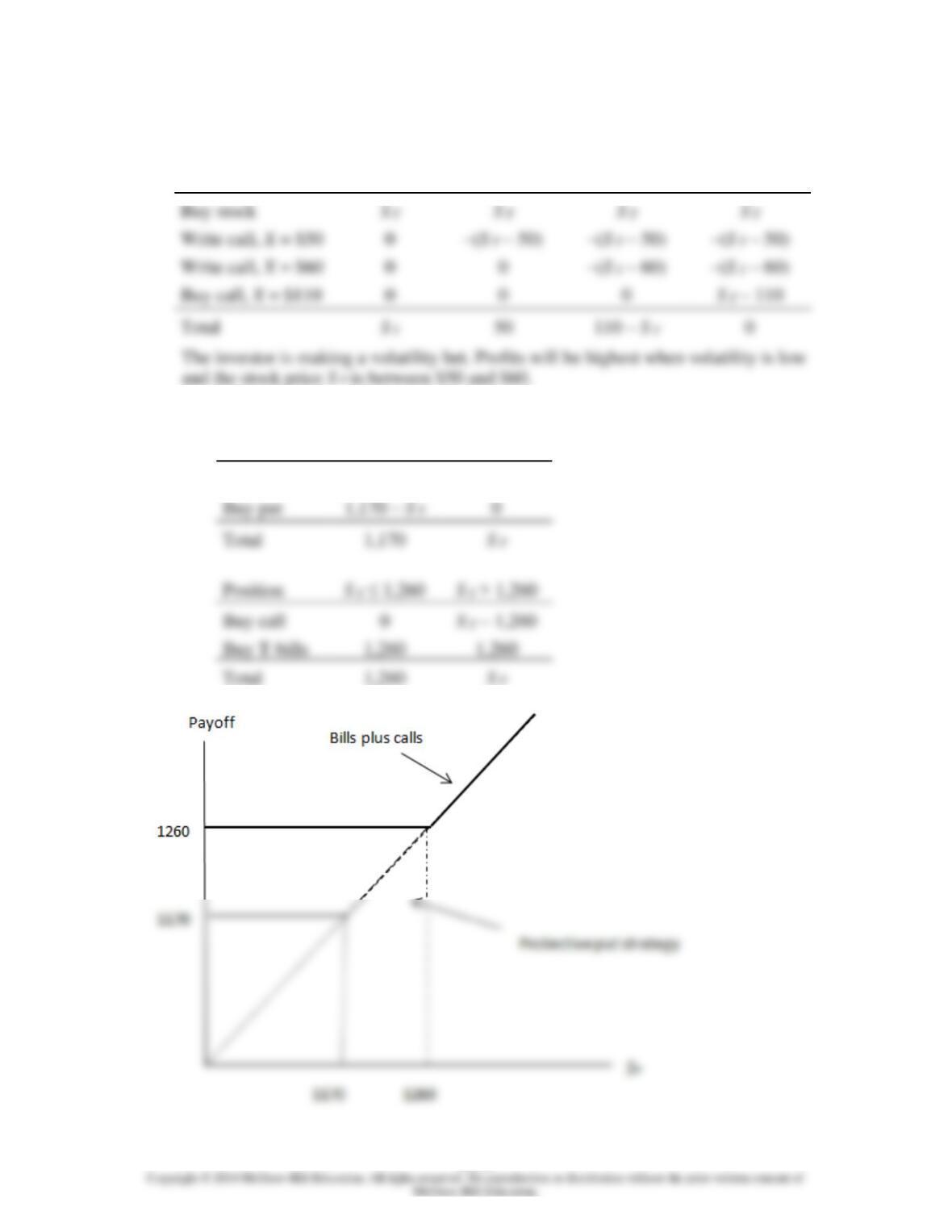
c. Breakeven occurs when the payoff offsets the initial proceeds of $6, which
occurs at stock price S T = $56. The investor must be bearish: the position does
worse when the stock price increases.
Chapter 20 – Options Markets: Introduction
20–15
28. Buy a share of stock, write a call with X = $50, write a call with X = $60, and buy a
call with X = $110.
Position
S T < 50
50 S T 60
60 < S T 110
S T > 110
Buy stock
Write call, X = $50
Write call, X = $60
Buy call, X = $110
S T – 110
Total
29. a.
Position
S T ≤ 1,179
S T > 1,170
Buy stock
S T
S T
Total
S T
Position
S T ≤ 1,260
S T > 1,260
Buy call
Buy T-bills
Total
S T
Chapter 20 – Options Markets: Introduction
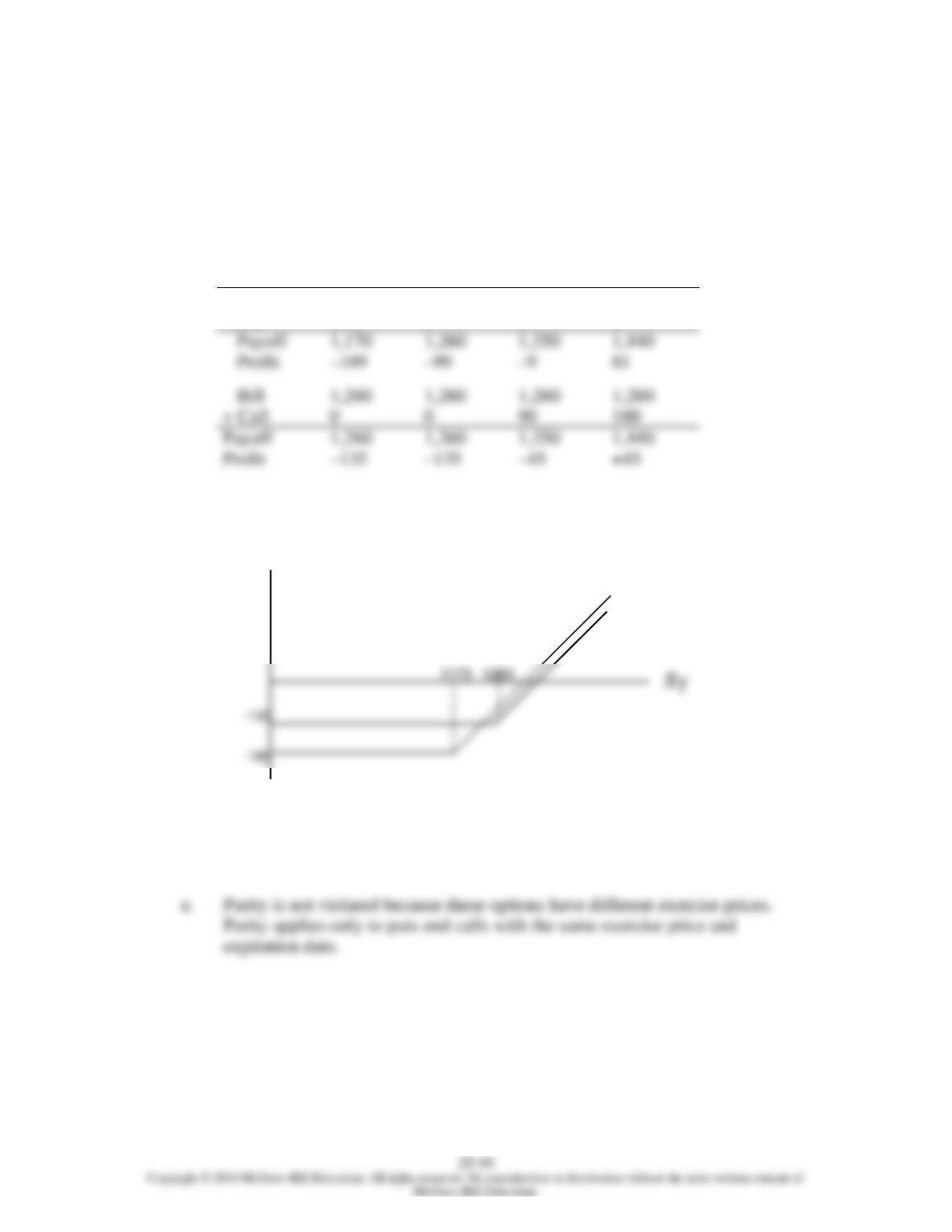
b. The bills plus call strategy has a greater payoff for some values of S T and
never a lower payoff. Since its payoffs are always at least as attractive and
sometimes greater, it must be more costly to purchase.
c. The initial cost of the stock plus put position is $1,350 + $9 = $1,359
The initial cost of the bills plus call position is: $1,215 + $180 = $1,395
S T = 1,000
S T = 1,260
S T = 1,350
S T = 1,440
Stock
1,000
1,260
1,350
1,440
+ Put
170
0
0
0
Payoff
1,170
1,260
1,350
1,440
Bill
1,260
1,260
1,260
1,260
+ Call
0
0
90
180
Payoff
1,260
1,260
1,350
1,440
Profit
+45
Profit
Bills plus calls
Protective put
d. The stock and put strategy is riskier. This strategy performs worse when the
market is down and better when the market is up. Therefore, its beta is higher.
Chapter 20 – Options Markets: Introduction
20–17
30. According to put-call parity (assuming no dividends), the present value of a
payment of $105 can be calculated using the options with January expiration and
31. From put-call parity:
C – P = S0 – X/(l + rf )T
CFA PROBLEMS
1. a. Donie should choose the long strangle strategy. A long strangle option
strategy consists of buying a put and a call with the same expiration date and
the same underlying asset, but different exercise prices. In a strangle strategy,
the call has an exercise price above the stock price and the put has an exercise
b. i. The maximum possible loss per share is $9, which is the total cost of the
two options ($5 + $4).
Chapter 20 – Options Markets: Introduction
2. i. Equity index-linked note: Unlike traditional debt securities that pay a
scheduled rate of coupon interest on a periodic basis and the par amount of
principal at maturity, the equity index-linked note typically pays little or no
coupon interest; at maturity, however, a unit holder receives the original issue
3. i. Conversion value of a convertible bond is the value of the security if it is
converted immediately. That is:
Conversion value = Market price of the common stock × Conversion ratio
4. a. i. The current market conversion price is computed as follows:
Market conversion price = Market price of the convertible bond/Conversion ratio
= $980/25
b. The two components of a convertible bond’s value are
Chapter 20 – Options Markets: Introduction
1. The straight bond value, which is the convertible bond’s value as a bond.
2. The option value, which is the value from a potential conversion to
equity.
(i.) In response to the increase in Ytel’s common equity price, the straight
bond value should stay the same and the option value should increase.
The increase in equity price does not affect the straight bond value component
of the Ytel convertible. The increase in equity price increases the option value
component significantly, because the call option becomes deep “in the
money” when the $51 per share equity price is compared to the convertible’s