
Global Resources
Case 20
Risk-Adjusted Discount Rates
Purpose: The case covers the process of adjusting the discount rate to account for the risk in a project.
It clearly demonstrates that the risk-adjusted discount rate approach can affect (and change) the ranking
of investments. It further brings an international dimension into the decision making process and
encourages the student to address the issue of whether international investments increase risk because
of uncertainty or decrease risk because of diversification. The concept of mutually exclusive
investments is also incorporated in the case.
Relation to Text: The case should follow Chapter 13.
Complexity: The case is moderately complex and should require one hour.
Solutions
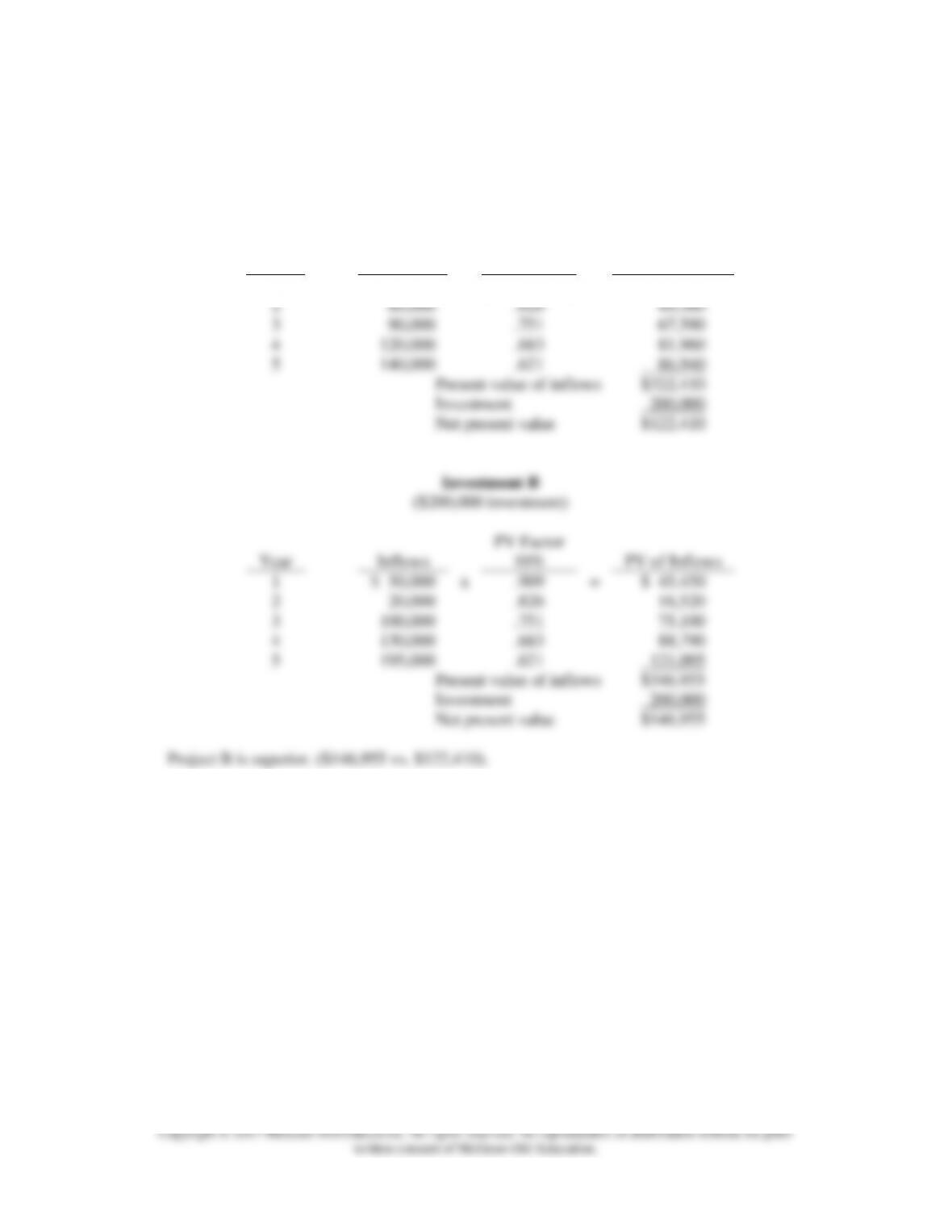
1.
Investment A
($200,000 investment)
PV Factor
Year
Inflows
10%
PV of Inflows
1
$ 40,000
x
.909
=
$ 36,360
2
60,000
.826
49,560
3
90,000
.751
67,590
4
120,000
.683
81,960
5
140,000
.621
86,940
Present value of inflows
$322,410
Investment
–200,000
Net present value
$122,410
Investment B
($200,000 investment)
PV Factor
Year
Inflows
10%
PV of Inflows
1
$ 50,000
x
.909
=
$ 45,450
2
20,000
.826
16,520
3
100,000
.751
75,100
4
130,000
.683
88,790
5
195,000
.621
121,095
Present value of inflows
$346,955
Investment
–200,000
Net present value
$146,955
2.
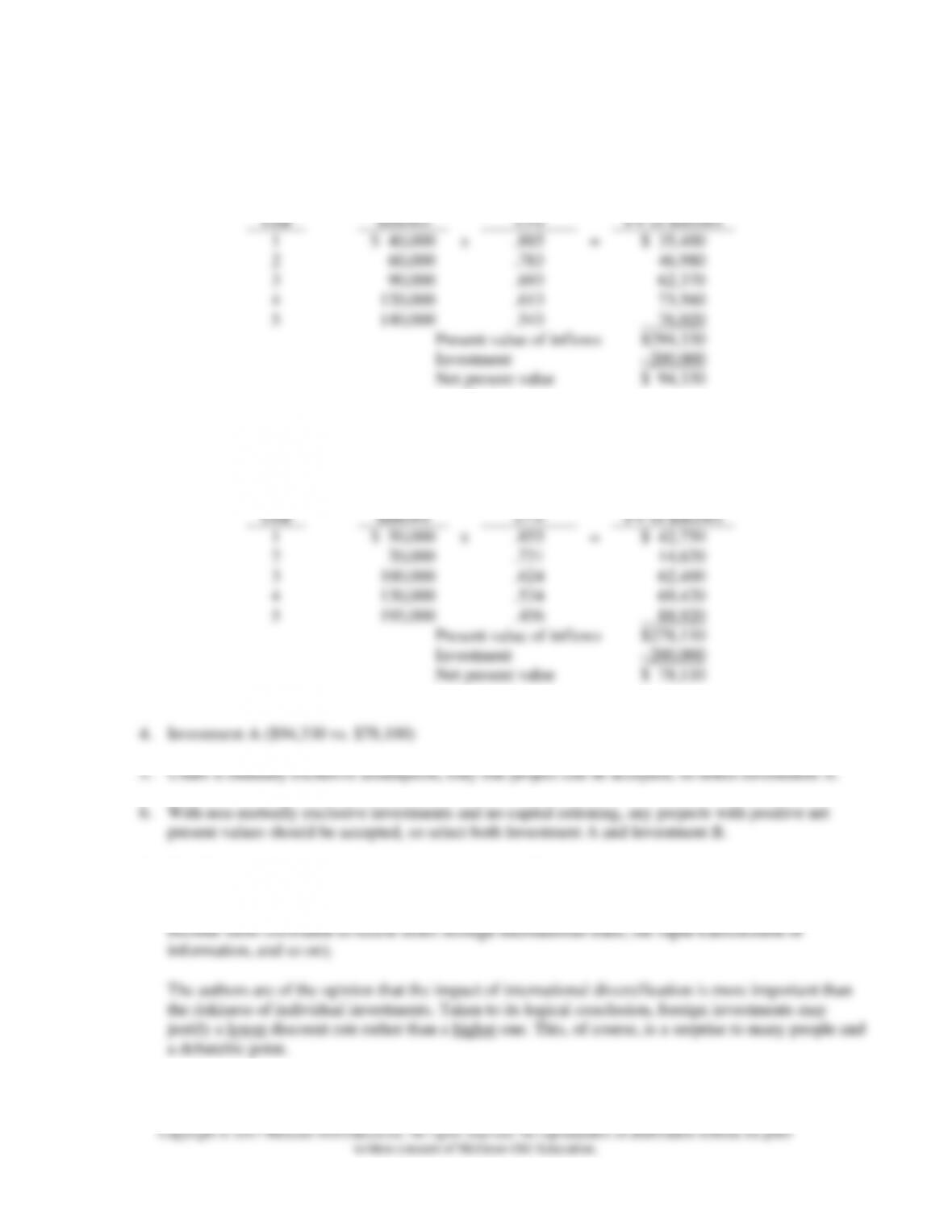
Investment A
($200,000 investment)
PV Factor
Year
Inflows
13%
PV of Inflows
1
$ 40,000
x
.885
=
$ 35,400
2
60,000
.783
46,980
3
90,000
.693
62,370
4
120,000
.613
73,560
5
140,000
.543
76,020
Present value of inflows
$294,330
Investment
–200,000
Net present value
$ 94,330
3.
Investment B
($200,000 investment)
PV Factor
Year
Inflows
17%
PV of Inflows
1
$ 50,000
x
.855
=
$ 42,750
2
20,000
.731
14,620
3
100,000
.624
62,400
4
130,000
.534
69,420
5
195,000
.456
88,920
Present value of inflows
$278,110
Investment
–200,000
Net present value
$ 78,110
7. Tai Ming introduces a classic debate in international financial management. Although international
investments are generally riskier than domestic investments, they do provide important international
diversification because different global economies are not perfectly correlated (though they have