Chapter 2 – Asset Classes and Financial Instruments
2-
1
CHAPTER 2: ASSET CLASSES AND FINANCIAL
INSTRUMENTS
PROBLEM SETS
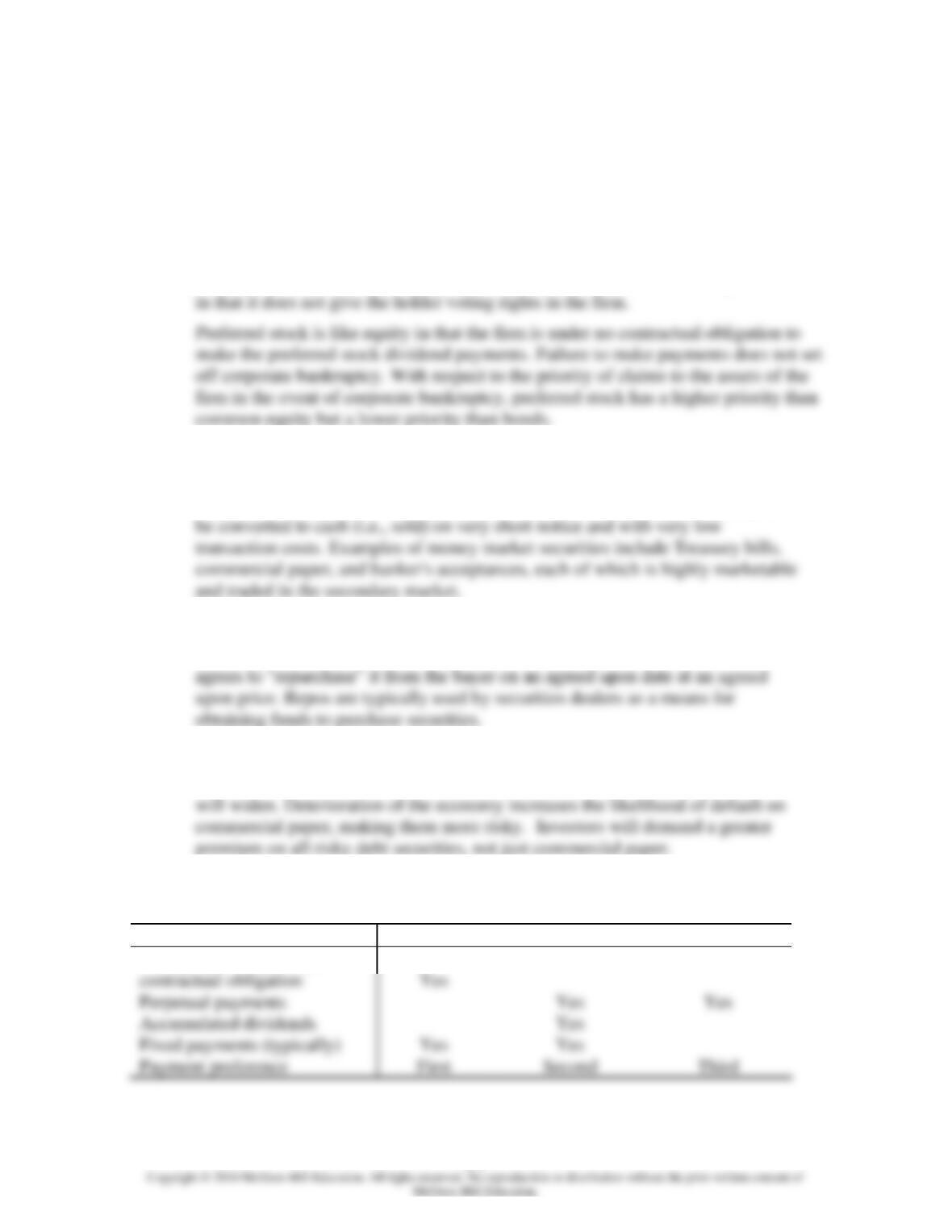
1. Preferred stock is like long-term debt in that it typically promises a fixed payment
each year. In this way, it is a perpetuity. Preferred stock is also like long-term debt
2. Money market securities are called cash equivalents because of their high level
of liquidity. The prices of money market securities are very stable, and they can
3. (a) A repurchase agreement is an agreement whereby the seller of a security
4. Spreads between risky commercial paper and risk-free government securities
5.
Corp. Bonds
Preferred Stock
Common Stock
Voting rights (typically)
Yes
contractual obligation
Perpetual payments
Yes
Accumulated dividends
Fixed payments (typically)
Chapter 2 – Asset Classes and Financial Instruments
2-
2
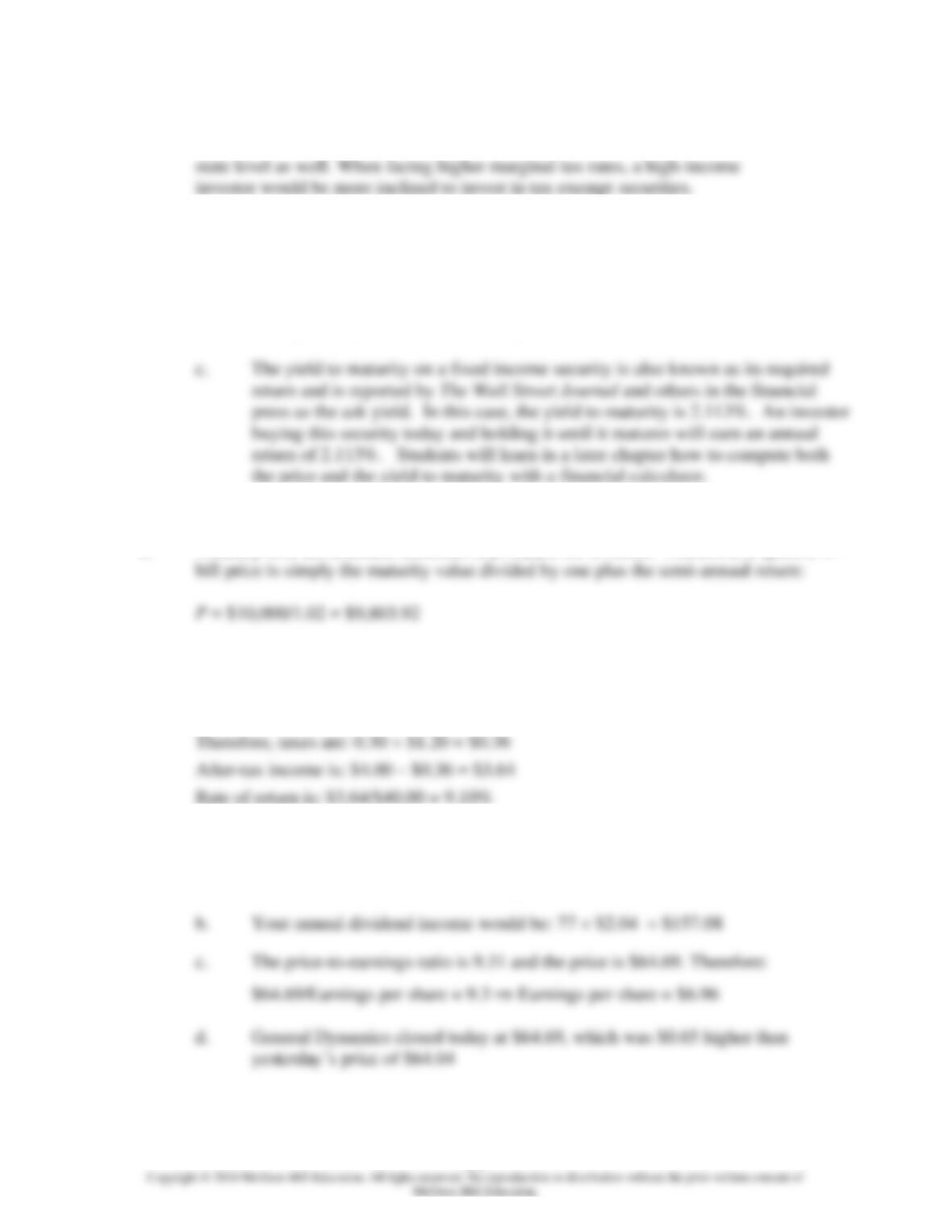
6. Municipal bond interest is tax-exempt at the federal level and possibly at the
7. a. You would have to pay the ask price of:
161.1875% of par value of $1,000 = $1611.875
b. The coupon rate is 6.25% implying coupon payments of $62.50 annually or,
more precisely, $31.25 semiannually.
8. Treasury bills are discount securities that mature for $10,000. Therefore, a specific T-
9. The total before-tax income is $4. After the 70% exclusion for preferred stock
dividends, the taxable income is: 0.30 $4 = $1.20
10. a. You could buy: $5,000/$64.69 = 77.29 shares. Since it is not possible to trade
in fractions of shares, you could buy 77 shares of GD.
Chapter 2 – Asset Classes and Financial Instruments
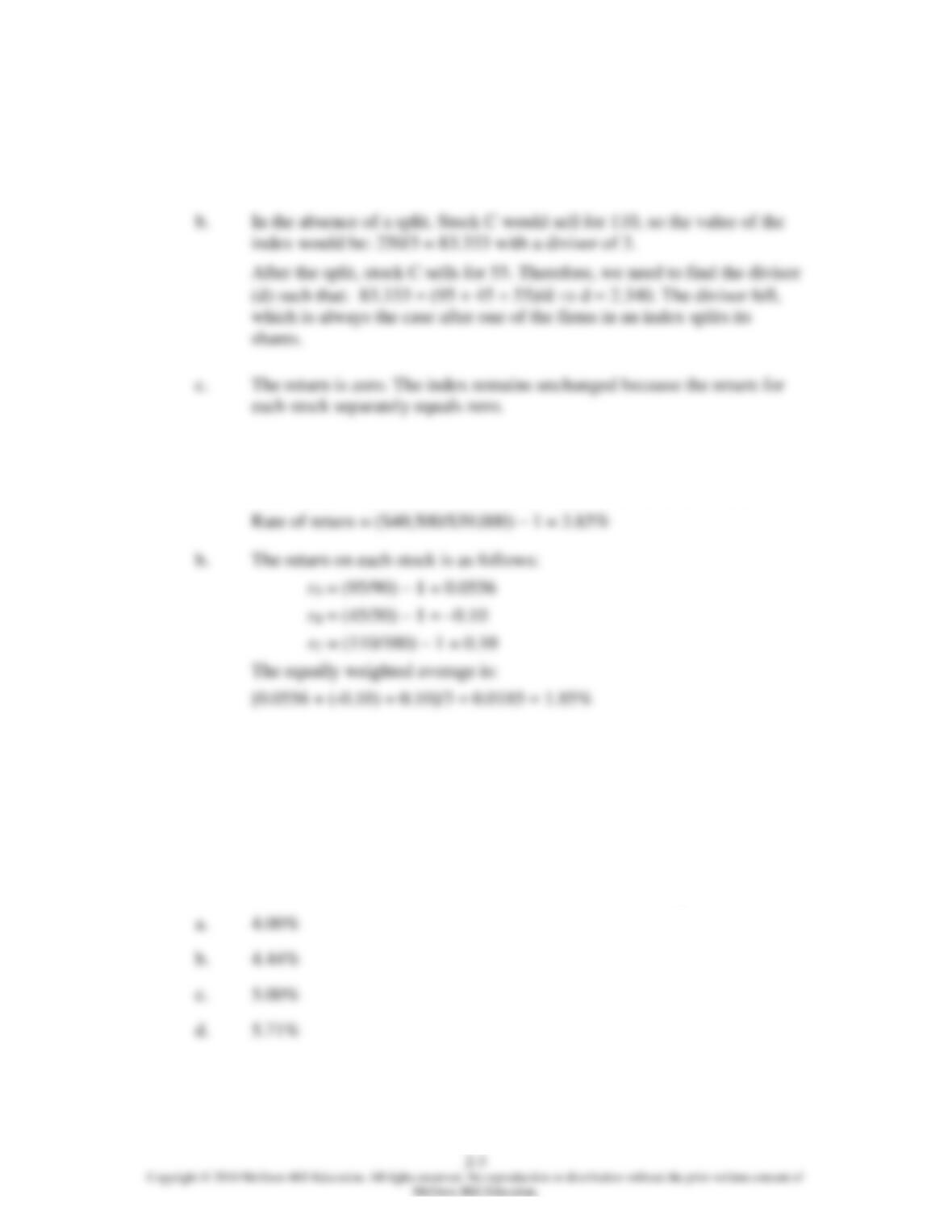
11. a. At t = 0, the value of the index is: (90 + 50 + 100)/3 = 80
At t = 1, the value of the index is: (95 + 45 + 110)/3 = 83.333
The rate of return is: (83.333/80) − 1 = 4.17%
12. a. Total market value at t = 0 is: ($9,000 + $10,000 + $20,000) = $39,000
Total market value at t = 1 is: ($9,500 + $9,000 + $22,000) = $40,500
13. The after-tax yield on the corporate bonds is: 0.09 (1 – 0.30) = 0.063 = 6.30%
Therefore, municipals must offer a yield to maturity of at least 6.30%.
14. Equation (2.2) shows that the equivalent taxable yield is: r = rm /(1 – t), so simply
substitute each tax rate in the denominator to obtain the following:
Chapter 2 – Asset Classes and Financial Instruments
2-
4
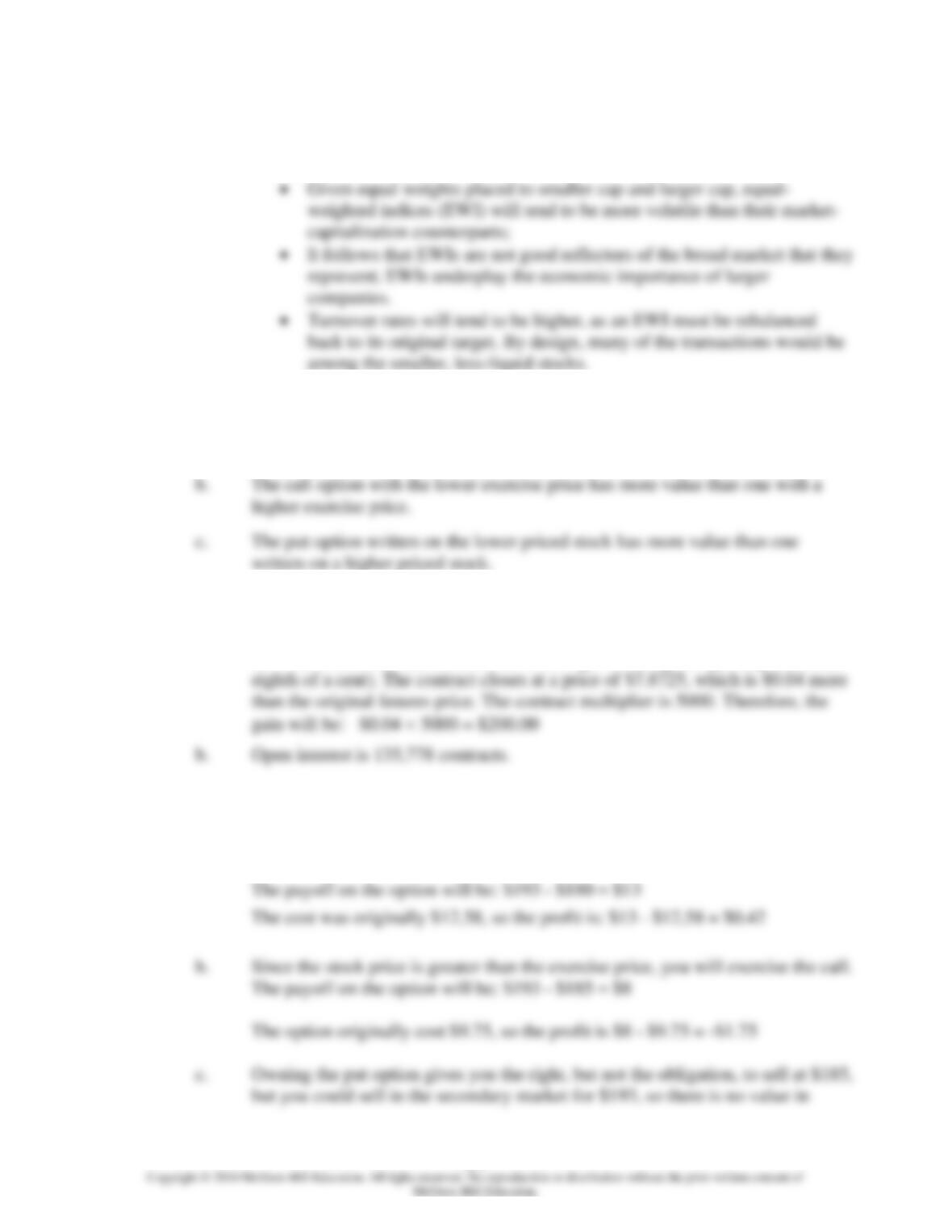
15. In an equally weighted index fund, each stock is given equal weight regardless of its
market capitalization. Smaller cap stocks will have the same weight as larger cap
stocks. The challenges are as follows:
16. a. The ten-year Treasury bond with the higher coupon rate will sell for a higher
price because its bondholder receives higher interest payments.
17. a. You bought the contract when the futures price was $7.8325 (see Figure
2.11 and remember that the number to the right of the apostrophe represents an
18. a. Owning the call option gives you the right, but not the obligation, to buy at
$180, while the stock is trading in the secondary market at $193. Since the
stock price exceeds the exercise price, you exercise the call.
Chapter 2 – Asset Classes and Financial Instruments
19. There is always a possibility that the option will be in-the-money at some time prior to
expiration. Investors will pay something for this possibility of a positive payoff.
20.
Value of Call at Expiration
Initial Cost
Profit
a.
0
4
-4
b.
0
4
-4
c.
0
4
-4
d.
5
4
1
e.
10
4
6
Value of Put at Expiration
Initial Cost
Profit
a.
10
6
4
b.
5
6
-1
c.
0
6
-6
d.
0
6
-6
e.
0
6
-6
21. A put option conveys the right to sell the underlying asset at the exercise price. A
22. A call option conveys the right to buy the underlying asset at the exercise price. A
CFA PROBLEMS
1. (d) There are tax advantages for corporations that own preferred shares.
Chapter 2 – Asset Classes and Financial Instruments
2-
6
4. a. The taxable bond. With a zero tax bracket, the after-tax yield for the
taxable bond is the same as the before-tax yield (5%), which is greater than
the yield on the municipal bond.
5. If the after-tax yields are equal, then: 0.056 = 0.08 × (1 – t)
This implies that t = 0.30 =30%.