Chapter 2
Foreign Exchange Parity Relations
1. Because the interest rate in A is greater than the interest rate in B,
is expected to depreciate relative
to
, and should trade with a forward discount. Accordingly, the correct answer is (c).
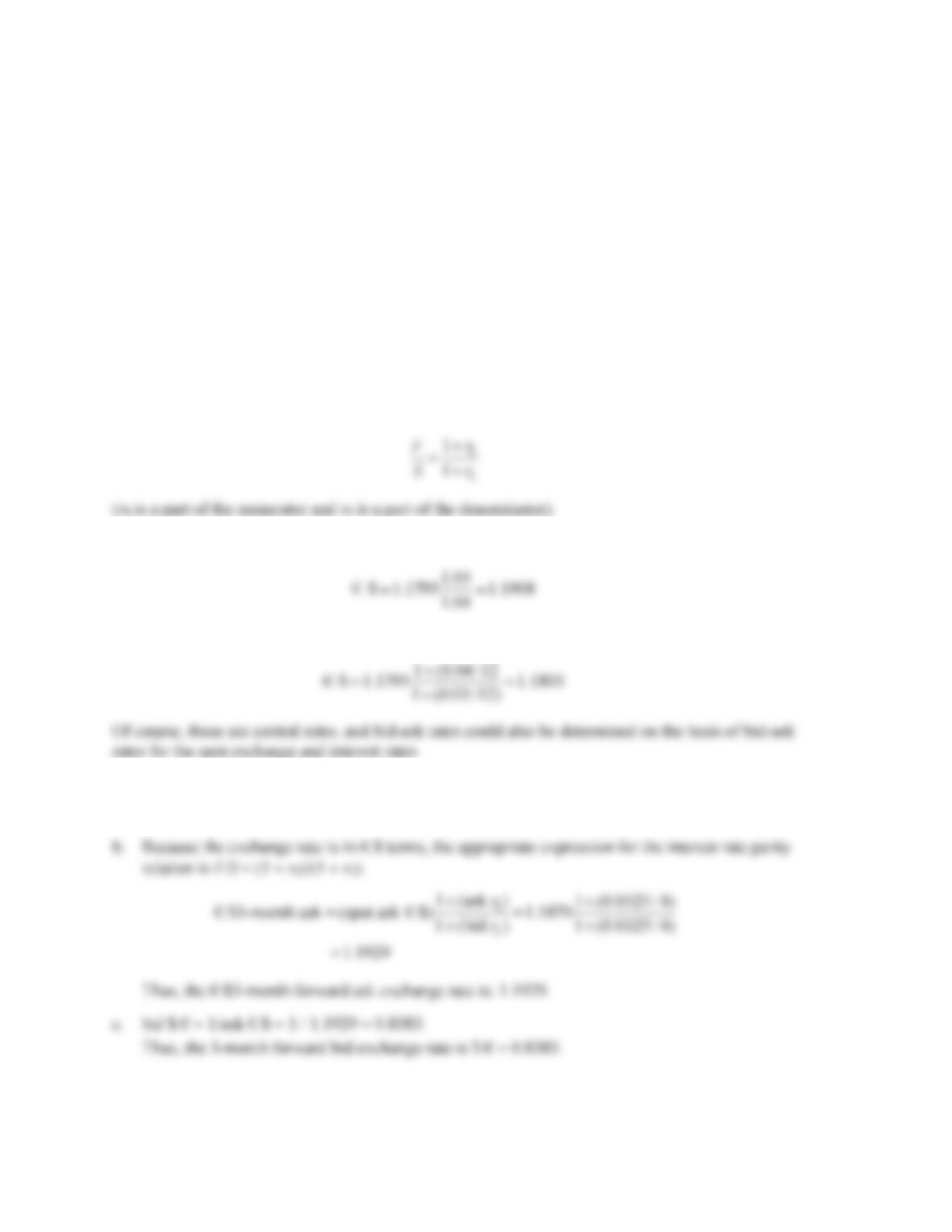
2. Because the exchange rate is given in €:$ terms, the appropriate expression for the interest rate parity
relation is
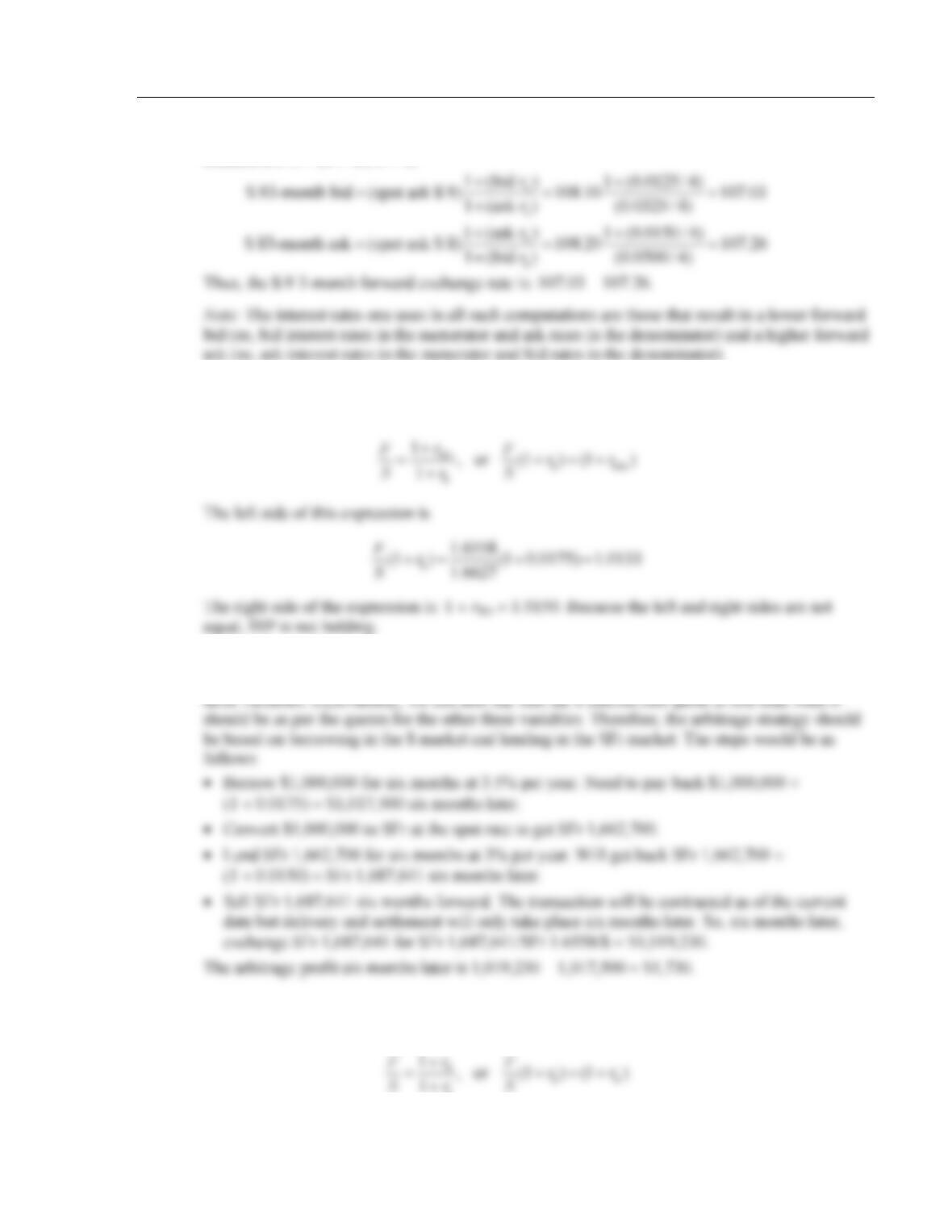
a. The one-year €:$ forward rate is given by
b. The one-month €:$ forward rate is given by
3. a. bid €:¥ = (bid $:¥) (bid €:$) = 108.10 1.1865 = 128.2607.
ask €:¥ = (ask $:¥) (ask €:$) = 108.20 1.1870 = 128.4334.
Chapter 2 Foreign Exchange Parity Relations 7
d. Because the exchange rate is in $:¥ terms, the appropriate expression for the interest rate parity
relation is F/S = (1 + r¥ )/1 + r$.
4. a. For six months, rSFr = 1.50% and r$ = 1.75%. Because the exchange rate is in $:SFr terms, the
appropriate expression for the interest rate parity relation is
b. Because IRP is not holding, there is an arbitrage possibility: Because 1.0133 < 1.0150, we can
say that the SFr interest rate quote is more than what it should be as per the quotes for the other
5. a. For three months, r$ = 1.30% and r¥ = 0.30%. Because the exchange rate is in $:¥ terms, the
appropriate expression for the interest rate parity relation is
$
8 Solnik/McLeavey • Global Investments, Sixth Edition
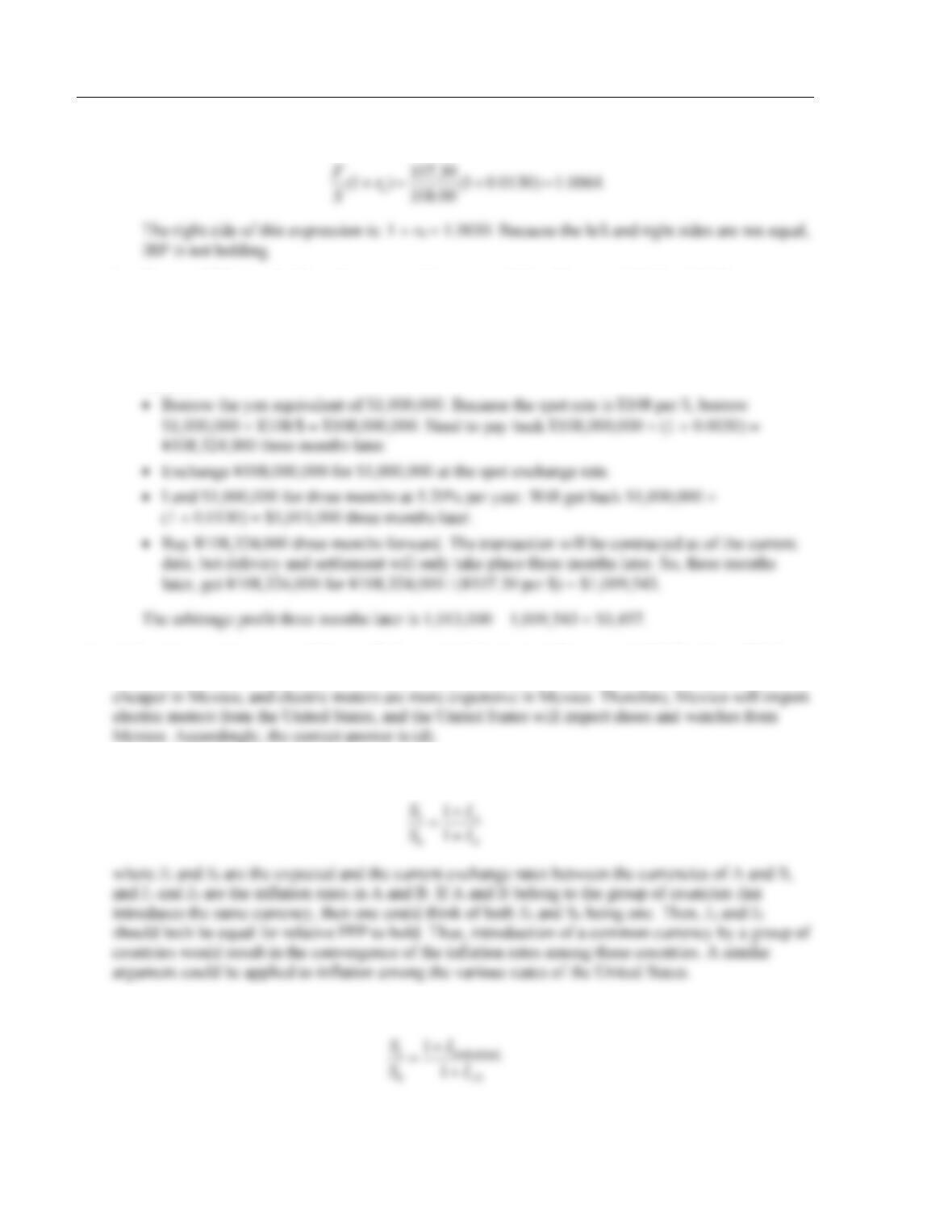
The left side of this expression is
b. Because IRP is not holding, there is an arbitrage possibility. Because 1.0064 > 1.0030, we can
say that the $ interest rate quote is more than what it should be as per the quotes for the other
three variables. Equivalently, we can also say that the ¥ interest rate quote is less than what it
should be as per the quotes for the other three variables. Therefore, the arbitrage strategy should
be based on lending in the $ market and borrowing in the ¥ market. The steps would be as
follows:
6. At the given exchange rate of 5 pesos/$, the cost in Mexico in dollar terms is $16 for shoes, $36 for
watches, and $120 for electric motors. Thus, compared with the United States, shoes and watches are
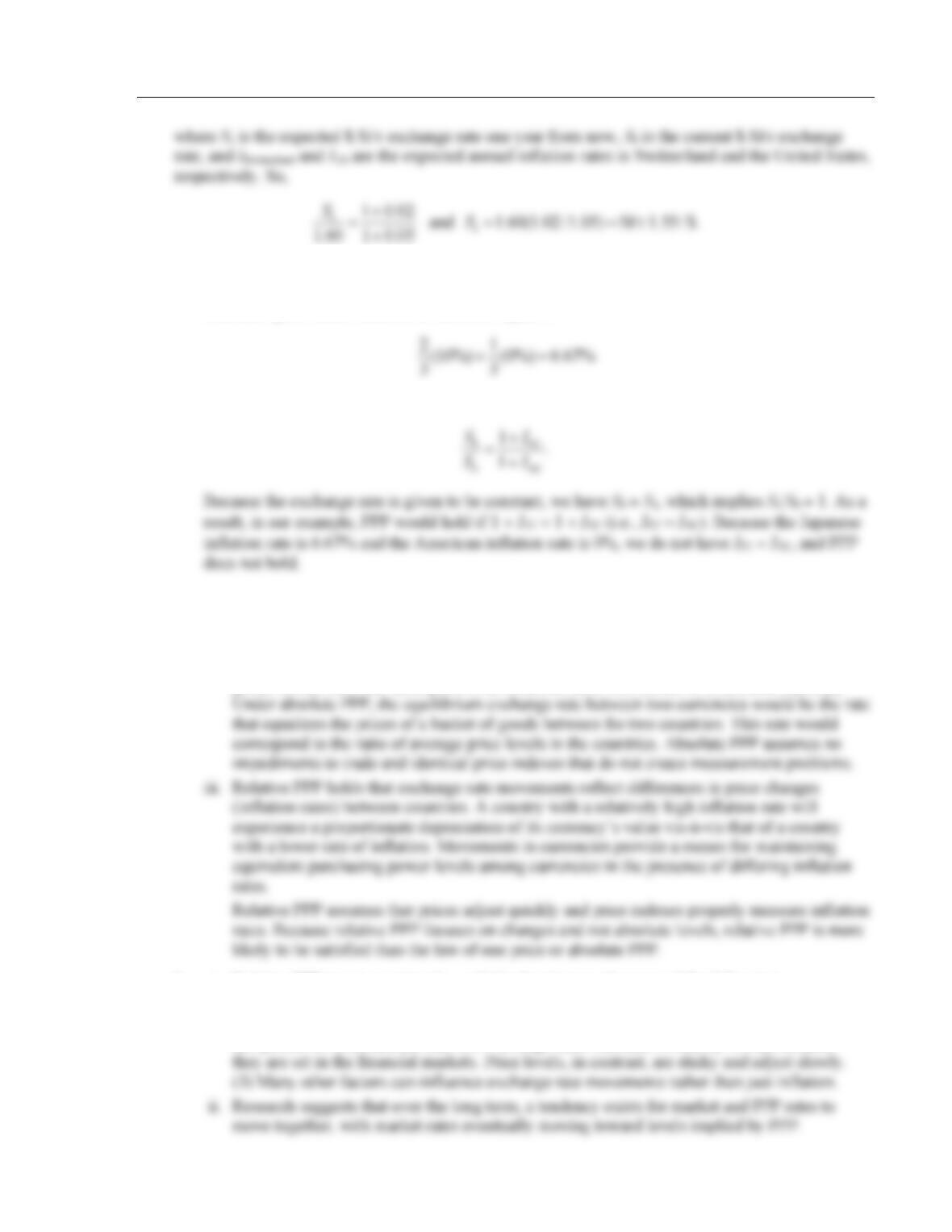
7. Consider two countries, A and B. Based on relative PPP,
8. Based on relative PPP,
Chapter 2 Foreign Exchange Parity Relations 9
9. a. A Japanese consumption basket consists of two-thirds sake and one-third TV sets. The price of
sake in yen is rising at a rate of 10% per year. The price of TV sets is constant. The Japanese
consumer price index inflation is therefore equal to
b. Relative PPP states that
10. a. i. The law of one price is that, assuming competitive markets and no transportation costs or
tariffs, the same goods should have the same real prices in all countries after converting
prices to a common currency.
ii. Absolute PPP, focusing on baskets of goods and services, states that the same basket of
goods should have the same price in all countries after conversion to a common currency.
b. i. Relative PPP is not consistently useful in the short run because of the following:
(1) Relationships between month-to-month movements in market exchange rates and PPP
are not consistently strong, according to empirical research. Deviations between the rates
can persist for extended periods. (2) Exchange rates fluctuate minute by minute because
10 Solnik/McLeavey • Global Investments, Sixth Edition
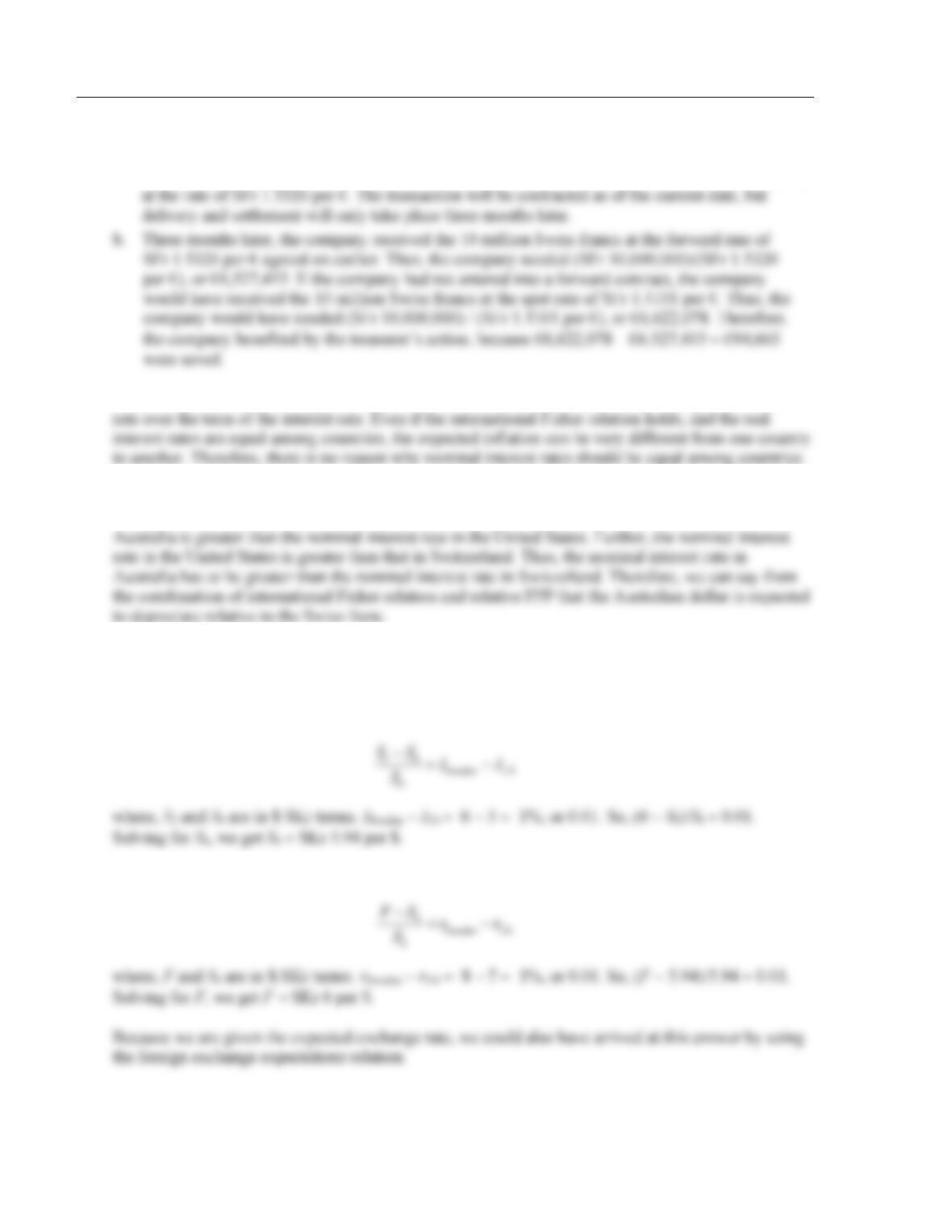
11. a. If the treasurer is worried that the franc might appreciate in the next three months, she could
hedge her foreign exchange exposure by trading this risk against the premium included in the
forward exchange rate. She could buy 10 million Swiss francs on the three-month forward market
12. The nominal interest rate is approximately the sum of the real interest rate and the expected inflation
13. Because the Australian dollar is expected to depreciate relative to the dollar, we know from the
combination of international Fisher relation and relative PPP that the nominal interest rate in
14. According to the approximate version of the international Fisher relation, rSweden − rUS = ISweden − IUS.
So, 8 − 7 = 6 − IUS, which means that IUS = 5%.
According to the approximate version of relative PPP,
According to the approximate version of IRP,
Chapter 2 Foreign Exchange Parity Relations 11
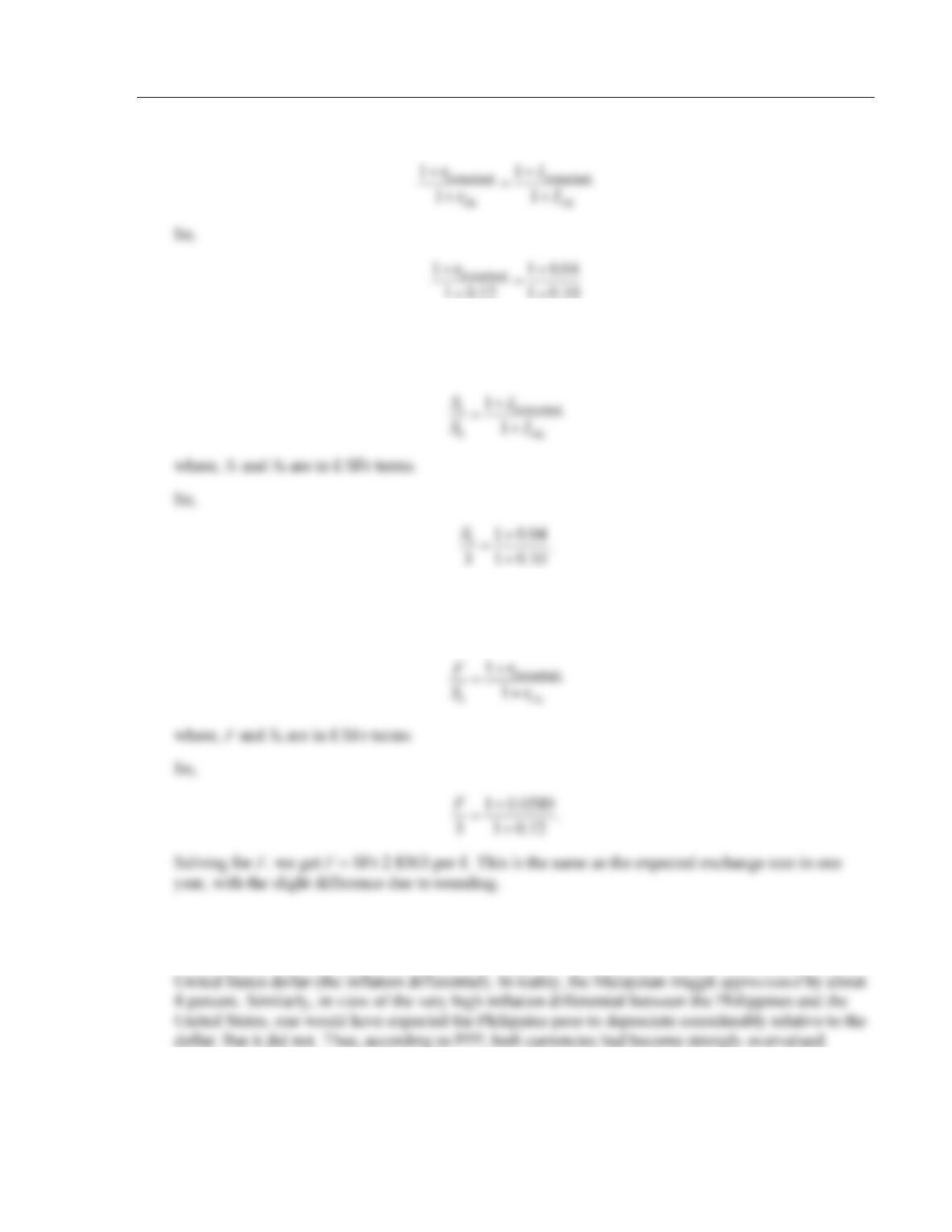
15. According to the international Fisher relation,
++
1 0.12 1 0.10
therefore, rSwitzerland = 0.0589, or 5.89%.
According to relative PPP,
Solving for S1 we get S1 = SFr 2.8364 per £.
According to IRP,
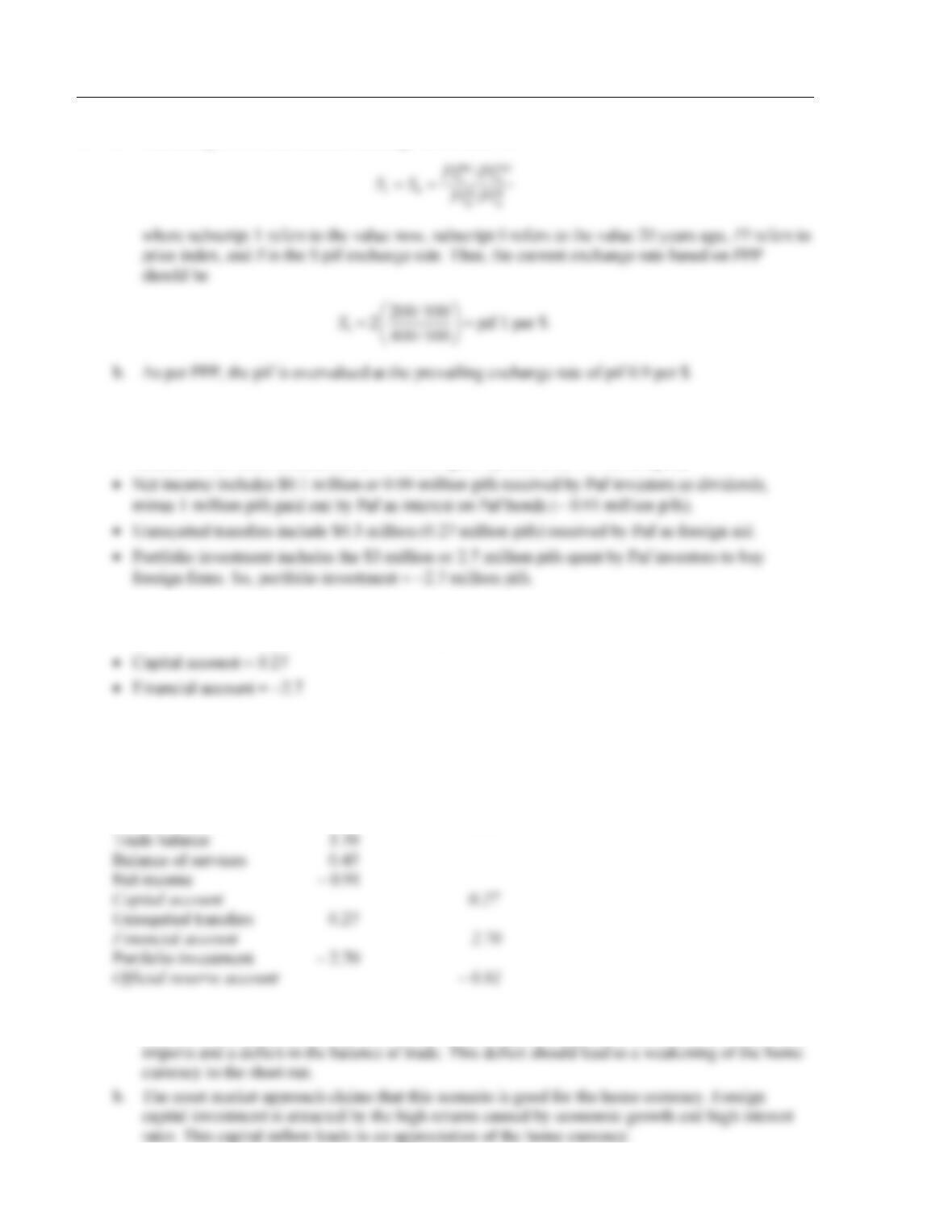
16. During the 1991–1996 period, the cumulative inflation rates were about 25 percent in Malaysia,
61 percent in the Philippines, and 18 percent in the United States. Over this period, based on relative
PPP, one would have expected the Malaysian ringgit to depreciate by about 7 percent relative to the
12 Solnik/McLeavey • Global Investments, Sixth Edition
17. a. According to PPP, the current exchange rate should be
18. Exports equal 10 million pifs and imports equal $7 million (6.3 million pifs). Accordingly, the trade
balance is 10 − 6.3 = 3.7 million pifs.
• Balance of services includes the $0.5 million spent by tourists (0.45 million pifs).
Based on the preceding,
• Current account = 3.24 (= 3.70 + 0.45 − 0.91)
The sum of current account, capital account, and financial account is 0.81. By definition of balance of
payments, the sum of the current account, the capital account, the financial account, and the change in
official reserves must be equal to zero. Therefore, official reserve account = −0.81.
The following summarizes the effect of the transactions on the balance of payments.
Current account 3.24
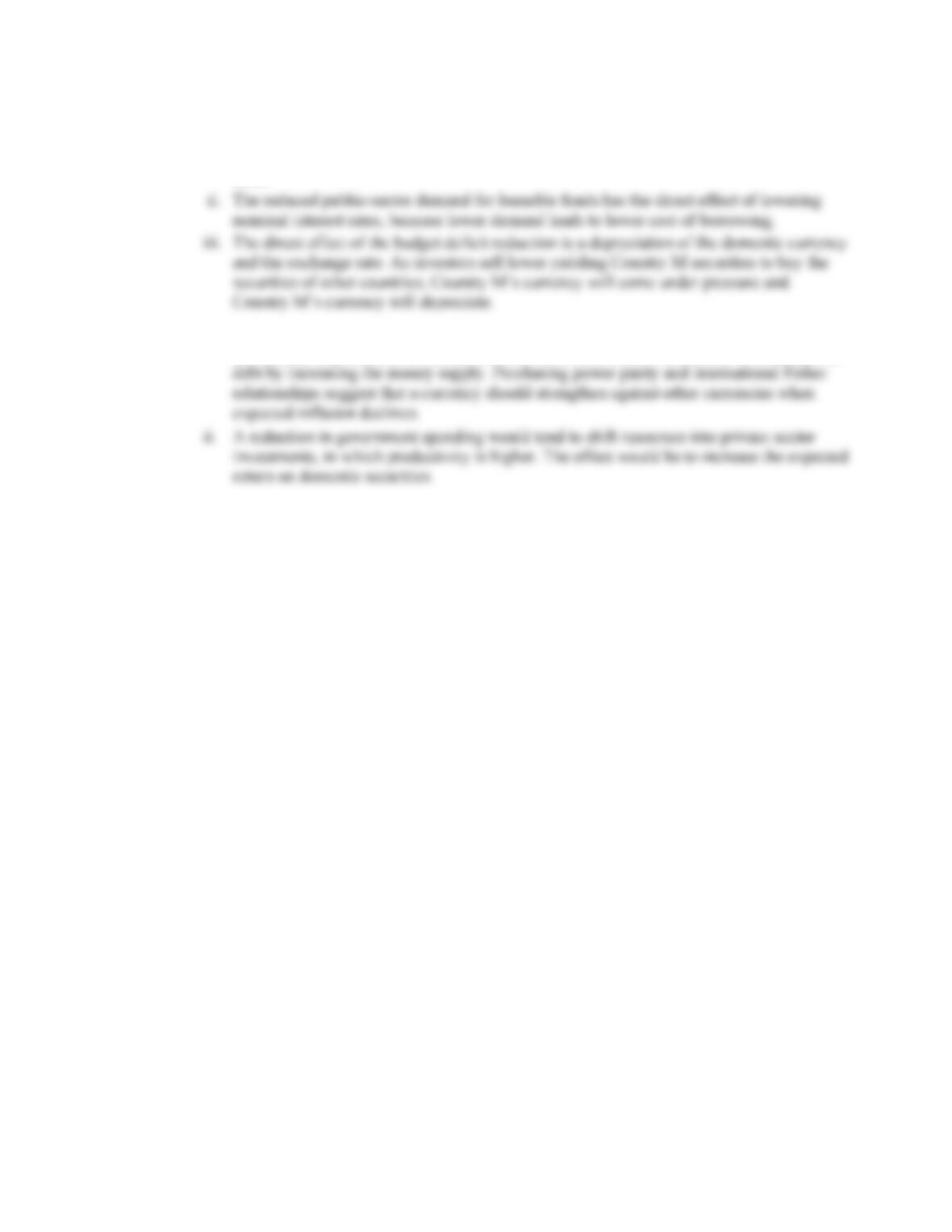
19. a. A traditional flow market approach would suggest that the home currency should depreciate
because of increased inflation. An increase in domestic consumption could also lead to increased
Chapter 2 Foreign Exchange Parity Relations 13
20. a. i. The immediate effect of reducing the budget deficit is to reduce the demand for loanable
funds because the government needs to borrow less to bridge the gap between spending and
taxes.
b. i. In the case of a credible, sustainable, and large reduction in the budget deficit, reduced
inflationary expectations are likely because the central bank is less likely to monetize the