Chapter 02 – Asset Classes and Financial Instruments
CHAPTER 2: ASSET CLASSES AND
FINANCIAL INSTRUMENTS
PROBLEM SETS
1. Preferred stock is like long-term debt in that it typically promises a fixed payment each
year. In this way, it is a perpetuity. Preferred stock is also like long-term debt in that it
2. Money market securities are called “cash equivalents” because of their great liquidity.
3. The spread will widen. Deterioration of the economy increases credit risk, that is, the
5. a. You would have to pay the asked price of:
b. The coupon rate is 11.750% implying coupon payments of $117.50 annually or, more
c. Current yield = Annual coupon income/price
2-2
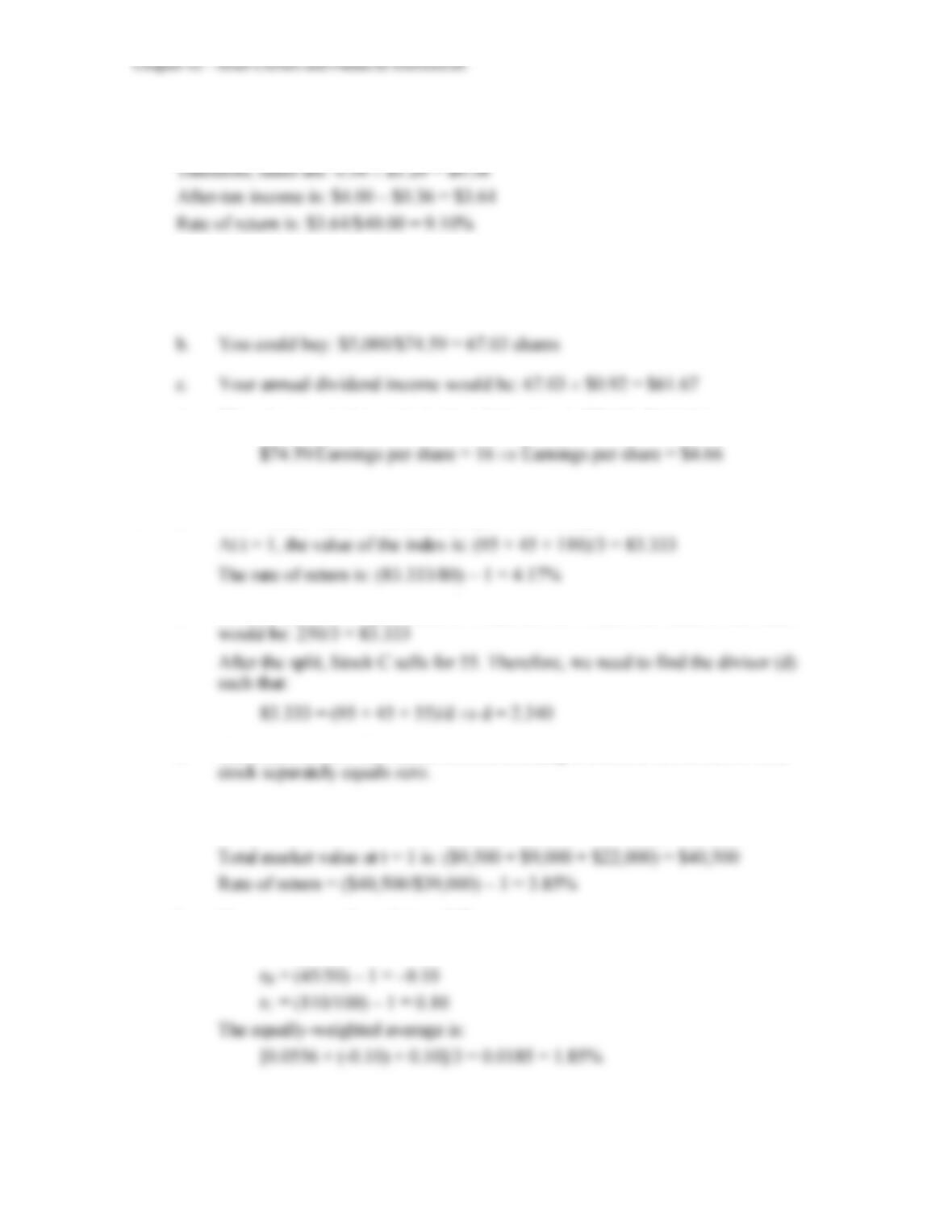
7. The total before-tax income is $4. After the 70% exclusion for preferred stock dividends, the
taxable income is: 0.30 $4 = $1.20
8. a. General Dynamics closed today at $74.59, which was $0.17 higher than yesterday’s
price. Yesterday’s closing price was: $74.42
d. The price-to-earnings ratio is 16 and the price is $74.59. Therefore:
9. a. At t = 0, the value of the index is: (90 + 50 + 100)/3 = 80
b. In the absence of a split, Stock C would sell for 110, so the value of the index
c. The return is zero. The index remains unchanged because the return for each
10. a. Total market value at t = 0 is: ($9,000 + $10,000 + $20,000) = $39,000
b. The return on each stock is as follows:
rA = (95/90) – 1 = 0.0556
Chapter 02 – Asset Classes and Financial Instruments
2-3
11. The after-tax yield on the corporate bonds is: 0.09 (1 – 0.30) = 0.0630 = 6.30%
12. Equation (2.2) shows that the equivalent taxable yield is: r = rm/(1 – t)
b. 4.44%
d. 5.71%
13. a. The higher coupon bond.
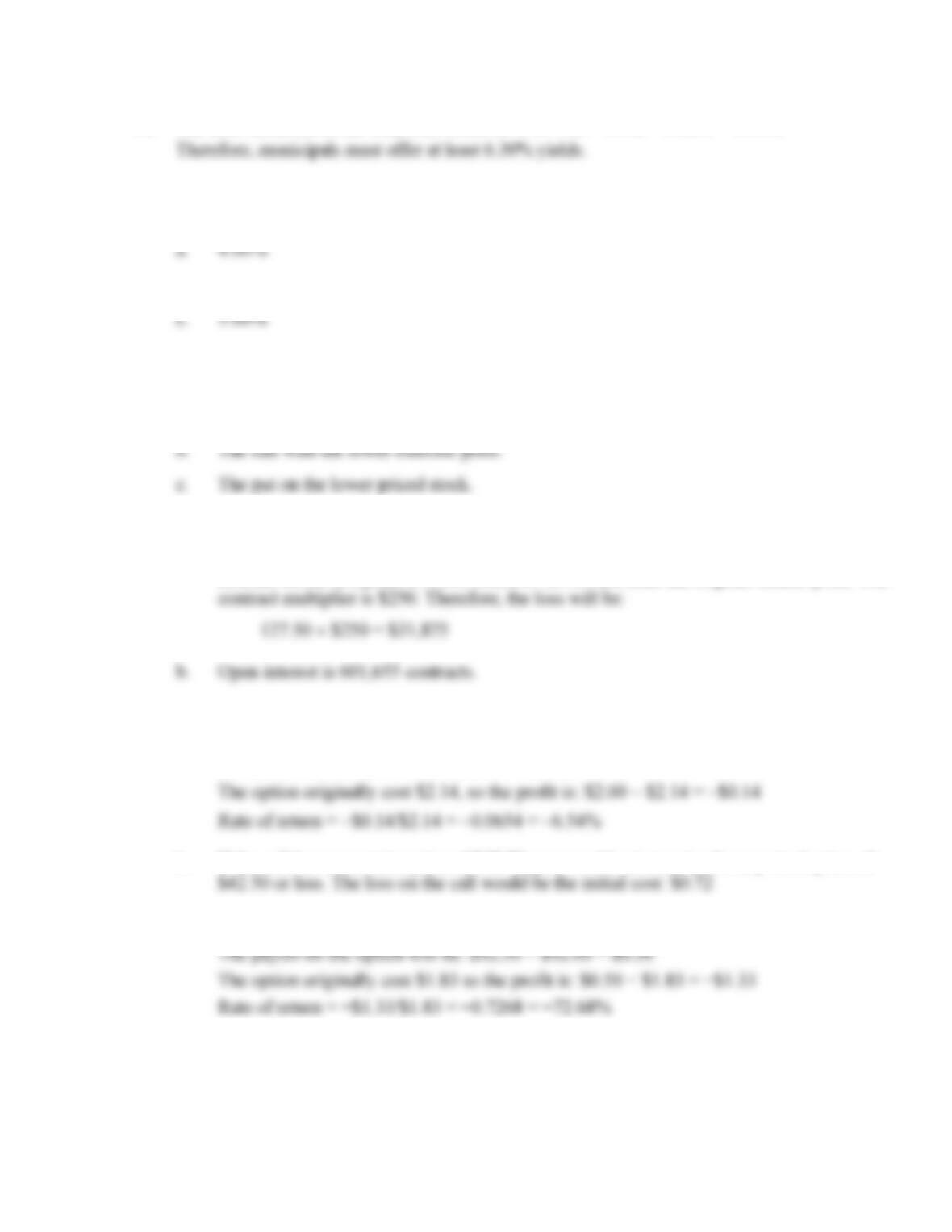
14. a. You bought the contract when the futures price was 1427.50 (see Figure 2.12). The
contract closes at a price of 1300, which is 127.50 less than the original futures price. The
15. a. Since the stock price exceeds the exercise price, you will exercise the call.
The payoff on the option will be: $42 − $40 = $2
b. If the call has an exercise price of $42.50, you would not exercise for any stock price of
c. Since the stock price is less than the exercise price, you will exercise the put.
Chapter 02 – Asset Classes and Financial Instruments
2-4
16. There is always a possibility that the option will be in-the-money at some time prior to
expiration. Investors will pay something for this possibility of a positive payoff.
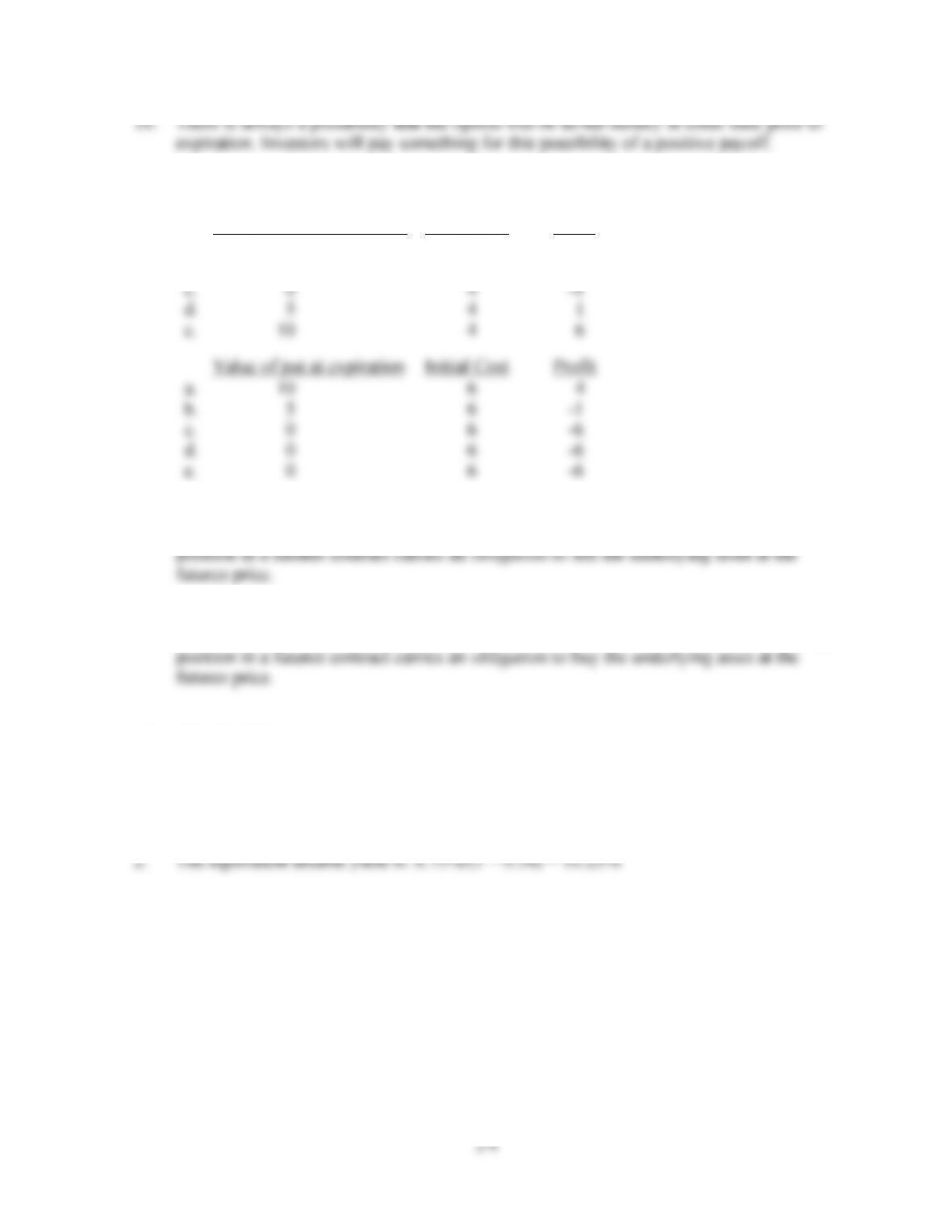
17.
Value of call at expiration
Initial Cost
Profit
a.
0
4
-4
b.
0
4
-4
c.
0
4
-4
d.
5
4
1
e.
10
4
6
Value of put at expiration
Initial Cost
Profit
a.
10
6
4
b.
5
6
-1
c.
0
6
-6
d.
0
6
-6
e.
0
6
-6
18. A put option conveys the right to sell the underlying asset at the exercise price. A short
19. A call option conveys the right to buy the underlying asset at the exercise price. A long
CFA PROBLEMS
1. (d)
3. (a) Writing a call entails unlimited potential losses as the stock price rises.
2-5
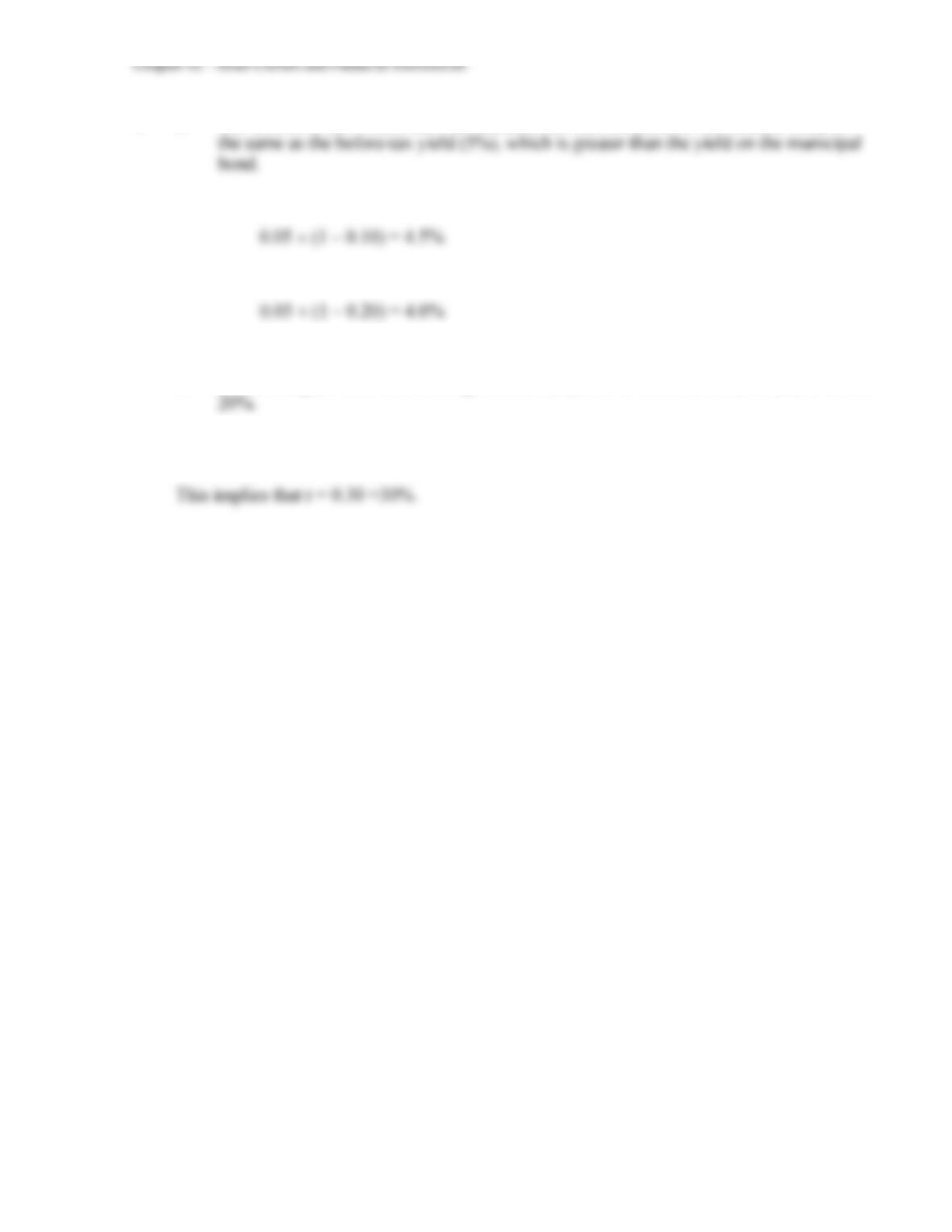
4. a. The taxable bond. With a zero tax bracket, the after-tax yield for the taxable bond is
b. The taxable bond. The after-tax yield for the taxable bond is:
c. You are indifferent. The after-tax yield for the taxable bond is:
The after-tax yield is the same as that of the municipal bond.
d. The municipal bond offers the higher after-tax yield for investors in tax brackets above
5. If the after-tax yields are equal, then: 0.056 = 0.08 (1 – t)