12. If an on-the-run issue for an issuer is evaluated properly using a binomial model, how
would the theoretical value compare to the actual market price?
For an on-the-run issue that is option-free the theoretical value is identical to the bond value
found when we discount at either the zero-coupon rates or the one-year forwards. Since the
binomial model uses forward rates, it would be consistent with the actual market price given by
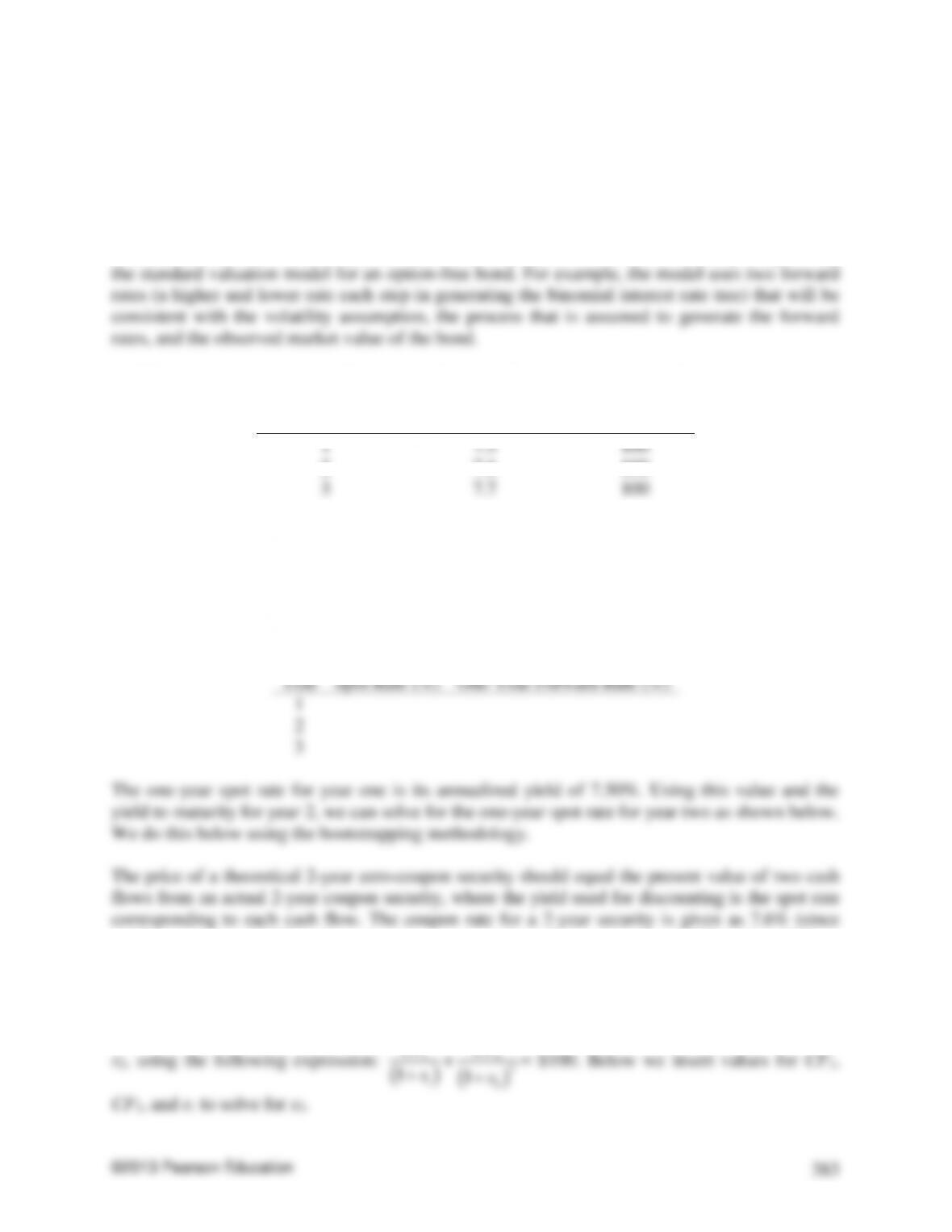
13. The current on-the-run yields for the Ramsey Corporation are as follows:
Maturity (years)
Yield to Maturity (%)
Market Value
1
7.5
100
2
7.6
100
3
7.7
100
Assume that each bond is an annual-pay bond. Each bond is trading at par, so its coupon
rate is equal to its yield to maturity.
Answer the below questions.
(a) Using the bootstrapping methodology, complete the following table:
Year
Spot Rate (%)
One-Year Forward Rate (%)
1
2
3
The one-year spot rate for year one is its annualized yield of 7.50%. Using this value and the
yield to maturity for year 2, we can solve for the one-year spot rate for year two as shown below.
We do this below using the bootstrapping methodology.
The price of a theoretical 2-year zero-coupon security should equal the present value of two cash
flows from an actual 2-year coupon security, where the yield used for discounting is the spot rate
corresponding to each cash flow. The coupon rate for a 2-year security is given as 7.6% (since
yield to maturity of 7.6% is the same as coupon rate given the market value is 100). Using $100 as
par, the cash flow for this security for year one is CF1 = $7.60 and for year two is CF2 = $7.60 +
$100 = $107.60.
Given the one year spot rate of s1 = 7.5%, we can now solve for the 2-year theoretical spot rate,
12
CF CF
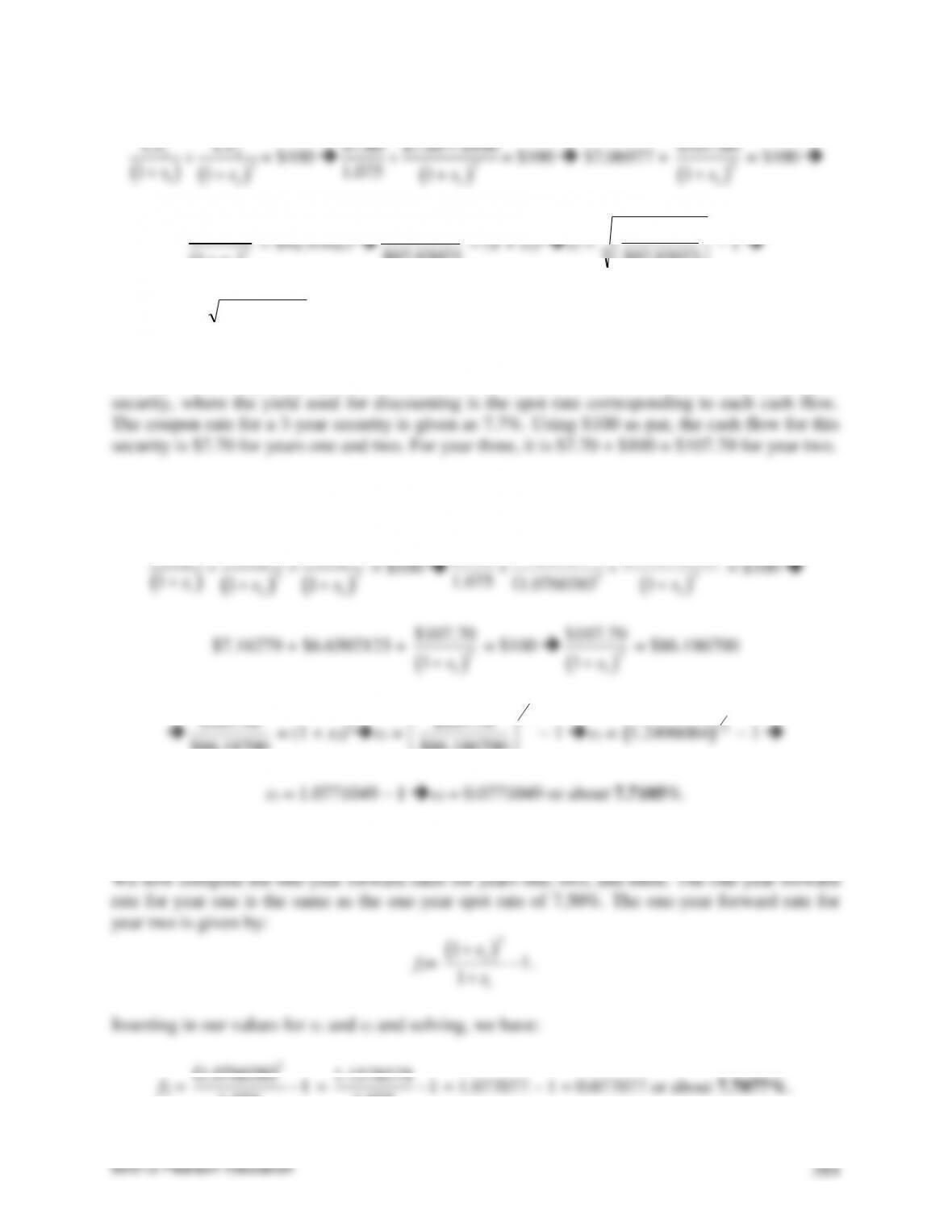
( ) ( )
12
2
12
11
CF CF
ss
++
( )
2
2
$7.60 $7.60 $100
1.075 1s
+
( )
2
2
$107.60
1s+
( )
2
1s+
$107.60
60.107$
60.107$
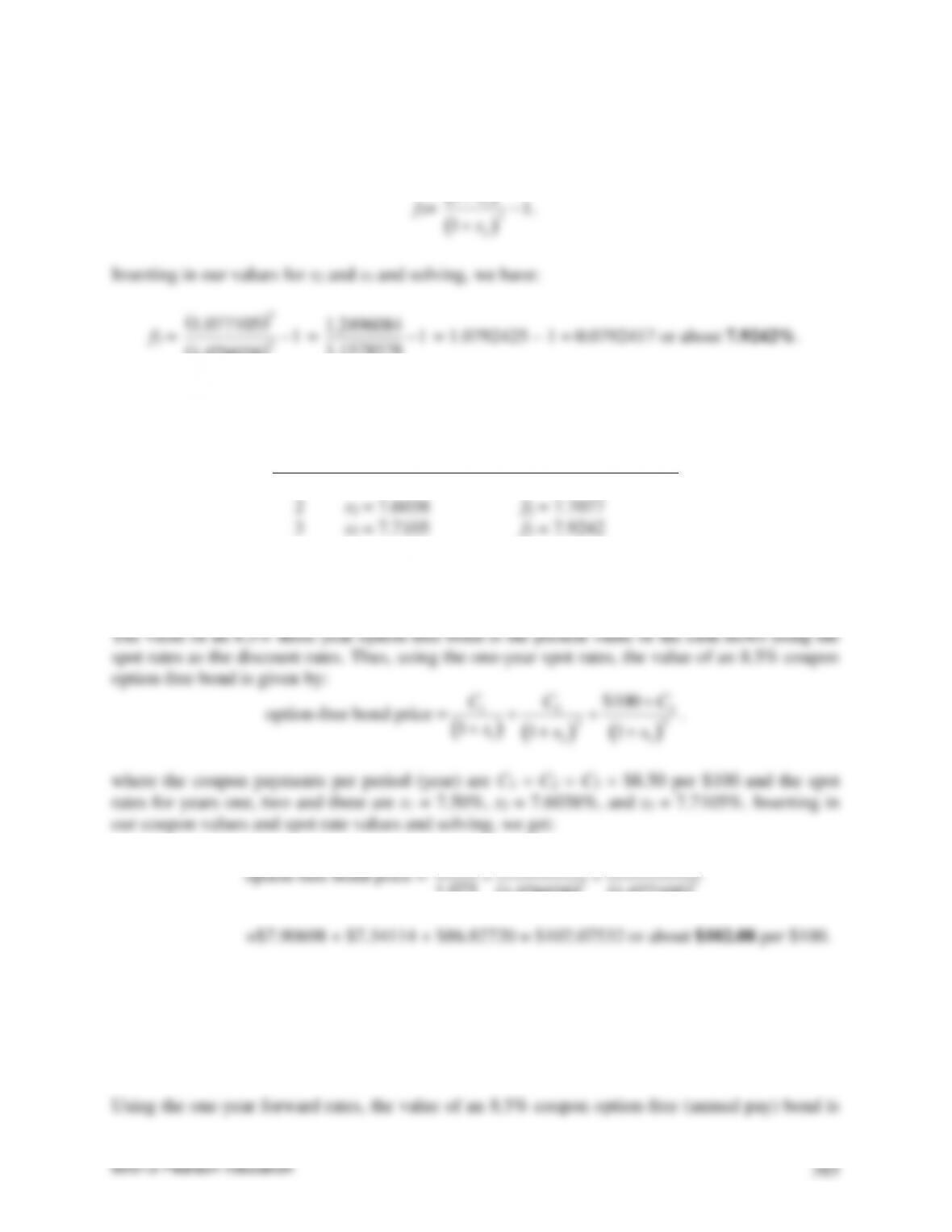
The one-year forward rate for year three is given by:
( )
( )
3
3
2
2
11
1
s
s
+−
+
Inserting in our values for s2 and s3 and solving, we have:
( )
3
1 077105 1
.
1.2496084 1
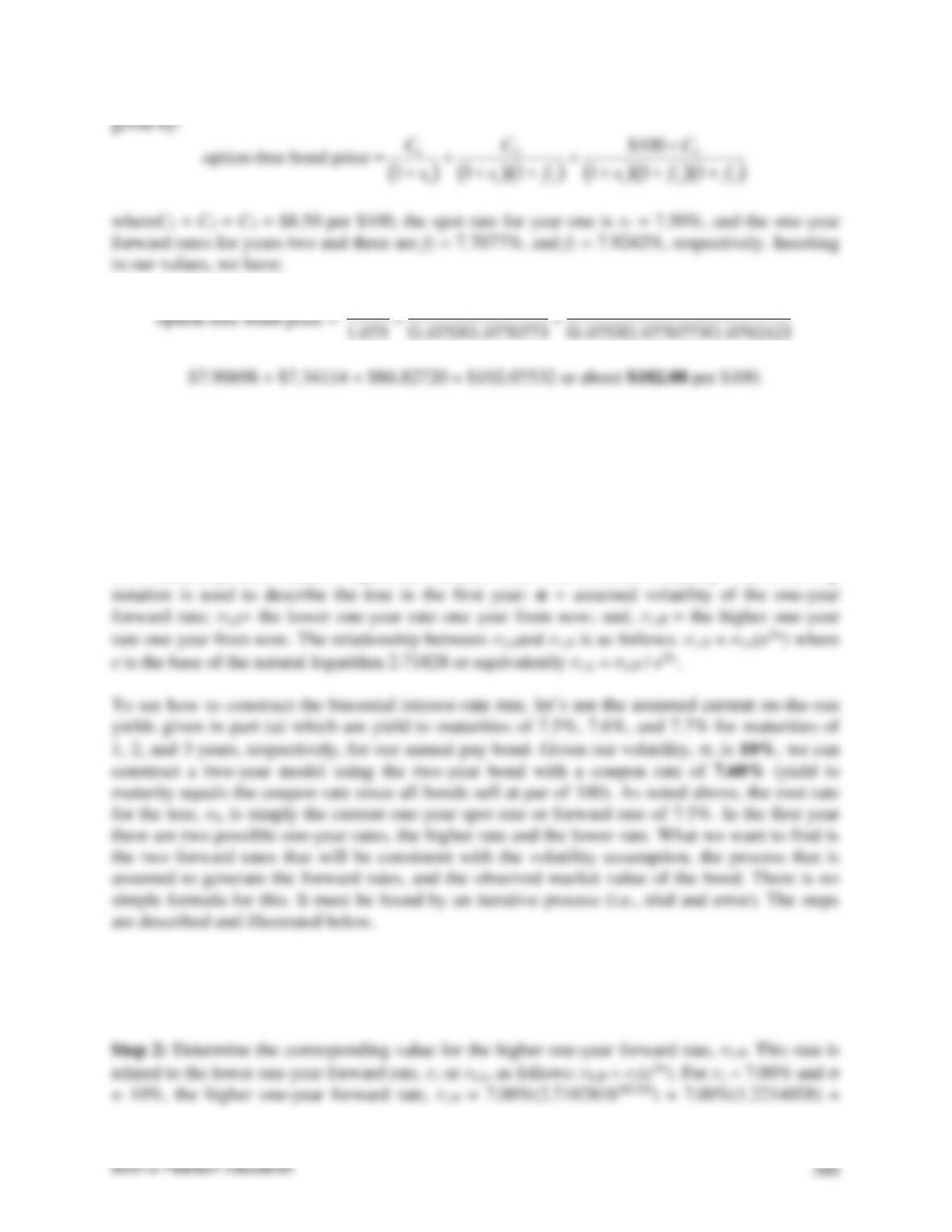
given by:
option-free bond price =
( ) ( )( ) ( )( )
( )
3
12
1 1 2 1 2 3
$100
1 1 1 1 1 1
C
CC
s s f s f f
+
++
+ + + + + +
whereC1 = C2 = C3 = $8.50 per $100, the spot rate for year one is s1 = 7.50%, and the one-year
forward rates for years two and three are f2 = 7.7077%, and f3 = 7.9242%, respectively. Inserting
in our values, we have:
$8.50 $8.50 $100 $8.50
+
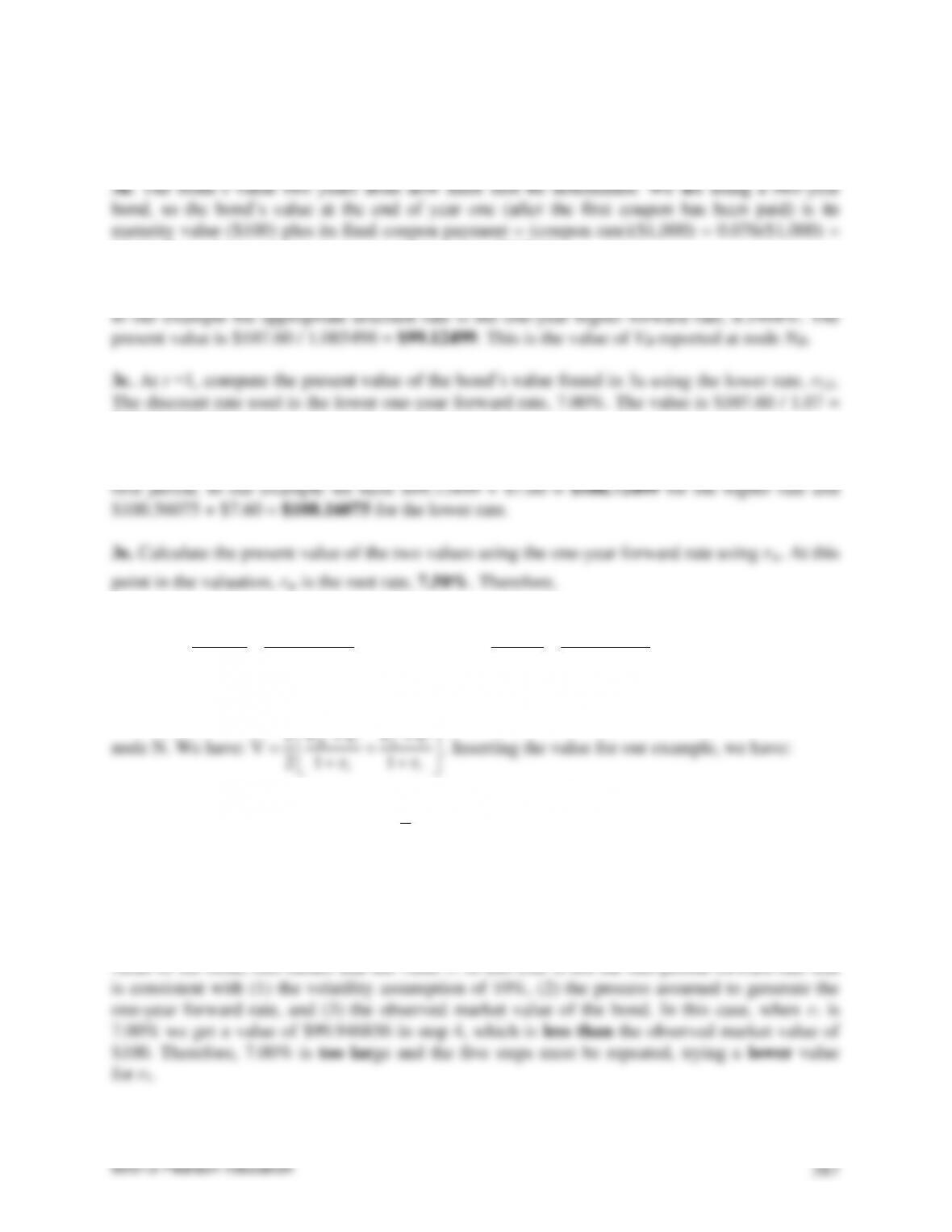
8.5498%. This value would be reported at node NH.
Step 3: Compute the bond’s value one year from now. This value is determined as follows:
$7.60. Thus, the bond value two years from now is $107.60.
3b. At t = 1, compute the present value of the bond’s value found in 3a using the higher rate, r1,H.
$100.56075. This is the value of VL reported at node NL.
3d. Add the coupon to VH and VL to get the respective cash flow at NH and NL at the end of the
*
1r
CVH
+
+
=
075.1
72499.106$
= $99.27906 and
*
1r
CVL
+
+
=
075.1
16075.108$
= $100.61465.
Step 4: Calculate the average present value of the two cash flows in step 3. This is the value at
+
+
+
+
** 112
1
r
CV
r
CV LH
value at node N = V =
1$99.27906 $100.61465
2+
= $99.946856.
Step 5: Compare the value in step 4 with the bond’s market value. If the two values are the
same, the r1 used in this trial is the one we seek. This is the one-year forward rate at t = 1 that
would then be used in the binomial interest-rate tree for the lower rate, and the corresponding
rate would be for the higher rate. If, instead, the value found in step 4 is not equal to the market
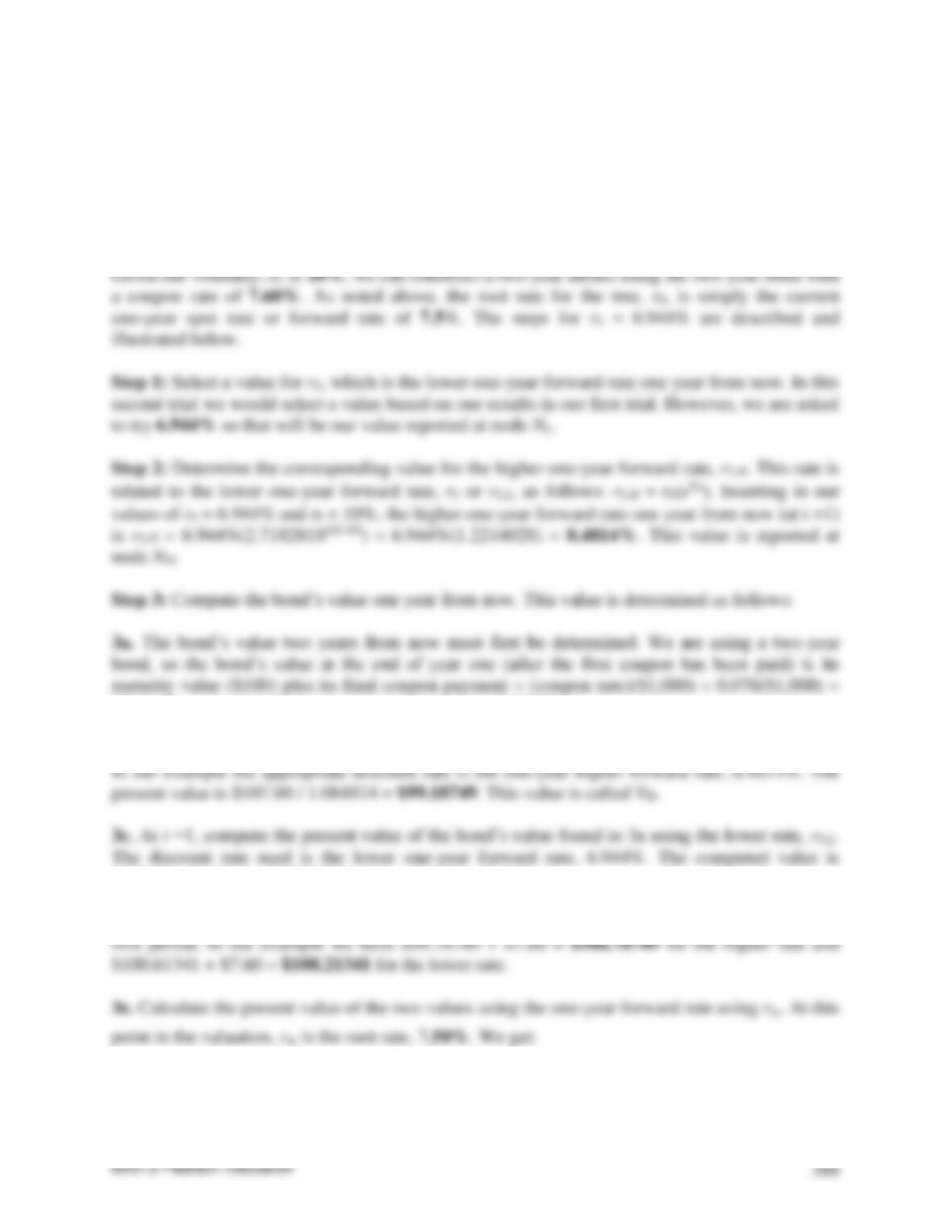
In conclusion, we have demonstrated that the lower one-year forward rate one year from
now cannot be 7.00%.
(e) Demonstrate that if σ is assumed to be 10%, the lower one-year forward rate one year
from now is 6.944%.
$7.60. Thus, the bond value two years from now is $107.60.
3b. At t = 1, compute the present value of the bond’s value found in 3a using the higher rate, r1,H.
$107.60 / 1.06944 = $100.61341. This value is called VL.
3d. Add the coupon to VH and VL to get the respective cash flow at NH and NL at the end of the
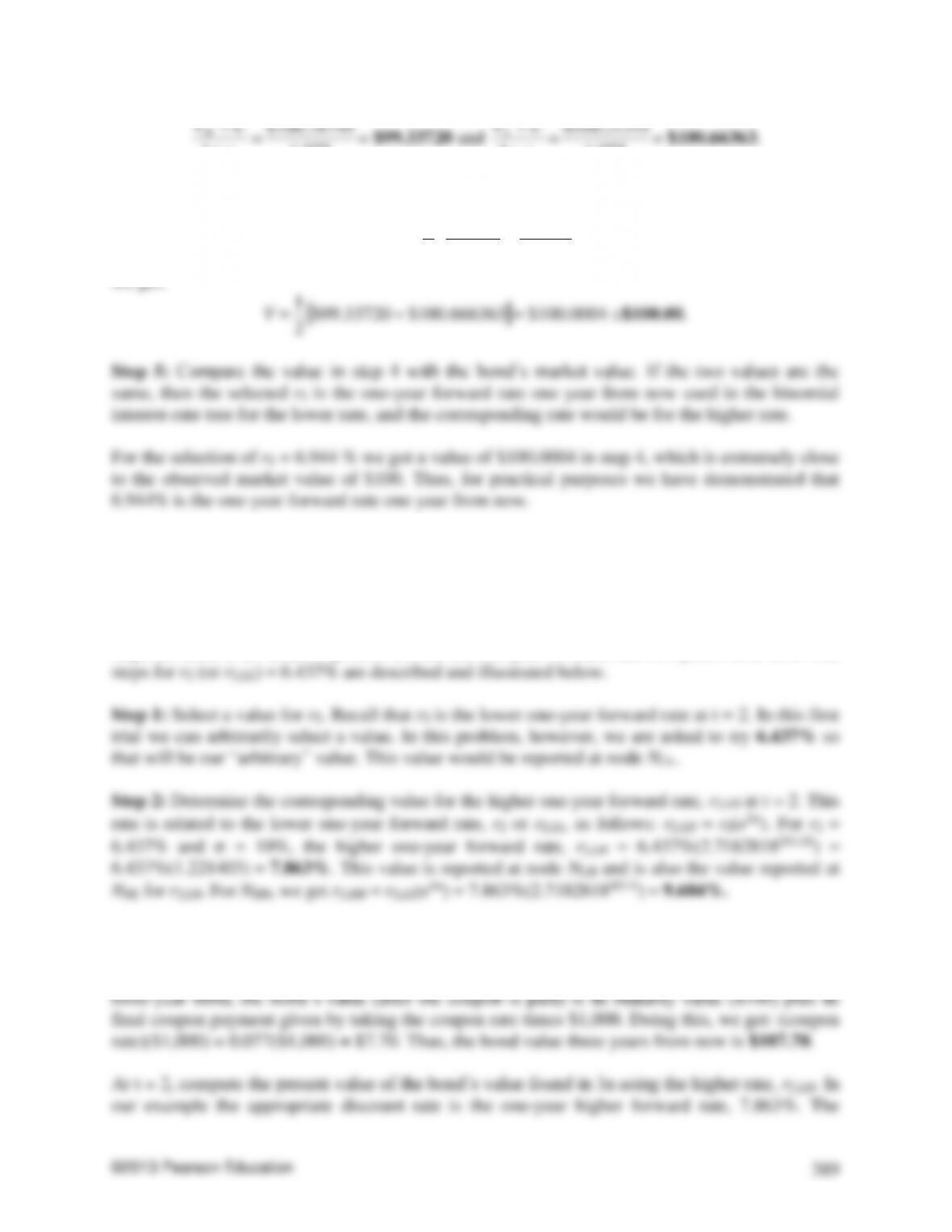
*
1r
CVH
+
+
=
075.1
78749.106$
= $99.33720 and
*
1r
CVL
+
+
=
075.1
21341.108$
= $100.66363.
Step 4: Calculate the average present value of the two cash flows in step 3. This is the
value at node N using the formula: V =
+
+
+
+
+
** 112
1
r
CV
r
CV LH
. Inserting in the values form 3e,
we get:
1+
(f) Demonstrate that if σ is assumed to be 10%, the lower one-year forward rate two years
from now is approximately 6.437%.
Now we want to “grow” our binomial tree for one more year—that is, we want to determine r2.
Now we will use the three-year on-the-run issue, the 7.7% coupon bond, to get r2. The same five
steps are used in an iterative process to find the one-year forward rate two years from now. The
Step 3: Compute the bond’s value one year from t = 1.
First, the bond’s value three years from now must first be determined. Since we are using a
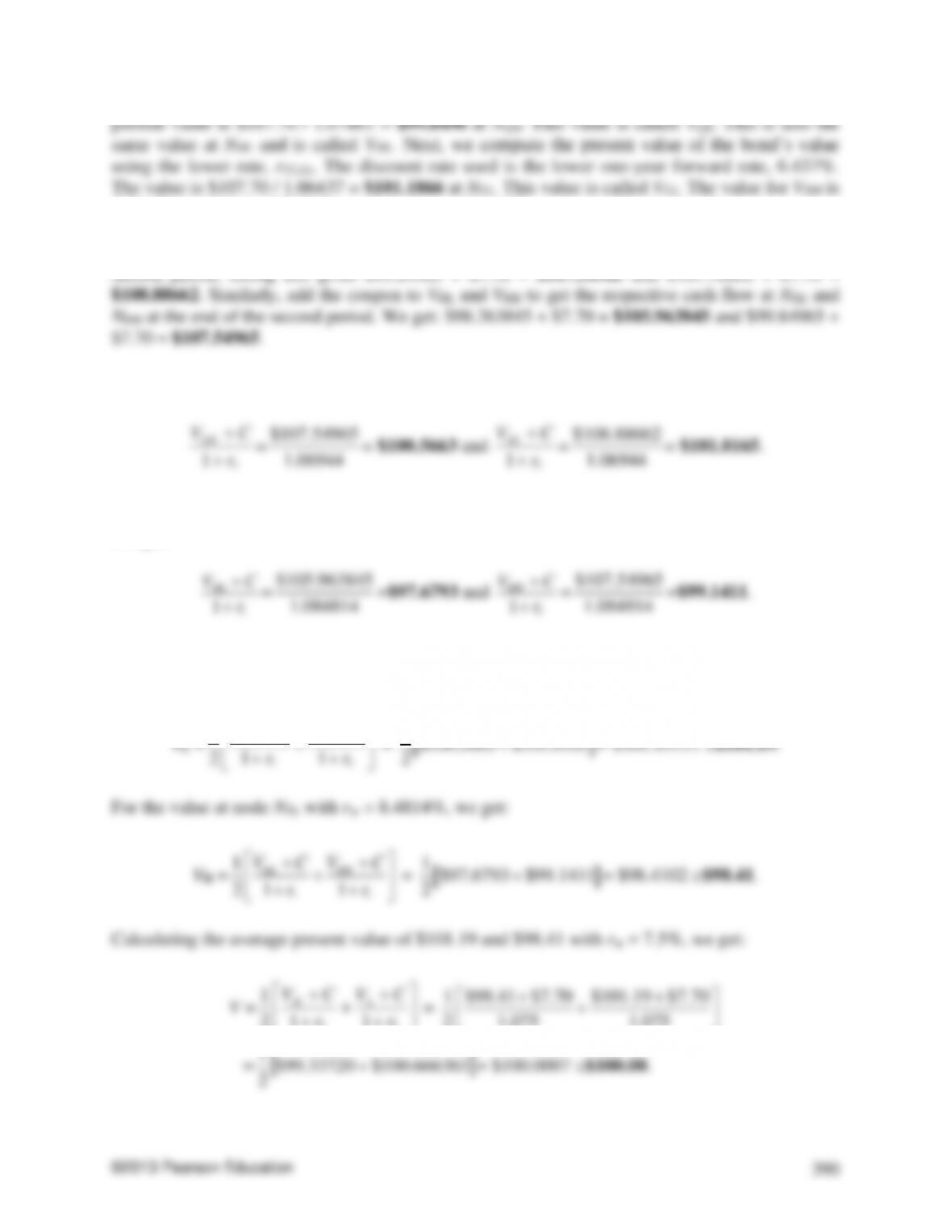
present value is $107.70 / 1.07863 = $99.8496 at NLH. This value is called VLH. This is also the
same value at NHL and is called VHL. Next, we compute the present value of the bond’s value
using the lower rate, r12,LL. The discount rate used is the lower one-year forward rate, 6.437%.
The value is $107.70 / 1.06437 = $101.1866 at NLL. This value is called VLL. The value for VHH is
$107.70 / 1.09604 = $98.2638 given our rate of 9.604% reported at NHH in Step 2.
Add the coupon to VLH and VLL to get the respective cash flow at NLH and NLL at the end of the
Now calculate the present value for VLH and VLL using the root rate of r* = 6.944%. We get:
*
1r
+
1.06944
*
1r
+
1.06944
Now calculate the present value for VHL and VHH using r* = 6.944%(1.221402758) = 8.4814%.
We get:
*
1
r
+
1.084814
*
1
r
+
1.084814
Step 4: Calculate the average present value of the two cash flows in step 3 for both NL and NH.
For the value at node NL, with r* = 6.944%, we get:
+
+
1
CV
CV LLLH
1$100.5663 $101.8165
©2013 Pearson Education
391
Step 5: Compare the value in step 4 with the bond’s market value. If the two values are the
same, the r2 used in this trial is the one we seek. If the value is greater than (lesser than) the
bond’s market value then we need to try a larger (smaller) value for r2. Since the values are both
$100.00, we have demonstrated that the lower one-year forward rate two years from now is
approximately 6.437%.
(g) Show the binomial interest-rate tree that should be used to value any bond of this
issuer.
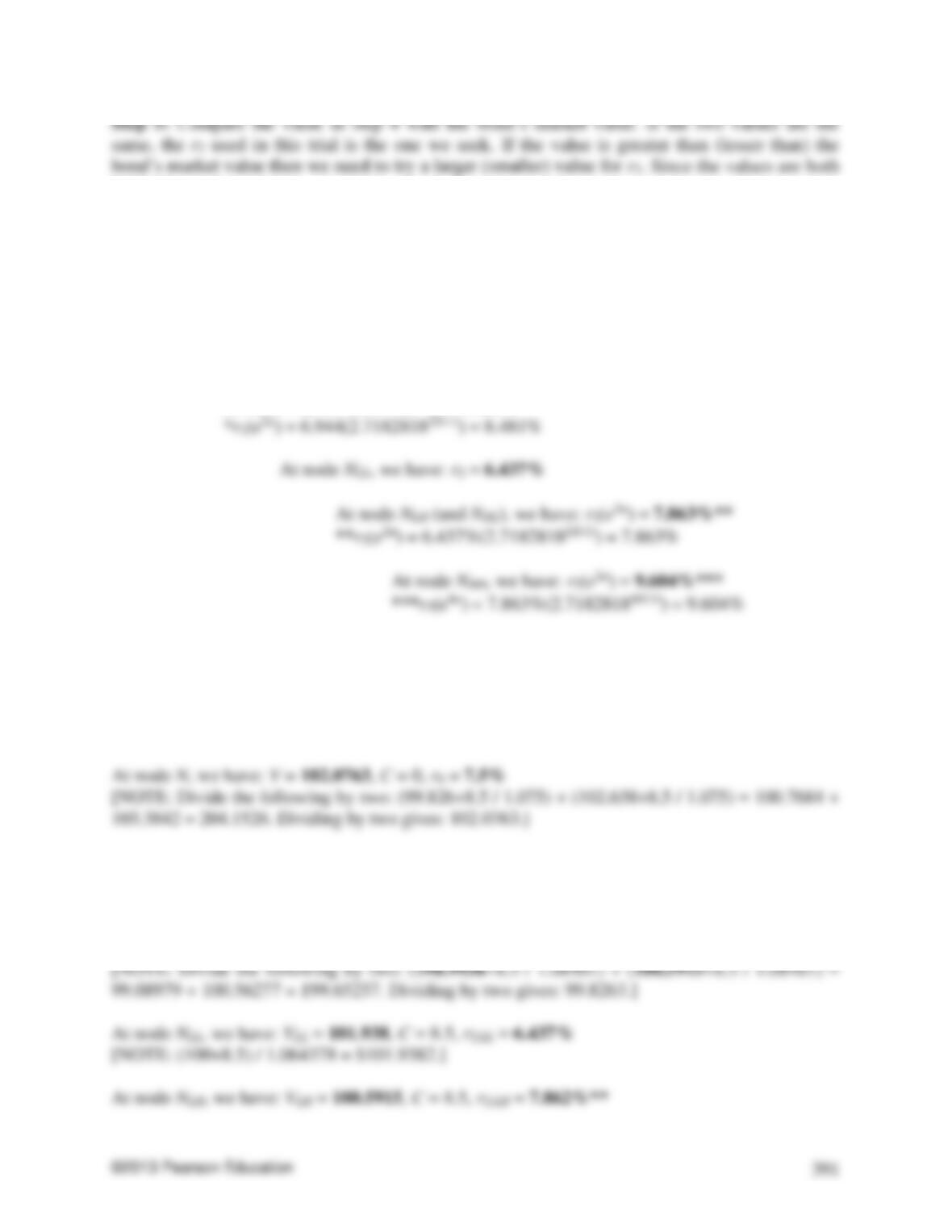
At node N, we have: r0 = 7.5%
At node NL, we have: r1 = 6.944%
At node NH, we have: r1(e2) = 8.481%*
(h) Determine the value of an 8.5% coupon option-free bond for this issuer using the binomial
interest–rate tree given in part g.
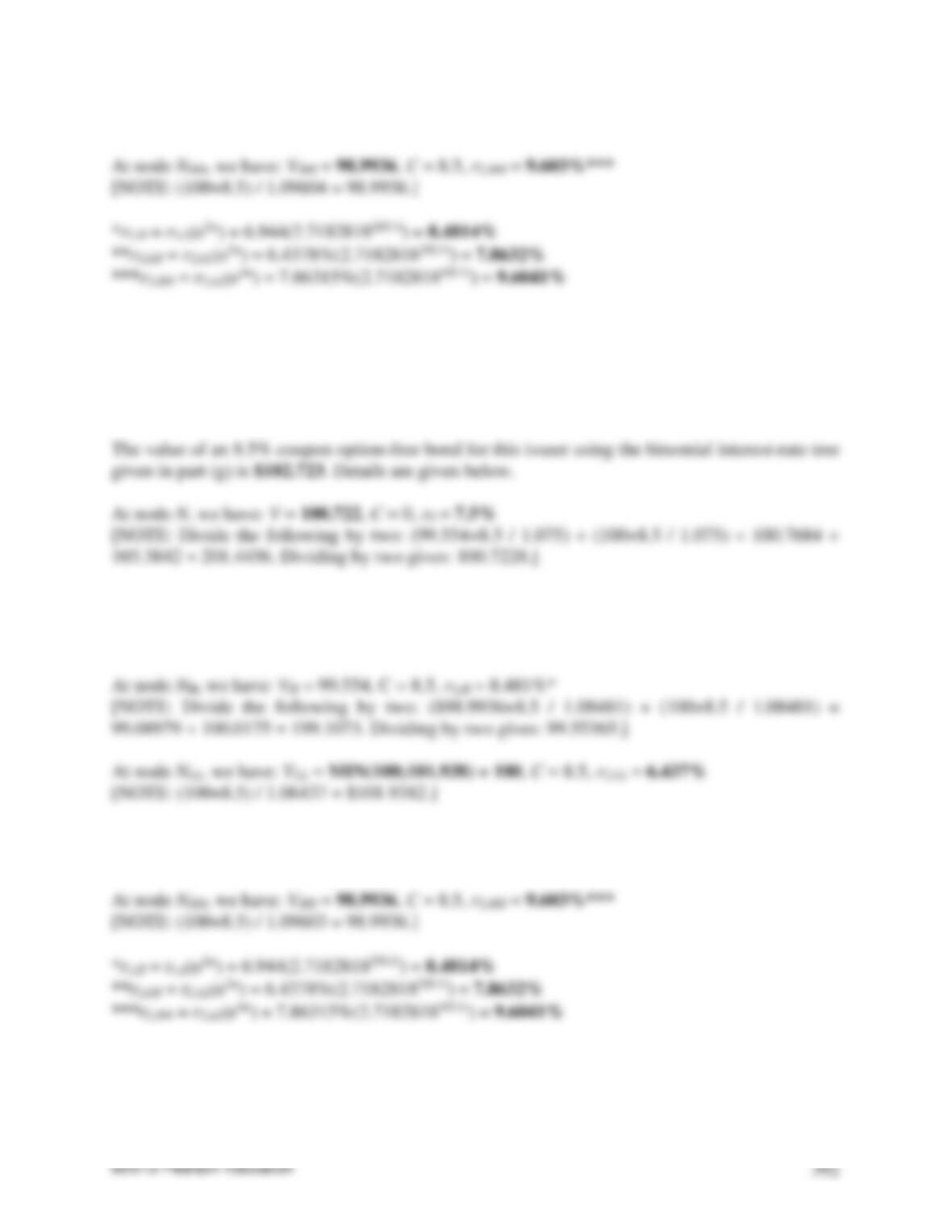
The value of an 8.5% coupon option-free bond for this issuer using the binomial interest-rate tree
given in part (g) is $102.0763. Details are given below.
At node NL, we have: VL = 102.638, C = 8.5, r1,L = 6.944%
[NOTE: Divide the following by two: (100.5915+8.5 / 1.06944) + ($101.938+8.5 / 1.06944) =
102.0081 + 103.2671 = 205.2752. Dividing by two gives: 102.6376.]
At node NH, we have: VH = 99.826, C = 8.5, r1,H = 8.481%*
[NOTE: (100+8.5) / 1.07863 = 100.5915.]
(i) Determine the value of an 8.5% coupon bond that is callable at par (100) assuming that
the issue will be called if the price exceeds par.
The value of an 8.5% coupon callable bond for this issuer using the binomial interest-rate tree
given in part (g) is $100.723. Details are given below.
At node NL, we have: VL = MIN(100;101.455) = 100, C = 8.5, r1,L = 6.944%
[NOTE: Divide the following by two: (100+8.5 / 1.06944) + ($100+8.5 / 1.06944) = 101.45497 +
101.45497 = 202.90993. Dividing by two gives: 101.45497.]
At node NLH, we have: VLH = MIN(100;100.5915) = 100, C = 8.5, r2,LH = 7.862%**
[NOTE: (100+8.5) / 1.07862 = 100.5915.]
14. Explain how an increase in expected interest-rate volatility can decrease the value of
a callable bond.
©2013 Pearson Education
393
From an investor’s point of view, they have sold a call option to the firm. The firm will exercise
its call option when interest rates fall by enough to make it worth the company’s costs to
refinance its debt at a lower interest rate. The probability of this fall occurring increases when
there is greater volatility in interest rates.
If and when interest rates fall, investors will have to “sell” their bonds back to the firm. If they
want to invest the money received in bonds, they will have to purchase bonds with lower coupon
payments. Thus, as expected interest-rate volatility increases, then the value of holding a callable
fond can decrease.
15. Answer the below questions.
(a) What is meant by the option-adjusted spread?
(b) What is the option-adjusted spread relative to?
16. “The option-adjusted spread measures the yield spread over the Treasury on-the-run
yield curve.” Explain why you agree or disagree with this statement.
As seen below, there are various ways to measure the option-adjusted yield spread. In terms of
the option-adjusted spread (OAS), it measures the yield spread over the spot rate curve or
benchmark used in the valuation. More details are supplied below.
©2013 Pearson Education
394
Treasury securities with maturities coinciding with the amount and timing of the cash flows of
the corporate bond.
The option-adjusted spread (OAS) is a spread over the spot rate curve or benchmark used in the
valuation. In the case of the binomial method, the OAS is a spread over the binomial interest rate
tree. Some market participants construct the binomial interest-rate tree using the Treasury spot
rates. In this case the OAS reflects the richness or cheapness of the security, if any, plus a credit
spread. Other market participants construct the binomial interest–rate tree from the issuer’s spot
rate curve. In this case the credit risk is already incorporated into the analysis, and the OAS
therefore reflects the richness or cheapness of a security. Therefore, it is critical to know the
on-the-run issues that the modeler used to construct the binomial interest-rate tree.
17. What is the effect of greater expected interest-rate volatility on the option-adjusted
spread of a security?
18. The following excerpt is taken from an article titled “Call Provisions Drop Off” that
appeared in the January 27, 1992, issue of BondWeek, p. 2:
“Issuance of callable long-term bonds dropped off further last year as interest rates fell,
removing the incentive for many issuers to pay extra for the provision, said Street capital
Answer the below questions.
(a) What “incentive” is this article referring to in the first sentence of the excerpt?
The call option embedded in a callable bond becomes more valuable when issuers expect interest
rates to fall. The likelihood of this occurring is greater if interest rates are believed to be high.
(b) Why would issuers not be willing to pay for this incentive if they feel that interest rates
will continue to decline?
©2013 Pearson Education
395
issuers feel are reasonable terms. Issuers will not issue callable bonds if they cannot get the terms
they want.
19. The following excerpt is taken from an article titled “Eagle Eyes High-Coupon Callable
Corporates” that appeared in the January 20, 1992, issue of BondWeek, p. 7:
“If the bond market rallies further, Eagle Asset Management may take profits, trading $8
million of seven- to 10-year Treasuries for high-coupon single-A industrials that are
Answer the below questions.
(a) Why is modified duration an inappropriate measure for a high-coupon callable bond?
Money managers want to know the price sensitivity of a bond when interest rates change.
Modified duration is a measure of the sensitivity of a bond’s price to interest-rate changes,
assuming that the expected cash flow does not change with interest rates. Consequently,
(b) What would be a better measure than modified duration?
Although modified duration may be inappropriate as a measure of a bond’s price sensitivity to
interest rate changes, there is a duration measure that is more appropriate for bonds with
embedded options. Because duration measures price responsiveness to changes in interest rates,
( )
( )
0
2
P dy
where P_ = price if yield is decreased by x basis points, P+ = price if yield is increased by x basis
points, P0 = initial price (per $100 of par value), and Δ y (or dy) = change in rate used to
calculate price (x basis points in decimal form).
©2013 Pearson Education
396
duration formula is applied to a bond with an embedded option, the new prices at the higher and
lower yield levels should reflect the value from the valuation model. Duration calculated in this
way is called effective duration or option-adjusted duration.
(c) Why would the replacement of 10-year Treasuries with high-coupon callable bonds
reduce the portfolio’s duration?
The replacement of 10-year Treasuries with high-coupon callable bonds reduces the portfolio’s
duration because the effective duration for callable bonds can be well below the modified
duration. More details are given below on the relationships among duration, modified duration,
and effective duration.