Problem 16-3
A 9-year bond has a yield of 10% and a duration of 7.194 years. If the market yield changes by 50 basis points, what is the
percentage change in the bond’s price? (Do not round intermediate calculations. Input the amount as a positive value.
Round your answer to 2 decimal places. Omit the “%” sign in your response.)
Dates 1/1/2013 Dates 1/1/2013
1/1/2016 1/1/2016
Base Base
Yield to Maturity 6.000%
Yield to Maturity
10.000%
Coupon Rate 6.000%
Coupon Rate
Years to Maturity
Holding Period
Market Price
6.000%
Problem 16-4
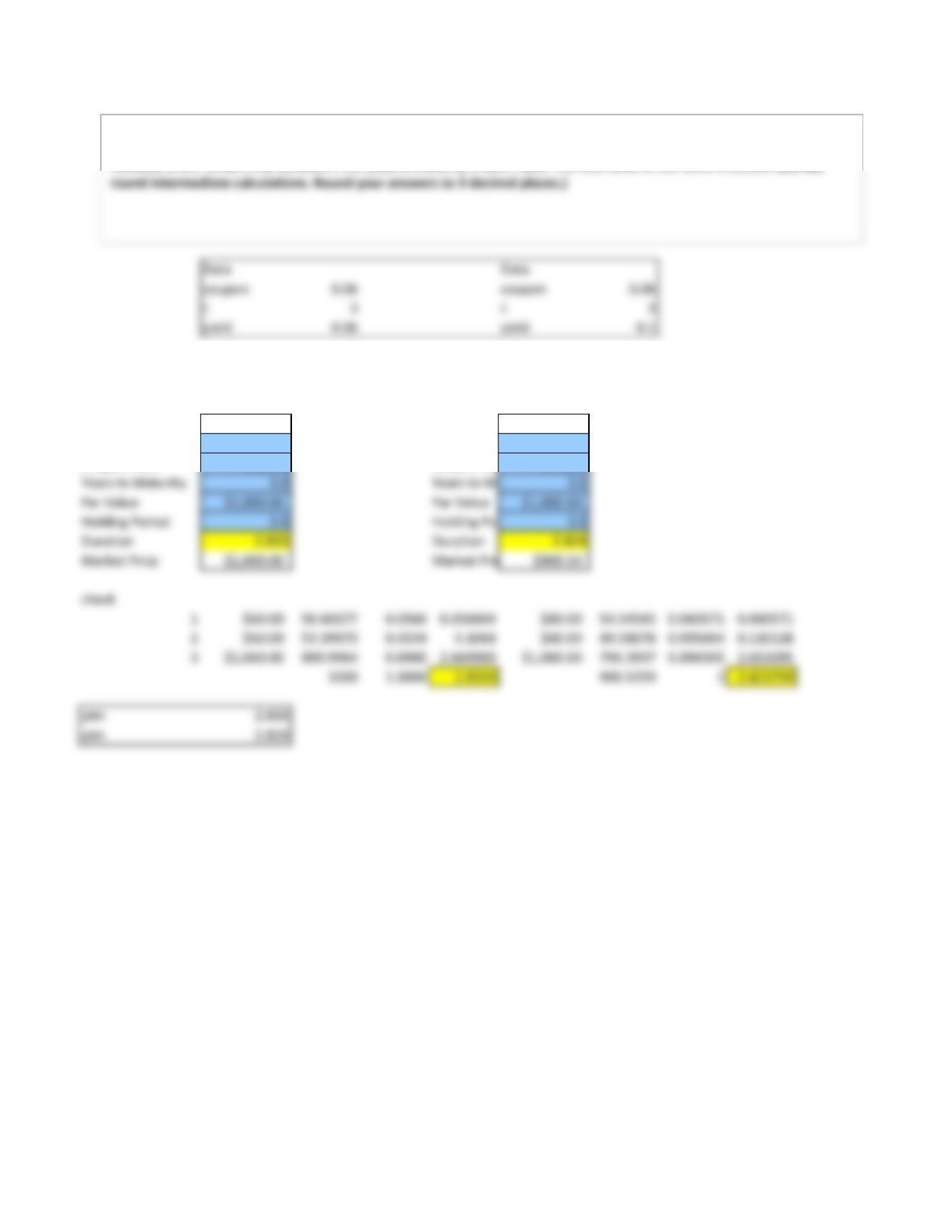
Find the duration of a 6% coupon bond making annual coupon payments if it has 3 years until maturity and has a yield to
maturity of 6%. What is the duration if the yield to maturity is 10%? Note: The face value of the bond is $1,000. (Do not
Dates 1/1/2013 Dates 1/1/2013
1/1/2019 1/1/2019
Base Base
Yield to Maturity 3.000% Yield to Maturity 5.000%
1 $30.00 29.12621 0.029126 0.029126214
2 $30.00 28.27788 0.028278 0.056555755
Problem 16-5
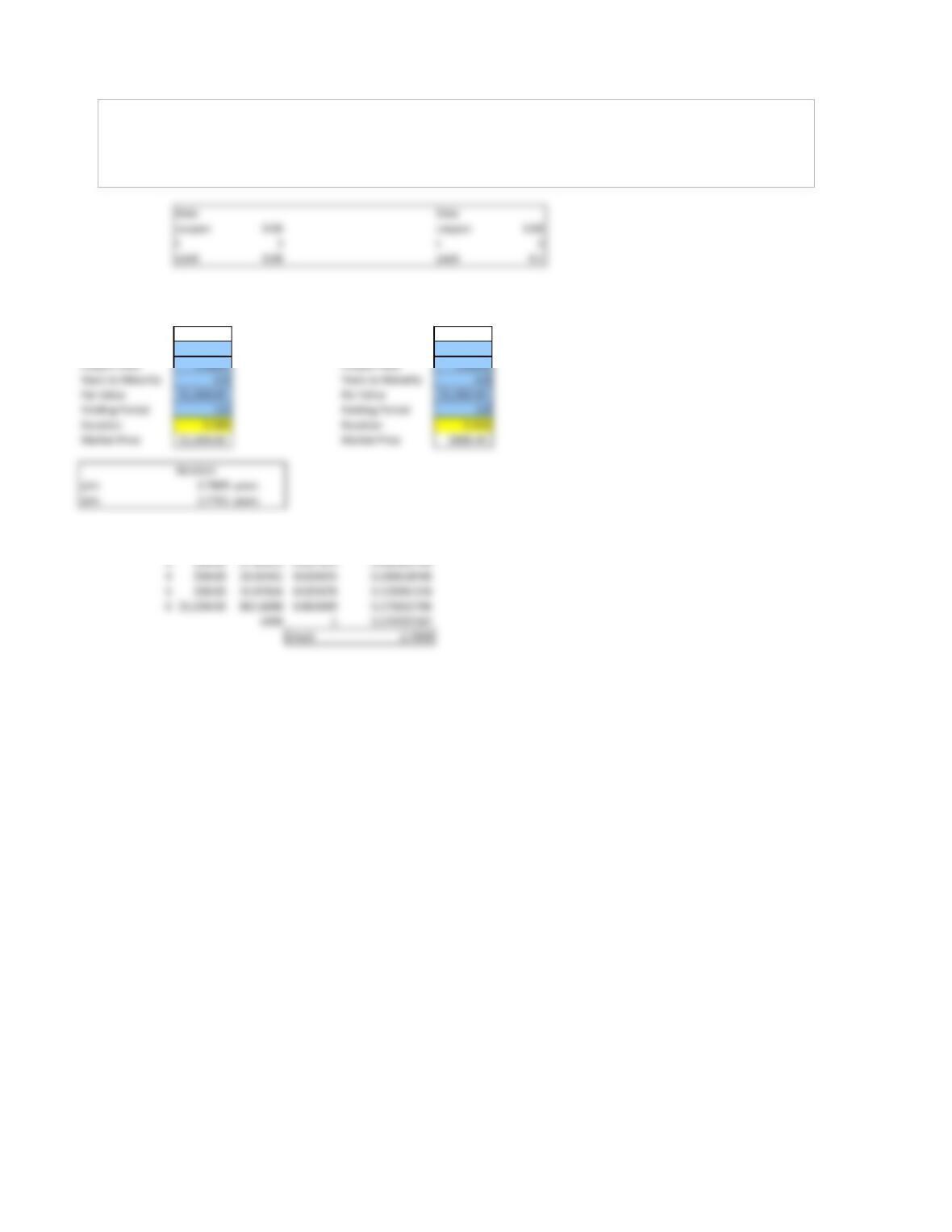
Find the duration of a 6% coupon bond making semiannually coupon payments if it has 3 years until maturity and has a yield to maturity of 6%. What
is the duration if the yield to maturity is 10%? Note: The face value of the bond is $1,000. (Do not round intermediate calculations. Round your
answers to 4 decimal places.)
Data
110 mil
5 4 mil
Problem 16-9
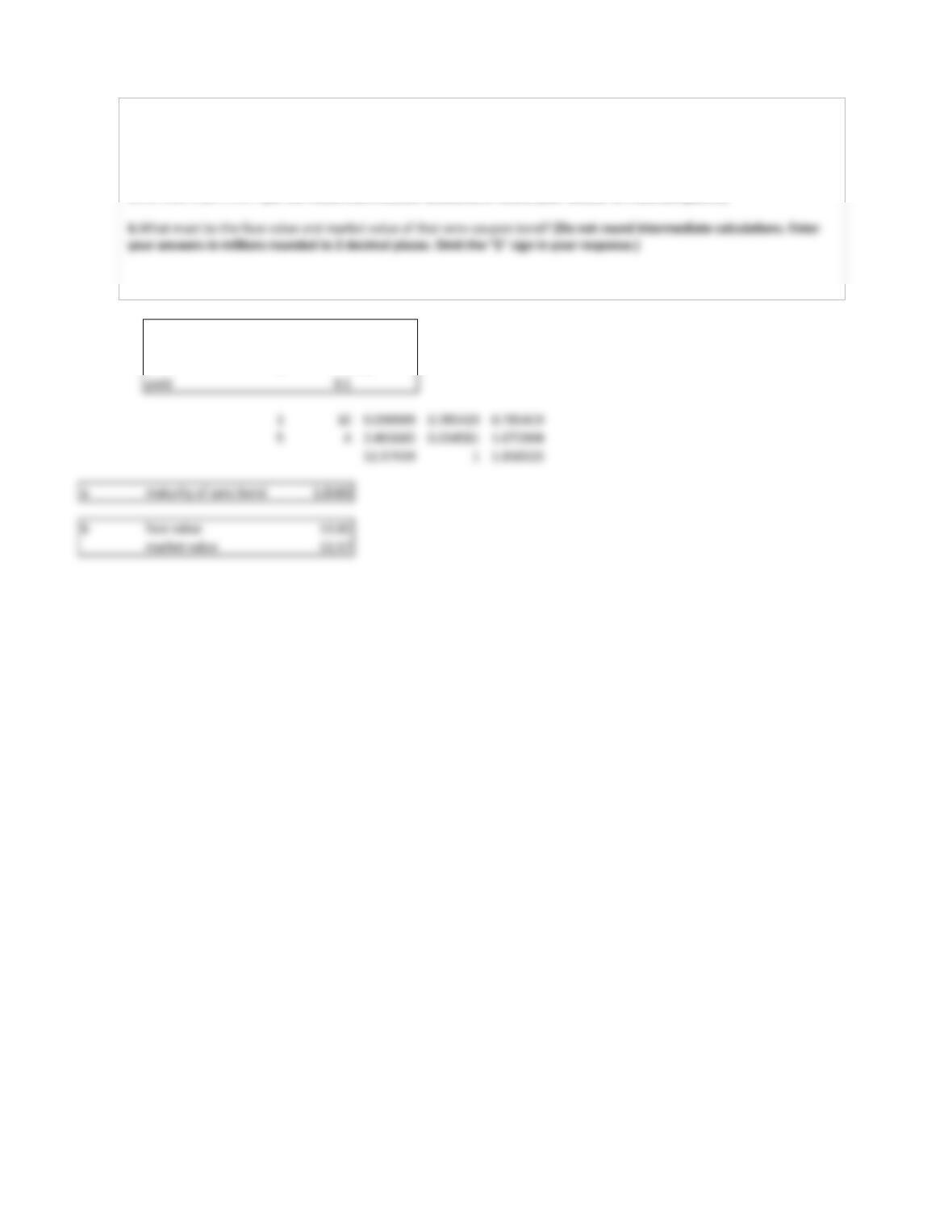
An insurance company must make payments to a customer of $10 million in 1 year and $4 million in 5 years. The yield curve is
flat at 10%.
a.If it wants to fully fund and immunize its obligation to this customer with a single issue of a zero-coupon bond, what maturity
bond must it purchase? (Do not round intermediate calculations. Round your answer to 4 decimal places.)
par 1000
Data
t 1 t 2 t 3
yield 0.07 yield 0.08 yield 0.09
Problem 16-11
Currently, the term structure is as follows: 1-year zero-coupon bonds yield 7%, 2-year bonds yield 8%, 3-year bonds and
longer-maturity bonds all yield 9%. You are choosing between 1-, 2-, and 3-year maturity bonds all paying annual coupons of
8%.
Data
tuition 10000
a present value 17832.65
Duration 1.4808
b duration 1.4808
face value 19985.21
Problem 16-12
You will be paying $10,000 a year in tuition expenses at the end of the next 2 years. Bonds currently yield 8%.
a.What is the present value and duration of your obligation? (Do not round intermediate calculations. Round “Present value” to 2 decimal places
and “Duration” to 4 decimal places. Omit the “$” sign in your response.)
b.What maturity zero-coupon bond would immunize your obligation? (Do not round intermediate calculations. Round “Duration” to 4 decimal
c-1.Now suppose that rates immediately increase to 9%. What happens to your net position, that is, to the difference between the value of the bond
and that of your tuition obligation?
(Do not round intermediate calculations. Input the amount as a positive value. Round your answer to 2 decimal
c-2.Now suppose that rates immediately falls to 7%. What happens to your net position, that is, to the difference between the value of the bond and
Data
perp 2 mil
yield 0.16
Problem 16-13
Pension funds pay lifetime annuities to recipients. If a firm will remain in business indefinitely, the pension obligation will resemble a perpetuity. Suppose,
therefore, that you are managing a pension fund with obligations to make perpetual payments of $2 million per year to beneficiaries. The yield to maturity
on all bonds is 16%.
a.If the duration of 5-year maturity bonds with coupon rates of 12% (paid annually) is 4 years and the duration of 20-year maturity bonds with coupon
rates of 6% (paid annually) is 11 years, how much of each of these coupon bonds (in market value) will you want to hold to both fully fund and immunize
Data
perpetuity duration 21
a w 0.6875
1-w 0.3125
Data
portfolio 1 mil
Problem 16-14
You are managing a portfolio of $1 million. Your target duration is 10 years, and you can choose from two bonds: a zero–
coupon bond with maturity of 5 years, and a perpetuity, each currently yielding 5%.
a.What weight of each bond will you hold to immunize your portfolio? (Round your answers to 2 decimal places. Omit the
“%” sign in your response.)
b.How will these weights change next year if target duration is now 9 years? (Round your answers to 2 decimal places. Omit
the “%” sign in your response.)
Data
payment 10000
t10
first payment 5
r 0.1
110000 9090.909 0.14795 0.14795
210000 8264.463 0.1345 0.269001
310000 7513.148 0.122273 0.366819
a duration 8.7255 4.7255
b $41,968.22
520
roblem 16-15
My pension plan will pay me $10,000 once a year for a 10-year period. The first payment will come in exactly 5 years.
The pension fund wants to immunize its position.
a.What is the duration of its obligation to me? The current interest rate is 10% per year. (Do not round intermediate
Data
t30 par 1000
coupon 0.12
Problem 16-16
A 30-year maturity bond making annual coupon payments with a coupon rate of 12% has duration of 11.54 years and convexity of 192.4. The bond currently sells
at a yield to maturity of 8%.
a.Find the price of the bond if its yield to maturity falls to 7% or rises to 9%. (Do not round intermediate calculations. Round your answers to 2 decimal places.
Omit the “$” sign in your response.)
c.What is the percentage error for each rule? (Negative answers should be indicated by a minus sign. Do not round intermediate calculations. Round your
Data
price 107.18 100
Problem 16-18
Frank Meyers, CFA, is a fixed-income portfolio manager for a large pension fund. A member of the Investment Committee, Fred Spice, is very interested in learning about the
management of fixed-income portfolios. Spice has approached Meyers with several questions. Specifically, Spice would like to know how fixed-income managers position portfolios to
capitalize on their expectations of future interest rates.
Characteristics of Fixed-Rate Bond and Fixed-Rate Note
Spice asks Meyers to quantify price changes from changes in interest rates. To illustrate, Meyers computes the value change for the fixed-rate note in the table. Specifically, he assumes
an increase in the level of interest rate of 100 basis points. Using the information in the table, what is the predicted chan ge in the price of the fixed-rate note? (Negative amount should
Data par 1000
t30 20
coupon 0.07 0.065
price 867.42 879.5
Problem 16-19
A 30-year maturity bond has a 7% coupon rate, paid annually. It sells today for $867.42. A 20-year maturity
bond has 6.5% coupon rate, also paid annually. It sells today for $879.50. A bond market analyst forecasts that
in 5 years, 25-year maturity bonds will sell at yields to maturity of 8% and 15-year maturity bonds will sell at
yields of 7.5%. Because the yield curve is upward sloping, the analyst believes that coupons will be invested in
short-term securities at a rate of 6%.
t25 15
ytm 0.08 0.075
increase 0.09
$374.84 $774.84
0.09 $333.28 $691.79
a actual -0.1109 -0.1072
predicted -0.1106 -0.10634
roblem 16-22
A 12.75-year maturity zero-coupon bond selling at a yield to maturity of 8% (effective annual yield) has convexity of 150.3 and modified duration of
11.81 years. A 30-year maturity 6% coupon bond making annual coupon payments also selling at a yield to maturity of 8% has nearly identical
duration—11.79 years—but considerably higher convexity of 231.2.
a.
Suppose the yield to maturity on both bonds increases to 9%. What will be the actual percentage capital loss/gain on each bond? What percentage
capital loss/gain would be predicted by the duration-with-convexity rule? (Input all amounts as positive values. Do not round intermediate
calculations. Round your answers to 2 decimal places. Omit the “%” sign in your response.)
Data
Dates 1/1/2013 1 $70.00 65.42056 2 130.8411
1/1/2023 2 $70.00 61.14071 6 366.8443
Base 3 $70.00 57.14085 12 685.6902
Yield to Maturity 7.000% 4 $70.00 53.40266 20 1068.053
Dates 1/1/2013
1/1/2023
Base
Yield to Maturity 8.000%
Coupon Rate 7.000%
Problem 16-23
A newly issued bond has a maturity of 10 years and pays a 7% coupon rate (with coupon payments coming once annually). The bond sells
at par value.
a.What are the convexity and the duration of the bond? Use the formula for convexity in footnote 7.(Round your answers to 3 decimal
places.)