Chapter 16 – Managing Bond Portfolios
16–12
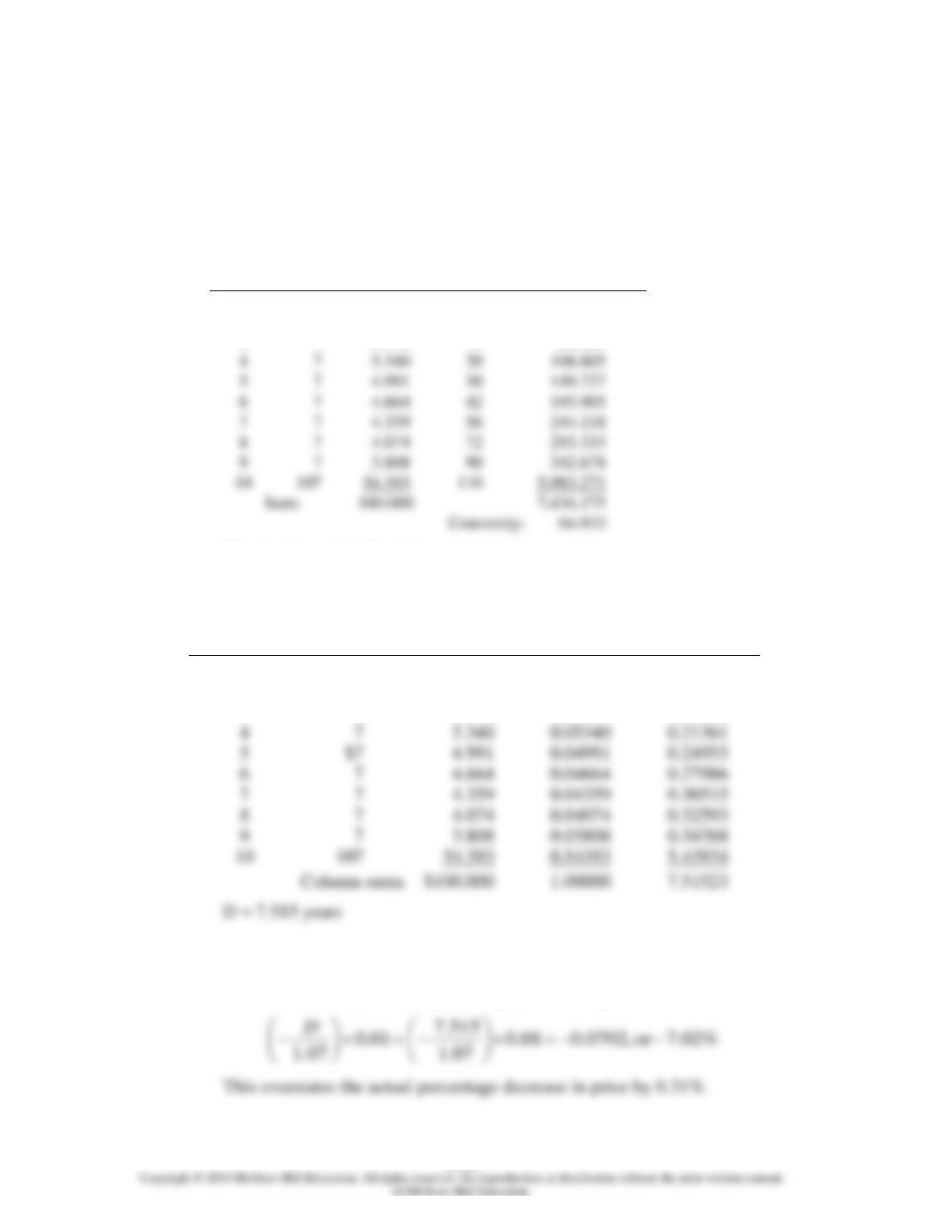
23. a. The following spreadsheet shows that the convexity of the bond is 64.933.
The present value of each cash flow is obtained by discounting at 7%.
(Since the bond has a 7% coupon and sells at par, its YTM is 7%.)
Convexity equals: the sum of the last column (7,434.175) divided by:
[P × (1 + y)2] = 100 × (1.07)2 = 114.49
Time
(t)
Cash Flow
(CF)
PV(CF)
t2 + t
(t2 + t) × PV(CF)
1
7
6.542
2
13.084
2
7
6.114
6
36.684
3
7
5.714
12
68.569
4
7
5.340
6
7
4.664
42
7
7
4.359
8
7
4.074
9
7
3.808
90
64.933
The duration of the bond is:
(1)
(2)
(3)
(4)
(5)
Time until
Payment
(Years)
Cash Flow
PV of CF
(Discount
Rate = 7%)
Weight
Column (1) ×
Column (4)
1
$7
$ 6.542
0.06542
0.06542
2
7
6.114
0.06114
0.12228
3
7
5.714
0.05714
0.17142
4
7
5.340
0.05340
0.21361
5
$7
4.991
0.04991
0.24955
6
7
4.664
0.04664
0.27986
7
7
4.359
0.04359
0.30515
8
7
4.074
0.04074
0.32593
9
7
3.808
0.03808
0.34268
107
54.393
0.54393
5.43934
1.00000
7.51523
b. If the yield to maturity increases to 8%, the bond price will fall to 93.29%
of par value, a percentage decrease of 6.71%.
c. The duration rule predicts a percentage price change of
Chapter 16 – Managing Bond Portfolios
16–13
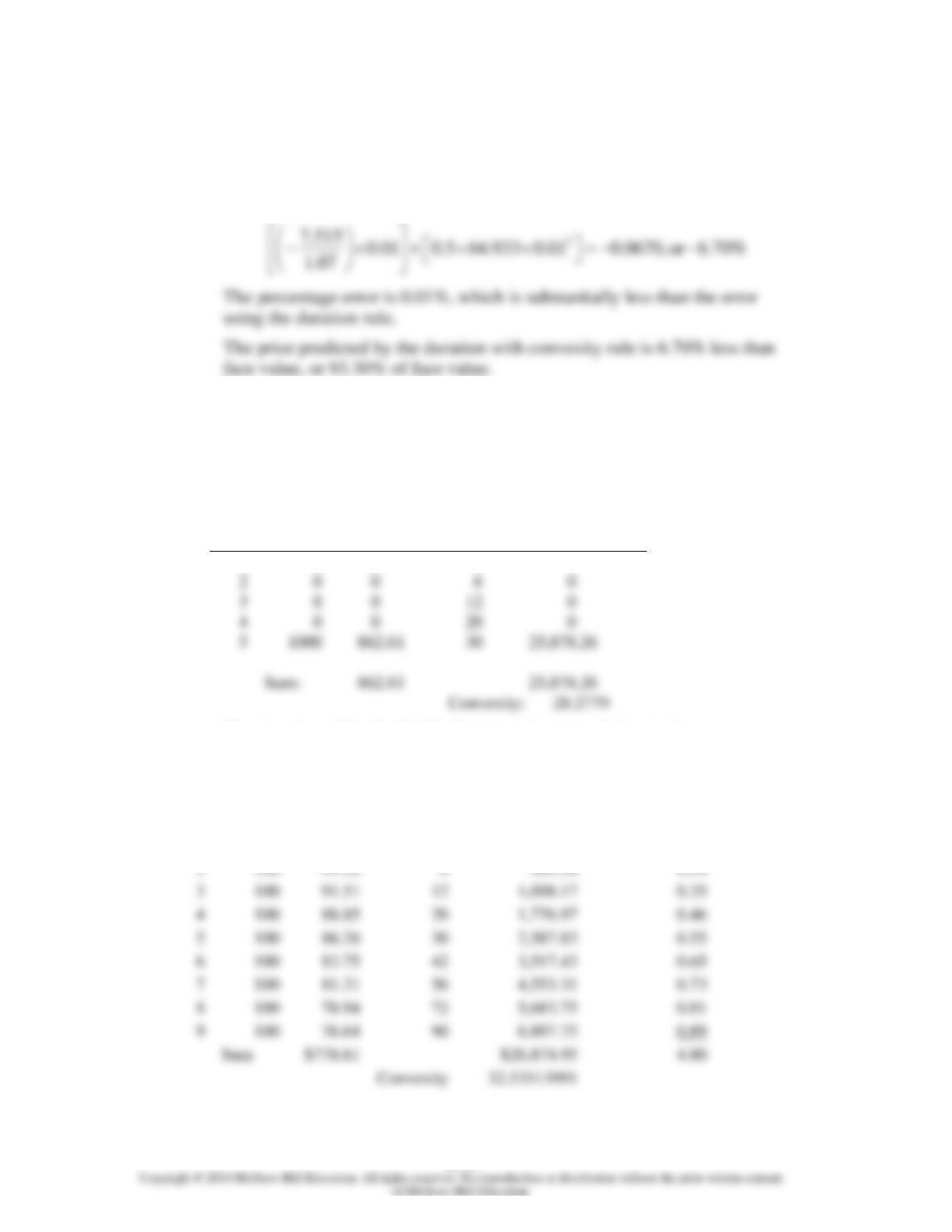
The price predicted by the duration rule is 7.02% less than face value, or
92.98% of face value.
d. The duration-with-convexity rule predicts a percentage price change of
24.a. The following spreadsheet shows that the convexity of the “bullet” bond is
28. 2779. The present value of each cash flow is obtained by discounting at
3%. Convexity equals the sum of the last column (25,878.26) divided by
[P × (1 + y)2] = 862.61 × (1.03)2 = 915.1416
Time
(t)
Cash flow
(CF)
PV(CF)
t2 + t
(t2 + t) × PV(CF)
1
0
0
2
0
The duration of the “bullet” is five years because of the single payment at
maturity.
b. Time
(t)
Cash
Flow
(CF)
PV(CF)
t + t2
(t + t2) x
PV(CF)
t X
PV(CF)/price
1
100
$ 97.09
2
$ 194.17
0.12
2
100
6
0.24
3
100
0.35
4
100
0.46
5
100
0.55
6
100
0.65
7
100
0.73
8
100
0.81
9
100
0.89
4.80
Chapter 16 – Managing Bond Portfolios
16–14
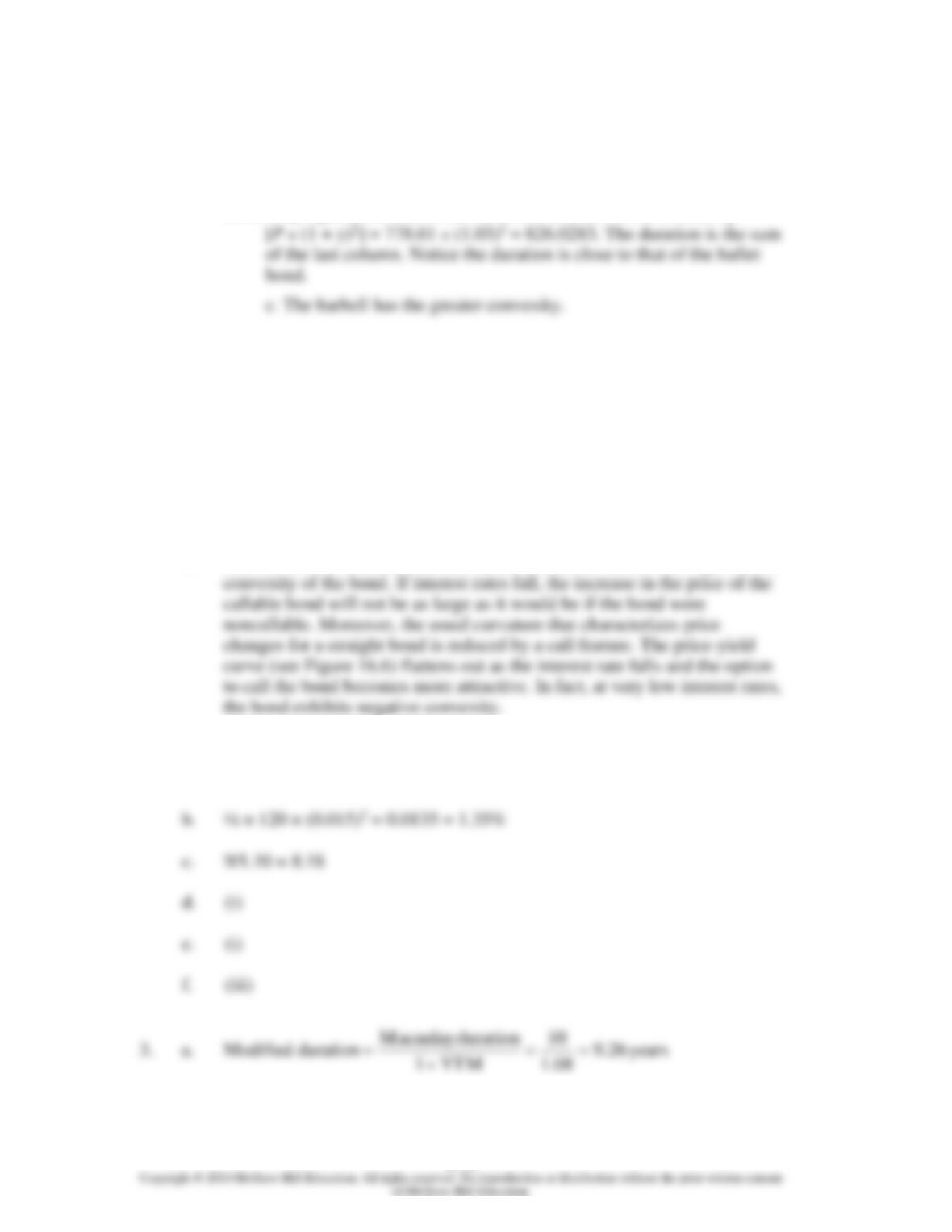
The present value of each cash flow is obtained by discounting at 3%.
Convexity equals: the sum of the last column (26,874.95) divided by
CFA PROBLEMS
1. a. The call feature provides a valuable option to the issuer, since it can buy
back the bond at a specified call price even if the present value of the
scheduled remaining payments is greater than the call price. The investor
will demand, and the issuer will be willing to pay, a higher yield on the
issue as compensation for this feature.
b. The call feature reduces both the duration (interest rate sensitivity) and the
2. a. Bond price decreases by $80.00, calculated as follows:
10 × 0.01 × 800 = 80.00
Chapter 16 – Managing Bond Portfolios
16–15
b. For option-free coupon bonds, modified duration is a better measure of the
bond’s sensitivity to changes in interest rates. Maturity considers only the
ii. Modified duration decreases as maturity decreases.
d. Convexity measures the curvature of the bond’s price-yield curve. Such
curvature means that the duration rule for bond price change (which is
based only on the slope of the curve at the original yield) is only an
4. a. (i) Current yield = Coupon/Price = $70/$960 = 0.0729, or 7.29%
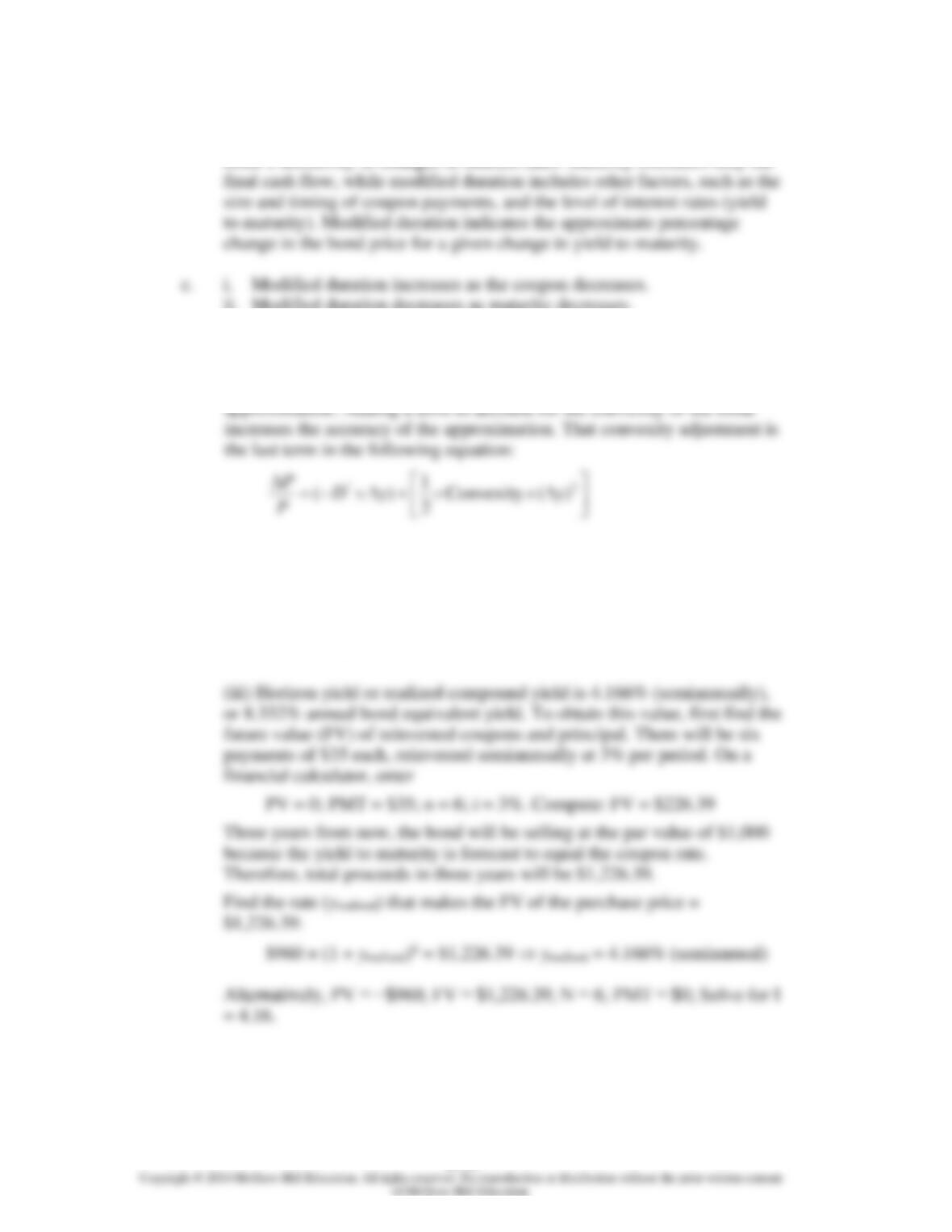
(ii) YTM = 3.993% semiannually or 7.986% annual bond equivalent yield.
[Financial calculator: n = 10; PV = –960; FV = 1000; PMT = 35 Compute
the interest rate.]
b. Shortcomings of each measure:
Chapter 16 – Managing Bond Portfolios
(i) Current yield does not account for capital gains or losses on bonds bought at
prices other than par value. It also does not account for reinvestment income on
coupon payments.
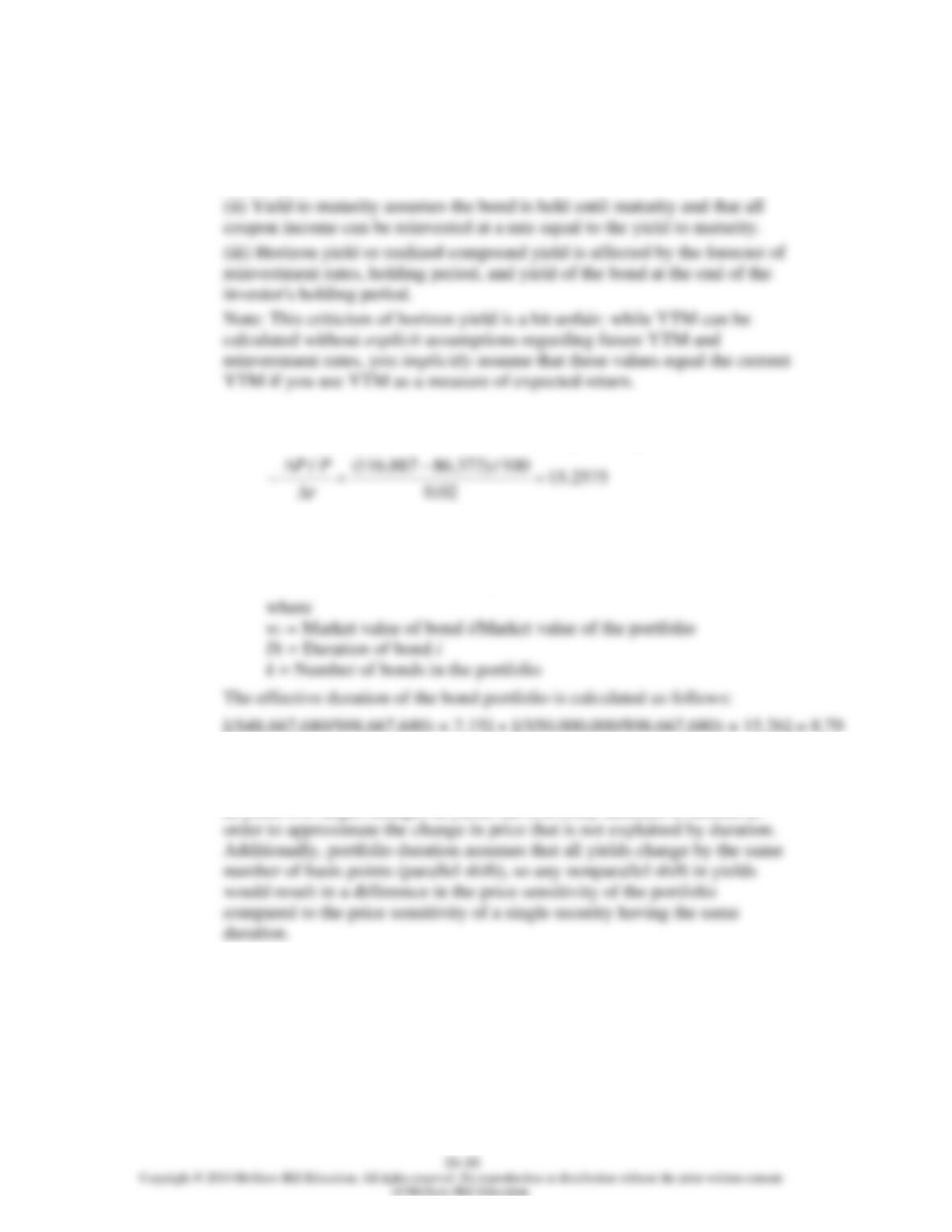
5. a. (i) The effective duration of the 4.75% Treasury security is:
(ii) The duration of the portfolio is the weighted average of the durations
of the individual bonds in the portfolio:
Portfolio duration = w1D1 + w2D2 + w3D3 + … + wkDk
b. VanHusen’s remarks would be correct if there were a small, parallel shift
in yields. Duration is a first (linear) approximation only for small changes
in yield. For larger changes in yield, the convexity measure is needed in
Chapter 16 – Managing Bond Portfolios
16–17
6. a. The Aa bond initially has a higher YTM (yield spread of 40 b.p. versus 31
b.p.), but it is expected to have a widening spread relative to Treasuries.
This will reduce the rate of return. The Aaa spread is expected to be stable.
b. Other variables to be considered:
• Potential changes in issue-specific credit quality: If the credit
quality of the bonds changes, spreads relative to Treasuries will also
change.
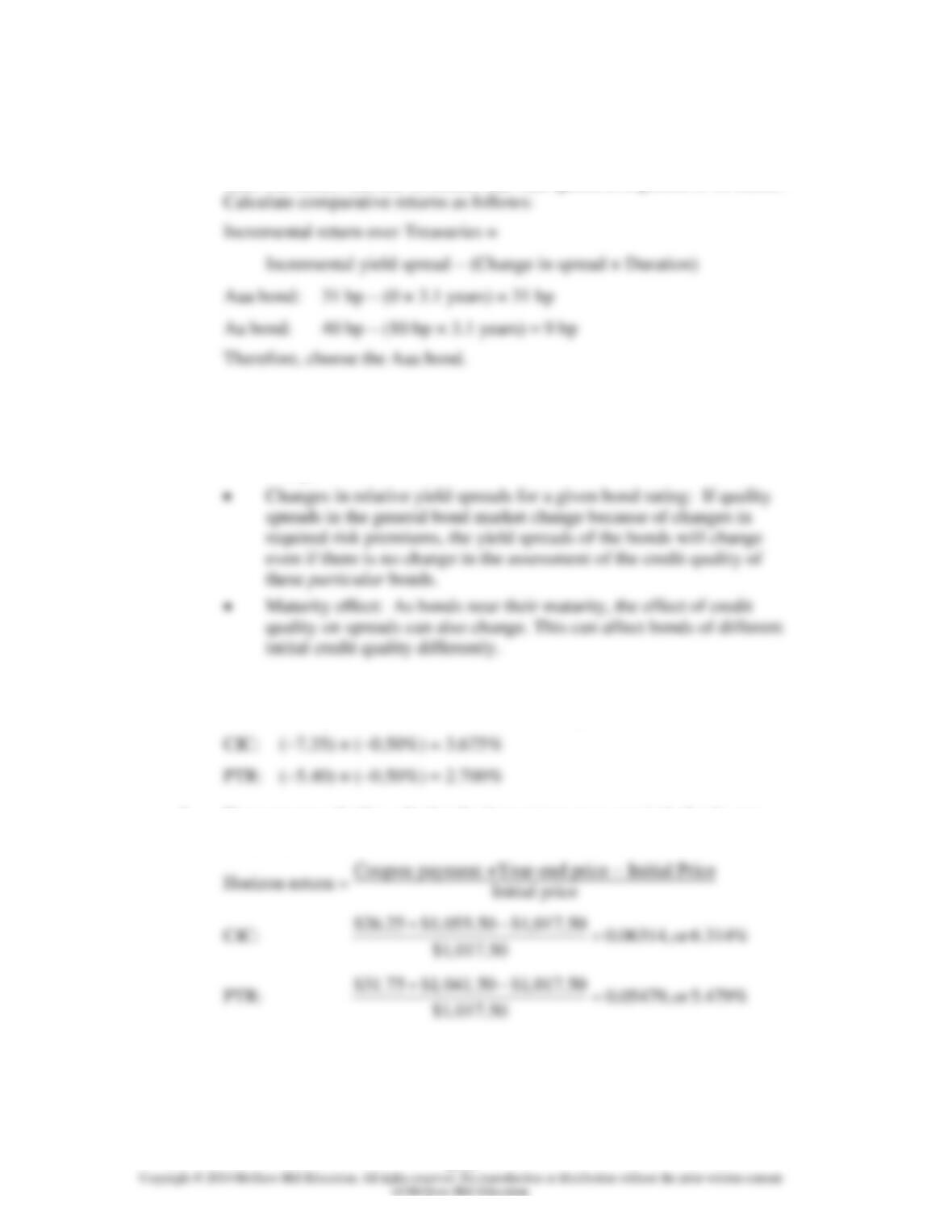
7. a. % price change = (−Effective duration) × Change in YTM (%)
b. Since we are asked to calculate horizon return over a period of only one
coupon period, there is no reinvestment income.
c. Notice that CIC is noncallable but PTR is callable. Therefore, CIC has
positive convexity, while PTR has negative convexity. Thus, the convexity
Chapter 16 – Managing Bond Portfolios
16–18
8. The economic climate is one of impending interest rate increases. Hence, we
will seek to shorten portfolio duration.
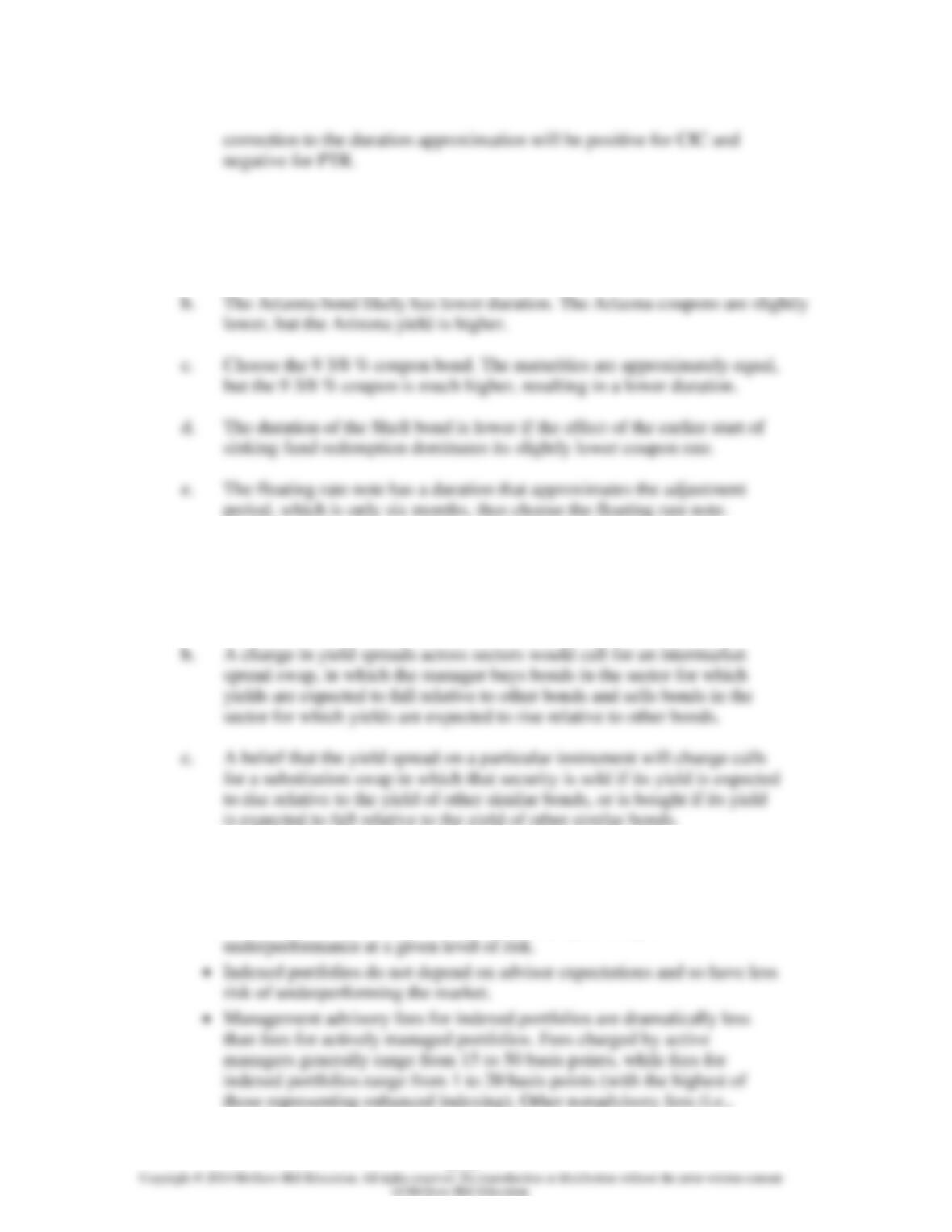
a. Choose the short maturity (2014) bond.
9. a. A manager who believes that the level of interest rates will change should
engage in a rate anticipation swap, lengthening duration if rates are
expected to fall, and shortening duration if rates are expected to rise.
10. a. The advantages of a bond indexing strategy are
• Historically, the majority of active managers underperform benchmark
indexes in most periods; indexing reduces the possibility of
Chapter 16 – Managing Bond Portfolios
16–19
custodial fees) are also less for indexed portfolios.
• Plan sponsors have greater control over indexed portfolios because
individual managers do not have as much freedom to vary from the
• The chosen bond index and portfolio returns may not meet the client
objectives or the liability stream.
• Bond indexing may restrict the fund from participating in sectors or other
opportunities that could increase returns.
b. The stratified sampling, or cellular, method divides the index into cells,
with each cell representing a different characteristic of the index. Common
c. Tracking error is defined as the discrepancy between the performance of
an indexed portfolio and the benchmark index. When the amount invested
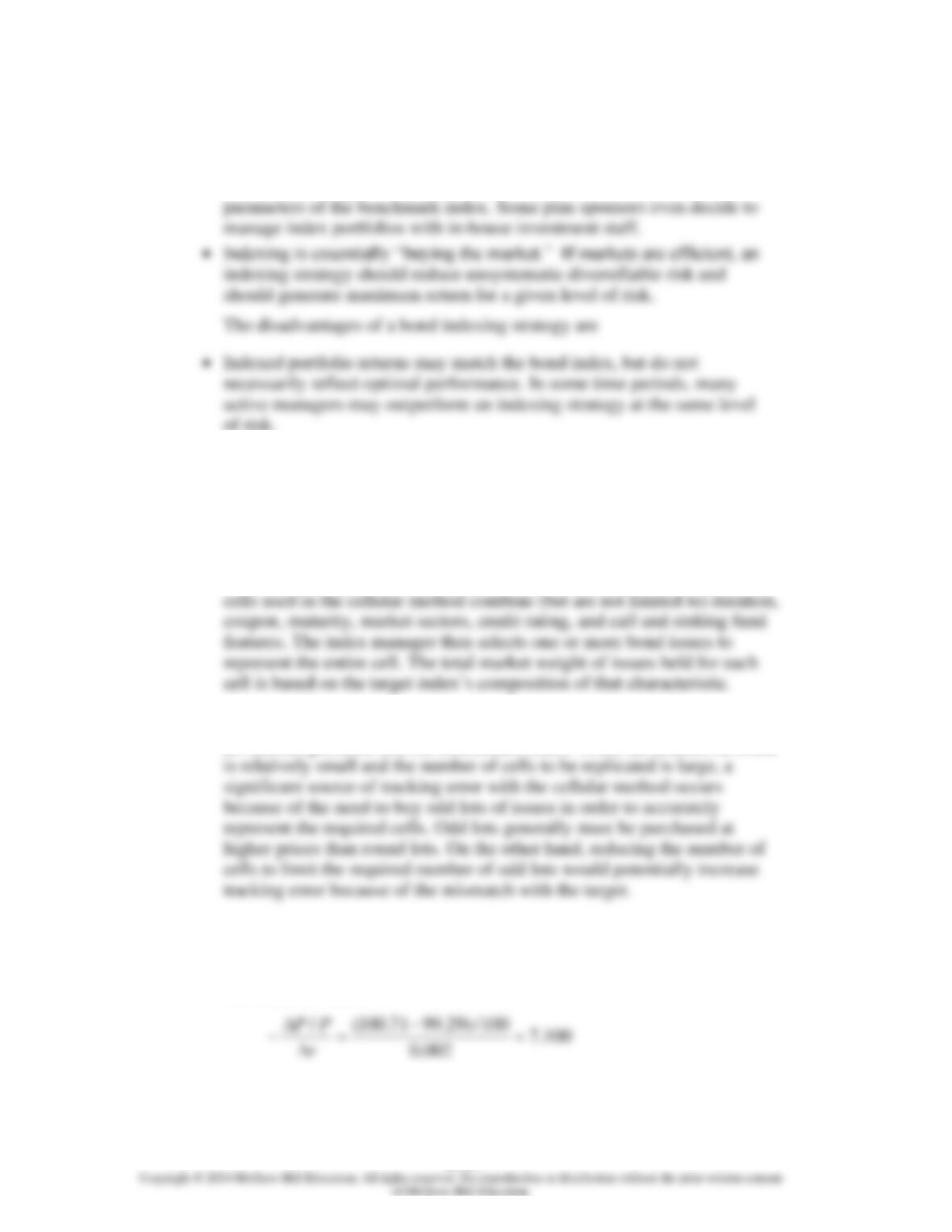
11. a. For an option-free bond, the effective duration and modified duration are
approximately the same. Using the data provided, the duration is
calculated as follows:
b. The total percentage price change for the bond is estimated as follows:
Chapter 16 – Managing Bond Portfolios
16–20
c. The assistant’s argument is incorrect. Because modified convexity does not
recognize the fact that cash flows for bonds with an embedded option can
12. ∆P/P = −D* ∆y
For Strategy I:
13. a. i. Strong economic recovery with rising inflation expectations. Interest rates
and bond yields will most likely rise, and the prices of both bonds will fall.
The probability that the callable bond will be called would decrease, and the
b. Projected price change = (Modified duration) × (Change in YTM)
= (–6.80) × (–0.75%) = 5.1%
Therefore, the price will increase to approximately $105.10 from its
current level of $100.

Chapter 16 – Managing Bond Portfolios
c. For Bond A, the callable bond, bond life, and therefore bond cash flows are
uncertain. If one ignores the call feature and analyzes the bond on a “to