Chapter 15 – The Term Structure of Interest Rates
CHAPTER 15: THE TERM STRUCTURE OF INTEREST RATES
PROBLEM SETS.
1. In general, the forward rate can be viewed as the sum of the market’s expectation of
the future short rate plus a potential risk (or liquidity) premium. According to the
expectations theory of the term structure of interest rates, the liquidity premium is
zero so that the forward rate is equal to the market’s expectation of the future short
2. True. Under the expectations hypothesis, there are no risk premia built into bond
3. Uncertain. Expectations of lower inflation will usually lead to lower nominal
4. The liquidity theory holds that investors demand a premium to compensate them for
5. The pure expectations theory, also referred to as the unbiased expectations theory,
purports that forward rates are solely a function of expected future spot rates. Under
Chapter 15 – The Term Structure of Interest Rates
15-2
6. The yield curve slopes upward because short-term rates are lower than long-term
7.
Maturity
Price
YTM
Forward Rate
1
$943.40
6.00%
2
$898.47
5.50%
3
$847.62
5.67%
4
$792.16
6.00%
8. The expected price path of the 4-year zero coupon bond is shown below. (Note that
we discount the face value by the appropriate sequence of forward rates implied by
this year’s yield curve.)
Beginning
of Year
Expected Price
Expected Rate of Return
9. If expectations theory holds, then the forward rate equals the short rate, and the one-
year interest rate three years from now would be
10. a. A 3-year zero coupon bond with face value $100 will sell today at a yield of
6% and a price of:
Chapter 15 – The Term Structure of Interest Rates
15-3
b. The forward rates based on today’s yield curve are as follows:
11. a.
2
$9 $109 $101.86
1.07 1.08
P= + =
the solution for f 2 in the following equation:
2
2
(1.08)
1 1.0901
1.07
f+ = =
f 2 = 0.0901 = 9.01%.
Chapter 15 – The Term Structure of Interest Rates
15-4
12. a. The current bond price is:
13.
Year
Forward
Rate
PV of $1 received at period end
1
5%
$1/1.05 = $0.9524
2
7
1/(1.051.07) = $0.8901
3
8
1/(1.051.071.08) = $0.8241
c.
Period
Payment Received
at End of Period:
Will Grow by
a Factor of:
To a Future
Value of:
1
$60.00
1.07 1.08
$69.34
2
3
$1,194.14
Chapter 15 – The Term Structure of Interest Rates
15-5
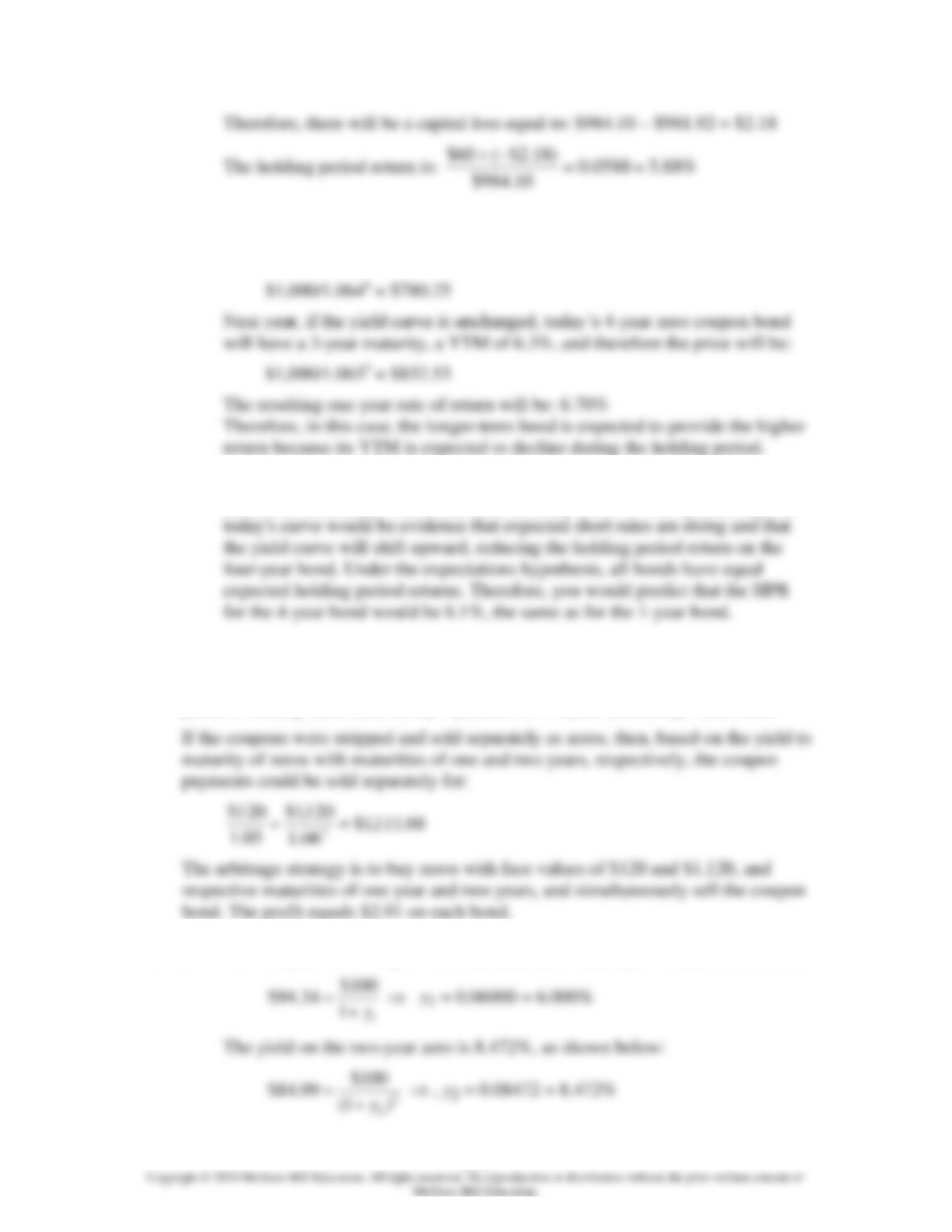
14. a. The return on the one-year zero-coupon bond will be 6.1%.
The price of the 4-year zero today is:
b. If you believe in the expectations hypothesis, you would not expect that the
yield curve next year will be the same as today’s curve. The upward slope in
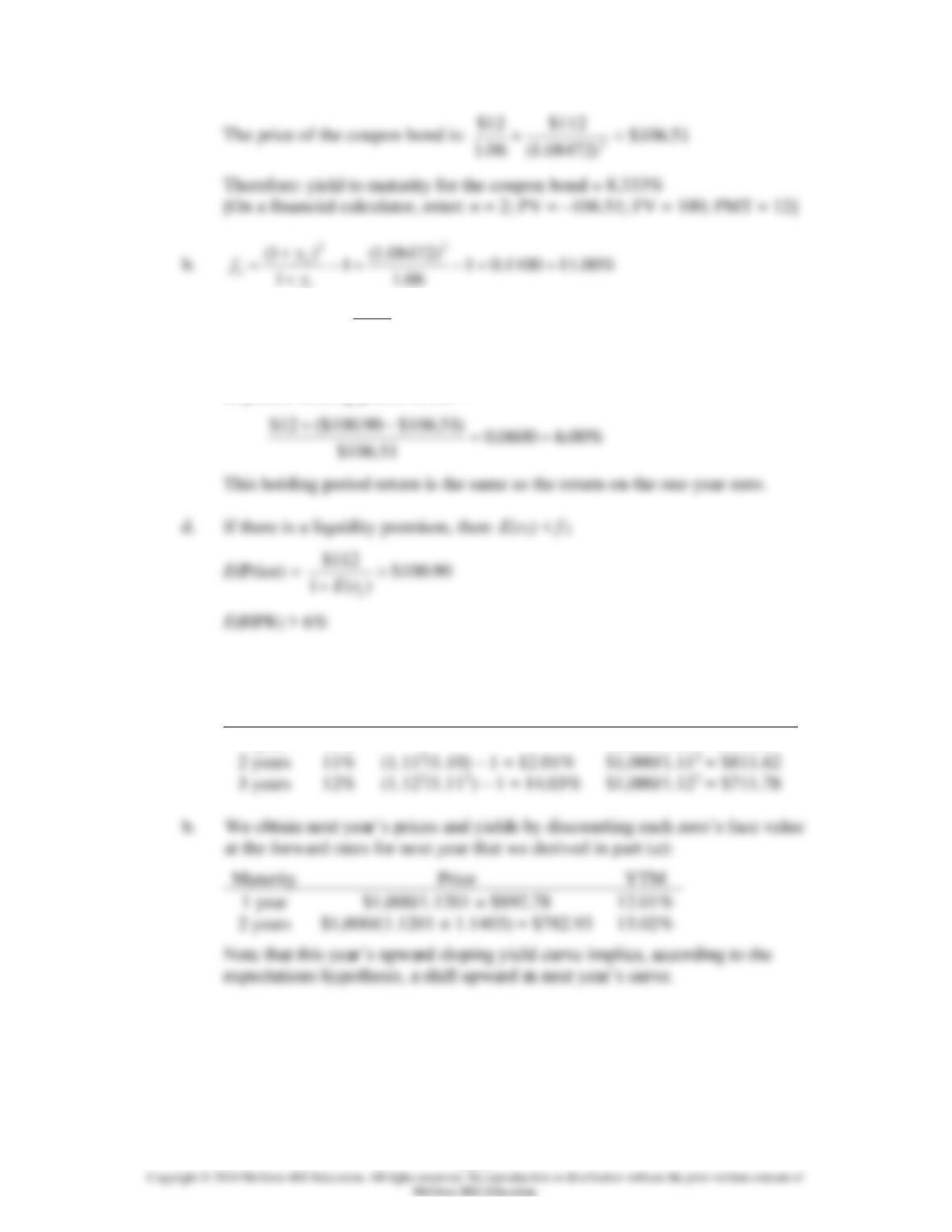
15. The price of the coupon bond, based on its yield to maturity, is:
[$120 × Annuity factor (5.8%, 2)] + [$1,000 × PV factor (5.8%, 2)] = $1,113.99
16. a. The one-year zero-coupon bond has a yield to maturity of 6%, as shown below:
Chapter 15 – The Term Structure of Interest Rates
15-6
1
c. Expected price
90.100$
11.1
112$ ==
(Note that next year, the coupon bond will have one payment left.)
Expected holding period return =
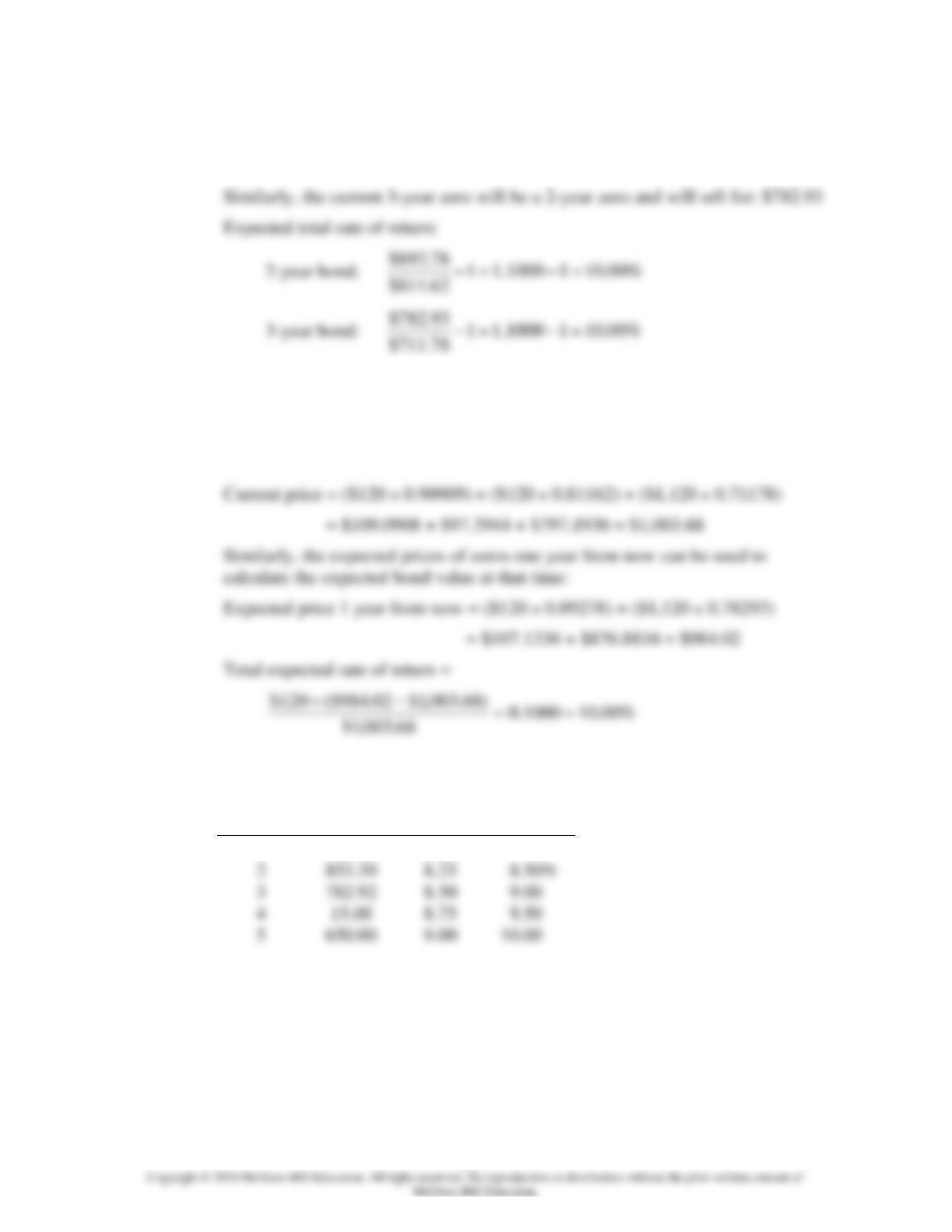
17. a. We obtain forward rates from the following table:
Maturity
YTM
Forward Rate
Price (for parts c, d)
1 year
10%
$1,000/1.10 = $909.09
11%
12%
Maturity
YTM
13.02%
Chapter 15 – The Term Structure of Interest Rates
15-7
c. Next year, the 2-year zero will be a 1-year zero, and will therefore sell at a
price of: $1,000/1.1201 = $892.78
d. The current price of the bond should equal the value of each payment times
the present value of $1 to be received at the “maturity” of that payment. The
present value schedule can be taken directly from the prices of zero-coupon
bonds calculated above.
18. a.
Maturity
(years)
Price
YTM
Forward
Rate
1
$925.93
8.00%
2
853.39
8.50%
3
782.92
9.00
4
15.00
9.50
5
650.00
Chapter 15 – The Term Structure of Interest Rates
15-8
b. For each 3-year zero issued today, use the proceeds to buy:
$782.92/$715.00 = 1.095 four-year zeros
Your cash flows are thus as follows:
Time
Cash Flow
the issuer pays out $1,000 face value
receive face value
c. For each 4-year zero issued today, use the proceeds to buy:
$715.00/$650.00 = 1.100 five-year zeros
Your cash flows are thus as follows:
Time
Cash Flow
the issuer pays out $1,000 face value
receive face value
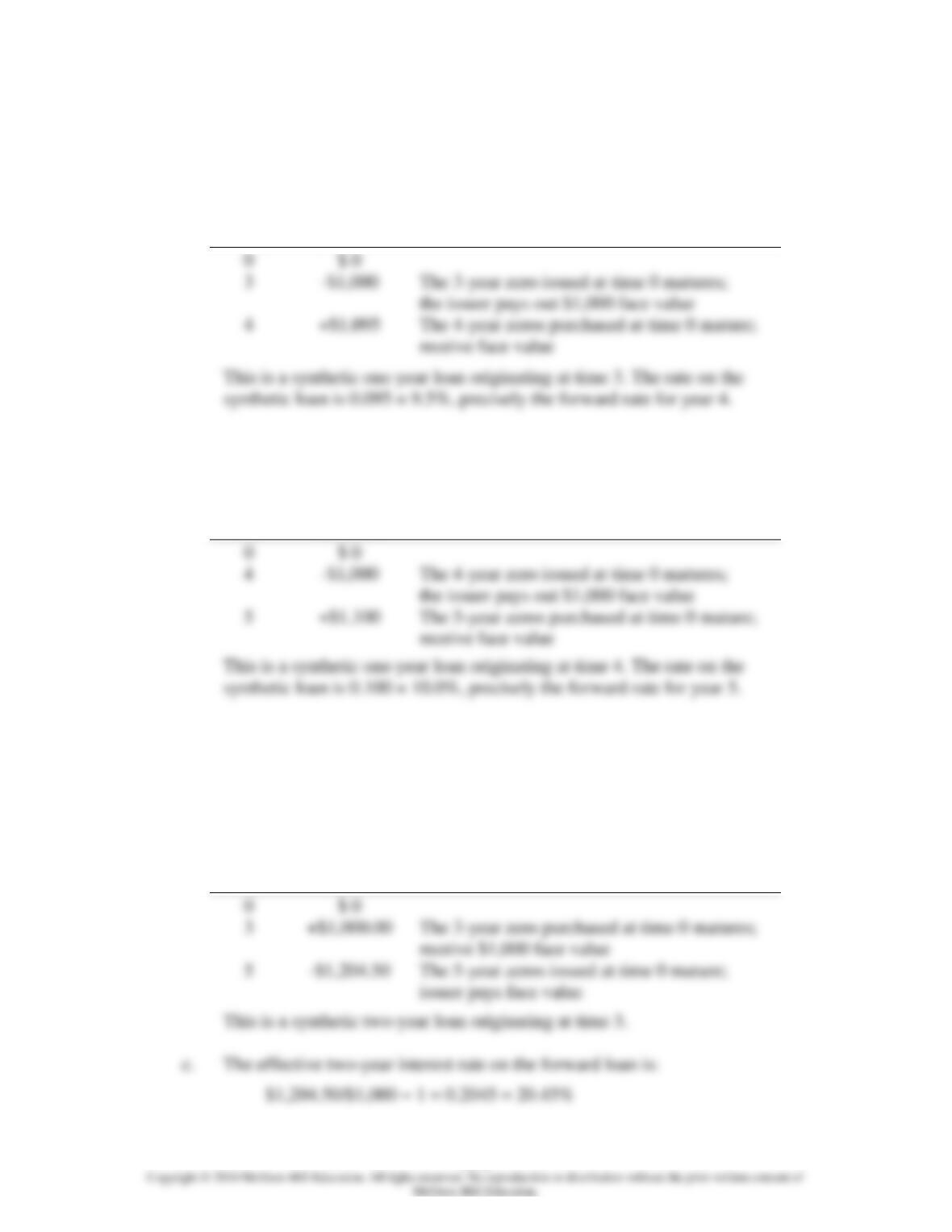
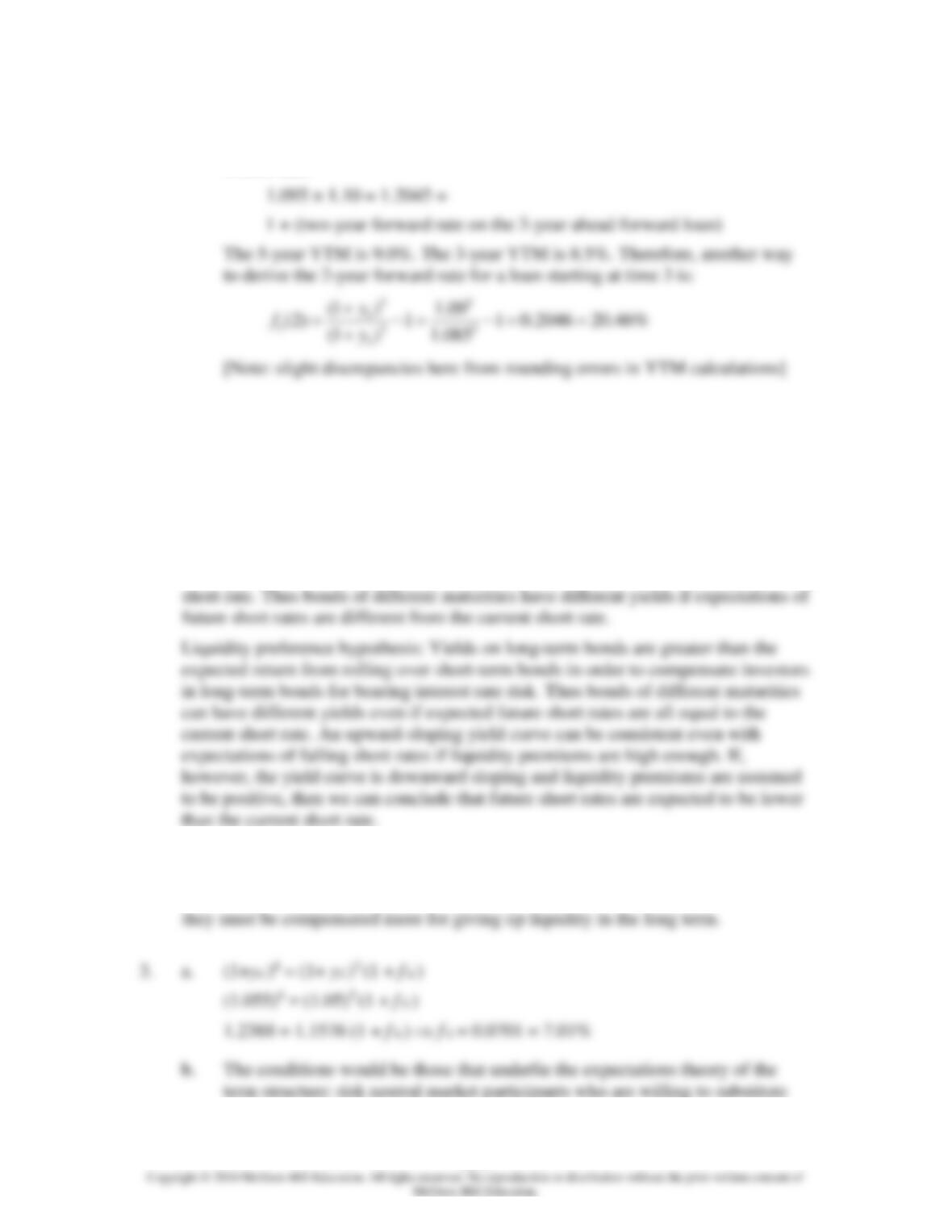
19. a. For each three-year zero you buy today, issue:
$782.92/$650.00 = 1.2045 five-year zeros
The time-0 cash flow equals zero.
b. Your cash flows are thus as follows:
Time
Cash Flow
receive $1,000 face value
issuer pays face value
Chapter 15 – The Term Structure of Interest Rates
15-9
d. The one-year forward rates for years 4 and 5 are 9.5% and 10%, respectively.
Notice that:
CFA PROBLEMS
1. Expectations hypothesis: The yields on long-term bonds are geometric averages of
present and expected future short rates. An upward sloping curve is explained by
expected future short rates being higher than the current short rate. A downward-
sloping yield curve implies expected future short rates are lower than the current
2. d. Investors bid up the price of short term securities and force yields to be relatively
low, while doing just the opposite at the long end of the term structure. Therefore,
Chapter 15 – The Term Structure of Interest Rates
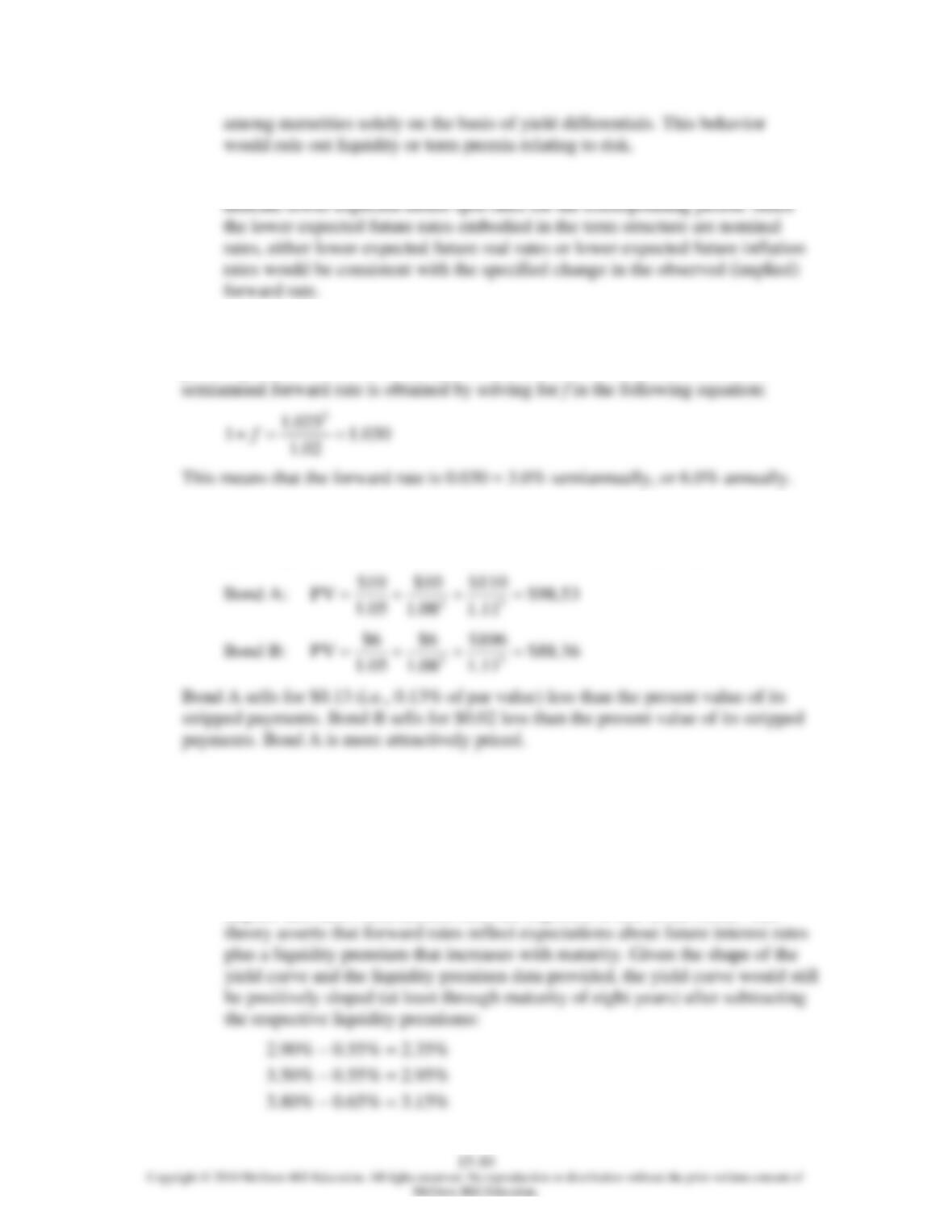
4. The given rates are annual rates, but each period is a half-year. Therefore, the per
period spot rates are 2.5% on one-year bonds and 2% on six-month bonds. The
5. The present value of each bond’s payments can be derived by discounting each cash
flow by the appropriate rate from the spot interest rate (i.e., the pure yield) curve:
6. a. Based on the pure expectations theory, VanHusen’s conclusion is incorrect.
According to this theory, the expected return over any time horizon would be
the same, regardless of the maturity strategy employed.
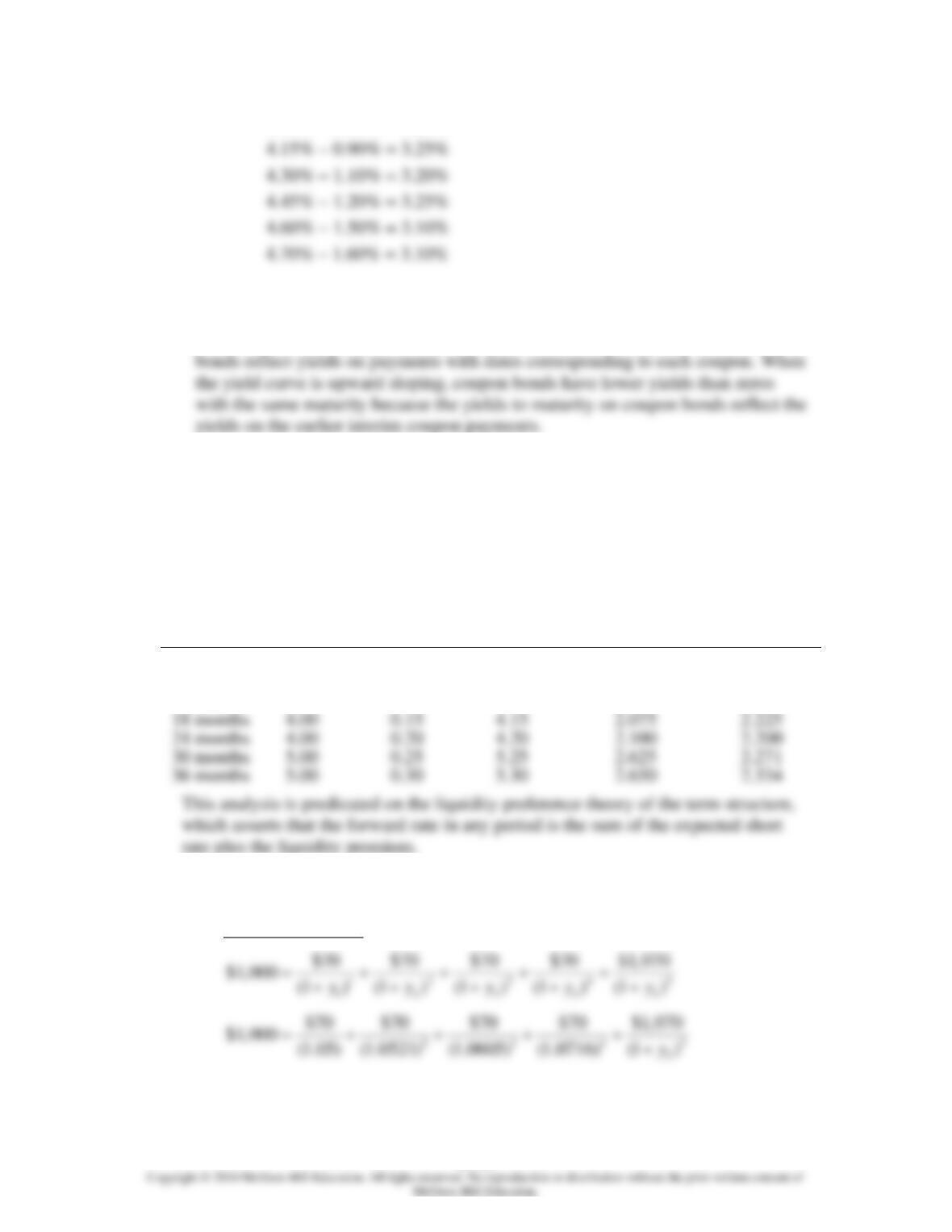
b. According to the liquidity preference theory, the shape of the yield curve
implies that short-term interest rates are expected to rise in the future. This
Chapter 15 – The Term Structure of Interest Rates
15–11
4.00% – 0.75% = 3.25%
7. The coupon bonds can be viewed as portfolios of stripped zeros: each coupon can
stand alone as an independent zero-coupon bond. Therefore, yields on coupon
8. The following table shows the expected short-term interest rate based on the
projections of Federal Reserve rate cuts, the term premium (which increases at a
rate of 0.10% per 12 months), the forward rate (which is the sum of the expected
rate and term premium), and the YTM, which is the geometric average of the
forward rates.
Time
Expected
Short Rate
Term
Premium
Forward
Rate
(annual)
Forward Rate
(semiannual)
YTM
(semiannual)
0
5.00%
0.00%
5.00%
2.500%
2.500%
6 months
4.50
0.05
4.55
2.275
2.387
12 months
4.00
0.10
4.10
2.050
2.275
18 months
4.00
0.15
4.15
2.075
2.225
24 months
4.00
0.20
4.20
2.100
2.200
30 months
5.00
0.25
5.25
2.625
2.271
36 months
5.00
0.30
5.30
2.650
2.334
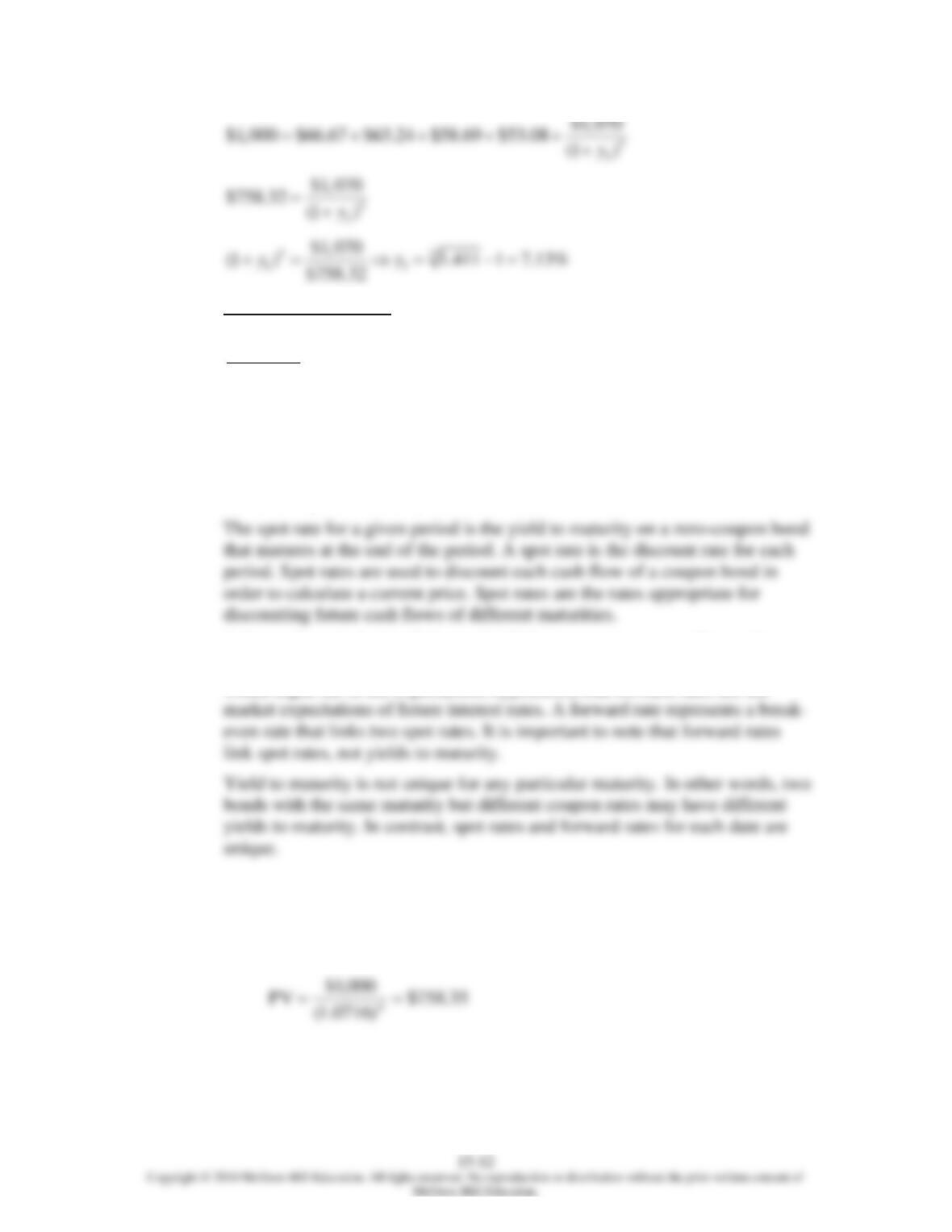
9. a. Five-year spot rate:
Chapter 15 – The Term Structure of Interest Rates
Five-year forward rate:
%01.710701.11
)0716.1(
)0713.1(
4
5=−=−
b. The yield to maturity is the single discount rate that equates the present value
of a series of cash flows to a current price. It is the internal rate of return.
The short rate for a given interval is the interest rate for that interval available
at different points in time.
A forward rate is the implicit rate that links any two spot rates. Forward rates
are directly related to spot rates, and therefore to yield to maturity. Some
would argue (as in the expectations hypothesis) that forward rates are the
c. The four-year spot rate is 7.16%. Therefore, 7.16% is the theoretical yield to
maturity for the zero-coupon U.S. Treasury note. The price of the zero-coupon
note discounted at 7.16% is the present value of $1,000 to be received in four4
years. Using annual compounding:
Chapter 15 – The Term Structure of Interest Rates
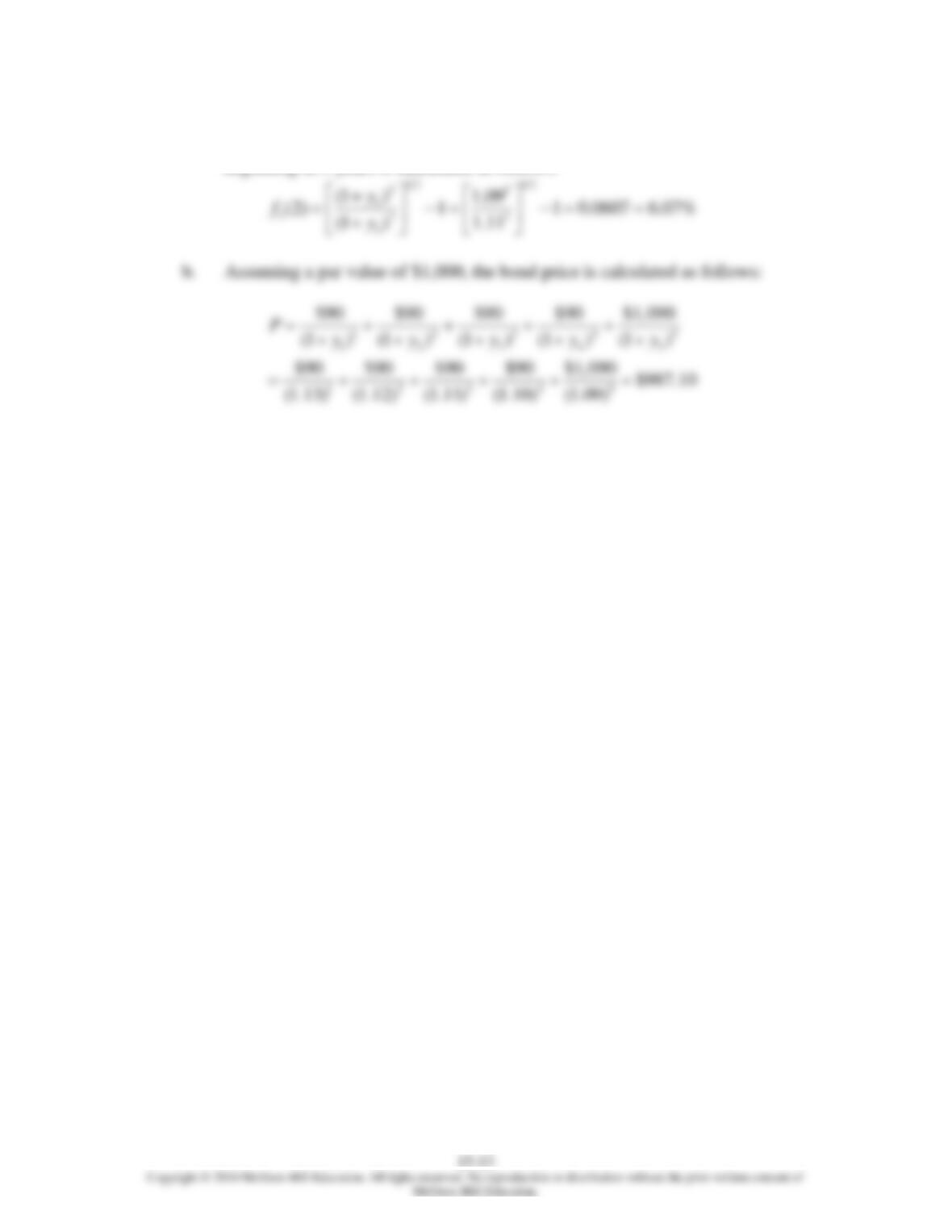
10. a. The two-year implied annually compounded forward rate for a deferred loan
beginning in 3 years is calculated as follows: