CHAPTER 15
ASSET-BACKED SECURITIES
CHAPTER SUMMARY
A security created by pooling loans other than residential primemortgage loans and commercial
mortgage loans is referred to as an asset-backed security (ABS). The market classifies securities
backed by subprime mortgage loans as mortgage-related ABS. The two types of assets that can
used as collateral for an asset-backed securitization are existing assets/existing receivables or
assets/receivables to arise in the future. Securitizations with existing collateral are referred to as
CREATION OF AN ABS
A security created by pooling loans other than mortgage loans is referred to as an asset-backed
security (ABS). The textbook uses the following illustration to explain how an ABS is created
and the parties to a securitization. Suppose that Exception Dental Equipment, Inc. has a bulk of
and disposing of the collateral (i.e., the dental equipment in our illustration) if the borrower fails
to make the contractual loan payments. While the servicer of the loans need not be the originator
of the loans, in our illustration we are assuming that the originator (EDE) is also the servicer.
Suppose EDE has more than $300 million of installment sales contracts and wants to raise this
amount. Rather than issuing corporate bonds for $300 million, the EDE’s treasurer decides to
©2013 Pearson Education 329
The Parties to a Securitization
In our hypothetical securitization, Exceptional Dental Equipment, Inc. (EDE) is not the issuer of
the ABS (although it is sometimes referred to as the issuer because it is the entity that ultimately
raises the funds). Rather, it originated the loans. Hence, in this transaction, EDE is called the
“seller” because it sold the receivables to DEAT. EDE is also called the “originator” because it
originated the loans. DEAT (i.e., the SPV in the securitization) is referred to as the “issuer” or
“trust” in the prospectus.
While in our simple transaction EDE manufactured the dental equipment and originated the
loans, there is another type of securitization transaction involving another company (called
a conduit) that buys the loans and securitizes them. A conduit that finances dental equipment
originator and has restrictions on its activities. It is the intermediate SPV that purchases the
assets from the originator. The intermediate SPV then sells the assets to the SPV that issues
the asset-backed securities (i.e., the issuing entity). In the prospectus for a securitization
transaction, the intermediate SPV is referred to as the depositor.
Transaction Structure
requirements.
We will only focus on the first of these reasons to see the critical role of the SPV in
a securitization. Suppose that Exceptional Dental Equipment, Inc. (EDE) has a BB credit rating.
If it wants to raise funds equal to $300 million by issuing a corporate bond, its funding cost the
going rate for a firm with a BB credit rating. If EDE defaults on any of its outstanding debt, the
on how the rating agencies will evaluate the credit risk based on the collateral (i.e., the loans). In
turn, this will depend on the credit enhancement for each bond class. So, due to the SPV, quality
of the collateral, and credit enhancement, a corporation can raise funds via a securitization where
some of the bond classes have a credit rating better than the corporation seeking to raise funds
and that in the aggregate the funding cost is less than issuing corporate bonds.
a predetermined schedule that prioritizes the manner in which principal and interest generated by
the underlying collateral must be used. This schedule, which is explained in the deal’s
prospectus, is known as the cash flow waterfall, or simply the waterfall. The cash flows that
remain after all of the scheduled periodic payment obligations are met can be associated with the
excess spread. The excess spread is the first line of defense against collateral losses, since deals
©2013 Pearson Education 331
Optional Clean-Up Call Provisions
For ABS there is an optional clean-up call provision granted to the trustee. There are several
types of clean-up call provisions: percent of collateral call, percent of bond clean-up call, percent
of tranche clean-up call, call on or after specified date, latter of percent or date call, auction call,
and insurer call.
The most common is the percent of collateral call where the outstanding bonds can be called at
par value if the outstanding collateral’s balance falls below a predetermined percent of the
original collateral’s balance.
COLLATERAL TYPE AND SECURITIZATION STRUCTURE
Structuring a securitization will depend on the characteristics of the underlying assets. Two
characteristics affect the structure: amortization and interest rate. Specifically, the structure
a nonamortizing asset, the concept of a prepayment does not apply. Credit card receivables are
examples of nonamortizing assets.
Fixed-Rate Versus Floating-Rate Assets
The assets that are securitized can have a fixed rate or a floating rate. The type of rate chosen
impacts the structure in terms of the coupon rate for the bonds issued. For example, a structure
©2013 Pearson Education 332
Asset Risks
Evaluating asset risks involves the analysis of the credit quality of the collateral. The rating
agencies will look at the underlying borrower’s ability to pay and the borrower’s equity in the
asset. If there are a few borrowers in the pool that are significant in size relative to the entire pool
balance, this diversification benefit can be lost, resulting in a higher level of credit risk referred
to as concentration risk.
Structural Risks
(most commonly bond insurers), the servicer, a trustee, issuer’s counsel, a guaranteed investment
contract provider (this entity insures the reinvestment rate on investable funds), and accountants.
The rating agency will investigate all third-party providers. For the third-party guarantors, the
rating agencies will perform a credit analysis of their ability to pay.
While still viewed as a “third party” in many securitizations, the servicer is likely to be the
(3) rate reduction bonds.
Credit Card Receivable-Backed Securities
Credit cards are issued by banks (e.g., Visa and MasterCard), retailers (e.g., JC Penney and
Sears), and leading global payments and travel companies (e.g., American Express). The cash
flow for a pool of credit card receivables consists of finance charge collections, principal
Each series is a separate credit card deal and the trust can issue bond classes to the public. For
example, a series can have a senior bond class and two subordinate bond classes. However, each
series will have a different level of credit enhancement. It is the cash flow from the trust portfolio
that is used to make the payments due to the bond classes for all the series.
Because a card receivable is a non-amortizing asset, it therefore has a revolving structure.
a provision, referred to as an early amortization provision or a rapid amortization provision
is included to safeguard the credit quality of the structure.
The only way that the principal cash flows can be altered is by occurrence of a pay-out event.
When early amortization occurs, the bond classes are retired sequentially (i.e., highest rated bond
class first, then the second highest rated bond class, and so on). This is accomplished by
quality of the structure. The only way that the principal cash flows can be altered is by triggering
the early amortization provision.
The following concepts must be understood in order to assess the performance of the portfolio of
receivables and the ability of the collateral to satisfy the interest obligation and repay principal as
scheduled: gross portfolio yield, charge-offs, net portfolio yield, delinquencies, and monthly
financial institutions specializing in auto loans. The cash flow for auto loan-backed securities
consists of regularly scheduled monthly loan payments (interest and scheduled principal
repayments) and any prepayments.
Prepayments for auto loan-backed securities are measured in terms of the absolute prepayment
speed (ABS). The ABS measure is the monthly prepayment expressed as a percentage of the
original collateral amount. The single-month mortality rate (SMM) is the monthly conditional
prepayment rate (CPR) based on the prior month’s balance. There is a mathematical relationship
between the ABS and SMM. Given the SMM (expressed as a decimal), the ABS (expressed as
a decimal) is obtained as follows:
SMM
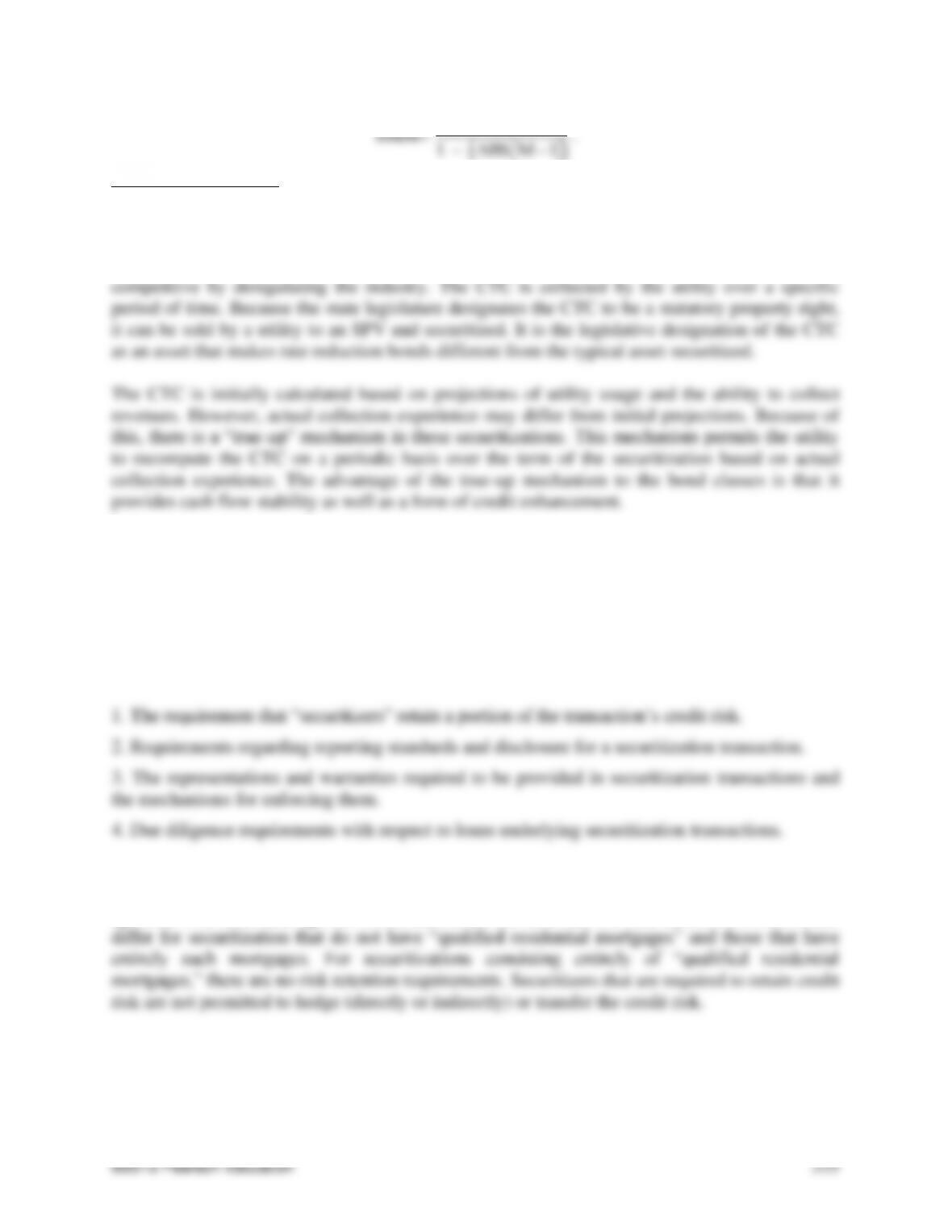
where M is the number of months after origination (i.e., loan age). Given the ABS, the SMM is
obtained as follows:
SMM=
()
ABS
1 – ABS M –1
.
Rate Reduction Bonds
Rate reduction bonds are backed by a special charge (tariff) included in the utility bills of utility
customers in. The charge, called the competitive transition charge (or CTC), is effectively
a legislated asset. It is the result of the movement to make the electric utility industry more
DODD-FRANK WALL STREET REFORM AND CONSUMER PROTECTION ACT
Because of the turmoil that occurred in the securitization market and related sectors of the
financial market, in July 2010, Congress passed the Dodd-Frank Wall Street Reform and
Consumer Protection Act.
The key features of the act that impact securitizations are
The specifics regarding how the above requirements should be handled were not set forth in the
act. With respect to nonagency RMBS, joint rules are to be specified by the three federal banking
agencies. The rules dealing with the amount and form of credit risk that securitizers must retain
COLLATERALIZED DEBT OBLIGATIONS
©2013 Pearson Education 336
When the ABS market began, there was a debt product that employed the securitization to pool
a diversified pool of some asset type and issue securities backed by the cash flow of the asset
pool. These debt products are called collateralized debt obligations (CDOs).
Although many types of asset classes have been used as collateral in a CDO, the following are
the major ones: investment-grade corporate bonds; high-yield corporate bonds; emerging market
bonds; nonagency residential mortgage-backed securities (nonagency RMBS); commercial
mortgage-backed securities (CMBS); leveraged bank loans; and, collateralized debt obligations.
CDOs backed by investment-grade corporate bonds, high-yield corporate bonds, and emerging
market bonds are referred to as collateralized bond obligations; those backed by nonagency
RMBS and CMBS are referred to as structured finance CDOs. CDOs backed by leveraged
bank loans are called collateralized loan obligations (CLOs). Finally, CDOs backed by bond
the tranches as they mature depends on the performance of the collateral. The proceeds to meet
the obligations to the CDO tranches (interest and principal repayment) can come from coupon
interest payments from the collateral assets, from maturing of collateral assets, and from sale of
collateral assets.
In a typical structure, one or more of the tranches has a floating rate. With the exception of deals
reinvestment period or revolving period is where principal proceeds are reinvested and is
usually for five or more years. In the final period, the collateral is sold and the debt holders are
paid off.
Income is derived from interest income from the collateral assets and capital appreciation. The
KEY POINTS
• Asset-backed securities are created by pooling loans and receivables through a process known
as securitization.
• The main parties to a securitization are the seller/originator (party seeking to raise funds),
special purpose vehicle, and servicer.
• The motivation for issuing asset-backed securities rather than issuing a corporate bond is the
potential reduction in funding cost. The key to this savings is the role of the special purpose
ANSWERS TO QUESTIONS FOR CHAPTER 15
(Questions are in bold print followed by answers.)
1. Why is the entity seeking to raise funds through a securitization referred to as the “seller”
or the “originator”?
A security created by pooling loans other than mortgage loans is referred to as an asset-backed
2. In achieving the benefits associated with a securitization, why is the special purpose
vehicle important to the transaction?
To understand the role of the special purpose vehicle (SPV) and the benefit derived from it, we
need to understand why a corporation would want to raise funds via securitization rather than
simply issue corporate bonds. There are four principal reasons why a corporation may elect to
©2013 Pearson Education 339
of the collateral, and credit enhancement, a corporation can raise funds via a securitization where
some of the bond classes have a credit rating better than the corporation seeking to raise funds
and that in the aggregate the funding cost is less than issuing corporate bonds.
3. In a securitization, what is the difference between a servicer and a special purpose
vehicle?
4. Answer the below questions.
a. What is the difference between a one-step securitization and a two-step securitization?
In a one-step securitization, the originator of the loans sells the receivables to the SPV who is
referred to as the “issuer” or “trust” of the asset-backed securities (ABS). In a two-step
securitization, the securitization involves two SPVs. This is done to ensure that the transaction is
b. What is meant by the “depositor” in a securitization?
5. What is meant by a cash flow waterfall?