
CHAPTER 14: Discussion Questions and Problems
1. Differentiate the following terms/concepts:
a. Certainty equivalent and a gamble
b. Loss aversion and myopic loss aversion
c. Speculative price bubble and ex post rational stock price
d. Greater fool theory and speculation
2. In a Ponzi scheme, named after Charles Ponzi, investors are paid profits out of
money paid by subsequent investors, instead of from revenues generated by a
real business operation. Unless an ever-increasing flow of money from investors
is available, a Ponzi scheme is doomed to failure. What’s the difference between
a Ponzi scheme and an asset price bubble?
3. An individual with cash to invest has two investment choices:
Buy a stock fund which every year either earns 40% or -20% with a 50/50
probability.
Buy a bond fund which every year returns either 5% or 0% also with 50/50
probability.
2 | P a g e
Assume that the returns on the two funds are independent, and that returns from
year to year are also identical. Also assume an initial portfolio value of $1. (The
answers, however, will be unaffected if you use a different initial portfolio
value.)
In addition, suppose the value function is linear and is specified as:
v(z) = z for z≥0 and v(z) = -3(-z) for z<0
a. Which fund does the investor prefer if he looks at his portfolio i/ once a
year; or ii/ once every two years?
One year:
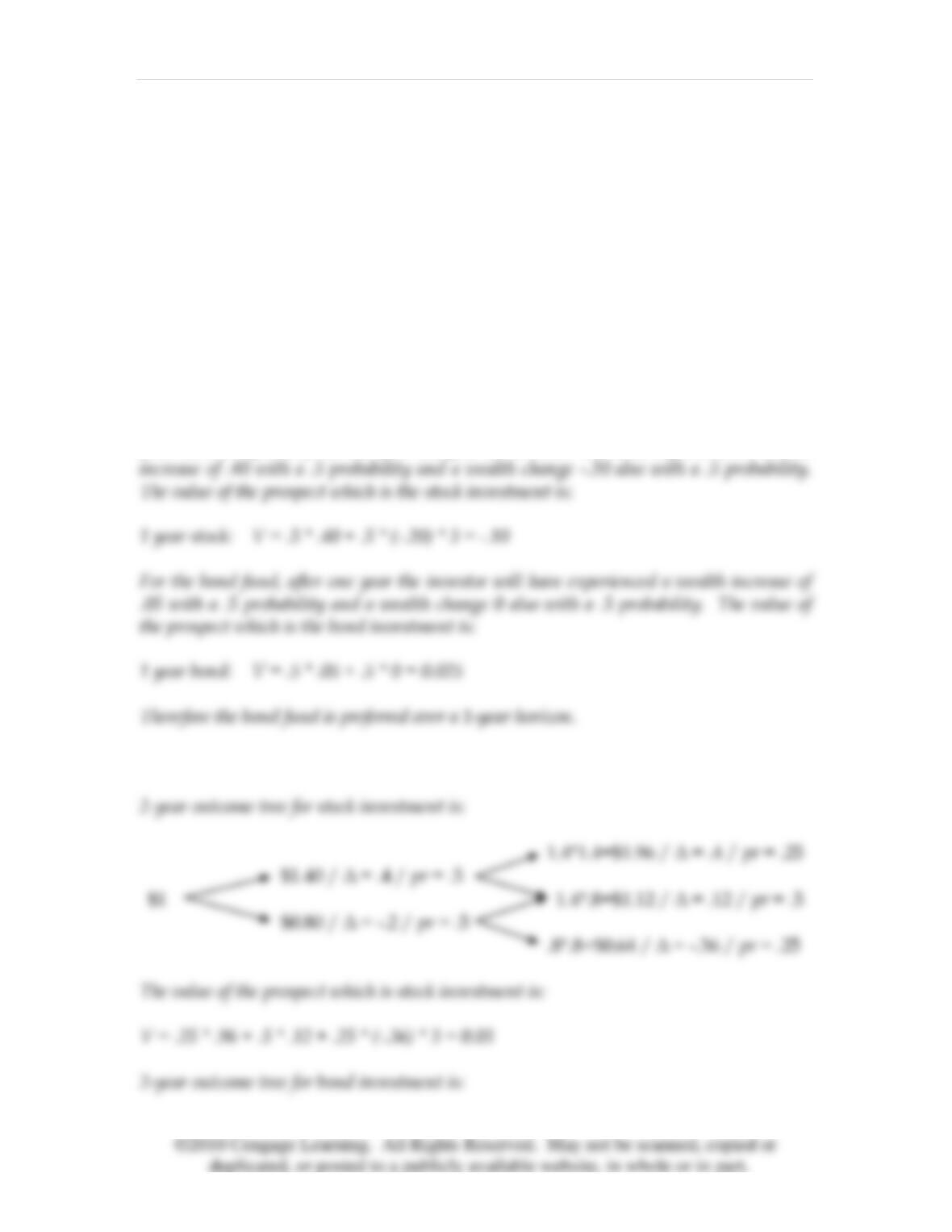
If we arbitrarily start from $1, after one year the investor will have experienced a wealth
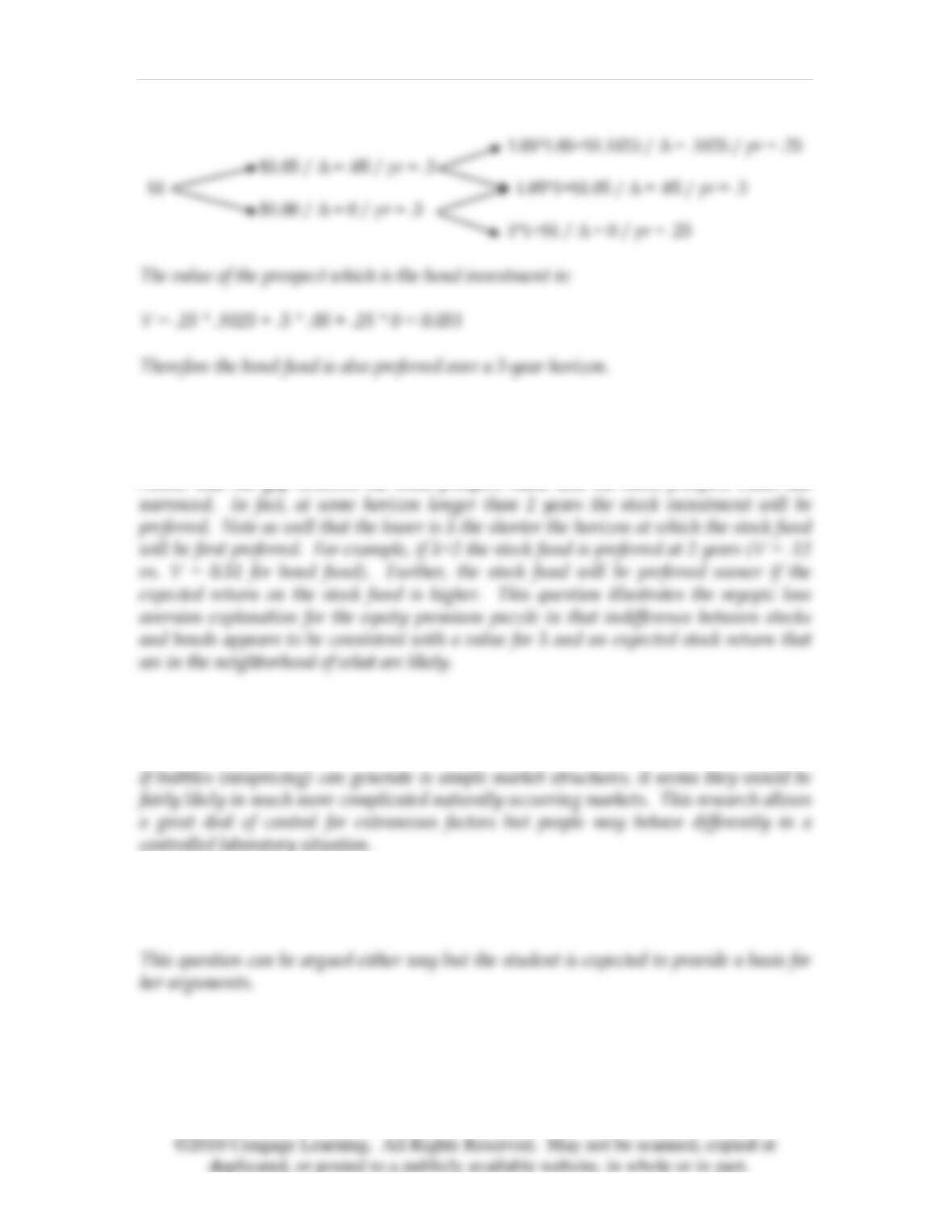
2 yrs:
3 | P a g e
b. How does your answer to part a. help us understand the equity
premium puzzle?
Notice that the gap between the bond prospect value and the stock prospect value has
4. What do experimental bubble markets teach us about the likelihood of bubbles
in the real world? In what sense does this research have its limitations?
5. Do you believe that stock prices are too volatile? Be sure to explain what you
mean when you say “volatility” and “too much.”