Chapter 14 – Bond Prices and Yields
14-1
CHAPTER 14: BOND PRICES AND YIELDS
PROBLEM SETS
1. a. Catastrophe bond—A bond that allows the issuer to transfer “catastrophe risk”
from the firm to the capital markets. Investors in these bonds receive a
compensation for taking on the risk in the form of higher coupon rates. In the
event of a catastrophe, the bondholders will receive only part or perhaps none of
the principal payment due to them at maturity. Disaster can be defined by total
insured losses or by criteria such as wind speed in a hurricane or Richter level in
an earthquake.
d. Samurai bond—Yen-dominated bonds sold in Japan by non-Japanese issuers.
e. Junk bond—A bond with a low credit rating due to its high default risk; also
known as high-yield bonds.
i. Original issue discount bond—A bond issued at a discount to the face value.
j. Indexed bond— A bond that makes payments that are tied to a general price
index or the price of a particular commodity.
k. Callable bond—A bond that gives the issuer the option to repurchase the bond
Chapter 14 – Bond Prices and Yields
14-2
l. Puttable bond—A bond that gives the bondholder the option to sell back the bond
at a specified put price before the maturity date.
3. Zero coupon bonds provide no coupons to be reinvested. Therefore, the investor’s
4. A bond’s coupon interest payments and principal repayment are not affected by
changes in market rates. Consequently, if market rates increase, bond investors in
5. Annual coupon rate: 4.80% → $48 Coupon payments
Current yield:
$48 4.95%
$970
=
7. The effective annual yield on the semiannual coupon bonds is 8.16%. If the
Chapter 14 – Bond Prices and Yields
9. Yield to maturity: Using a financial calculator, enter the following:
10.
a.
Zero coupon
8% coupon
10% coupon
Current prices
$463.19
$1,000.00
$1,134.20
b. Price 1 year from now
$500.25
$1,000.00
$1,124.94
Price increase
$ 37.06
$ 0.00
− $ 9.26
Coupon income
$ 0.00
$ 80.00
Pretax income
$ 37.06
$ 80.00
$ 90.74
Pretax rate of return
Taxes*
$ 11.12
$ 24.00
$ 28.15
After-tax income
$ 25.94
$ 56.00
$ 62.59
After-tax rate of return
c. Price 1 year from now
$543.93
$1,065.15
$1,195.46
Price increase
$ 80.74
$ 65.15
$ 61.26
Coupon income
$ 0.00
$ 80.00
Pretax income
$ 80.74
Pretax rate of return
$ 19.86
$ 37.03
$ 42.25
After-tax income
$ 60.88
After-tax rate of return
Chapter 14 – Bond Prices and Yields
14-4
11. a. On a financial calculator, enter the following:
n = 40; FV = 1000; PV = –950; PMT = 40
You will find that the yield to maturity on a semiannual basis is 4.26%. This implies
12. Since the bond payments are now made annually instead of semiannually, the
bond equivalent yield to maturity is the same as the effective annual yield to
maturity. [On a financial calculator, n = 20; FV = 1000; PV = –price; PMT = 80]
The resulting yields for the three bonds are:
$950
1,000
1,050
13.
Price
Maturity
(years.
Bond Equivalent
YTM
$400.00
20.00
4.688%
500.00
20.00
3.526
500.00
10.00
7.177
385.54
10.00
10.000
463.19
10.00
8.000
400.00
11.91
8.000
Chapter 14 – Bond Prices and Yields
14-5
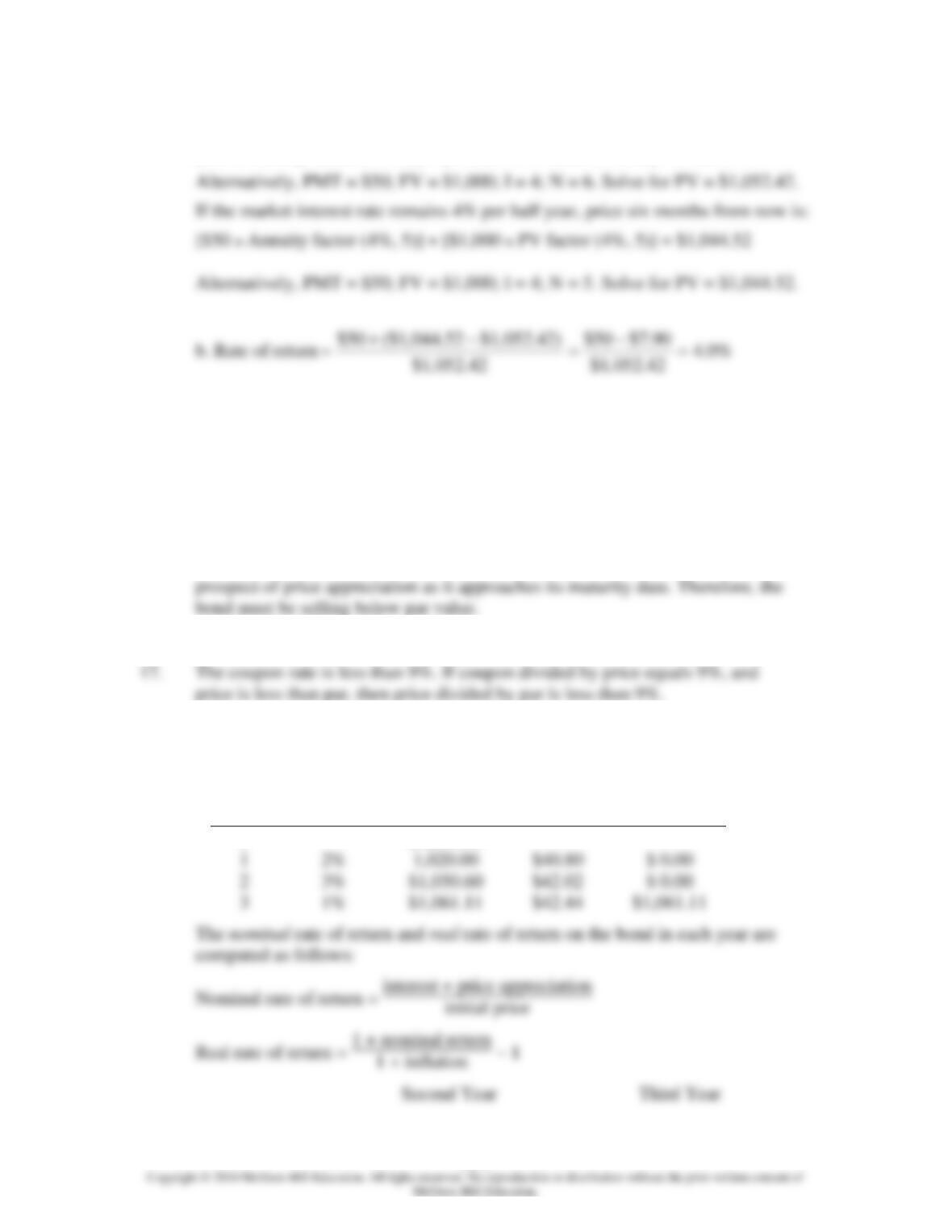
14. a. The bond pays $50 every 6 months. The current price is:
[$50 × Annuity factor (4%, 6)] + [$1,000 × PV factor (4%, 6)] = $1,052.42
15. The reported bond price is: $1,001.250
However, 15 days have passed since the last semiannual coupon was paid, so:
Accrued interest = $35 * (15/182) = $2.885
The invoice price is the reported price plus accrued interest: $1,004.14
16. If the yield to maturity is greater than the current yield, then the bond offers the
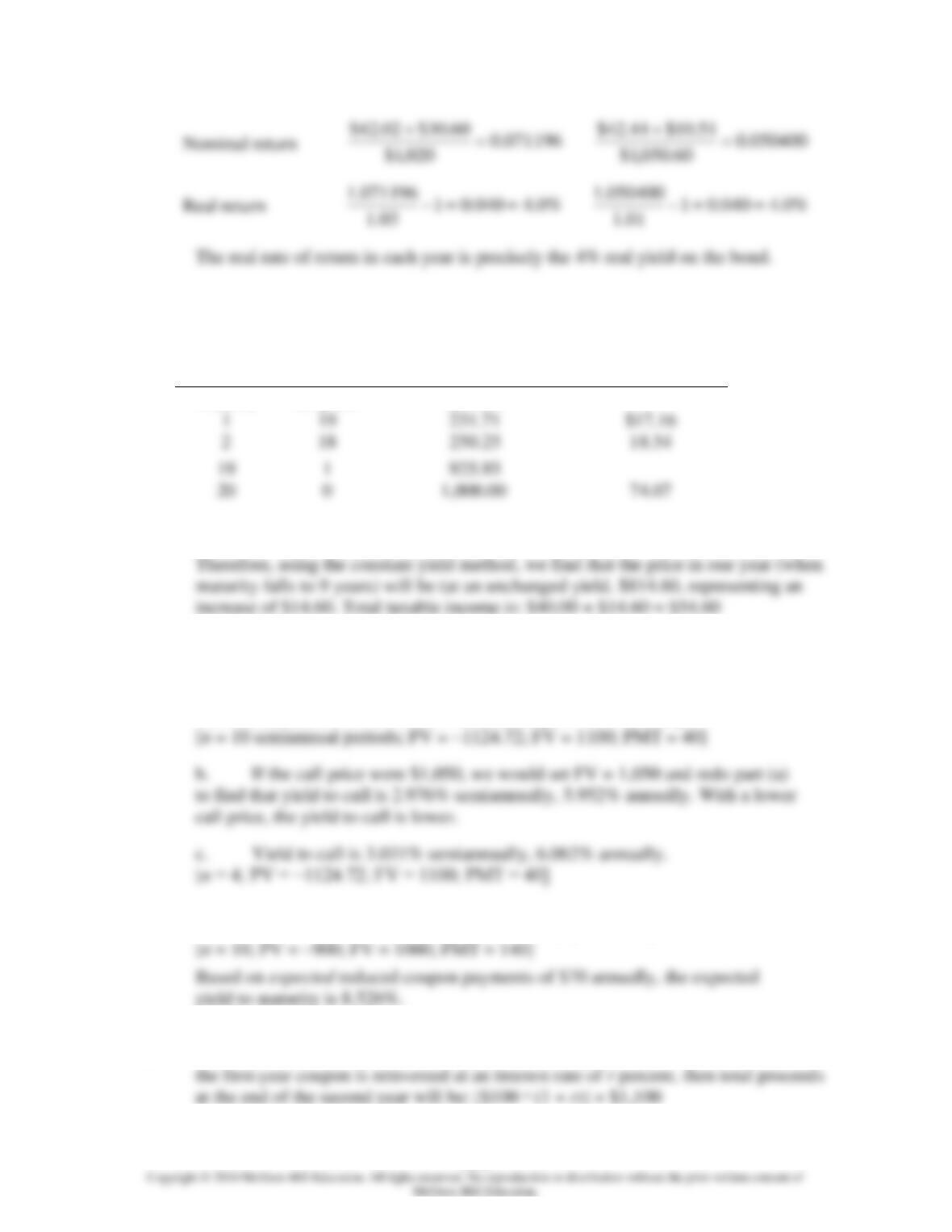
18.
Time
Inflation
in Year Just
Ended
Par Value
Coupon
Payment
Principal
Repayment
0
$1,000.00
1,020.00
$40.80
$1,050.60
$42.02
Chapter 14 – Bond Prices and Yields
14-6
19. The price schedule is as follows:
Year
Remaining
Maturity (T).
Constant Yield Value
$1,000/(1.08)T
Imputed Interest
(increase in constant
yield value)
0 (now)
20 years
$214.55
1
2
20. The bond is issued at a price of $800. Therefore, its yield to maturity is: 6.8245%
21. a. The bond sells for $1,124.72 based on the 3.5% yield to maturity.
[n = 60; i = 3.5; FV = 1000; PMT = 40]
Therefore, yield to call is 3.368% semiannually, 6.736% annually.
22. The stated yield to maturity, based on promised payments, equals 16.075%.
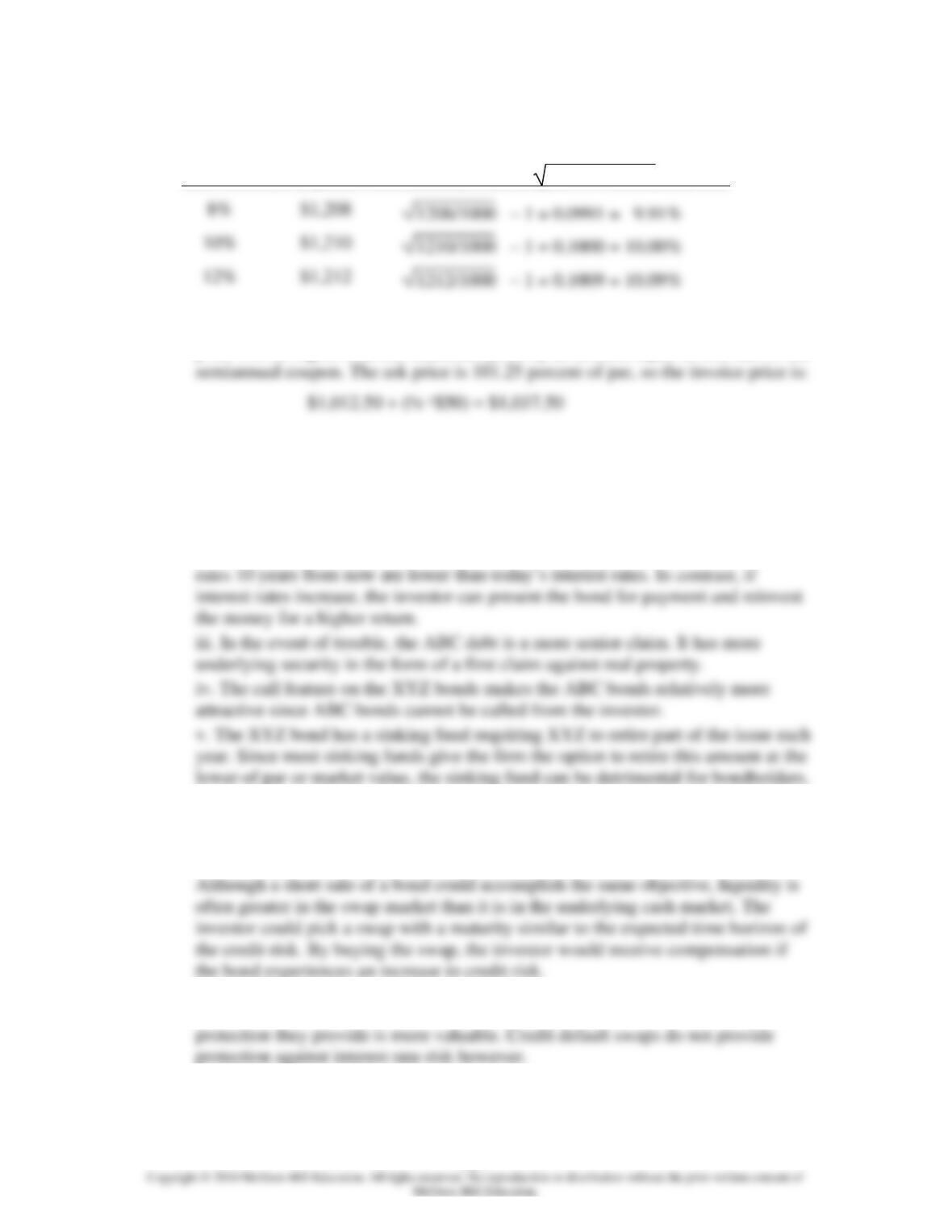
23. The bond is selling at par value. Its yield to maturity equals the coupon rate, 10%. If
Chapter 14 – Bond Prices and Yields
14-7
Therefore, realized compound yield to maturity is a function of r, as shown in the
following table:
r
Total proceeds
Realized YTM = Proceeds/1000 – 1
24. April 15 is midway through the semiannual coupon period. Therefore, the invoice
price will be higher than the stated ask price by an amount equal to one-half of the
25. Factors that might make the ABC debt more attractive to investors, therefore
justifying a lower coupon rate and yield to maturity, are:
i. The ABC debt is a larger issue and therefore may sell with greater liquidity.
ii. An option to extend the term from 10 years to 20 years is favorable if interest
26. A. If an investor believes the firm’s credit prospects are poor in the near term and
wishes to capitalize on this, the investor should buy a credit default swap.
27. a. When credit risk increases, credit default swaps increase in value because the
Chapter 14 – Bond Prices and Yields
14-8
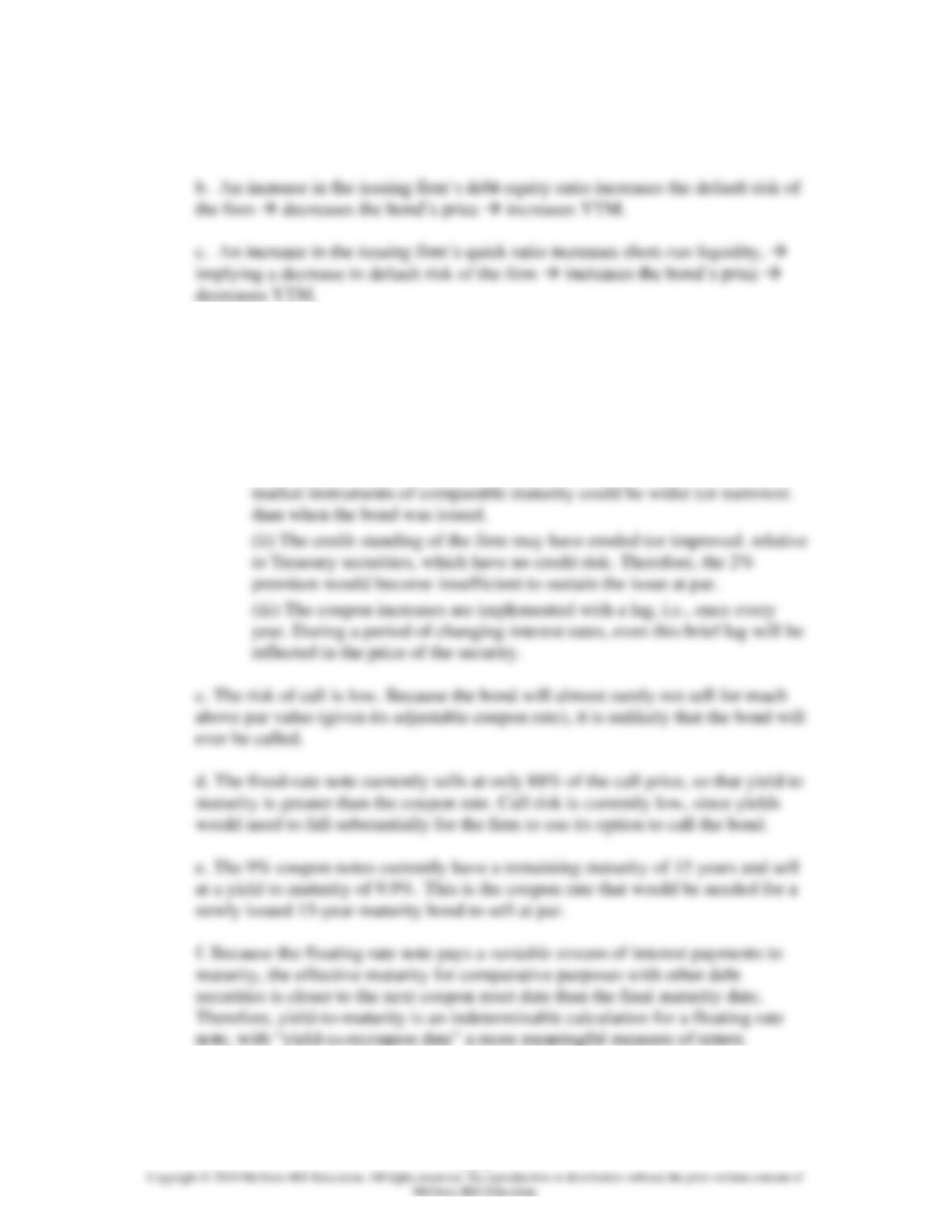
28. a. An increase in the firm’s times interest-earned ratio decreases the default risk
of the firm→increases the bond’s price → decreases the YTM.
29. a. The floating rate note pays a coupon that adjusts to market levels. Therefore, it
will not experience dramatic price changes as market yields fluctuate. The fixed
rate note will therefore have a greater price range.
b. Floating rate notes may not sell at par for any of several reasons:
(i) The yield spread between one-year Treasury bills and other money
Chapter 14 – Bond Prices and Yields
14-9
30. a. The yield to maturity on the par bond equals its coupon rate, 8.75%. All else
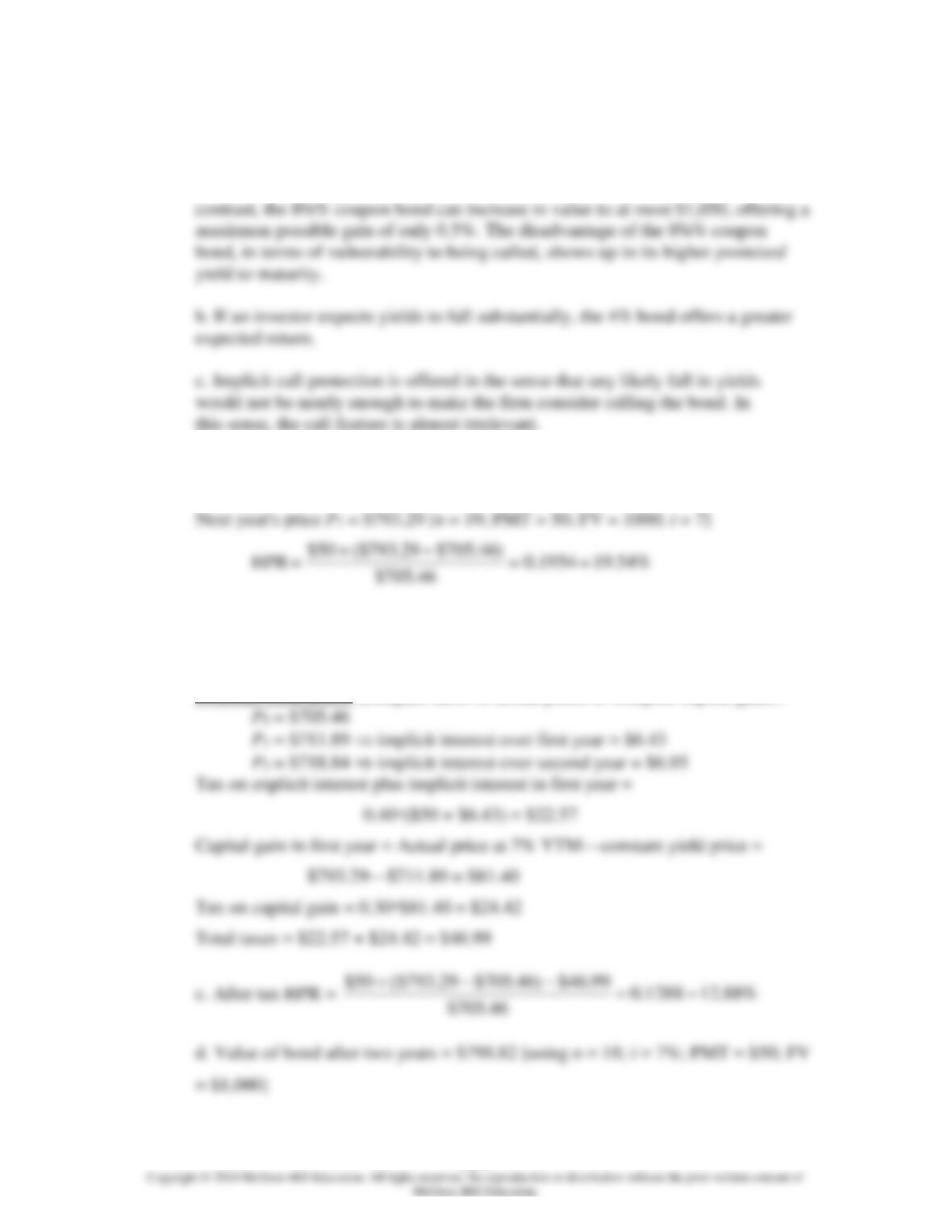
equal, the 4% coupon bond would be more attractive because its coupon rate is far
below current market yields, and its price is far below the call price. Therefore, if
yields fall, capital gains on the bond will not be limited by the call price. In
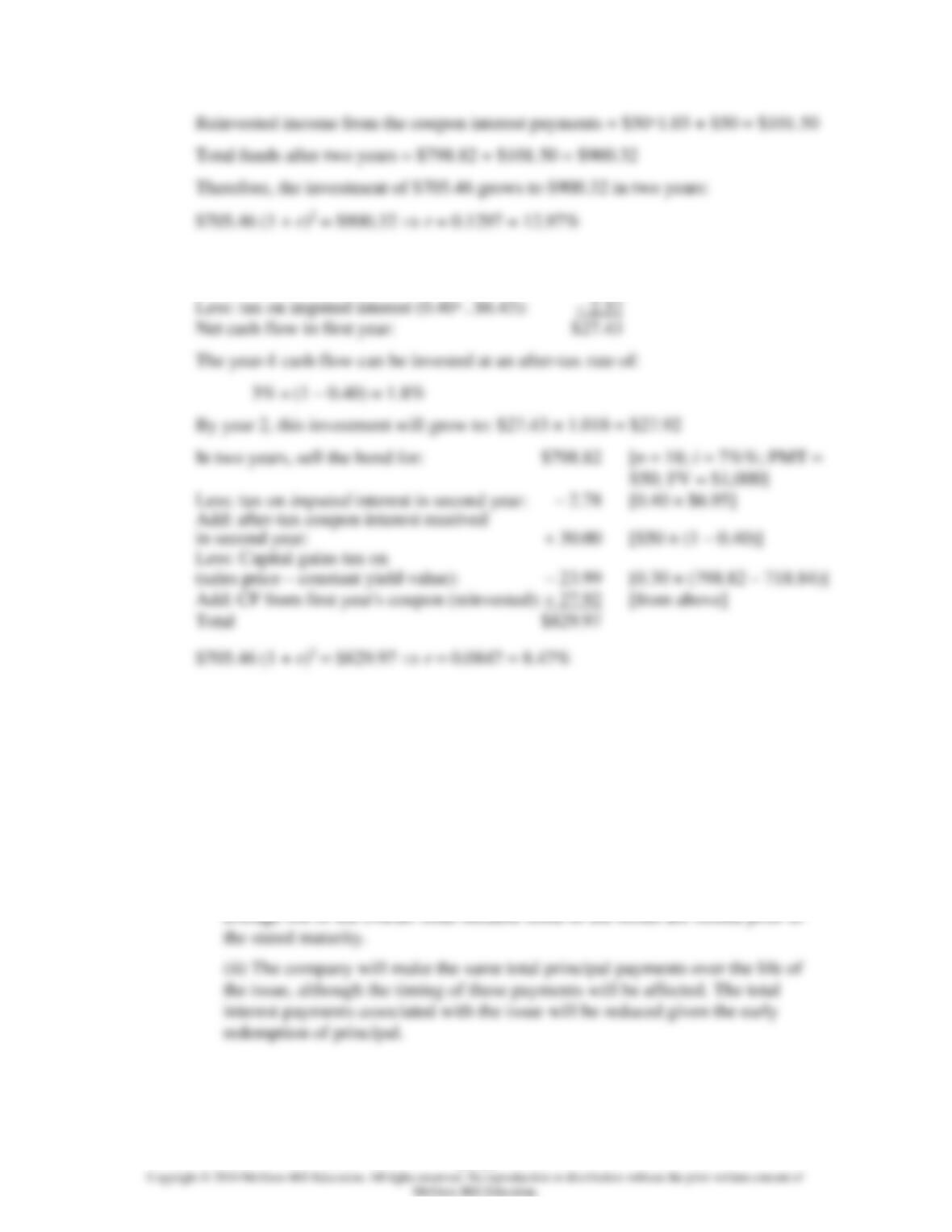
31. a. Initial price P0 = $705.46 [n = 20; PMT = 50; FV = 1000; i = 8]
b. Using OID tax rules, the cost basis and imputed interest under the constant
yield method are obtained by discounting bond payments at the original 8% yield
and simply reducing maturity by one year at a time:
Constant yield prices (compare these to actual prices to compute capital gains.:
Chapter 14 – Bond Prices and Yields
14–10
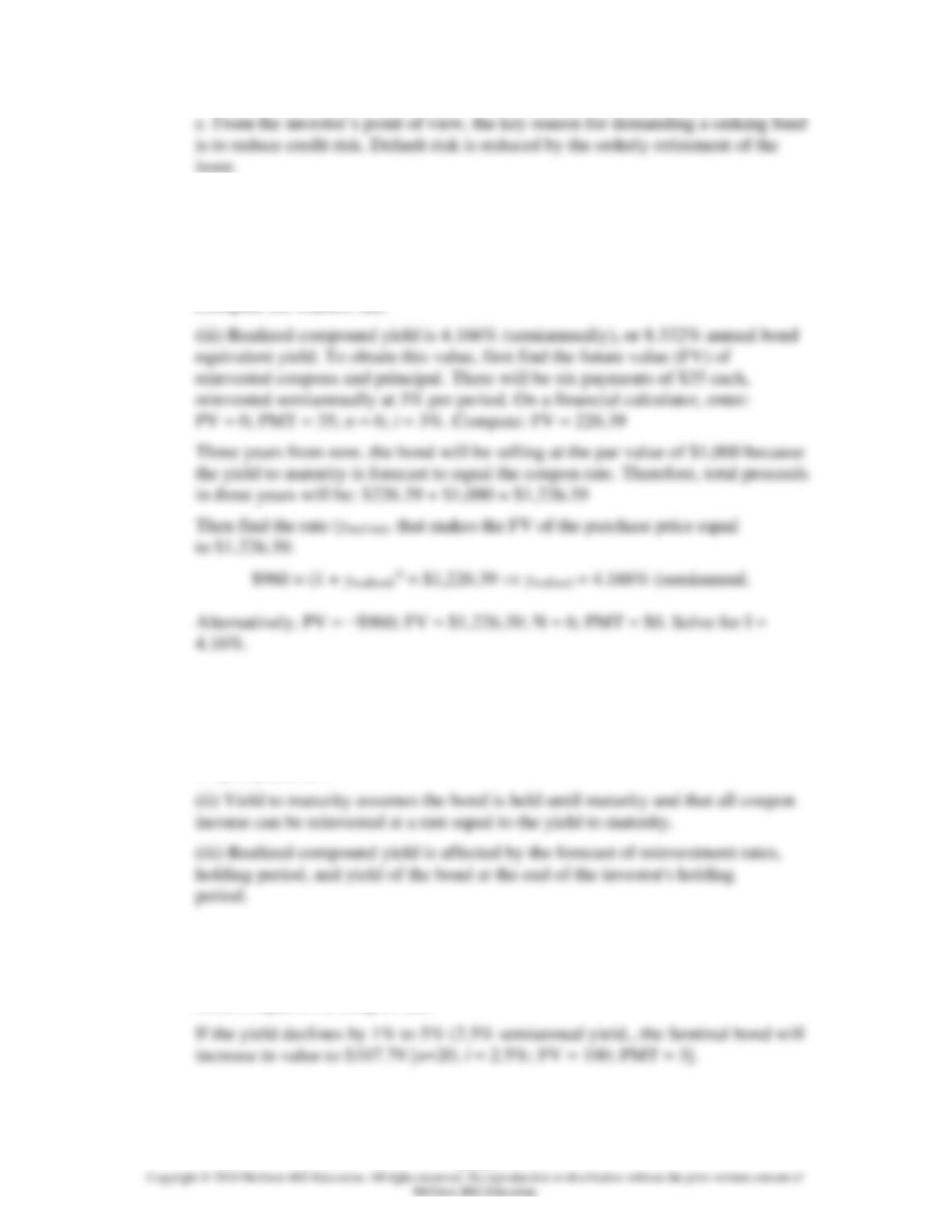
e. Coupon interest received in first year: $50.00
Less: tax on coupon interest @ 40%: – 20.00
CFA PROBLEMS
1. a. A sinking fund provision requires the early redemption of a bond issue. The
provision may be for a specific number of bonds or a percentage of the bond issue
over a specified time period. The sinking fund can retire all or a portion of an
issue over the life of the issue.
b. (i) Compared to a bond without a sinking fund, the sinking fund reduces the
Chapter 14 – Bond Prices and Yields
14–11
2. a. (i) Current yield = Coupon/Price = $70/$960 = 0.0729 = 7.29%
(ii) YTM = 3.993% semiannually, or 7.986% annual bond equivalent yield.
On a financial calculator, enter: n = 10; PV = –960; FV = 1000; PMT = 35
Compute the interest rate.
b. Shortcomings of each measure:
(i) Current yield does not account for capital gains or losses on bonds bought at
prices other than par value. It also does not account for reinvestment income on
coupon payments.
3. a. The maturity of each bond is 10 years, and we assume that coupons are paid
semiannually. Since both bonds are selling at par value, the current yield for each
bond is equal to its coupon rate.
Chapter 14 – Bond Prices and Yields
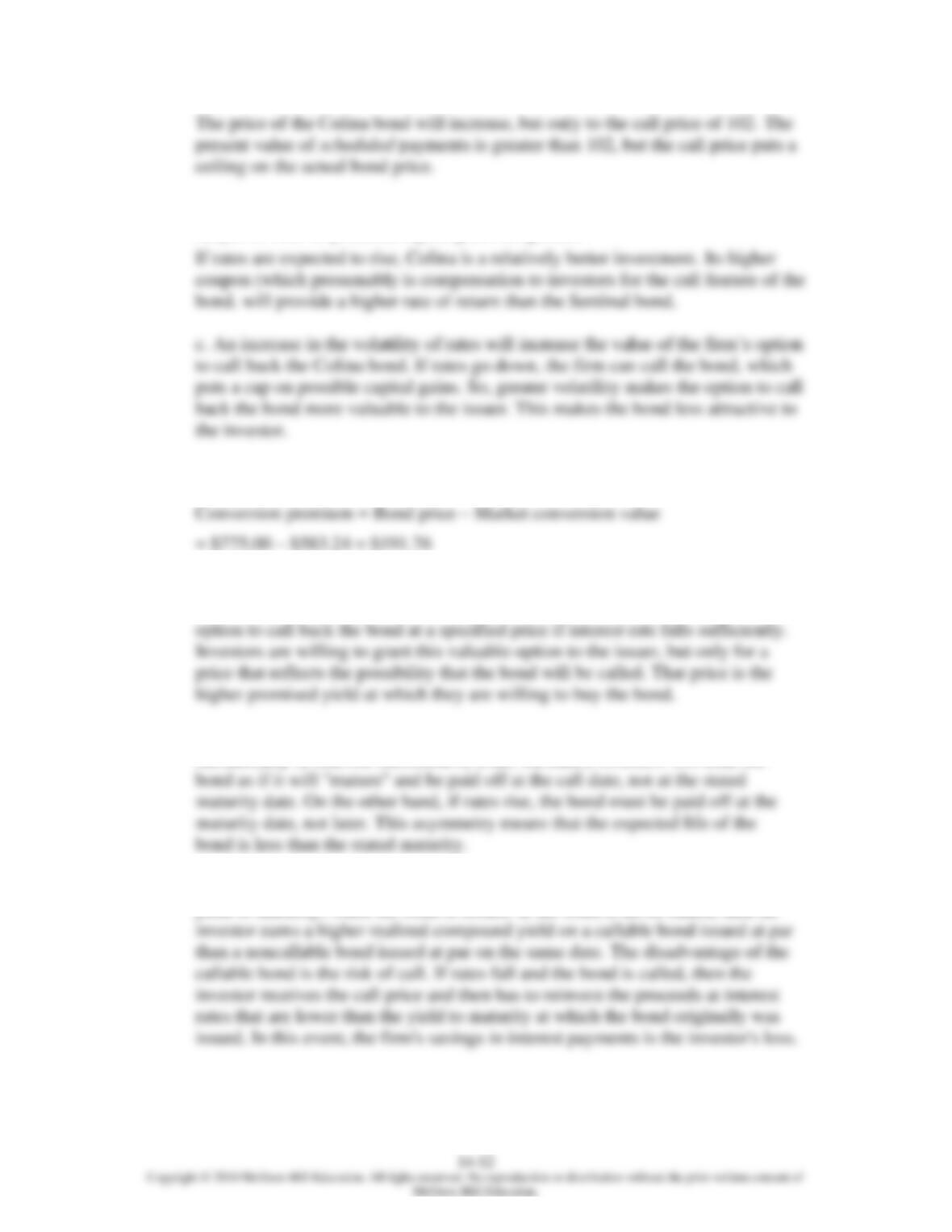
b. If rates are expected to fall, the Sentinal bond is more attractive: since it is not
subject to call, its potential capital gains are greater.
4. Market conversion value = Value if converted into stock = 20.83 × $28 = $583.24
5. a. The call feature requires the firm to offer a higher coupon (or higher promised
yield to maturity) on the bond in order to compensate the investor for the firm’s
b. The call feature reduces the expected life of the bond. If interest rates fall
substantially so that the likelihood of a call increases, investors will treat the
c. The advantage of a callable bond is the higher coupon (and higher promised
yield to maturity) when the bond is issued. If the bond is never called, then an
Chapter 14 – Bond Prices and Yields
14–13
6. a. (iii)
b. (iii) The yield to maturity on the callable bond must compensate the
investor for the risk of call.