CHAPTER 13: Discussion Questions and Problems
1. Differentiate the following terms/concepts:
a. Momentum and reversal
b. Mean-reversion and continuation scenarios in BSV model
c. Size factor and book-to-market factor
d. Risk-based and behavioral explanations (for anomalies)
A risk-based (rational) explanation would argue that value stocks do better on average
2. In the context of the BSV model, explain intuitively (nontechnically) why
two consecutive earnings changes in the same direction make investors less
likely to think that they are in regime 1 (mean-reversion) vs. the case of two
earnings changes in alternate directions.
Investors, however, being coarsely calibrated, believe that stocks switch between two
regimes. Under regime 1, it is believed that earnings mean-revert. This means that a
3. In the chapter example of the DHS model, in one of the two cases even
rational investors overreacted. This implies that overreaction is rational.
Comment.
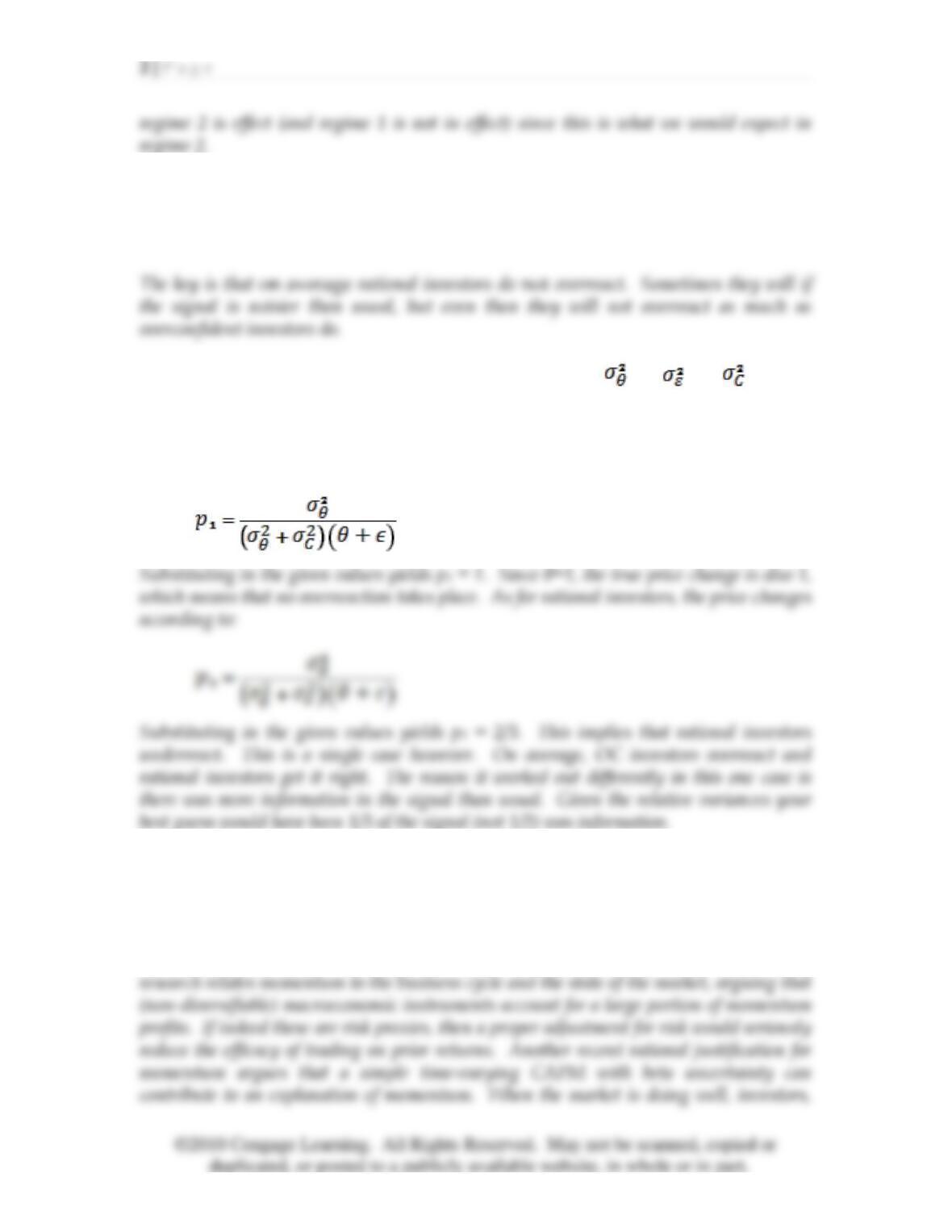
4. Again using the DHS model, suppose that θ=1; =1; =2; =1; and
s1=2. Describe and comment on the path of prices when overconfident investors
determine prices vs. the rational path of prices.
When OC investors determine the path of prices, the price change is:
5. Momentum is the anomaly that gives those subscribing to efficient
markets the most trouble. Explain.
The Fama-French three-factor model has a role for size and value but not momentum.
But other risk-based explanations for momentum have been proposed. For example, some