The payment rules state (i) how to disburse periodic coupon interest to each tranche on the basis
of the amount of principal outstanding at the beginning of the period, and (ii) how to disburse
principal payments to tranches based on its schedule of principal repayments. The latter also
states which tranches have priority with respect to current and future principal payments to
10. Explain the role of a support bond in a CMO structure.
The support bond class in a CMO structure provides for the prepayment protection for the other
bond classes. It is the support bonds that forego principal payments if the collateral prepayments
are slow. Support bonds do not receive any principal until the PAC bonds receive the scheduled
11. What was the motivation for the creation of PAC bonds?
The motivation for the creation of PAC bonds was to diminish the uncertainty in cash flows
including prepayment risk. More details are supplied below.
©2013 Pearson Education
278
designed to reduce prepayment risk.
Potential demand for a CMO product with less uncertainty about the cash flow increased in the
mid-1980s because of two trends in the corporate bond market. First was the increased event risk
faced by investors. The second trend was a decline in the number of AAA rated corporate issues.
Traditional corporate bond buyers sought a structure with both the characteristics of a corporate
bond (either a bullet maturity or a sinking fund type of schedule of principal repayment) and high
12. Suppose that a savings and loan association has decided to invest in mortgage-backed
securities and is considering the following two securities: (i) a Freddie Mac pass-through
security with a WAM of 340 months or (ii) a PAC tranche of a Freddie Mac CMO issue
with an average life of two years. Which mortgage-backed security would probably be
better from an asset/liability perspective?
Below we first describe the two choices in order to establish asset/liability possibilities.
The first choice is a pass-through security. The cash flow of a mortgage pass-through security
depends on the cash flow of the underlying mortgages. A weighted average maturity (WAM) is
found by weighting the remaining number of months to maturity for each mortgage loan in the
classes of bondholders with varying stated maturities. When there is more than one class of
bondholders with the same level of credit priority, the structure is called a pay-through structure,
as opposed to a pass-through structure in which there is only one class of bondholders at a given
13. Suppose that a PAC bond is created assuming prepayments speeds of 80 PSA and
350 PSA. If the collateral pays at 100 PSA over its life, what will this PAC tranche’s
average life be?
14. Suppose that $1 billion of pass-throughs is used to create a CMO structure with a PAC
bond with a par value of $700 million and a support bond with a par value of $300 million.
Answer the below questions.
(a) Which of the following will have the greatest average life variability: (i) the collateral,
(ii) the PAC bond, or (iii) the support bond? Why?
The support bond will have the greatest average life variability because its purpose is to reduce
variability in the cash flows, and thus the variability in the average life, of the PAC bonds. More
details are given below.
collateral. The support bond class is used to create a more stable average life for the PAC bond
class. Support bondholders have less priority over all other classes in the CMO issue in receiving
principal payments from the underlying collateral.
(b) Which of the following will have the least average life variability: (i) the collateral,
(ii) the PAC bond, or (iii) the support bond? Why?
The PAC bond will have the least average life variability because its payment schedule is
structured to achieve stability in the cash flows and thus reduce variability in the average life.
More details are given below.
15. Suppose that the $1 billion of collateral in Question 14 was divided into a PAC bond
with a par value of $800 million and a support bond with a par value of $200 million. Will
the PAC bond in this CMO structure have more or less protection than the PAC bond in
Question 14?
The PAC bond in the structure of $800 million versus $200 million will have less protection that
$700 million versus $300 million. This is because $300 million support is greater than $200
16. Suppose that $1 billion of pass-throughs is used to create a CMO structure with a PAC
bond with a par value of $700 million (PAC I), a support bond with a schedule (PAC II)
with a par value of $100 million, and a support bond without a schedule with a par value of
$200 million.
Answer the below questions.
(a) Will the PAC I or PAC II have the smaller average life variability? Why?
The PAC II will have greater average life variability. This is because the primary function of
PAC II is to support PAC I bonds by allowing them to have more stable cash flows and thus less
average life variability. More details are given below.
(b) Will the support bond without a schedule or the PAC II have the greater average life
variability? Why?
17. In a CMO structure with several PAC bonds, explain why, when the support bonds are
paid off, the structure will be just like a sequential-pay CMO.
The PAC bonds and support bonds are formed from the sequential-pay CMO. If the support
bonds are paid off earlier than expected, then the structure reverts to a sequential-pay CMO.
More details on the sequential-pay structure are supplied below.
©2013 Pearson Education
282
the preceding tranche has been paid off. More specifically, the first tranche receives all the
principal payments until the entire principal amount owed to that bond class is paid off; then the
next tranche begins to receive principal and continues to do so until it is paid off in entirety. This
process continues until the last tranche is paid off. Tranches that are paid off later have greater
maturities and thus greater average lives.
Although the priority rules for the disbursement of the principal payments are known, the precise
amount of the principal in each period is not. This will depend on the cash flow, and therefore
principal payments, of the collateral, which depends on the actual prepayment rate of the
18. Suppose that for the first four years of a CMO, prepayments are well within the initial
PAC collar. What will happen to the effective upper collar?
If the prepayments are well within the initial PAC collar, this means that there are more
bodyguards (i.e., support bonds) around than was expected when the PAC was structured at the
initial collar. This will result in an increase in the upper range of the effective collar. More
details are supplied below.
payments.
The PAC schedule may not be satisfied even if the actual prepayments never fall outside the
initial collar. This is because single PSA speed does not necessarily hold for the life of the
structure.
Finally, any prepayment speeds faster than the collar jeopardize satisfaction of the principal
repayment schedule and increase extension risk. This does not mean that the schedule will be
busted—the term used in the CMO market when a PAC schedule is broken. It does mean that the
prepayment protection is reduced.
19. Consider the following CMO structure backed by 9% collateral:
Tranche
Par Amount
(in millions)
Coupon
Rate (%)
A
$300
7.00%
B
$200
6.75%
C
$200
7.25%
D
$250
7.75%
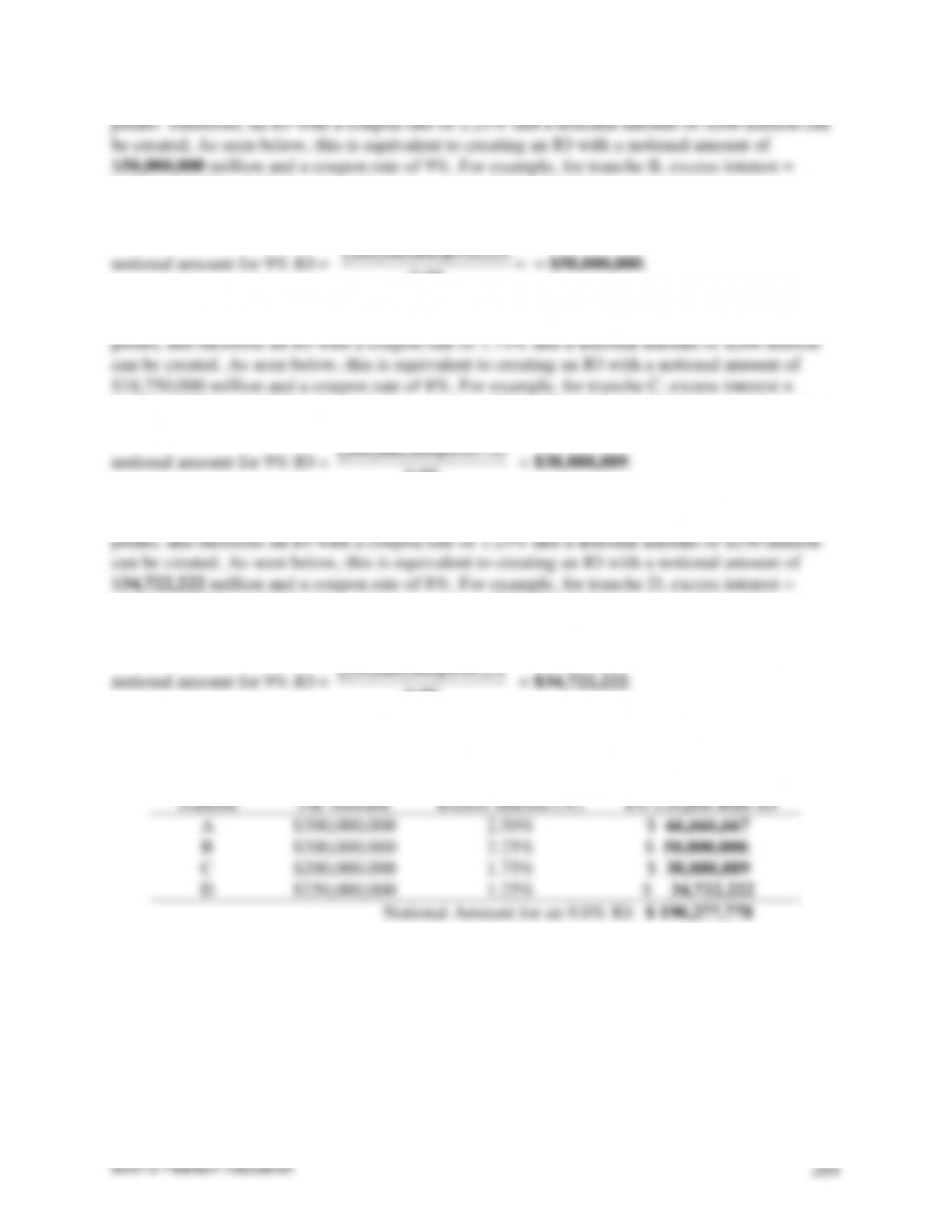
points. Therefore, an IO with a coupon rate of 2.25% and a notional amount of $200 million can
be created. As seen below, this is equivalent to creating an IO with a notional amount of
$50,000,000 million and a coupon rate of 9%. For example, for tranche B, excess interest =
0.090 – 0.0675 = 0.0225 and tranche’s par value = $200,000,000. Inserting in these values in our
equation gives:
( )
)0225.0(000,000,200
( )
)0125.0(000,000,250
20. An issuer is considering the following two CMO structures:
STRUCTURE I:
Tranche
Par Amount
(in millions)
Coupon
Rate (%)
A
$100
6.50%
B
$200
6.75%
C
$200
7.25%
D
$150
7.75%
E
$300
8.00%
F
$800
8.50%
Tranches A to E are a sequence of PAC I’s, and F is the support bond.
STRUCTURE II:
Tranche
Par Amount
(in millions)
Coupon
Rate (%)
A
$100
6.50%
B
$200
6.75%
C
$200
7.25%
D
$150
7.75%
E
$300
8.00%
F
$300
8.00%
G
$500
?
Tranches A to E are a sequence of PAC I’s, F is a PAC II, and G is a support bond without
a PAC schedule.
Answer the below questions.
(a) In structure II, tranche G is created from tranche F in structure I. What is the coupon
rate for tranche G assuming that the combined coupon rate for tranches F and G in
structure II should be 8.5%?
(b) What is the effect on the value and average life of tranches A to E by including the PAC
II in structure II?
(c) What is the difference in the average life variability of tranche G in structure II and
tranche F in structure II?
21. Answer the below questions.
(a) What is the role of a lockout in a CMO structure?
The role of a lockout in a CMO structure is to provide greater prepayment protection to all PAC
bonds. More details are given below.
(b) Explain why in a reverse PAC bond structure the longest average life bond can turn out
to be effectively a support bond if all the support bonds in the structure are paid off.
By definition, the support bonds—or bodyguards—are the bonds that provide prepayment
protection for the PAC tranches. In a reverse PAC bond structure, the longest average life bond
22. Answer the below questions.
(a) What type of prepayment protection is afforded a TAC bond?
©2013 Pearson Education
287
principal repayment. The difference between a PAC bond and a TAC bond is that the former has
a wide PSA range over which the schedule of principal repayment is protected against
contraction risk and extension risk. A TAC bond, in contrast, has a single PSA rate from which
the schedule of principal repayment is protected. As a result, the prepayment protection afforded
the TAC bond is less than that for a PAC bond.
(b) What type of prepayment protection is afforded a reverse TAC bond?
If mortgage rates rise, the price of any bond will decline. But pass-throughs will decline more
because the higher rates will tend to slow down the rate of prepayment. This is just the time when
(c) What type of prepayment protection is afforded a VADM?
Accrual or Z bonds have been used in CMO structures as support for bonds called very
23. Answer the below questions.
(a) What is a PO security? What is an IO security?
In early 1987, stripped MBS began to be issued where all the interest is allocated to one class
(the IO class) and the entire principal to the other class (the PO class). The IO class receives no
©2013 Pearson Education
288
realize depends on the speed at which prepayments are made. The faster the prepayments, the
higher the yield the investor will realize. For example, suppose that there is a pass-through
backed by 30-year mortgages with $400 million in par value and that investors can purchase POs
backed by this pass-through for $175 million. The dollar return on this investment will be $225
million. How quickly that dollar return is recovered by PO investors determines the yield that
will be realized. In the extreme case, if all the homeowners in the underlying mortgage pool
decide to prepay their mortgage loans immediately, PO investors will realize the $225 million
immediately. At the other extreme, if all homeowners decide to keep their houses for 30 years
and make no prepayments, the $225 million will be spread out over 30 years, which will result in
a lower yield for PO investors.
The price of the PO can be expected to change as mortgage rates in the market change. When
mortgage rates decline below the coupon rate, prepayments are expected to speed up,
accelerating payments to the PO holder. Thus the cash flow of a PO improves (in the sense that
(b) How is the price of an interest-only security expected to change when interest rates
change?
The price of an interest-only security (IO) can move in various directions depending on the
direction of the change in interest rates and also the change relative to the coupon rate. Details on
the precise expectations of IO price changes are supplied below.
If mortgage rates decline below the coupon rate, prepayments on the interest-only security (IO)
are expected to accelerate. This results in a deterioration of the expected cash flow for an IO.
©2013 Pearson Education
289
created from this pass-through. Notice that as mortgage rates decline below 9%, the price of the
pass-through does not respond much. This is the negative convexity (or price compression)
property of pass-throughs. For the PO security, the price falls monotonically as mortgage rates
rise. For the IO security, at mortgage rates above approximately 11%, the price declines as
mortgage rates rise; as mortgage rates fall below about 11%, the price of an IO falls as mortgage
rates decline. Both POs and IOs display substantial price volatility when mortgage rates change.
The greater price volatility of the IO and PO compared with the pass-through from which they
were created can be seen by the steepness of a tangent line to the curves at any given mortgage
rate.
24. Suppose that 10% coupon pass-throughs are stripped into two classes. Class X-1
receives 70% of the principal and 9% of the interest. Class X-2 receives 30% of the
principal and 91% of the interest. Answer the following questions.
(a) What type of stripped MBS would this be?
The type of stripped MBS described in the question is a synthetic-coupon pass-through because
each class receives an unequal distribution of principal and interest.
Stripped mortgage-backed securities (MBSs), introduced by Fannie Mae in 1986, are another
example of derivative mortgage products. A pass-through divides the cash flow from the
(b) What is the effective coupon rate on Class X-1?
Class X-1 receives 9% or 0.09 of the interest. Because the coupon rate is 10%, it effectively will
receive 0.09(10%) = 0.9%. More details are supplied below concerning the relationship between
yield and price that Class X-1 investors can expect.
©2013 Pearson Education
290
is purchased at a substantial discount from par value. The yield an investor will realize on a PO
depends on the speed at which prepayments are made. The faster the prepayments, the higher the
yield the investor will realize.
(c) What is the effective coupon rate on Class X-2?
Class X-2 receives 30% of the principal and 91% or 0.91 of the interest. Because the coupon rate
is 10%, it effectively will receive 0.91(10%) = 9.1%. More details are supplied below concerning
the relationship between yield and price that Class X-2 investors can expect.