Chapter 12: The Capital Budgeting Decision
Chapter 12
The Capital Budgeting Decision
Discussion Questions
12-1.
What are the important administrative considerations in the capital budgeting
process?
Important administrative considerations relate to the search for and discovery of
investment opportunities, the collection of data, the evaluation of projects, and
the reevaluation of prior decisions.
12-2.
Why does capital budgeting rely on analysis of cash flows rather than on net
income?
Cash flow rather than net income is used in capital budgeting analysis because
the primary concern is with the amount of actual dollars generated. For
example, depreciation is subtracted out in arriving at net income, but this non-
cash deduction should be added back in to determine cash flow or actual dollars
generated.
12-3.
What are the weaknesses of the payback method?
The weaknesses of the payback method are:
a. There is no consideration of inflows after payback is reached.
b. The concept fails to consider the time value of money.
12-4.
What is normally used as the discount rate in the net present value method?
The cost of capital as determined in Chapter 11.
12-5.
What does the term mutually exclusive investments mean?
The selection of one investment precludes the selection of other alternative
investments because the investments compete with one another. For example, if
a company is going to build one new plant and is considering five cities, one
city will win and the others will lose.
12-6.
How does the modified internal rate of return include concepts from both the
traditional internal rate of return and the net present value methods?
The modified internal rate of return calls for the determination of the interest
rate that equates future inflows to the investment, as does the traditional internal
rate or return. However, it incorporates the reinvestment rate assumption of the
net present value method. That is, inflows are reinvested at the cost of capital.
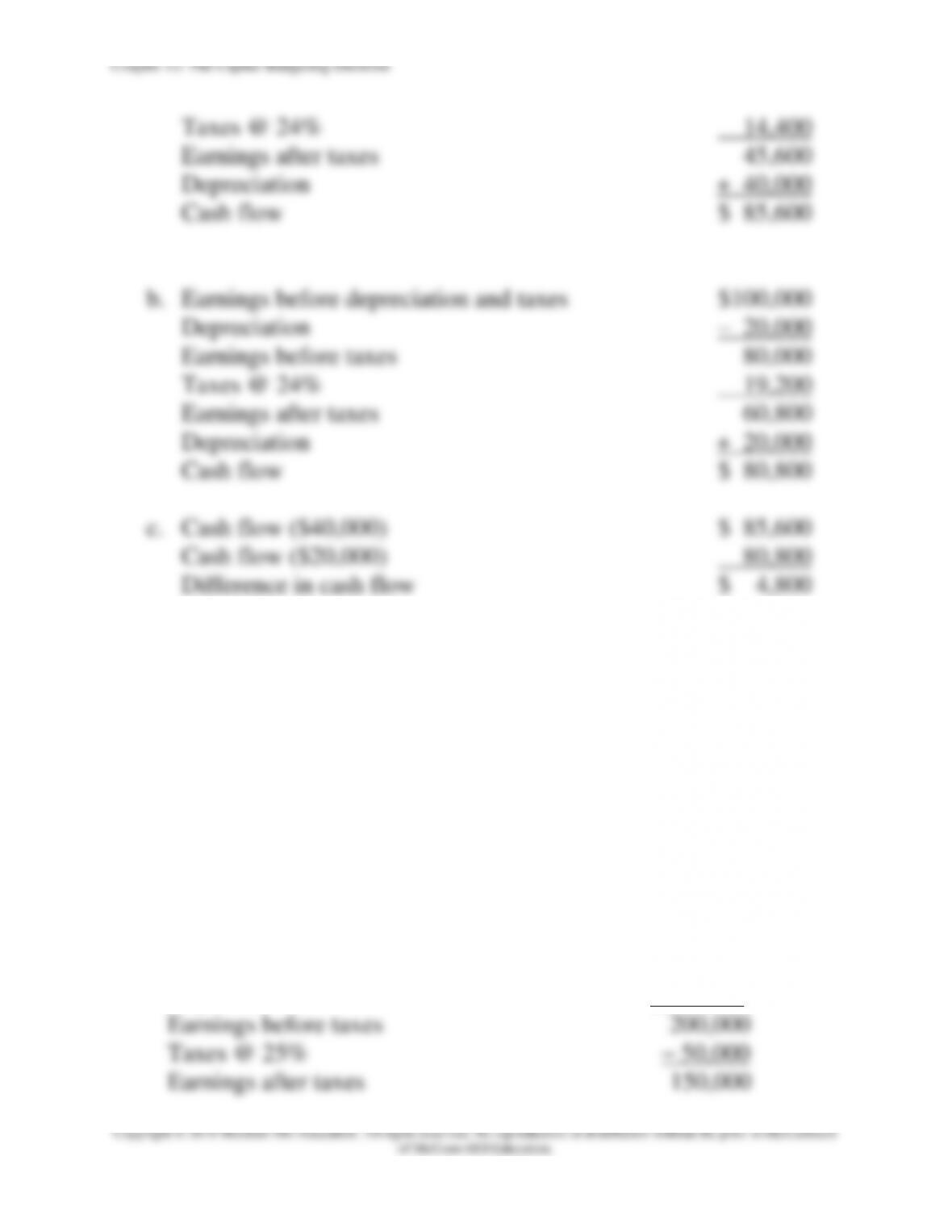
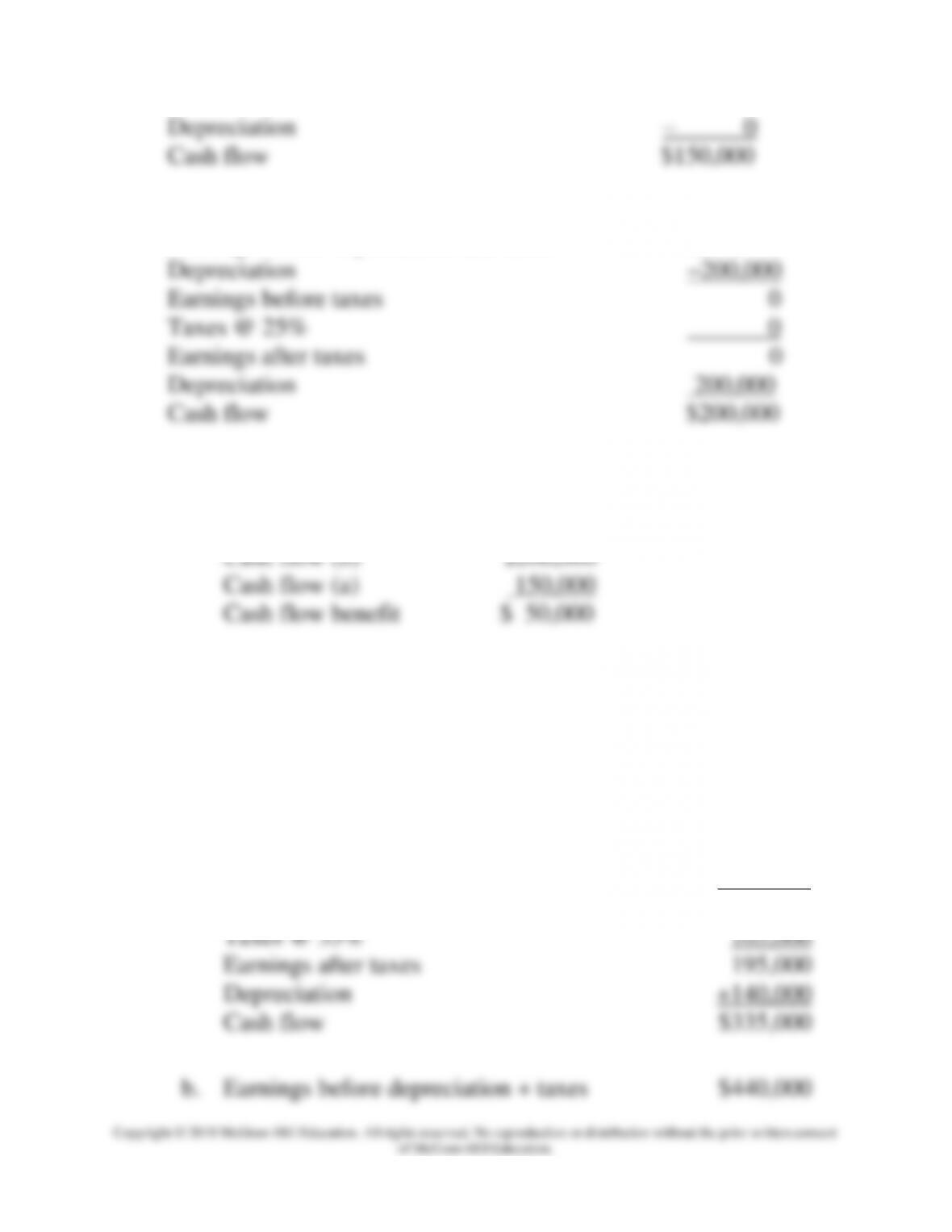
Chapter 12: The Capital Budgeting Decision
b.
Earnings before depreciation and taxes $200,000
c.
The $200,000 in depreciation provided a cash flow benefit
of $80,000.
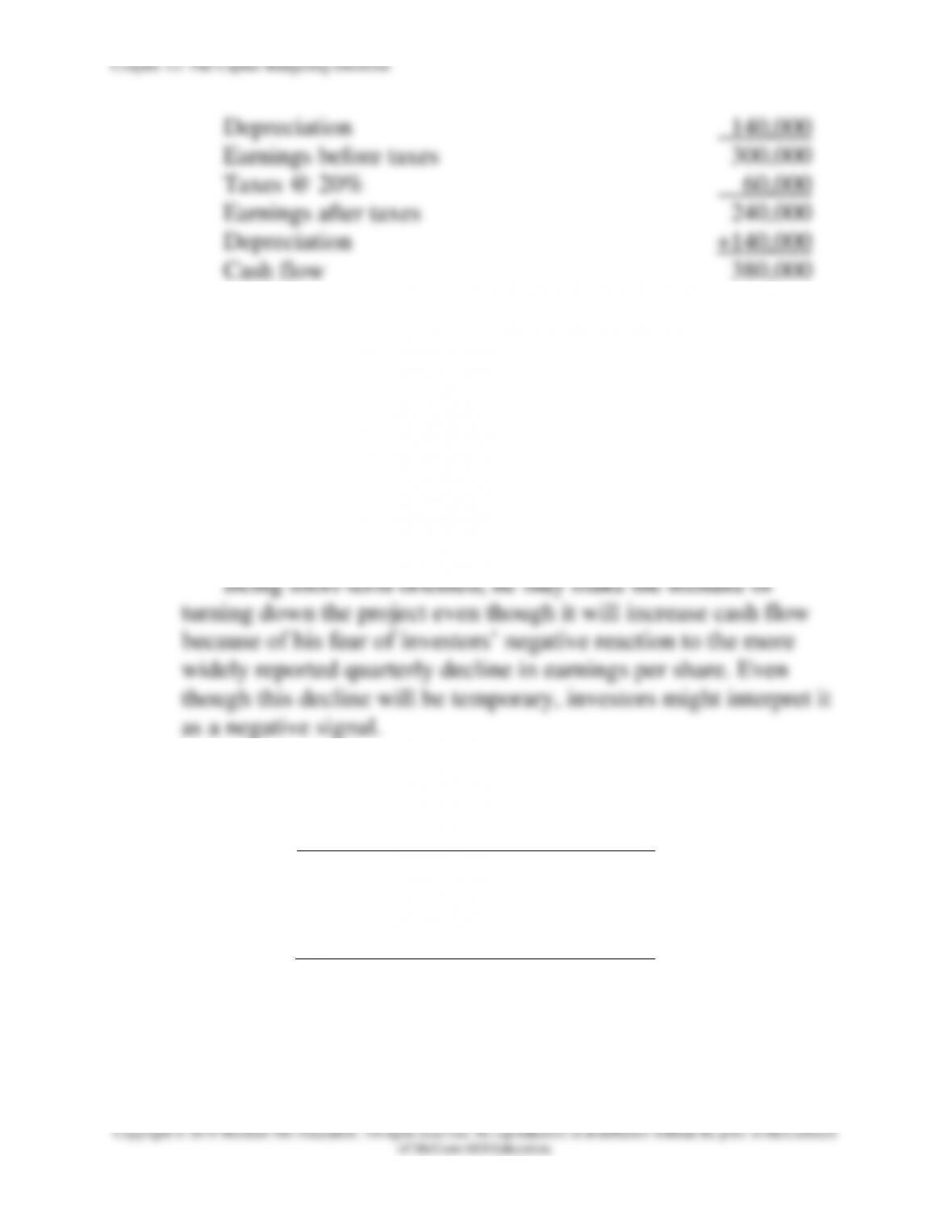
4. Cash flow (LO12-2) Assume a firm has earnings before depreciation and taxes of
$440,000 and depreciation of $140,000.
a. If it is in a 35 percent tax bracket, compute its cash flow.
b. If it is in a 20 percent tax bracket, compute its cash flow.
12–4. Solution:
a. Earnings before depreciation and taxes $440,000
Depreciation 140,000
Earnings before taxes 300,000

Chapter 12: The Capital Budgeting Decision
Payback for Product X Payback for Product Y
7. Payback method (LO12-3) Assume a $40,000 investment and the following cash flows for
two alternatives.
Year
Investment X
Investment Y
1
$ 6,000
$15,000
2
8,000
20,000
3
9,000
10,000
4
17,000
—
5
20,000
—
Which of the alternatives would you select under the payback method?
12–7. Solution:
Payback for Investment X Payback for Investment Y
$40,000–$6,000 1 year $40,000–$15,000 1 year


Chapter 12: The Capital Budgeting Decision
Year
Electric Co.
Water Works
1……………….
$85,000
$30,000
2……………….
25,000
25,000
3……………….
30,000
85,000
4–10………….
10,000
10,000
a. Using the payback method, what will the decision be?
b. Explain why the answer in part a can be misleading.
12–9. Solution:
Short-Line Railroad
a.
Payback for Electric Co. Payback for Water Works
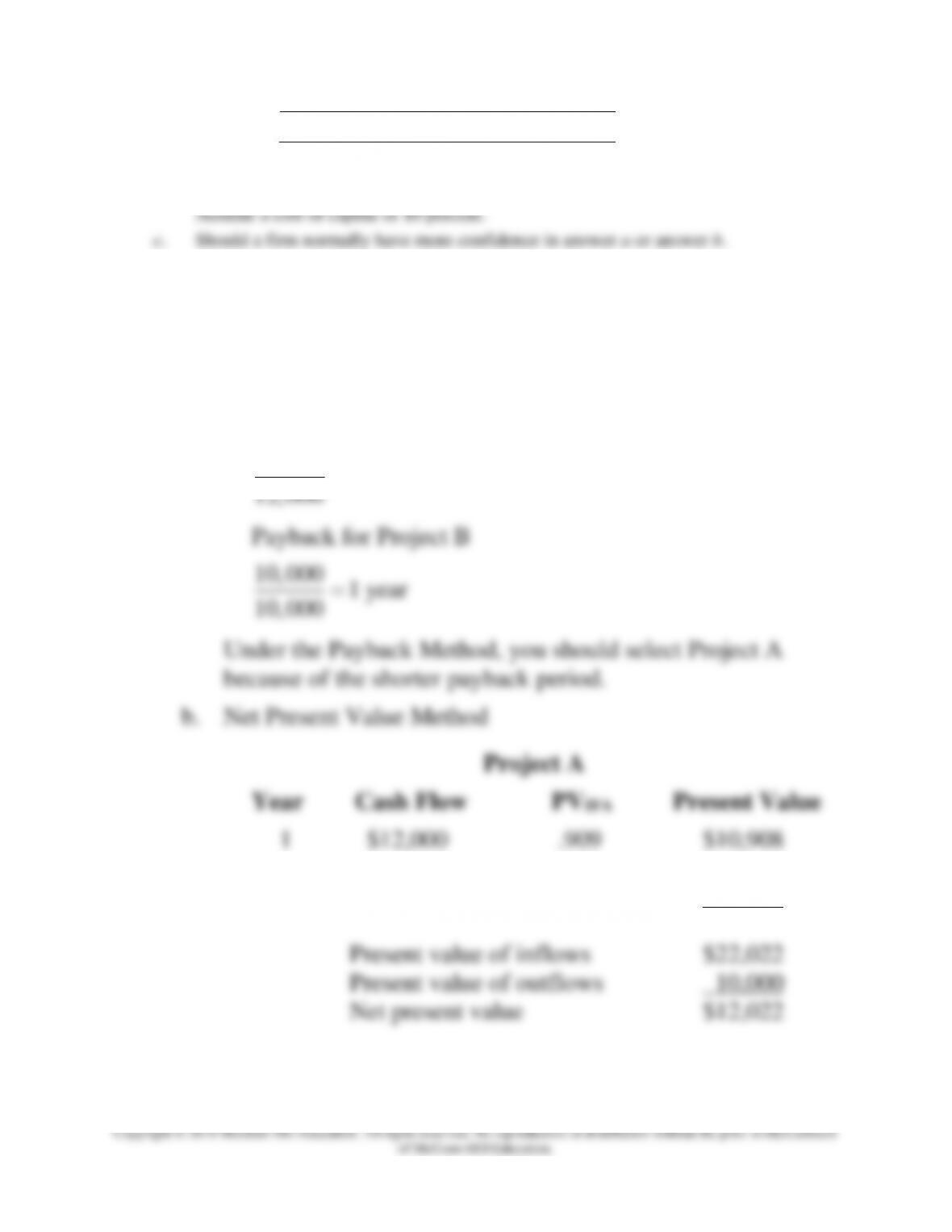
10. Payback and net present value (LO12-3 and 4) X-treme Vitamin Company is
considering two investments, both of which cost $10,000. The cash flows are as follows:
Year
Project A
Project B
1 ………………..
$12,000
$10,000
2 ………………..
8,000
6,000
Chapter 12: The Capital Budgeting Decision
3 ………………..
6,000
16,000
a. Which of the two projects should be chosen based on the payback method?
b. Which of the two projects should be chosen based on the net present value method?
12–10. Solution:
X-treme Vitamin Company
a. Payback Method
Payback for Project A
10,000 .83 years
12,000
=
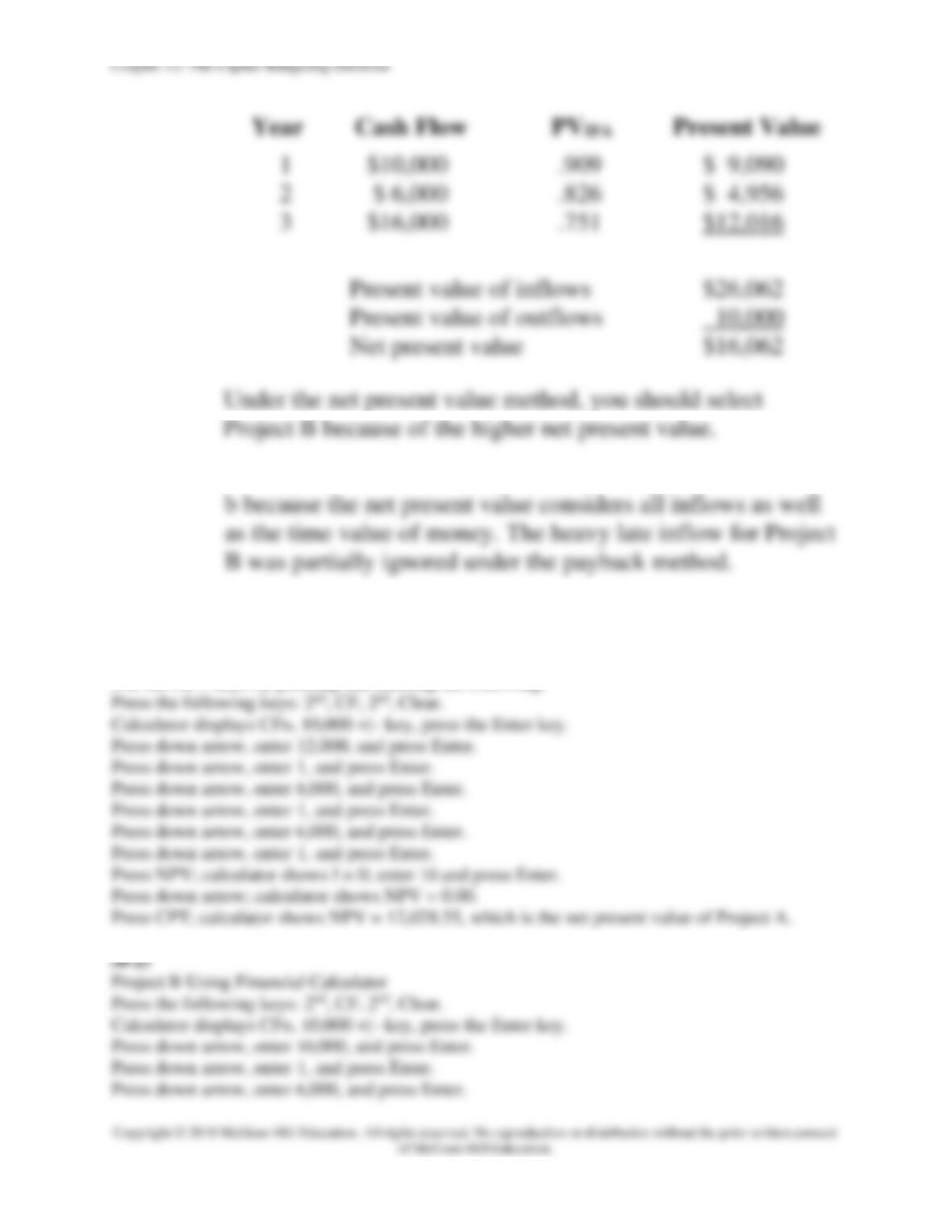
2 $ 8,000 .826 $ 6,608
3 $ 6,000 .751 $ 4,506
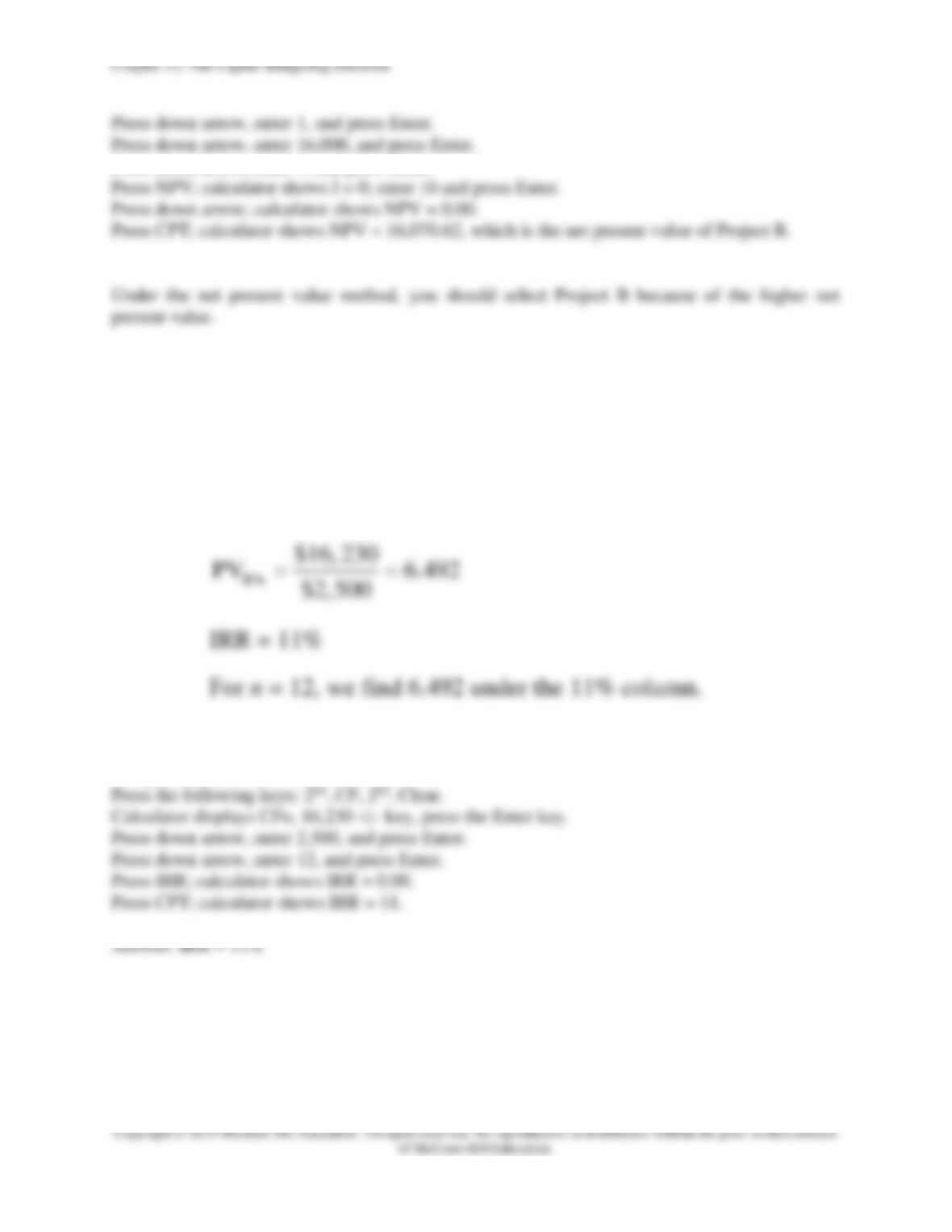
Project B

Chapter 12: The Capital Budgeting Decision
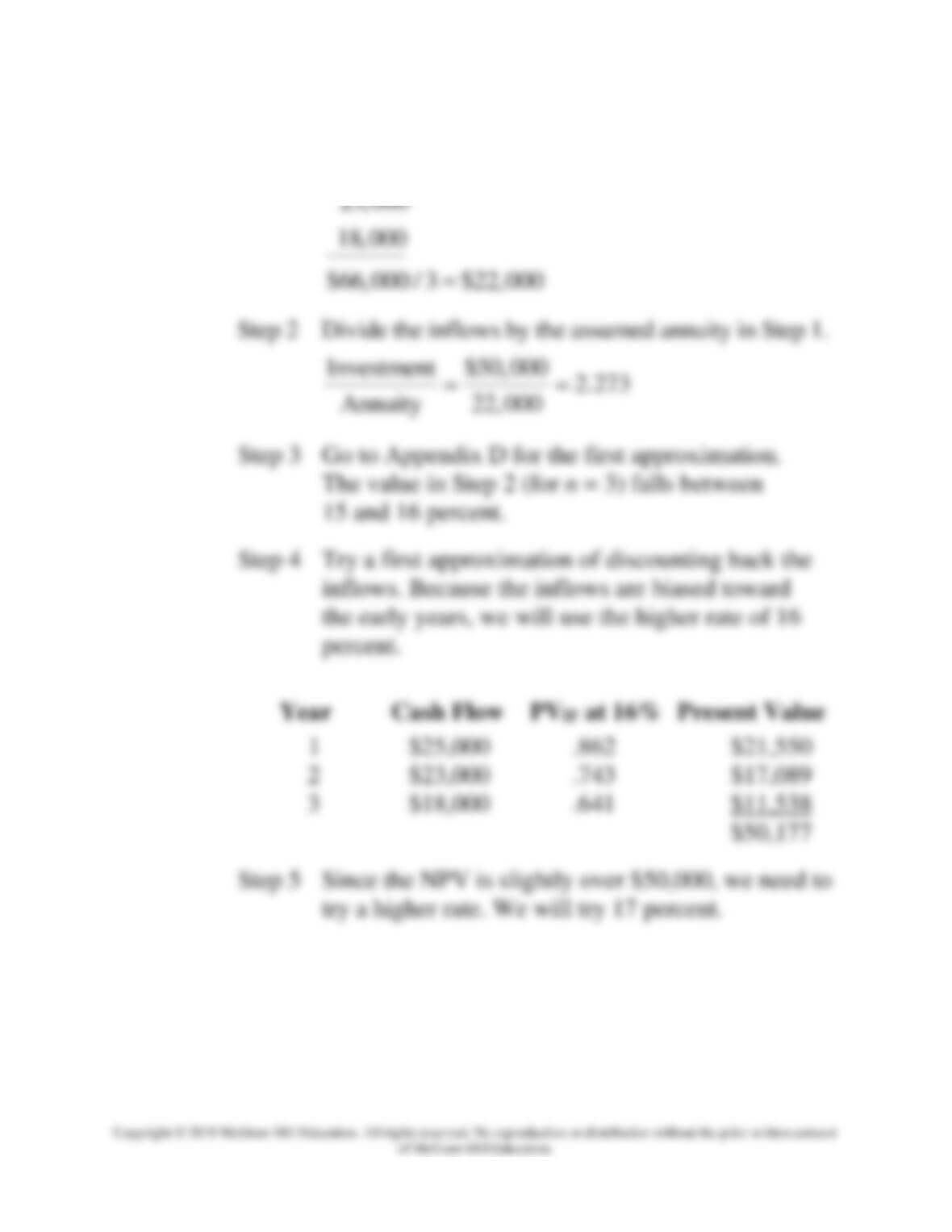
a. Step 1 Average the inflows.
$25,000
23,000
18,000
$66,000 / 3 $22,000=
Step 2 Divide the inflows by the assumed annuity in Step 1.
Investment $50,000 2.273
Annuity 22,000
==
Step 3 Go to Appendix D for the first approximation.
The value in Step 2 (for n = 3) falls between
15 and 16 percent.
Step 4 Try a first approximation of discounting back the
inflows. Because the inflows are biased toward
the early years, we will use the higher rate of 16
percent.
Year Cash Flow PVIF at 16% Present Value
1 $25,000 .862 $21,550
2 $23,000 .743 $17,089
3 $18,000 .641 $11,538
$50,177
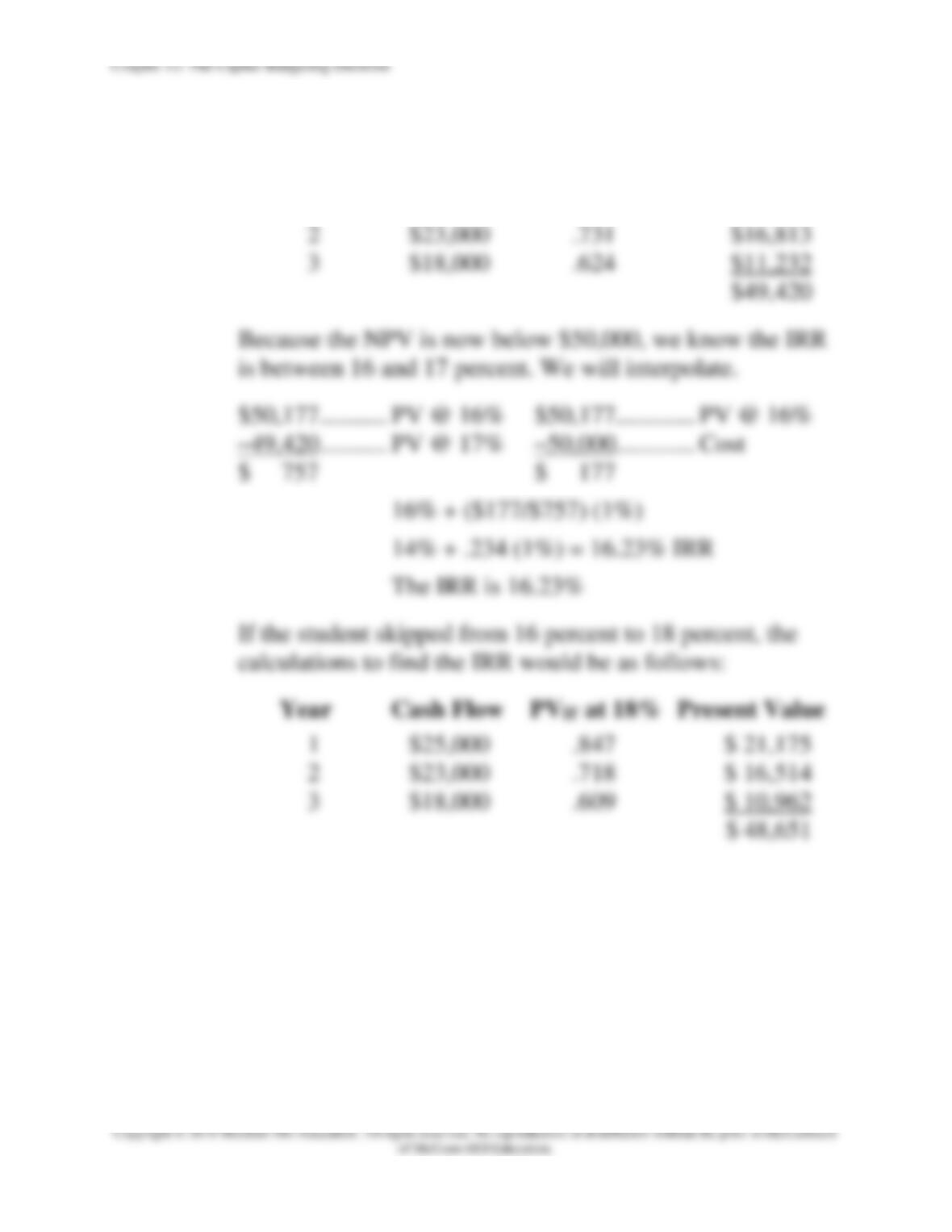
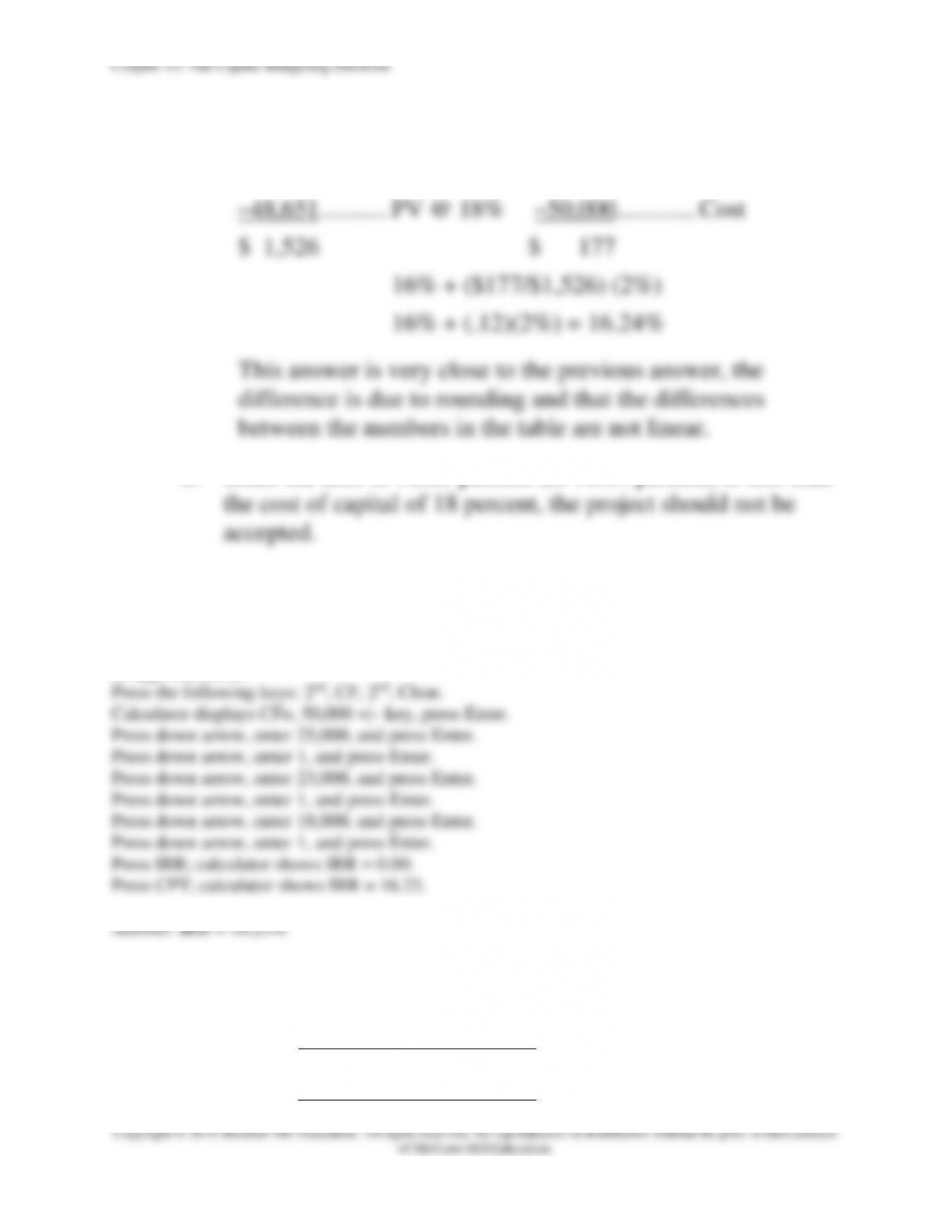
Step 5 Since the NPV is slightly over $50,000, we need to
try a higher rate. We will try 17 percent.
Chapter 12: The Capital Budgeting Decision
Calculator Solution:
Using a financial calculator,
Press the following keys: 2nd, CF, 2nd, Clear.
Calculator displays CFo, 60,000 +|– key, press the Enter key
Press down arrow, enter 15,000, and press Enter.
Press down arrow, enter 1, and press Enter.
Press down arrow, enter 25,000, and press Enter.
Press down arrow, enter 1, and press Enter.
Press down arrow, enter 30,000, and press Enter.
Press down arrow, enter 1, and press Enter.
Press NPV; calculator shows I = 0; enter 10 and press Enter.
Press down arrow; calculator shows NPV = 0.00.
Press CPT; calculator shows NPV = –3,163.04, which is the net present value of the project.
Note, the $10,000 outflow in year 3 has been subtracted from the $40,000 inflow in the third year,
and thus the year 3 net cash flow is $30,000.
16. Net present value method (LO12-4) Skyline Corp. will invest $130,000 in a project that
will not begin to produce returns until after the 3rd year. From the end of the 3rd year until
the end of the 12th year (10 periods), the annual cash flow will be $34,000. If the cost of
capital is 12 percent, should this project be undertaken?
12–16. Solution:
Skyline Corporation
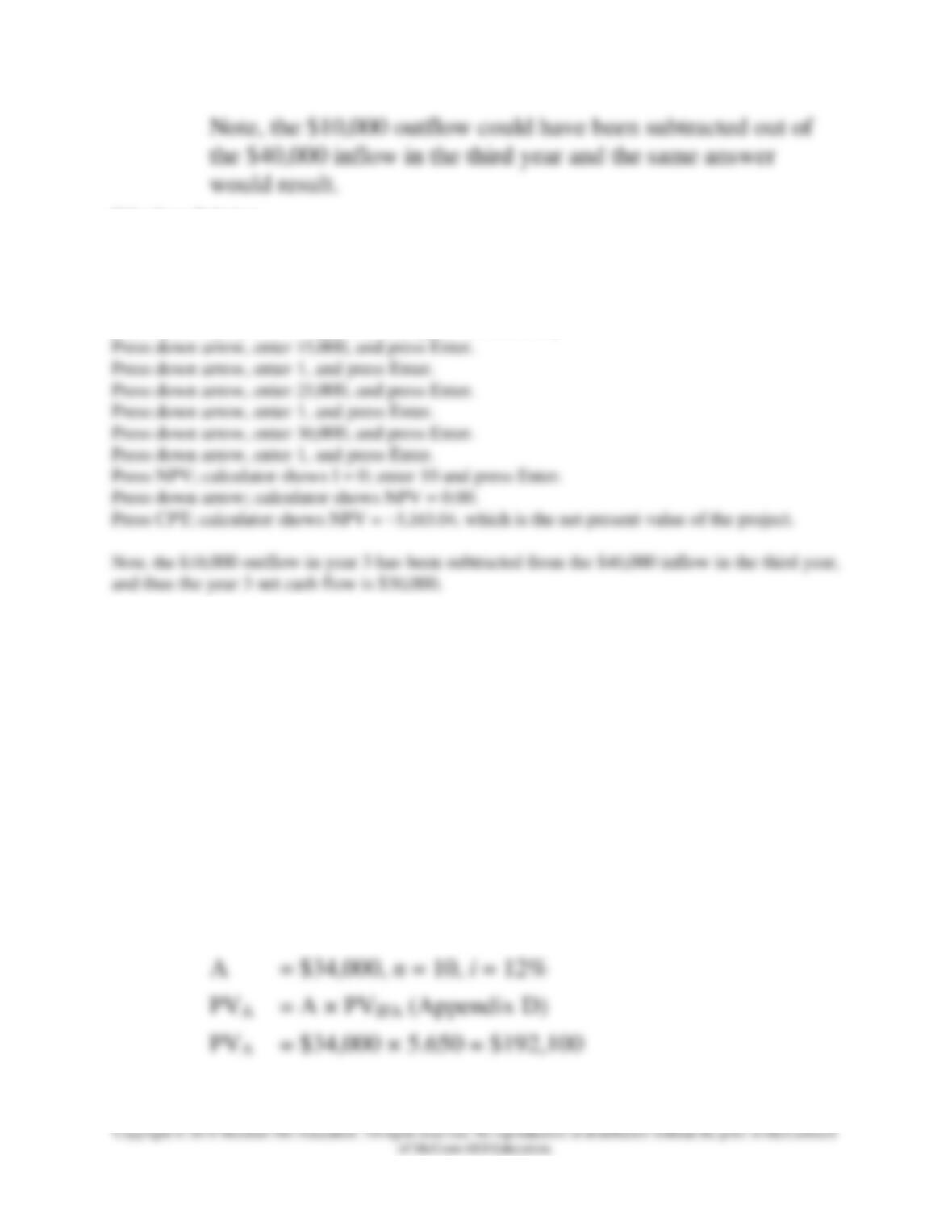
Present Value of Inflows
Find the present value of a deferred annuity