Chapter 11
Cost of Capital
Discussion Questions
11-1.
Why do we use the overall cost of capital for investment decisions even when
only one source of capital will be used (e.g., debt)?
Though an investment financed by low-cost debt might appear acceptable at first
glance, the use of debt could increase the overall risk of the firm and eventually
make all forms of financing more expensive. Each project must be measured
against the overall cost of funds to the firm.
11-2.
How does the cost of a source of capital relate to the valuation concepts presented
previously in Chapter 10?
The cost of a source of financing directly relates to the required rate of return for
that means of financing. Of course, the required rate of return is used to establish
valuation.
11-3.
In computing the cost of capital, do we use the historical costs of existing debt
and equity or the current costs as determined in the market? Why?
In computing the cost of capital, we use the current costs for the various sources
of financing rather than the historical costs. We must consider what these funds
will cost us to finance projects in the future rather than their past costs.
11-4.
Why is the cost of debt less than the cost of preferred stock if both securities are
priced to yield 10 percent in the market?
Even though debt and preferred stock may be both priced to yield 10 percent in
the market, the cost of debt is less because the interest on debt is a tax-deductible
expense. A 10 percent market rate of interest on debt will only cost a firm in a
35 percent tax bracket an aftertax rate of 6.5 percent. The answer is the yield
multiplied by the difference of (one minus the tax rate).
11-5.
What are the two sources of equity (ownership) capital for the firm?
The two sources of equity capital are retained earnings and new common
stock.
11-6.
Explain why retained earnings have an associated opportunity cost?
Retained earnings belong to the existing common stockholders. If the funds are
paid out instead of reinvested, the stockholders could earn a return on them. Thus,
we say retaining funds for reinvestment carries an opportunity cost.
11-7.
Why is the cost of retained earnings the equivalent of the firm’s own
required rate of return on common stock (Ke)?
Because stockholders can earn a return at least equal to their present
investment. For this reason, the firm’s rate of return (Ke) serves as a means
of approximating the opportunities for alternate investments.
11-8.
Why is the cost of issuing new common stock (Kn) higher than the cost of
retained earnings (Ke)?
In issuing new common stock, we must earn a slightly higher return than
the normal cost of common equity in order to cover the distribution costs
of the new security. In the case of the Baker Corporation, the cost of new
common stock was six percent higher.
11-9.
How are the weights determined to arrive at the optimal weighted average
cost of capital?
The weights are determined by examining different capital structures and
using that mix which gives the minimum cost of capital. We must solve a
multidimensional problem to determine the proper weights.
11-10.
Explain the traditional, U-shaped approach to the cost of capital.
The logic of the U-shaped approach to cost of capital can be explained
through Figure 11-1. It is assumed that as we initially increase the
debt-to-equity mix, the cost of capital will go down. After we reach an
optimum point, the increased use of debt will increase the overall cost of
financing to the firm. Thus we say the weighted average cost of capital
curve is U-shaped.
11-11.
It has often been said that if the company can’t earn a rate of return greater
than the cost of capital, it should not make investments. Explain.
If the firm cannot earn the overall cost of financing on a given project, the
investment will have a negative impact on the firm’s operations and will
lower the overall wealth of the shareholders.
11-12.
What effect would inflation have on a company’s cost of capital? (Hint:
Think about how inflation influences interest rates, stock prices, corporate
profits, and growth.)
Inflation can only have a negative impact on a firm’s cost of capital,
forcing it to go up. This is true because inflation tends to increase interest
rates and lower stock prices, thus raising the cost of debt and equity
directly and the cost of preferred stock indirectly.
11-13.
What is the concept of marginal cost of capital?
The marginal cost of capital is the cost of incremental funds. After a firm
reaches a given level of financing, capital costs will go up because the firm
must tap more expensive sources. For example, new common stock may be
needed to replace retained earnings as a source of equity capital.
Appendix A
Discussion Questions
11A-1.
How does the capital asset pricing model help explain changing costs of
capital?
The capital asset pricing model explains the relationship between risk and
return, and the price adjustment of capital assets to changes in risk and return.
As investors react to their economic environment and their willingness to take
risk, they change the prices of financial assets like common stock, bonds, and
preferred stock. As the prices of these securities adjust to investors’ required
returns, the company’s cost of capital is adjusted accordingly.
11A-2.
How does the SML react to changes in the rate of interest, changes in the rate of
inflation, and changing investor expectations?
The SML, Security Market Line, reflects the risk-return trade-offs of securities.
As interest rates increase, the SML moves up parallel to the old SML. Now
investors require a higher minimum return on risk-free assets and an equally
higher rate for all levels of risk. A change in the rate of inflation has a similar
impact. The risk-free rate goes up to provide the appropriate inflation premium
and there is an upward shift in the SML.
In regard to changing investor expectations, as investors become more risk-
averse, the SML increases its slope. The more risk taken, the greater the return
premium that is desired (see Figure 11A-4).
Chapter 11
Problems
1. Cost of capital (LO11-2) In March, Hertz Pain Relievers bought a massage machine that
provided a return of 8 percent. It was financed by debt costing 7 percent. In August Mr.
Hertz came up with a heating compound that would have a return of 14 percent.
The chief financial officer, Mr. Smith, told him it was impractical because it would require
the issuance of common stock at a cost of 16 percent to finance the purchase.
Is the company following a logical approach to using its cost of capital?
11–1. Solution:
No. Each individual project should not be measured against the
2. Cost of capital (LO11-2) Speedy Delivery Systems can buy a piece of equipment that is
anticipated to provide an 11 percent return and can be financed at 6 percent with debt. Later
in the year, the firm turns down an opportunity to buy a new machine that would yield a 9
percent return but would cost 15 percent to finance through common equity. Assume debt
and common equity each represent 50 percent of the firm’s capital structure.
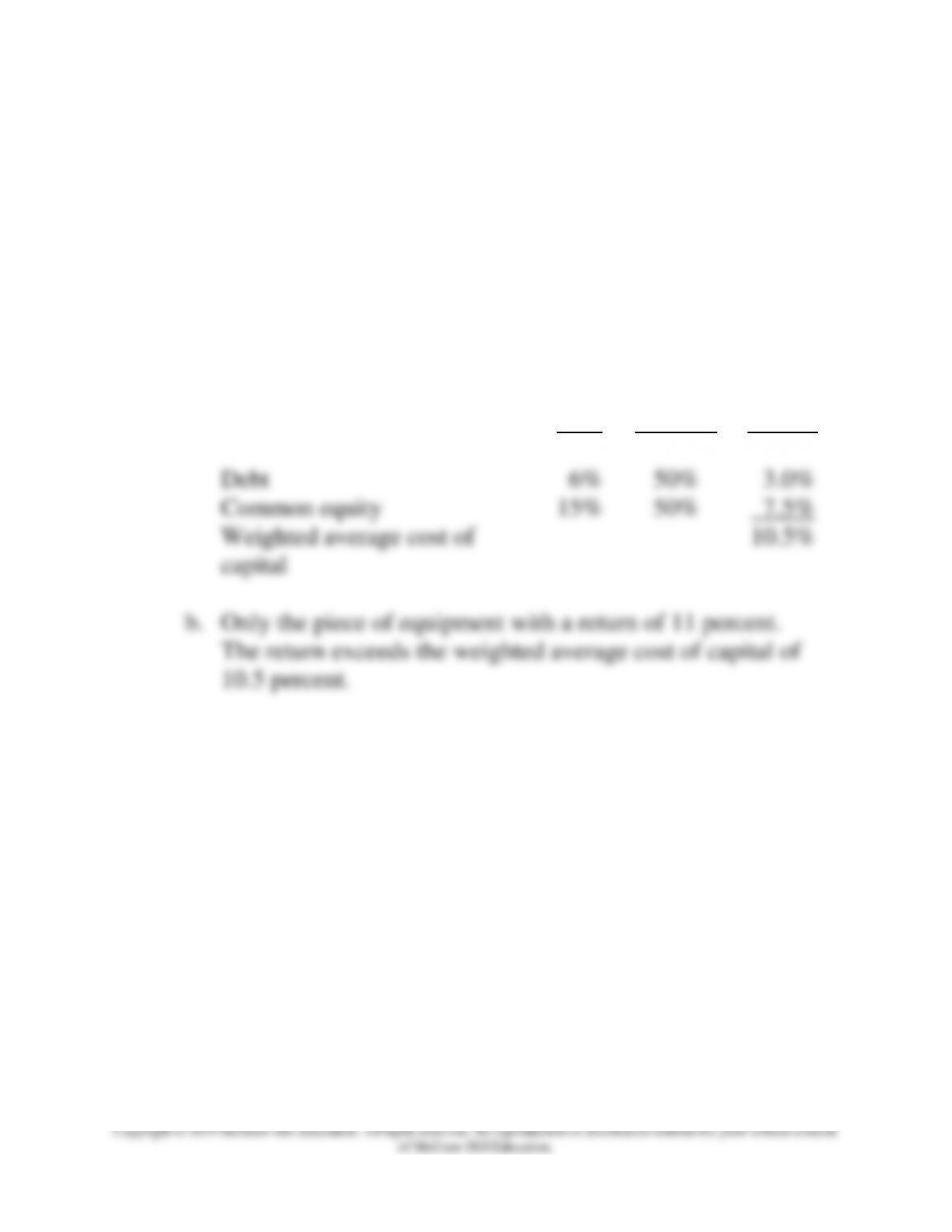
a. Compute the weighted average cost of capital.
b. Which project(s) should be accepted?
11-2. Solution:
Speedy Delivery Systems
Weighted
a.
Cost
Weights
Cost
Debt
6%
50%
3.0%
Common equity
15%
50%
7.5%
Weighted average cost of
capital
10.5%
b.
Only the piece of equipment with a return of 11 percent.
The return exceeds the weighted average cost of capital of
10.5 percent.
3. Effect of discount rate (LO11-2) A brilliant young scientist is killed in a plane crash. It is
anticipated that he could have earned $240,000 a year for the next 50 years. The attorney
for the plaintiff’s estate argues that the lost income should be discounted back to the
present at 4 percent. The lawyer for the defendant’s insurance company argues for a
discount rate of 8 percent. What is the difference between the present value of the
settlement at 4 percent and 8 percent? Compute each one separately.
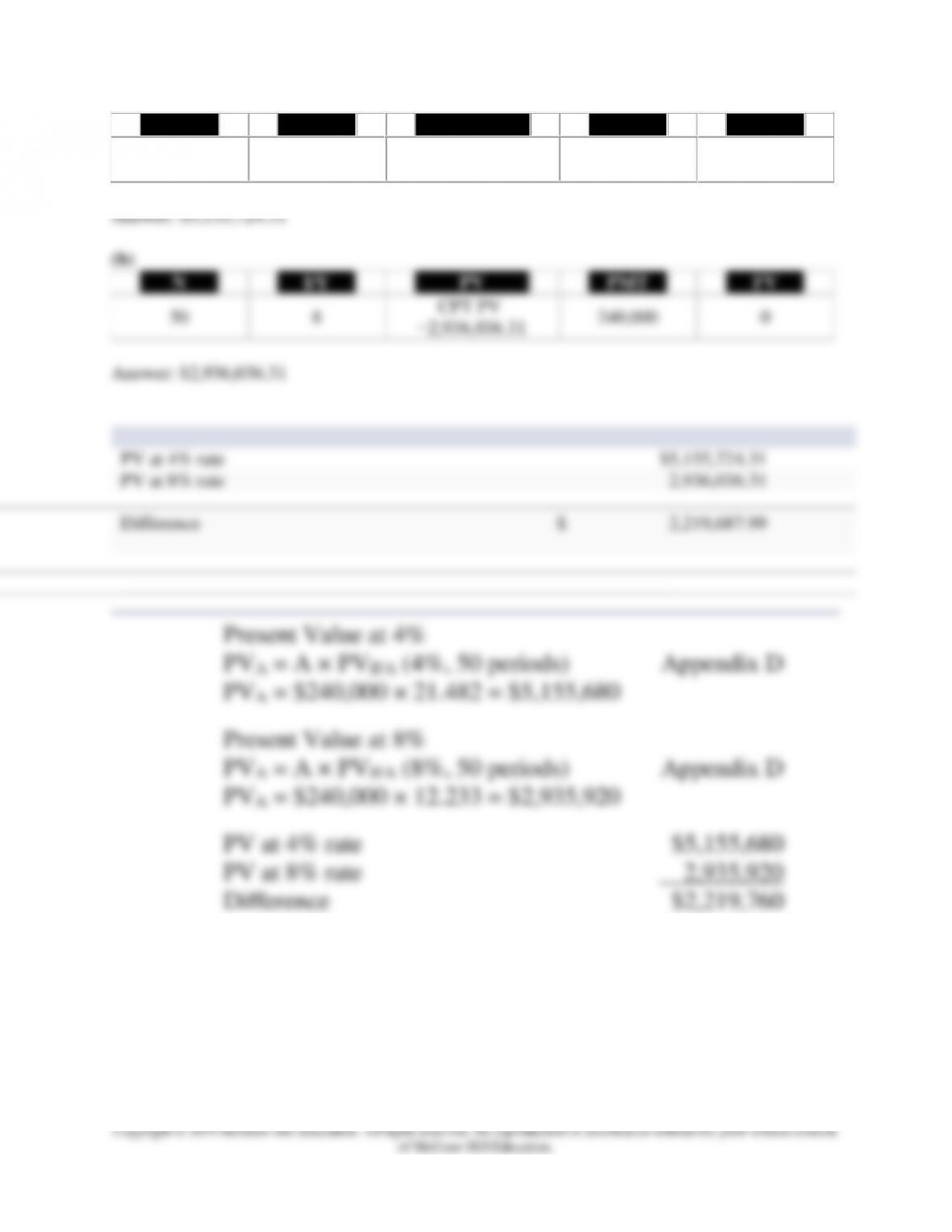
11-3. Solution:
Law Suit Settlement
Calculator Solution:
(a)
N
I/Y
PV
PMT
FV
50
4
CPT
PV −5,155,724.31
240,000
0
Answer: $5,155,724.31
(b)
N
I/Y
PV
PMT
FV
50
8
CPT PV
−2,936,036.31
240,000
0
Answer: $2,936,036.31
PV at 4% rate
$
5,155,724.31
PV at 8% rate
2,936,036.31
Difference
$
2,219,687.99
Present Value at 4%
PVA = A × PVIFA (4%, 50 periods) Appendix D
PVA = $240,000 × 21.482 = $5,155,680
Present Value at 8%
PVA = A × PVIFA (8%, 50 periods) Appendix D
PVA = $240,000 × 12.233 = $2,935,920
PV at 4% rate $5,155,680
PV at 8% rate 2,935,920
Difference $2,219,760
4. Aftertax cost of debt (LO11-3) Telecom Systems can issue debt yielding 9 percent. The
company is in a 30 percent bracket. What is its aftertax cost of debt?
11-4. Solution:
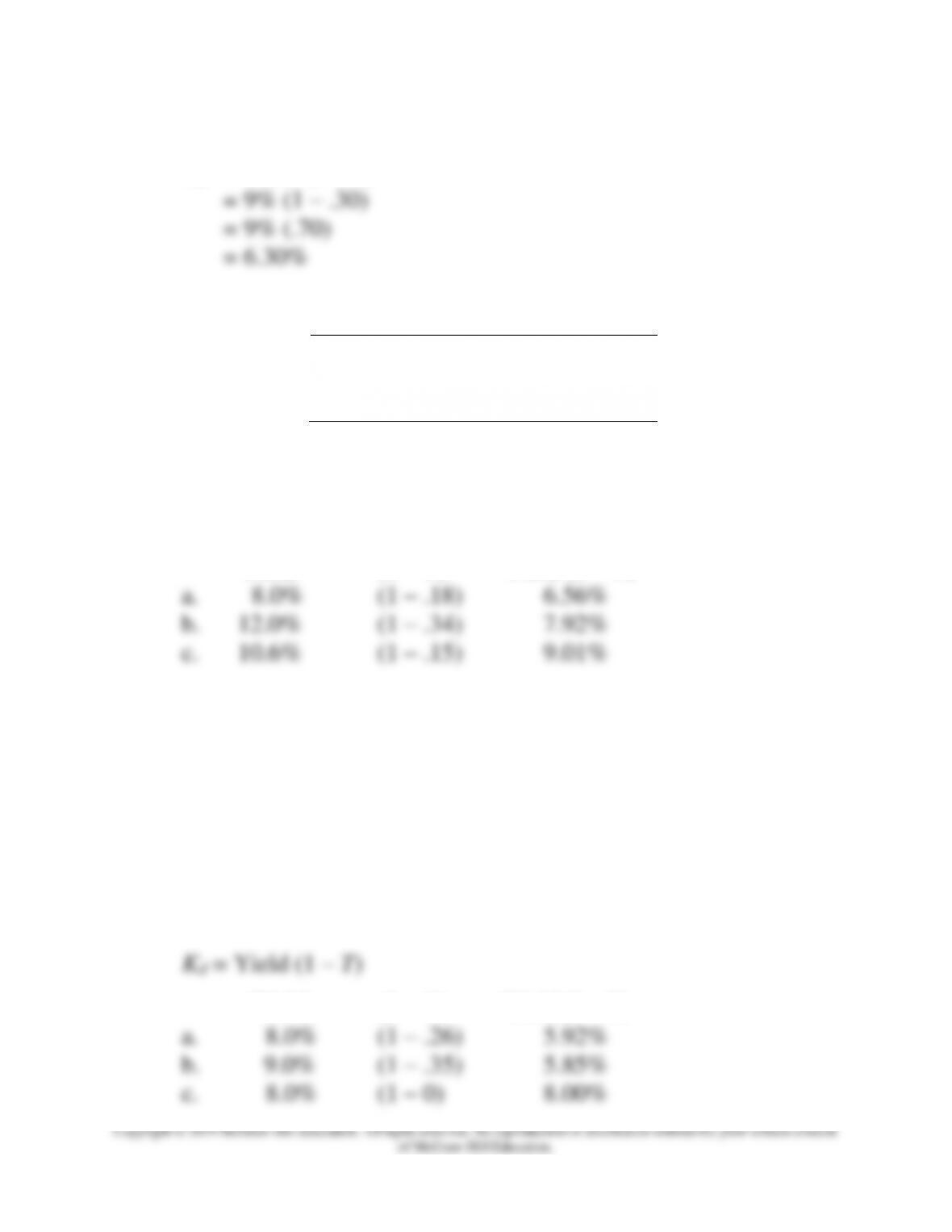
Telecom Systems
Kd = Yield (1 – T)
5. Calculate the aftertax cost of debt under each of the following conditions:
Yield
Corporate Tax Rate
a. 8.0%
18%
b. 12.0%
34%
c. 10.6%
15%
11-5. Solution:
Kd = Yield (1 – T)
Yield (1 – T) Yield (1 – T)
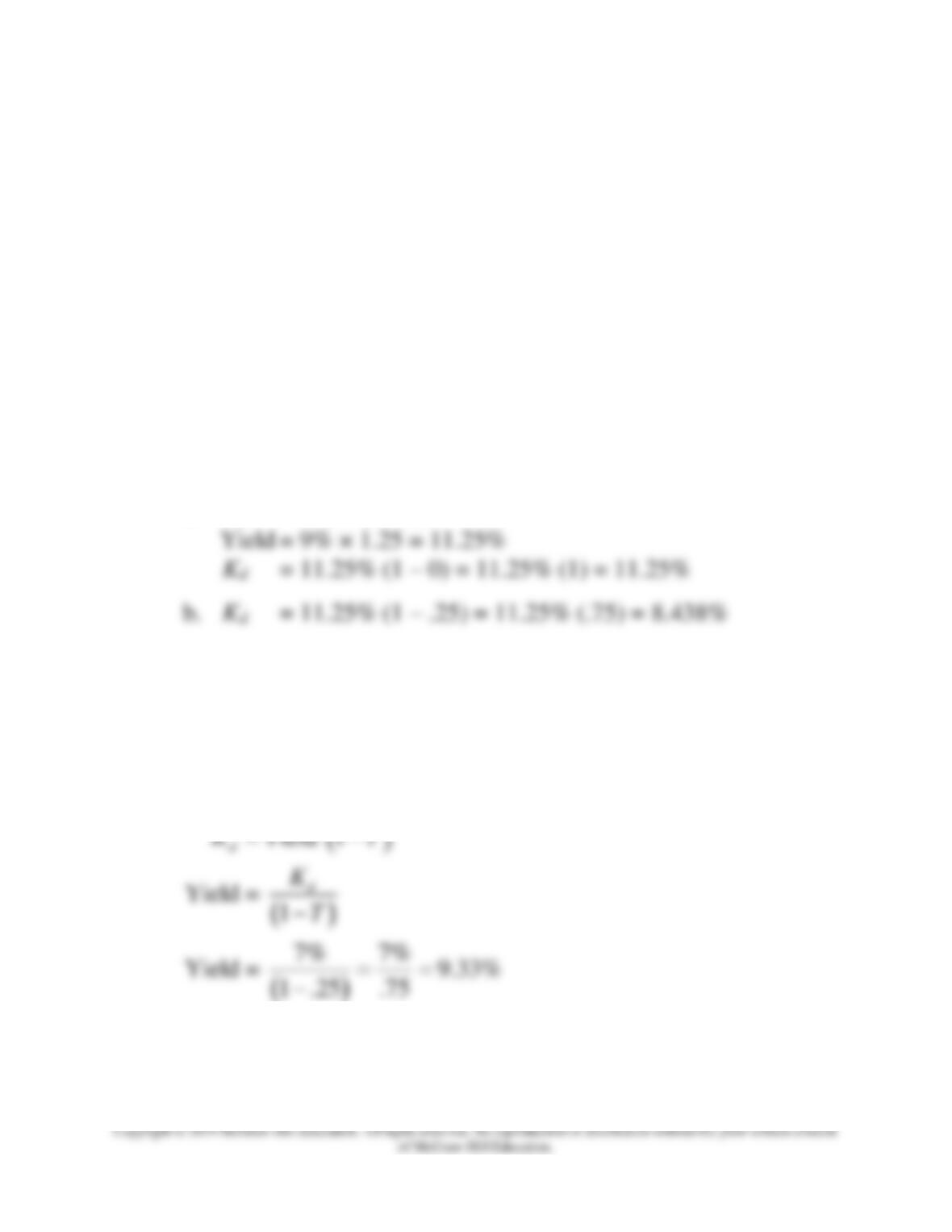
6. Aftertax cost of debt (LO11-3) Calculate the aftertax cost of debt under each of the
following conditions:
Yield
Corporate Tax Rate
a.
8.0%
26%
b.
9.0
35
c.
8.0
0
11-6. Solution:
Yield (1 – T) Yield(1 – T)
7. Aftertax cost of debt (LO11-3) The Goodsmith Charitable Foundation, which is tax-
exempt, issued debt last year at 9 percent to help finance a new playground facility in Los
Angeles. This year the cost of debt is 25 percent higher—that is, firms that paid 11 percent
for debt last year will be paying 13.75 percent this year.
a. If the Goodsmith Charitable Foundation borrowed money this year, what would the
aftertax cost of debt be, based on their cost last year and the 25 percent increase?
b. If the receipts of the foundation were found to be taxable by the IRS (at a rate of 25
percent because of involvement in political activities), what would the aftertax cost of
debt be?
11-7. Solution:
Goodsmith Charitable Foundation
a. Kd = Yield (1 – T)
8. Aftertax cost of debt (LO11-3) Royal Jewelers Inc. has an aftertax cost of debt of 7
percent. With a tax rate of 25 percent, what can you assume the yield on the debt is?
11–8. Solution:
Regal Jewelers Inc.
( )
( )
( )
Yield 1
Yield = 1
7% 7%
Yield = 9.33%
1 .25 .75
d
d
KT
K
T
=−
−
==
−
9. Approximate yield to maturity and cost of debt (LO11-3) Airborne Airlines Inc. has a
$1,000 par value bond outstanding with 25 years to maturity. The bond carries an annual
interest payment of $88 and is currently selling for $950. Airborne is in a 25 percent tax
bracket. The firm wishes to know what the aftertax cost of a new bond issue is likely to be.
The yield to maturity on the new issue will be the same as the yield to maturity on the old
issue because the risk and maturity date will be similar.
a. Compute the yield to maturity on the old issue and use this as the yield for the new
issue.
b. Make the appropriate tax adjustment to determine the aftertax cost of debt.
11-9. Solution:
Calculator Solution:
(a)
N
I/Y
PV
PMT
FV
25
CPT I/Y 9.32
−950
88
1,000
Answer: 9.32% The yield to maturity
(b)
Kd
=
Yield (1 − T)
=
9.32% (1 – .25)
=
9.32% (.75)
=
6.99%
10. Approximate yield to maturity and cost of debt (LO11-3) Russell Container Corporation
has a $1,000 par value bond outstanding with 30 years to maturity. The bond carries an
annual interest payment of $105 and is currently selling for $880 per bond. Russell Corp. is
11–10. Solution:
Calculator Solution:
(a)
N
I/Y
PV
PMT
FV
30
CPT I/Y 11.99
−880
105
1,000
Answer: 11.99% The yield to maturity
(b)
Kd
=
Yield (1 − T)
=
11.99% (1 – .25)
=
11.99% (.75)
=
8.99%
11. Changing rates and cost of debt (LO11-3) Terrier Company is in a 40 percent tax bracket
and has a bond outstanding that yields 10 percent to maturity.
a. What is Terrier’s aftertax cost of debt?
11–11. Solution:
Terrier Company
a. Kd = Yield (1 – T)
b. Kd(new) = Yield (1 – T)
12. Real-world example and cost of debt (LO11-3) KeySpan Corp. is planning to issue debt
that will mature in 2035. In many respects, the issue is similar to the currently outstanding
debt of the corporation.
a. Using Table 11-3, identify the yield to maturity on similarly outstanding debt for the
firm in terms of maturity.
b. Assume that because the new debt will be issued at par, the required yield to maturity
11–12. Solution:
KeySpan Corp. 2035
a. 4.02%
b. 4.02% + .15% = 4.17%
c. Kd = Yield (1 – T)
13. Cost of preferred stock (LO11-3) Medco Corporation can sell preferred stock for $90
with an estimated flotation cost of $2. It is anticipated the preferred stock will pay $8 per
share in dividends.
a. Compute the cost of preferred stock for Medco Corp.
b. Do we need to make a tax adjustment for the issuing firm?
11-13. Solution:
Medco Corporation
a.
$8 $8 9.09%
$90 $2 $88
p
p
p
D
KPF
=−
= = =
−
b. No tax adjustment is required. Preferred stock dividends are
not a tax deductible expense for the issuing firm (the
14. Wallace Container Company issued $100 par value preferred stock 12 years ago. The stock
provided a 9 percent yield at the time of issue. The preferred stock is now selling for $72.
What is the current yield or cost of the preferred stock? (Disregard flotation costs.)
11-14. Solution:
Wallace Container Company
$9
Yield = 12.5%
$72
p
p
D
D==
15. Comparison of the costs of debt and preferred stock (LO11-3) The treasurer of Riley
Coal Co. is asked to compute the cost of fixed income securities for her corporation. Even
before making the calculations, she assumes the aftertax cost of debt is at least 3 percent
less than that for preferred stock. Based on the following facts, is she correct?
Debt can be issued at a yield of 11.0 percent, and the corporate tax rate is 21 percent.
Preferred stock will be priced at $60 and pay a dividend of $6.40. The flotation cost on the
preferred stock is $6.
11-15. Solution:
Riley Coal Inc.
Aftertax cost of debt
Yield (1 )
=11.0%(1 .21) = 11.0% (.79) = 8.69%
d
KT=−
−
Aftertax cost of preferred stock
$6.40 $6.40 11.85%
$60 $6 $54
p
p
p
D
KPF
= = = =
−−
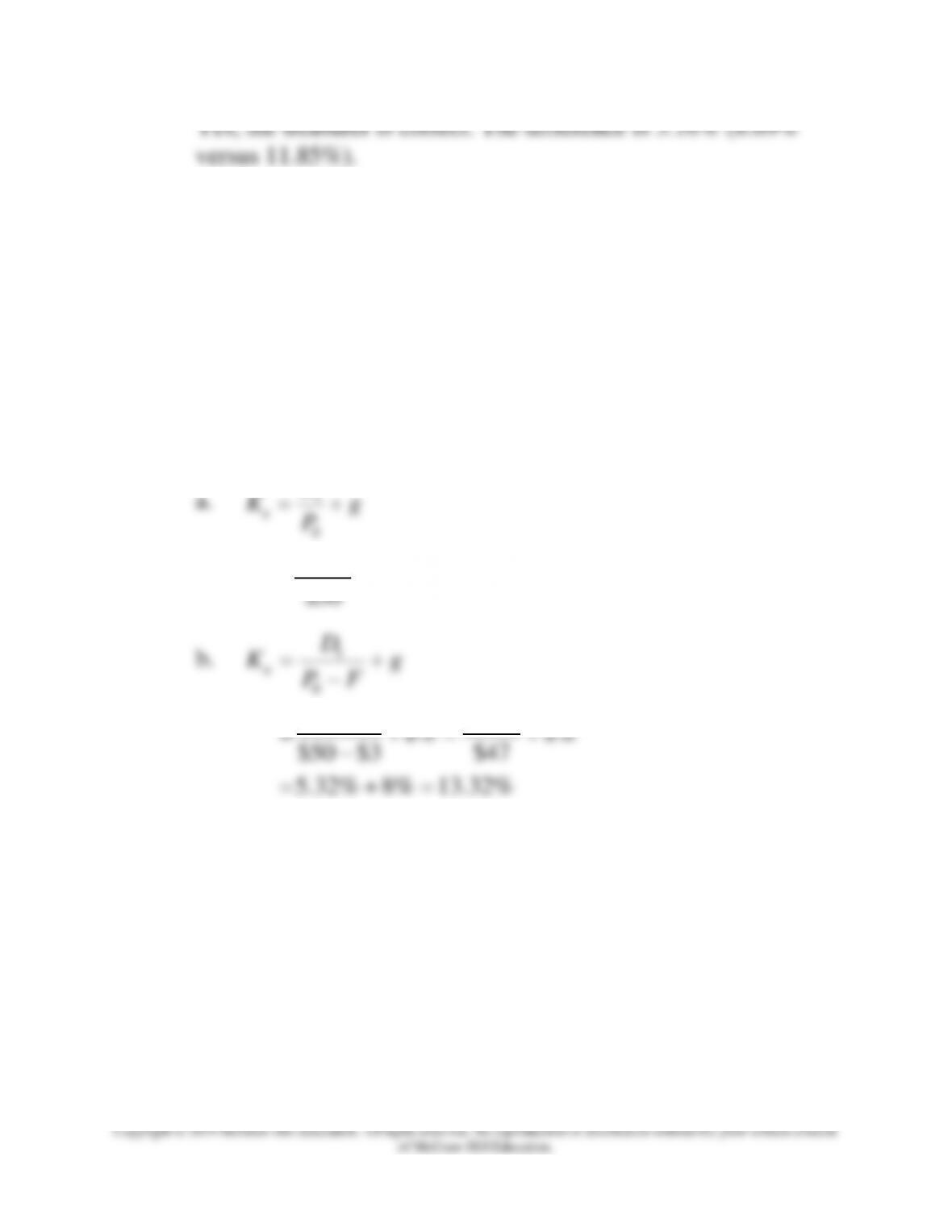
16. Murray Motor Company wants you to calculate its cost of common stock. During the next
12 months, the company expects to pay dividends (D1) of $2.50 per share, and the current
price of its common stock is $50 per share. The expected growth rate is 8 percent.
a. Compute the cost of retained earnings (Ke). Use Formula 11-6.
b. If a $3 flotation cost is involved, compute the cost of new common stock (Kn).
Use Formula 11-7.
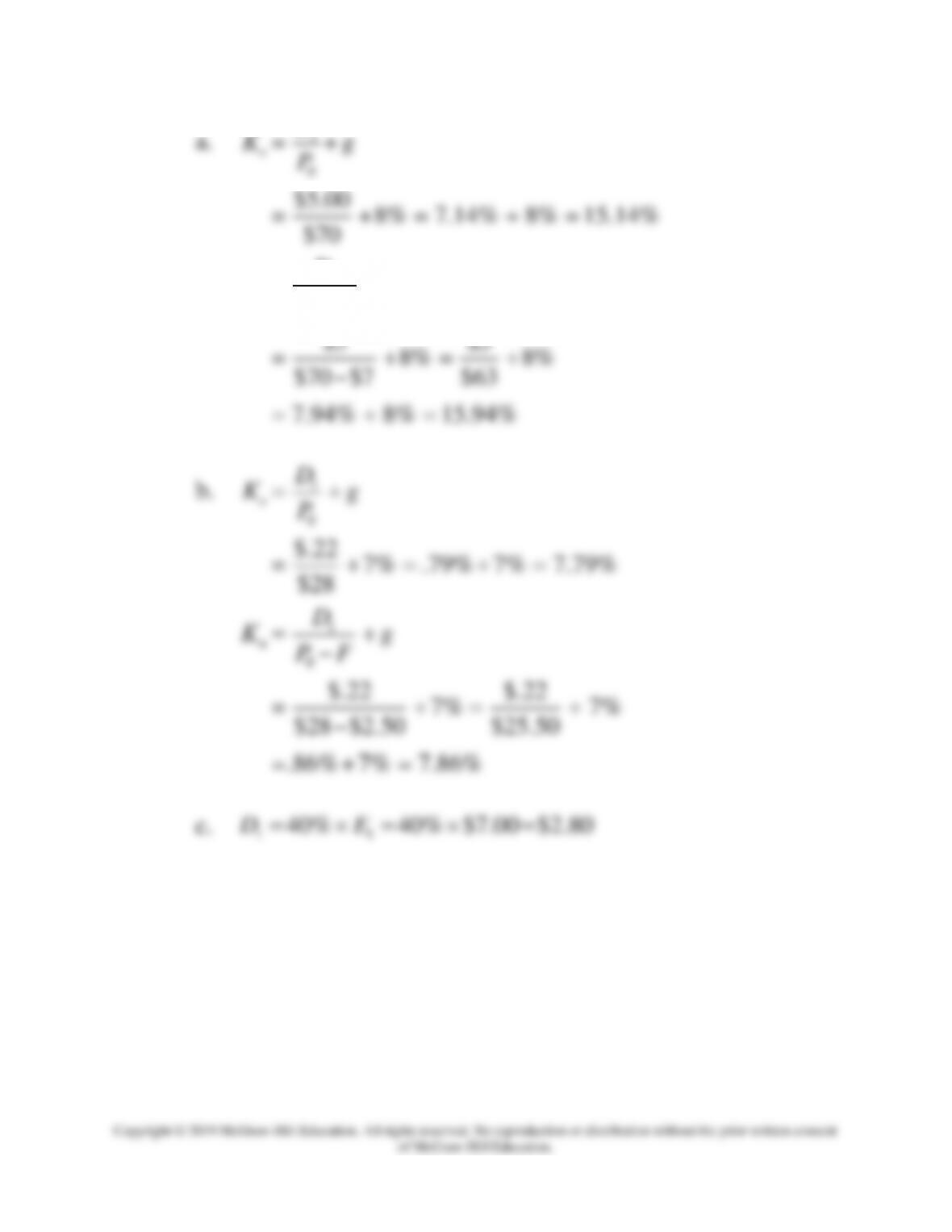
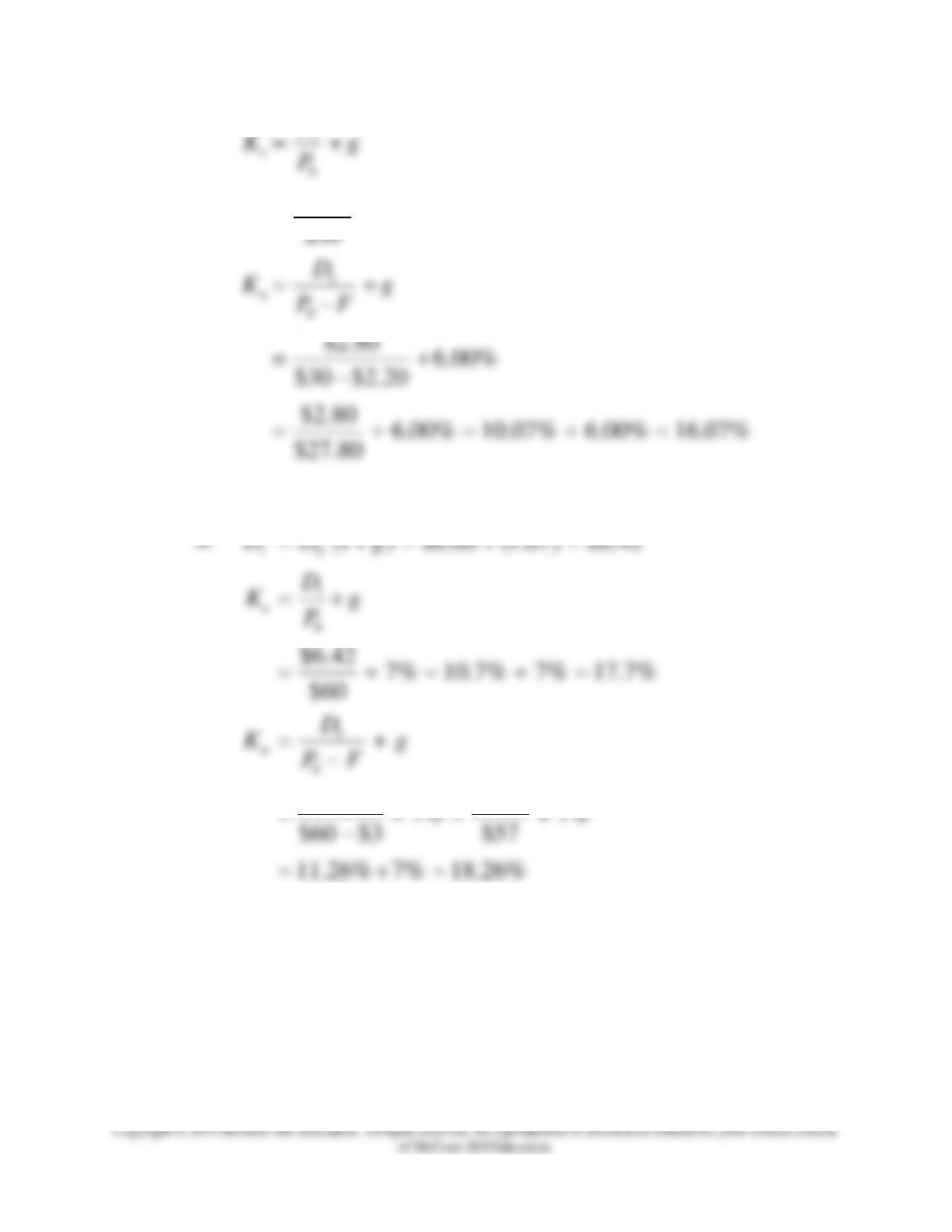
11-16. Solution:
Murray Motor Co.
1
D
1
D
1
0
1
0
$2.80
= 6.00% 9.33% 6.00% 15.33%
$30
$2.80
= 6.00%
$30 $2.20
$2.80 6.00% 10.07% 6.00% 16.07%
$27.80
e
n
D
Kg
P
D
Kg
PF
=+
+ = + =
=+
−
+
−
= + = + =
the right of the decimal point.
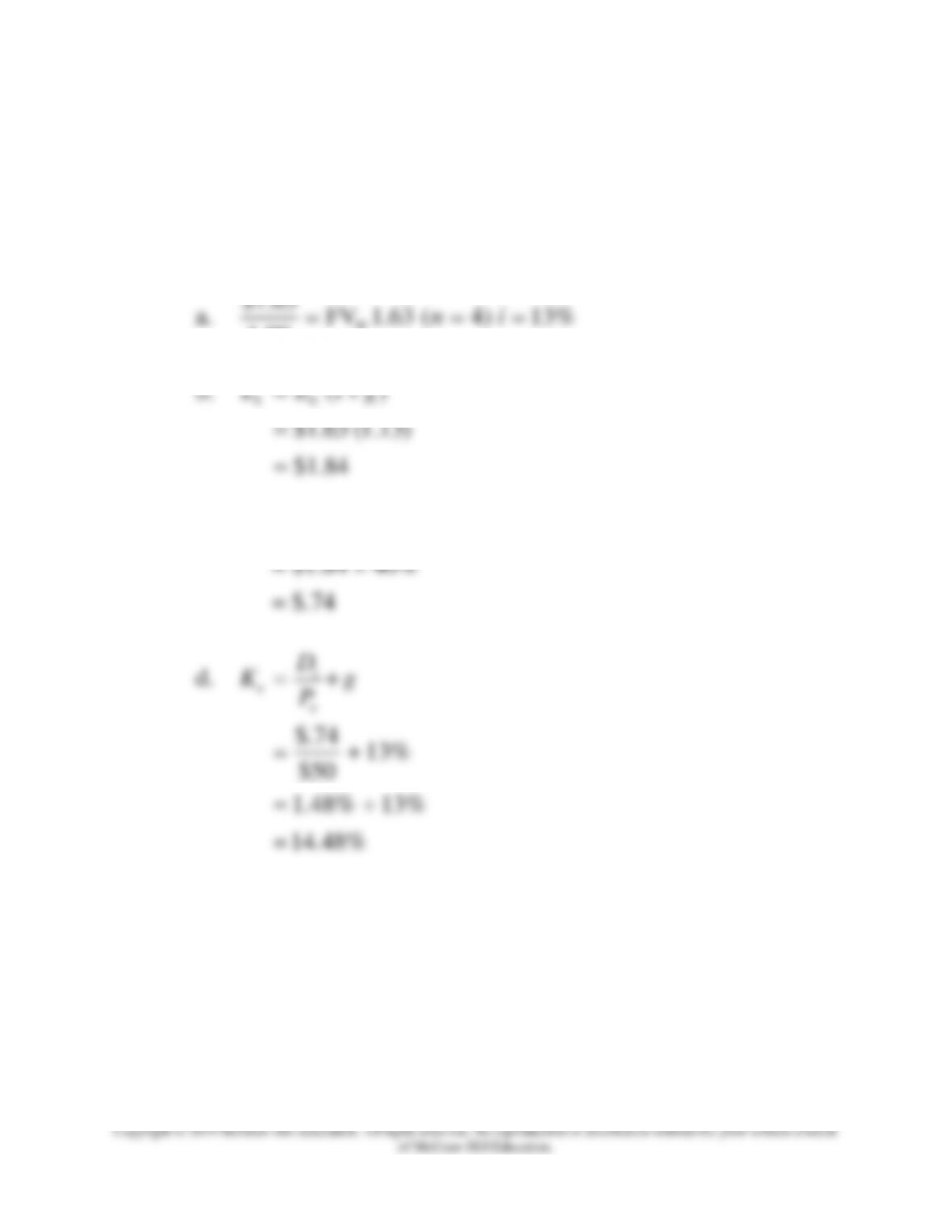
d. The current price of the stock is $50. Using the growth rate (g) from part a and (D1)
from part c, compute Ke.
e. If the flotation cost is $3.75, compute the cost of new common stock (Kn).
11-18. Solution:
Keystone Control Systems
IF
$1.63 FV 1.63 ( 4) 13%
1.00 ni= = =
$1.84
=
c.
11
40%
$1.84 40%
$.74
DE=
=
=
d.
1
$.74 13%
$50
1.48% 13%
14.48%
e
o
D
Kg
P
=+
=+
=+
=
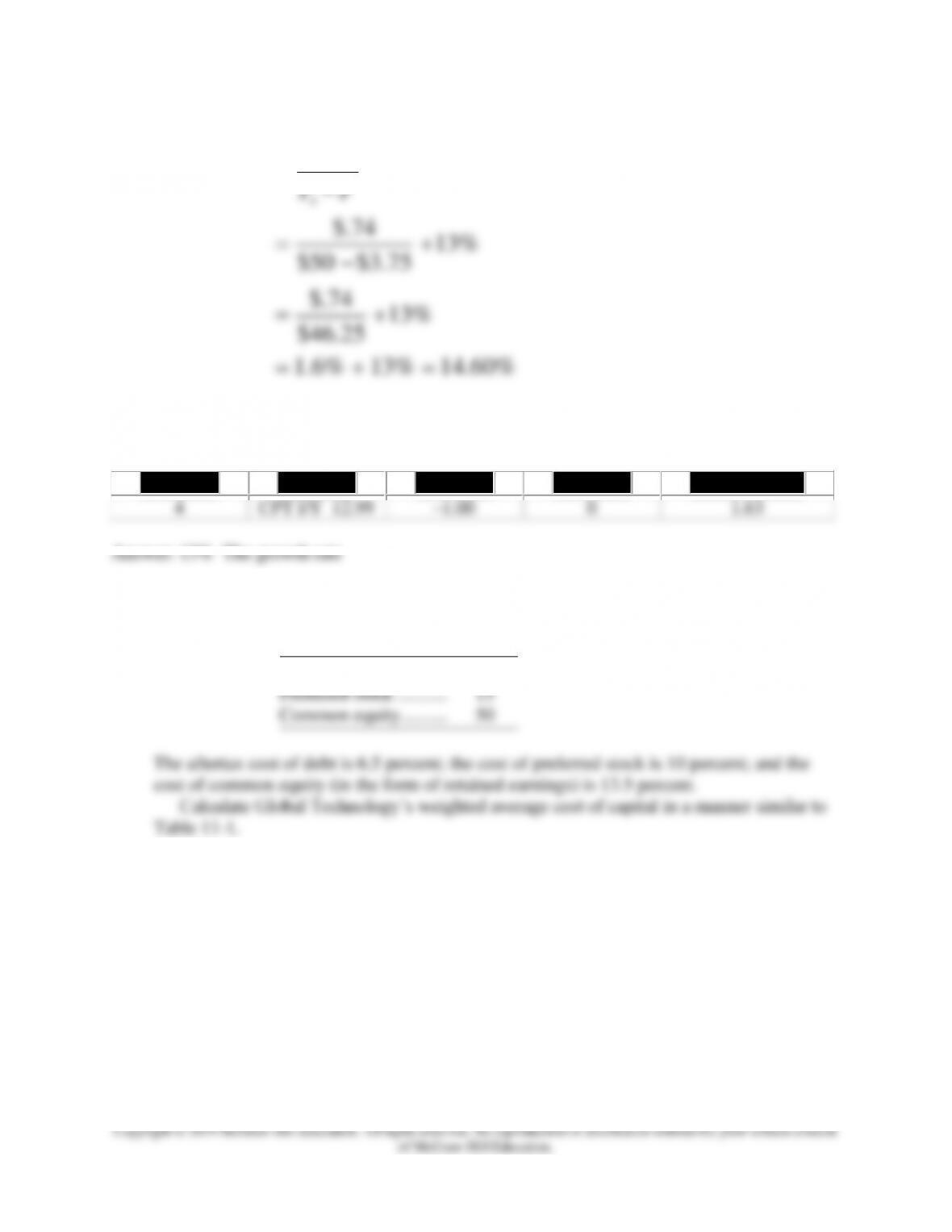
11-18. (Continued)
e.
1
$.74 13%
$50 $3.75
$.74 13%
$46.25
1.6% 13% 14.60%
n
o
D
Kg
PF
=+
−
=+
−
=+
= + =
Calculator Solution:
(a)
N
I/Y
PV
PMT
FV
4
CPT I/Y 12.99
–1.00
0
1.63
Answer: 13% The growth rate
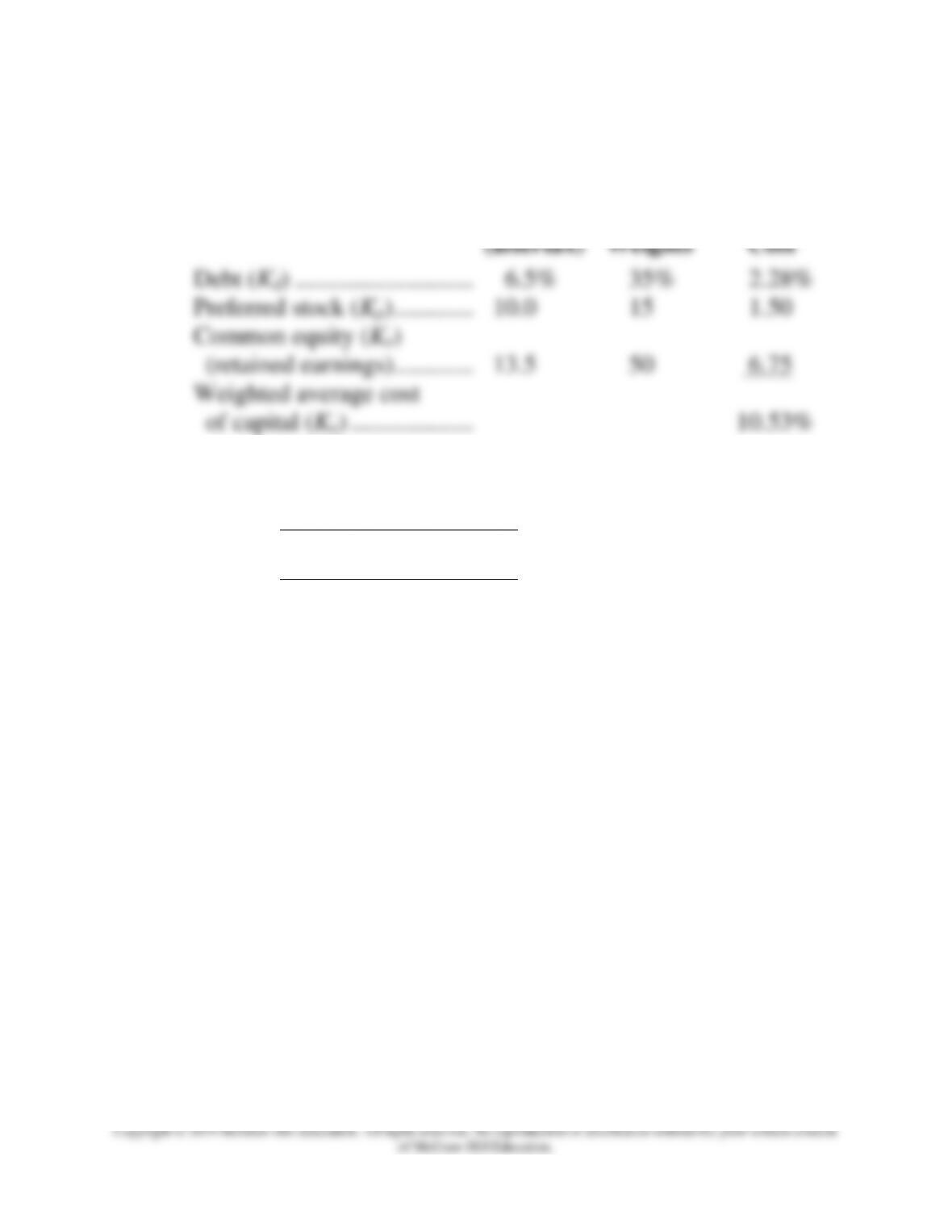
19. Global Technology’s capital structure is as follows:
Debt ………………………. 35%
11–19. Solution:
Global Technology
Cost
(aftertax)
Weights
Weighted
Cost
Debt (Kd) …………………………..
Preferred stock (Kp) ………………….
Common equity (Ke)
(retained earnings) ………………….
Weighted average cost
of capital (Ka) ………………………..
6.5%
10.0
13.5
35%
15
50
2.28%
1.50
6.75
10.53%
20. Evans Technology has the following capital structure.
Debt ………………………. 40%
Common equity ………. 60
The aftertax cost of debt is 6 percent; and the cost of common equity (in the form of
retained earnings) is 13 percent.
a. What is the firm’s weighted average cost of capital?
b. An outside consultant has suggested that because debt is cheaper than equity, the
firm should switch to a capital structure that is 50 percent debt and 50 percent
equity. Under this new and more debt-oriented arrangement, the aftertax cost of
debt is 7 percent, and the cost of common equity (in the form of retained earnings)
is 15 percent. Recalculate the firm’s weighted average cost of capital.
c. Which plan is optimal in terms of minimizing the weighted average cost of
capital?
11–20. Solution:
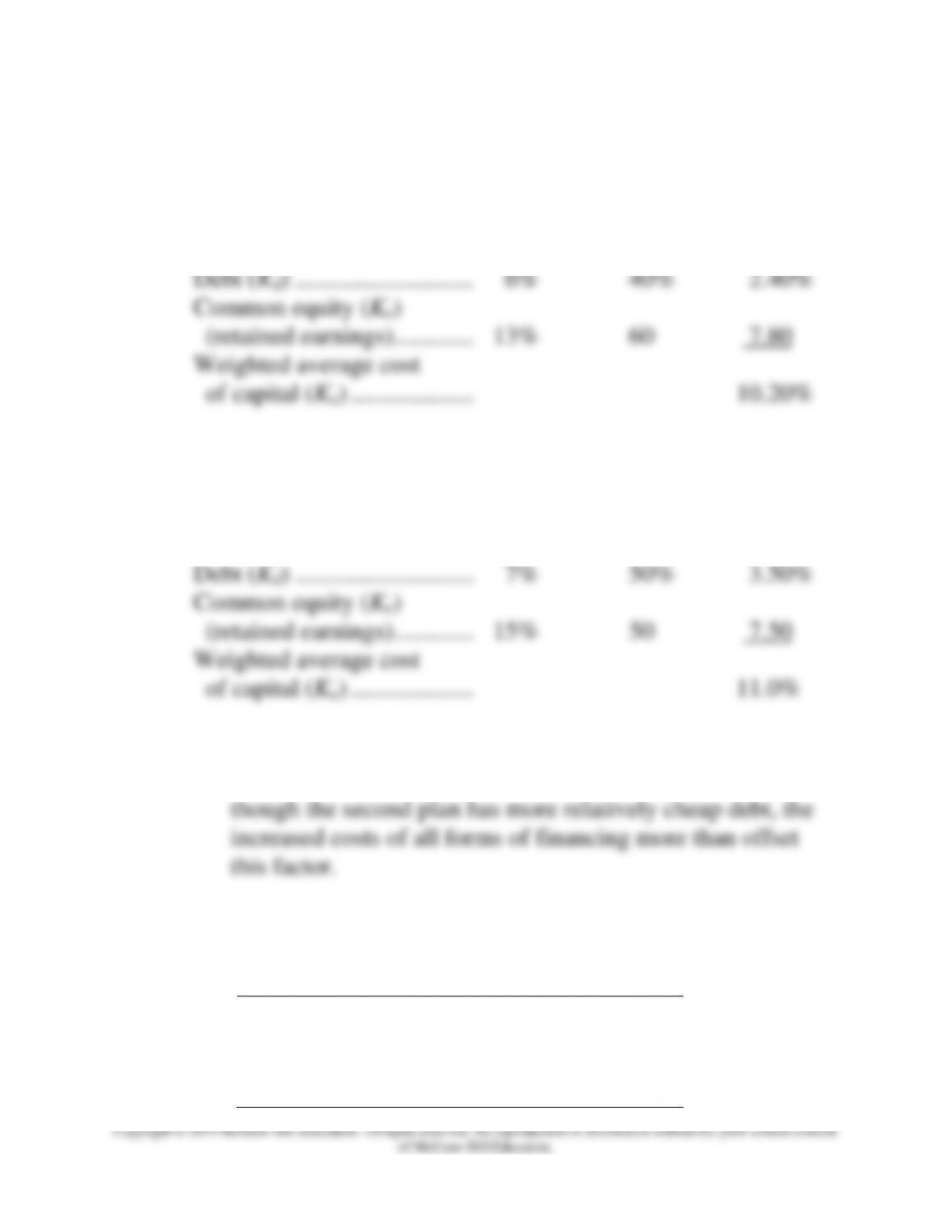
Evans Technology
a.
Cost
(aftertax)
Weights
Weighted
Cost
Debt (Kd) …………………………..
Common equity (Ke)
(retained earnings) ………………….
Weighted average cost
of capital (Ka) ………………………..
6%
13%
40%
60
2.40%
7.80
10.20%
b.
Cost
(aftertax)
Weights
Weighted
Cost
Debt (Kd) …………………………..
Common equity (Ke)
(retained earnings) ………………….
Weighted average cost
of capital (Ka) ………………………..
7%
15%
50%
50
3.50%
7.50
11.0%
c. The plan presented in part a is the better alternative. Even
21. Weighted average cost of capital (LO11-1) Sauer Milk Inc. wants to determine the
minimum cost of capital point for the firm. Assume it is considering the following financial
plans:
Cost
(aftertax)
Weights
Plan A
Debt …………………………………
4.0%
30%
Preferred stock ………………….
8.0
15
Common equity …………………
12.0
55
Plan B
Debt …………………………………
4.5%
40%
Preferred stock ………………….
8.5
15
Common equity …………………
13.0
45
Plan C
Debt …………………………………
5.0%
45%
Preferred stock ………………….
18.7
15
Common equity …………………
12.8
40
Plan D
Debt …………………………………
12.0%
50%
Preferred stock ………………….
19.2
15
Common equity …………………
14.5
35
a. Which of the four plans has the lowest weighted average cost of capital? (Round to
two places to the right of the decimal point.)
b. Briefly discuss the results from Plan C and Plan D, and why one is better than
the other.
11-21. Solution:
Sauer Milk Inc.
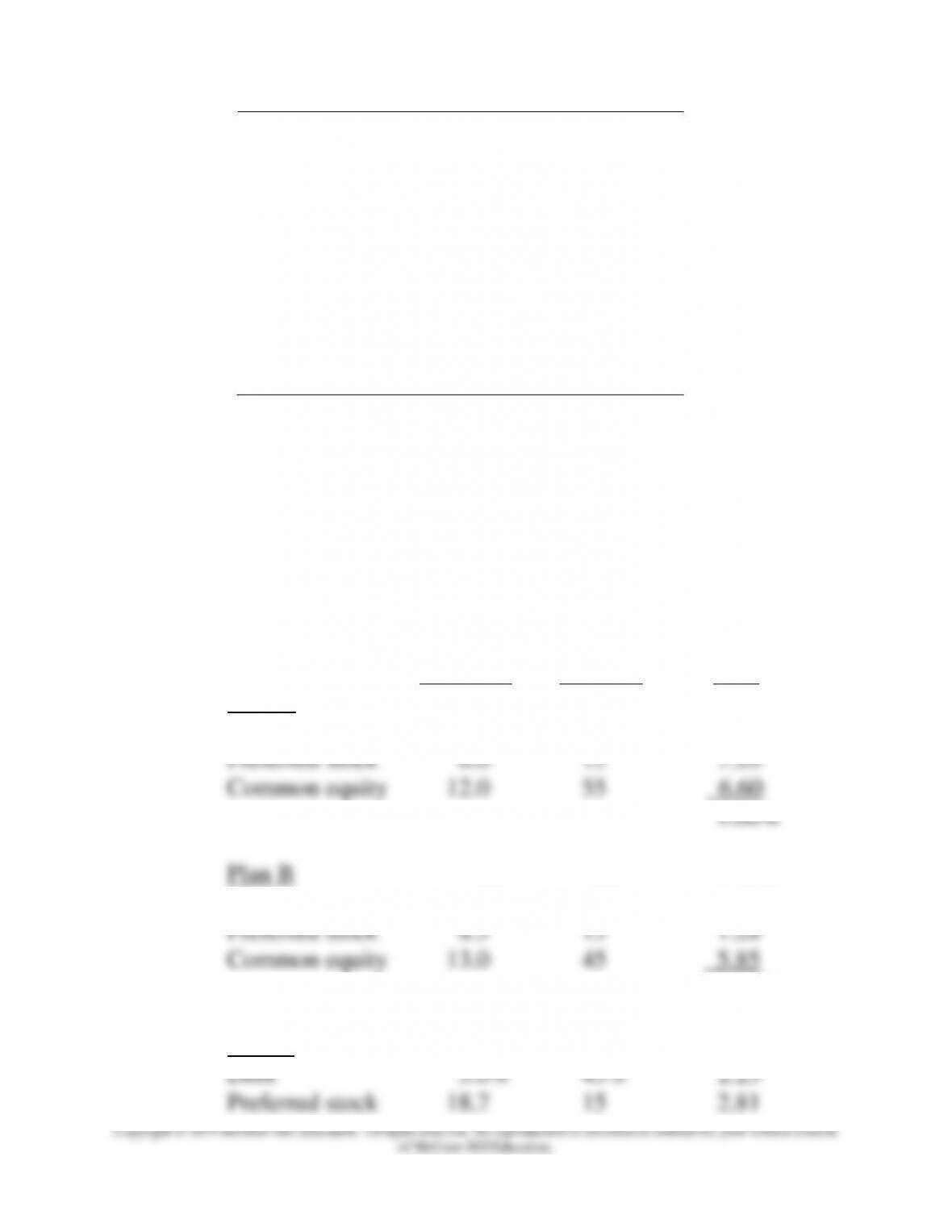
a. Cost Weighted
(aftertax) Weights Cost
Plan A
Debt
4.0%
30%
1.20%
Preferred stock
8.0
15
1.20
Common equity
12.0
55
6.60
9.00%
Plan B
Debt
4.5%
40%
1.80%
Preferred stock
8.5
15
1.28
Common equity
13.0
45
5.85
8.93%
Plan C
Debt
5.0%
45%
2.25
Preferred stock
18.7
15
2.81