
WEIGHTED AVERAGE LOAN TERM
360 mo
WEIGHTED AVERAGE REMAINING MATURITY
359 mo
WEIGHTED AVERAGE LTV
73%
WEIGHTED AVERAGE CREDIT SCORE
729
Answer the below questions.
a. What does the “pass–through rate” of 5% for this security mean?
b. What is the average note rate being paid by the borrowers in the loan pool for this
security?
c. Why does the pass-through rate differ from the average note rate paid by the borrowers
in the loan pool for this security?
d. What is the pool number for this security, and why is the pool number important?
e. What is the prefix for this security, and what does a prefix indicate?
The “CL” appearing before the pool number is called the pool prefix. All agency issuers have
their own pool prefix, and it indicates the type of collateral. In the case of Fannie Mae, there is
a two-character prefix indicating (1) whether the loans are conventional, government insured, or
f. The “maturity date” for this security is shown as “10/01/2035.” An investor in this
security might be concerned about its very long maturity (30 years). Why is the maturity
date a misleading measure of the security’s maturity?
The maturity is misleading because of prepayments that, in essence, make the maturity less.
Not all of the mortgages that are included in the loan pool that are securitized need to have the
g. If an investor purchased $15 million principal of this security and, in some month, the
cash flow available to be paid to the security holders (after all fees are paid) is $12 million,
how much is the investor entitled to receive?
h. Every month a pool factor would be reported for this security. If the pool factor for some
month is 0.92, what is the outstanding mortgage balance for the loan pool for that month?
When a pass-through security is first issued, the principal is known. Over time, because of
regularly scheduled principal payments and prepayments, the amount of the pool’s outstanding
i. Why does the weighted average loan term differ from the weighted average remaining
maturity?
A weighted-average maturity (WAM) is found by weighting the remaining number of months to
maturity for each mortgage loan in the pool by the amount of the mortgage outstanding. This
j. Wells Fargo Bank, N.A. is identified as the seller and the servicer. What does that mean?
Ginnie Mae provides the guarantee, but Wells Fargo Bank, N.A., is the issuer or seller of the
security. It also services the payments and in this capacity is said to be the servicer. More details
are given below.
k. What does the following mean: “MORTGAGE-BACKED SECURITIES PROGRAM
SUPPLEMENT TO PROSPECTUS DATED JULY 01, 2004”?
When issuing MBS, the GSEs provide a prospectus for the offering. What is issued first is what
is termed a “prospectus.” However, the prospectus contains general information about the
12. Why is an assumed prepayment speed necessary to project the cash flow of a pass-through?
13. What does a conditional prepayment rate of 10% mean?
current and expected future economic environment. It is referred to as a conditional rate because
it is conditional on the remaining mortgage balance.
The CPR is an annual prepayment rate. To estimate monthly prepayments, the CPR must be
converted into a monthly prepayment rate, commonly referred to as the single-monthly
mortality rate (SMM).
For our problem we want to know what a conditional prepayment rate of 8% means. Assuming
the CPR used to estimate prepayments is 10%, the corresponding SMM is
SMM× (beginning mortgage balance for month t – scheduled principal payment for month t).
14. Indicate whether you agree or disagree with the following statement: “The PSA
prepayment benchmark is a model for forecasting prepayments for a pass-through security.”
The Public Securities Association (PSA) prepayment benchmark is expressed as a monthly series
of annual prepayment rates. This benchmark is commonly referred to as a prepayment model,
The PSA benchmark assumes the following CPRs for 30-year mortgages: (i) a CPR of 0.2% for
the first month, increased by 0.2% per year per month for the next 30 months when it reaches 6%
per year, and (ii) a 6% CPR for the remaining years. This benchmark, referred to as “100% PSA”
©2013 Pearson Education
253
If t > 30: CPR = 6%
where t is the number of months since the mortgage originated.
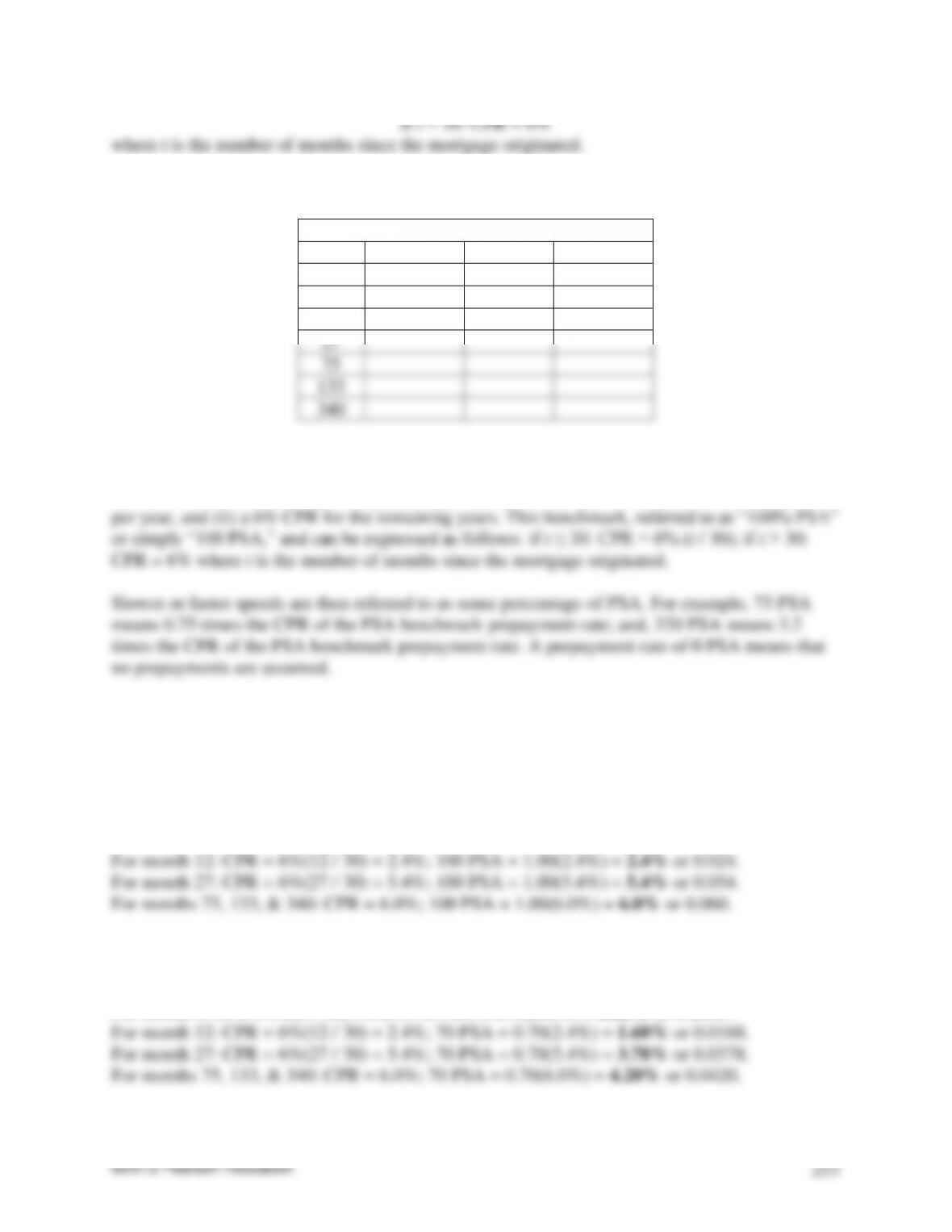
15.(a) Complete the following table:
CPR Assuming:
Month
100% PSA
70% PSA
210% PSA
1
3
12
27
75
133
340
The PSA benchmark assumes the following CPRs for 30-year mortgages: (i) a CPR of 0.2% for
the first month, increased by 0.2% per year per month for the next 30 months when it reaches 6%
Given the above information and the months from the above table, we compute the CPRs as
given below.
With 100 PSA, we get the below CPR values.
For month 1: CPR = 6%(1 / 30) = 0.2%; 100 PSA = 1.00(0.2%) = 0.2% or 0.002.
For month 3: CPR = 6%(3 / 30) = 0.6%; 100 PSA = 1.00(0.6%) = 0.6% or 0.006.
With 70 PSA, we get the below CPR values.
For month 1: CPR = 6%(1 / 30) = 0.2%; 70 PSA = 0.70(0.2%) = 0.14% or 0.0014.
For month 3: CPR = 6%(3 / 30) = 0.6%; 70 PSA = 0.70(0.6%) = 0.42% or 0.0042.

With 210 PSA, we get the below CPR values.
For month 1: CPR = 6%(1 / 30) = 0.2%; 210 PSA = 2.10(0.2%) = 0.42% or 0.0042.
Inserting the CPR values into the above table, we have:
CPR Assuming:
Month
100% PSA
70% PSA
210% PSA
1
0.2%
0.14%
0.42%
3
0.6%
0.42%
1.26%
12
2.4%
1.68%
5.04%
27
5.4%
3.78%
11.34%
75
6.0%
4.20%
12.60%
133
6.0%
4.20%
12.60%
340
6.0%
4.20%
12.60%
(b) Complete the following table:
SMM Assuming:
Month
100% PSA
70% PSA
210% PSA
1
3
12
27
75
133
340
SMM = 1 – (1 – 0.006)1/12 = 1 – (0.994)0.083333 = 0.0005014 or 0.05014%.
For month 12: CPR = 6%(12 / 30) = 2.4%=0.024; 100 PSA = 1.00(2.4%) = 0.024.
SMM = 1 – (1 – 0.024)1/12 = 1 – (0.976)0.083333 = 0.0020223 or 0.20223%.

©2013 Pearson Education
255
For months 75, 133, and 340: CPR = 6% = 0.06; 100 PSA = 1.00(0.06) = 0.06;
SMM = 1 – (1 – 0.06)1/12 = 1 – (0.94)0.083333 = 0.0051430 or 0.51430%.
With 70 PSA, we get the below SMM values.
For months 75, 133, & 340: CPR = 6% = 0.06; 70 PSA = 0.70(0.06) = 0.0420.
SMM = 1 – (1 – 0.042)1/12 = 1 – (0.958)0.083333 = 0.0035692 or 0.35692%.
With 210 PSA, we get the below SMM values.
For month 1: CPR = 6%(1 / 30) = 0.2%; 210 PSA = 2.10(0.2%) = 0.42% or 0.0042.
SMM = 1 – (1 – 0.0042)1/12 = 1 – (0.9958)0.083333 = 0.0003507or 0.03507%.
Inserting the SMM values into the above table, we have:
SMM Assuming:
Month
100% PSA
70% PSA
210% PSA
1
0.01668%
0.01167%
0.03507%
3
0.05014%
0.03507%
0.10561%.
12
0.20223%
0.14109%
0.43003%.
27
0.46154%
0.32059%
0.99800%

75
0.51430%
0.35692%
1.11602%
133
0.51430%
0.35692%
1.11602%
340
0.51430%
0.35692%
1.11602%
16. Complete the following table (in thousands of dollars) assuming a prepayment rate of
165 PSA:
Original balance: $ 100,000,000
Pass-through rate: 9.0%
WAM: 360 months
Month
Outst.
Balance
SMM
Mortg.
Paym.
Interest
Sch.
Princ.
Pre-
paym.
Total
Princ.
Cash
Flow
1
$100,000
$841
2
$ 99,934
$841
cash flow for months 1 and 2. The cash flow will be broken down into three components: (1) interest
(based on the pass-through rate), (2) the regularly scheduled principal repayment, and
(3) prepayments based on 165 PSA. We will now walk through the exhibit column by column with
dollar values given in thousands.
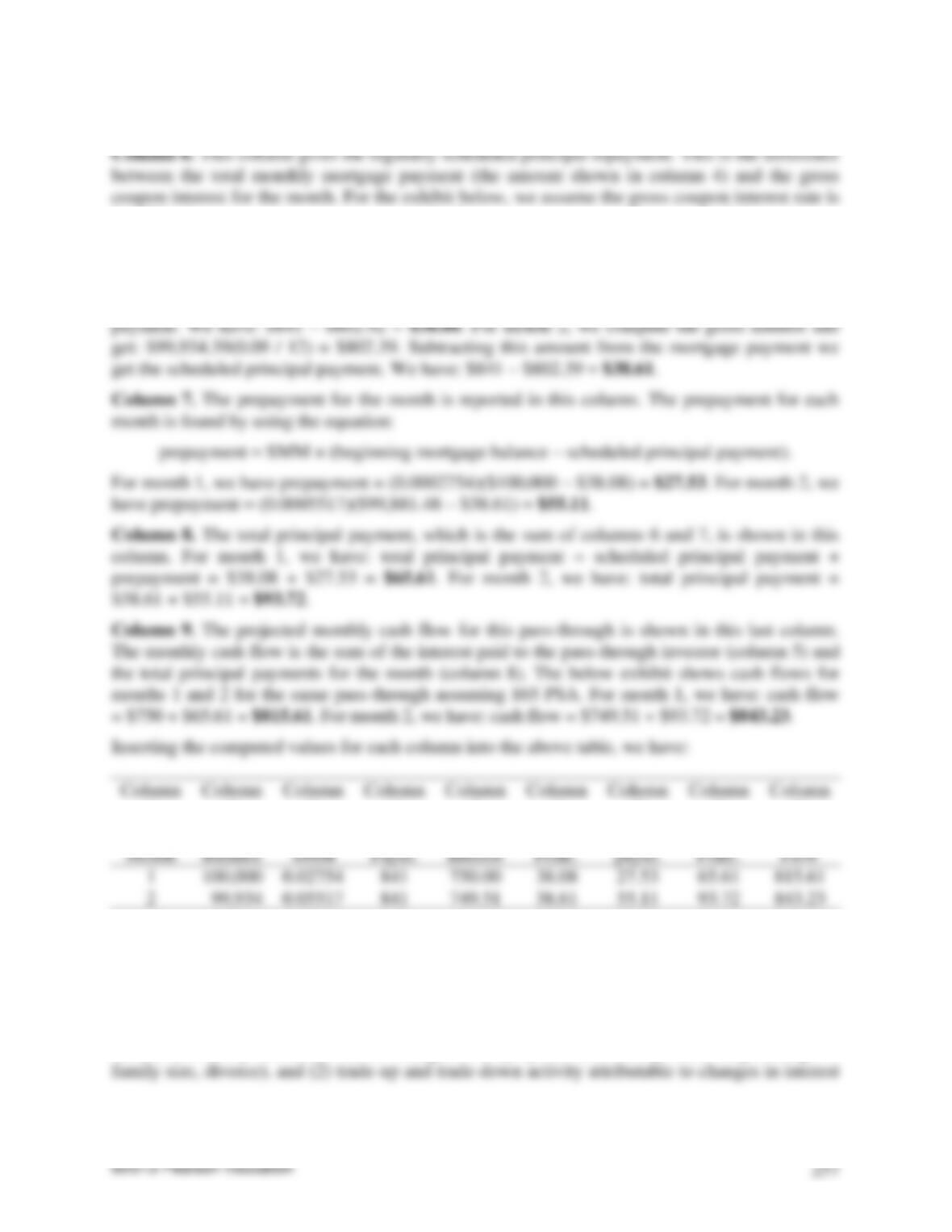
Column 2. This column gives the outstanding mortgage balance at the beginning of the month. It
is equal to the outstanding balance at the beginning of the preceding month reduced by the total
principal payment in the preceding month. The outstanding balances are given as $100,000 for
month 1 and $99,934 for month 2.
For month 1: CPR = 6%(1 / 30) = 0.2% = 0.002; 165 PSA = 1.65(0.002) = 0.0033.
SMM = 1 – (1 – 0.0033)1/12= 1 – (0.9967)0.083333= 0.0002754 or 0.02754%.
For month 2: CPR = 6%(2 / 30) = 0.4% = 0.004; 165 PSA = 1.65(0.004) = 0.0066.
SMM = 1 – (1 – 0.0066)1/12= 1 – (0.9934)0.083333= 0.0005517 or 0.05517%.
computed later.)
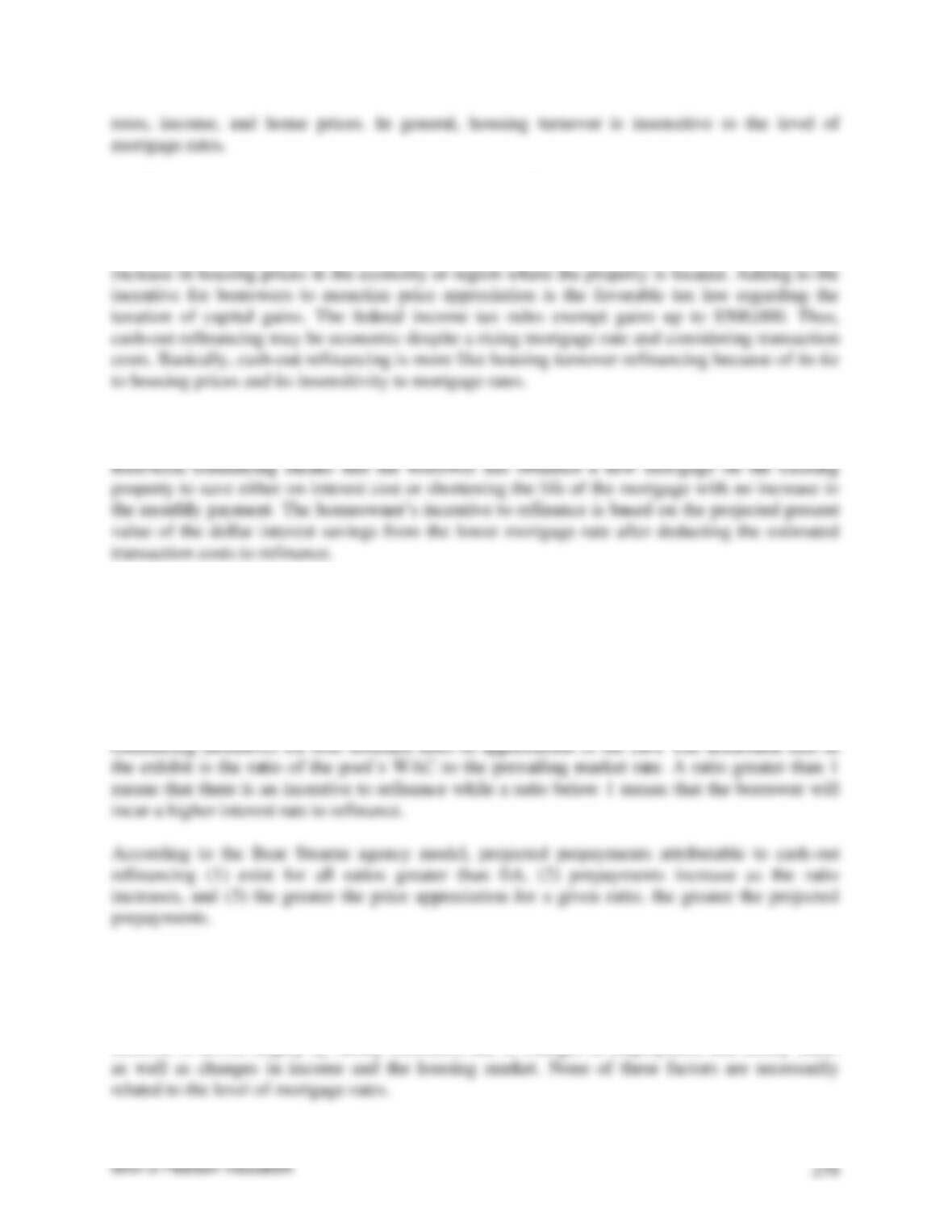
9.635% (the coupon interest rate or weighted-average coupon rate for a pool of the mortgage
outstanding is greater that the pass-through rate of 9.00% to take into account fees). We multiply
the outstanding mortgage balance at the beginning of the month by the coupon interest rate
divided by 12. For month 1, we first compute the gross interest and get: $100,000(0.09635 / 12)
= $802.92. Subtracting this amount from the mortgage payment, we get the scheduled principal
©2013 Pearson Education
258
rates, income, and home prices. In general, housing turnover is insensitive to the level of
mortgage rates.
b. What is meant by prepayments due to cash-out refinancing?
Cash-out refinancing means refinancing by a borrower in order to monetize the price
appreciation of the property. Prepayments due to cash-out refinancing will depend on the
c. What is meant by prepayments due to rate/term refinancing?
18. Answer the below questions.
a. What factor can be used as a proxy for cash-out refinancing incentives?
Cash-out refinancing is driven by price appreciation that has occurred since the origination of the
loans in the pool. A proxy measure for price appreciation must be used. For the Bear Stearns
agency prepayment model, the pool’s HPI is used and Exhibit 11-11 illustrates the cash-out
b. Why are prepayments attributable to cash-out refinancing likely to be insensitive to
changes in mortgage rates?
In general, housing turnover is insensitive to the level of mortgage rates. This is because housing
turnover is driven largely by family relocation due to changes in employment and family status

19. What is the S-curve for prepayments? Explain the reason for the shape.
The S-curve for prepayment is a graph where values for the “CPR%” are given along the vertical
line and values for the “WAC/Mortgage Rate” ratio are found along the horizontal axis.
The reason for the observed S-curve for prepayments is that as the rate ratio increases, the CPR
(i.e., prepayment rate) increases. There is some level of the rate ratio, however, at which the
20. Answer the below questions.
a. What is the burnout effect?
The burnout effect refers to the incentive to refinance being “extinguished.” This occurs because
the composition of borrowers in a mortgage pool changes over time due to seasoning and
b. What is the threshold media effect?
21. Answer the below questions.
a. What is the cash flow yield of a mortgage pass-through security?
Given the projected cash flow and the price of a pass-through, its yield can be calculated. The
yield is the interest rate that will make the present value of the expected cash flow equal to the
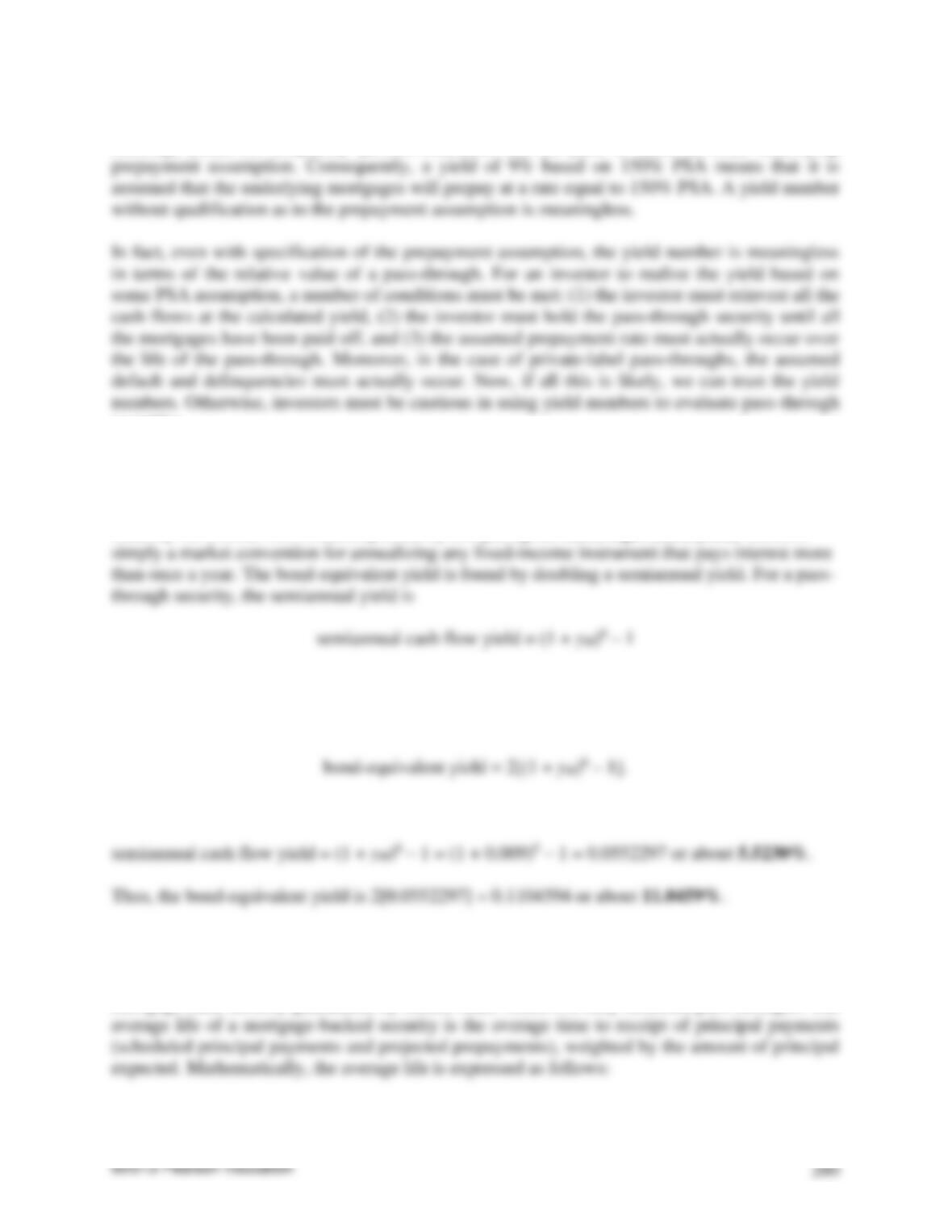
The yield corresponding to a price must be qualified by an assumption concerning prepayments.
Although yields are frequently quoted, remember that the yield is based on some underlying
securities.
22. What is the bond-equivalent yield if the monthly cash flow yield is 0.9%?
The yield on a pass-through must be calculated so as to make it comparable to the yield to
maturity for a bond. This is accomplished by computing the bond-equivalent yield, which is
where yM is the monthly interest rate that will equate the present value of the projected monthly
cash flow to the price of the pass-through. The bond-equivalent yield is found by doubling the
semiannual cash flow yield; that is,
Inserting in our values, we get:
23. What is the average life of a pass-through, and what does it depend on?
A measure commonly used to estimate the life of a pass-through is its average life. Consider a
mortgage-back security guaranteed by Ginnie Mae, which is a fully modified pass-throughs. The
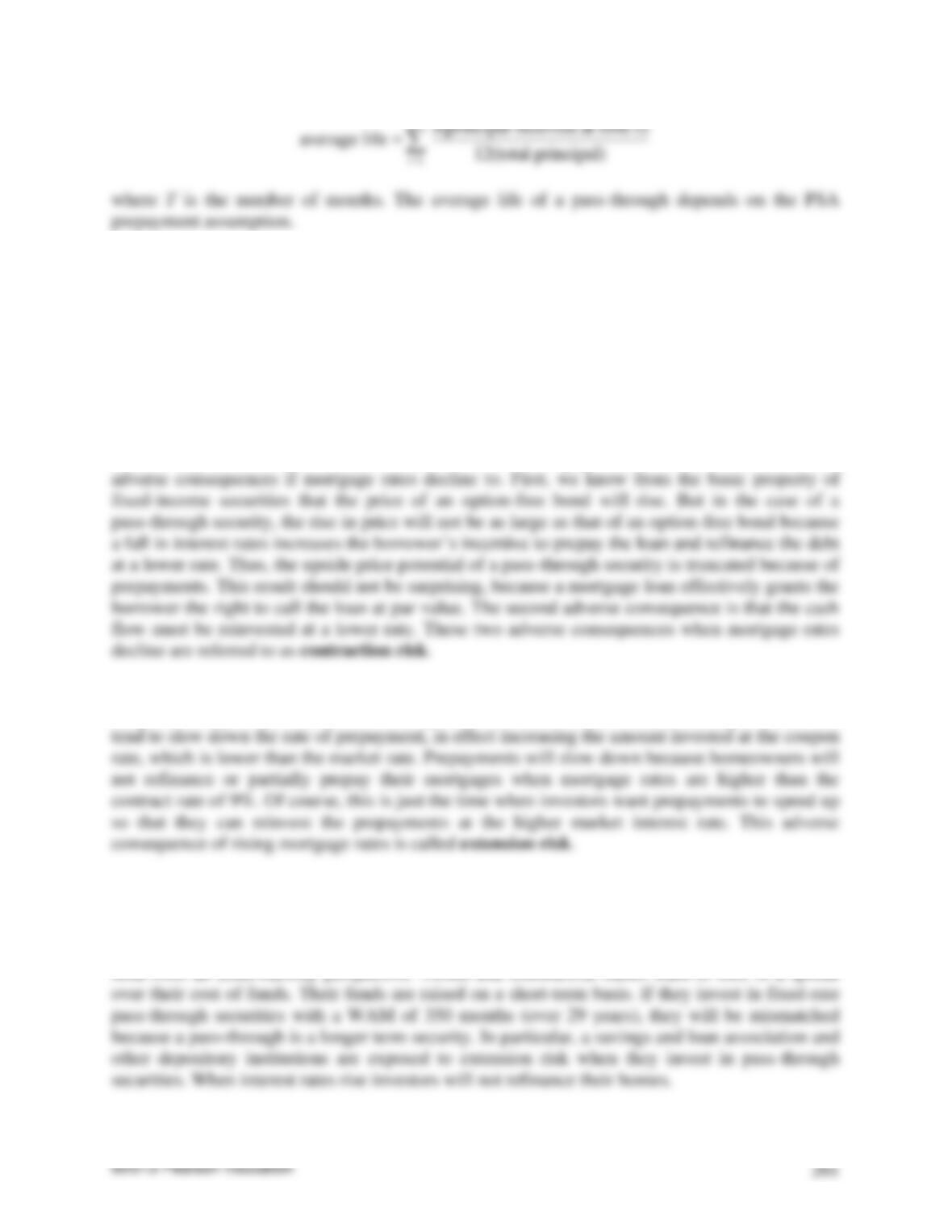
average life =
1
(principal received at time t)
12(total principal)
T
t
t
=
where T is the number of months. The average life of a pass-through depends on the PSA
prepayment assumption.
24. Answer the below questions.
a. What are contraction risk and extension risk?
Contraction risk is the adverse result when mortgage rates decline, while extension risk is the
adverse consequence when mortgage rates rise. More details are given below.
An investor who owns pass-through securities does not know what the cash flow will be because
that depends on prepayments. To understand this prepayment uncertainty, suppose that an
investor buys a 9% coupon Ginnie Mae at a time when mortgage rates are 9%. There will be two
Now let’s look at what happens if mortgage rates rise to 12%. The price of the pass-through, like
the price of any bond, will decline. But again it will decline more because the higher rates will
b. Why would a pass-through with a WAM of 350 months be an unattractive investment
for a savings and loan association?
Prepayment risk makes pass-through securities unattractive for certain financial institutions to
hold from an asset-liability perspective. Thrifts and commercial banks want to lock in a spread

25. Answer the below questions.
a. Distinguish between a TBA and specified pool trade.
Pass-throughs are quoted in the same manner as U.S. Treasury coupon securities. They are
identified by a pool prefix and pool number. Many trades occur while a pool is still unspecified,
b. What delivery options are granted to the seller in a TBA trade?
When an investor purchases, say, $1 million GNMA 8s on a TBA basis, the investor can receive
up to three pools, with pool numbers being announced shortly before the settlement date. Three