Chapter 11
Currency Risk Management
Note: In these problems, the notation / is used to mean “per.” For example, ¥158/$ means “¥158 per $”.
1. To lock in the rate at which yen can be converted into U.S. dollars, the investor should enter into a
contract to sell ¥160 million forward at a forward exchange rate of $:¥ = 160. The hedge will be
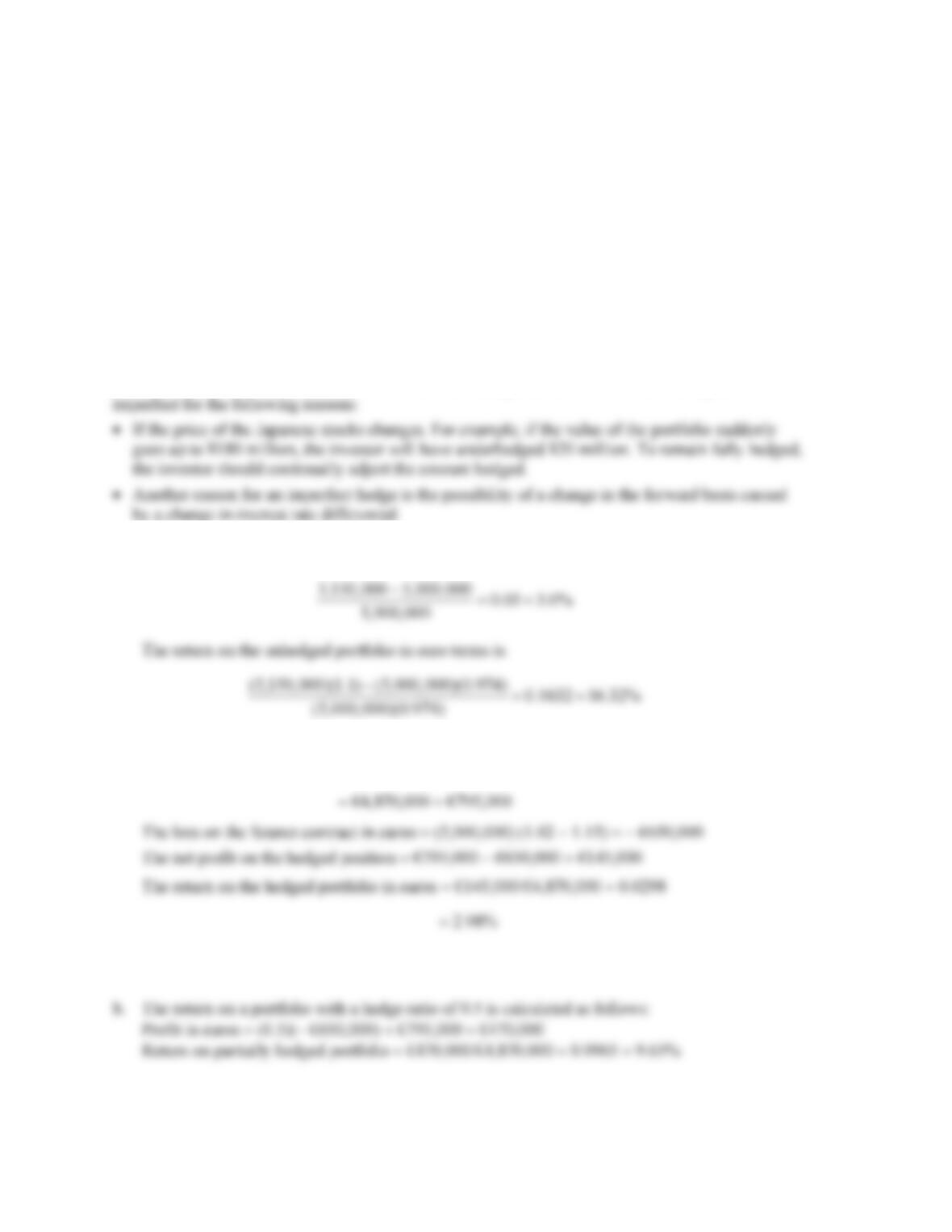
2. a. The return on the unhedged portfolio in dollar terms is
The return on the hedged portfolio in euro terms is determined as follows:
The portfolio profit in euros = (5,150,000)(1.1) − (5,000,000)(0.974) = €5,665,000
This indicates that the position is almost perfectly hedged because a return of 3 percent in dollars
has been transformed into a return of 2.98 percent in euros.
Chapter 11 Currency Risk Management 67
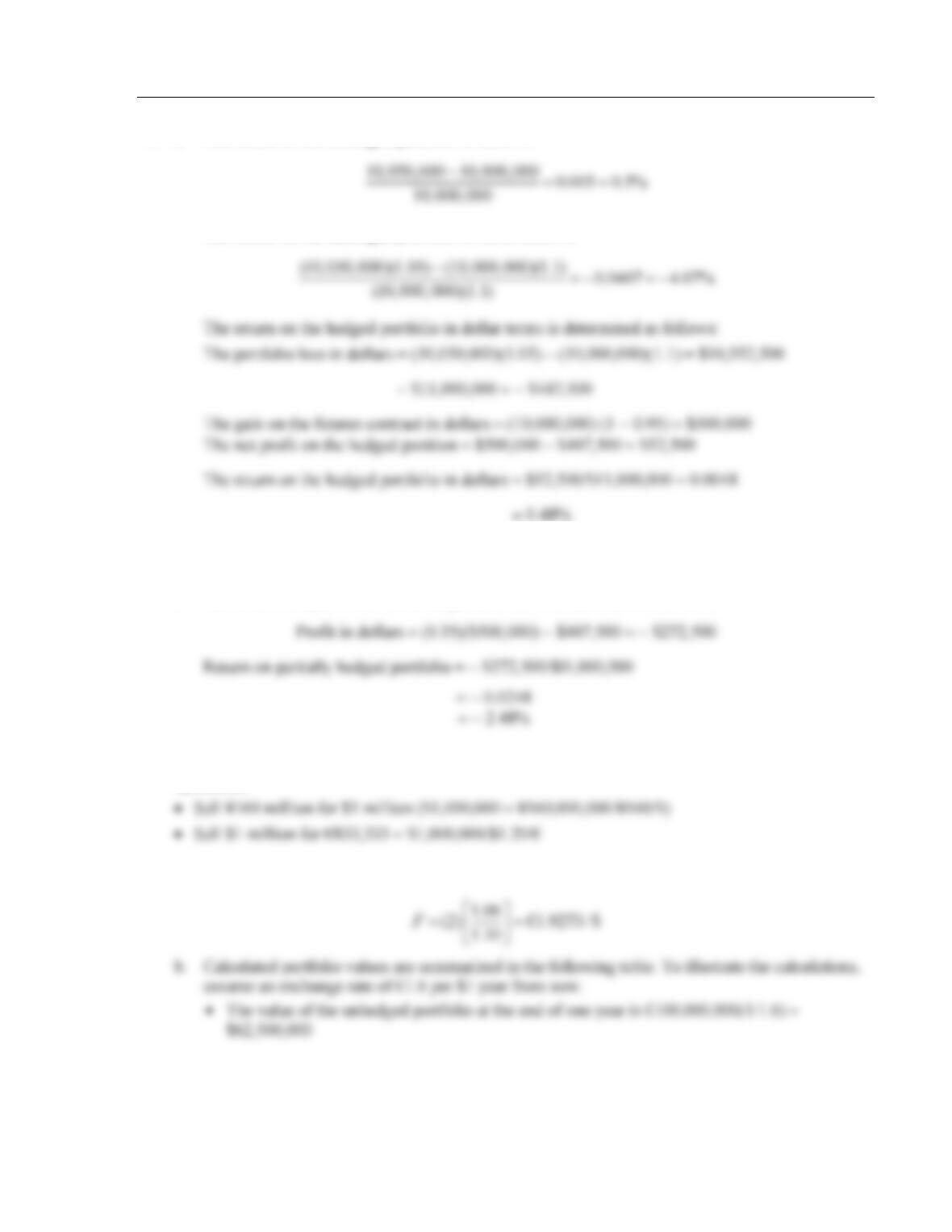
3. a. The return on the unhedged portfolio in euros is
The return on the unhedged portfolio in dollar terms is
This indicates that the position is almost perfectly hedged because a return of 0.5% in euros has
been transformed into a return of 0.48% in dollars.
b. The return on a portfolio with a hedge ratio of 0.35 is calculated as follows:
4. The investor should sell ¥160 million forward against euros, a transaction that combines two forward
operations:
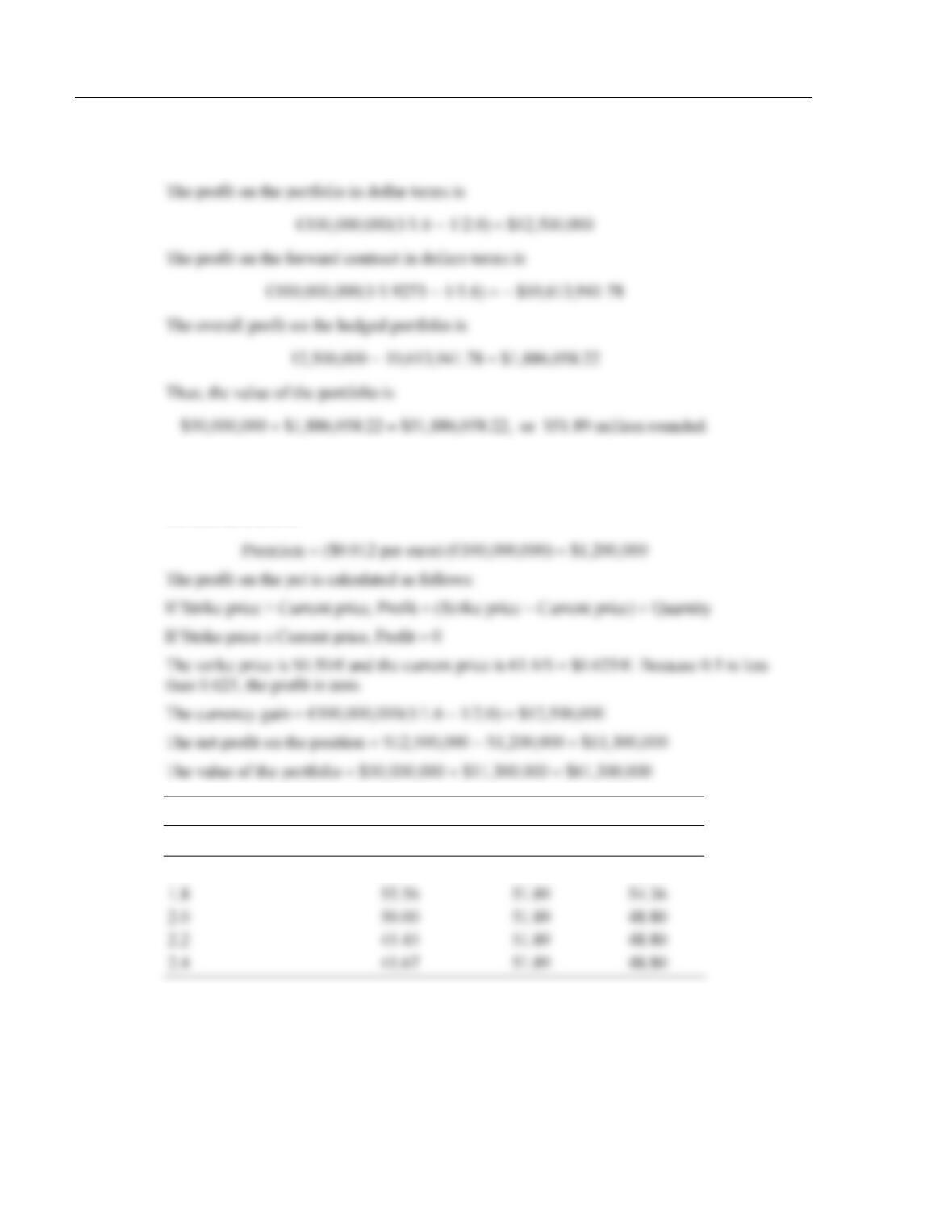
5. a. The one-year forward exchange rate is
68 Solnik/McLeavey • Global Investments, Sixth Edition
• To hedge using forward contracts, you would sell euros forward at €1.9273 per dollar. The
value of the portfolio hedged with the currency forward contract is calculated as follows:
• To ensure using options you will need to buy puts on the euro. Because the premium is paid
in dollars, there is no exchange risk on the option premium. Assuming that the premium is
financed at a dollar interest rate of 0 percent, you would buy €100 million worth of puts on
the euro at a cost of
Portfolio Value (in $ million)
Exchange Rate (€/$)
Unhedged Value
Hedged Value
Ensured Value
1.6
62.50
51.89
61.30
c. Basis risk, transactions costs, and cross-hedge risk.
Chapter 11 Currency Risk Management 69
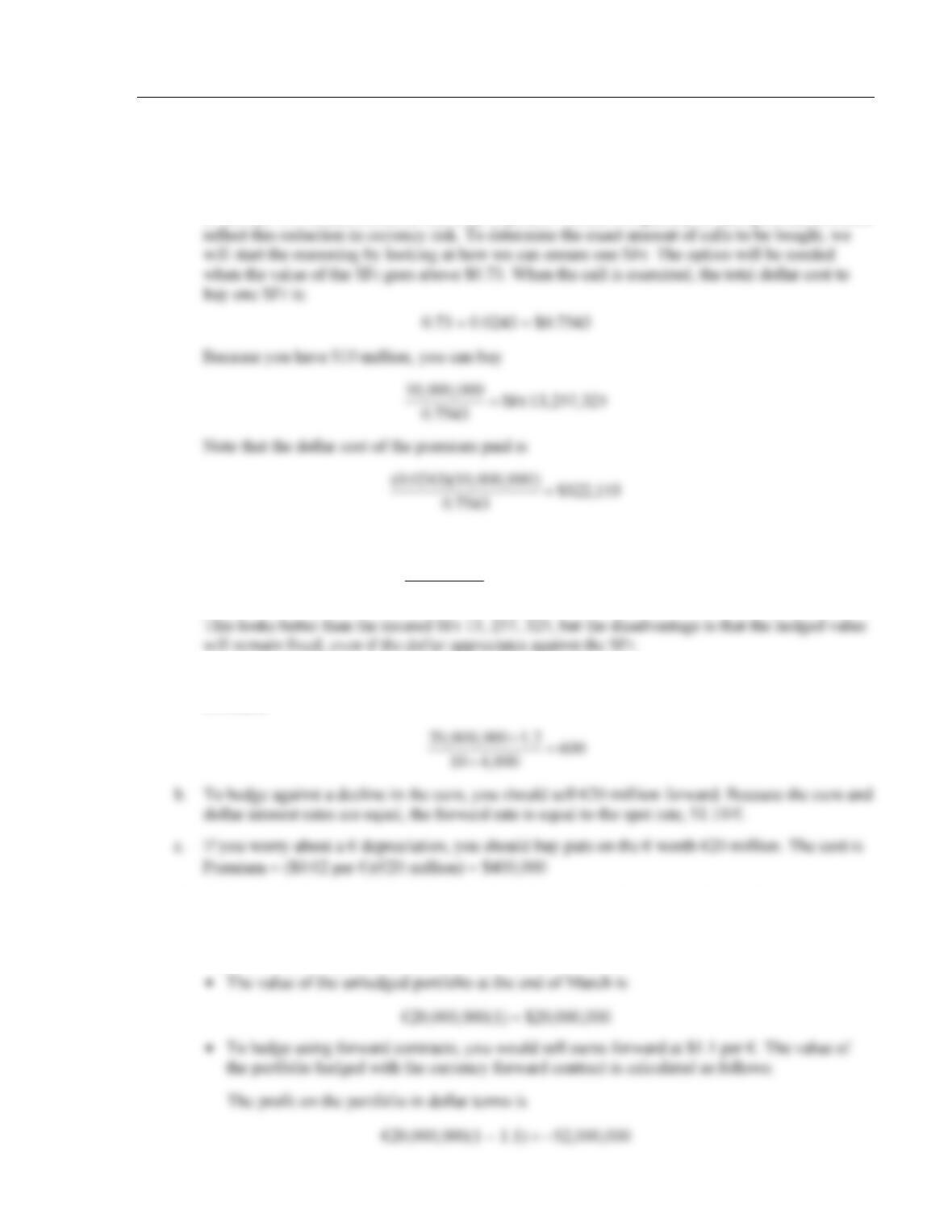
6. a. As a Swiss investor with dollar investments, you would want to buy puts to sell the U.S dollar ($)
for Swiss francs (SFr). Puts on the $ are not available. However, puts on the $ are equivalent to
calls to buy SFr for $. Therefore, you should buy calls on the SFr to insure the SFr value of the
portfolio. Because the option premium is paid in dollars while you care about SFr, the purchase
of the call will reduce the dollar currency exposure. Hence, the quantity of calls purchased should
b. If you hedge using forward currency contracts, the portfolio will have a fixed SFr value of
10,000,000 SFr 13,533,631
0.7389 =
7. a. To protect against a decline in share value, you should sell futures. You should sell 600
contracts:
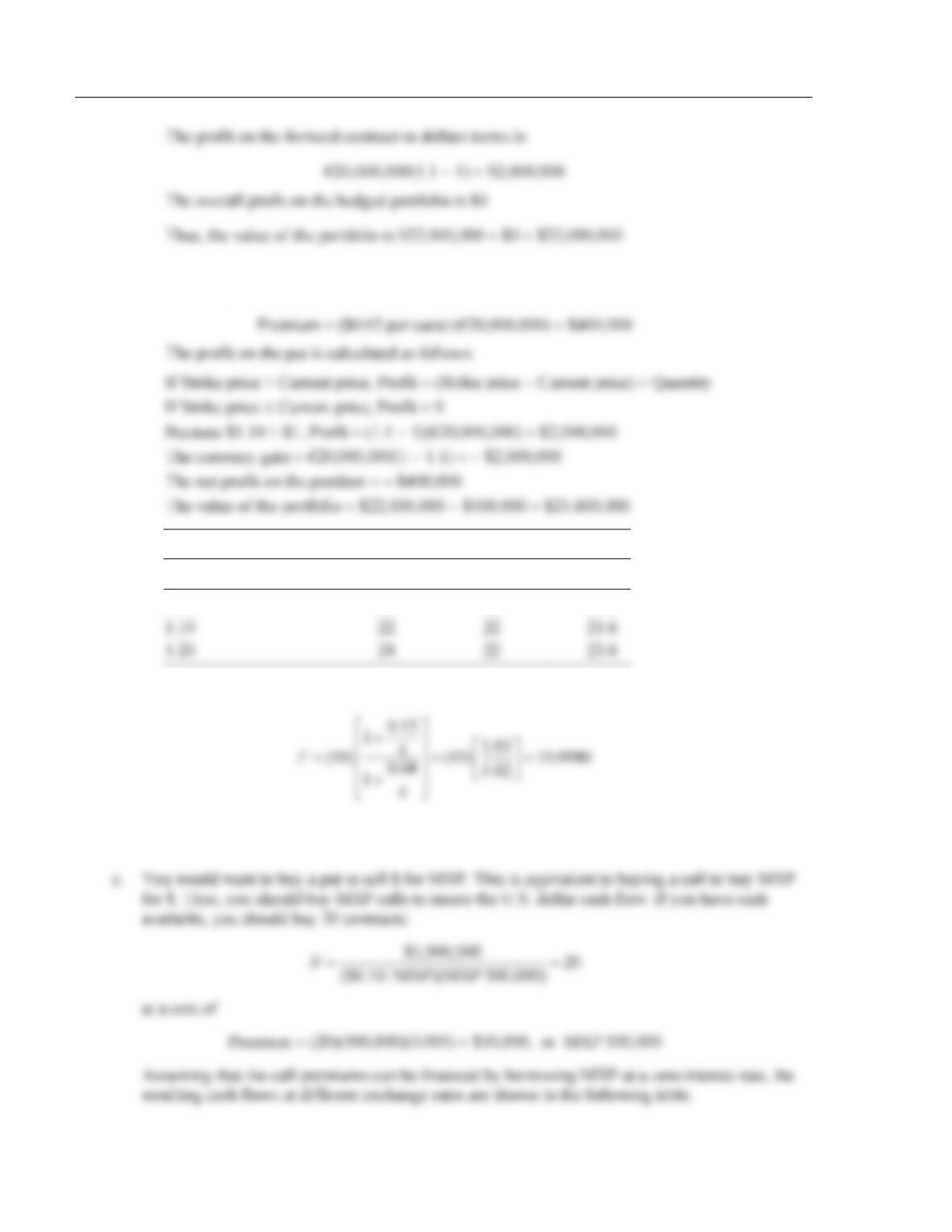
d. Assuming that the investor can get this amount from some other sources, that is, borrow at a
zero-dollar interest rate (this is a dollar investment not exposed to currency risk), we get the final
dollar simulated portfolio values in the following table. To illustrate, the calculations are
explained, assuming an exchange rate of $1.0 per € in March.
70 Solnik/McLeavey • Global Investments, Sixth Edition
• To insure using options, you will need to buy puts on the euro. You would buy €20 million
worth of puts on the euro at a cost of
Portfolio Value (in $ million)
Exchange Rate ($/€)
Unhedged
Hedged
Ensured
1.00
20
22
21.6
8. a. The three-month forward rate (MXP/$) is
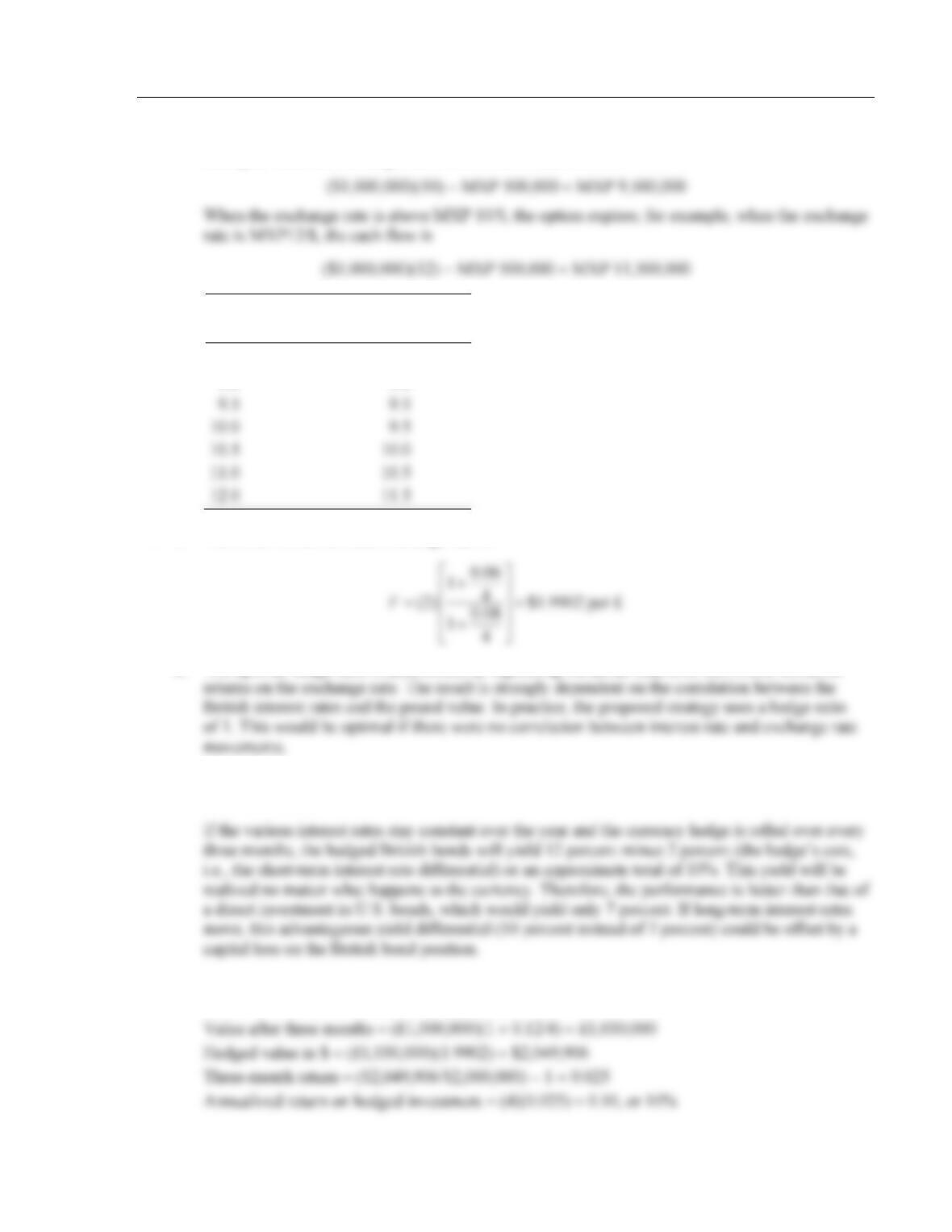
b. Buy Mexican pesos forward against U.S. dollars. You would sell $1 million forward and get
MXP 10.0980 million on February 4.
Chapter 11 Currency Risk Management 71
When the exchange rate is below the strike price of MXP10/$, the option is exercised; for
example, when the exchange rate is MXP8/$ the cash flow is
Exchange Rate
$:MPX
MXP Cash Flow
(in MXP million)
8.0
9.5
9.0
9.5
9.5
9.5
9.5
9. a. The three-month forward exchange rate is
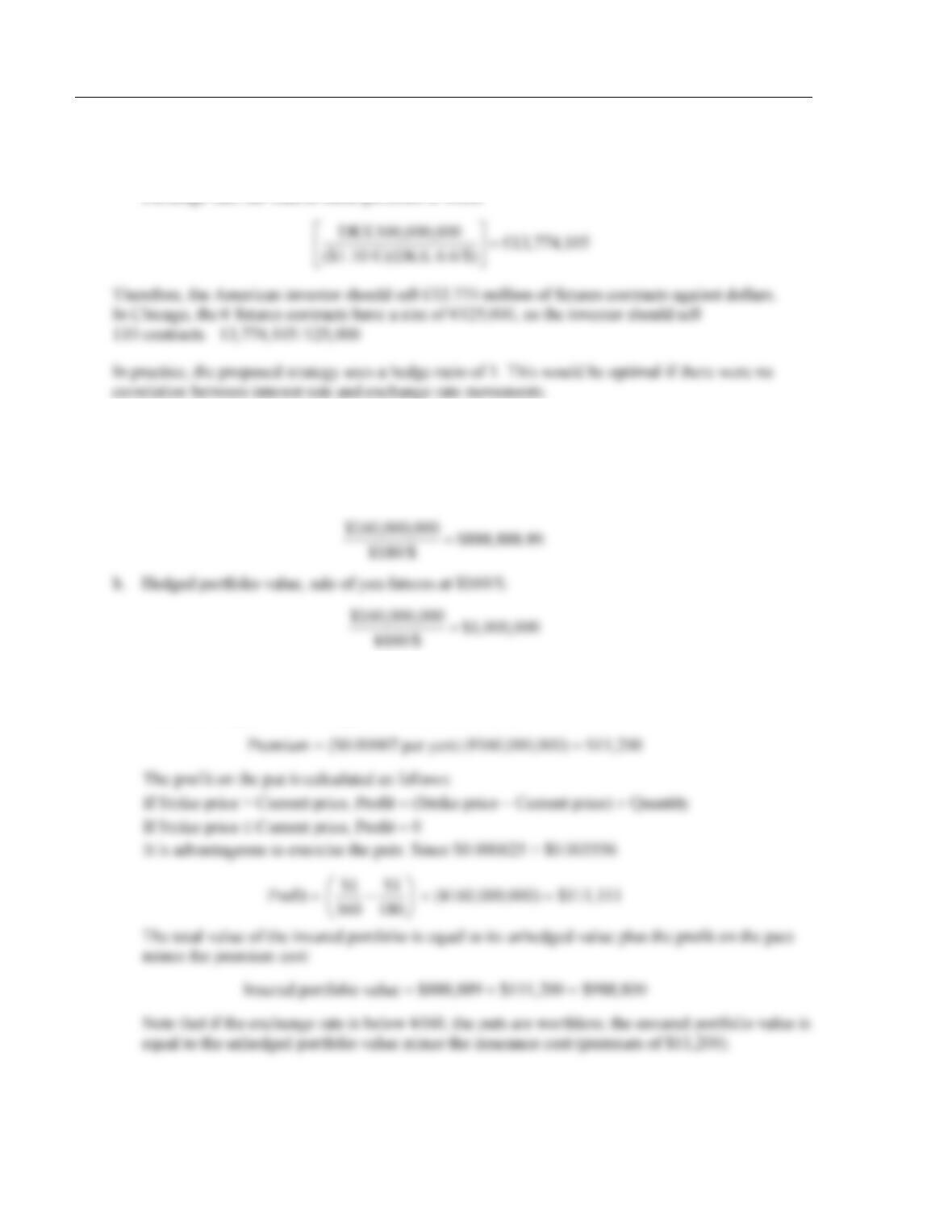
b. The optimal hedge ratio is determined by regressing the dollar returns of the British bonds on
c. Assume that the American investor buys £1 million of British bonds and sells forward £1 million
for U.S. dollars.
Illustrative Calculations
Initial investment = £1,000,000 or $2,000,000
72 Solnik/McLeavey • Global Investments, Sixth Edition
10. She would use € futures as a proxy for Danish kroner futures because the two exchange rates, €/$
and DKK/$, tend to move together. Denmark is part of the EU, but has not adopted the euro.
However, Denmark attempts to maintain a stable exchange rate with the euro. At the current spot
exchange rate, the Danish stock portfolio is worth
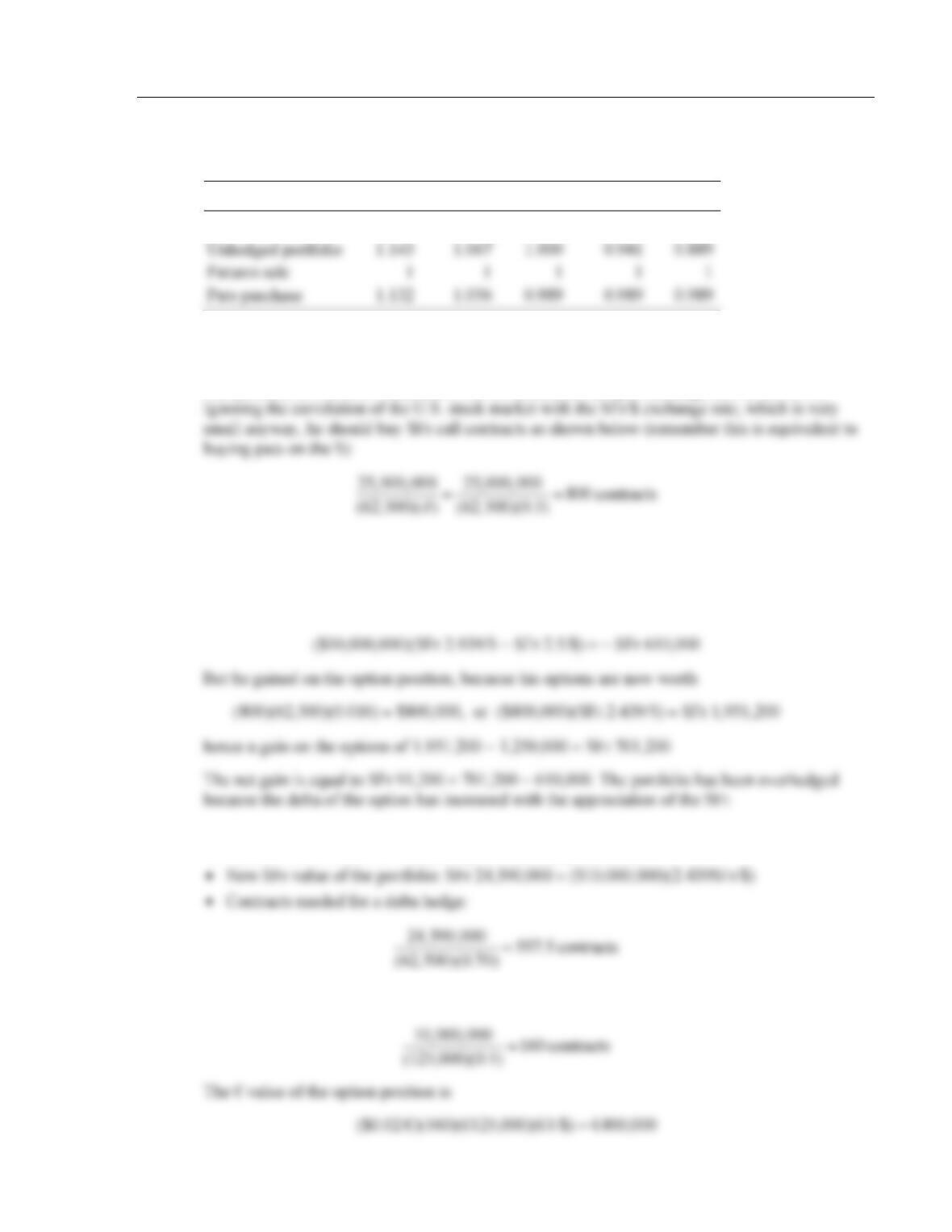
11. The following table provides the value of the portfolio in dollars at various exchange rates for the two
hedging strategies, as well as the unhedged value. The calculations are explained for an exchange rate
of ¥180/$ or $0.005556/¥.
a. Unhedged portfolio value:
c. Insured portfolio value, purchase of yen puts at $0.007 per 100 yen: To insure using options you
will need to buy puts on the yen. The yen puts give the right to sell 1 yen for $1/160 = $0.00625.
You would buy ¥160 million puts on the yen at a cost of
Chapter 11 Currency Risk Management 73
The following table summarizes the portfolio’s final dollar value as a function of the spot
exchange rate:
Rounded value of the portfolio (in $ million)
¥ Exchange Rate
140
150
160
170
180
12. a. The Swiss investor wishes to use options as a delta-hedging device; therefore, the delta of the
option should be taken into account.
The portfolio is worth $10 million, or SFr 25 million at the spot exchange rate of SFr 2.5/$.
This would require payment of a premium of
(800)(62,500)(0.01) = $500,000, or (500,000)(2.50 SFr/$) = SFr 1,250,000
b. A few days later, the Swiss investor lost on his portfolio an amount of
c. In a dynamic strategy, the Swiss investor could sell part of his option contracts to adjust to the
new delta. The investor now needs only 557 contracts, as shown:
13. a. To have a good dynamic hedge, you should buy 160 call contracts on the euro:
74 Solnik/McLeavey • Global Investments, Sixth Edition
b. The portfolio value shows a loss in euros of
c. This net gain is due to the fact that the delta increased to 0.9, but the hedge was not rebalanced
dynamically.
d. We can reduce the number of option contracts to
14. This question can be answered by calculating the impact of the depreciation of the pound in the three
strategies for an equivalent claim of one FTSE index.
In a direct investment in the British stock market (e.g., index fund), we must invest £6,000 to get one
unit of index. In a future purchase, we only have to deposit £1,500/10 = £150 per unit of index because
one futures contract is for the index times 10. In the call purchase, we only invest £20 per unit of index.
a. Direct investment in the FTSE index: You invest £6,000, or (£6000) ($2/£) = $12,000. The £
15. An American investor hedging the British pound risk has to “pay” the interest rate differential
(British minus U.S. interest rate), while a British investor hedging the U.S. dollar risk “receives” it.
It seems to be the reason why the journal suggests that Americans should not hedge their British
investments, but that British investors should hedge their U.S. investments.
Chapter 11 Currency Risk Management 75
16. a. Traditional ways for the exporter to hedge against a decline in the value of the dollar would be to
(i) buy puts on the dollar or, equivalently, (ii) buy calls on the pound. The Range Forward Contract
b. This contract is the sum of
• a call pound, giving the exporter the right to buy pounds at $1.470/£; and
17. Again, assume that we buy the calls by borrowing pounds at a zero interest rate. For example, to
“insure” with $1.50 strike calls on the £, we need to buy calls on £10 million. The cost is $300,000,
which we finance with £200,000, given the spot exchange rate.
The following table provides portfolio values at various exchange rates. To explain, portfolio values
are calculated at an exchange rate of $1.7/£.
a. Unhedged portfolio value:
76 Solnik/McLeavey • Global Investments, Sixth Edition
The dollar depreciation leads to a currency loss:
Rounded Portfolio Value (in £ thousand):
Exchange Rate
Insured
with
Insured
with
Insured
with
($/£)
Unhedged
Hedged
Call (150)
Call (155)
Call (160)
1.3
11,538
10,000
11,338
11,438
11,505
1.4
10,714
10,000
10,514
10,614
10,681
1.5
10,000
10,000
9,800
9,900
1.6
9,375
10,000
9,800
9,577
1.7
8,824
10,000
9,800
9,577
• Hedging with forward contracts allows to the exporter to eliminate the risk of a decline in the
dollar. However, it also means that the British exporter will not benefit if the dollar
appreciates.
• Options allow the exporter to “insure” rather then “hedge.” In other words, a floor is set on
The choice between the following five alternatives depends on the expectations and risk aversion
of the exporter. We can rank them in decreasing order of protection against a drop in the dollar
(e.g., from $1.50 to $1.70 per pound), as follows:
i. Hedge—Portfolio value £10,000,000
18. a. The manager would have to sell
Chapter 11 Currency Risk Management 77
b. The profit on the investment in the U.K. company:
In pounds = 5,022,000 − 5,000,000 = £22,000
19. a. The manager would have to sell
10,000,000 44contracts
(902)(250) =
b. The profit on the investment in the U.S. company:
In dollars = 10,050,000 − 10,000,000 = $50,000
20. Appreciation of a foreign currency will, indeed, increase the dollar returns that accrue to a U.S. investor.
However, the amount of the expected appreciation must be compared with the forward premium or
discount on that currency in order to determine whether or not hedging should be undertaken.
In the present example, the yen is forecast to appreciate from 100 to 98 (2%). However, the forward