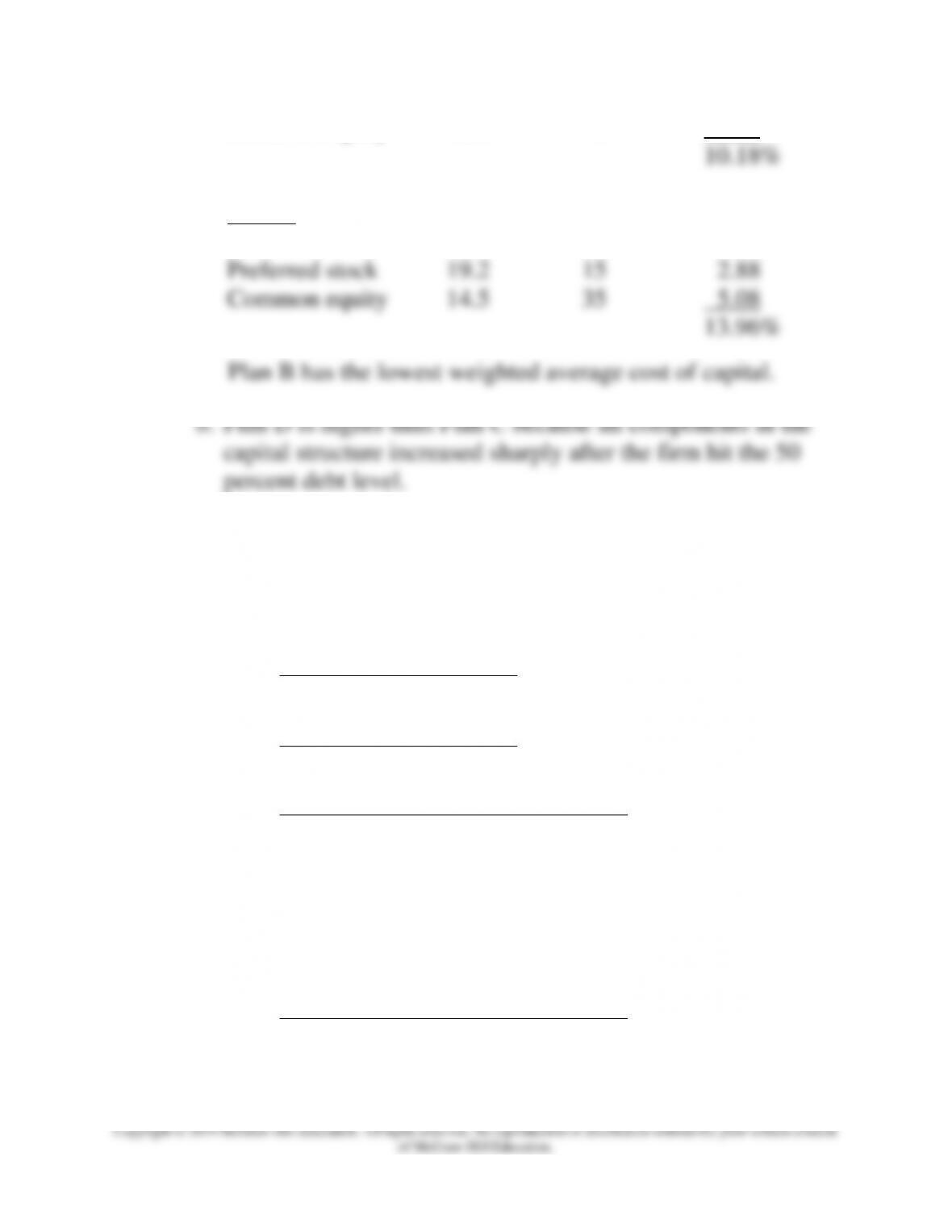
Common equity
12.8
40
5.12
10.18%
Plan D
Debt
12.0%
50%
6.00%
Preferred stock
19.2
15
2.88
Common equity
14.5
35
5.08
13.96%
Plan B has the lowest weighted average cost of capital.
b. Plan D is higher than Plan C because all components in the
capital structure increased sharply after the firm hit the 50
percent debt level.
22. Weighted average cost of capital (LO11-1) Given the following information, calculate
the weighted average cost of capital for Hamilton Corp. Line up the calculations in the
order shown in Table 11-1.
Percent of capital structure:
Debt ………………………. 35%
Preferred stock ……….. 20
Common equity ………. 45
Additional information:
Bond coupon rate …………………………. 11%
Bond yield to maturity ………………….. 9%
Dividend, expected common …………. $ 5.00
Dividend, preferred ………………………. $ 12.00
Price, common …………………………….. $ 60.00
Price, preferred …………………………….. $106.00
Flotation cost, preferred ………………… $ 4.50
Growth rate …………………………………. 6%
Corporate tax rate …………………………. 25%
11-22. Solution:
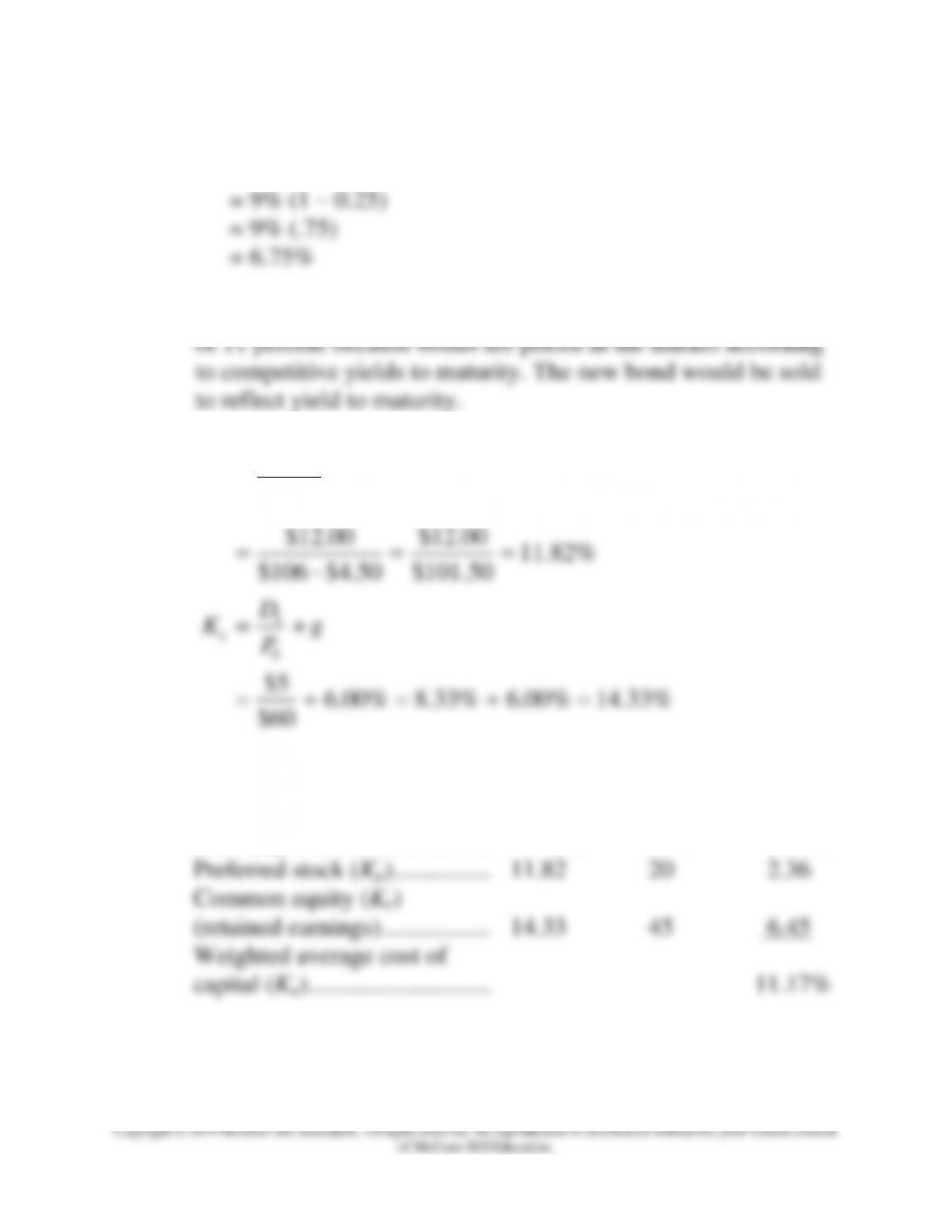
The Hamilton Corp.
Kd = Yield (1 – T)
The bond yield of 9 percent is used rather than the coupon rate
1
0
$12.00 $12.00 11.82%
$106 $4.50 $101.50
$5 6.00% 8.33% 6.00% 14.33%
$60
p
p
p
e
D
KPF
D
Kg
P
=
−
= = =
−
=+
= + = + =
Cost
(aftertax)
Weights
Weighted
Cost
Debt (Kd) …………………………..
Preferred stock (Kp) ………………….
Common equity (Ke)
(retained earnings) ……………………
Weighted average cost of
capital (Ka) …………………………..
6.75%
11.82
14.33
35%
20
45
2.36%
2.36
6.45
11.17%
23. Given the following information, calculate the weighted average cost of capital for Digital
Processing Inc. Line up the calculations in the order shown in Table 11-1.
Percent of capital structure:
Preferred stock …………….. 20%
Common equity ……………. 40
Debt ……………………………. 40
Additional information:
Corporate tax rate …………………………. 25%
Dividend, preferred ………………………. $8.50
Dividend, expected common …………. $2.50
Dividend, preferred ………………………. $105.00
Growth rate …………………………………. 7%
Bond yield …………………………………… 9.5
Flotation cost, preferred ………………… $3.60
Price, common …………………………….. $75.00
11–23. Solution:
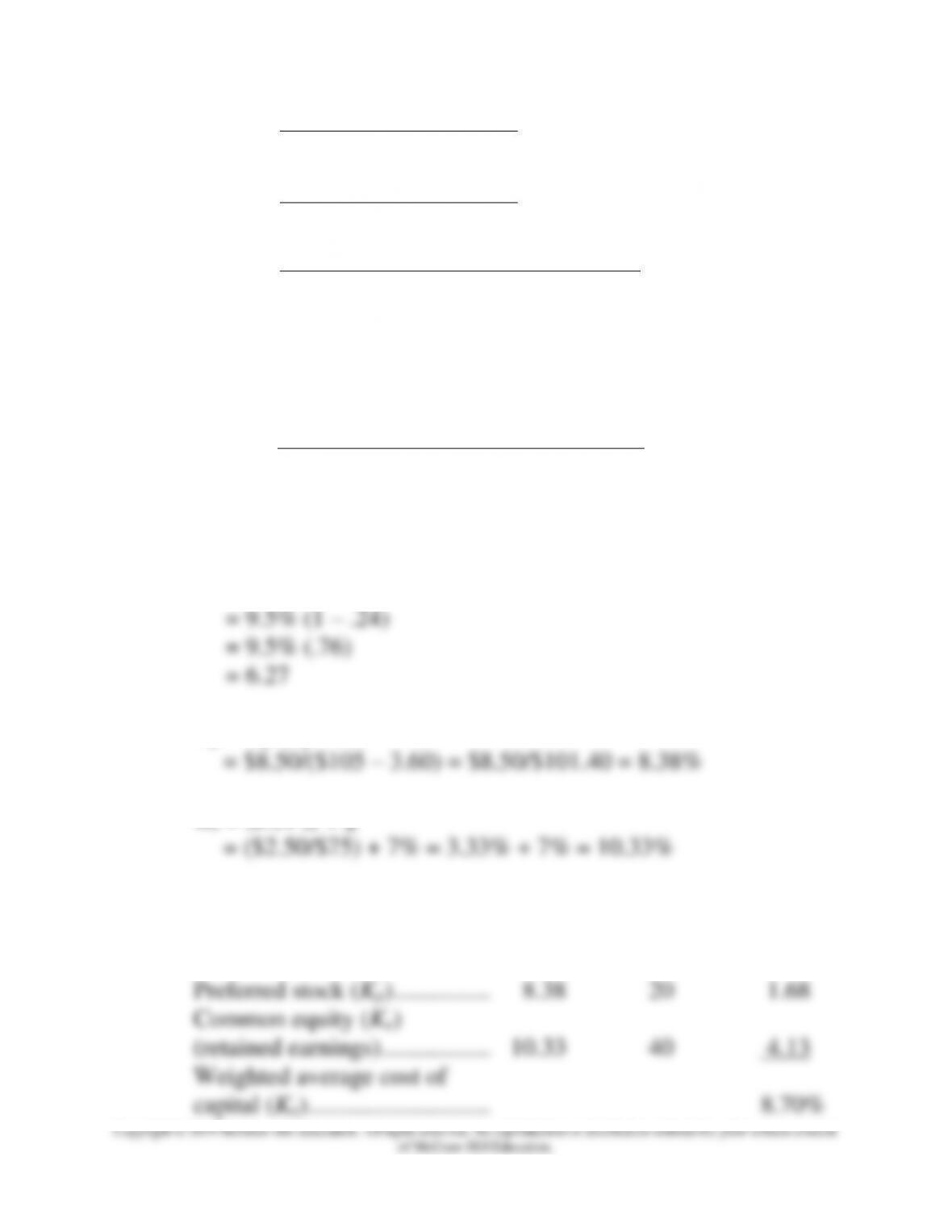
Digital Processing Inc.
Kd = Yield (1 – T)
Kp = Dp/(Pp – F)
Ke = (D1/P0) + g
Cost
(aftertax)
Weights
Weighted
Cost
Debt (Kd) …………………………..
Preferred stock (Kp) ………………….
Common equity (Ke)
(retained earnings) ……………………
Weighted average cost of
7.22%
8.38
10.33
40%
20
40
2.89%
1.68
4.13
24. Changes in costs and weighted average cost of capital (LO11-1) Brook’s Window
Shields Inc. is trying to calculate its cost of capital for use in a capital budgeting decision.
Mr. Glass, the vice president of finance, has given you the following information and has
asked you to compute the weighted average cost of capital.
The company currently has outstanding a bond with a 12.2 percent coupon rate and
another bond with a 9.5 percent coupon rate. The firm has been informed by its investment
banker that bonds of equal risk and credit rating are now selling to yield 13.4 percent.
The common stock has a price of $58 and an expected dividend (D1) of $5.30 per share.
The firm’s historical growth rate of earnings and dividends per share has been 9.5 percent,
but security analysts on Wall Street expect this growth to slow to 7 percent in future years.
The preferred stock is selling at $54 per share and carries a dividend of $6.75 per share.
The corporate tax rate is 25 percent. The flotation cost is 2.1 percent of the selling price for
preferred stock. The optimal capital structure is 40 percent debt, 25 percent preferred stock,
and 35 percent common equity in the form of retained earnings.
Compute the cost of capital for the individual components in the capital structure, and
then calculate the weighted average cost of capital (similar to Table 11-1).
11-24. Solution:
Brook’s Window Shields Inc.
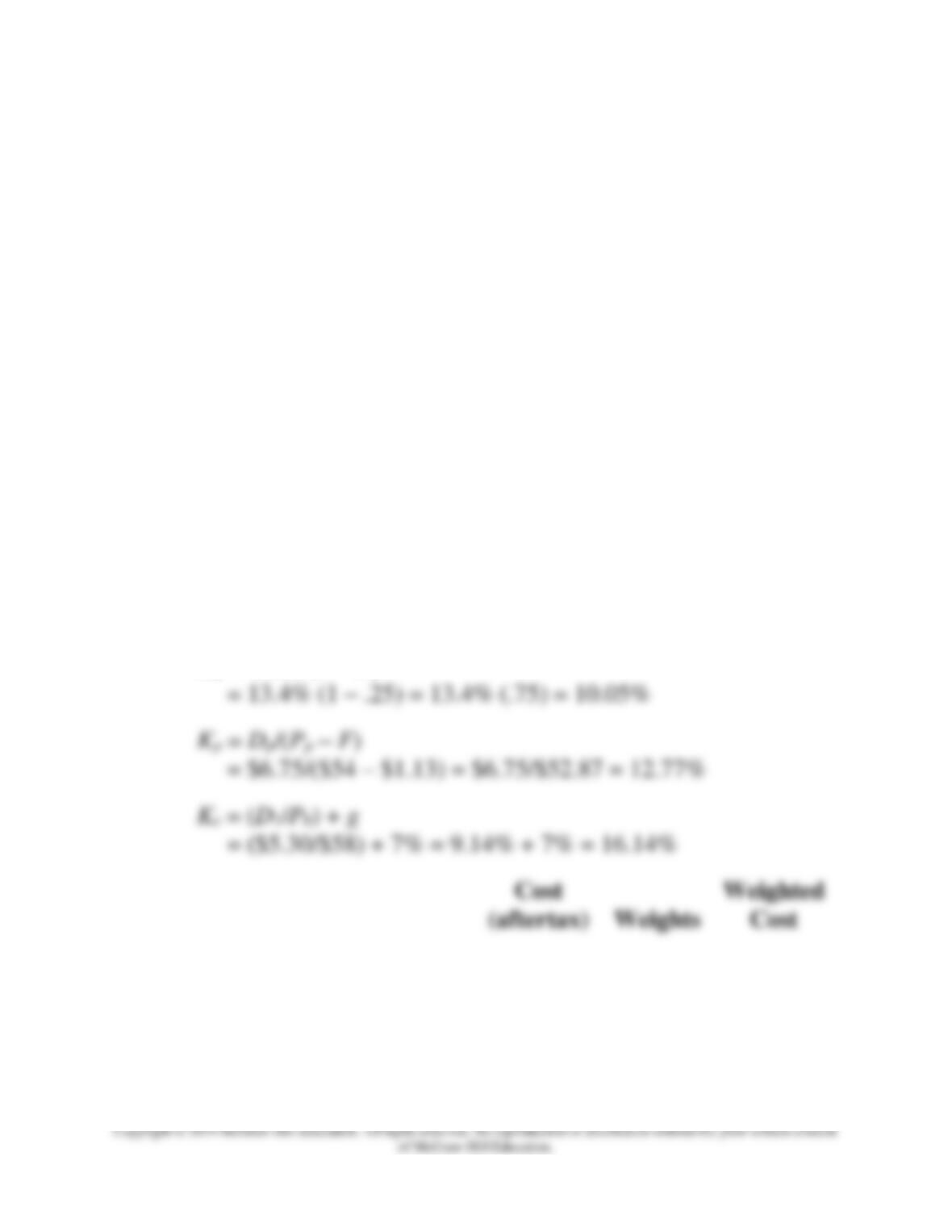
Kd = Yield (1 – T)
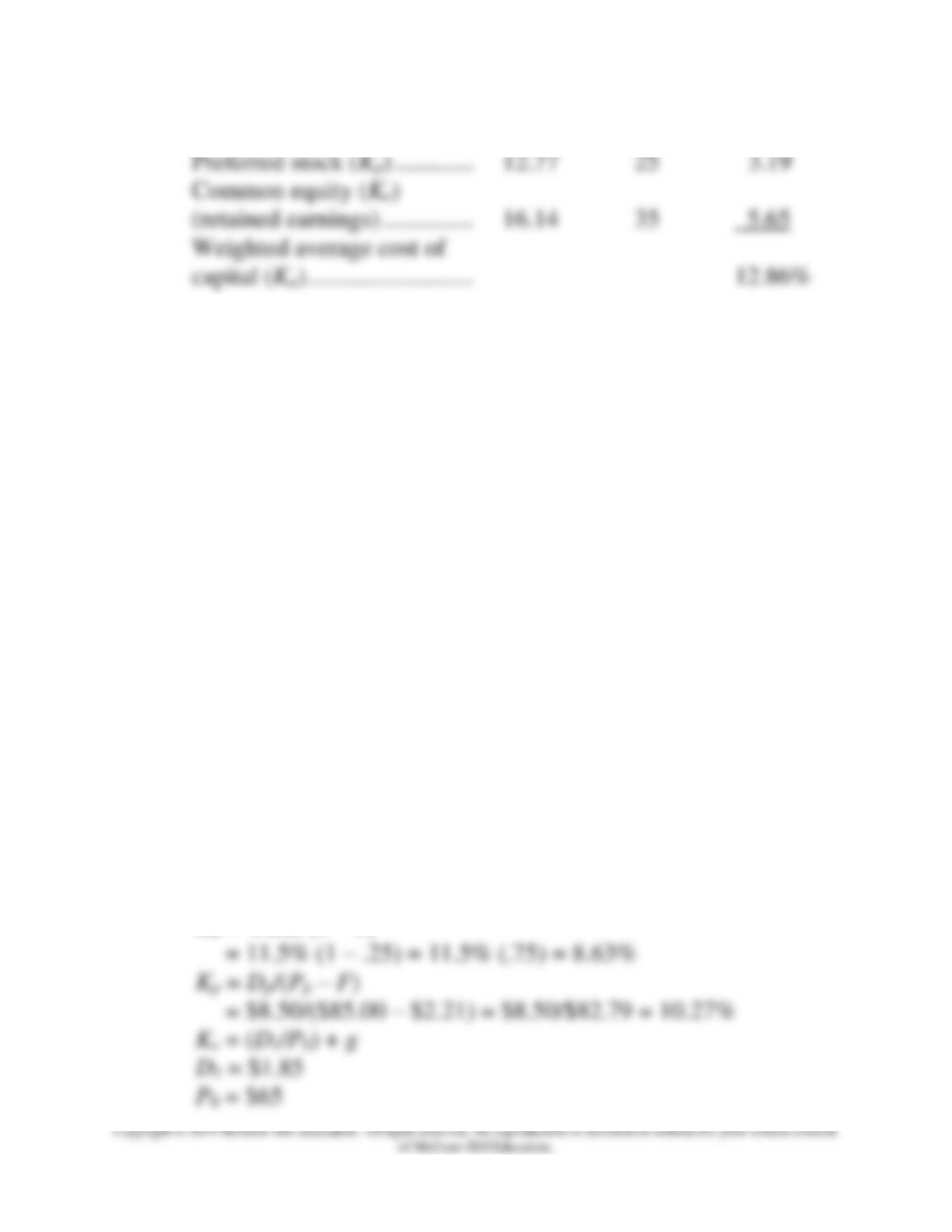
Debt (Kd) …………………………..
Preferred stock (Kp) …………………
Common equity (Ke)
(retained earnings) …………………..
Weighted average cost of
capital (Ka) …………………………..
10.05%
12.77
16.14
40%
25
35
4.02%
3.19
5.65
12.86%
25. Changes in cost and weighted average cost of capital (LO11-1) A-Rod Manufacturing
Company is trying to calculate its cost of capital for use in making a capital budgeting
decision. Mr. Jeter, the vice president of finance, has given you the following information
and has asked you to compute the weighted average cost of capital.
The company currently has outstanding a bond with a 10.6 percent coupon rate and
another bond with an 8.2 percent rate. The firm has been informed by its investment banker
that bonds of equal risk and credit rating are now selling to yield 11.5 percent. The
common stock has a price of $65 and an expected dividend (D1) of $1.50 per share. The
historical growth pattern (g) for dividends is as follows:
$1.40
1.54
1.69
1.85
Compute the historical growth rate, round it to the nearest whole number, and use it for g.
The preferred stock is selling at $85 per share and pays a dividend of $8.50 per share.
The corporate tax rate is 25 percent. The flotation cost is 2.6 percent of the selling price for
preferred stock. The optimal capital structure for the firm is 35 percent debt, 5 percent
preferred stock, and 60 percent common equity in the form of retained earnings.
Compute the cost of capital for the individual components in the capital structure, and
then calculate the weighted average cost of capital (similar to Table 11-1).
11-25. Solution:
A-Rod Construction Company
Kd = Yield (1 – T)
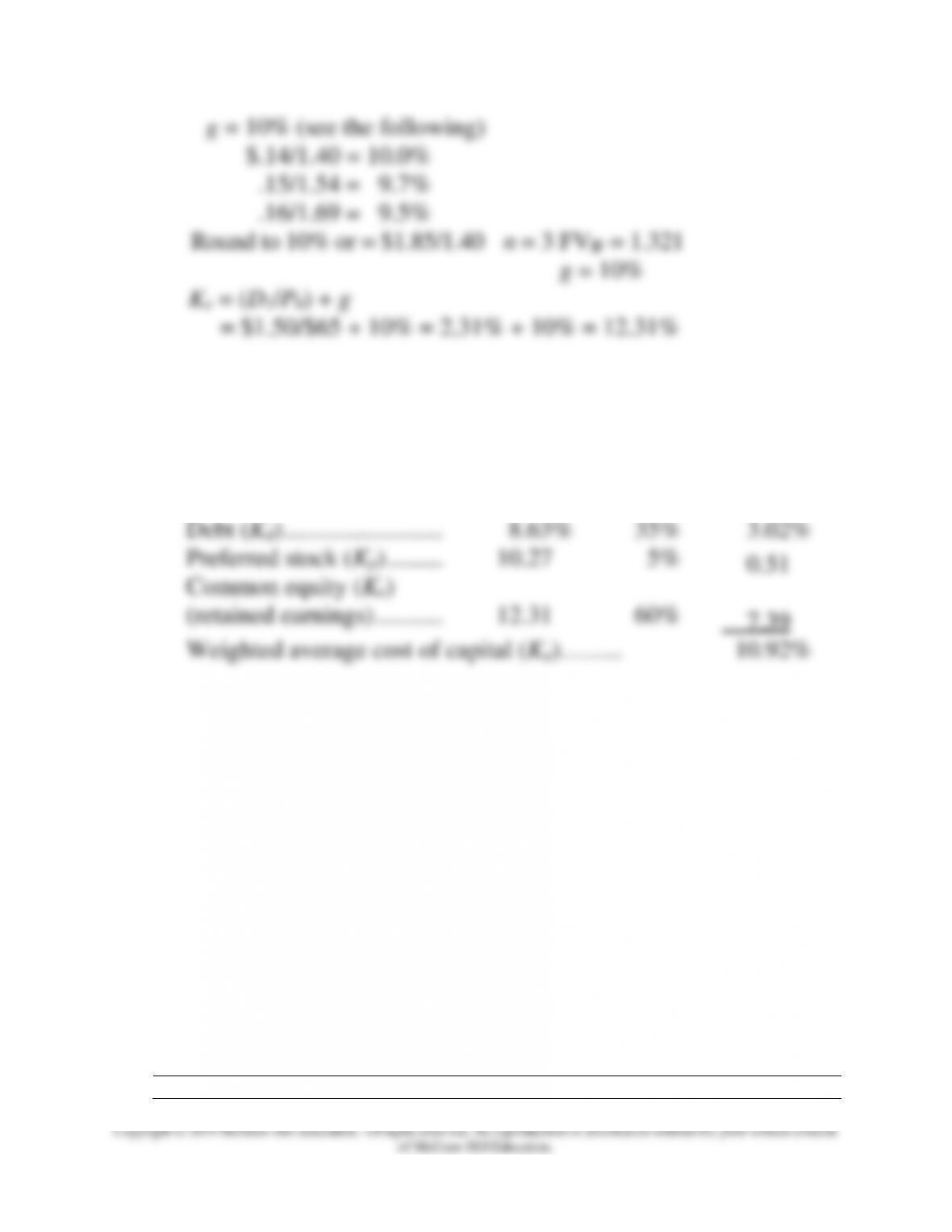
Bring the preceding values together to compute the weighted average
cost of capital.
Cost
(aftertax)
Weights
Weighted
Cost
Debt (Kd) ……………………..
Preferred stock (Kp) ………
Common equity (Ke)
(retained earnings) ………..
8.63%
10.27
12.31
35%
5%
60%
3.02%
0.51
7.39
Weighted average cost of capital (Ka)……..
10.92%
26. Impact of credit ratings on cost of capital (LO11-3) Northwest Utility Company faces
increasing needs for capital. Fortunately, it has an Aa3 credit rating. The corporate tax rate
is 25 percent. Northwest’s treasurer is trying to determine the corporation’s current
weighted average cost of capital in order to assess the profitability of capital budgeting
projects.
Historically, the corporation’s earnings and dividends per share have increased about
8.2 percent annually and this should continue in the future. Northwest’s common stock is
selling at $64 per share, and the company will pay a $6.50 per share dividend (D1).
The company’s $96 preferred stock has been yielding 8 percent in the current market.
Flotation costs for the company have been estimated by its investment banker to be $6.00
for preferred stock.
The company’s optimal capital structure is 55 percent debt, 20 percent preferred stock,
and 25 percent common equity in the form of retained earnings. Refer to the following
table on bond issues for comparative yields on bonds of equal risk to Northwest:
Data on Bond Issues
Issue
Moody’s
Price
Yield to
Rating
Maturity
Utilities:
Southwest Electric Power––7¼ 2023 ……………
Aa2
$ 895.18
8.74%
Pacific Bell––7⅜ 2025 …………………………..
Aa3
891.25
8.73
Pennsylvania Power & Light––8½
2022……………………………………………………….
A2
970.66
8.77
Industrials:
Johnson & Johnson––6¾ 2023 …………………….
Aaa
880.24
8.55%
Dillard’s Department Stores––71/8
2023……………………………………………………….
A2
960.92
8.22
Marriott Corp.––10 2015 …………………………..
B2
1,035.10
9.77
Compute the answers to the following questions from the information given:
a. Cost of debt, Kd (use the accompanying table––relate to the utility bond credit rating
for yield)
b. Cost of preferred stock, Kp
c. Cost of common equity in the form of retained earnings, Ke
d. Weighted average cost of capital
11-26. Solution:
Northwest Utility Company
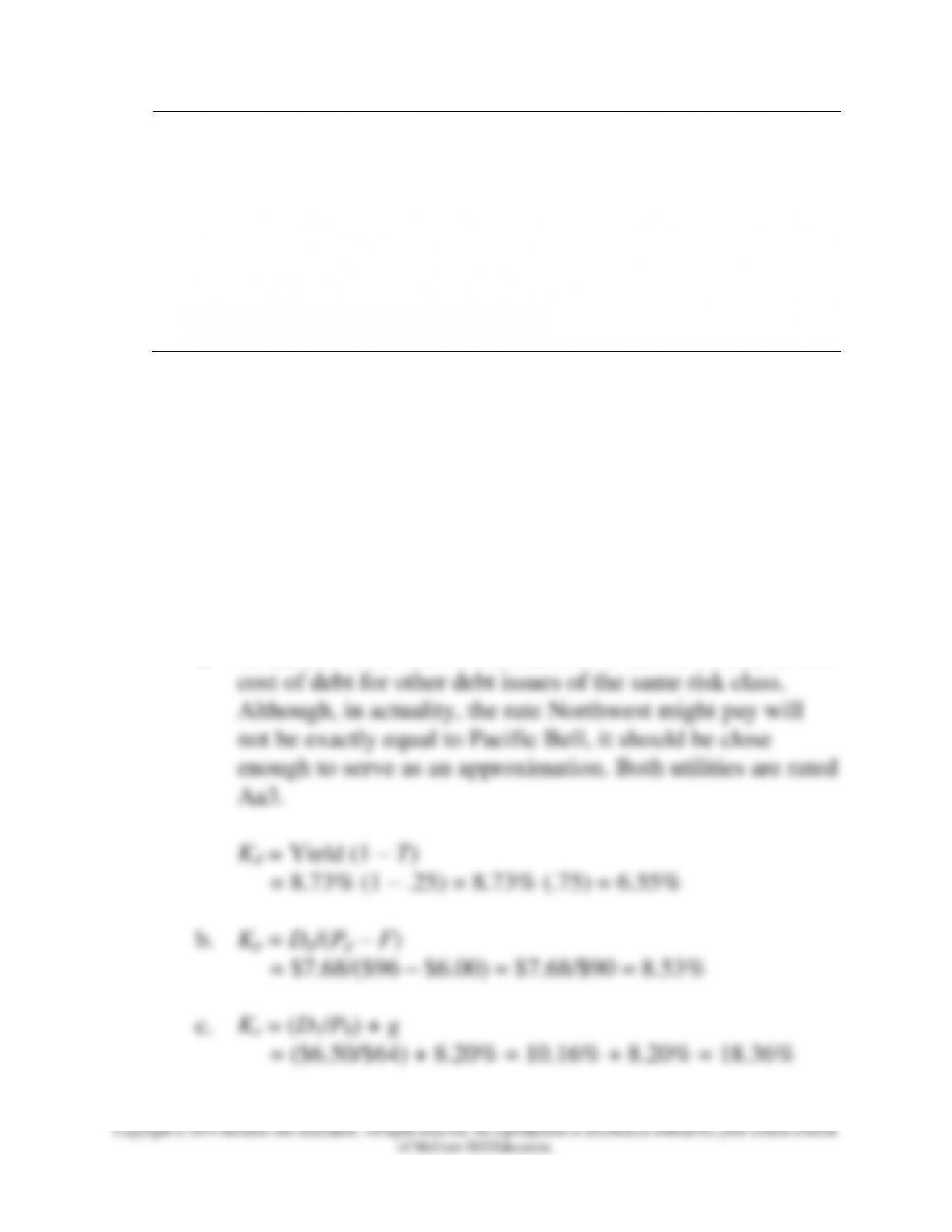
a. The student must realize that the cost of debt is related to the
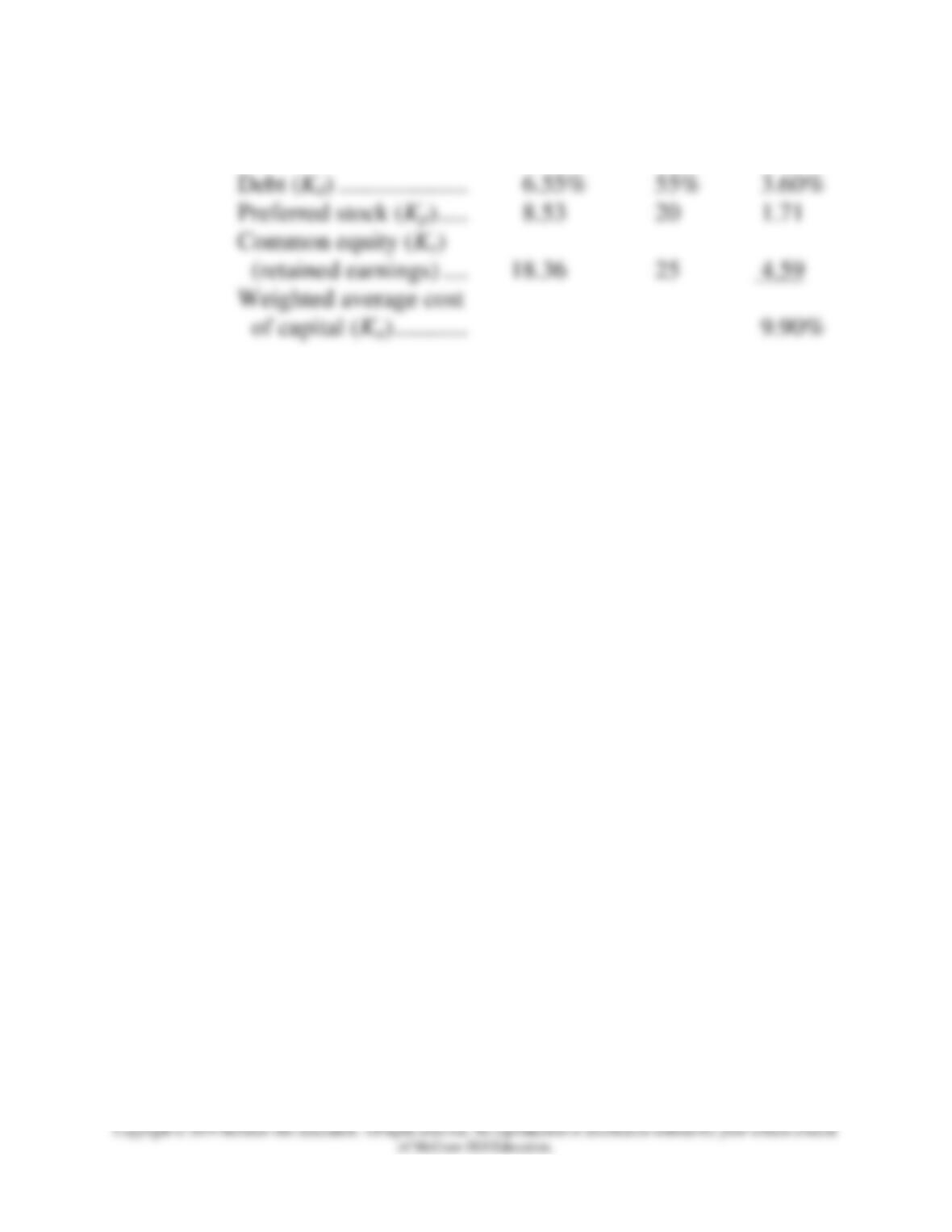
d.
Cost
(aftertax)
Weights
Weighted
Cost
Debt (Kd) …………………
Preferred stock (Kp) …..
Common equity (Ke)
(retained earnings) ….
Weighted average cost
of capital (Ka) …………
6.55%
8.53
18.36
55%
20
25
3.60%
1.71
4.59
9.90%
27. Marginal cost of capital (LO11-5) Delta Corporation has the following capital structure:
Cost
(aftertax)
Weights
Weighted
Cost
Debt …………………………..…………………………..
8.1%
35%
2.84%
Preferred stock (Kp) ………………………………………………………
9.6
5
.48
Common equity (Ke)
(retained earnings) ……………………………………………………
10.1
60
6.06
Weighted average cost of capital (Ka) …………………………..
9.38%
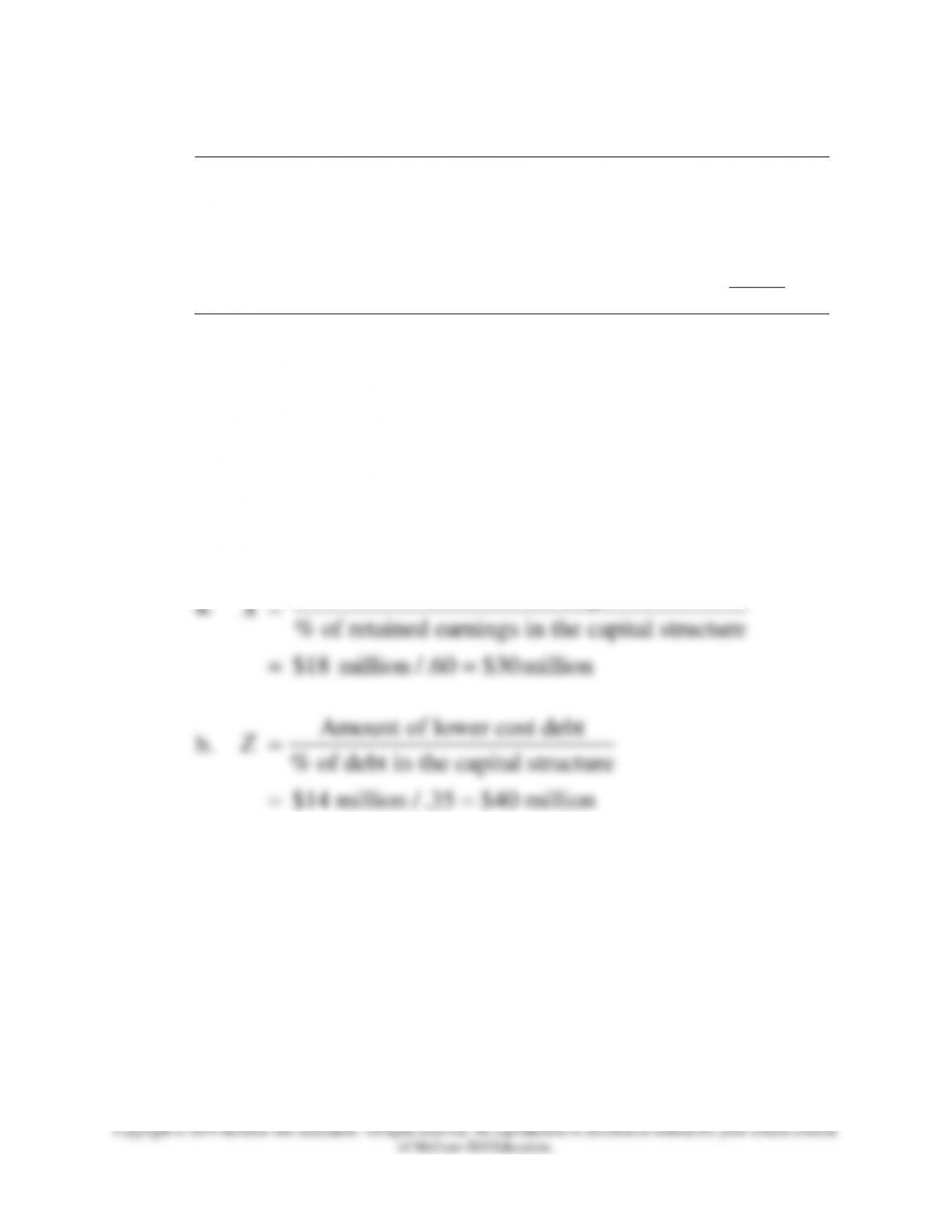
a. If the firm has $18 million in retained earnings, at what size capital structure will the
firm run out of retained earnings?
b. The 8.1 percent cost of debt referred to earlier applies only to the first $14 million of
debt. After that, the cost of debt will go up. At what size capital structure will there be
a change in the cost of debt?
11-27. Solution:
Delta Corporation
Retained earnings
% of retained earnings in the capital structure
$18 million /.60 $30million
==
b.
Amount of lower cost debt
% of debt in the capital structure
$14 million / .35 $40 million
Z=
==
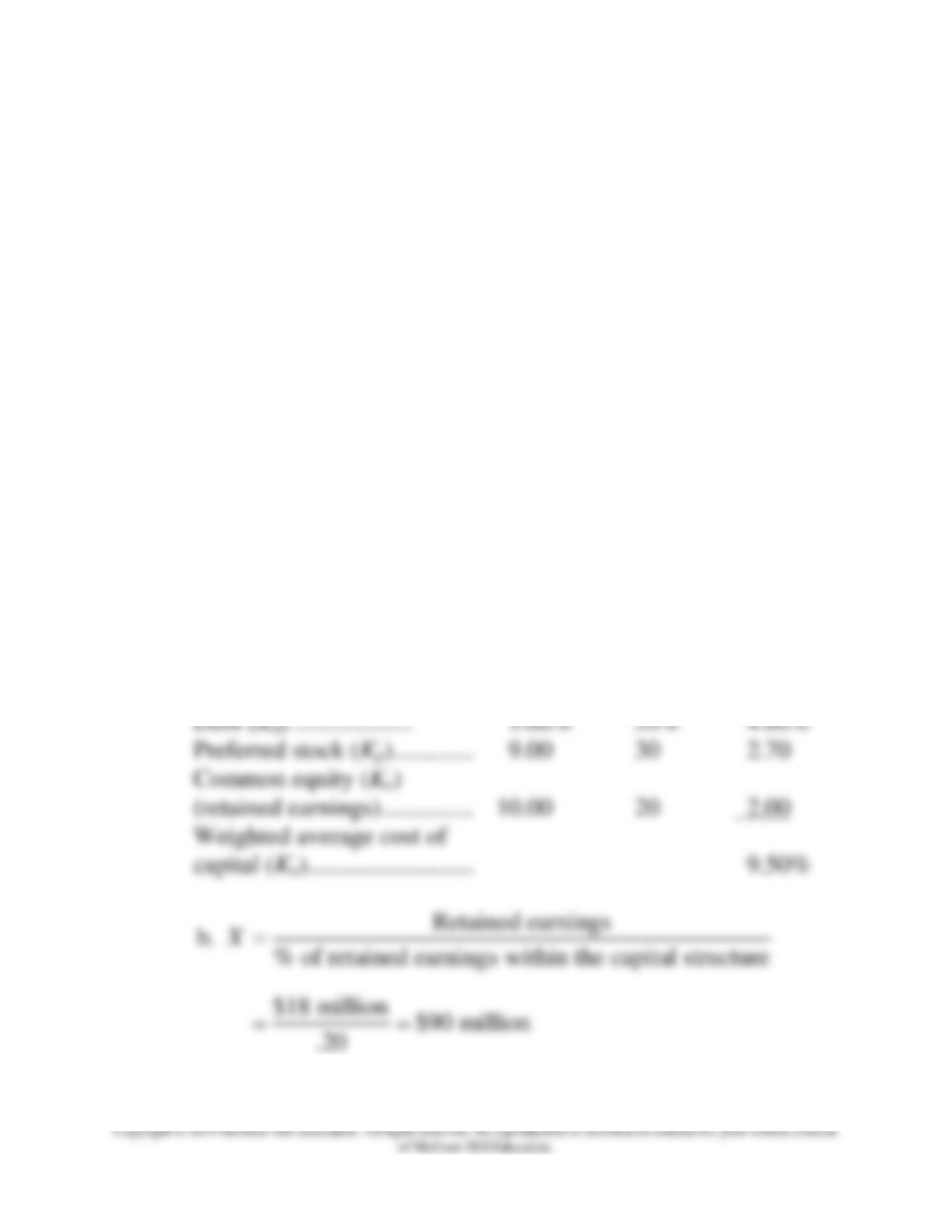
28. Marginal cost of capital (LO11-5) The Nolan Corporation finds it is necessary to
determine its marginal cost of capital. Nolan’s current capital structure calls for 50 percent
debt, 30 percent preferred stock, and 20 percent common equity. Initially, common equity
will be in the form of retained earnings (Ke) and then new common stock (Kn). The costs of
the various sources of financing are as follows: debt, 9.6 percent; preferred stock, 9
percent; retained earnings, 10 percent; and new common stock, 11.2 percent.
a. What is the initial weighted average cost of capital? (Include debt, preferred stock, and
common equity in the form of retained earnings, Ke.)
b. If the firm has $18 million in retained earnings, at what size capital structure will the
firm run out of retained earnings?
c. What will the marginal cost of capital be immediately after that point? (Equity will
remain at 20 percent of the capital structure, but will all be in the form of new
common stock, Kn.)
d. The 9.6 percent cost of debt referred to earlier applies only to the first $29 million of
debt. After that, the cost of debt will be 11.2 percent. At what size capital structure
will there be a change in the cost of debt?
e. What will the marginal cost of capital be immediately after that point? (Consider the
facts in both parts c and d.)
11-28. Solution:
Nolan Corporation
a.
Cost
(aftertax)
Weights
Weighted
Cost
Debt (Kd) ……………….
Preferred stock (Kp) ………………….
Common equity (Ke)
(retained earnings) ……………………
Weighted average cost of
capital (Ka) …………………………..
9.60%
9.00
10.00
50%
30
20
4.80%
2.70
2.00
9.50%
Retained earnings
b. % of retained earnings within the capital structure
$18 million $90 million
.20
X=
==
11–28. (Continued)
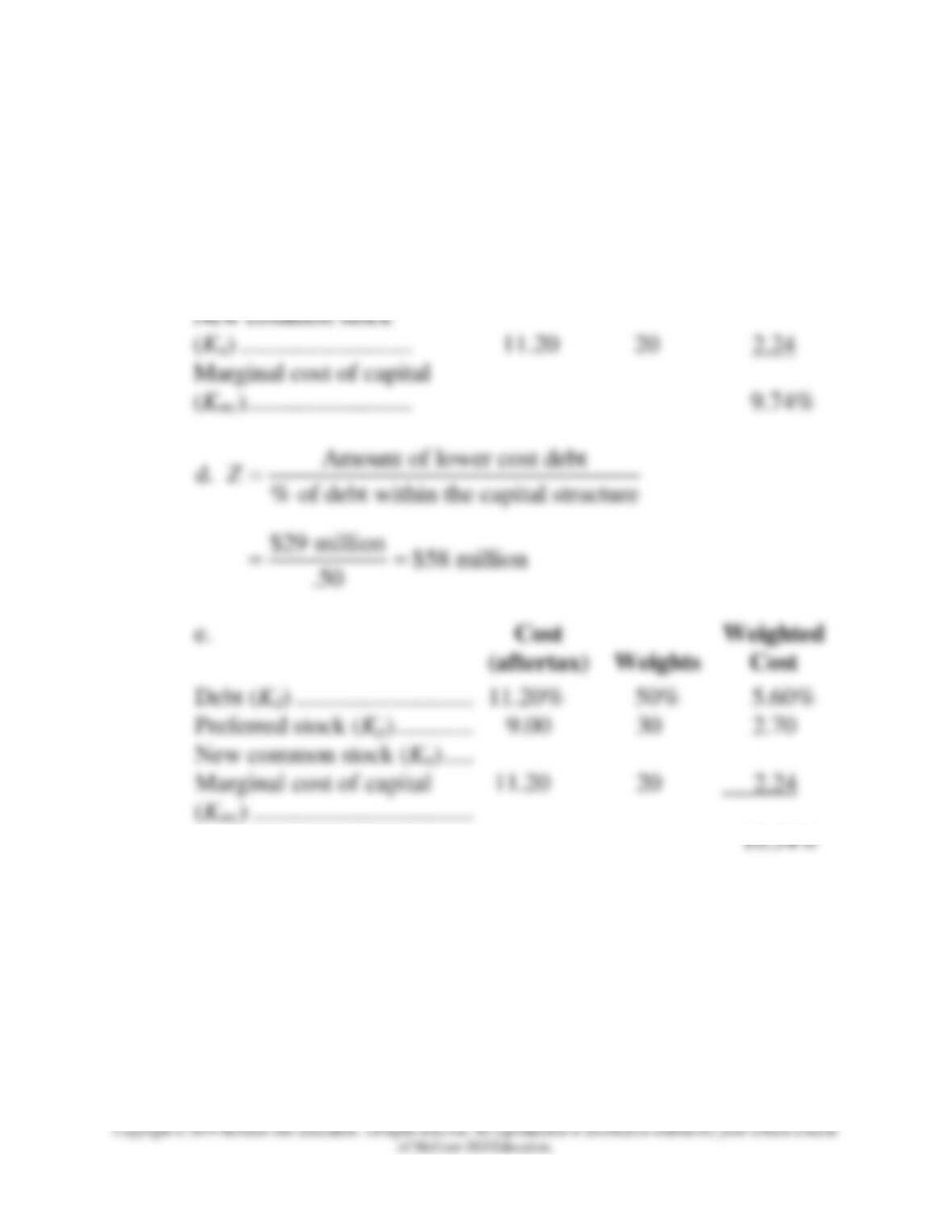
c.
Cost
(aftertax)
Weights
Weighted
Cost
Debt (Kd) ……………….
Preferred stock (Kp) …
New common stock
(Kn) ……………………….
Marginal cost of capital
(Kmc) ………………………
9.60%
9.00
11.20
50%
30
20
4.80%
2.70
2.24
9.74%
Amount of lower cost debt
d. % of debt within the capital structure
$29 million $58 million
.50
Z=
==
e.
Cost
(aftertax)
Weights
Weighted
Cost
Debt (Kd) …………………………..
Preferred stock (Kp) ………………….
New common stock (Kn) …………..
Marginal cost of capital
(Kmc) ………………………………………
11.20%
9.00
11.20
50%
30
20
5.60%
2.70
2.24
10.54%
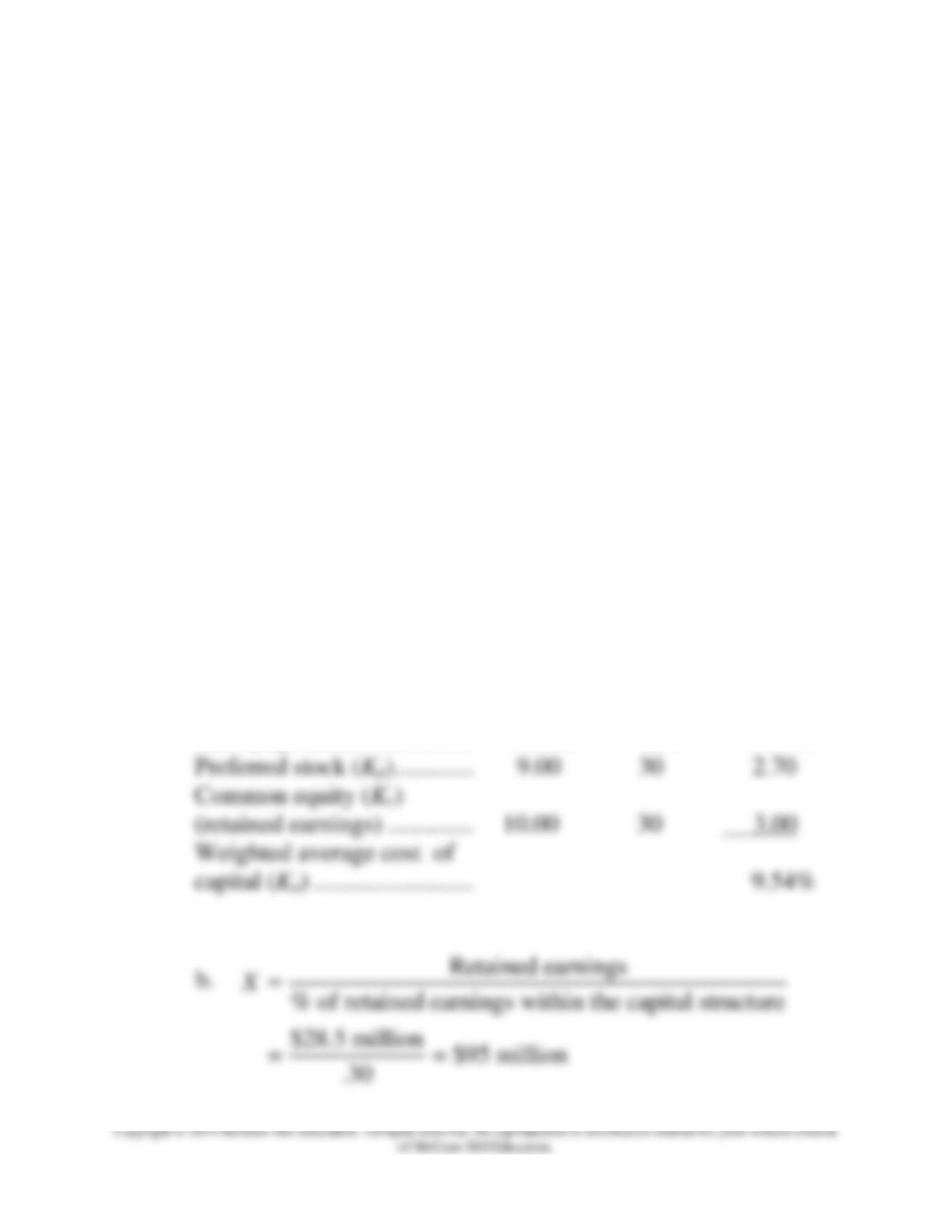
29. Marginal cost of capital (LO11-5) The McGee Corporation finds it is necessary to
determine its marginal cost of capital. McGee’s current capital structure calls for 40 percent
debt, 30 percent preferred stock, and 30 percent common equity. Initially, common equity
will be in the form of retained earnings (Ke) and then new common stock (Kn). The costs of
the various sources of financing are as follows: debt, 9.6 percent; preferred stock, 9.0
percent; retained earnings, 10.0 percent; and new common stock, 11.4 percent.
a. What is the initial weighted average cost of capital? (Include debt, preferred stock, and
common equity in the form of retained earnings, Ke.)
b. If the firm has $28.5 million in retained earnings, at what size capital structure will the
firm run out of retained earnings?
c. What will the marginal cost of capital be immediately after that point? (Equity will
remain at 30 percent of the capital structure, but will all be in the form of new
common stock, Kn.)
d. The 9.6 percent cost of debt referred to earlier applies only to the first $30 million of
debt. After that, the cost of debt will be 11.2 percent. At what size capital structure
will there be a change in the cost of debt?
e. What will the marginal cost of capital be immediately after that point? (Consider the
facts in both parts c and d.)
11-29. Solution:
The McGee Corporation
a.
Cost
(aftertax)
Weights
Weighted
Cost
Debt (Kd) …………………………..
Preferred stock (Kp) ………………….
Common equity (Ke)
(retained earnings) …………………..
Weighted average cost of
capital (Ka) …………………………..
9.60%
9.00
10.00
40%
30
30
3.84%
2.70
3.00
9.54%
b.
Retained earnings
% of retained earnings within the capital structure
$28.5 million $95 million
X=
==