Chapter 10
Derivatives: Risk Management with Speculation,
Hedging, and Risk Transfer
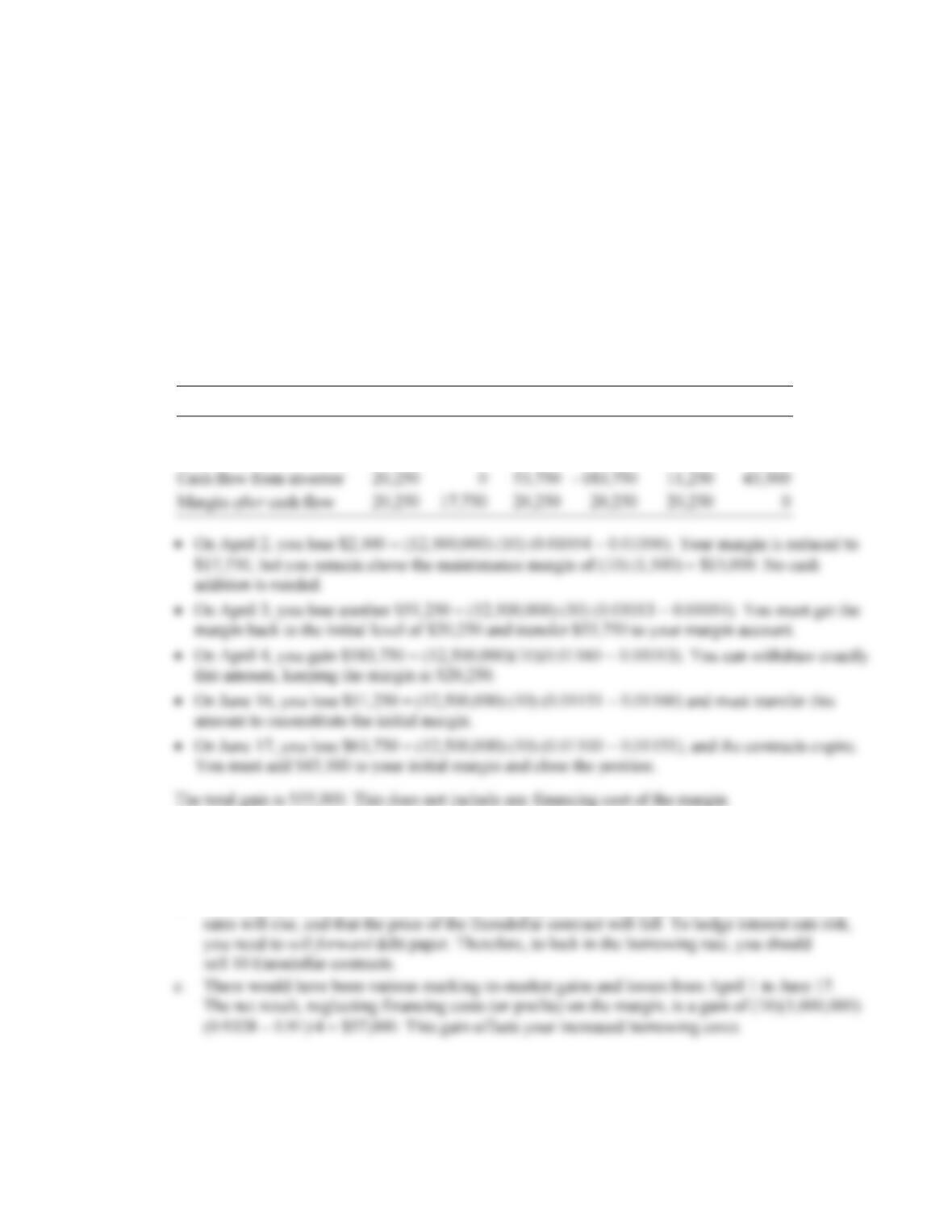
1. Following are the results for 10 contracts, in dollars:
April 1
April 2
April 3
April 4
June 16
June 17
Gain/loss
0
− 2,500
− 51,250
183,750
− 11,250
− 63,750
Margin before cash flow
0
17,750
− 33,500
204,000
9,000
− 43,500
2. a. The implicit interest rate is 100 − 93.28 = 6.72 percent. This is a forward interest rate. It suggests
that the term structure of the interest rate is upward sloping (long-term rates higher than short-
term rates).
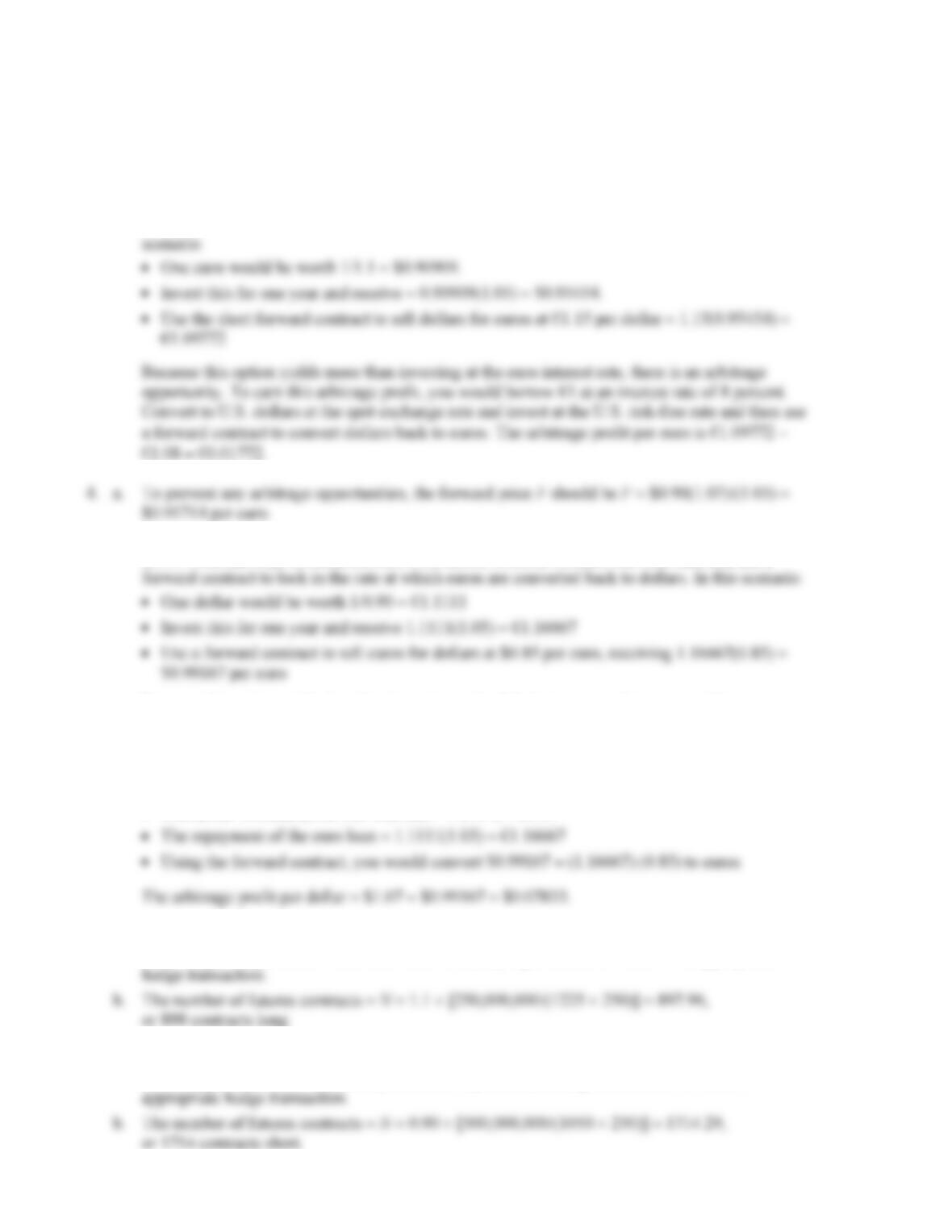
b. Your position will be to borrow (i.e., sell debt paper). Your risk exposure here is that interest
58 Solnik/McLeavey • Global Investments, Sixth Edition
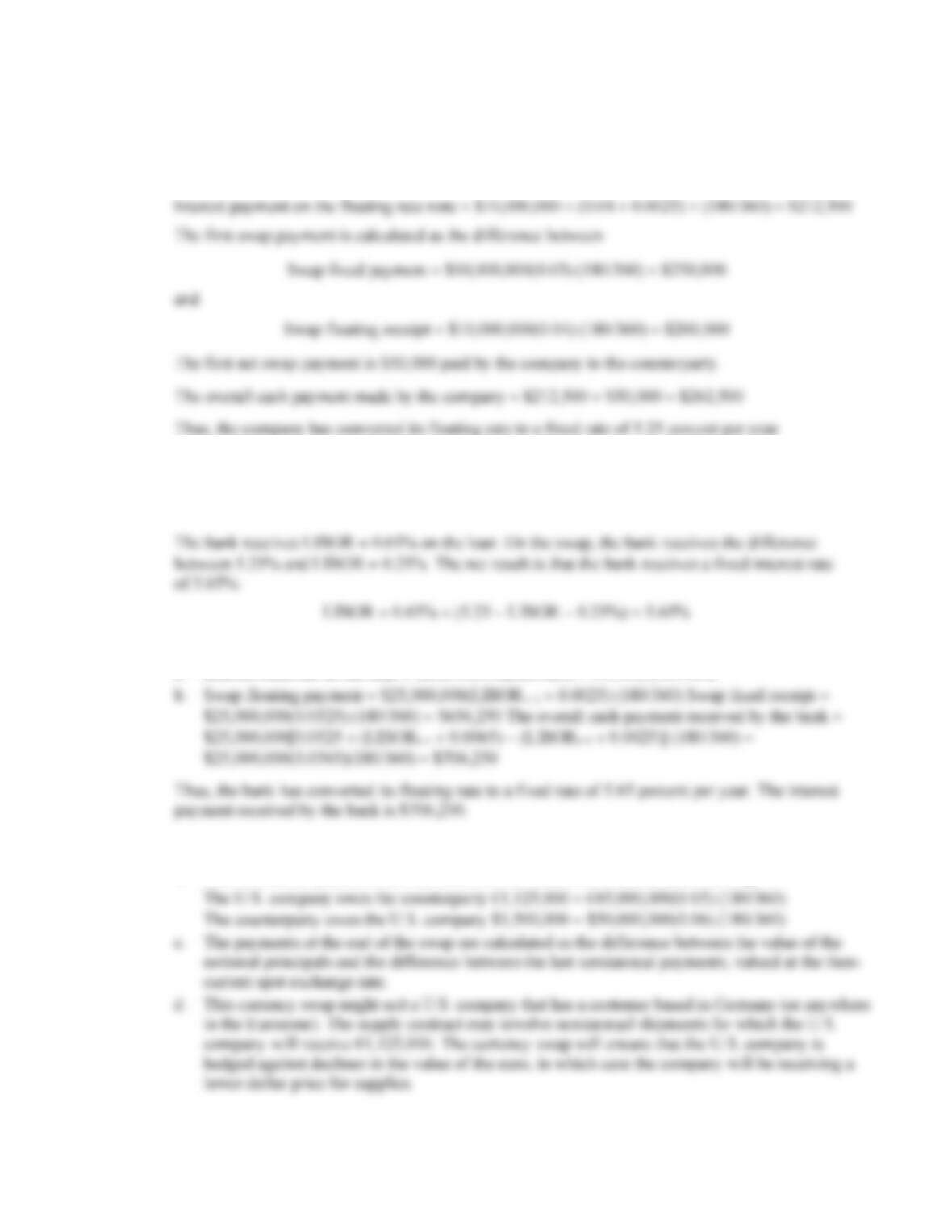
3. a. In order to prevent any arbitrage opportunities, the forward price F should be F = €1.1(1.08)/
(1.05) = €1.13143 per $.
b. If the trader invested €1 at the euro risk-free rate, he would have 1(1.08) = €1.08 at the end of one
year. Alternatively, he could convert €1 to U.S. dollars, invest at the U.S. risk-free rate, and use a
forward contract to lock in the rate at which U.S. dollars are converted back to euros. In this
b. If the trader invested $1 at the U.S. risk-free rate, at the end of one year he would have 1(1.07) =
$1.07. Alternatively, he could convert $1 to euros, invest at the euro risk-free rate, and use a
Because this option yields less than investing at the U.S. interest rate, there is an arbitrage
opportunity. To earn this arbitrage profit, you would borrow €1/0.9 = €1.1111 at an interest rate
of 5 percent. Convert to one U.S. dollar and invest at the U.S. risk-free rate and then use a
forward contract to convert a portion of the dollar proceeds to euros to repay the loan plus
interest.
• One dollar invested at the risk-free rate = 1 (1.07) = $1.07
5. a. A long hedge would be appropriate here. Because the objective is to lock in the price at which
the manager can purchase shares at a future date, buying a futures contract is the appropriate
6. a. A short hedge would be appropriate here. Because the objective is to lock in the price at which
the manager can effectively sell a portion of the portfolio, selling a futures contract is the
Chapter 10 Derivatives: Risk Management with Speculation, Hedging, and Risk Transfer 59
7. The company can enter into a swap to pay a fixed rate of 5 percent and receive a floating rate of
LIBOR. Remember that the floating payment is based on LIBOR in arrears and is therefore known
now. It will be reset after six months on the settlement date.
8. Because the risk exposure faced by the bank is a decline in interest rates, the bank should enter into
the swap to receive a fixed rate of 5.25% and pay a floating rate of LIBORt−1 + 0.0025. Clearly, the
bank should choose swap (b).
This can be confirmed by looking at the semiannual payments:
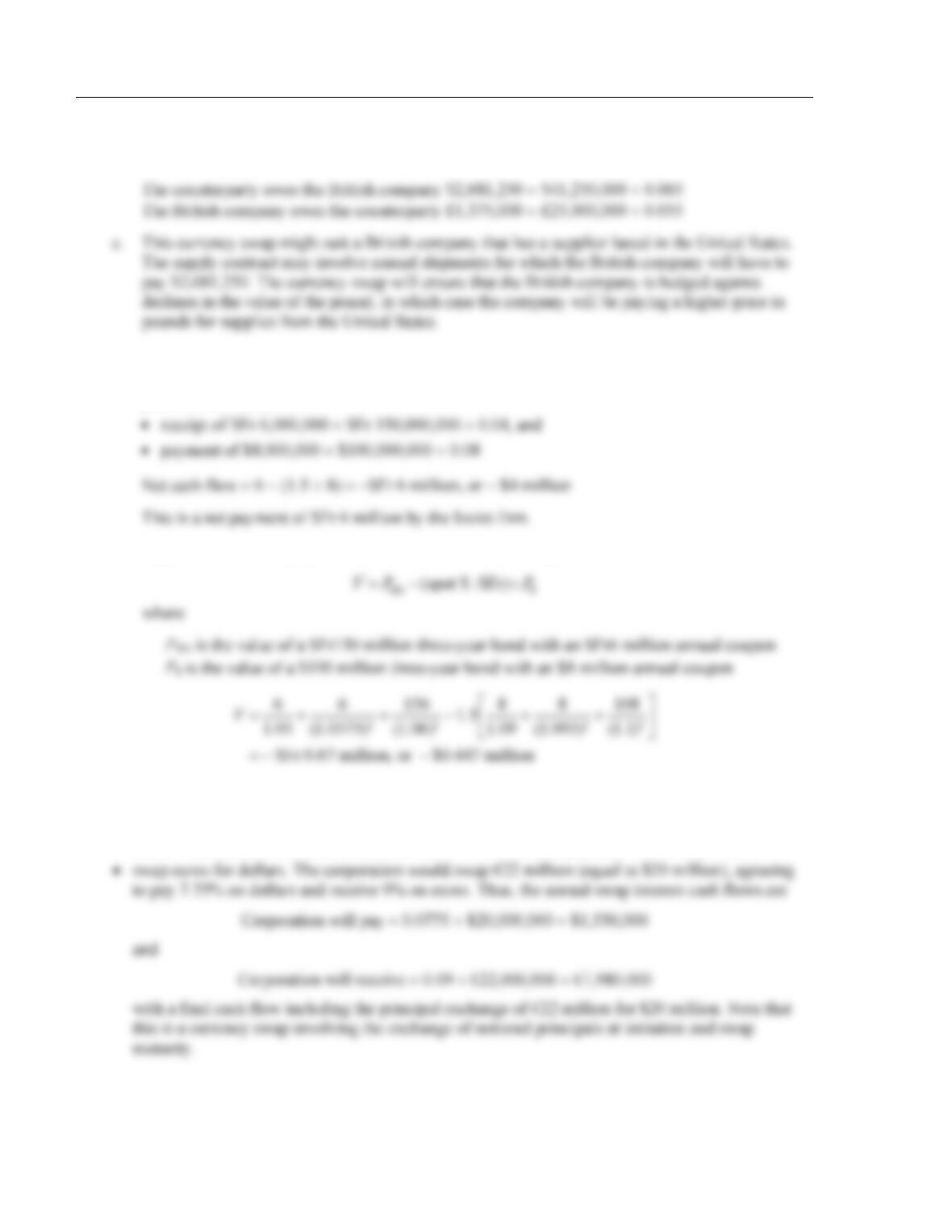
a. Interest received on the loan = $25,000,000(LIBORt−1 + 0.0065) (180/360)
9. a. There is no payment at the beginning of the swap; the notional principals are equal in value.
b. The semiannual payments are calculated as the difference between the following:
60 Solnik/McLeavey • Global Investments, Sixth Edition
10. a. There is no payment at the beginning of the swap; the notional principals are equal in value.
b. The annual payments are calculated as the difference between the following:
11. a. Each year, the Swiss firm receives Swiss francs and pays dollars. Given the interest rates as of
the inception of the swap contract (8% in dollars and 4% in Swiss francs), the net payment for
year 4 is the balance of
b. Right after the fourth payment, the market value of the swap, V, is
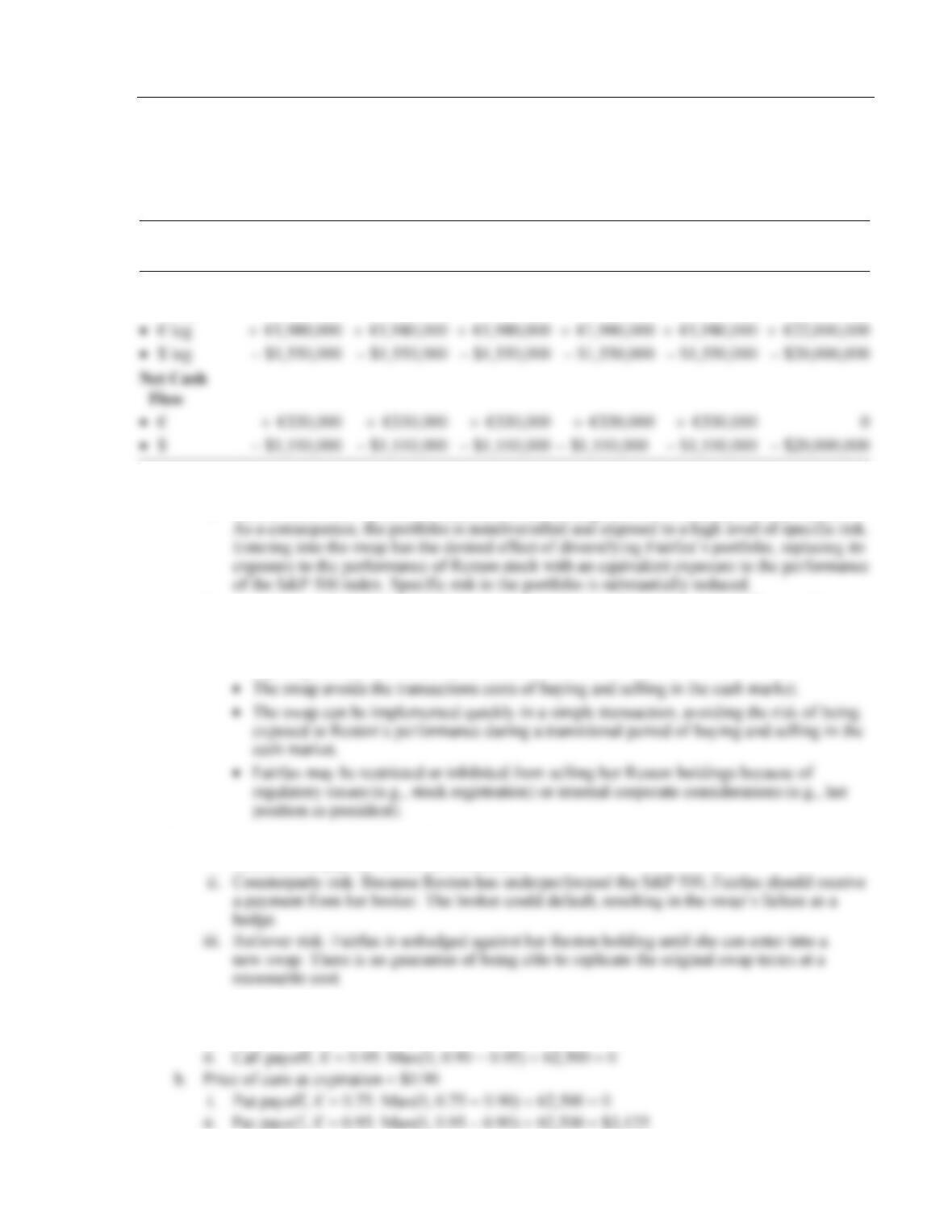
12. The French corporation could borrow directly 20 million dollars at 7.75 percent, with annual interest
rate payments of $1,550,000. Instead, the French corporation should:
• borrow €22 million at the subsidized rate of 7.5%. The interest payment will be €1,650,000.
Chapter 10 Derivatives: Risk Management with Speculation, Hedging, and Risk Transfer 61
Effectively, the corporation will end up borrowing 20 million in dollars at 7.75 percent (annual
interest of $1,550,000) and make an annual 1.5 percent cost saving in euros (annual cost saving of
€330,000). This is illustrated in the following table, which gives the payments (negative sign) and
receipts (positive sign) of the French corporation:
Year 1
Interest
Year 2
Interest
Year 3
Interest
Year 4
Interest
Year 5
Interest
Year 5
principal
Loan in
€ Swap
− €1,650,000
− €1,650,000
− €1,650,000
− €1,650,000
− €1,650,000
− €22,000,000
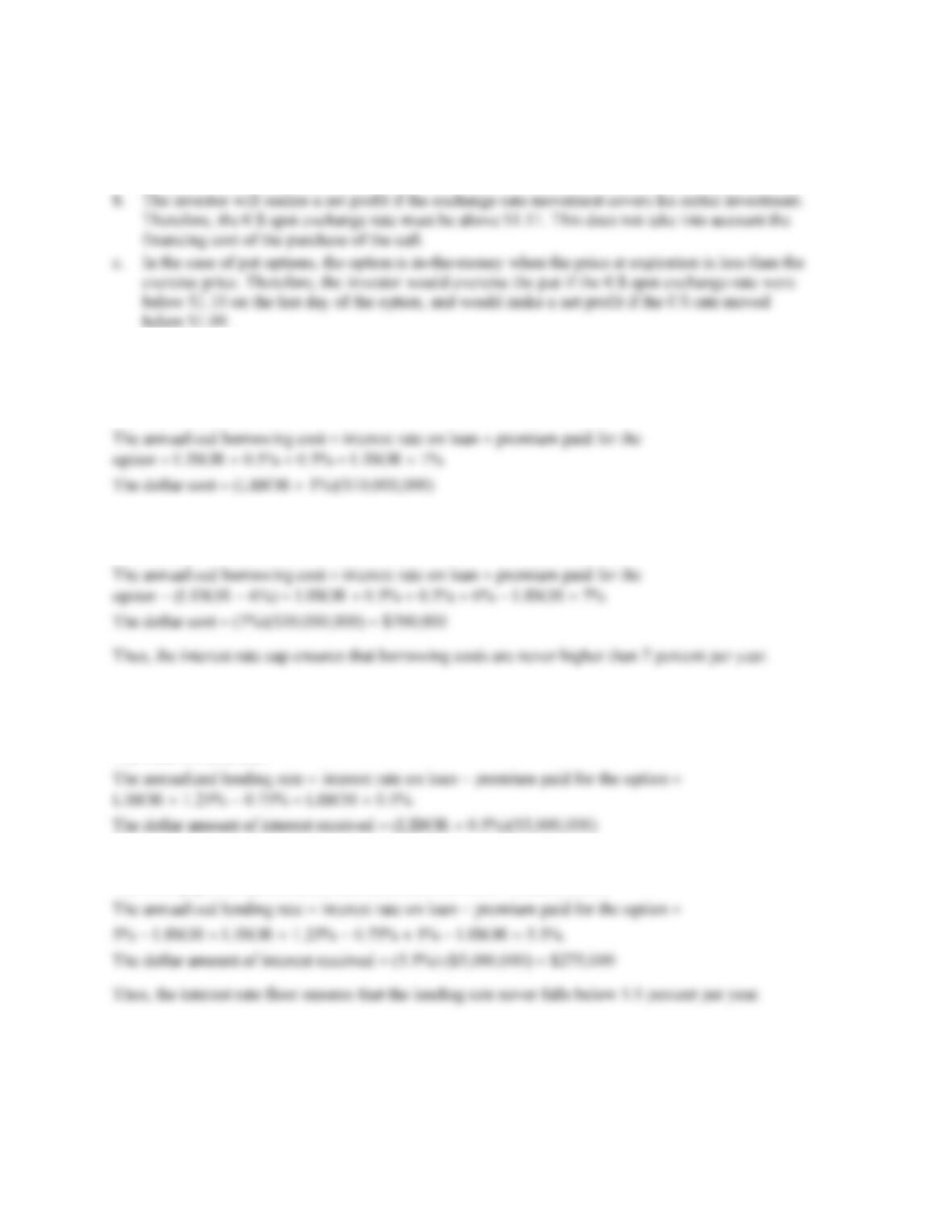
13. a. The swap is an appropriate and cost-effective tool for controlling risk in Fairfax’s portfolio.
i. Reston Industries represents a disproportionately large portion of Fairfax’s total portfolio.
ii. As a strategy for hedging Fairfax’s exposure to Reston, the swap is potentially superior to an
equivalent buy/sell strategy in the underlying securities:
• The swap allows Fairfax to reduce her exposure to Reston stock without being taxed on
capital gains on the sale of Reston stocks.
b. i. Personal liquidity and cash flow risk: Because Reston has outperformed the S&P 500 index,
Fairfax must pay her broker the difference.
14. a. Price of euro at expiration = $0.90
i. Call payoff, K = 0.75: Max(0, 0.90 − 0.75) 62,500 = $9,375
+ €1,980,000
+ €1,980,000
+ €22,000,000
62 Solnik/McLeavey • Global Investments, Sixth Edition
15. a. If the exchange rate at expiration is greater than the exercise price, the call option is in-the-money
and should be exercised. Therefore, an investor should exercise the call if the €:$ spot exchange
rate is above $1.10 at expiration.
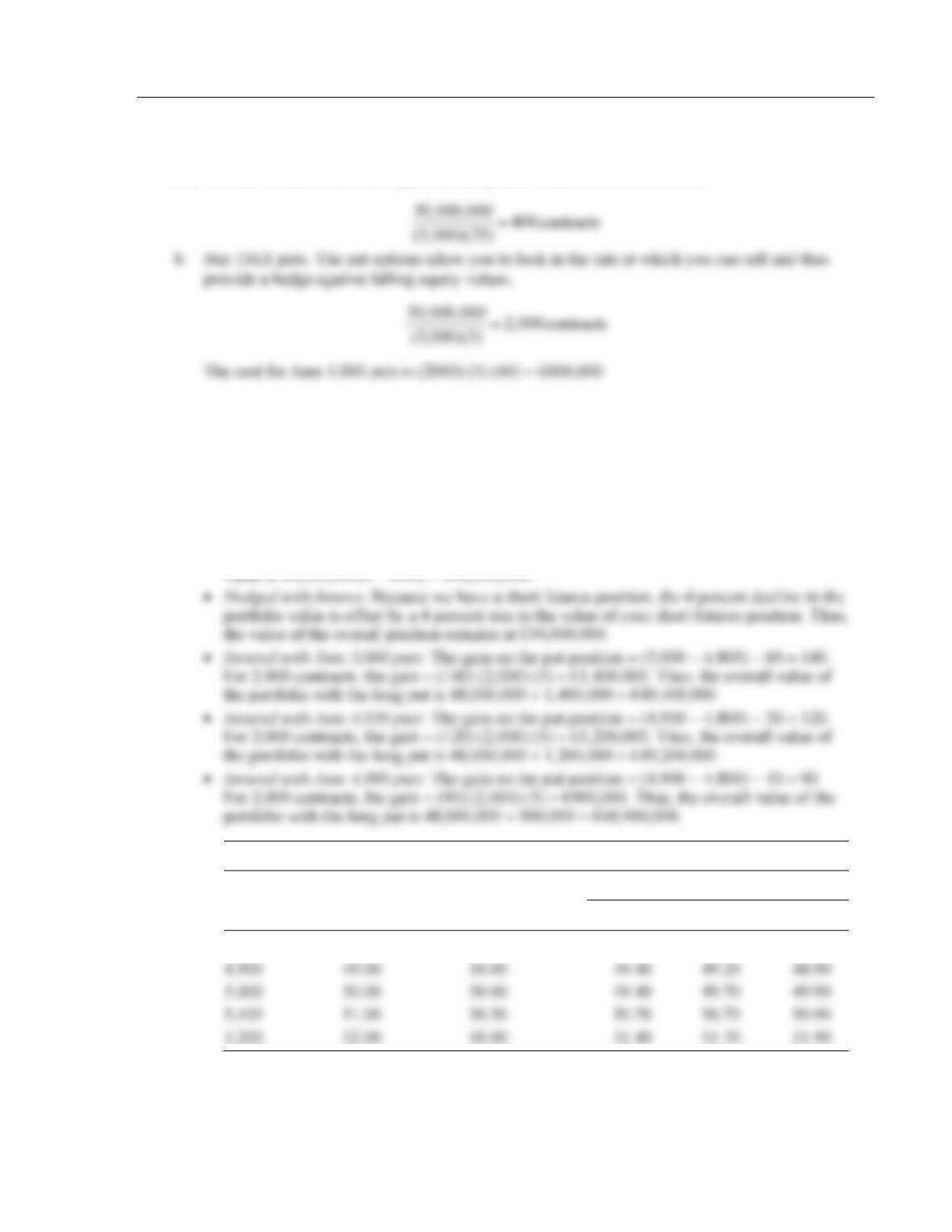
16. Let’s study the net cash flow on each semiannual payment date:
If LIBOR 6%
The cap is worthless.
If LIBOR > 6%
The cap pays the option holder the difference between LIBOR and 6 percent.
17. Let’s study the net cash flow on each semiannual payment date:
If LIBOR > 5%
The floor is worthless.
If LIBOR < 5%
The floor pays the option holder the difference between 5% and LIBOR.
Chapter 10 Derivatives: Risk Management with Speculation, Hedging, and Risk Transfer 63
18. a. Because you are long on the underlying (the German stock portfolio), a short futures position
would be an appropriate hedge. You should sell DAX futures. Assuming that the portfolio moves in
line with the stock index, the hedge ratio is equal to 1. Hence, you would sell:
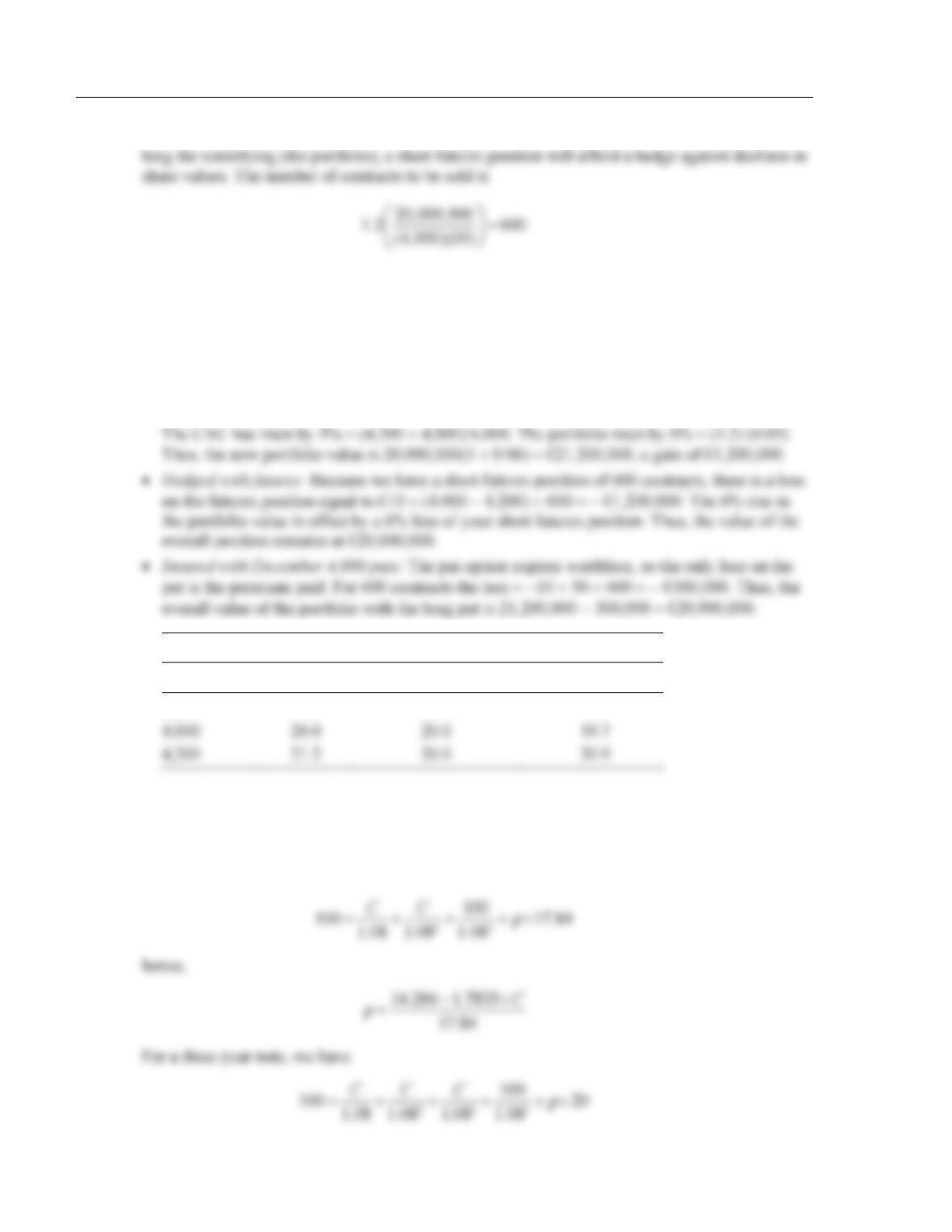
c. When we hedge with futures, we will be using 400 contracts; when we hedge with options, we
will be using 2,000 contracts, because the contracts’ sizes are different. The simulated results at
maturity are given in the following table. We basically assume that the portfolio is equal to
10,000 times the DAX index. We also assume a zero interest rate; otherwise, we would have to
reflect the fact that the payment of option premiums precedes the expiration date.
Sample calculations when DAX index is at 4,800:
• Unhedged position: We assume that the portfolio rises or falls by the same percentage as the
index. The DAX has declined by 4%: (4,800 − 5,000)/5,000 = − 4%. Thus, the new portfolio
Value of the Portfolio at Maturity (in € million)
Insured with Puts
DAX Index
Unhedged
Hedged with Futures
June 5,000
June 4,950
June 4,900
4,800
48.00
50.00
49.40
49.20
48.90
64 Solnik/McLeavey • Global Investments, Sixth Edition
19. a. Because the beta of the portfolio is 1.2, the hedge ratio should be equal to 1.2. Because you are
b. The manager should buy 600 put contracts. The cost is €10 50 600 = €300,000. If the CAC
index goes above 4,000 in December, the put option will expire worthless and the manager is out
the premium paid of €300,000. If the index falls below 4,000, the gain on the put position will
offset declines in portfolio value. Assuming that the portfolio exactly follows the CAC index
with a beta of 1.2, we can simulate the result of the strategies in December.
Sample calculations when CAC index is at 4,200 in December (5% rise in the index):
• Unhedged position: The portfolio rises or falls by (1.2) (the percentage change in the index).
Value of the Portfolio in December (in € million)
CAC Index
Unhedged
Hedged with Futures
Insured with Puts
3,800
18.8
20.0
19.7
c. No. CAC futures or options cannot protect against a depreciation of the euro. You would have to
use currency futures or option on the euro to hedge against a depreciation in the euro.
20. a. The guaranteed note can be decomposed as the sum of a straight bond with a coupon C plus p
times a call option on the index (p is the participation rate). For a two-year note, we have
Chapter 10 Derivatives: Risk Management with Speculation, Hedging, and Risk Transfer 65
hence,
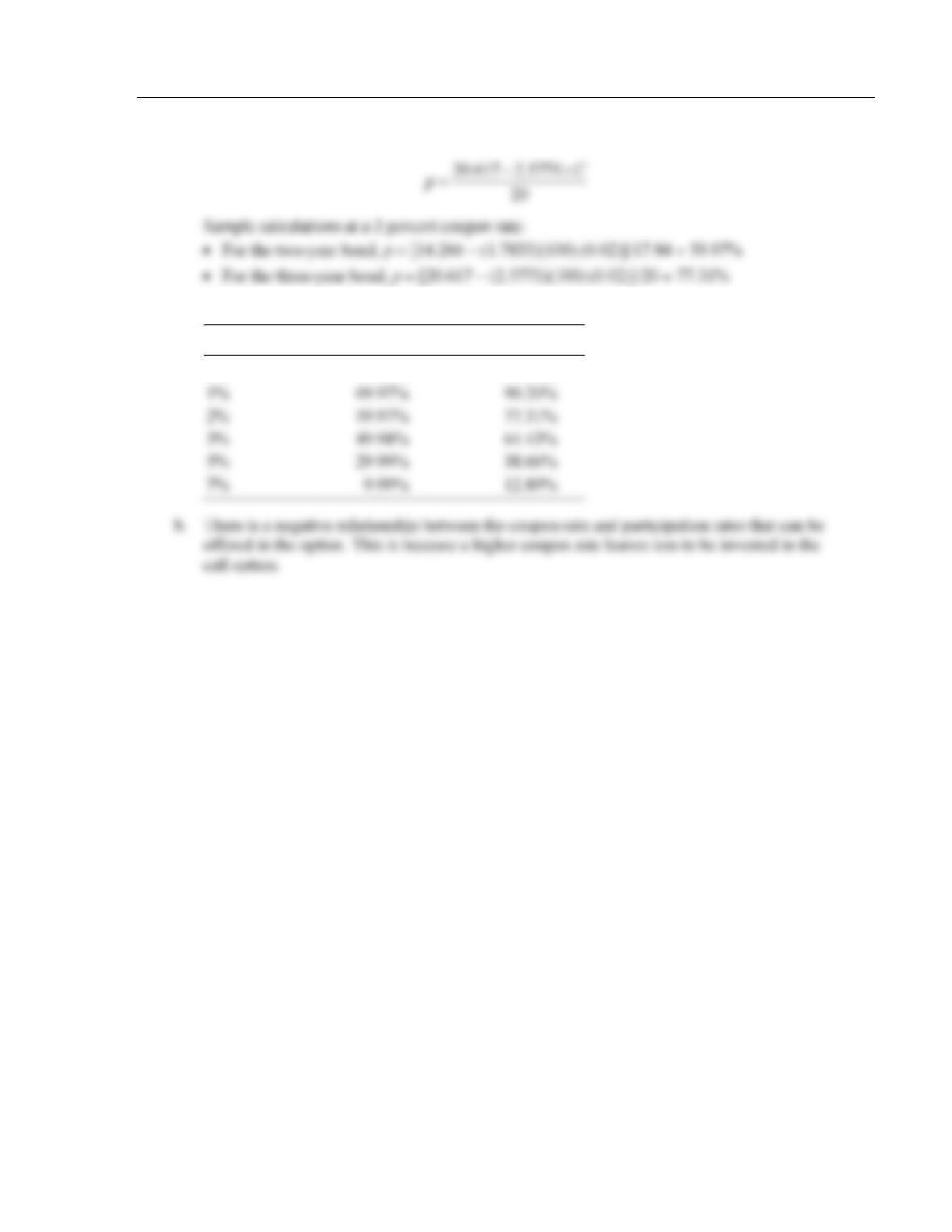
The following table gives the fair participation rates for various coupon rates:
Coupon Rate
p (2-Year Bond)
p (3-Year Bond)
0%
79.97%
103.08%
1%
69.97%
2%
59.97%
3%
49.98%
5%
29.99%