Chapter 10
Lesson 10-1 Utility Expenses
Check Your Understanding (Example 1)
Check Your Understanding (Example 2)
Check Your Understanding (Example 3)
hours, take the previous result and divide by 1,000.
Financial Algebra Solutions Manual Chapter 10 Page 141
© 2011 Cengage Learning. All Rights Reserved. May not be scanned, copied or duplicated, or posted to a publicly accessible website, in whole or in part.
Check Your Understanding (Example 4)
Because balanced billing is based on the previous
Check Your Understanding (Example 5)
Multiply the old dishwasher cost by the savings
()
100
⎢⎥
⎢⎥
⎣⎦
Applications
1. Edison was foreshadowing our current attempt
to switch to an energy policy based increasingly
on solar and even wind power, as opposed
to oil.
3c. dial 1: 8, dial 2: 4, dial 3: 4, dial 4: 3; 8,443
5. $3.91 × 1.09 ≈ $4.26
$4.26 × 370 = $1,576.20
6. Using the formula from Example 3, substitute
7c. $914.35 $584.41
$584.41
− = 0.564 ≈ 57% or more
225 for w, and d for c.
mm
÷÷
⎛⎞⎛
⎞
12. kWh: 52,344 – 50,361 = 1,983
Cost: 1,983 × $0.095 = $188.39
Delivery: 30 days @ $0.18 = $5.40
14. Let x represent the amount still owed at the end
of the year. Multiply the monthly amount paid by
12 and add the amount still owed.
x + 12($223) = x + $2,676
15. Since they used less than they were billed for,
16. Substitute 500 for w, 25 for m, and $0.125 for c.
25
500 60 ($0.125)
⎛⎞
⎜⎟
4,200(3)
$0.11 1,000
⎛
⎜
⎝⎠
⎞
⎟
= $1.386
Round to the nearest ten cents, $1.40.
17b. $1.40 × 365 = $511
understanding from Example 5, substitute
$1,100 for c, 36 for p, and $510 for r.
36 ($510)
100
⎡⎤
⎢⎥
⎢⎥
⎣⎦
18. $4.173 $1.192
$1.192
19a. 1 kilowatt-hour is the same as 1,000 watt-hours,
so if 3.413 BTU’s are equivalent to 1 watt-hour,
3.413 × 1,000 = 3,413 BTU’s are equivalent to
Lesson 10-2 Electronic Utilities
Check Your Understanding (Example 1)
The first 3 minutes are $0.35. Subtract to find the
The call went 1
94 minutes over the initial
Check Your Understanding (Example 2)
The first line of the piecewise function represents
the cost of a call that is 5 minutes or less, which is
65 cents. In the second line of the function, use
shown below.
0 65 when 3
0 65 0 22 3 when 3 and is an integer
m
cm m m m
≤
⎧
⎪
=+ − >
⎨
$.
( ) $. $. ( )
Check Your Understanding (Example 3)
Because the number of minutes used is an integer,
To find the number of 12-cent text messages in
$45, divide.
month for the three services.
$95(0.25) + $95 = $23.75 + $95 = $118.75
$134 – $118.75 = $15.25
Check Your Understanding (Example 6)
The cusp is the ordered pair on a graph where
Applications
1. While in the U.S. many middle- and upper-class
neighborhoods are obsessed with the
is $0.70.
3b. Since 14 is an integer, use line 2 of the
piecewise function.
$0.70 + $0.24([ 1
92 – 6] + 1) = $0.70 + $0.96
= $1.66
4. The first line of the piecewise function
represents the cost of a call that is 2 minutes or
piecewise functions looks like the one shown
below.
5b. $39.99 + $12.86 = $52.85
5c. 52 85 39 99
39 99
−$. $.
$. = 0.321
Round to the nearest percent, 32%.
5d. Divide the extra charges by the basic charges
and multiply by 100 to convert to a percent.
6. Multiply Vicki’s number of messages by the per-
text cost to find her per-text cost for the month.
Then subtract the unlimited texting cost.
142
(
$
)
Round to the nearest percent, 9%.
pic
++
⎝⎠
($ $ $ )
8a. $90 + $77 = $167
$167 × 12 = $2,004
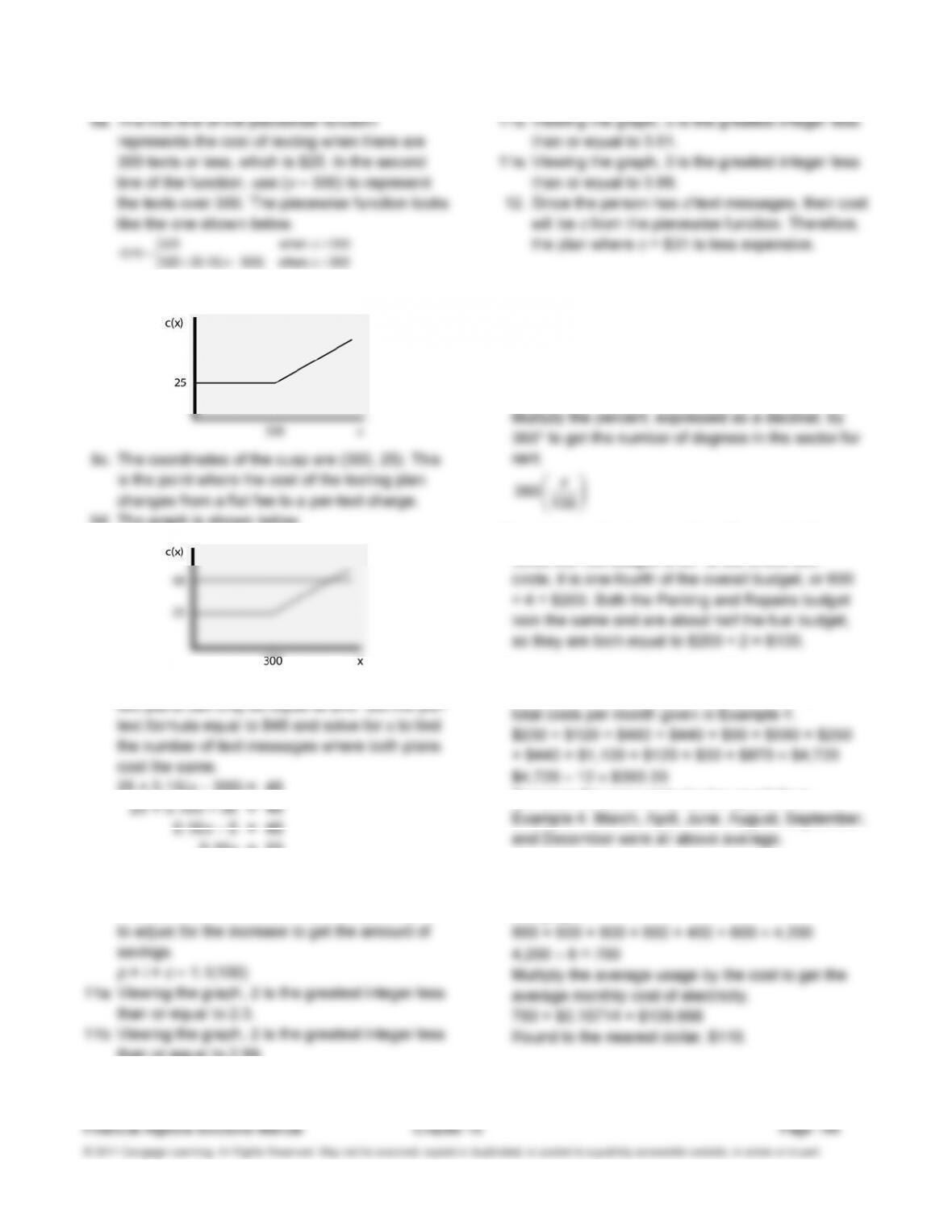
25 0 10 300 when 300
⎩
9b. The graph is shown below.
9d. The graph is shown below.
9e. Since the unlimited plan is $48, the cost of the
25 + 0.10(x – 300) = 48
0.10x = 53
x = 530
10. Add Tobi’s three current charges together then
subtract Fi-Zone’s current rate multiplied by 1.1
Lesson 10-3 Charting a Budget
Check Your Understanding (Example 1)
Semimonthly; bimonthly means every two months,
while semimonthly means twice per month.
Check Your Understanding (Example 2)
⎝⎠
Check Your Understanding (Example 3)
Since the fuel budget is 90° of the entire 360°
Check Your Understanding (Example 4)
Compute the average monthly budget using the
Compare this amount to the bar graph from
Check Your Understanding (Example 5)
First compute the average monthly usage using the
line graph.
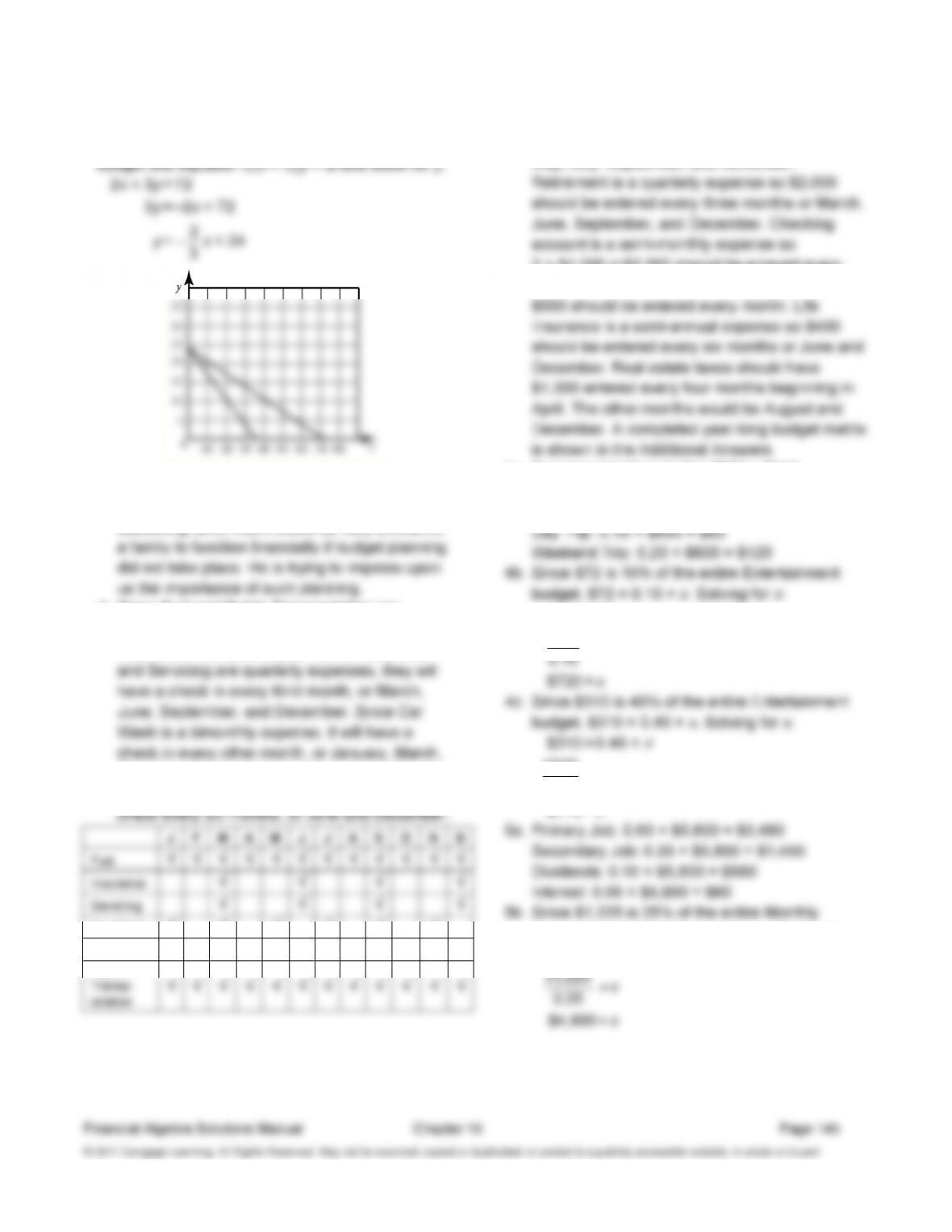
Check Your Understanding (Example 6)
Substitute Cx = 2 and Cy = 3 and B = 72 in the
Financial Algebra Solutions Manual Chapter 10 Page 145
© 2011 Cengage Learning. All Rights Reserved. May not be scanned, copied or duplicated, or posted to a publicly accessible website, in whole or in part.
Applications
1. It appears that the author of the quote is
cautioning us all that it would be very difficult for
2. Since Fuel and Public Transportation are
monthly expenses, they will have a check in
each month across the year. Since Insurance
May, July, September, and November. Since
Parking is a semiannual expense, it will have a
√
Car Wash √ √ √ √ √
√
Parking
√
√
Public
3. Savings is bimonthly, so $600 should be placed
in savings every other month or January, March,
4a. Summer Vacation: 0.40 × $600 = $240
Concerts: 0.20 × $600 = $120
Movies: 0.10 × $600 = $60
$72 = 0.10 ×
x
$
72
$
.
310
040 = x
$775 = x
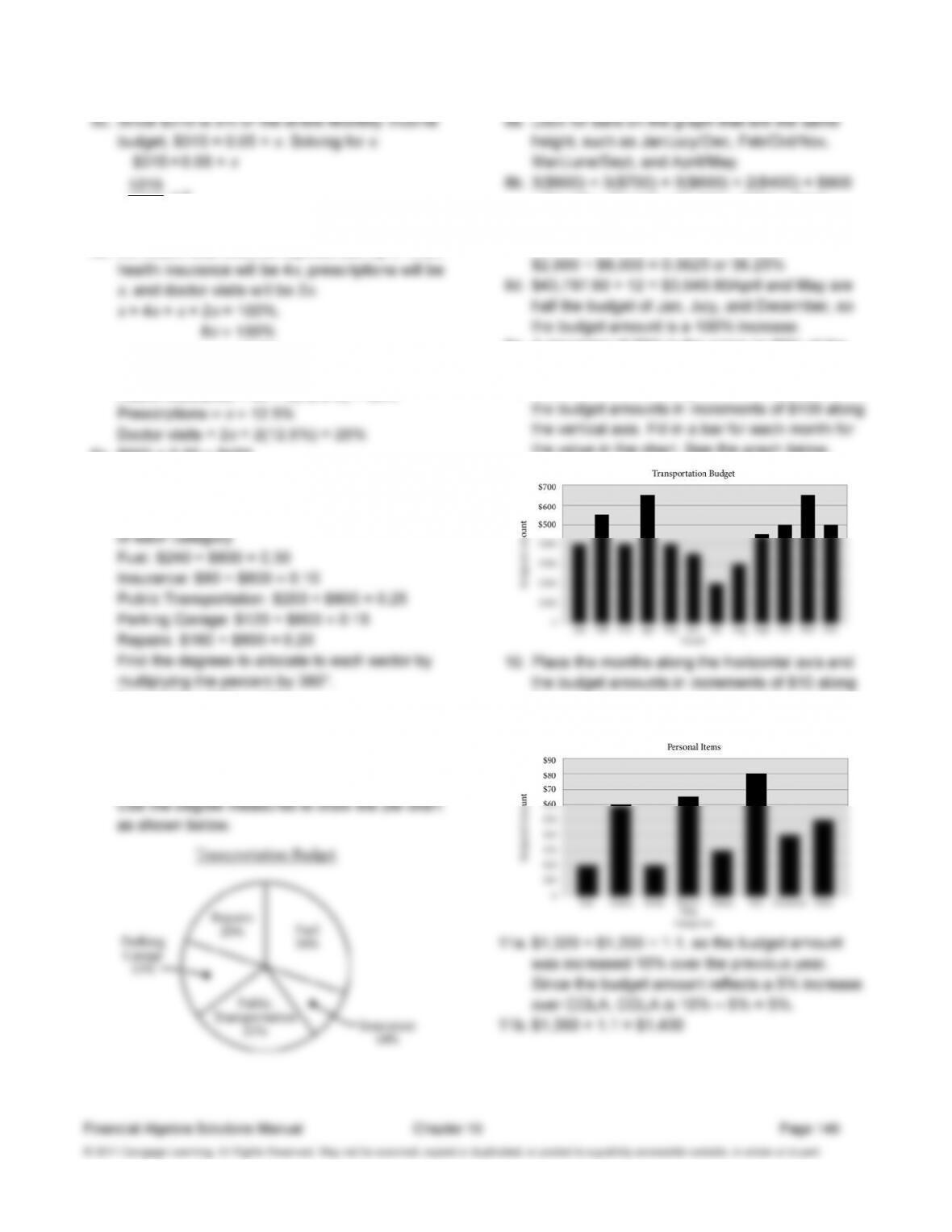
Income budget, $1,225 = 0.25 × x. Solving for x:
$1,225 = 0.25 ×
x
$,
1 225
.
005 = x
$6,300 = x
6a. Let health club dues be represented by x. Then
x = 12.5%
6b. Heath club dues = x = 12.5%
Health insurance = 4x = 4(12.5%) = 50%
6c. $900 × 0.50 = $450
7. Add to find the total transportation budget.
$240 + $80 + $200 + $120 + $160 = $800
Find the percent (expressed as a decimal) value
Fuel: 0.30 × 360° = 108°
Insurance: 0.10 × 360° = 36°
Public Transportation: 0.25 × 360° = 90°
Parking Garage: 0.15 × 360° = 54°
Repairs: 0.20 × 360° = 72°
Use the degree measures to draw the pie chart
as shown below.
= $2,400 + $2,100 + $1,800 + $800 + $900
= $8,000
8c. $600 + $800 + $900 + $600 = $2,900
8e. A decrease of 20% is the same as 80% of the
original value, or 0.80 × $800 = $640.
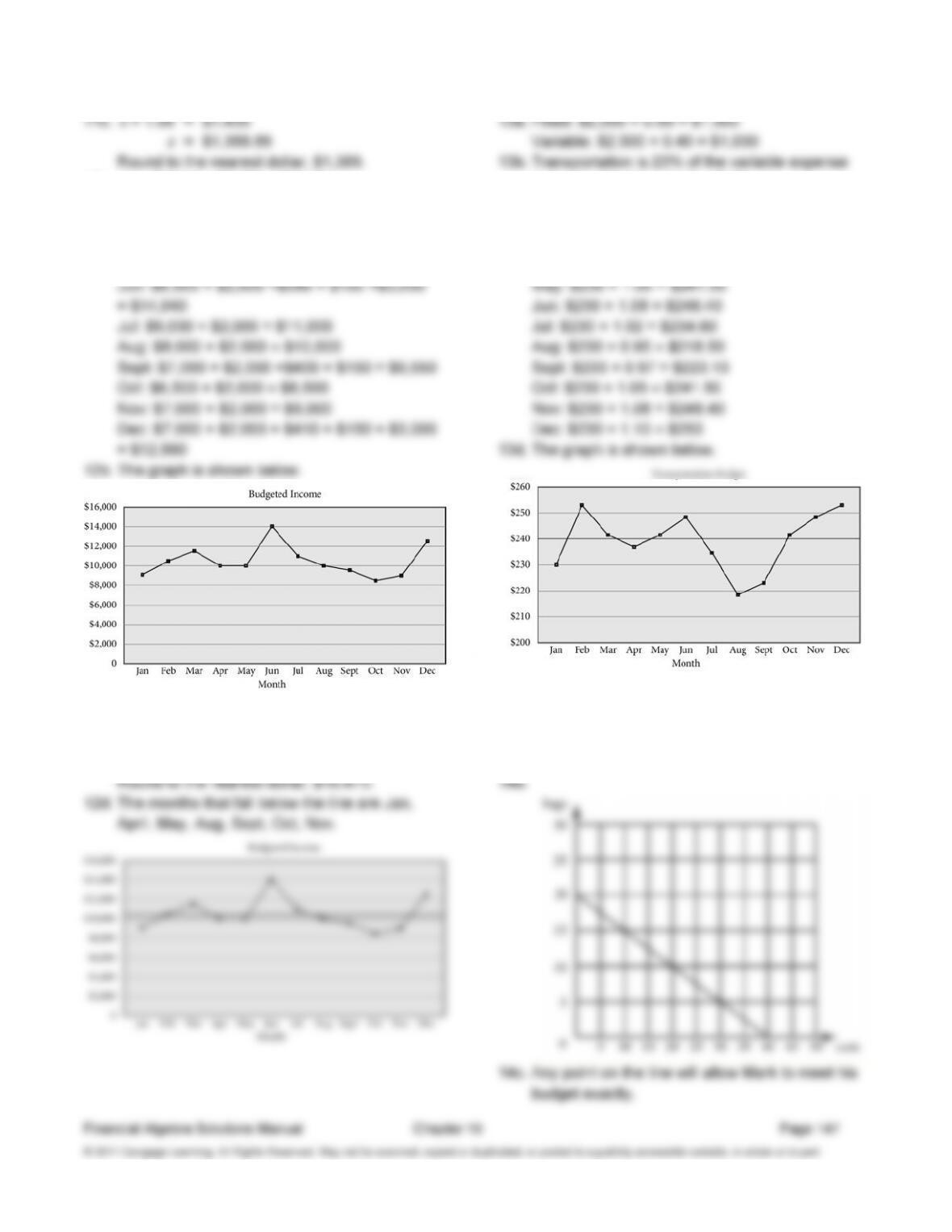
9. Place the months along the horizontal axis and
the value in the chart. See the graph below.
the vertical axis. Fill in a bar for each month for
the value in the chart. See the graph below.
12a. Jan: $7,000 + $2,000 = $9,000
Feb: $8,500 + $2,000 = $10,500
Mar: $9,000 + $2,000 + $380 + $150 = $11,530
Apr: $8,000 + $2,000 = $10,000
May: $8,000 + $2,000 = $10,000
12c. $9,000 + $10,500 + $11,530 + $10,000 +
$10,000 + $14,040 + $11,000 + $10,000 +
$9,550 + $8,500 + $9,000 + $12,560 = $125,680
$125,680 ÷ 12 = $10,473.33
budget or $1,000 × 0.23 = $230.
13c. Jan: $230
Feb: $230 × 1.10 = $253
Mar: $230 × 1.05 = $241.50
Apr: $230 × 1.03 = $236.90
14a. Substitute Cx = 1.50 and Cy = 3 and B = 60 in
the budget line equation Cxx + Cyy = B to get
1.50x + 3y = 60. The cost could have also been
substituted in reverse order to get 3x + 1.50y
= 60.
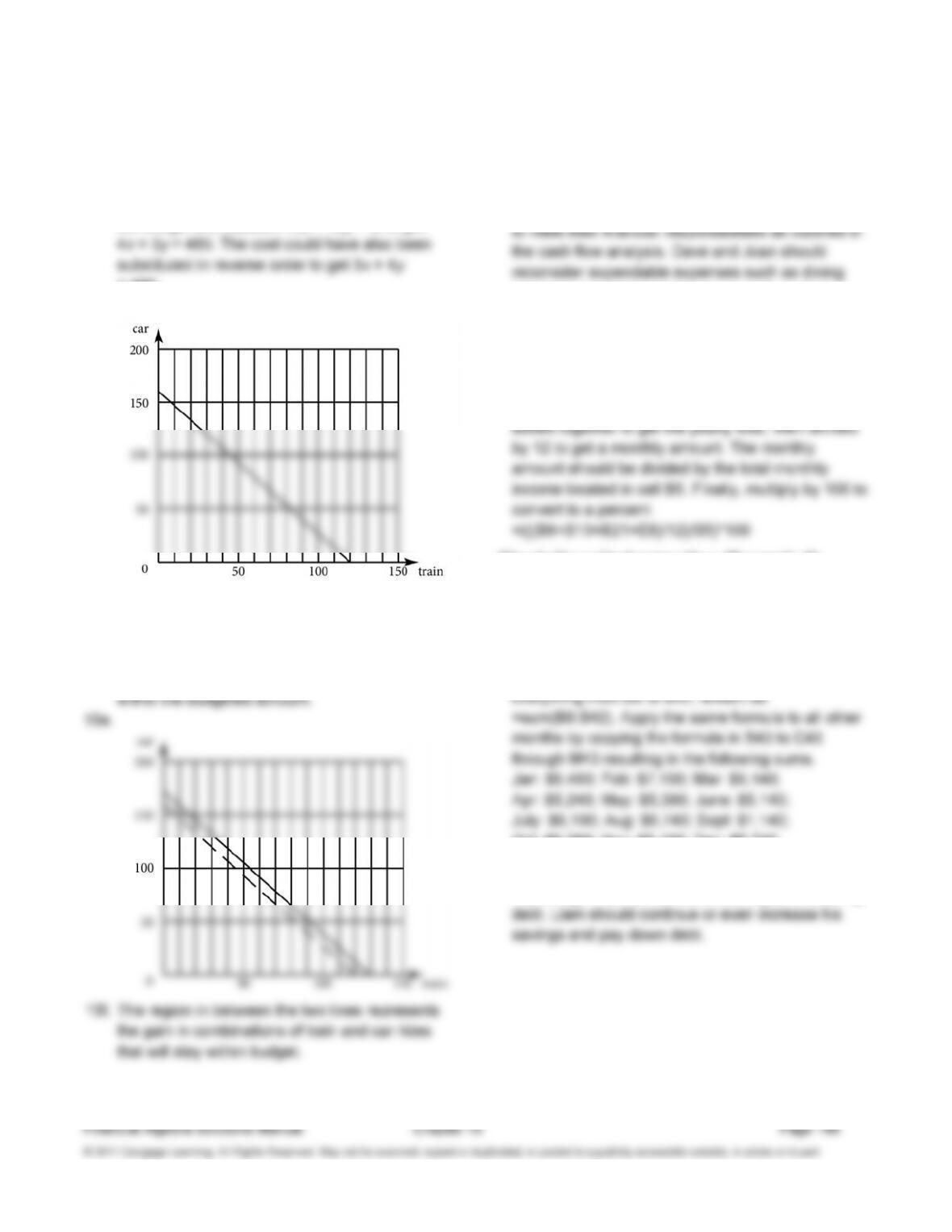
14d. Any point below the line will allow Mark to be
under his budget.
14e. Any point above the line will be above Marks
budget.
15a. Substitute Cx = 4 and Cy = 3 and B = 480 in
the budget line equation Cx
x + Cyy = B to get
= 480.
15b.
15c. Points on the budget line represent
combinations of car and train rides that stay
exactly at the budgeted amount.
15d. Points below the budget line represent
combinations of car and train rides that stay
Lesson 10-4 Cash Flow and
Budgeting
Check Your Understanding (Example 1)
Unless they borrow the $160, they will not be able
out and entertainment. If they can reduce that
amount by $160, the money coming in and the
money going out will break even.
Check Your Understanding (Example 2)
The transportation related expenses are located in
cells B8, B13, B21, and E8. These should be
Check Your Understanding (Example 3)
Multiplying the monthly positive cash flow by 12,
gives $1,320 which is approximately equal to the
annual surplus of $1,284.
Check Your Understanding (Example 4)
The January total for expenses is the sum of
3c. Electricity is row 7. Since columns will be
skipped, the sum formula cannot be used.
Check Your Understanding (Example 6)
Tome’s debt without his car or student loans is
approximately 27.5%.
averages.
4a. Assets: $422,000 + $22,000 + $2,380
+ $140,500 + $250,000 + $1,800 + $67,000
= $905,680
Applications
1. Many people avoid making a budget. They think
that they know where their money is going but
for a variety of reasons, never confront the
Liabilities: $120,000 + $21,000 + $940
2a. $740 $800 $650 $820 $820 $880
6
= $785
4d. Bob’s net worth has shown an increase over this
period of time. These numbers imply that he is
6
= $260
5c. She falls just below the 15–30% interval.
6a. The weekly contribution of $10 was not included
over the year and therefore would not impact the
+++++
= $83
Mar: $250
Apr: $250 + $110 = $360
2f. $140 $160 $120 $90 $140 $160
6
+++++
May: $2,000
3a. September would be column D and December
would be column G. Food is row 2. Since
columns will be skipped, the sum formula cannot
Nov: $250
Dec: $110 + $250 = $360
to when they are due.
3b. $740 $800 $820 $820
6
7. Use the template from page 510 and fill in the amounts given on Laura’s Financial Report.
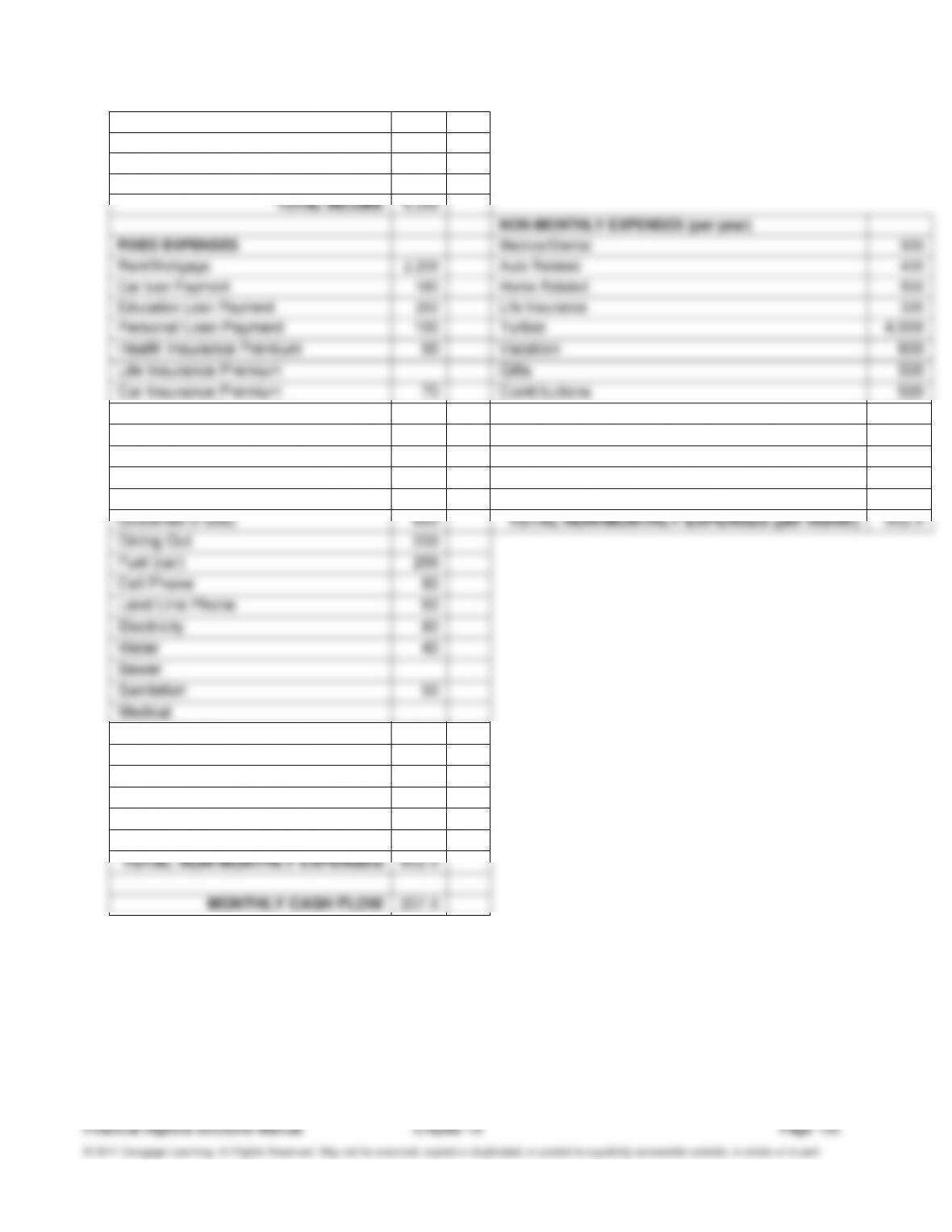
INCOME
Primary Employment 5,000
Secondary Employment ,200 1
Other Income
Homeowner’s/Renter’s Insurance 30 Repairs 280
Cable TV 40 Taxes 3,000
TOTAL FIXED EXPENSES 930 Oth2, er
TOTAL NON-MONTHLY EXPENSES (per year) ,83010
VARIABLE EXPENSES
Entertainment 250
Savings 400
Debt Reduction 200
Other
TOTAL VARIABLE EXPENSES 1602,
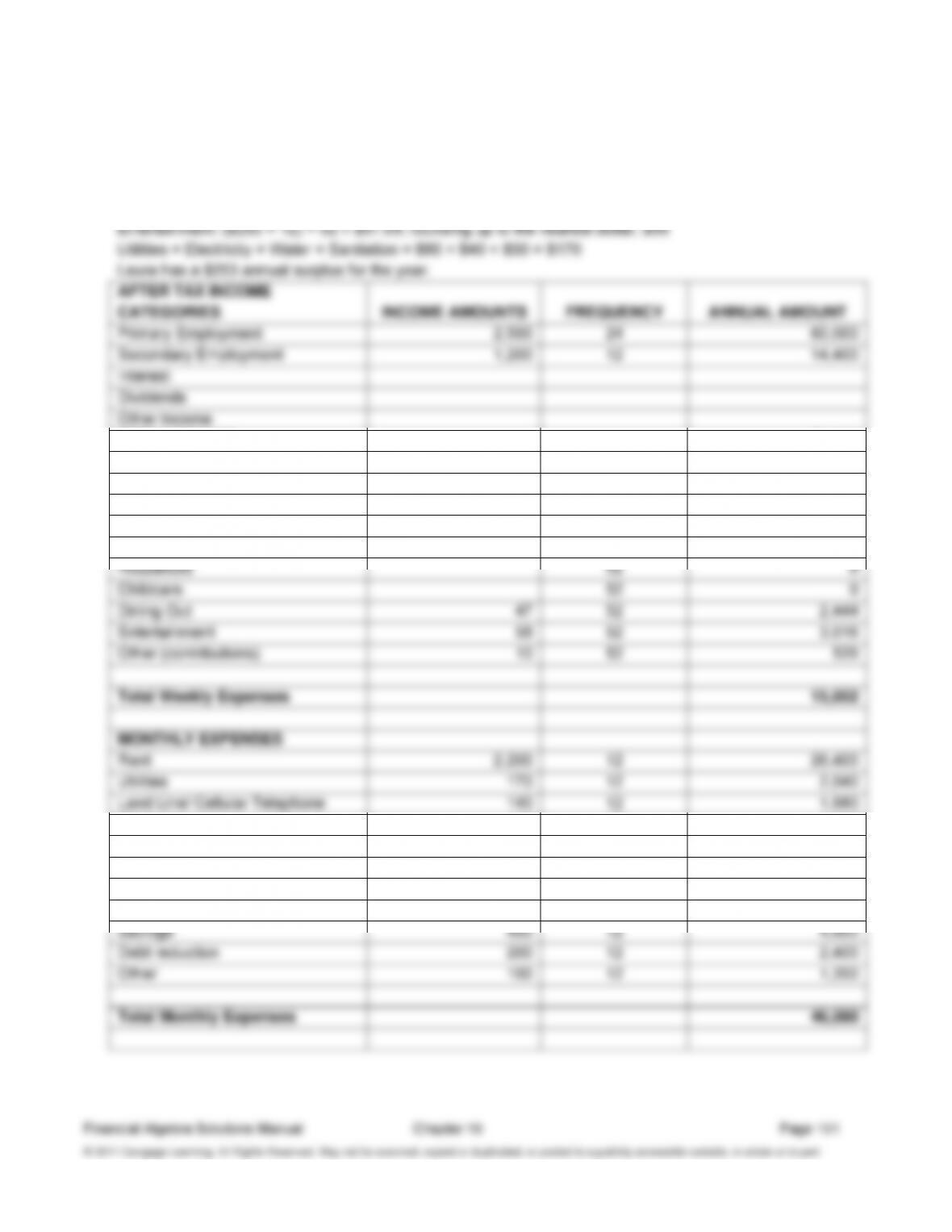
8. Use the template from page 513 and fill in the amounts given on Laura’s Financial Report with the following
changes.
Food: ($600 × 12) ÷ 52 ≈ $138.46; rounding up to the nearest dollar, $139
Fuel: ($200 × 12) ÷ 52 ≈ $46.15; rounding up to the nearest dollar, $47
Dining Out: ($200 × 12) ÷ 52 ≈ $46.15; rounding up to the nearest dollar, $47
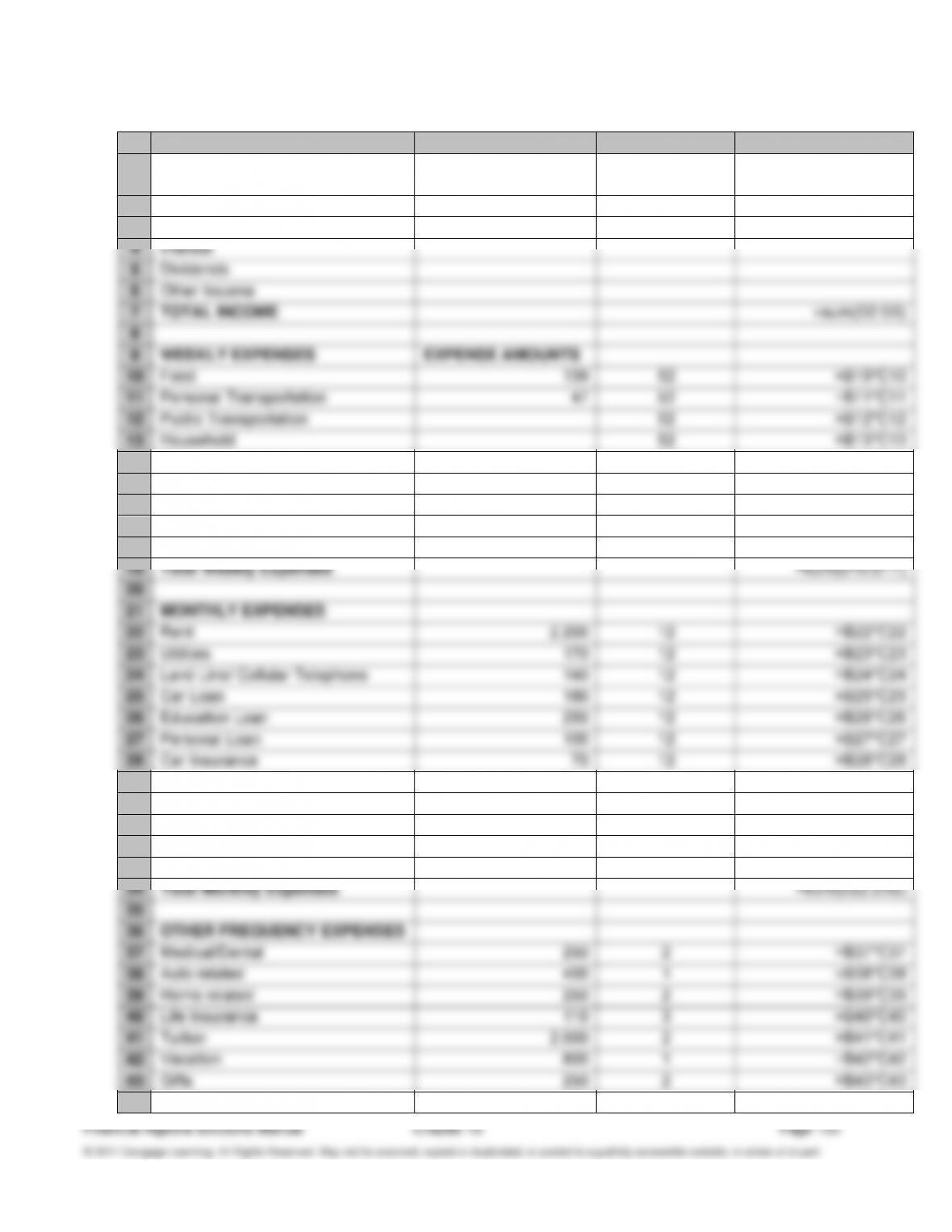
TOTAL INCOME 74,400
WEEKLY EXPENSES EXPENSE AMOUNTS
Food 139 52 7,228
Personal Transportation 47 52 2,444
Public Transportation 52 0
Car Loan 180 12 2,160
Education Loan 250 12 3,000
Personal Loan 100 12 1,200
Car Insurance 70 12 840
Renter’s Insurance 30 12 360
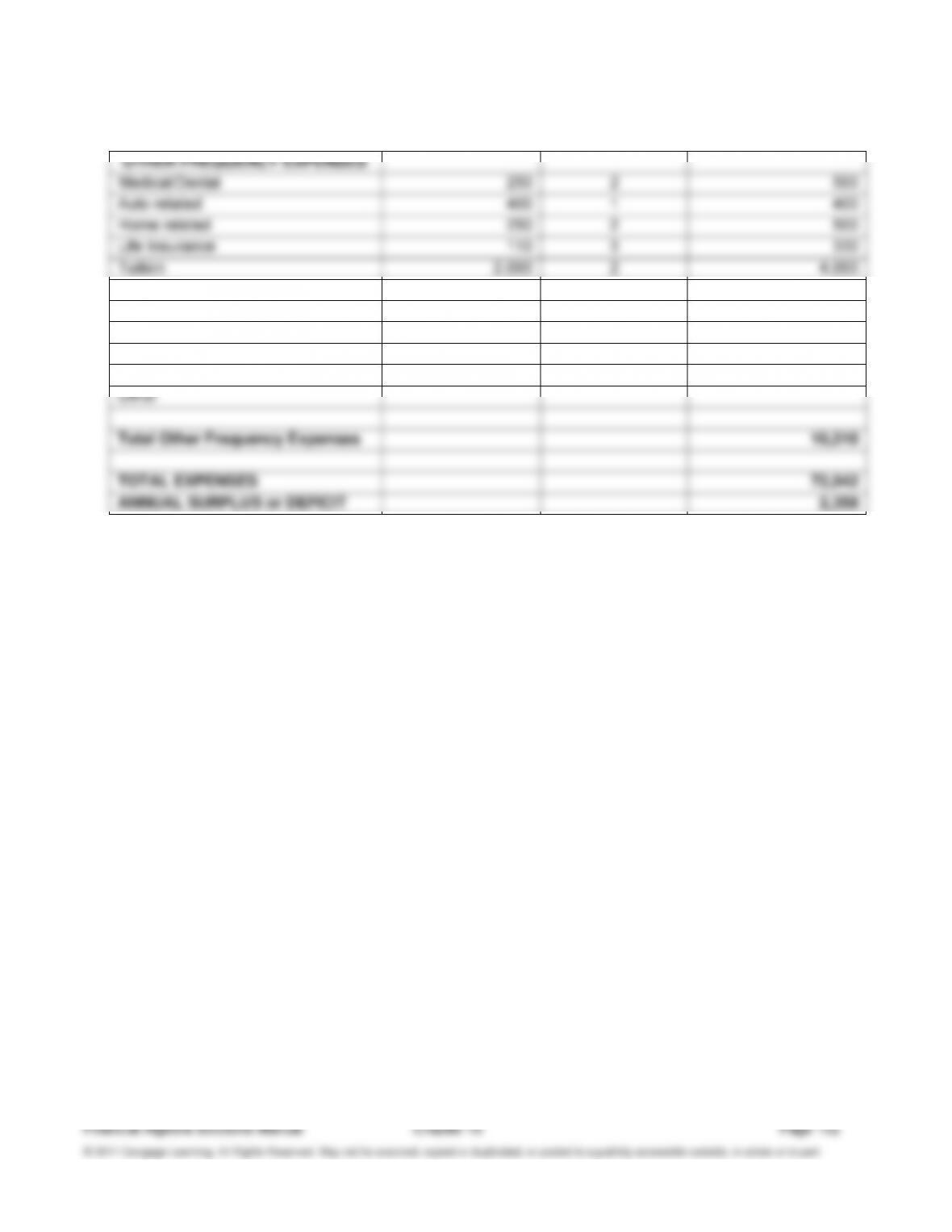
Vacation 800 1 800
Gifts 250 2 500
Contributions 1 0
Repairs 280 1 280
Taxes 1,500 2 3,000
9. See the spreadsheet below for the formulas in the spreadsheet.
A B C D
1 AFTER TAX INCOME
CATEGORIES INCOME AMOUNTS FREQUENCY ANNUAL AMOUNT
2 Primary Employment 2500 24 =B2*C2
3 Secondary Employment 1200 12 =B3*C3
14 Childcare 52 =B14*C14
15 Dining Out 47 52 =B15*C15
16 Entertainment 58 52 =B16*C16
17 Other (contributions) 10 52 =B17*C17
18
29 Renter’s Insurance 30 12 =B29*C29
30 Savings 400 12 =B30*C30
31 Debt reduction 200 12 =B31*C31
32 Other 100 12 =B32*C32
33
44 Repairs 280 1 =B44*C44
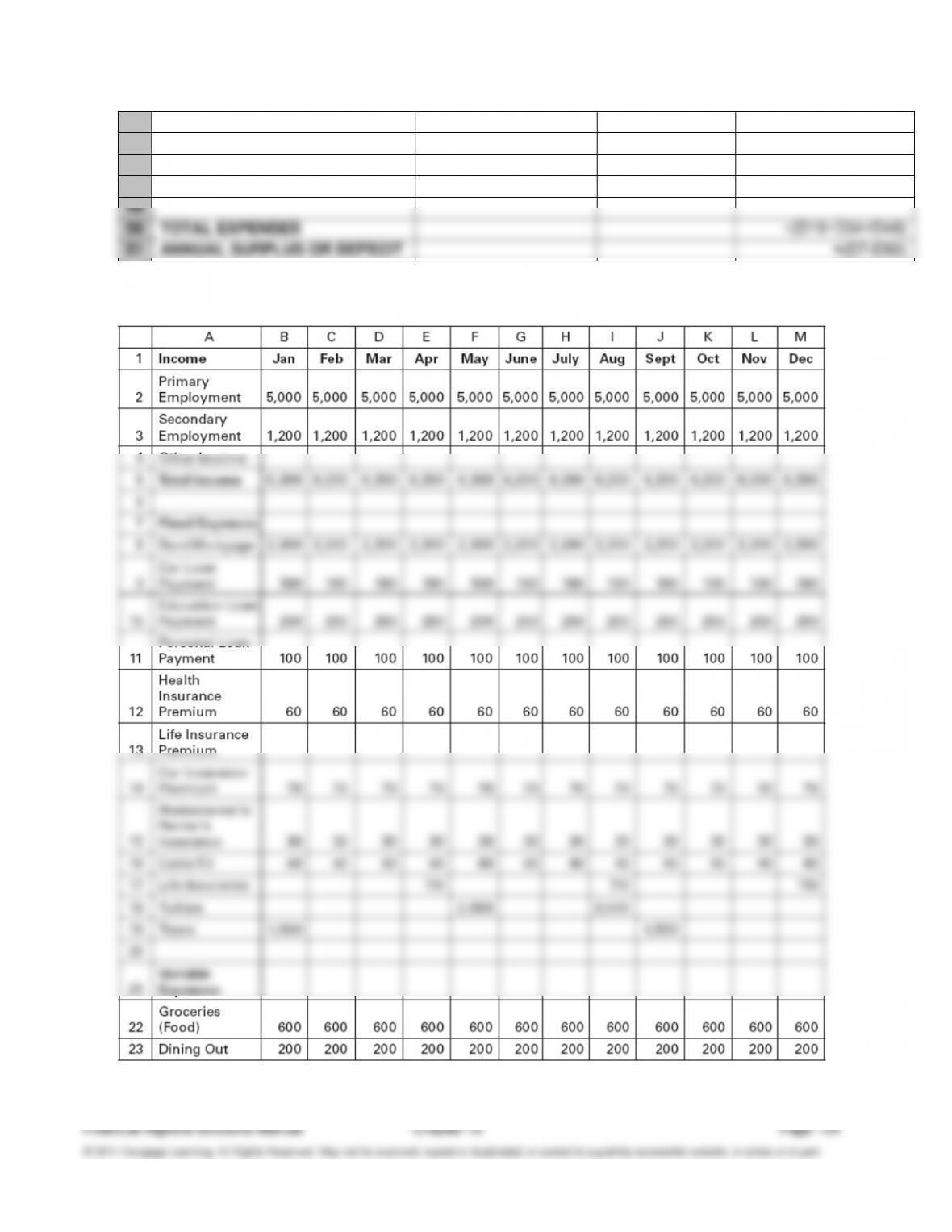
45 Taxes 1,500 2 =B45*C45
46 Other =B46*C46
47
48 Total Other Frequency Expenses =sum(D37:D46)
10. Use the template from page 513 and fill in the amounts given on Laura’s Financial Report being careful to
place the amounts in the correct months.
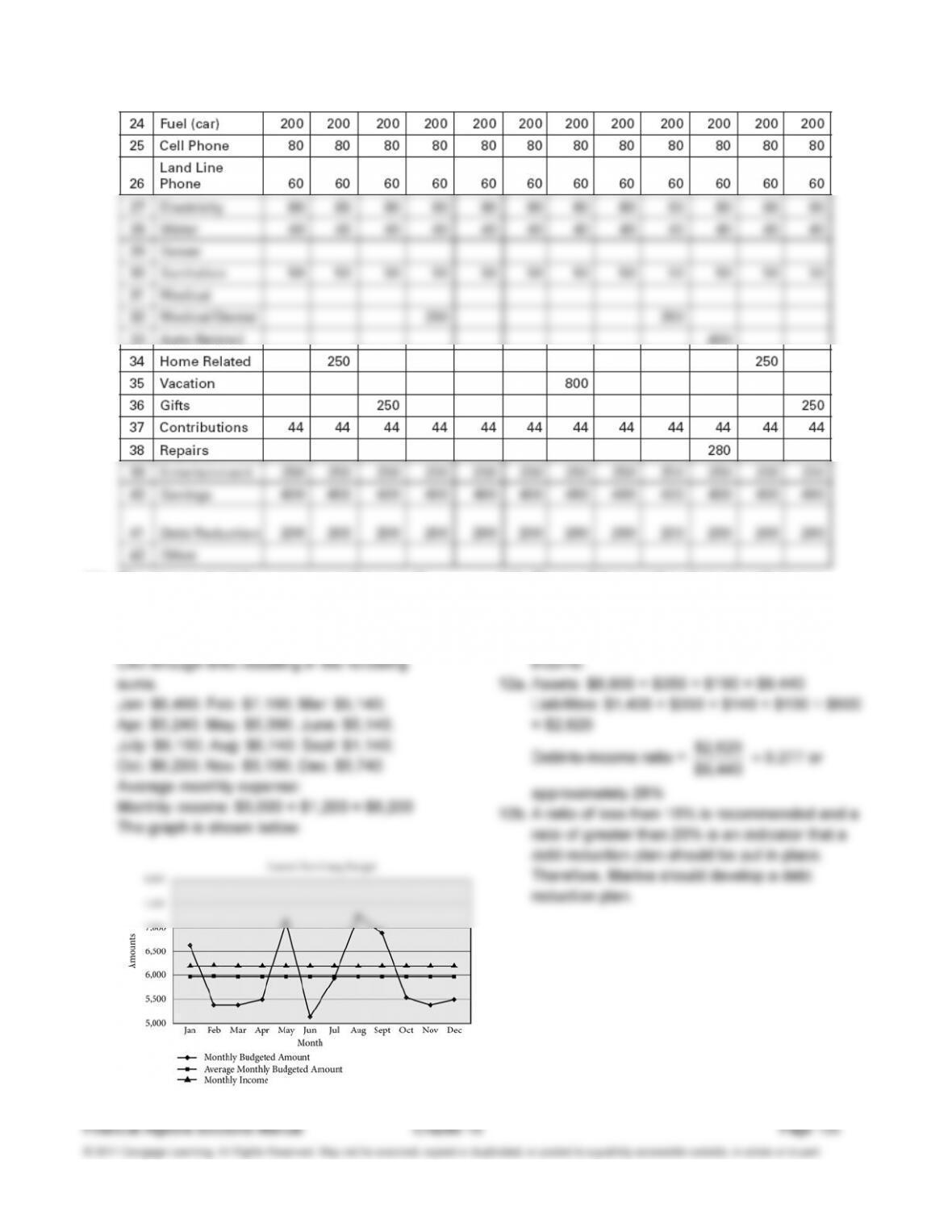
11a. The January total for expenses is the sum of
everything from B8 to B42, written as
=sum(B8:B42). Apply the same formula to all
other months by copying the formula in B43 to
11b. There will be months when she will have a
surplus. She must save that money in order to
pay the expenses during the months where
those expenses are more than her monthly
Assessment
Really? Really! Revisited
2. 0.0043 × 2 = 0.0086
4. 0.0172 × 2 = 0.0344
5. between 50 and 51
Applications
1. Place the months along the horizontal axis and
2,135 × 0.18 = $384.30
3. 6 × 7 × 500 = 21,000 watts
21,000 ÷ 1,000 = 21 kWh
21 × $0.15 = $3.15
4a.
Income 7,000 6,000 5,710 4,500 5,000 6,240
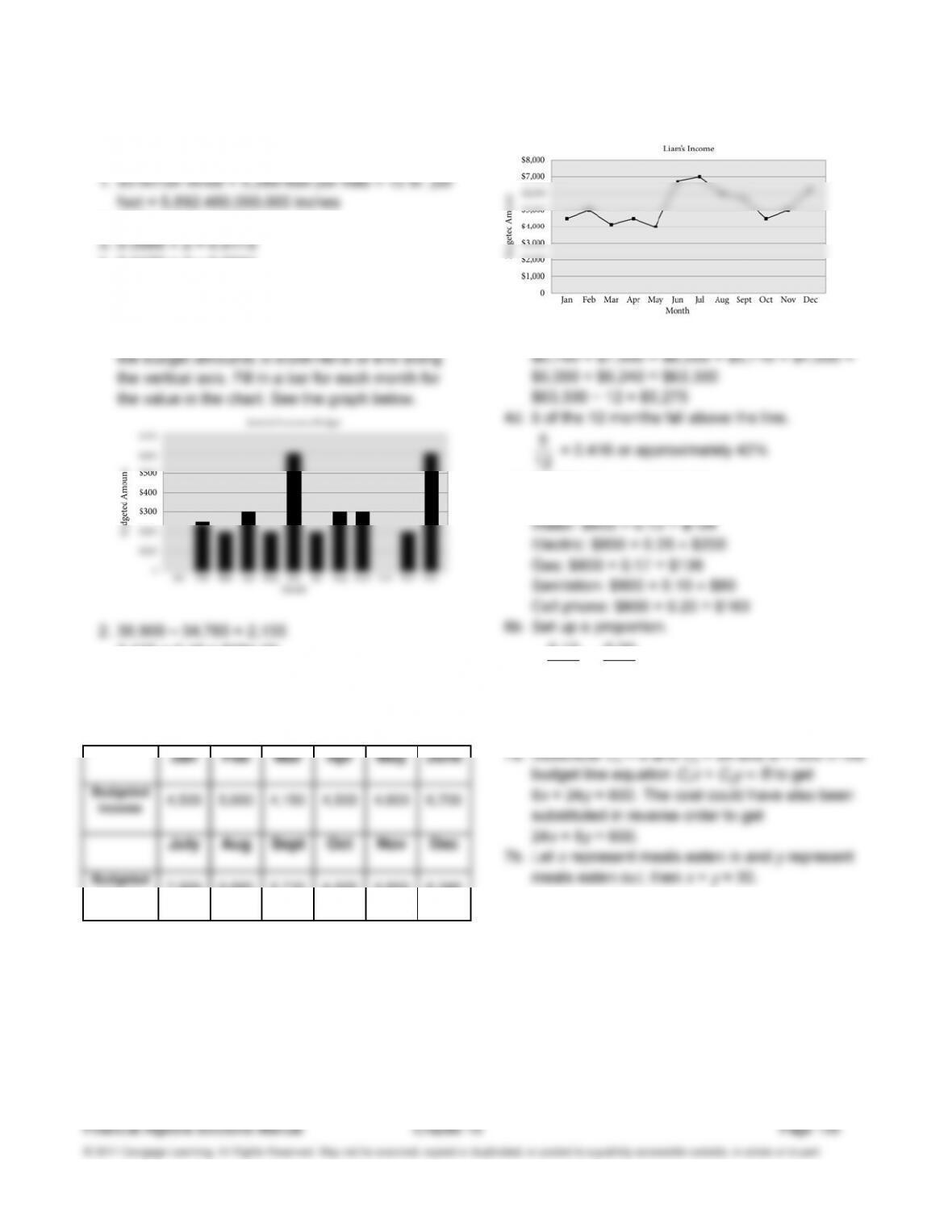
4b. The graph is shown below.
4c. $4,500 + $5,000 + $4,150 + $4,500 + $4,000 +
0.13
117 = 0.20
x
0.13x = 23.4
x = $180
6c. $204 ÷ 0.17 = $1,200
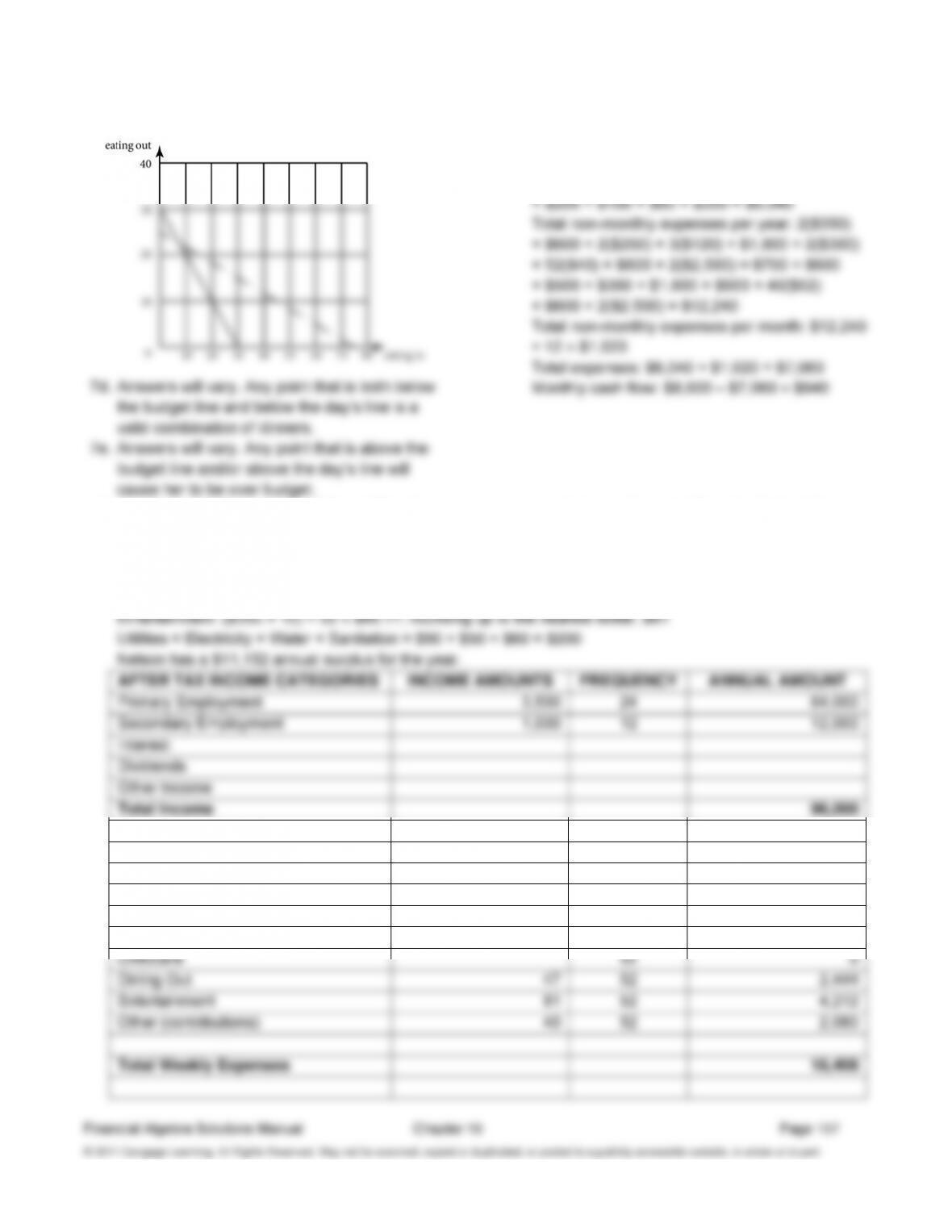
7c. The graph is shown below. 8. Total income: $7,000 + $1,000 = $8,000
Total monthly expenses: $2,800 + $200 + $90
+ $60 + $50 + $200 + $300 + $50 + $120
+ $200 + $500 + $100 + $50 + $90 + $500
9. Use the template from page 513 and fill in the amounts given on Nelson’s Financial Report with the following
changes.
Food: ($500 × 12) ÷ 52 ≈ $115.38; rounding up to the nearest dollar, $116
Fuel: ($300 × 12) ÷ 52 ≈ $69.23; rounding up to the nearest dollar, $70
Dining Out: ($200 × 12) ÷ 52 ≈ $46.15; rounding up to the nearest dollar, $47
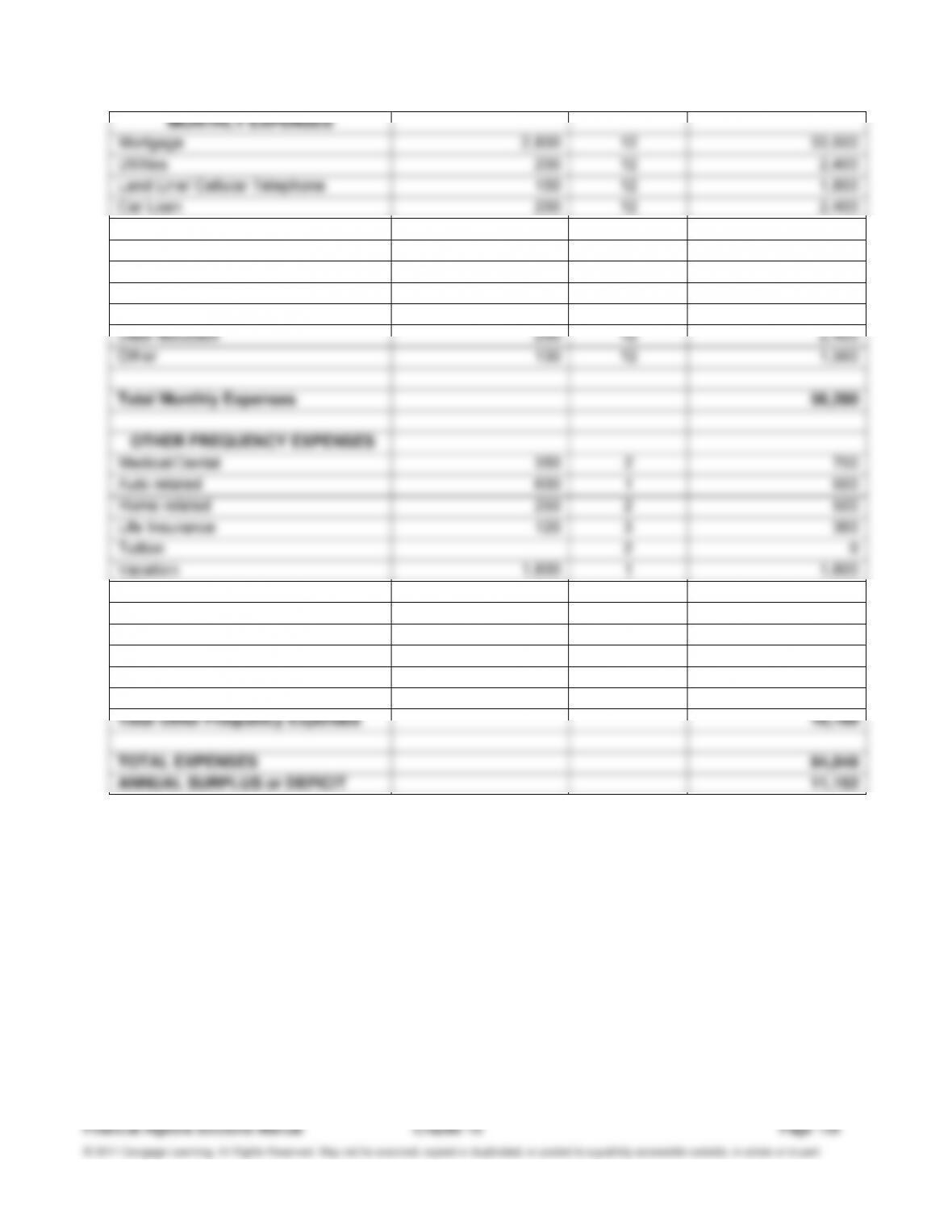
WEEKLY EXPENSES EXPENSE AMOUNTS
Food 116 52 6,032
Personal Transportation 70 52 3,640
Public Transportation 52 0
Household 52 0
Financial Algebra Solutions Manual Chapter 10 Page 158
© 2011 Cengage Learning. All Rights Reserved. May not be scanned, copied or duplicated, or posted to a publicly accessible website, in whole or in part.
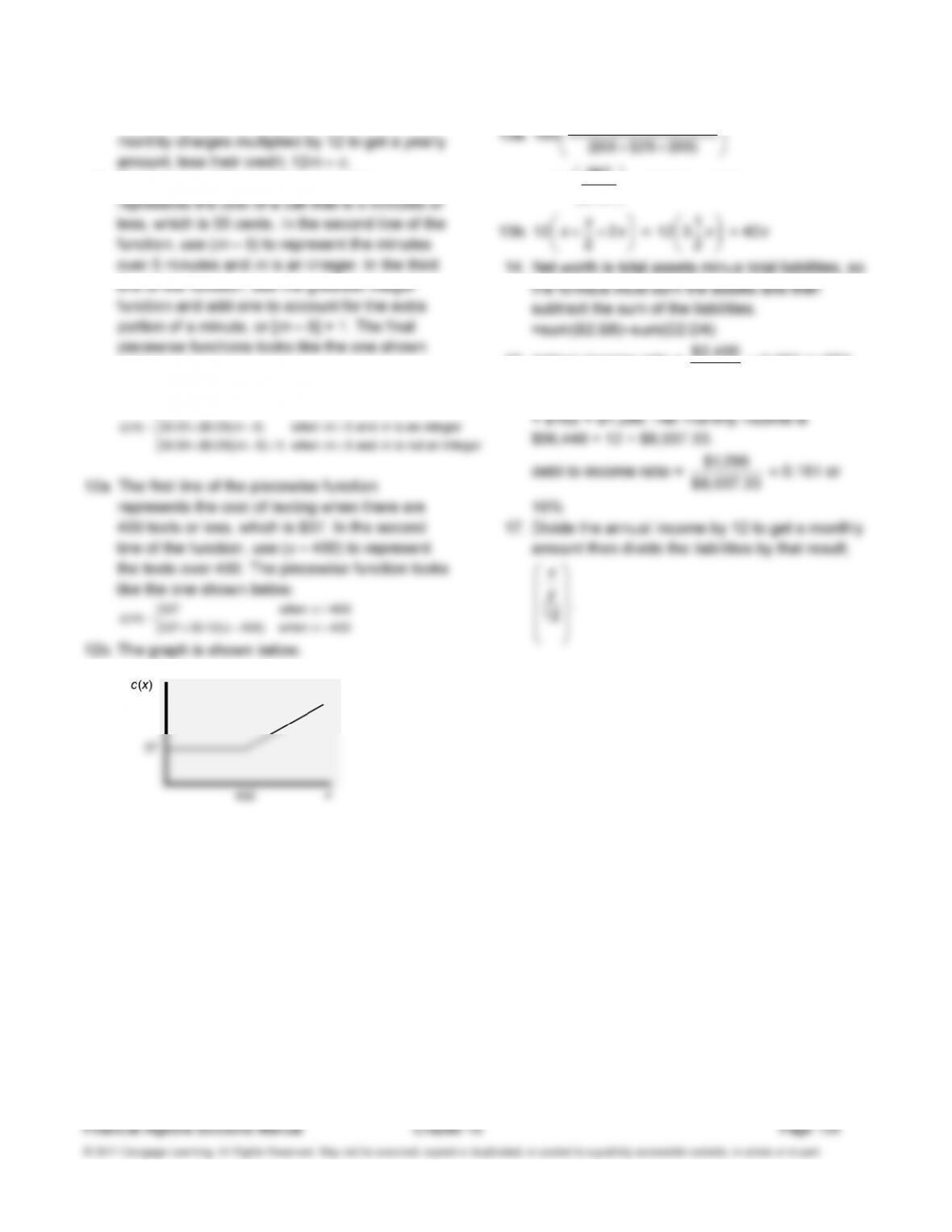
MONTHLY EXPENSES
Mortgage 2,800 12 33,600
Utilities 200 12 2,400
Land Line/ Cellular Telephone 150 12 1,800
Car Loan 200 12 2,400
Education Loan 200 12 2,400
Personal Loan 100 12 1,200
Car Insurance 90 12 1,080
Homeowner’s Insurance 120 12 1,440
Savings 500 12 6,000
Gifts 300 2 600
Contributions 1 0
Repairs 600 1 600
Taxes 2,500 2 5,000
Other
10. The Seinfeld’s total electricity charges are the
⎛⎞
++ −
($$$)$