CHAPTER 10
RESIDENTIAL MORTGAGE LOANS
CHAPTER SUMMARY
Although the American dream may be to own a home, the major portion of the funds to purchase
one must be borrowed. The market where these funds are borrowed is called the mortgage
market. A mortgage is a pledge of property to secure payment of a debt. Typically, property
ORIGINATION OF RESIDENTIAL MORTGAGE LOANS
The original lender is called the mortgage originator. The principal originators of residential
mortgage loans are thrifts, commercial banks, and mortgage bankers. Mortgage originators may
service the mortgages they originate, for which they obtain a servicing fee.
Underwriting Standards
Originators may generate income for themselves in one or more ways. First, they typically
charge an origination fee. The second source of revenue is the profit that might be generated
Mortgage originators can either (i) hold the mortgage in their portfolio, (ii) sell the mortgage to
an investor who wishes to hold the mortgage or who will place the mortgage in a pool of
A conforming mortgage is one that meets the underwriting standards established by these
agencies for being in a pool of mortgages underlying a security that they guarantee. If an
©2013 Pearson Education
217
mortgage. Mortgages acquired by the agency may be held as investments in their portfolio or
securitized.
Payment-to-Income Ratio
Loan-to-Value Ratio
The loan-to-value ratio (LTV) is the ratio of the amount of the loan to the market (or appraised)
value of the property. The lower this ratio is, the greater the protection for the lender if the
TYPES OF RESIDENTIAL MORTGAGE LOANS
There are different types of residential mortgage loans. They can be classified according to the
Lien Status
The lien status of a mortgage loan indicates the loan’s seniority in the event of the forced
liquidation of the property due to default by the obligor.
Credit Classification
While the credit scores have different underlying methodologies, the scores generically are
©2013 Pearson Education
218
referred to as a cash-out-refinancing. If instead, there is financing where the loan balance
remains unchanged, the transaction is said to be a rate-and-term refinancing or no-cash
refinancing.
The front ratio is computed by dividing the total monthly payments (which include interest and
principal on the loan plus property taxes and homeowner insurance) by the applicant’s pre-tax
monthly income. The back ratio is computed in a similar manner. The modification is that it
adds other debt payments such as auto loan and credit card payments to the total payments.
The credit score is the primary attribute used to characterize loans as either prime or subprime.
Prime (or A-grade) loans generally have FICO scores of 660 or higher, front and back ratios with
the above-noted maximum of 28% and 36%, and LTVs less than 95%.
Interest Rate Type
(1) periodic rate caps, and (2) lifetime rate caps and floors.
Amortization Type
The amount of the monthly loan payment that represents the repayment of the principal
borrowed is called the amortization. Traditionally, both FRMs and ARMs are fully amortizing
loans.
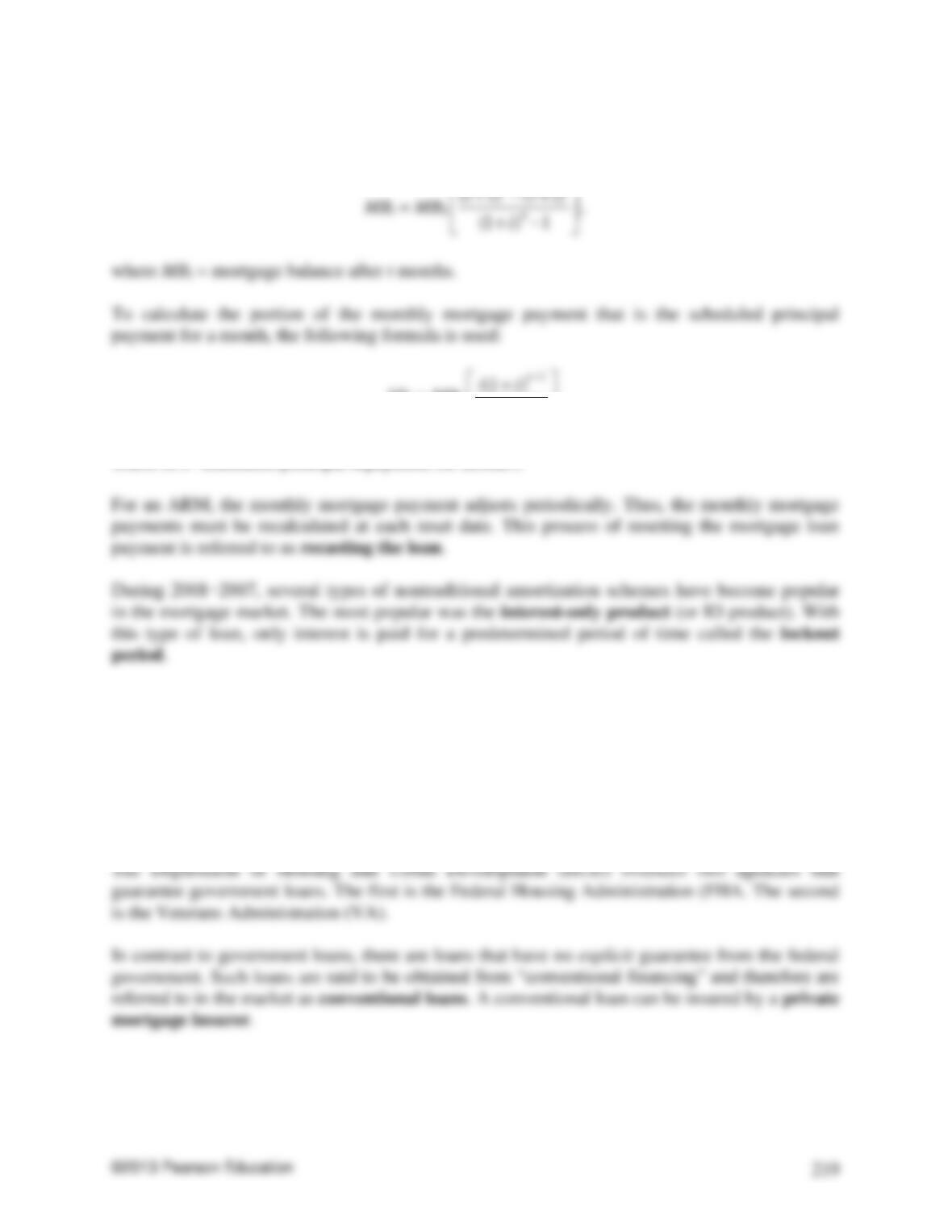
To calculate the remaining mortgage balance at the end of any month, the following formula is
used:
(1 (1 +
))
n
t
ii
+−
Fannie Mae are identical because they are specified by the same statute. Loans larger than the
conforming limit for a given property type are referred to as jumbo loans.
Prepayments and Prepayment Penalties
Homeowners often repay all or part of their mortgage balance prior to the scheduled maturity
date. The amount of the payment made in excess of the monthly mortgage payment is called
CONFORMING LOANS
Freddie Mac and Fannie Mae are government-sponsored enterprises (GSEs) whose mission is to
provide liquidity and support to the mortgage market. While Fannie Mae and Freddie Mac can
buy or sell any type of residential mortgage, the mortgages that are packaged into securities are
restricted to government loans and those that satisfy their underwriting guidelines. The
RISKS ASSOCIATED WITH INVESTING IN MORTGAGE LOANS
The principal investors in mortgage loans include thrifts and commercial banks. Pension funds
and life insurance companies also invest in these loans, but their ownership is small compared to
Credit Risk
Credit risk is the risk that the homeowner/borrower will default. For FHA– and VA-insured
mortgages, this risk is minimal. The LTV ratio provides a useful measure of the risk of loss of
principal in case of default.
Price Risk
The price of a fixed-income instrument will move in an opposite direction from market interest
rates. Thus, a rise in interest rates will decrease the price of a mortgage loan.
Prepayments and Cash Flow Uncertainty
The three components of the cash flow are: interest; principal repayment (scheduled principal
repayment or amortization); and, prepayment.
amortization type (fully amortizing and interest-only), credit guarantees (government loans
and conventional loans), loan balances, and prepayments and prepayment penalties.
• The two GSEs, Fannie Mae and Freddie Mac, can purchase any type of loan; however, the
only conventional loans that they can securitize to create a mortgage-backed security are
ANSWERS TO QUESTIONS FOR CHAPTER 10
(Questions are in bold print followed by answers.)
1. What type of property is security for a residential mortgage loan?
Typically, property refers to real estate. If the property owner (the mortgagor) fails to pay the
2. Do you agree that the payment-to-income (PTI) ratio is the sole primary factor in
determining whether funds will be lent to an applicant for a mortgage loan?
No, one would disagree with the statement as there are two primary factors.
A potential homeowner who wants to borrow funds to purchase a home will apply for a loan
3. Explain why the higher the loan–to-value ratio is, the greater the credit risk is to which
the lender is exposed.
The loan-to-value ratio (LTV) is the ratio of the amount of the loan to the market (or appraised)
value of the property. The higher this ratio is, the less the protection (and the greater the credit
risk) for the lender if the applicant defaults on the payments and the lender must repossess and
©2013 Pearson Education
224
foreclose on the property and then sell it because the applicant defaults, there is less protection
for the lender. The LTV has been found in numerous studies to be the single most important
determinant of the likelihood of default. The rationale is straightforward: Homeowners with
large amounts of equity in their properties are unlikely to default. They will either try to protect
this equity by remaining current or, if they fail, sell the house or refinance it to unlock the equity.
In any case, the lender is protected by the buyer’s self-interest. On the other hand, if the borrower
has little or no equity in the property, the value of the default option is much greater.
4. What is the difference between a cash-out refinancing and a rate-and-term refinancing?
5. What are the front ratio and back ratio, and how do they differ?
6. What is the difference between a prime loan and a subprime loan?
7. What is the relationship between FICO scores and credit risk, and how are the scores
used in classifying loans?
©2013 Pearson Education
225
firm’s credit risk. Thus, if a firm receives a high FICO score this means it has low credit risk.
Although loan originators place a great deal of emphasis on borrowers’ credit histories, these
data are not available to the rating agencies. The Fair Credit Reporting Act restricts access to
such information to parties involved in a credit extension decision. As a result, the agencies use
credit proxies such as the debt-to-income ratio, the mortgage coupon rate, past delinquencies or
seasoned loans, or either originators’ credit scores (e.g., A, B, C, or D) or credit scores by
vendors. The most frequently used credit score developed by financial institutions is the one
developed by Fair, Isaacs & Company. The score, referred to as the FICO score, uses 45 criteria
to rank the credit worthiness of an individual.
8. What is an alternative-A loan?
9. What is an FHA-insured loan?
10. What is a conventional loan?
11. Answer the below questions.
(a) What is meant by conforming limits?
For government loans and the loans guaranteed by Freddie Mac and Fannie Mae, there are limits
on the loan balance. The maximum loan size for one– to four-family homes changes every year.
(b) What is a jumbo loan?
12. Answer the below questions.
(a) When a prepayment is made that is less than the full amount to completely pay off the
loan, what happens to future monthly mortgage payments for a fixed-rate mortgage loan?
Homeowners often repay all or part of their mortgage balance prior to the scheduled maturity
date. The amount of the payment made in excess of the monthly mortgage payment is called a
prepayment. This type of prepayment in which the entire mortgage balance is not paid off is
are designed to discourage refinancing activity and require a fee to be paid if the loan is prepaid
within a certain amount of time after funding. The laws and regulations governing the imposition
of prepayment penalties are established at the federal and state levels. Usually, the applicable
(b) What is the impact of a prepayment that is less than the amount required to completely
pay off a loan?
5.5%, then there is an incentive for the borrower to refinance the loan. The decision to refinance
will depend on several factors, but the single most important one is the prevailing mortgage rate
13. Consider the following fixed-rate, level-payment mortgage: maturity = 360 months
amount borrowed = $100,000 annual mortgage rate = 10%
(a) Construct an amortization schedule for the first 10 months.
Fully amortizing fixed-rate loans have a payment that is constant over the life of the loan. For
our problem, we have a loan with an original balance of $100,000, an annual mortgage rate of
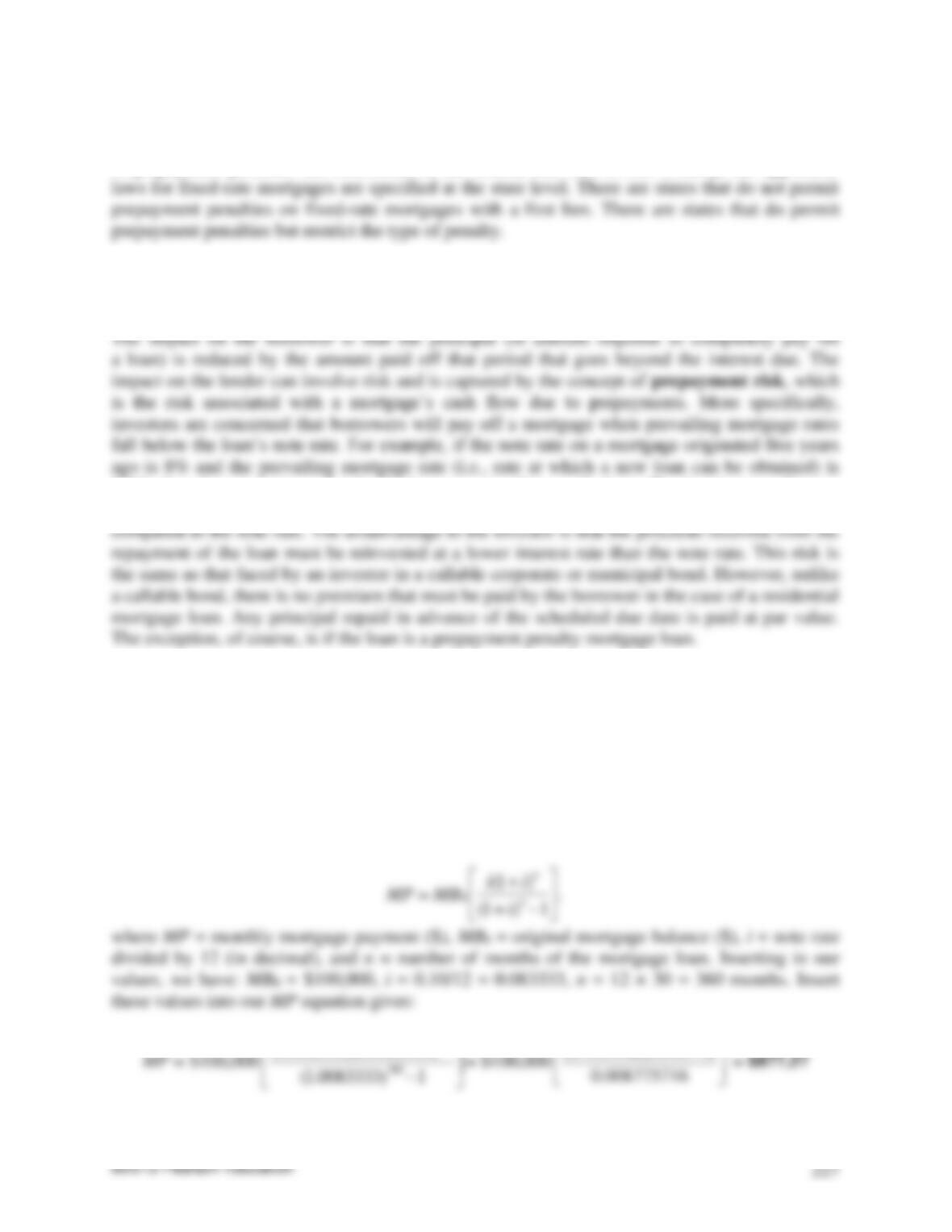
10%, and a term of 360 months. The formula for calculating the monthly mortgage payment is
360
360
(0.008333)(1 .0083333)
(1.0083333 1
)
−
(0.165132)(18.8374)
0.008775716
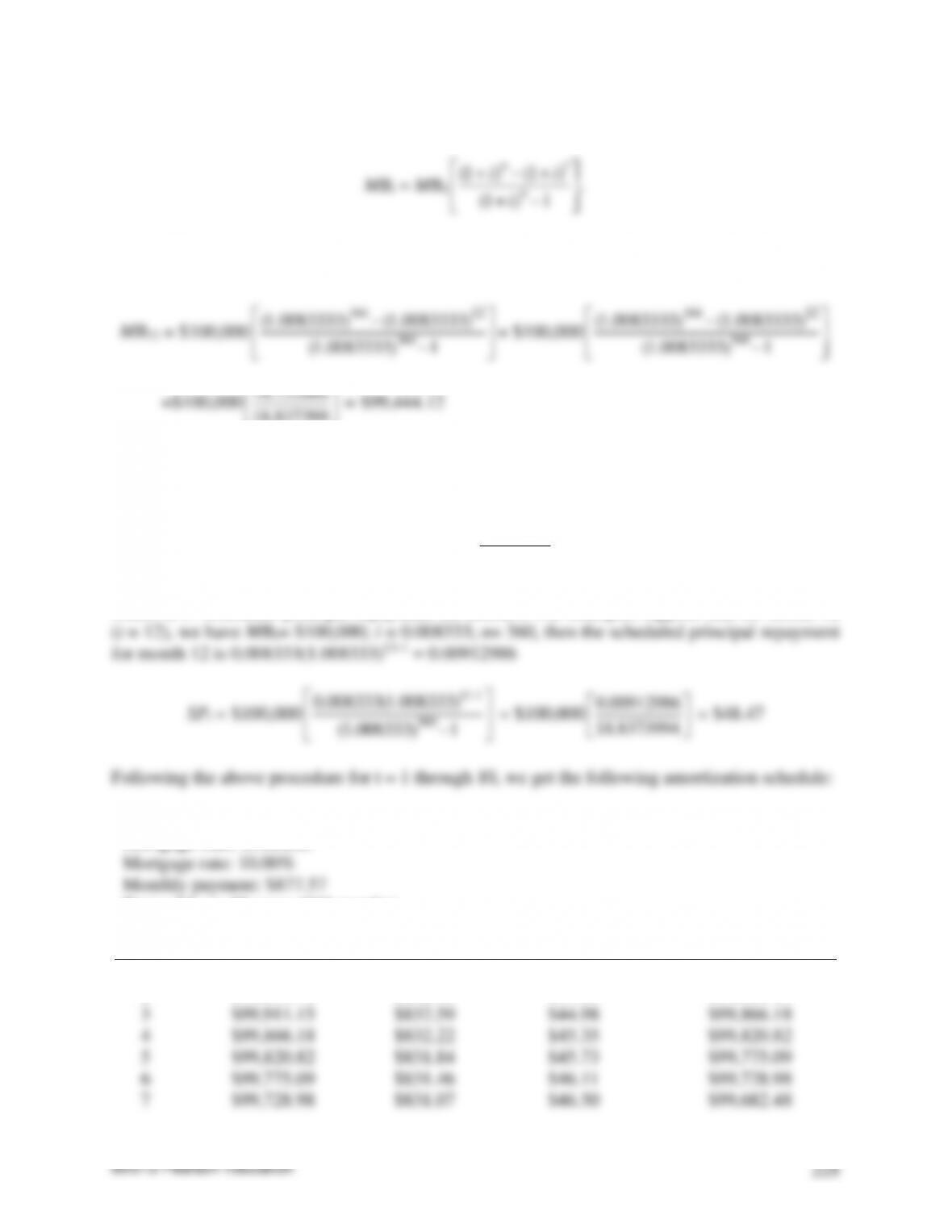
To calculate the remaining mortgage balance at the end of any month, the following formula is used:
(1 (1 +
))
n
t
ii
+−
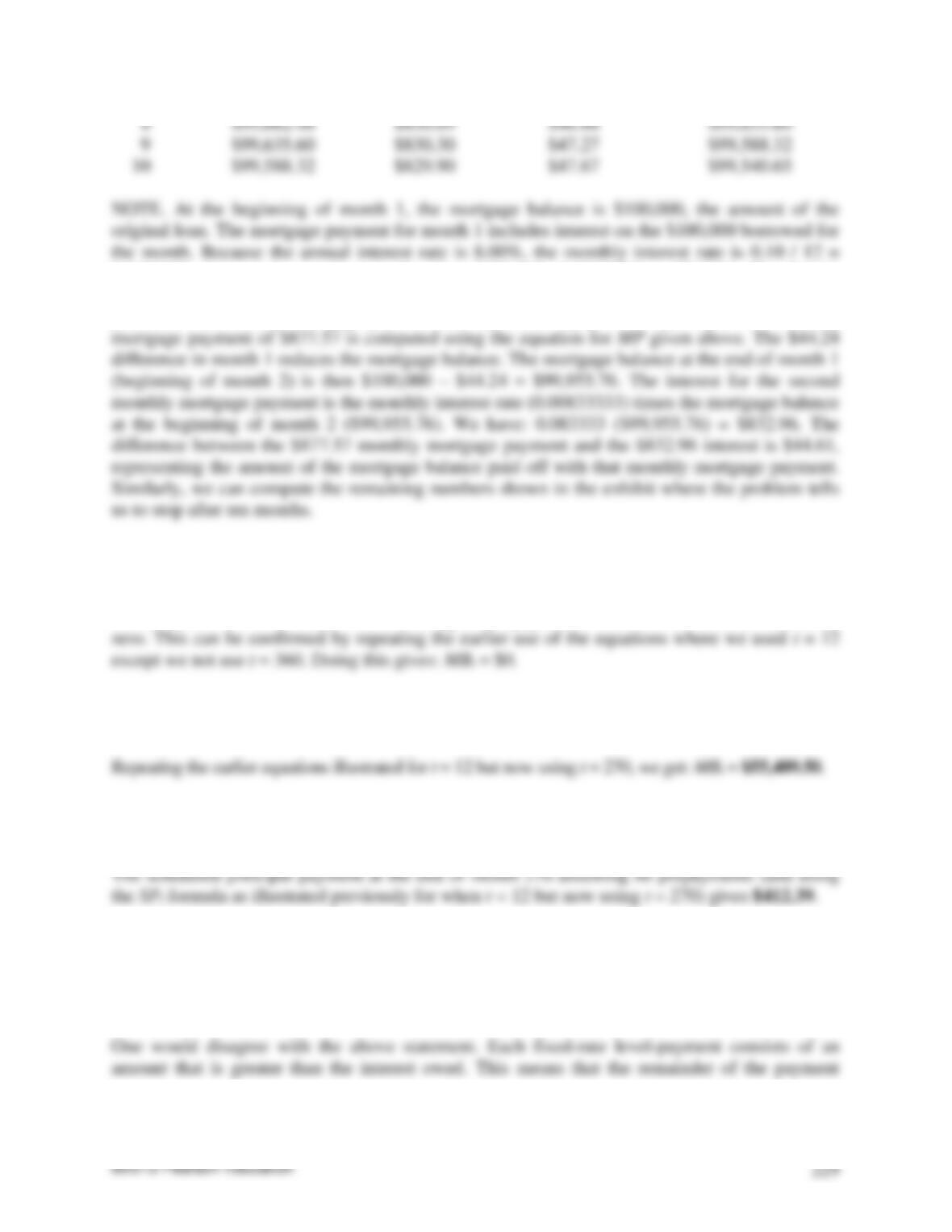
where MBt = mortgage balance after t months. For month 12 (t = 12), we have MB0= $100,000;
i = 0.008333; n= 360. The mortgage balance at the end of month 12 is
360
(1.0083333 1
)
−
360
(1.0083333 1
)
−
18.732686
©2013 Pearson Education
229
8
$99,682.48
$830.69
$46.88
$99,635.60
9
$99,635.60
$830.30
$47.27
$99,588.32
10
$99,588.32
$829.90
$47.67
$99,540.65
NOTE. At the beginning of month 1, the mortgage balance is $100,000, the amount of the
original loan. The mortgage payment for month 1 includes interest on the $100,000 borrowed for
the month. Because the annual interest rate is 8.00%, the monthly interest rate is 0.10 / 12 =
0.0083333. Interest for month 1 is therefore $100,000 (0.0083333) = $833.33. The $44.24
difference between the monthly mortgage payment of $877.57 and the interest of $833.33 is the
portion of the monthly mortgage payment that represents repayment of principal. The monthly
(b)What will the mortgage balance be at the end of the 360th month assuming no
prepayments?
At the end of the 360th month and assuming no prepayments, we know the balance should be
(c)Without constructing an amortization schedule, what is the mortgage balance at the end
of month 270 assuming no prepayments?
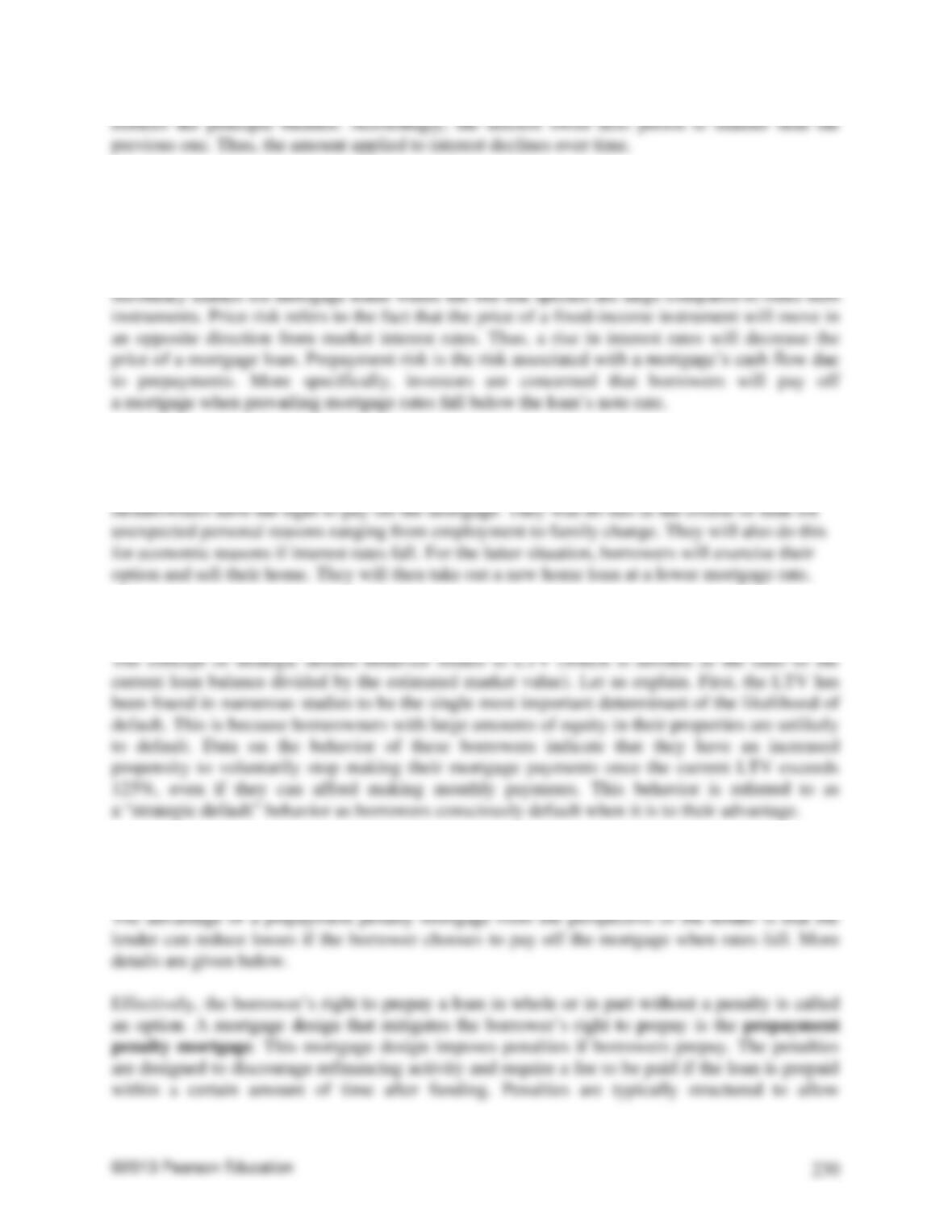
(d)Without constructing an amortization schedule, what is the scheduled principal
payment at the end of month 270 assuming no prepayments?
14. Explain whether you agree or disagree with the following statement:
In a fixed-rate level-payment mortgage the amount of the mortgage payment applied to
interest is fixed over time, while the amount applied to the repayment of principal increases
over time.
©2013 Pearson Education
230
reduces the principal balance. Accordingly, the interest owed next period is smaller than the
previous one. Thus, the amount applied to interest declines over time.
15. Why is the cash flow of a residential mortgage loan unknown?
There are many factors that can the cash flow of a residential mortgage unknown. These include:
(1) credit risk, (2) liquidity risk, (3) price risk, and (4) prepayment risk. Credit risk is the risk that
the homeowner/borrower will default. Liquidity risk refers to the degree of liquidity in the
16. In what sense has the investor in a residential mortgage granted the borrower
(homeowner) an option?
17. What is meant by strategic default behavior?
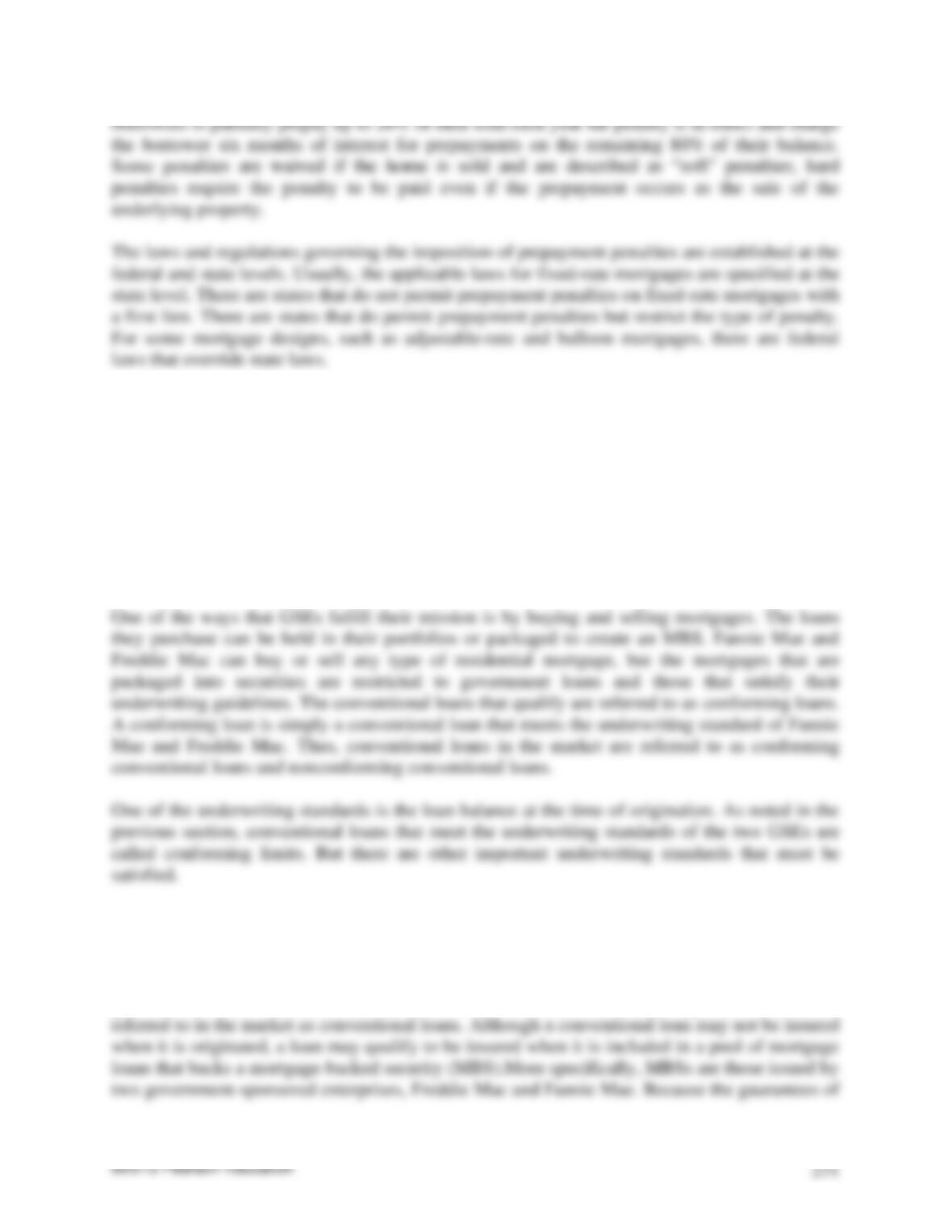
18. What is the advantage of a prepayment penalty mortgage from the perspective of the
lender?
©2013 Pearson Education
231
borrowers to partially prepay up to 20% of their loan each year the penalty is in effect and charge
the borrower six months of interest for prepayments on the remaining 80% of their balance.
Some penalties are waived if the home is sold and are described as “soft” penalties; hard
penalties require the penalty to be paid even if the prepayment occurs as the sale of the
underlying property.
The laws and regulations governing the imposition of prepayment penalties are established at the
federal and state levels. Usually, the applicable laws for fixed-rate mortgages are specified at the
state level. There are states that do not permit prepayment penalties on fixed-rate mortgages with
a first lien. There are states that do permit prepayment penalties but restrict the type of penalty.
For some mortgage designs, such as adjustable-rate and balloon mortgages, there are federal
laws that override state laws.
19. Explain whether you agree or disagree with the following statements:
a. “Freddie Mac and Fannie Mae are only allowed to purchase conforming conventional
loans.”
The two GSEs, Fannie Mae and Freddie Mac, can purchase any type of loan; however, the only
conventional loans that they can securitize to create a mortgage-backed security are conforming
loans, that is conventional loans that satisfy their underwriting standards. More details are given
below.
b. “In packaging loans to create a mortgage-backed security, Freddie Mac and Fannie Mae
can only use government loans.”
In contrast to government loans, there are loans that have no explicit guarantee from the federal
government. Such loans are said to be obtained from “conventional financing” and therefore are
©2013 Pearson Education
232
Freddie Mac and Fannie Mae do not carry the full faith and credit of the U.S. government, they
are not classified as government loans.
20. Answer the below questions.
(a)What features of an adjustable-rate mortgage will affect its cash flow?
(1) periodic rate caps and (2) lifetime rate cap and floor. A periodic rate cap limits the amount
that the interest rate may increase or decrease at the reset date. The periodic rate cap is expressed
(b)What are the two categories of benchmark indexes used in adjustable-rate mortgages?
Two categories of reference rates have been used in adjustable-rate mortgages(ARMs):
(1) market-determined rates and (2) calculated rates based on the cost of funds for thrifts.
Market-determined rates include the London Interbank Offered Rate (LIBOR), the 1-year
21. Answer the below questions.
(a)What is the original LTV of a mortgage loan?
The original LTV of a mortgage loan is the LTV at the time of origination. The LTV is the ratio
(b)What is the current LTV of a mortgage loan?
©2013 Pearson Education
233
The current LTV is the LTV based on the current unpaid mortgage balance and the estimated
current market value of the property.
(c)What is the problem with using the original LTV to assess the likelihood that a seasoned
mortgage will default?
At one time, investors considered only the original LTV in their analysis of credit risk. Because
of periods in which there has been a decline in housing prices, the current LTV has become the
22. Answer the below questions.
(a)What is a home equity loan?
A popular mortgage product backed by residential property that is classified as a subprime
mortgage loan is the home equity loan (HEL). Typically the borrower has either an impaired
(b)What is the difference between a closed-end and open-end home equity loan?
While home equity loans can be either closed end or open end, most home equity loan
securitizations are backed by closed-end HELs. A closed-end HEL is designed the same way as a
23. For mortgage loans, what is prepayment risk?
Prepayment risk is the risk associated with a mortgage’s cash flow due to prepayments. More
specifically, investors are concerned that borrowers will pay off a mortgage when prevailing
mortgage rates fall below the loan’s note rate. More details are given below.
ago is 8% and the prevailing mortgage rate (i.e., rate at which a new loan can be obtained) is
5.5%, then there is an incentive for the borrower to refinance the loan. The decision to refinance
will depend on several factors, but the single most important one is the prevailing mortgage rate