
Inputs:
Factor Expected Actual Beta
Problem 10-1
Suppose that two factors have been identified for the U.S. economy: the growth rate of industrial production, IP, and the
inflation rate, IR. IP is expected to be 3%, and IR 5%. A stock with a beta of 1 on IP and .5 on IR currently is expected to
provide a rate of return of 12%. If industrial production actually grows by 5%, while the inflation rate turns out to be 8%,
Industrial Production 0.05 0.06 2.1
Expected rate of return 0.18

Inputs:
E(rp ) = rf + βP1 [E(r1 ) − rf ] + βP2 [E(r2 ) − rf ]
Portfolio
Beta on F1
Beta on F2
ER
A 1.1 1.5 0.25
Answer:
rf 5.00%
F1 = 9.00% rf βP1 F1βP2 F2
F26.73% 0.25 0.05 1.1 1.5
0.22 0.05 2 -0.15
Problem 10-4
Suppose that there are two independent economic factors, F1and F2. The risk-free rate is 6%, and all stocks have
independent firm-specific components with a standard deviation of 45%. The following are well-diversified portfolios:
Portfolio Beta on F1Beta on F2Expected Return
A1.5 2.0 31%

0.058
E(rA) = rf + (βA * RP)
E(rA) = 0.21 E(rB) = 0.17
Problem 10-6
Assume that both portfolios Aand Bare well diversified, that E(rA) = 12%, and E(rB) = 9%. If the economy has only one
E(rA) – E(rB) 0.04

$1,000,000 × [0.02 + (1.0 × RM)] − $1,000,000 × [(–0.02) + (1.0 × RM)]
Inputs:
Portfolio $ 1000000
RM =0.25
alpha stks. First half 0.016
alpha stks second half
-0.016
Beta 1.2
Answers:
Expected profit 32000
Problem 10-7
Assume that stock market returns have the market index as a common factor, and that all stocks in the economy have a beta of 1 on the
market index. Firm-specific returns all have a standard deviation of 30%.
Suppose that an analyst studies 20 stocks, and finds that one -half have an alpha of +2%,and the other half an alpha of –2%. Suppose the
analyst buys $1 million of an equally weighted portfolio of the positive alpha stocks, and shorts $1 million of an equally weighted portfolio
of the negative alpha stocks.
a. What is the expected profit (in dollars) and standard deviation of the analyst’s profit? (Do not round intermediate calculations. Round
your answers to the nearest whole dollar amount. Omit the “$” sign in your response.)
Expected profit = 32000
Standard deviation = 111803.40 70710.68 50000.00
Stock value = Stock value =
Stocks = 20 100000
Stocks = 50 40000
Stocks = 100 20000

Security
βi
E(R i) %
σ(e i) %
A 0.6 8 21
B 0.8 10 7
C 1 12 16
B 233.96
C545
Answers:
a.
Problem 10-8
Assume that security returns are generated by the single-index model,
Ri= αi+ βiRM+ ei
where Riis the excess return for security iand RMis the market’s excess return. The risk-free rate is 2%. Suppose also
that there are three securities A, B, and C, characterized by the following data:
Security βiE(Ri)σ(ei)
a. If σM= 20%, calculate the variance of returns of securities A, B, and C. (Do not round intermediate calculations.
Round your answers to the nearest whole number.)
Variance
b. Now assume that there are an infinite number of assets with return characteristics identical to those of A, B, and C,
respectively. What will be the mean and variance of excess returns for securities A, B, and C? (Enter the variance
answers as a percent squared and mean as a percentage. Do not round intermediate calculations. Round your
answers to the nearest whole number. Omit the “%” sign in your response.)
Mean Variance
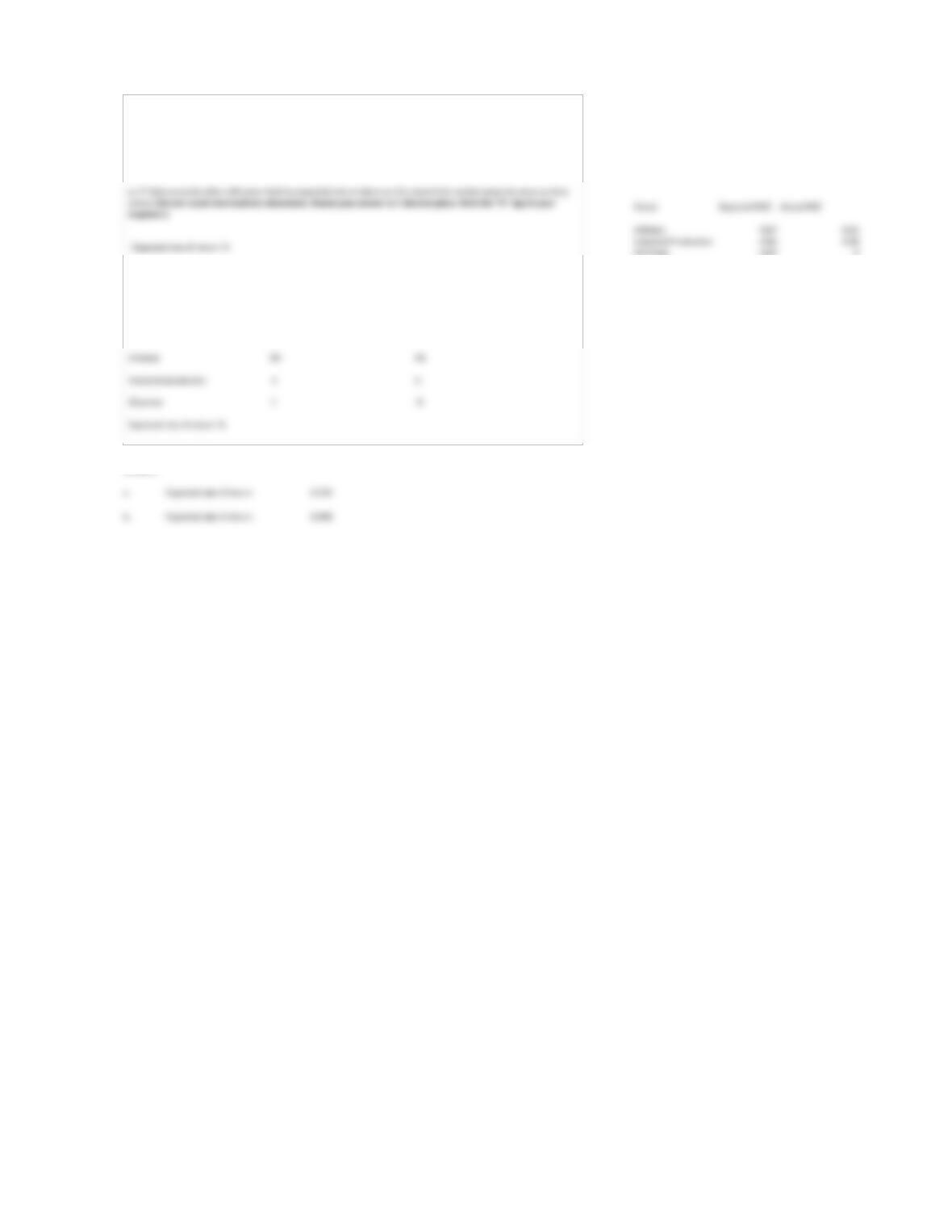
Factor Factor Beta Factor Risk Premium
Inflation 0.8 0.06
Industrial Production 0.4 0.07
Oil Prices 0.1 0.03
Oil Prices 0.03 0
rf = 0.03
Answers:
Problem 10-10
Consider the following multifactor (APT) model of security returns for a particular stock.
Factor Factor Beta Factor Risk Premium
Inflation 1.2 6%
Industrial production 0.5 8
Oil prices 0.3 3
b. Suppose that the market expected the values for the three macro factors given in column 1 below, but that the actual
values turn out as given in column 2. Calculate the revised expectations for the rate of return on the stock once the
“surprises” become known. (Do not round intermediate calculations. Round your answer to 1 decimal place. Omit the
“%” sign in your response.)
Factor Expected Rate of Change Actual Rate of Change
Factor Expected ROC Actual ROC
Industrial Production 0.06 0.08
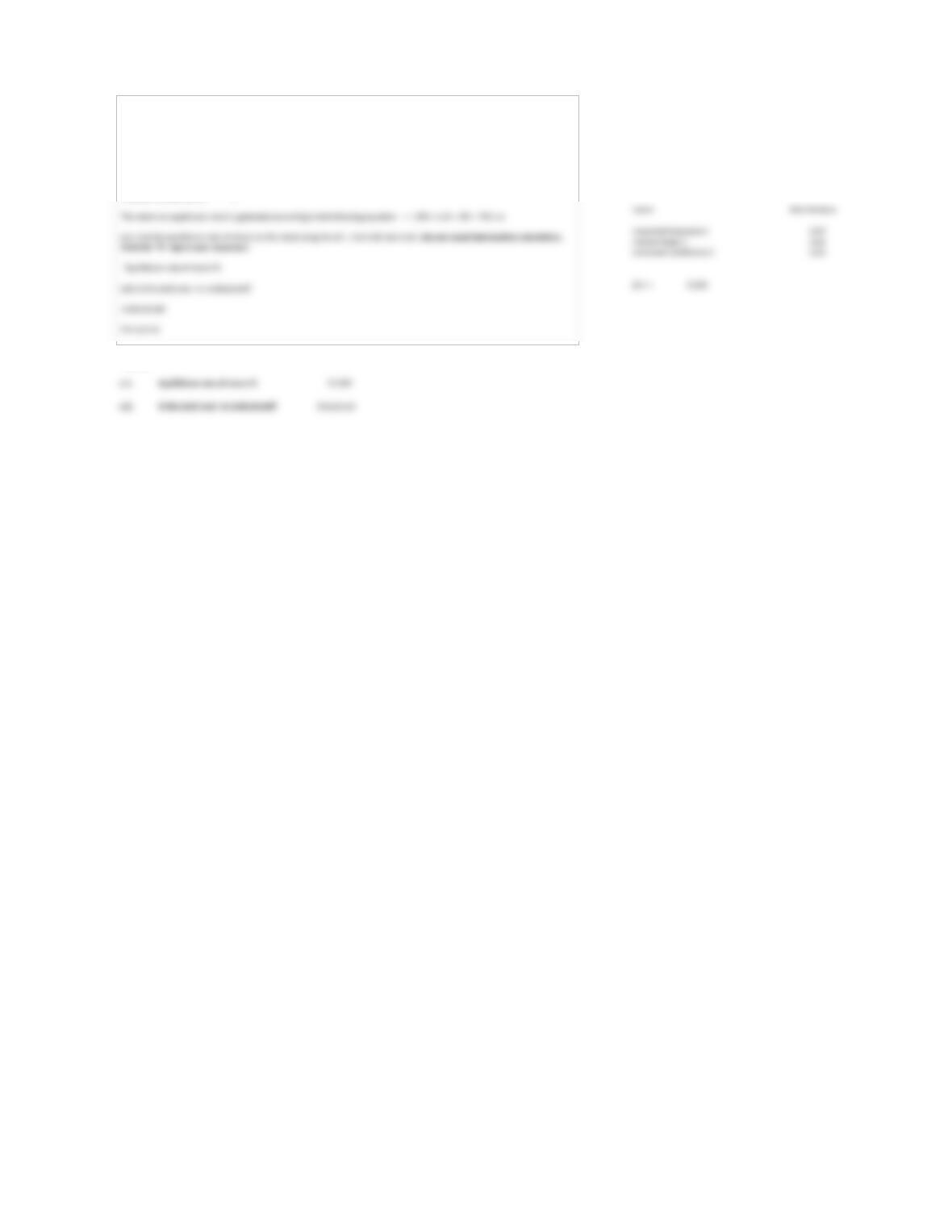
r = rf + 1.0I + .5R + .75C + e
r = 0.09 1.6 0.9 1.2
r = 0.256
rf = 0.09
Answers:
Problem 10-11
Suppose that the market can be described by the following three sources of systematic risk with associated risk premiums.
Factor Risk Premium
Industrial production (I)6%
Interest rates (R) 2
Consumer confidence (C) 4

Real GDP Inflation
High Growth 1.25 1.5
Large Cap 0.75 1.25
Utility Fund 1 2
Answer:
Problem 10-13
Orb Trust (Orb) has historically leaned toward a passive management style of its portfolios. The only model that Orb’s seniormanagement has promoted in the
past is the capital asset pricing model (CAPM). Now Orb’s management has asked one of its analysts, Kevin McCracken, CFA, to investigate the use of the
arbitrage pricing theory (APT) model.
McCracken believes that a two-factor APT model is adequate, where the factors are the sensitivity to changes in real GDP and changes in inflation.
McCracken has concluded that the factor risk premium for real GDP is 8% while the factor risk premium for inflation is 2%. Heestimates for Orb’s High Growth
Fund that the sensitivities to these two factors are 1.25 and 1.5, respectively. Using his APT results, he computes the expected return of the fund. For
comparison purposes, he then uses fundamental analysis to also compute the expected return of Orb’s High Growth Fund. McCracken finds that the two
macroeconomic policies of the government are successful.
According to the APT, if the risk-free rate is 4%, what should be McCracken’s estimate of the expected return of Orb’s High Grow th Fund? (Do not round
intermediate calculations. Omit the “%” sign in your response.)
Expected return %
Factor Risk Premium 0.08 0.02

Real GDP Inflation
High Growth 1.25 1.5
Large Cap 0.75 1.25
Problem 10-14
Orb Trust (Orb) has historically leaned toward a passive management style of its portfolios. The only model that Orb’s senior management has
promoted in the past is the capital asset pricing model (CAPM). Now Orb’s management has asked one of its analysts, Kevin McCracken, CFA, to
investigate the use of the arbitrage pricing theory (APT) model.
McCracken believes that a two-factor APT model is adequate, where the factors are the sensitivity to changes in real GDP and changes in inflation.
McCracken has concluded that the factor risk premium for real GDP is 8% while the factor risk premium for inflation is 2%. He estimates for Orb’s High
Growth Fund that the sensitivities to these two factors are 1.25 and 1.5, respectively. Using his APT results, he computes the expected return of the
With respect to McCracken’s APT model estimate of Orb’s Large Cap Fund and the information Kwon provides, is an arbitrage opportunity available?
Yes
No
Utility Fund 1 2
Factor Risk Premium 0.08 0.02

a = High Growth Fund
b = Large Cap Fund
c = Utility Fund
Problem 10-15
Orb Trust (Orb) has historically leaned toward a passive management style of its portfolios. The only model that Orb’s senior management has promoted in
the past is the capital asset pricing model (CAPM). Now Orb’s management has asked one of its analysts, Kevin McCracken, CFA, to investigate the use of the
arbitrage pricing theory (APT) model.
McCracken believes that a two-factor APT model is adequate, where the factors are the sensitivity to changes in real GDP and changes in inflation.
McCracken has concluded that the factor risk premium for real GDP is 8% while the factor risk premium for inflation is 2%. He estimates for Orb’s High
Growth Fund that the sensitivities to these two factors are 1.25 and 1.5, respectively. Using his APT results, he computes the expected return of the fund.
For comparison purposes, he then uses fundamental analysis to also compute the expected return of Orb’s High Growth Fund. McCracken finds that the two
The GDP Fund composed from the other three funds would have a weight in Utility Fund equal to
–3.2

Answer:
Problem 10-16
Orb Trust (Orb) has historically leaned toward a passive management style of its portfolios. The only model that Orb’s seniormanagement has promoted in the
past is the capital asset pricing model (CAPM). Now Orb’s management has asked one of its analysts, Kevin McCracken, CFA, to investigate the use of the
arbitrage pricing theory (APT) model.
McCracken believes that a two-factor APT model is adequate, where the factors are the sensitivity to changes in real GDPand changes in inflation.
McCracken has concluded that the factor risk premium for real GDP is 8% while the factor risk premium for inflation is 2%. Heestimates for Orb’s High Growth
With respect to the comments of Stiles and McCracken concerning for whom the GDP Fund would be appropriate:
McCracken was correct and Stiles was wrong.
Stiles was correct and McCracken was wrong.
Both were correct.