Chapter 10: Valuation and Rates of Return
$1,000.00
c. The answer to part a of $1,224.35 and part b of
$1,224.07 are basically the same because in both cases
Chapter 10: Valuation and Rates of Return
N
I/Y
PV
PMT
FV
18
14
CPT PV −353.26
40
1,000
N
I/Y
PV
PMT
FV
15
18
CPT PV −847.25
150
1,000
Answer: $847.25 Bond Price
Present Value of Interest Payments
PVA = A × PVIFA (n = 15, i = 18%) Appendix D
PVA = $150 × 5.092 = $763.80
Present Value of Principal Payment at Maturity
PV = FV × PVIF (n = 15, i = 18%) Appendix B
PV = $1,000 × .084 = $84.00 $763.80
84.00
Bond Price = $847.80
17. Deep discount bonds (LO10-3) Lance Whittingham IV specializes in buying deep
discount bonds. These represent bonds that are trading at well below par value. He
has his eye on a bond issued by the Leisure Time Corporation. The $1,000 par value
bond pays 4 percent annual interest and has 18 years remaining to maturity. The
current yield to maturity on similar bonds is 14 percent.
a. What is the current price of the bonds?
b. By what percent will the price of the bonds increase between now and maturity?
c. What is the annual compound rate of growth in the value of the bonds? (An
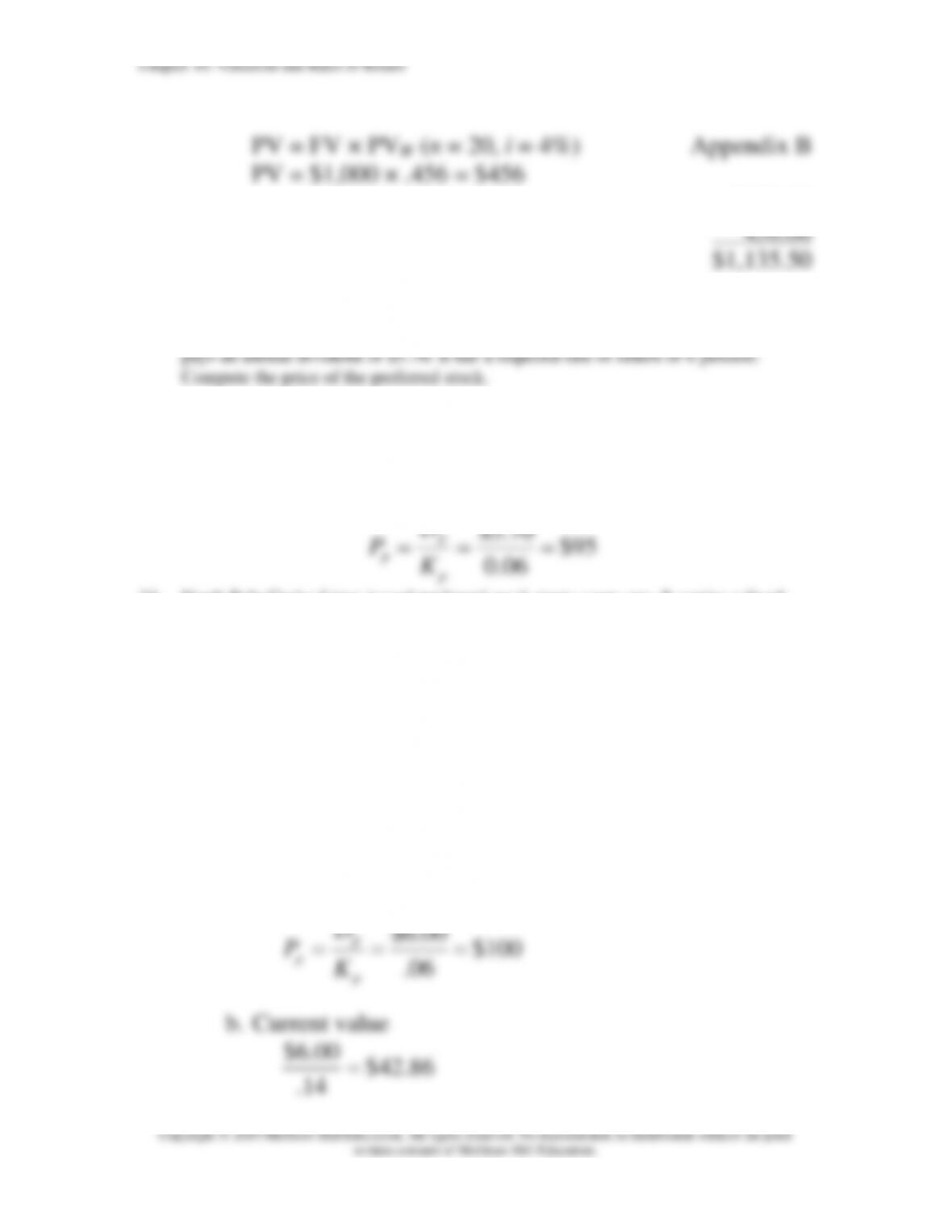
10-17. Solution:
Lance Whittingham IV – Leisure Time Corporation
Calculator Solution:
Chapter 10: Valuation and Rates of Return
25. Preferred stock value (LO10-4) X-Tech Company issued preferred stock many
years ago. It carries a fixed dividend of $12.00 per share. With the passage of time,
yields have soared from the original 10 percent to 17 percent (yield is the same as
required rate of return).
a. What was the original issue price?
b. What is the current value of this preferred stock?
c. If the yield on the Standard & Poor’s Preferred Stock Index declines, how will
the price of the preferred stock be affected?
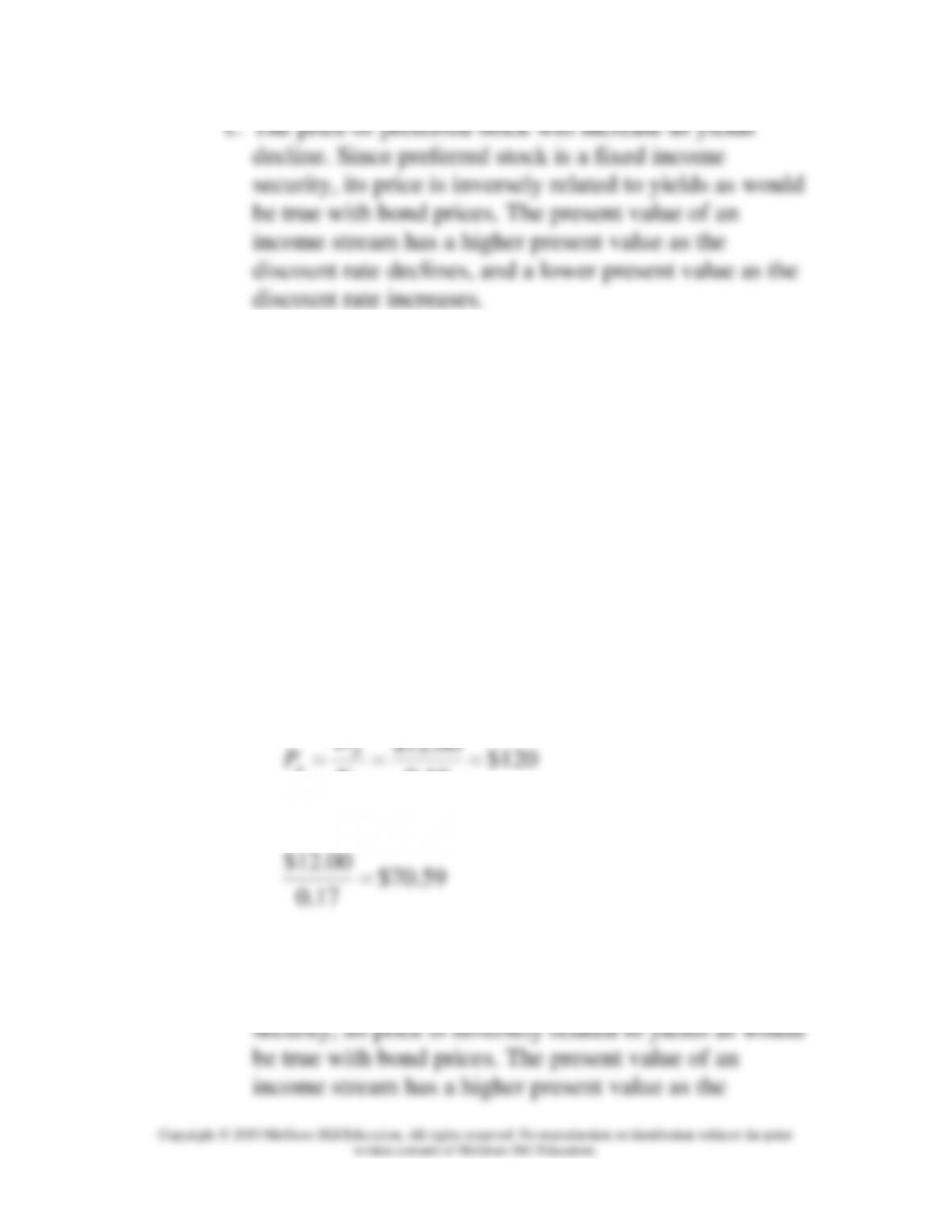
10-25. Solution:
X-Tech Company
a. Original price
$12.00 $120
0.10
p
p
p
D
PK
= = =
b. Current value
$12.00 $70.59
0.17
=
c. The price of preferred stock will increase as yields
decline. Since preferred stock is a fixed income
Chapter 10: Valuation and Rates of Return
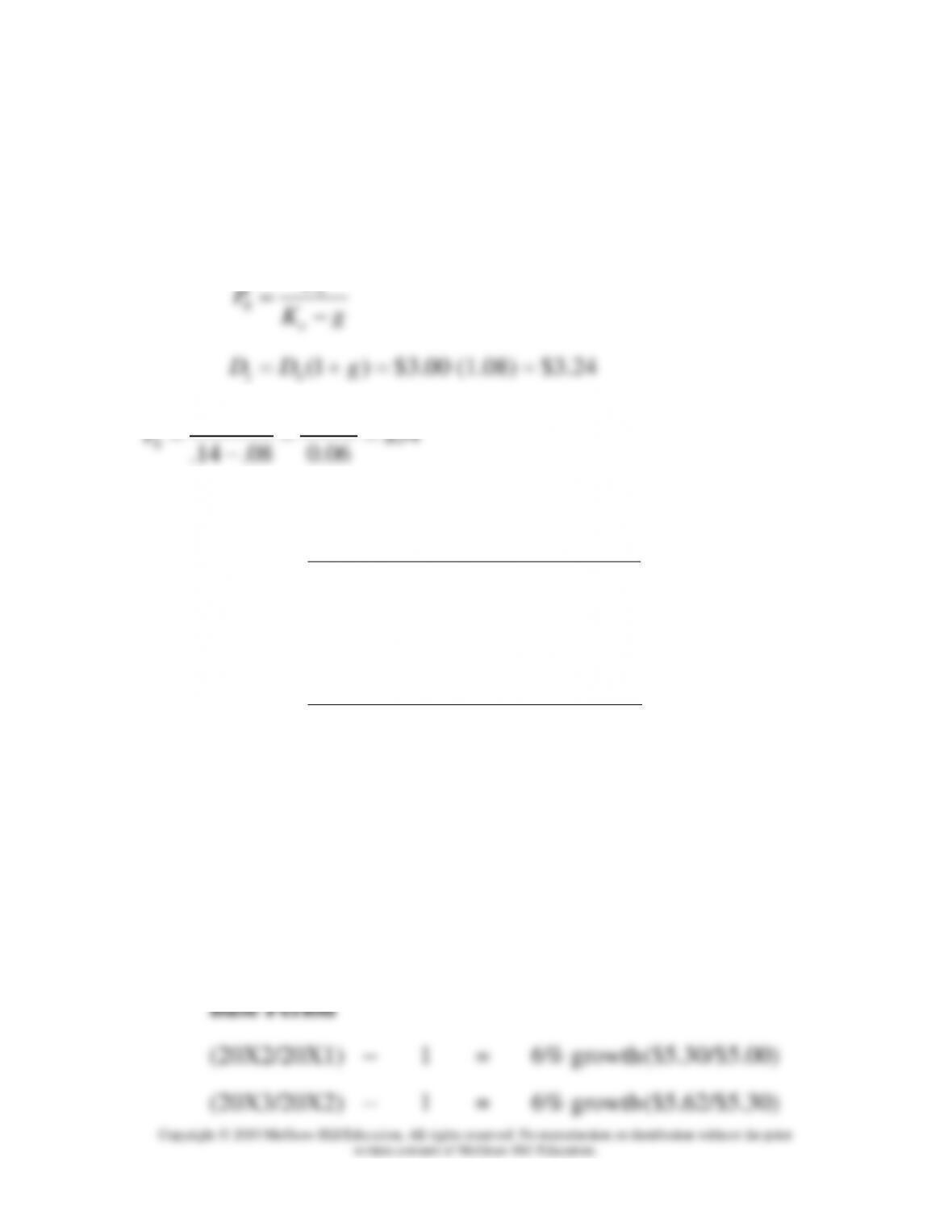
growth rate for the firm (g). The new dividend after 12 months will represent D1.
The required rate of return (Ke) is 14 percent. Compute the price of the stock (P0).
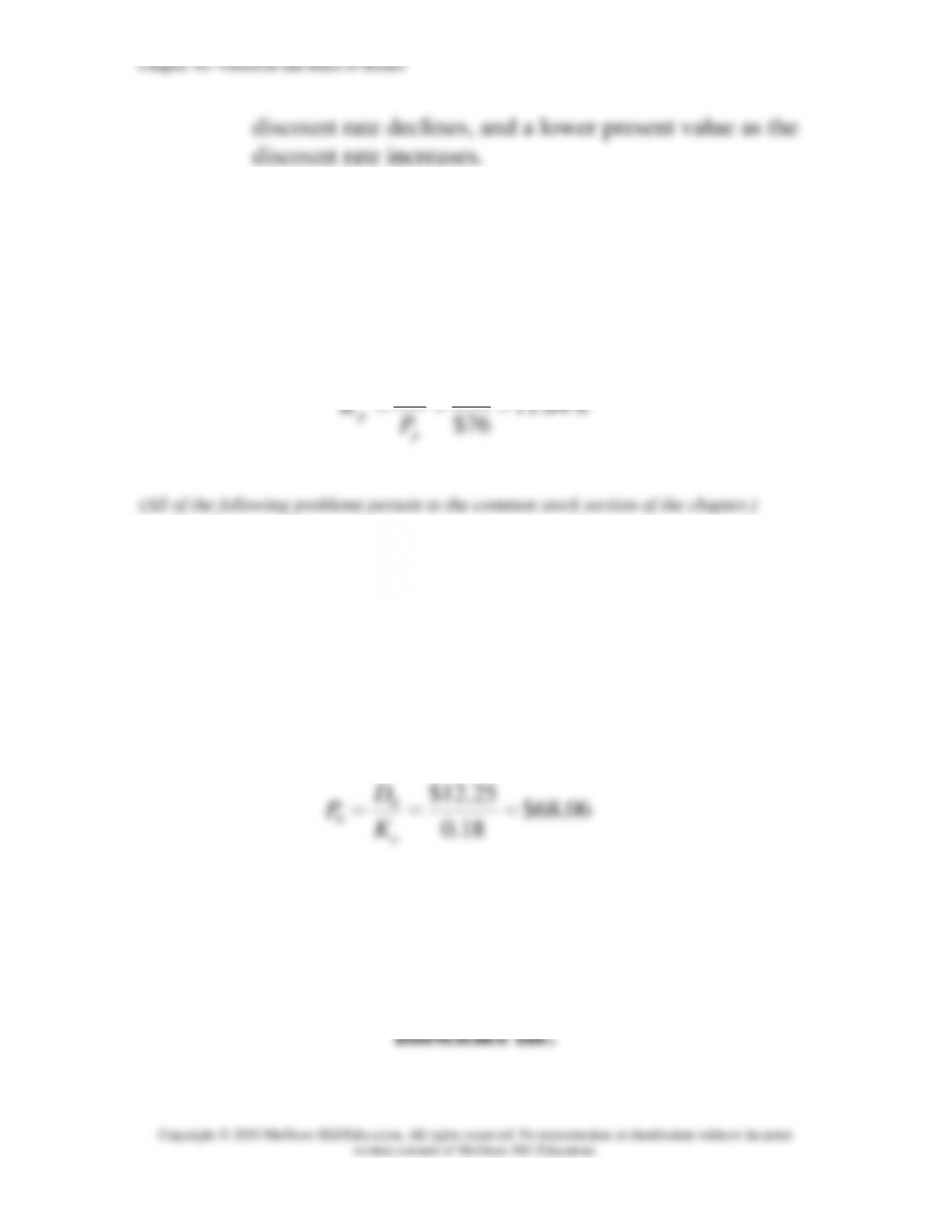
10–30. Solution:
Maxwell Communications
1
0
e
D
PKg
=
−
10
(1 ) $3.00 (1.08) $3.24D D g= + = =
0
$3.24 $3.24 $54
.14 .08 0.06
P= = =
−
31. Common stock value based on determining growth rate (LO10-5) Justin Cement
Company has had the following pattern of earnings per share over the last five years:
Year Earnings per Share
20X1 ……………………… $5.00
20X2 ……………………… 5.30
20X3 ……………………… 5.62
20X4 ……………………… 5.96
20X5 ……………………… 6.32
The earnings per share have grown at a constant rate (on a rounded basis) and will
continue to do so in the future. Dividends represent 40 percent of earnings. Project
earnings and dividends for the next year (20X6).
If the required rate of return (Ke) is 13 percent, what is the anticipated stock price
(P0) at the beginning of 20X6?
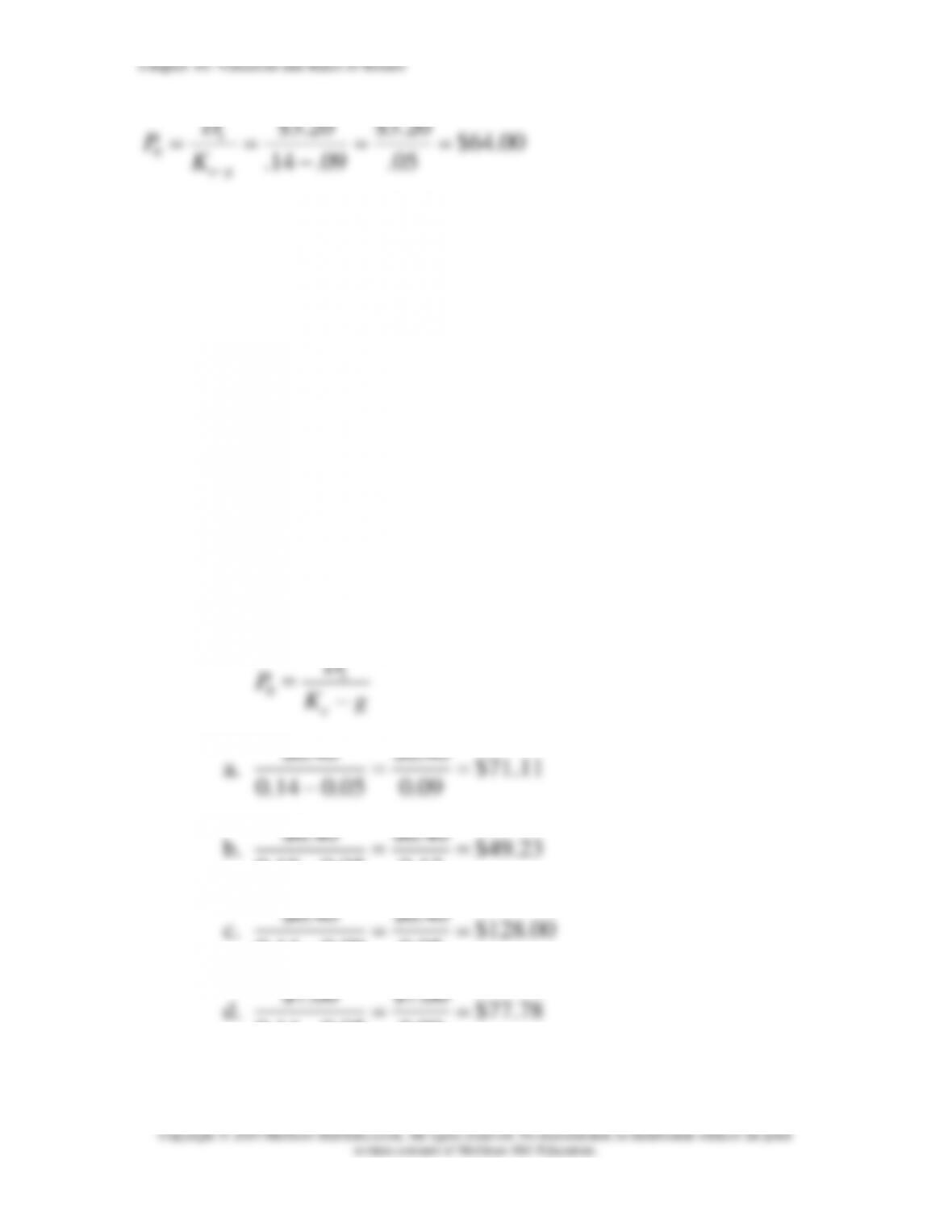
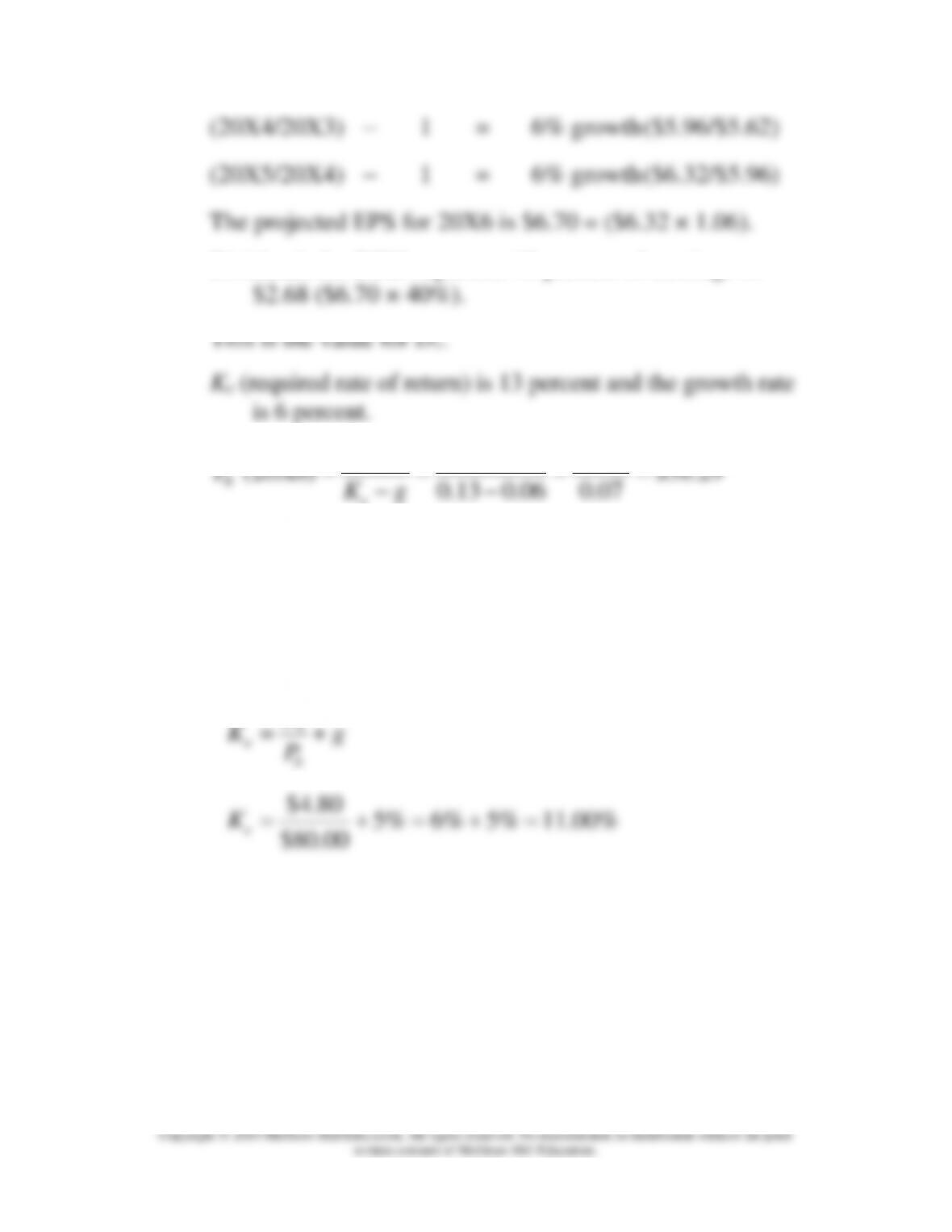
10-31. Solution:
Justin Cement Company
Earnings have been growing at a rate of 6 percent per year.
Chapter 10: Valuation and Rates of Return
Dividends for 20X6 represent 40 percent of earnings or
1
0
$2.68 $2.68
(20X6) $38.29
0.13 0.06 0.07
e
D
PKg
= = = =
−−
32. Common stock required rate of return (LO10-5) A firm pays a $4.80 dividend at
the end of year one (D1), has a stock price of $80, and a constant growth rate (g) of
5 percent. Compute the required rate of return (Ke).
10-32. Solution:
1
0
e
D
Kg
P
=+
$4.80 5% 6% 5% 11.00%
$80.00
e
K= +=+=
33. Common stock required rate of return (LO10-5) A firm pays a $1.50 dividend at
the end of year one (D1), has a stock price of $155 (P0), and a constant growth rate
(g) of 10 percent.
a. Compute the required rate of return (Ke).
Indicate whether each of the following changes would make the required rate of
return (Ke) go up or down. (Each question is separate from the others. That is,
assume only one variable changes at a time.) No actual numbers are necessary.
b. The dividend payment increases.
c. The expected growth rate increases.