Chapter 10: Valuation and Rates of Return
Chapter 10
Valuation and Rates of Return
Discussion Questions
10-1.
How is valuation of any financial asset related to future cash flows?
The valuation of a financial asset is equal to the present value of future
cash flows.
10-2.
Why might investors demand a lower rate of return for an investment in
Microsoft as compared to United Airlines?
Because Microsoft has less risk than United Airlines, Microsoft has
relatively high returns and a strong market position; United Airlines has
had financial difficulties and emerged from bankruptcy in 2006.
10-3.
What are the three factors that influence the required rate of return by
investors?
The three factors that influence the demanded rate of return are:
a. The real rate of return
b. The inflation premium
c. The risk premium
10-4.
If inflationary expectations increase, what is likely to happen to yield to
maturity on bonds in the marketplace? What is also likely to happen to the
price of bonds?
If inflationary expectations increase, the yield to maturity (the required rate
of return) will increase. This will mean a lower bond price.
10-5.
Why is the remaining time to maturity an important factor in evaluating the
impact of a change in yield to maturity on bond prices?
The longer the time period remaining to maturity, the greater the impact of
a difference between the rate the bond is paying and the current yield to
maturity (required rate of return). For example, a 2 percent ($20)
differential is not very significant for one year, but very significant for
20 years. In the latter case, it will have a much greater effect on the bond
price.
Chapter 10: Valuation and Rates of Return
Chapter 10
Problems
(For the first 20 bond problems, assume interest payments are on an annual basis.)
1. Bond value (LO10-3) The Lone Star Company has $1,000 par value bonds
outstanding at 10 percent interest. The bonds will mature in 20 years. Compute the
current price of the bonds if the present yield to maturity is
a. 6 percent.
b. 9 percent.
c. 13 percent.
10-1. Solution:
Loan Star Company
Calculator Solution:
(a) 6 percent yield to maturity
N
I/Y
PV
PMT
FV
20
6
CPT PV −1,458.80
100
1,000
Answer: $1,458.80 Current bond price
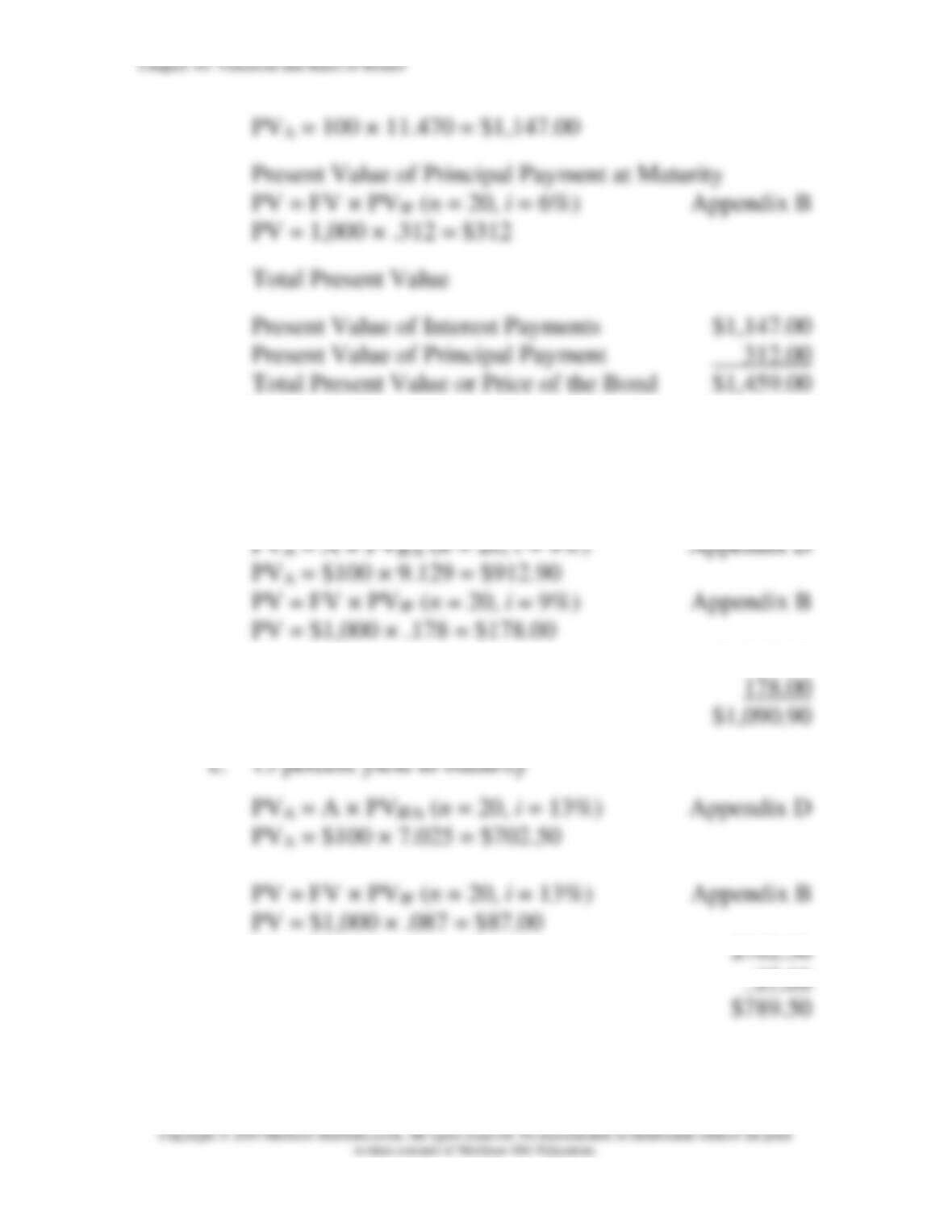
(b) 9 percent yield to maturity
N
I/Y
PV
PMT
FV
20
9
CPT PV −1,091.29
100
1,000
Answer: $1,091.29 Current bond price
(c) 13 percent yield to maturity
N
I/Y
PV
PMT
FV
20
13
CPT PV −789.26
100
1,000
Chapter 10: Valuation and Rates of Return
Exodus Limousine Company
Calculator Solution:
(a) 5 percent yield to maturity
N
I/Y
PV
PMT
FV
50
5
CPT PV −1,912.80
100
1,000
Answer: $1,912.80 Current bond price
(b) 15 percent yield to maturity
N
I/Y
PV
PMT
FV
50
15
CPT PV −666.97
100
1,000
Present Value of Interest Payments
PVA = A × PVIFA (n = 50, i = 15%) Appendix D
PVA = $1,000 × 6.661 = $666.10
Chapter 10: Valuation and Rates of Return
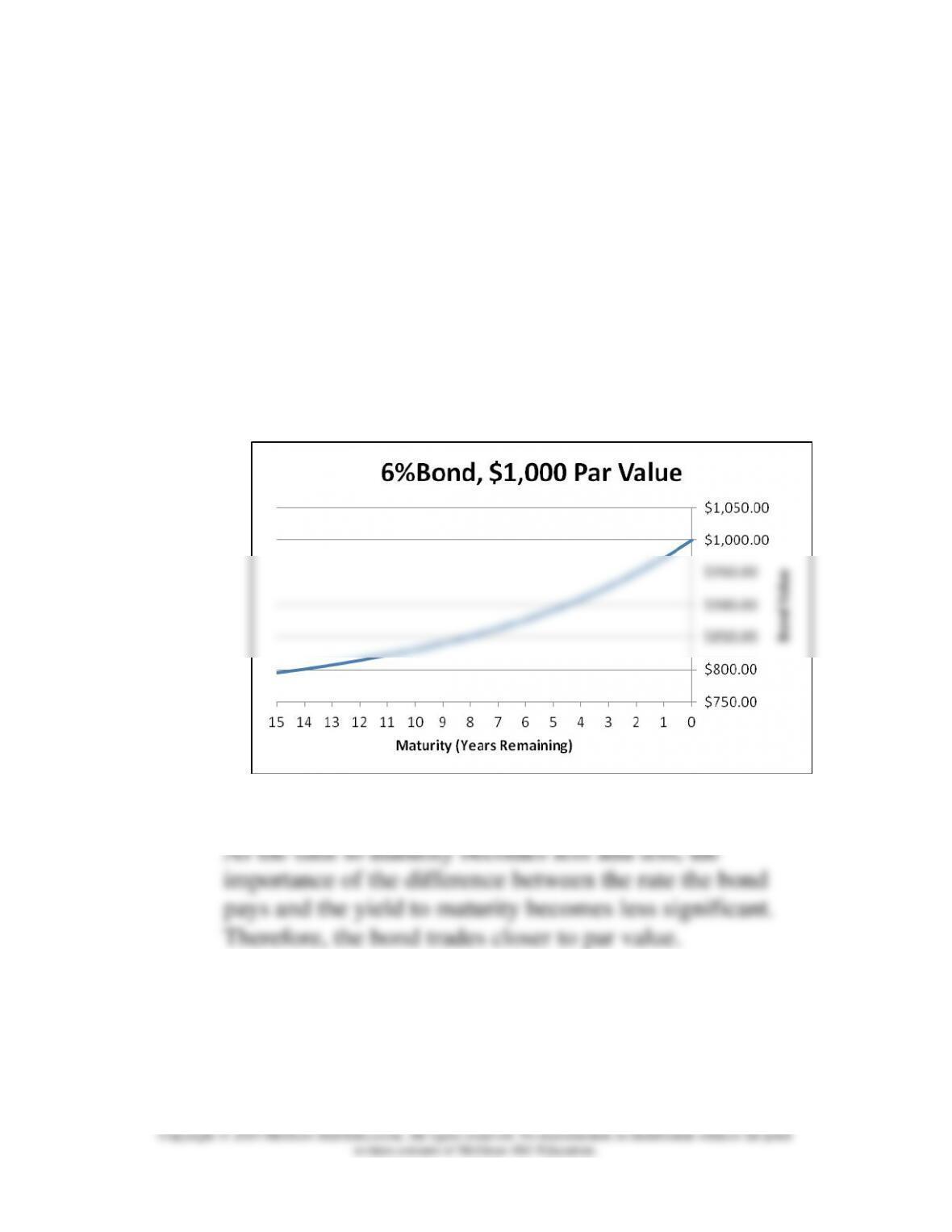
8 percent, and remains so over the remaining life of the bond, the bond will have
the following values over time:
Remaining
Maturity
Bond
Price
15
$795.67
10
$830.49
5
$891.86
1
$973.21
Graph the relationship in a manner similar to the bottom half of Figure 10-2. Also
explain why the pattern of price change takes place.
10-7. Solution:
Toxaway Telephone Company
8. Go to Table 10-1, which is based on bonds paying 10 percent interest for 20 years.
Assume interest rates in the market (yield to maturity) decline from 11 percent to
8 percent:
a. What is the bond price at 11 percent?
b. What is the bond price at 8 percent?
Chapter 10: Valuation and Rates of Return
c. What would be your percentage return on investment if you bought when rates were
11 percent and sold when rates were 8 percent?
10-8. Solution:
Purchase Price $920.37
9. Interest rate effect (LO10-3) Go to Table 10-1, which is based on bonds paying 10
percent interest for 20 years. Assume interest rates in the market (yield to maturity)
increase from 9 to 12 percent.
a. What is the bond price at 9 percent?
b. What is the bond price at 12 percent?
c. What would be your percentage return on the investment if you bought when
rates were 9 percent and sold when rates were 12 percent?
10–9. Solution:
Purchase Price $1,091.29
10. Interest rate effect (LO10-3) Using Table 10-1, assume interest rates in the market
(yield to maturity) are 14 percent for 20 years on a bond paying 10 percent.
a. What is the price of the bond?
Chapter 10: Valuation and Rates of Return
b. Assume five years have passed and interest rates in the market have gone down
to 12 percent. Now, using Table 10-2 for 15 years, what is the price of the
bond?
c. What would your percentage return be if you bought the bonds when interest
rates in the market were 14 percent for 20 years and sold them 5 years later
when interest rates were 12 percent?
10–10. Solution:
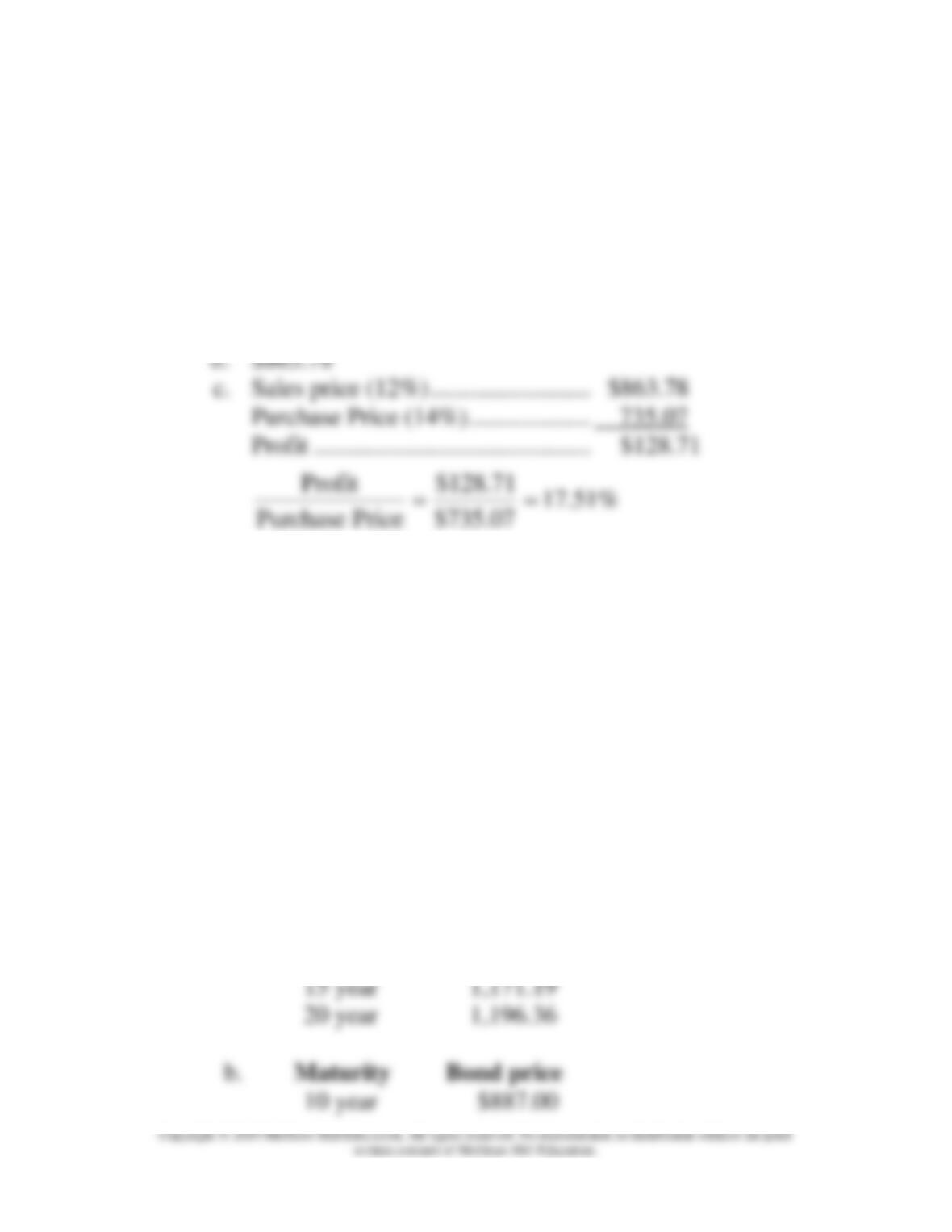
a. $735.07
Purchase Price $735.07
11. Effect of maturity on bond price (LO10-3) Using Table 10-2:
a. Assume the interest rate in the market (yield to maturity) goes down to 8
percent for the 10 percent bonds. Using column 2, indicate what the bond price
will be with a 10-year, a 15-year, and a 20-year time period.
b. Assume the interest rate in the market (yield to maturity) goes up to 12 percent
for the 10 percent bonds. Using column 3, indicate what the bond price will be
with a 10-year, a 15-year, and a 20-year period.
c. Based on the information in part a, if you think interest rates in the market are
going down, which bond would you choose to own?
d. Based on information in part b, if you think interest rates in the market are
going up, which bond would you choose to own?
10-11. Solution:
a.
Maturity
Bond price
10 year
$1,134.20
15 year
1,171.19
20 year
1,196.36
b.
Maturity
Bond price
10 year
$887.00
Chapter 10: Valuation and Rates of Return
Answer: $1,224.08 New bond price
Present Value of Interest Payments
PVA = A × PVIFA (n = 20, i = 12%) Appendix D
PVA = $150 × 7.469 = $1,120.35
Present Value of Principal Payment at Maturity
PV = FV × PVIF (n = 20, i = 12%) Appendix B
PV = $1,000 × .104 = $104
$1,120.35
104.00
$1,224.35