Chapter 1
Currency Exchange Rates
1. Since the value of the British pound in U.S. dollars has gone down, it has depreciated with respect to
the U.S. dollar. Therefore, the British will have to spend more British pounds to purchase U.S. goods.
Accordingly, the correct answer is (c).
4. a. One baht was worth 1/25 or 0.04 dollars earlier. It is worth 1/30 or 0.0333 dollars now. Thus,
the baht has depreciated with respect to the dollar. Percentage change in the dollar value of the
5. The increase in £:$ exchange rate implies that the pound has appreciated with respect to the dollar.
This is unfavorable to the trader since the trader has a short position in pounds.
6. Three cross-exchange rates need to be computed: SFr/€, ¥/€, SFr/¥.
7. These quotations mean that Bank A is willing to buy one euro for 1.1210 dollars (bid rate) or to
8. The percentage spread is considerably higher for the Polish zloty than for the British pound. The
market for the Polish zloty is much less liquid than the market for the British pound. There is a lot
2 Solnik/McLeavey • Global Investments, Sixth Edition
9. These quotes are unreasonable because they deviate from Bank A to Bank B by more than the
spread; for example, Bank A’s ask rate (121.25) is smaller than Bank B’s bid rate (121.30). There is,
10. The €:SFr quotation is obtained as follows. In obtaining this quotation, we keep in mind that €:SFr =
$:SFr €:$, and that the price for each transaction (bid or ask) is the one that is more advantageous
to the trader.
11. The A$:SFr quotation is obtained as follows. In obtaining this quotation, we keep in mind that
A$:SFr = ($:SFr) ($:A$), and that the price (bid or ask) for each transaction is the one that is more
advantageous to the bank.
The A$:SFr bid price is the number of SFr the bank is willing to pay to buy one A$. This transaction
Chapter 1 Currency Exchange Rates 3
12. The SFr:A$ quotation is obtained as follows. In obtaining this quotation, we keep in mind that
SFr:A$ = ($:As) ($:SFr), and that the price (bid or ask) for each transaction is the one that is more
advantageous to the bank.
The SFr:A$ bid price is the number of A$ the bank is willing to pay to buy one SFr. This transaction
13. The bid ¥:C$ rate would be the inverse of the ask C$:¥ rate, and the ask ¥:C$ rate would be the
inverse of the bid C$:¥ rate. Therefore,
14. a. There would be no arbitrage opportunities if cross rate SFr:DKr = $:DKr SFr:$.
Because $:SFr =1.65, SFr:$ = 1/1.65 = 0.6061.
15. The implicit cross rate between yen and pound is £:¥ = $:¥ £:$ = 128.17 1.4570 = 186.74.
However, Midland Bank is quoting a lower rate of ¥183 per £. So, triangular arbitrage is possible.
In the cross rate of ¥183 per £ quoted by Midland, one pound is worth 183 yen, whereas the cross
4 Solnik/McLeavey • Global Investments, Sixth Edition
16. a. The implicit cross rate between Australian dollars and Swiss francs is SFr:A$ = $:A$ SFr:$ =
($:A$) ($:SFr) = 1.8215/1.5971 = 1.1405. However, the quoted cross rate is higher at
A$1.1450 per SFr. So, triangular arbitrage is possible.
b. In the quoted cross rate of A$1.1450 per SFr, one Swiss franc is worth A$1.1450, whereas the
cross rate based on the direct rates implies that one Swiss franc is worth A$1.1405. Thus, the
17. The value of the £ in $ is worth less three months forward than it is now. Thus, the £ is trading at a
forward discount relative to the $. Therefore, the £ is “weak” relative to the $. Because a $ is worth
18. The midpoint of the spot dollar to pound exchange rate is £:$ = 1.4573. The midpoint of the six-
month forward dollar to pound exchange rate is £:$ = 1.4421.
a. Based on the midpoints, the dollar value of a pound is 1.4573 now and only 1.4421 six months
forward. Thus, the pound is worth less six months forward than now. That is, the pound is trading
1.4573 6
19. The midpoint of the spot Swiss franc to dollar exchange rate is $:SFr = 1.5965. The midpoint of the
three-month forward Swiss franc to dollar exchange rate is $:SFr = 1.5947.
a. Based on the midpoints, a dollar is worth SFr 1.5965 now and only 1.5947 three months forward.
Chapter 1 Currency Exchange Rates 5
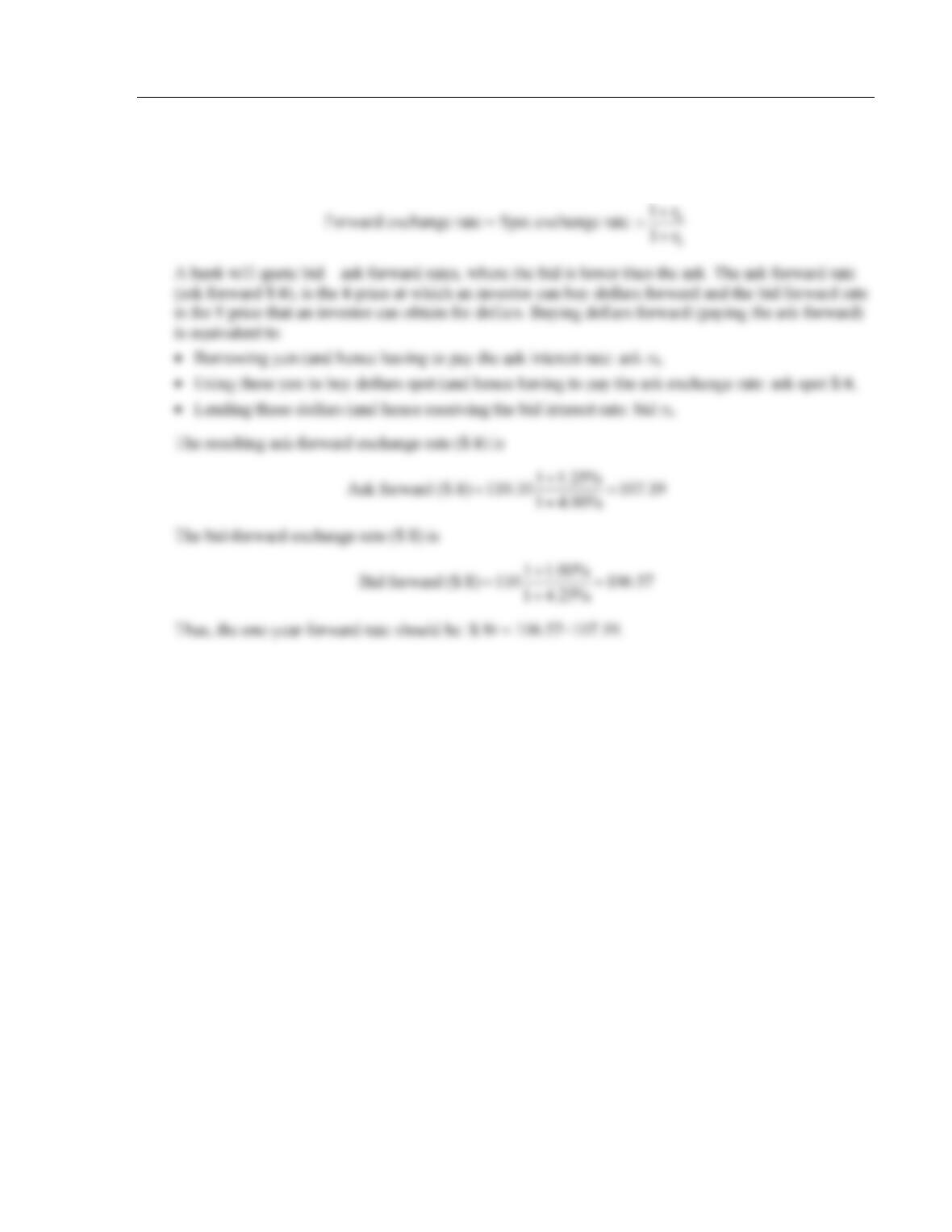
20. Let’s first make sure we calculate the forward rate in the proper direction. The one-year forward
rate $:¥ is given by Equation (1.3), where the dollar is the quoted currency (a) measured in yen
(currency b):