CHAPTER 1: Discussion Questions and Problems
1. Differentiate the following terms/concepts:
a. Prospect and probability distribution
probability, whereas a probability distribution defines the likelihood of possible outcomes.
b. Risk and uncertainty
c. Utility function and expected utility
d. Risk aversion, risk seeking, and risk neutrality
Risk aversion describes someone who prefers the expected value of a lottery to the lottery
2. When eating out, Rory prefers spaghetti over a hamburger. Last night she
had a choice of spaghetti and macaroni and cheese and decided on the spaghetti
again. The night before, Rory had a choice between spaghetti, pizza, and a
hamburger and this time she had pizza. Then, today she chose macaroni and
cheese over a hamburger. Does her selection today indicate that Rory’s choices
are consistent with economic rationality? Why or why not?
3. Consider a person with the following utility function over wealth: u(w) = ew,
where e is the exponential function (approximately equal to 2.7183) and w =
wealth in hundreds of thousands of dollars. Suppose that this person has a 40%
2 | P a g e
chance of wealth of $50,000 and a 60% chance of wealth of $1,000,000 as
summarized by P(0.40, $50,000, $1,000,000).
a. What is the expected value of wealth?
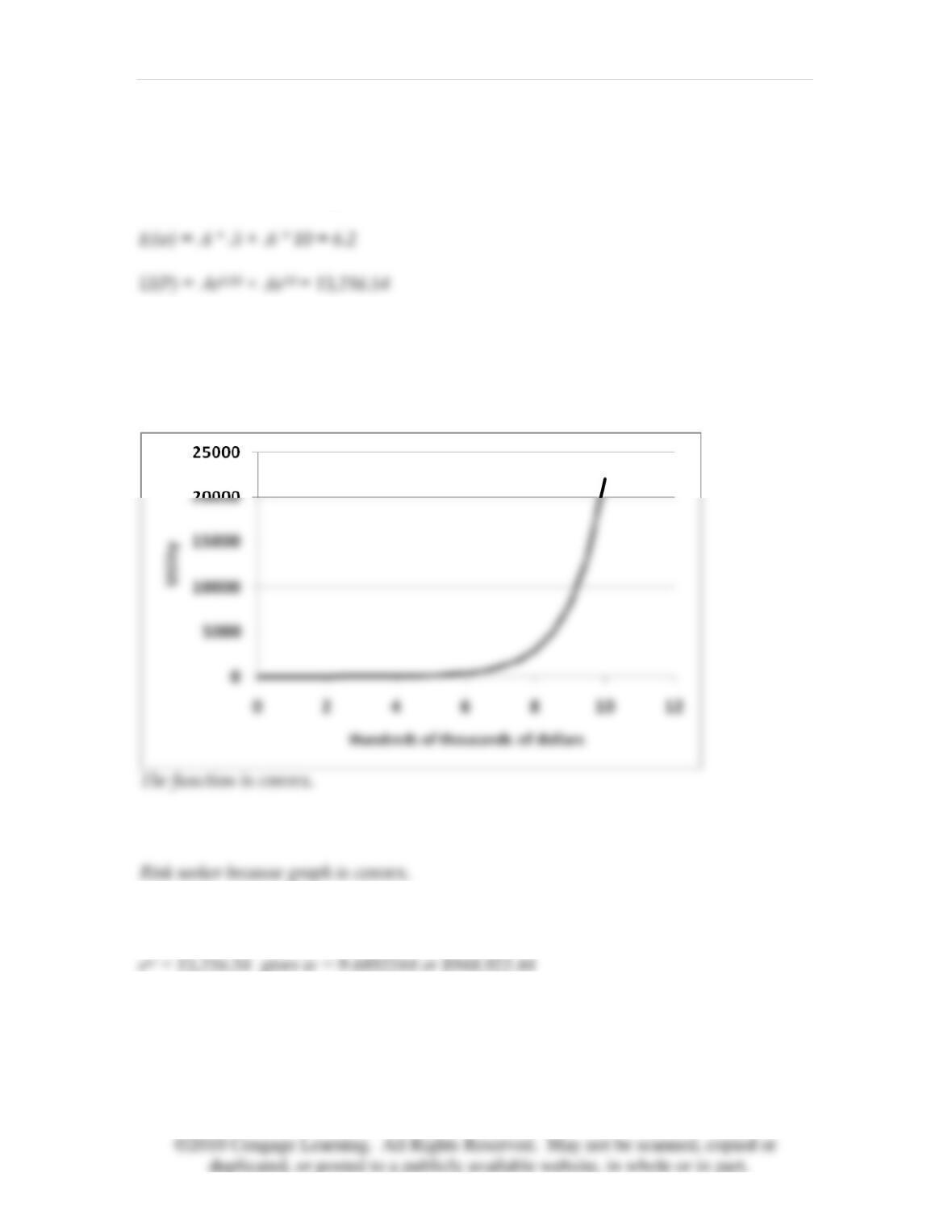
b. Construct a graph of this utility function.
c. Is this person risk averse, risk neutral, or a risk seeker?
d. What is this person’s certainty equivalent for the prospect?
4. An individual has the following utility function: u(w) = w.5 where w = wealth.
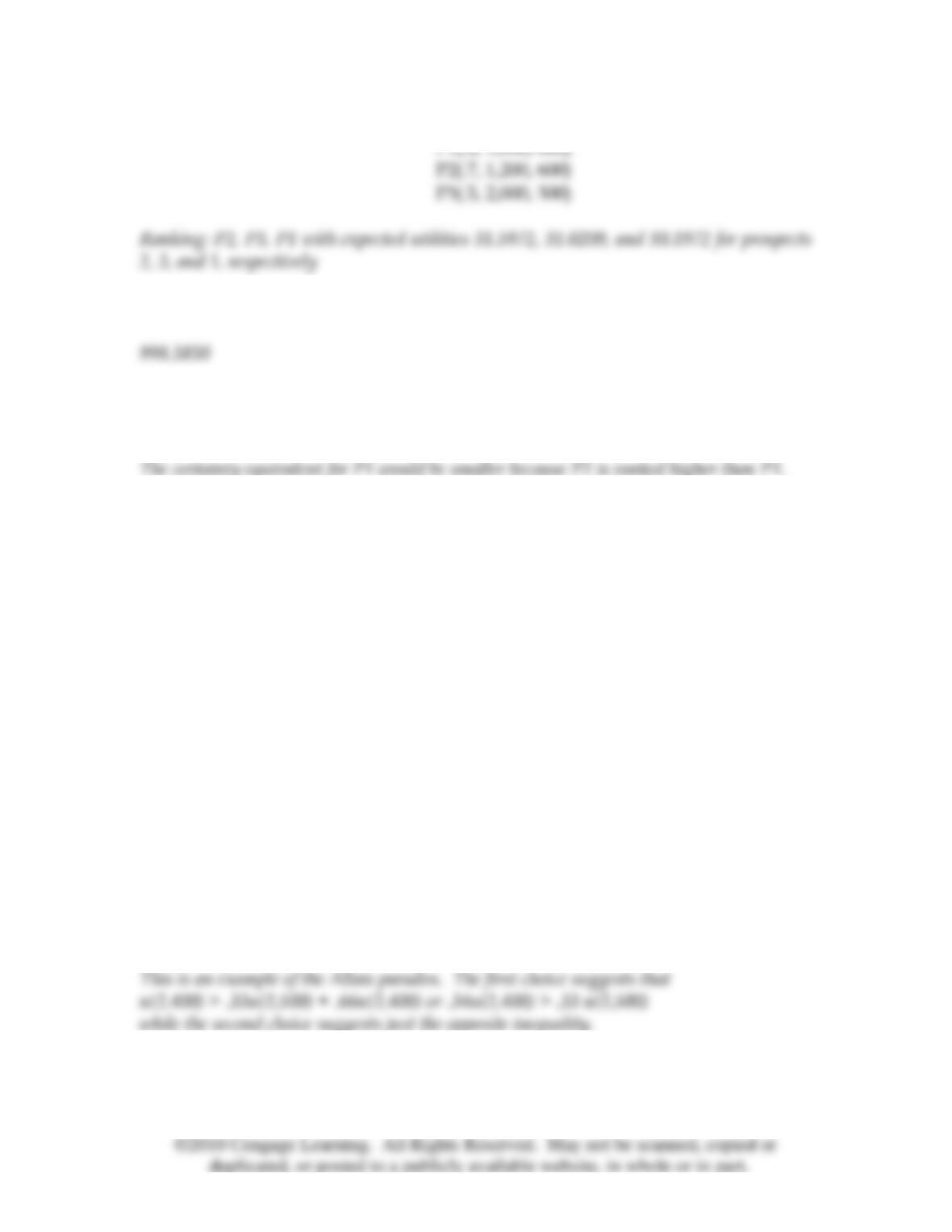
a. Using expected utility, order the following prospects in terms of
preference, from the most to the least preferred:
3 | P a g e
b. What is the certainty equivalent for prospect P2?
c. Without doing any calculations, would the certainty equivalent for
prospect P1 be larger or smaller? Why?
5. Consider two prospects:
Problem 1: Choose between
Prospect A: $2,500 with probability .33,
$2,400 with probability .66,
Zero with probability .01.
And Prospect B: $2,400 with certainty.
Problem 2: Choose between
Prospect C: $2,500 with probability .33,
Zero with probability .67.
And Prospect D: $2,400 with probability .34,
Zero with probability .66.
It has been shown by Daniel Kahneman and Amos Tversky (1979, “Prospect
theory: An analysis of decision under risk,” Econometrica 47(2), 263-291) that
more people choose B when presented with problem 1 and when presented with
problem 2, most people choose C. These choices violate expected utility theory.
Why?