International Business, 2e
Geringer, McNett, Ball
Instructor Guide to Module C
Bonus C-17
Copyright © 2020 by McGraw-Hill Education. All rights reserved. No reproduction or distribution without the prior written consent of McGraw-Hill
Education.
Online and Hybrid: Virtual teams evaluate Demaria’s advice for their own career development,
particularly as it relates to working with people from other cultures. Share conclusions with
class, either online or in face-to-face setting.
Face-to-Face: Students evaluate their own career strategy in light of Demaria’s advice.
1. What do you think of the nature of the international work that Demaria was involved in?
Would this sort of activity be interesting and fulfilling to you? Why or why not?
2. What do you think of Demaria’s advice to be as brave as you can? When would this be
good to follow and when would it not be?
Students will have various answers to this question. Many will discuss overcoming the fear of
International Business, 2e
Geringer, McNett, Ball
Instructor Guide to Module C
Bonus C-18
END OF MODULE EXERCISES
CRITICAL THINKING QUESTIONS
1. What recent developments have caused supply chain management to become increasingly
important to international companies? Do you expect supply chain management to become
less, or more, important as 3D printing technology becomes more commercially viable?
Explain your rationale.
Individual businesses no longer operate in a vacuum and are forced to compete with businesses
from around the globe. For this reason management should be constantly searching for
2. Is the reduction of inventory an appropriate goal of supply chain management systems?
What benefits might result from reducing inventory? What problems might result from
inventory reduction efforts?
3. What are the main differences between sequential and concurrent approaches to the
design of products and services? What problems might a company encounter if it decided to
use concurrent design?
4. Why would a company choose to source raw materials, components, or other products or
services from a foreign supplier? What problems or concerns can arise from relying on foreign
International Business, 2e
Geringer, McNett, Ball
Instructor Guide to Module C
Bonus C-19
sources for a company’s supplies, and how might these differ from the factors arising from
outsourcing to a domestic firm?
5. What concerns arise as a firm purchases an increasing portion of its materials from outside
firms, especially those located in foreign countries, rather than producing these materials
itself? How might this threaten the long-term competitiveness of a firm, and what might a
firm do in order to lessen such risks?
The reason for a large and increasing proportion of cost of raw materials in the overall cost of
goods sold is due to the greater complexity of products and the increasing pressure for firms to
focus on their core business and outsource other non-core activities. Also, competitive
pressures and an emphasis on reducing concept to market cycle times have resulted in a rapid
International Business, 2e
Geringer, McNett, Ball
Instructor Guide to Module C
Bonus C-20
6. In what ways may the emergence of global electronic procurement be a potential benefit
for small and midsized companies, and in what ways might global electronic procurement
pose a threat to these companies?
The answers to this question may vary. Smaller companies are using the Internet to purchase
raw materials as well as to sell their products to customers, often on a worldwide basis.
Developments such as e-procurement exchanges have opened the door for many smaller
7. What are the advantages to a worldwide firm of global standardization of its production
facilities? Why might a firm not want to achieve such standardization across its network of
facilities?
The complexity of a global manufacturing company’s operation is immense. Standardization of
its production facilities allows the business to simplify the production systems and allows for
more control from headquarters. Most planning and design functions are done at a central
International Business, 2e
Geringer, McNett, Ball
Instructor Guide to Module C
Bonus C-21
Copyright © 2020 by McGraw-Hill Education. All rights reserved. No reproduction or distribution without the prior written consent of McGraw-Hill
Education.
personnel inspect and replace worn parts. A fatalistic attitude that is common in some cultures
is a deterrent to planning, the basis of preventive maintenance.
8. How might an international company’s decision to adopt approaches such as just–in-time
manufacturing systems or Six Sigma within its international network of subsidiaries result in a
decline in its short- and longer-term performance?
9. How might global logistics practices be impacted by developments such as 3D printing
technology or a sustained rise in the global price of oil?
10. What differences might you expect to see in the approach used for global manufacturing
and supply chain management for a product that has stable demand and limited change in its
basic design, versus a product that experiences substantial changes in demand and continued
GLOBALEDGE RESEARCH TASK
Exercise 1
All countries can be accessed in the ‘by Country’ section which is in “Global Insights” section.
Once a country is selected, its profile page will be displayed. Select ‘Indices’ from the left-hand
International Business, 2e
Geringer, McNett, Ball
Instructor Guide to Module C
Bonus C-22
Resource Name: International Logistics Performance Index
Exercise 2
All countries can be accessed in the ‘by Country’ section which is in “Global Insights” section.
Once a country is selected, its profile page will be displayed. Select ‘Indices’ from the left-hand
MINICASE: Modern Millennials Apparel Company Outsources Domestic Production
This minicase provides an opportunity for students to examine a situation in which a company
has closed its domestic manufacturing operations and outsourced the production to companies
in Vietnam. A number of issues have arisen in conjunction with this decision to offshore
production.
1. Identify specific concepts in the case found in this module and discuss their relevance to
the problems facing the company.
i. Outsourcing and offshoring – Companies tend to jump on the “band wagon” and follow
other companies in an effort to not be left behind. Modern Millennials Apparel appears
iii. Logistics – The ability to efficiently move product from point A to B is integral to
lowering costs. The Modern Millennials Apparel company’s original plans were a
logistical nightmare. In the Mexican maquiladora, Modern Millennials Apparel will have
International Business, 2e
Geringer, McNett, Ball
Instructor Guide to Module C
Bonus C-23
Copyright © 2020 by McGraw-Hill Education. All rights reserved. No reproduction or distribution without the prior written consent of McGraw-Hill
Education.
transportation rule. Required contingency plans include: Mexican and U.S. holidays,
weather forcing roads and bridges to close, cross docking of freight in order for the
appropriate licensed transportation lines in each country to travel and deliver their
contents.
iv. Organization and staffing – A new organization structure must be developed that will
allow for the continual monitoring and subsequent production adjustments coming
from both offshore sources. In addition, bilingual representatives will be needed to
communicate more efficiently with both the Vietnam and Mexico facilities.
vii. Design of the manufacturing systems – The Vietnam location resulted in a longer- than-
desired operations pipeline resulting in high inventories. Relocating some of the
2. Considering all of the problems incurred in Vietnam and the immense effort and capital
needed to start up the Mexico operation, would it have been a better idea for Modern
Millennials to keep its domestic operations? Why or why not?
In order for the company to retain and grow its market share in a low-cost provider strategy,
Modern Millennials Apparel must keep its prices in line with its competition. Given the vast
differences in labor costs and the high percentage of labor involved in producing garments,
International Business, 2e
Geringer, McNett, Ball
Instructor Guide to Module C
Bonus C-24
Modern Millennials Apparel has no choice but to move enough of its production to low labor
cost areas.
International Business, 2e
Geringer, McNett, Ball
Instructor Guide to Module C
Bonus C-25
BONUS ACTIVITIES
This section provides you with support of your course above and beyond what is found in the
text. We have developed these resources to support your course, to support your traditional,
hybrid, online, or flipped class.
VIDEO SUGGESTIONS
McGraw Hill’s collection of international business videos is available at
Implications of examination of operating standards in the food services are highlighted in the
video “McDonald’s: Russia watchdog widens probe into food chain,” found at
TEAM EXERCISES
These may be done individually or in groups or teams, either in or out of class, for later class
presentation. Some are also appropriate for use in hybrid/flipped classroom and online courses.
International Business, 2e
Geringer, McNett, Ball
Instructor Guide to Module C
Bonus C-26
1. 3D Printing’s Impact on Global Manufacturing and Supply Chains
We have had good response from students when we have asked them to analyze the
introductory vignette on 3D printing and the likely impact it will have on global manufacturing
2. Key Elements of the Global Supply Chain
Assign students to identify key elements of the global supply chain for a company such as Apple
(e.g., for the iPhone), Ford (e.g., for the Focus), or Old Navy (e.g., jeans or shirts). Have them try
3. Standardization
Have students report on the extent to which a company standardizes various parts of its total
product (e.g., you could use a well-known consumer product such as McDonald’s sandwiches or
SUPPLEMENTAL ACTIVITIES
Case Studies
Case studies that focus on intercultural issues and their effects in business environments are
available through Ivey Publishing and Harvard Business School. Ivey’s catalog is available for
Harvard Cases
“Market Expansion at CMS Electronics,” examines the challenges confronted by CMS
Electronics, a European provider of electronic manufacturing services, when trying to “follow
International Business, 2e
Geringer, McNett, Ball
Instructor Guide to Module C
Bonus C-27
small size. The case highlights the impacts of changes in the international manufacturing center
of gravity on the internationalization strategies of existing competitors. This is a HEC Montreal
Center for Case Studies case.
CONTROVERSIAL ISSUES
1. Global Debate: Is Cognizant Technology Solutions Leveraging Low-Cost Talent or Exploiting
It?
This box feature described earlier in this module’s Instructor Guide provides an excellent
foundation for debating some of the issues raised in the text, including issues about offshoring
and outsourcing.
2. IB in Practice: Zara: Using Innovative Supply Chain Management to Transform the
International Fashion Industry
This box feature described earlier in this module’s Instructor Guide can be an interesting tool
for generating discussion and debate. This discussion provides a useful overview of many of the
concepts discussed in the chapter. We find that students often have a broad range of
International Business, 2e
Geringer, McNett, Ball
Instructor Guide to Module C
Bonus C-28
challenges and logistics of their business, provide a fascinating example that the students find
interesting and stimulating for discussion.
3. Current Events for Sources of Content on Global Operations and Supply Chain Management
Controversy
A focus on current events that are relevant to the module’s topics is a good way to bring home
the concepts, review their application, and build news-review habits. Ask everyone to come
prepared with an article for every meeting. If a meaningful percentage of the final grade is
TEACHING SUGGESTIONS
1. Supply chain management (SCM) is an area of growing importance to which students may
want to pay attention. Our teaching experience with this chapter suggests that students are
2. Identify problems that a marketing manager might have with establishing and implementing
a newly internationalized supply chain, both backward and forward. How would the manager
International Business, 2e
Geringer, McNett, Ball
Instructor Guide to Module C
Bonus C-29
3. Overby Manufacturing of Boston has begun to build a plant in Bangkok and management is
choosing American personnel who will be sent to fill the top administrative positions. The Vice
President for Procurement wants to send a promising young buyer to head up the purchasing
4. Guest Lecturer possibilities: Some people who could contribute to the material in this
module would be:
• An overseas purchasing agent or someone who has been involved in designing or
implementing electronic purchasing system, ISO application, or a Six Sigma process.
• Someone with international quality control experience could be an interesting guest
International Business, 2e
Geringer, McNett, Ball
Instructor Guide to Module C
CONNECT TOOLS FOR ASSESSEMENT OF LEARNING
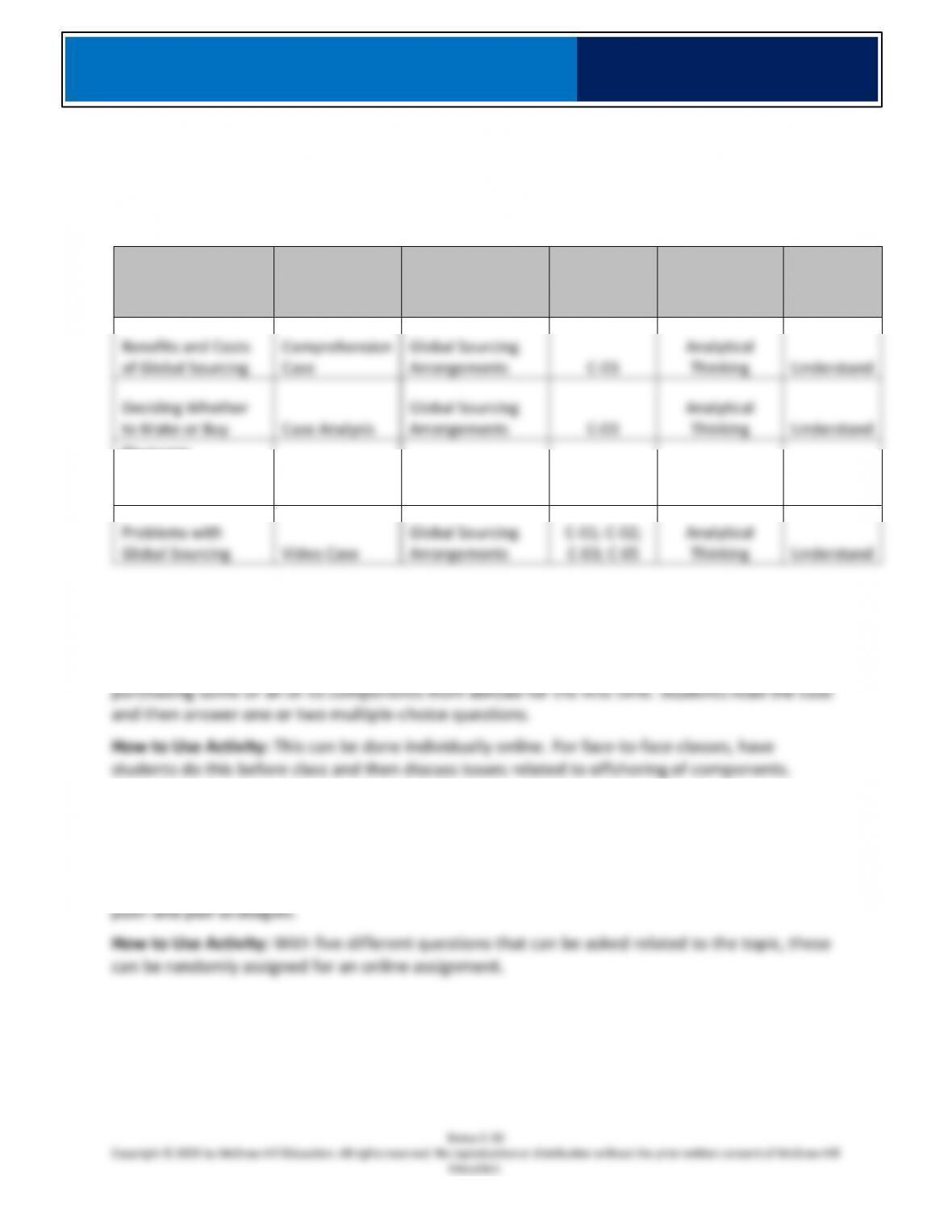
CONNECT CONTENT MATRIX
For every chapter, please refer to the Connect Content Matrix to see what application exercises
are available and what Learning Objectives they help reinforce/assess.
Title
Assignment
Type
Topic(s)
Learning
Objective(s)
AACSB
Accreditation
Tagging
Bloom’s
Taxonomy
Benefits and Costs
of Global Sourcing
Comprehension
Case
Global Sourcing
Arrangements
C-03
Analytical
Thinking
Understand
Deciding Whether
to Make or Buy
Case Analysis
Global Sourcing
Arrangements
C-03
Analytical
Thinking
Understand
Electronic
Purchasing for
Global Sourcing
Comprehension
Case
Global Sourcing
Arrangements
C-03
Analytical
Thinking
Understand
Problems with
Global Sourcing
Video Case
Global Sourcing
Arrangements
C-01; C-02;
C-03; C-05
Analytical
Thinking
Understand
CONNECT ACTIVITIES
1. Benefits and Costs of Global Sourcing
Activity Summary: This is a case about a U.S. manufacturer of skateboards that is considering
2. Deciding Whether to Make or Buy
Activity Summary: In this case analysis, students are told that they are given the assignment to
promote a fast-moving consumer good and then asked multiple-choice questions related to

International Business, 2e
Geringer, McNett, Ball
Instructor Guide to Module C
3. Electronic Purchasing for Global Sourcing
Activity Summary: This case discusses the solar industry setting up a B2B electronic purchasing
4. Problems with Global Sourcing
Activity Summary: This is a video case in which students watch a short video about waste