International Business, 2e
Geringer, McNett, Ball
Instructor Guide to Module B
Bonus B-13
Copyright © 2020 by McGraw-Hill Education. All rights reserved. No reproduction or distribution without the prior written consent of McGraw-Hill
Education.
can research different cases where a country has applied these practices, whether it is the
export of weapons, food, chemicals used for executions, or other products. The students’
findings can provide a strong basis for discussion or debate on these issues. Virtual teams can
be assigned questions and submit their work as a group. Alternatively, virtual teams can be
assigned to take different roles or perspectives to argue for (or against) and these assignments
can be submitted as a group and then opened up to discussion and debate on an online class
discussion site or blog, or presented and debated in a face-to-face setting.
Face-to-Face: Students develop responses to the questions in class in teams/groups, or else
assign perspectives and conduct an in-class debate and discussion.
1. Should home-country ethics be applied to exports?
The answers to this question will vary, and it is intended to help people think through the issues
from various perspectives. It is not uncommon for some students to suggest that there are
2. Should quality standards thought appropriate for the domestic market be maintained for
export markets in areas such as pharmaceuticals? Should the United Kingdom, which has
outlawed the death penalty, export execution drugs to the United States?
3. To what degree are ethics domestic and to what degree are they universal? What do you
think?
This question can raise interesting issues for discussion and debate. Some students may suggest
that ethics are linked to cultures and their institutions, which would imply that they are
International Business, 2e
Geringer, McNett, Ball
Instructor Guide to Module B
Bonus B-14
Copyright © 2020 by McGraw-Hill Education. All rights reserved. No reproduction or distribution without the prior written consent of McGraw-Hill
Education.
GET THAT JOB! FROM BACKPACK TO BRIEFCASE: Cameron Mauzy: Internationalizing through
Learning a Language and Immersing Abroad
1. Mauzy mentioned that he used to be concerned about just moving to another state, but
now he is actively engaged in traveling to and living in China. How does one overcome the
fear of traveling to and living in new places?
2. How is moving from one state or province to another like and unlike moving to another
country?
Student answers will vary depending on their experiences. This is an especially good question
3. Mauzy mentioned that it is important to be flexible. Why is that so important?
International Business, 2e
Geringer, McNett, Ball
Instructor Guide to Module B
END OF MODULE EXERCISES
CRITICAL THINKING QUESTIONS
1. In exporting, at what point does the risk of loss or damage pass to the buyer? Use
Incoterms to explain your response.
2. Explain the protection the various export payment terms offer the seller.
Cash in Advance offers most protection to the seller because the seller receives payment before
3. How does the bank operate as an intermediary in an L/C transaction?
4. The manager of the international department of the Cape Cod Five Bank learns that the
ship on which a local exporter shipped Wellfleet oysters in saltwater tanks to Spain has sunk
in high seas. She has received all the documents required in the letter of credit and is ready to
pay the exporter for the shipment. In view of the news about the ship, the manager now
knows that the Spanish customer will never receive the goods. Should the manager pay the
exporter, or should she withhold payment and notify the overseas customer? Explain your
answers.
5. How might the use of a free trade zone impact the pricing of an imported good composed
of French and domestic components that was assembled in the FTZ?
6. What are the consequences of losing an export bill of lading for a shipment you need to
collect?
International Business, 2e
Geringer, McNett, Ball
Instructor Guide to Module B
7. An importer brings plain sports shirts into the United States because the import duty is
lower than it is for shirts with adornments. In New Jersey, the importer sews on a figure of a
fox. Could the importer do this operation in a foreign trade zone with no cost impact?
8. How would you find sources for a product that you saw when traveling in Myanmar and
want to import to sell in your design studio?
9. “Exporting is so complicated it’s not worth the extra hassle.” How might you respond to
this statement made by your company’s director of marketing?
The answers to this question may vary, but the module’s introduction notes that reluctance to
engage in exporting is often linked to a lack of knowledge, particularly regarding how to identify
promising foreign markets and customers, understanding payment and financing procedures,
10. Exporting contributes about 12 percent to the U.S. GDP, which is low compared to other
developed nations. Why might this be the case?
GLOBALEDGE RESEARCH TASK
Exercise 1
“Export Tutorials” can be found in the Reference Desk section of globalEDGE. You can also access
the resource by searching for “Export Tutorials”. The first available category is “Export
International Business, 2e
Geringer, McNett, Ball
Instructor Guide to Module B
Bonus B-17
Copyright © 2020 by McGraw-Hill Education. All rights reserved. No reproduction or distribution without the prior written consent of McGraw-Hill
Education.
Search Phrase: Export Tutorials
Resource Name: Export Tutorials
Resource Link: https://globaledge.msu.edu/reference-desk/export-tutorials
Exercise 2
“Export Tutorials” can be found in the Reference Desk section of globalEDGE. You can also access
the resource by searching for “Export Tutorials”. The second available category is “Government
Regulations” where the requirements for licensing can be found in the first line. The two
MINICASE: Nashville Guitar Store
This minicase provides an opportunity for students to examine a situation in which a company
is purchasing products (guitars) that fail to meet buyer specifications, creating an opportunity
for the company to refurbish the product to an acceptable level of quality. The products are
then resold, with a portion of these going to foreign customers.
1. Can you think of other possible businesses that could use this import-add value-re-export
strategy?
2. Are there ways Mark could vertically integrate to capture more of the value his business
adds to the guitars?
Answers can vary here. He could potentially set up activities online or in brick-and-mortar
facilities to actively seek out damaged guitars or guitars that are in need of updating, thereby
International Business, 2e
Geringer, McNett, Ball
Instructor Guide to Module B
BONUS ACTIVITIES
This section provides you with support of your course above and beyond what is found in the
text. We have developed these resources to support your course, to support your traditional,
hybrid, online, or flipped class.
VIDEO SUGGESTIONS
McGraw Hill’s collection of international business videos is available at
TEAM EXERCISES
These may be done individually or in groups or teams, either in or out of class, for later class
presentation. Some are also appropriate for use in hybrid/flipped classroom and online courses.
1. Interviews
We have had good response from asking the students to interview people involved in exporting
2. Export Examples
Ask the students to choose a product and a country to which they wish to export it. Assume an
FOB factory selling price and prepare a quotation using one of the terms of sale in the text.
Specify export payment terms. What other documents will be required?
International Business, 2e
Geringer, McNett, Ball
Instructor Guide to Module B
Bonus B-19
3. Career Opportunities
Have students identify and discuss, first in small groups and then in large groups, what career
opportunities there might be in the area of exporting. Encourage the students to consider
SUPPLEMENTAL ACTIVITIES
Case Studies
Case studies that focus on intercultural issues and their effects in business environments are
available through Ivey Publishing and Harvard Business School. Ivey’s catalog is available for
“Ferro Industries – Exporting Challenge in a Small Firm,” examines the exporting challenge
facing a small firm within the Indian steel industry. Issues addressed include the stage at which
Harvard Cases
“Malincho” describes the challenges faced by a recent U.S. immigrant from Bulgaria who sets
up an importing business to bring bulk feta cheese from Bulgaria to the U.S.A. Lacking prior
experience in importing and exporting, he confronts issues such as identifying opportunities,
International Business, 2e
Geringer, McNett, Ball
Instructor Guide to Module B
Bonus B-20
CONTROVERSIAL ISSUES
1. Global Debate: The Ethics of Exporting: Do Home Values Apply?
This boxed element described earlier in this module’s Instructor Guide provides an excellent
foundation for debating some of the issues raised in the text, including issues about the
2. Current Events for Sources of Content on Importing and Exporting
A focus on current events that are relevant to the module’s topics is a good way to bring home
the concepts, review their application, and build news-review habits. Ask everyone to come
prepared with an article for every meeting. If a meaningful percentage of the final grade is
TEACHING SUGGESTIONS
1. This module covers the process of exporting in a hand-on way, describing the processes.
Unlike other topics in this text, this area is all implementation. It is an important area for
2. The issue of exporting opportunities sometimes is difficult for students to understand,
particularly regarding the sheer magnitude of exporting and importing activities and how it has
International Business, 2e
Geringer, McNett, Ball
Instructor Guide to Module B
might encounter in trying to export products successfully. Exploring how culture and other
institutional forces might impact the likelihood of exporting success can also be insightful for
students.
3. Guest Lecturer possibilities: Some people who could contribute to the material in this
module would be:
• If you have a foreign freight forwarder in your area, invite him or her to explain the
firm’s services to exporters. A good forwarder can help a newcomer to get started
and is one person who is knowledgeable about the entire exporting process.
International Business, 2e
Geringer, McNett, Ball
Instructor Guide to Module B
CONNECT TOOLS FOR ASSESSEMENT OF LEARNING
CONNECT CONTENT MATRIX
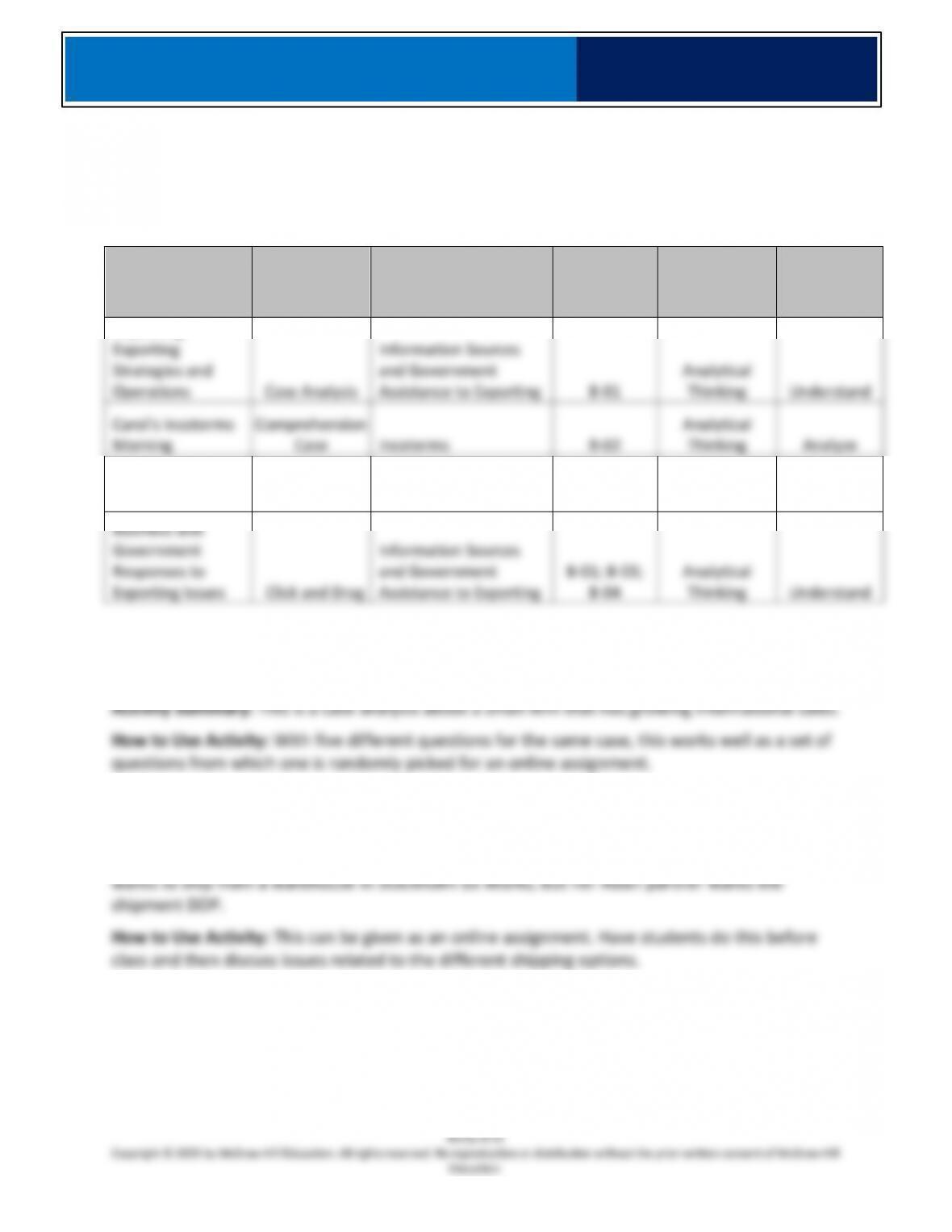
For every chapter, please refer to the Connect Content Matrix to see what application exercises
are available and what Learning Objectives they help reinforce/assess.
Title
Assignment
Type
Topic(s)
Learning
Objective(s)
AACSB
Accreditation
Tagging
Bloom’s
Taxonomy
Improving
Exporting
Strategies and
Operations
Case Analysis
Information Sources
and Government
Assistance to Exporting
B-01
Analytical
Thinking
Understand
Carol’s Incoterms
Morning
Comprehension
Case
Incoterms
B-02
Analytical
Thinking
Analyze
Financing Exports
and Imports
Click and Drag
Export and Import
Financing
B-03; B-04
Analytical
Thinking
Understand
Business and
Government
Responses to
Exporting Issues
Click and Drag
Information Sources
and Government
Assistance to Exporting
B-01; B-03;
B-04
Analytical
Thinking
Understand
CONNECT ACTIVITIES
1. Improving Exporting Strategies and Operations
2. Carol’s Incoterms Morning
Activity Summary: In this case, Carol Beal is an export manager for a clothing company. She
3. Financing Exports and Imports
Activity Summary: This is a click and drag activity in which students must place boxes of the
steps of a letter of credit into the correct order.
International Business, 2e
Geringer, McNett, Ball
Instructor Guide to Module B
How to Use Activity: This can be given as an online assignment or as an in-class assignments for
4. Business and Government Responses to Exporting Issues
Activity Summary: In this click and drag activity, students are presented with a grid that has