
International Business, 2e
Geringer, McNett, Ball
Instructor Guide to Module 13
13-1
Module 13: Marketing Internationally
YOUR CONTENT
Summary
Learning Objectives
Key Terms and Definitions
Content Outline
ENGAGEMENT & APPLICATION
Boxed Text Discussion Questions with Suggested Answers
End of Module Exercises
Critical Thinking Questions
globalEDGE Research Task
MiniCase
Bonus Activities
CONNECT TOOLS FOR ASSESSEMENT OF LEARNING
Connect Content Matrix
Connect Activities
International Business, 2e
Geringer, McNett, Ball
Instructor Guide to Module 13
13-2
YOUR CONTENT
SUMMARY
This chapter examines international marketing. Although the marketing functions are the same
for marketing domestically and internationally, the markets served vary greatly because of the
LEARNING OBJECTIVES
LO 13-2 Distinguish among the total product, the physical product, and the brand name.
LO 13-4 Identify the product strategies that can be formed from three product
alternatives and three kinds of promotional messages.
LO 13-6 Explain “glocal” advertising strategies.
LO 13-7 Define pricing and distribution strategies.
KEY TERMS AND DEFINITIONS
advertising (p. 351)
Paid, nonpersonal presentation of ideas, goods, or services by
an identified sponsor
corporate visual identity (CVI)
(p. 343)
A firm’s name, logo, slogan, graphics, color, and typeface that
help identify the firm to consumers and other interested
constituents
disintermediation (p. 363)
The unraveling of traditional distribution structures popularly
called “cutting out the middlemen”
foreign national pricing (p.
361)
Policy that sets local pricing based on market forces in another
country
International Business, 2e
Geringer, McNett, Ball
Instructor Guide to Module 13
13-3
international pricing (p. 361)
Policy that sets prices of goods produced in one country and
sold in another
marketing mix (p. 342)
A set of strategy decisions made about the product and its
promotion, pricing, and distribution in order to satisfy the
needs and desires of customers in a target market
programmed-management
approach (p. 357)
A middle-ground advertising strategy between globally
standardized and entirely local programs
promotion (p. 350)
Any form of communication between a firm and its publics ,
including advertising, public relations, sales promotions such as
rebates and “buy one get one,” and events and experiences,
such as sponsoring events to both yield purchases in the short
term and confidence in the firm in the long run
public relations (p. 359)
Various methods of communicating with the firm’s publics to
secure a favorable impression, rather than immediate sales
sales promotion (p. 359)
Any of the various activities, such as preparation of point-of–
purchase displays, contests, premiums, trade show exhibits,
celebrity-embraced promotion, money-off offers, and coupons
total product (p. 343)
What the customer buys, including the physical product, brand
name, accessories, after-sales service, warranty, instructions
for use, company image, and package

International Business, 2e
Geringer, McNett, Ball
Instructor Guide to Module 13
13-4
CONTENT OUTLINE
The following section provides the flow of information using the LEARNING OBJECTIVES as a
guide, KEY TERMS learners will need to take away from the course, and LECTURE NOTES to drive
home teaching points.
LO 13-1
Discuss why international marketing managers may wish to
standardize the marketing mix.
• Differences between Domestic and International Trade
• The Marketing Mix
o Standardize, Adapt or Start from Scratch?
Key Terms:
• marketing mix
• corporate visual
identity (CVI)
I. Differences between Domestic and International Trade
A. Marketing functions the same, but country-level environmental forces (uncontrollable)
vary widely (sociocultural, resource and environmental, economic, socioeconomic).
B. Controllable forces also vary across markets—distribution channels, taste and aesthetic
preferences, pricing structure of markets.
II. The Marketing Mix
A. Strategy decisions made about the product and its promotion, price, and distribution.
B. International marketing decisions: Can mix be standardized, adapted, or is a new mix
required?
1. Standardization is less costly, allows for longer production runs (economies of scale and
learning). Plus standardized corporate visual identity creates consistent image.
2. Adaptation often required. Marketing principle centers on needs of buyer, not seller.
Localization often practiced.
3. New mix might be required for significant local penetration.
LO 13-2
Distinguish among the total product, the physical product,
Key Terms:
I. Product Strategies
A. Total product: physical product, brand name, accessories, after-sales service, warranty,
instructions for use, company image, and package. Everything the consumer buys. (Figure
13.1)
B. Physical product is the product itself, without packaging, branding.
International Business, 2e
Geringer, McNett, Ball
Instructor Guide to Module 13
C. Brand name is part of the product’s identity.
A. 1. Many opportunities for adaptation may be less costly than changing the physical
product. Examples are tonic water, a standardized physical product but localized total
product. Chocolate is a localized physical product. Nescafe is a localized physical product
with standardized look and slogan.
LO 13-3
Compare the way consumer and industrial products and
services are modified for international sale.
• Modifying Types of Products
o Industrial Products
o Consumer Products
o Services
o Foreign Environmental Forces
• Sociocultural Forces
• Legal Forces
• Economic Forces
• Physical Forces
Key Terms:
II. Modifying Types of Products
1. Product modification depends on type of product (Figure 13.2).
A. Industrial Products
1. Require less adaptation than consumer products.
2. Sometimes necessary to meet legal requirements/standards (safety, health, emissions,
noise).
3. Requirements may be trade barriers.
B. Consumer Products
1. Often require more adaptation, except for luxury products.
2. One approach is to introduce standardized products to luxury segments and then push
downward.
3. Social and cultural values become more distinct in lower economic strata.
4. Adaptation may not be necessary in physical product, but in its other aspects (Mars
M&Ms in Bahrain).
International Business, 2e
Geringer, McNett, Ball
Instructor Guide to Module 13
13-6
C. Services—marketing less complex than marketing of consumer products, some adaptation
for legal requirements may be necessary.
III. Foreign Environmental Forces
A. Sociocultural Forces
1. Reflect consumer preferences.
2. Differences among approaches to washing clothes (French-top load, British-front load,
Germans-extractors, Italians-slow speed spins).
3. Whirlpool’s mistakes trying to standardize in Europe.
4. Colors, brand name connotations are significant.
B. Legal Forces
1. Exert significant impact on marketing decisions.
2. Safety standards, food, pharmaceutical requirements.
3. Varying legal approaches—brand name in many countries belongs to first registrant,
not U.S. approach (order of use).
C. Economic Forces
1. Affect pricing, packaging, production.
D. Physical Forces
1. Such as climate and terrain often require adjustment in product and production.
LO 13-4
Identify the product strategies that can be formed from three
product alternatives and three kinds of promotional
messages.
• Promotional Strategies
• Global and Regional Advertising
• Global and National Advertising
• Media Availability
Key Terms:
• promotion
• advertising
I. Promotional Strategies
A. Market same product everywhere (same message: Avon; different message: Honda).
B. Adapt the physical product for foreign markets (same message: Lever Bros. in Japan;
adapted message: Tang, Kraft).
International Business, 2e
Geringer, McNett, Ball
Instructor Guide to Module 13
13-7
C. Design a different physical product: same, adapted or different message (same message:
manual washing machine; different message: lower tech machines).
II. Advertising
A. Tends to change the least among the promotional messages.
B. Cultural dimensions play a role in these preferences.
1. Directness vs. indirectness (U.S. vs. Japan).
2. Comparison—banned in most countries.
3. Humor does not translate well.
4. Gender roles—what is appropriate differs by culture.
5. Explicitness—cultures have different tolerance levels.
6. Sophistication varies by culture.
7. Popular vs. traditional culture varies.
8. Information content vs. fluff.
C. Global and regional advertising increasingly used due to:
1. Cost savings.
2. Quality more easily achieved.
3. Brand image on regional level.
4. Regionalization.
5. Easily transmitted.
LO 13-5
Discuss some of the effects the Internet may have on
international marketing.
• Media Availability and Internet Advertising
o Type of Product
o Foreign Environmental Forces
Key Terms:
I. Media Availability and Internet Advertising
A. Advantages the internet brings to marketing:
1. Reaches an affluent, accessible audience.
2. Cheap.
International Business, 2e
Geringer, McNett, Ball
Instructor Guide to Module 13
13-8
3. Less heavily regulated.
4. Interactive, which increases customization.
5. Good way to reach specific audiences.
II. Type of Product
A. Industrial and luxury goods—supports standardization.
B. Capital goods: supports standardization (Caterpillar, GE). Bridging is communicating across
these differences and building awareness of shared values.
C. Consumer goods: if low-priced, consumed in the same way and bought for the same
reasons, supports standardization.
III. Foreign Environmental Forces
A. Positioning product as foreign or local major decision.
B. Many brands appeal to segments across markets.
1. Translations may be required, packaging modifications made.
2. Global product with local brands may be result of mergers.
LO 13-6
Explain “glocal” advertising strategies.
• Neither Purely Global nor Purely Local
o Personal Selling
o Sales Promotion
o Public Relations
Key Terms:
• programmed-
management approach
• sales promotion
• public relations
I. Neither Purely Global nor Purely Local
A. Glocal advertising—movement toward middle of standardized-localized spectrum on
advertising.
B. Gillette organizes advertising in regional clusters.
C. Programmed-management approach regionalizes marketing objectives, subsidiaries put
together marketing campaigns.
II. Personal Selling
D. Many businesses that use personal selling follow the home market model.
International Business, 2e
Geringer, McNett, Ball
Instructor Guide to Module 13
13-9
E. Staffing may be challenging.
III. Sales Promotion
A. Displays, couponing, contests, premiums, trade shows.
B. Face cultural constraints (space, appropriate and meaningful promotions).
IV. Public Relations
A. Overlooked tool in many international markets.
B. May be help during periods of public criticism in international markets.
LO 13-7
Define pricing and distribution strategies.
• Pricing Strategies
o Standardized Pricing
o Foreign National Pricing
o International Pricing
• Distribution Strategies
o Standardizing
o Foreign Environmental Forces
Key Terms:
• foreign national
pricing
• international pricing
• disintermediation
I. Pricing Strategies
A. Complex process because pricing influences other aspects of the firm, including profits.
B. Pricing strongly influenced by culture (sale concept undercuts quality concept in Britain
and Japan).
C. Standardized Pricing
1. Foreign pricing is based on the forces in a foreign market. Reflects cost differentials
across borders. May use price skimming to recover development costs or penetration,
to establish product in new market.
2. International pricing for exports, good produced in one country and sold in another.
D. Foreign National Pricing
1. Cost differentials vary across borders.
E. International Pricing
2. Internet information is making price comparison easy and may lead to a world price.
International Business, 2e
Geringer, McNett, Ball
Instructor Guide to Module 13
13–10
II. Distribution Strategies
A. Get product to international market and then distribute locally within it.
B. Standardizing Distribution
C. Subsidiaries usually design local distribution channels; decisions tend to be long-term.
D. Standardizing distribution locally may not be a realistic expectation due to local
conditions; start with home model and change as necessary (McDonalds uses
franchisers).
E. Foreign Environmental Forces
F. Disintermediation is the unraveling of traditional distribution structures, cutting out
the middleman, and often combines Internet sales with quick delivery.
International Business, 2e
Geringer, McNett, Ball
Instructor Guide to Module 13
13–11
ENGAGEMENT & APPLICATION
BOXED TEXT DISCUSSION QUESTIONS WITH SUGGESTED ANSWERS
IB IN PRACTICE: Ikea Adapts to Enter the Indian Market
1. If India is such a low-income country, why would they prefer to have their furniture
assembled, even though it would cost more?
2. Ikea is a very different type of furniture store than what is typical for India. Do you think
they will be successful?
GLOBAL DEBATE: Entering Cuba: Pipe Dream or Real Opportunity?
1. Should U.S. marketers continue to gear up for trade with Cuba, or adopt a go-slow
approach and wait for the political situation to clarify? Defend your answer.
International Business, 2e
Geringer, McNett, Ball
Instructor Guide to Module 13
13–12
2. Does Cuba present sufficient opportunities to foreign exporters? Why or why not?
3. What problems could the political climate in Cuba give U.S. exporters or investors?
There may be significant government intervention such exchange restrictions, limitations on
GET THAT JOB! FROM BACKPACK TO BRIEFCASE: Nicole Kissam: Consider a Career in
International Marketing
Nicole Kissam describes how her internship with AIESEC helped her decide that she wanted an
international career in marketing. She parlayed that internship into a job in Prague.
1. Research AIESEC, the organization Kissam had her internship with, and comment on
whether it would be an appropriate way for you to build your global mind-set.
2. Kissam stayed abroad when her internship was completed and took a position in Prague.
Discuss the advantages and disadvantages of this decision.
International Business, 2e
Geringer, McNett, Ball
Instructor Guide to Module 13
13–13
END OF MODULE EXERCISES
CRITICAL THINKING QUESTIONS
1. Former Louis Vitton CEO Yves Carcelle says, “One to two thousand people is all you need.
You can’t judge by average income—average doesn’t mean anything.” Although he was
speaking about the luxury goods market, do you think his comments about averages apply to
other segments of the market as well? Why or why not?
2. What future do you see for global advertising?
3. What advantages and disadvantages may result from standardizing the marketing mix
worldwide?
Standardizing marketing mixes can lead to important cost savings. Logistics and acquisition of
4. As people become more educated and living conditions improve, do their product
preferences become more similar? Why or why not?
5. Under what conditions would a glocal approach not be useful?
6. Assume you are a consultant to Sony, shortly before the introduction of the PlayStation 4.
What advice would you give Sony about making the device attractive to various foreign
customers?
International Business, 2e
Geringer, McNett, Ball
Instructor Guide to Module 13
13–14
Copyright © 2020 by McGraw-Hill Education. All rights reserved. No reproduction or distribution without the prior written consent of McGraw-Hill
Education.
language, content (acceptable expression, such as clothing and the use of profanity), price of
the package, appropriate background music, etc.
7. What cultural problems might you encounter in introducing the search and discovery
application Foursquare in foreign markets?
8. Candy Crush Saga is a simple game with 2.73 billion downloads and more than 1 trillion
rounds of the game played since its launch, but only about 16 percent of its fan base is in the
United States. What elements of Candy Crush Saga do you think appeal to consumers from
many different cultures?
GLOBALEDGE RESEARCH TASK
Exercise 1
Search for ‘China’ in globalEDGE and go to the introduction page. On the left, click on the
‘Resources’ page and review the resources listed.
Exercise 2
Search for ‘Country Brand Index’ on globalEDGE and open the external link of ‘FutureBrand:
Country Brand Index’.
MINICASE: Will Dollar Shave Club’s Edginess Work Abroad?

International Business, 2e
Geringer, McNett, Ball
Instructor Guide to Module 13
13–15
Copyright © 2020 by McGraw-Hill Education. All rights reserved. No reproduction or distribution without the prior written consent of McGraw-Hill
Education.
consumer goods multinational, in 2016. Now there are plans to expand into the European
market.
1. View one or more of DSC’s videos online. Did you find the videos funny? Uncomfortable?
Offensive? Please explain your reaction.
2. Do you think Dollar Shave Club’s approach will be successful in international markets? Why
or why not? What changes, if any, do you think the company would have to make in order to
enhance its success in international markets?
International Business, 2e
Geringer, McNett, Ball
Instructor Guide to Module 13
13–16
BONUS ACTIVITIES
This section provides you with support of your course above and beyond what is found in the
text. We have developed these resources to support your course, to support your traditional,
hybrid, online, or flipped class.
VIDEO SUGGESTIONS
McGraw Hill’s collection of international business videos is available at
TEAM EXERCISES
These may be done individually or in groups or teams, either in or out of class, for later class
presentation. Some are also appropriate for hybrid and online courses.
1. Social and Cultural Values as They Relate to Economic Strata
Ask small groups to discuss why they think marketers tend to find greater dissimilarities in
2. Technology Creates Homogeneous Markets
Theodore Levitt, in his book, The Marketing Imagination, predicted that technology would
3. Localize Global Inter Presence
In small teams (5 students) discuss ways a global Internet presence can be localized. You might
International Business, 2e
Geringer, McNett, Ball
Instructor Guide to Module 13
13–17
SUPPLEMENTAL ACTIVITIES
Case Studies
Case studies that focus on intercultural issues and their effects in business environments are
available through Ivey Publishing and Harvard Business School. Ivey’s catalog is available for
Ivey Cases
“Israeli Wines in China: Reaching for New Heights” describes the need for Golan Heights Wines,
which is trying to exploit the vast Chinese wine market, to establish a strong brand identity.
CONTROVERSIAL ISSUES
1. Some Multinationals on the Defensive
There is a group of organizations that regularly attack consumer product multinationals
because, the charge is that their advertising and promotion establish consumer desires rather
than satisfy consumer needs. The role of fashion and make-up establish unrealistic notions of
attractiveness. Empty calorie food is promoted as an indulgence the consumer deserves.
Specifically, the most frequent complaints are:
International Business, 2e
Geringer, McNett, Ball
Instructor Guide to Module 13
13–18
TEACHING SUGGESTIONS
1. This chapter is very important to students’ understanding of the importance of international
2. Focusing on the boxed material and the case study will help students achieve the objectives
3. Guest lecturers on culture are a way to underscore the importance of the information in the
culture chapter. Possible guests include:
• A marketing executive can share insights on how the firm plans and controls its
international advertising campaigns.
4. A good way to start this module is to have students who have studied abroad and foreign
International Business, 2e
Geringer, McNett, Ball
Instructor Guide to Module 13
13–19
CONNECT TOOLS FOR ASSESSEMENT OF LEARNING
CONNECT CONTENT MATRIX
For every chapter, please refer to the Connect Content Matrix to see what application exercises
are available and what Learning Objectives they help reinforce/assess.
CONNECT ACTIVITIES
1. Overcoming Cultural Barriers to Selling Tampons
Activity Summary: This is a case analysis about Procter & Gamble’s efforts to sell Tampax®
tampons in Latin America.
How to Use Activity: With four different questions for the same micro case, this works well as a
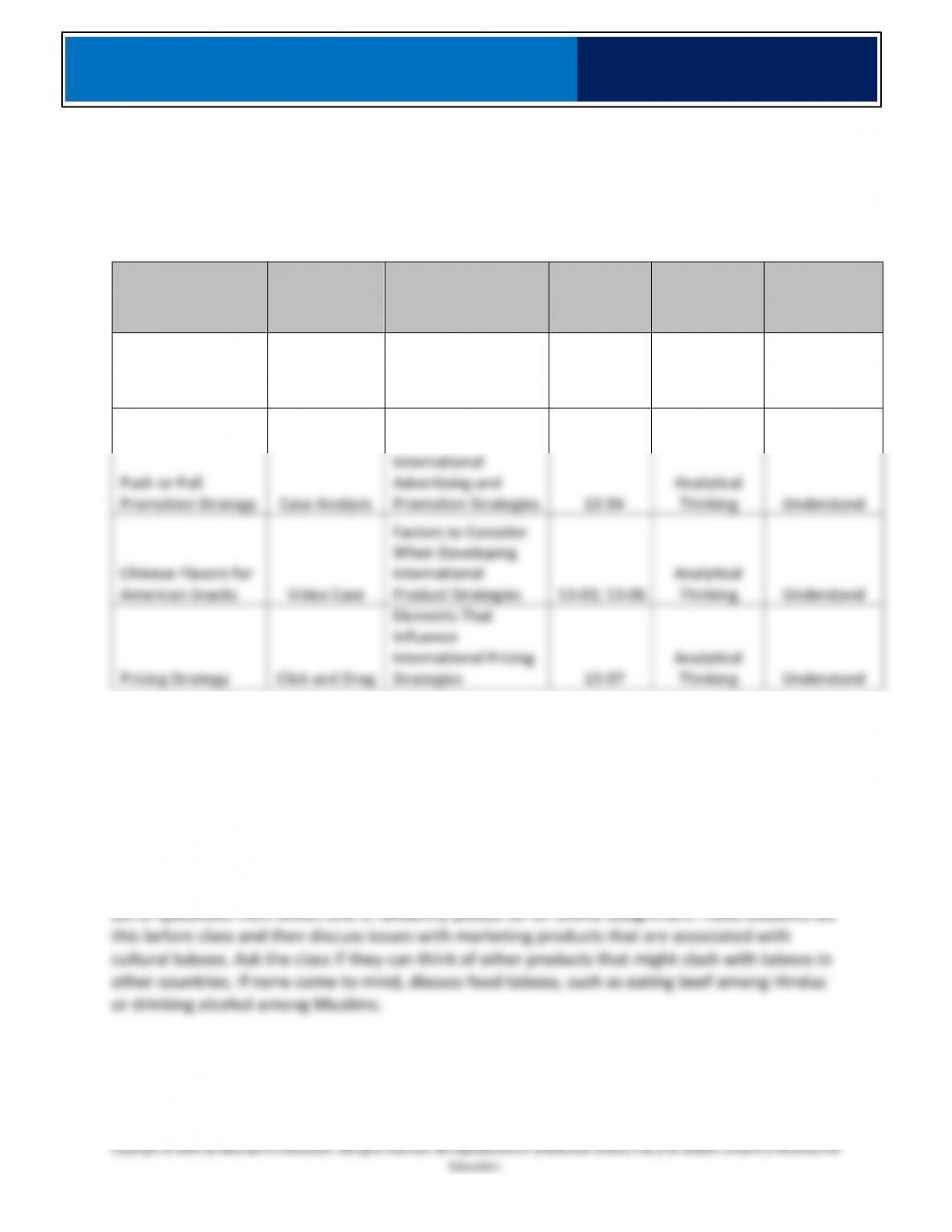
Title
Assignment
Type
Topic(s)
Learning
Objective(s)
AACSB
Accreditation
Tagging
Bloom’s
Taxonomy
Overcoming
Cultural Barriers to
Selling Tampons
Case Analysis
Differences Between
Domestic and
International Trade
13–01
Analytical
Thinking
Apply
Push or Pull
Promotion Strategy
Case Analysis
Factors That
Influence
International
Advertising and
Promotion Strategies
13–04
Analytical
Thinking
Understand
Chinese Flavors for
American Snacks
Video Case
Factors to Consider
When Developing
International
Product Strategies
13-03; 13-06
Analytical
Thinking
Understand
Pricing Strategy
Click and Drag
Elements That
Influence
International Pricing
Strategies
13–07
Analytical
Thinking
Understand
International Business, 2e
Geringer, McNett, Ball
Instructor Guide to Module 13
13–20
2. Push or Pull Promotion Strategy
Activity Summary: In this case analysis, students are told that they are given the assignment to
3. Chinese Flavors for American Snacks
Activity Summary: This is a video case in which students watch a short video about American
4. Pricing Strategy
Activity Summary: This is a click and drag activity in which boxes that describe different policies