International Business, 2e
Geringer, McNett, Ball
Instructor Guide to Module 8
08–12
END OF MODULE EXERCISES
CRITICAL THINKING QUESTIONS
1. Are people who argue today for a return to the gold system simply nostalgic or do they
have a point?
2. Was the Bretton Woods system bound to fail? Why or why not?
This question goes to the Triffin Paradox. The Bretton Woods system supported substantial
international trade growth during the 1950s and 1960s. Other countries changed their
currency’s value against the dollar and gold, while the U.S. dollar remained fixed. This meant
3. You are on a business trip from Portugal to the United States for 90 days, and you have a
per diem expense account of 400 euros, no receipts required. This per diem is advanced to
you before the trip (36,000 euros). You deposit it into your checking account and use your
Portuguese (euro) credit card to cover your costs while in the United States. After the first
two weeks of your trip, the dollar weakens against the euro by 15 percent. What ethical
dilemma might this currency fluctuation present for you? How will you handle it?
The dilemma is over what rate to use as the base of the calculation. Who should benefit from
the exchange rate movement in the euro’s favor, the traveler or the firm? There are arguments
International Business, 2e
Geringer, McNett, Ball
Instructor Guide to Module 8
08–13
Copyright © 2020 by McGraw-Hill Education. All rights reserved. No reproduction or distribution without the prior written consent of McGraw-Hill
Education.
The employee puts euro 36,000 in her European Bank. This was good for US$36,000, which was
the budgeted amount of dollars needed to cover expenses. At the end of the stay the credit
card company will convert the US$36,000 by dividing by 1.15, the new exchange rate (assume
no transaction costs for simplicity). This will yield euro 36,000x/1.15 or euro 31,304. The
employee has “made” euro 4,696!
4. If all nations used the SDR, what might the impact be on business?
5. Your firm is generating considerable revenues in a country that suddenly imposes exchange
controls prohibiting the purchase of foreign currency within the country and the export of
currency. What are some of the issues you will want to discuss with your regional finance
staff?
You have a problem with repatriation of profits generated in that currency and with recouping
your capital. What can you do? You can pay for all expatriate and visitor expenses in the local
6. Your U.S. firm is about to sign a contract to supply services to a bank in Beijing, with an up–
front payment agreement of 50 percent. Do you want this payment in U.S. dollars? Why or
why not?
If you get paid U.S. dollars today, you are out of the “exchange rate gain/loss” risk game. This is
the conservative approach of many companies who are not in financial services. If your “crystal
7. While the U.S. Federal Reserve has been slashing interest rates, the European Central Bank
is holding interest rates steady. Could this policy difference have influenced the relative
strength of the dollar against the euro? Why or why not?
8. Your Boston-based company earned 54 percent of its profits from Germany and France.
Given your answer in question 7, are you happy today? Why or why not?
International Business, 2e
Geringer, McNett, Ball
Instructor Guide to Module 8
08–14
9. Your Munich-based company earns 64 percent of its revenues from high-precision auto
component exports to the United States. You need to expand manufacturing capacity, and
the U.S. market has great growth potential for your product. Your raw materials could be
sourced in either location relatively easily and with no cost advantage in either. Given your
answer in question 7, where would you be most likely to add capacity, in Germany or the
United States? Why?
10. Why should managers regularly monitor the balance of payments of the countries in
which their business operates?
GLOBALEDGE RESEARCH TASK
Exercise 1
globalEDGE ‘Global Insights’ is where profiles of trade blocs, countries, U.S. states, and industries
can be found. When navigated as described in the exercise (i.e. globalEDGE > Global Insights > by
Exercise 2
International Business, 2e
Geringer, McNett, Ball
Instructor Guide to Module 8
08–15
Copyright © 2020 by McGraw-Hill Education. All rights reserved. No reproduction or distribution without the prior written consent of McGraw-Hill
Education.
where ‘Indices’ page of countries can be accessed on the left column menu. Students will need
to use Corruption Perceptions Index on this page to answer the question.
Search Phrase: Corruption Perceptions Index
Resource Name: Corruption Perceptions Index
Resource Link: https://globaledge.msu.edu/countries/germany/indices
MINICASE: SDR Exchange Risk
This minicase looks at the lending of the Asian Development Bank and its loan process. All of its
loans are made in SDR.
1. Why would the ADB hold SDR instead of dollars or euros?
2. What are the currency amounts that make up the SDR?
International Business, 2e
Geringer, McNett, Ball
Instructor Guide to Module 8
08–16
BONUS ACTIVITIES
This section provides you with support of your course above and beyond what is found in the
text. We have developed these resources to support your course, to support your traditional,
hybrid, online, or flipped class.
VIDEO SUGGESTIONS
McGraw Hill’s collection of international business videos is available at
TEAM EXERCISES
These may be done individually or in groups or teams, either in or out of class, for later class
presentation. Some are also appropriate for hybrid and online courses.
1. Islamic Financial Institutions
Many students are not aware of the difference between Islamic financial institutions and other
financial institutions. Assign small teams (5 students) to research Islamic financial institutions,
having each team focus on one topic. By dividing the topics, you can have all students focused
International Business, 2e
Instructor Guide to Module 8
08–17
Copyright © 2020 by McGraw-Hill Education. All rights reserved. No reproduction or distribution without the prior written consent of McGraw-Hill
Education.
• Discuss the contributions Islamic banking has made in developing countries.
2. Chinese Devalue the Yuan
The Chinese economy is the second largest in the world, yet its government controls the
exchange rate for its currency. This strategy costs China more in their imports, and they import
3. Inflation Rates by Country
SUPPLEMENTAL ACTIVITIES
CASE STUDIES
Case studies that focus on intercultural issues and their effects in business environments are
Harvard Cases
“Debt and Development in Jamaica” describes the economic development problems faced by
Jamaica over most of the past half-century. This case allows students to explore the
complicated economic difficulties faced by Jamaica, which remains burdened by a self–
reinforcing set of interrelated factors, including high public debt, a sluggish private sector, an
inefficient public sector, poverty, and crime, among others.
International Business, 2e
Geringer, McNett, Ball
Instructor Guide to Module 8
08–18
Copyright © 2020 by McGraw-Hill Education. All rights reserved. No reproduction or distribution without the prior written consent of McGraw-Hill
Education.
manufacturing, and incoming foreign investments threatened to overwhelm Brazilian markets.
Under President Dilma Rousseff, economic growth stagnated, and Brazil struggled to find the
best balance between reducing inflation, maintaining a flexible exchange rate, and improving
the competitiveness of Brazilian exports.
CONTROVERSIAL ISSUES
Inversions Still have Their Appeal
The U.S. Treasury restrictions tightened merger rules that went into effect recently, which make
it more difficult for U.S. companies to access their overseas cash unless it is taxed at U.S. rates
and tightens the conditions under which a merger can be an inversion. Inversions were once an
esoteric tax loophole, but in the past few years have come to be used more frequently as a way
Despite the Treasury clampdown, U.S. businesses continue to practice inversions as a part of
their corporate tax strategy. There were 14 inversions completed in 2014 and many are planned
as of mid-2015, including Coca Cola Enterprises (a bottler and distributor) and CF Industries,
both to the UK.
• What is meant by an inversion deal?
International Business, 2e
Geringer, McNett, Ball
Instructor Guide to Module 8
08–19
TEACHING SUGGESTIONS
2. Focusing on the boxed material and the case study will help students achieve the objectives
3. The Critical Thinking Questions at the end of the module will help in understanding chapter
content. These topics may be assigned as an outside class assignment. One of the problems in
giving textbook questions as outside assignments is that students frequently do not do the
4. Guest lecturers on the financial forces that affect management are a way to underscore the
importance of the information in this module. Possible guests include
• An economist who can speak to exchange rate volatility and its effects.
5. Students who view themselves as not strong in math may mistakenly think that this will be a
6. To cover such a vast subject as financial forces and the monetary system in the short time
available is impossible. Students who become interested in this area might be encouraged to
International Business, 2e
Geringer, McNett, Ball
Instructor Guide to Module 8
08–20
CONNECT TOOLS FOR ASSESSEMENT OF LEARNING
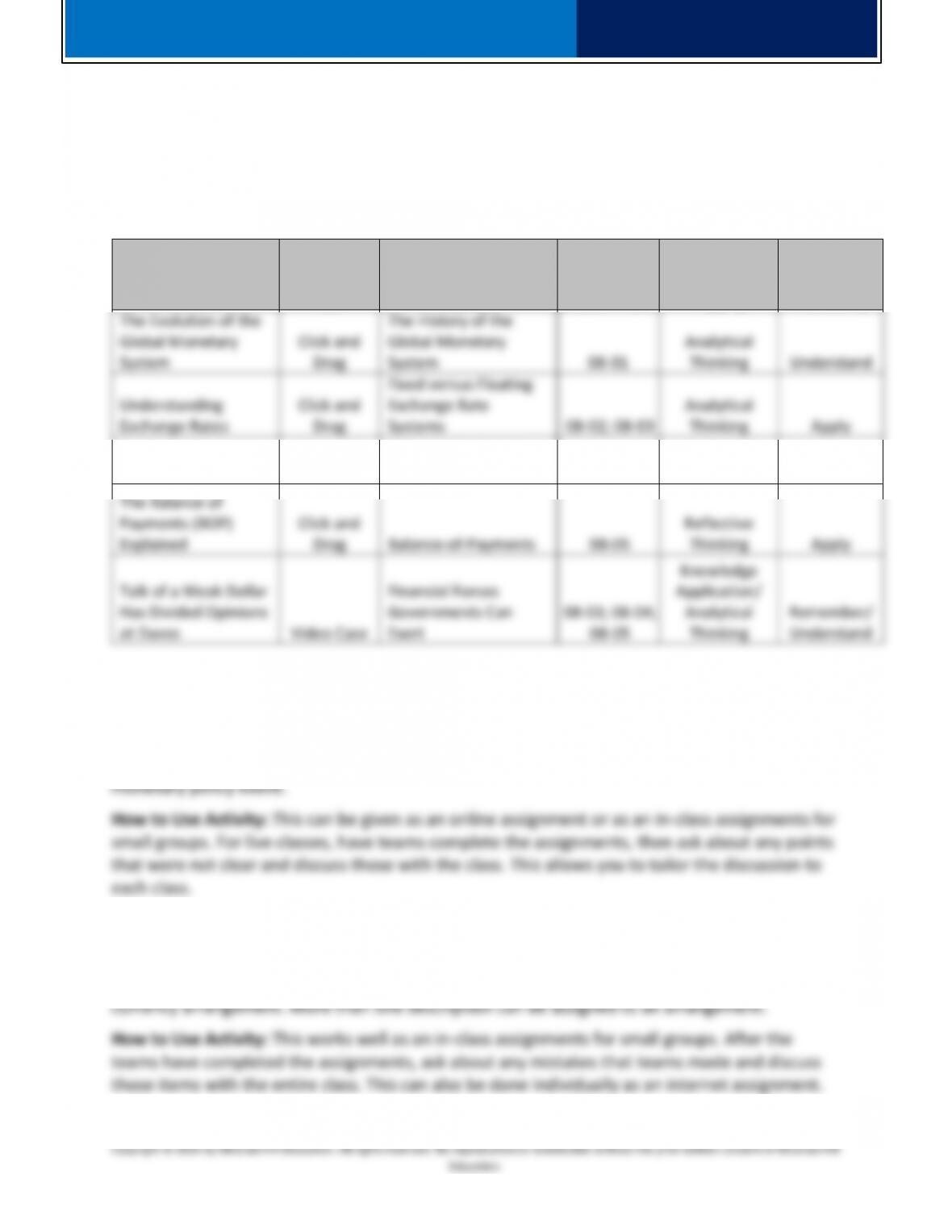
CONNECT CONTENT MATRIX
For every chapter, please refer to the Connect Content Matrix to see what application exercises
are available and what Learning Objectives they help reinforce/assess.
Title
Assignment
Type
Topic(s)
Learning
Objective(s)
AACSB
Accreditation
Tagging
Bloom’s
Taxonomy
The Evolution of the
Global Monetary
System
Click and
Drag
The History of the
Global Monetary
System
08–01
Analytical
Thinking
Understand
Understanding
Exchange Rates
Click and
Drag
Fixed versus Floating
Exchange Rate
Systems
08-02; 08-03
Analytical
Thinking
Apply
Predicting Exchange
Rate Movements
Click and
Drag
Different Exchange
Rate Regimes
08-02; 08-03
Analytical
Thinking
Understand
The Balance of
Payments (BOP)
Explained
Click and
Drag
Balance-of–Payments
08–05
Reflective
Thinking
Apply
Talk of a Weak Dollar
Has Divided Opinions
at Davos
Video Case
Financial Forces
Governments Can
Exert
08-03; 08-04;
08–05
Knowledge
Application/
Analytical
Thinking
Remember/
Understand
CONNECT ACTIVITIES
1. The Evolution of the Global Monetary System
Activity Summary: This is a click and drag activity in which students match descriptions to the
2. Understanding Exchange Rates
Activity Summary: In this click and drag activity, students assign descriptions to the correct
International Business, 2e
Geringer, McNett, Ball
Instructor Guide to Module 8
08–21
3. Predicting Exchange Rate Movements
4. The Balance-of-Payments (BOP) Explained
Activity Summary: This is a click and drag activity in which students have a selection of
5. Talk of a Weak Dollar Has Divided Opinions at Davos
Activity Summary: This is a video case in which members of the World Economic Forum in