
Instructor Guide to Module 3
International Business, 2e
Geringer, McNett, Ball
Instructor Guide to Module 3
03-15
1. What does Mallory mean, “Attitude is everything!”?
2. Would you consider taking her advice and beginning with an international internship or
volunteer position?
Instructor Guide to Module 3
International Business, 2e
Geringer, McNett, Ball
Instructor Guide to Module 3
03-16
END OF MODULE EXERCISES
CRITICAL THINKING QUESTIONS
1. Drawing on Hall’s high and low context, describe some of the communication issues that
might well arise when an Arab manager in a global company who has spent his career in the
Middle East is sent on temporary assignment to Germany for a year to integrate there a
process developed in one of the Middle East production facilities.
Because the Saudi is likely to be used to long-term relationships, his expectations for subtle
communication may be unfulfilled with the German need for explicitness. This may be
2. Your company has a policy of no gift giving or accepting. You are representing the company
in negotiations in China for design of a multi-phased manufacturing facility. Discuss the role
of gift giving you might expect in a culture such as China and how you plan to approach this
issue.
The gift giving will be very common. Remember that gift giving creates a mutual obligation: you
3. You are a Mexican who has just accepted a short-term assignment in Ireland. What are
some of the expectations you may have about Irish behavior, drawing on Hofstede’s cultural
dimensions?
The first challenge is to get the data correct. Ireland is PD 28, UA 35, I 70, M 68, P 24, I/R 65. The
abbreviations are taken from the horizontal axis in Table 3.3. Mexico’s data are PD 81, UA 82, I
Instructor Guide to Module 3
International Business, 2e
Geringer, McNett, Ball
Instructor Guide to Module 3
03-17
Copyright © 2020 by McGraw-Hill Education. All rights reserved. No reproduction or distribution without the prior written consent of McGraw-
Hill Education.
that when he sees these characteristics, he may be dealing with culture rather than individual
behavior and that it might be a good idea for him/her to put interpretations of the behavior on
hold until experience leads to a better understanding of the culture.
4. If you had the choice of sending either a U.S. or Mexican businessperson to Japan for a
three-year assignment, and both were equally qualified, why might sending the Mexican offer
less risk on the culture side?
5. How could Trompenaars’s universalism-particularism dimension be helpful in sorting out
confusion over ethical behavior in a company’s international division?
6. Give a short description of an example of Trompenaars’s achievement-ascription
dimension.
7. If you were advising a French colleague on her first work assignment to your home culture,
and she asked you what aspects of the material culture she should pay attention to, what
advice would you give her?
8. Choose a nationality of foreign worker that is found in your home environment and suggest
what culture-related difficulties such a worker may experience in your culture.
9. How do you evaluate your own global mind-set levels?
Instructor Guide to Module 3
International Business, 2e
Geringer, McNett, Ball
Instructor Guide to Module 3
03-18
Copyright © 2020 by McGraw-Hill Education. All rights reserved. No reproduction or distribution without the prior written consent of McGraw-
Hill Education.
The answers will vary but students should show an understanding of what the global mind-set is
and offer experiences to support that those capabilities have been internalized.
GLOBALEDGE RESEARCH TASK
Exercise 1
globalEDGE ‘Global Insights’ is where profiles of trade blocs, countries, U.S. states, and
industries can be found. When navigated as described in the exercise (i.e. globalEDGE > Global
Exercise 2
globalEDGE ‘Global Insights’ is where profiles of trade blocs, countries, U.S. states, and
industries can be found. When navigated as described in the exercise (i.e. globalEDGE > Global
MINICASE: Who Will Staff Up the China Operations?
1. Drawing on the cultural dimensions that we have reviewed, along with your business
knowledge, whom would you recommend for the position?
Instructor Guide to Module 3
International Business, 2e
Geringer, McNett, Ball
Instructor Guide to Module 3
03-19
Each of the candidates brings advantages to this position. In terms of culture experience, Tom is
probably in the weakest position as Gunther and Firdaus both have stronger backgrounds. As
2. What would be your reasoning for this choice?
3. Whom would you suggest for a backup candidate, if the first selection declined the
position?
Instructor Guide to Module 3
International Business, 2e
Geringer, McNett, Ball
Instructor Guide to Module 3
03-20
BONUS ACTIVITIES
This section provides you with support of your course above and beyond what is found in the
text. We have developed these resources to support your course, to support your traditional,
hybrid, online, or flipped class.
VIDEO SUGGESTIONS
McGraw Hill’s collection of international business videos is available at
TEAM EXERCISES
These may be done individually or in groups or teams, either in or out of class, for later class
presentation. Some are also appropriate for hybrid and online courses.
1. Cultural Analysis
Prepare a cultural analysis for a specific country, using the basic frameworks in the chapter. The
assignment is to describe the culture of an assigned country the student is likely to know little
Instructor Guide to Module 3
International Business, 2e
Geringer, McNett, Ball
Instructor Guide to Module 3
03-21
2. Cultural Artifact
This cultural artifact exercise may not be possible in some settings. If possible, ask each student
to bring an example of a food or goods item from their cultural heritage to share in class.
3. Name as Cultural Artifact
Ask students to break into groups of 5 and explain why they have the first name they do. Then
report back to class with a list of the different ways names have been chosen for them. If your
4. Experiential Exercise
There are a number of experiential exercises that work well to bring home the nature of
culture. BaFa BaFa, Randömia, and Blue Eyes, Brown Eyes among them. Although they take
SUPPLEMENTAL ACTIVITIES
Case Studies
Case studies that focus on intercultural issues and their effects in business environments are
Instructor Guide to Module 3
International Business, 2e
Geringer, McNett, Ball
Instructor Guide to Module 3
03-22
Copyright © 2020 by McGraw-Hill Education. All rights reserved. No reproduction or distribution without the prior written consent of McGraw-
Hill Education.
an account and offers downloadable review copies for educators. The case prices begin at
$7.50.
Ivey Cases
“Dave Shorter and Bob Chen” describes a work situation in which communication is
misunderstood based on cultural assumptions.
CONTROVERSIAL ISSUES
1. Global Debate: When in Rome, Should You “Do as the Romans Do”…and Feel Comfortable
About It?
This debate draws on the Global Debate in the module and explores the question, “When in
Rome, should you “Do as the Romans Do”?“ It focuses on the issue of complying with the norms
and expected social and cultural behaviors when a guest in another country. This serves as a
starting point for a stimulating class discussion on such topics as:
• Does one conform?
2. Current Events
A focus on current events that are relevant to the module’s topics is a good way to bring home
the concepts, review their application, and build news–review habits. Ask everyone to come
Instructor Guide to Module 3
International Business, 2e
Geringer, McNett, Ball
Instructor Guide to Module 3
03-23
Copyright © 2020 by McGraw-Hill Education. All rights reserved. No reproduction or distribution without the prior written consent of McGraw-
Hill Education.
prepared with an article for every meeting. If a meaningful percentage of the final grade is
allocated to discussion (10-15), motivation is there. Devote five minutes at the beginning of
class to discussion of current events. Discuss topics of culture controversy. Linkage to
international business issues can be made in the areas of child labor, prison labor, gender
separation, hiring practices, tax payment behavior, bribes, and many other issues. Depending
on the online interface, this activity may be done in chat forums (Blackboard) or discussion
boards, before class begins. This activity also works well in large lecture classes.
TEACHING SUGGESTIONS
1. This chapter is very important to students’ understanding of the importance of culture in
2. Focusing on the boxed material and the case study will help students achieve the objectives
3. The Critical Thinking Questions at the end of the module will help in understanding chapter
content, and Connect offers a way to hold them accountable. These topics may be assigned as
an outside class assignment. One of the problems in giving textbook questions as outside
4. Guest lecturers on culture are a way to underscore the importance of the information in the
culture chapter. Possible guests include:
5. A good way to start this module is to have students relate their own experiences with
different cultures. They could be from travel abroad, from encounters with people of different

Instructor Guide to Module 3
International Business, 2e
Geringer, McNett, Ball
Instructor Guide to Module 3
03-24
Copyright © 2020 by McGraw-Hill Education. All rights reserved. No reproduction or distribution without the prior written consent of McGraw-
Hill Education.
backgrounds in their community, church, classes, etc. Or, if they are foreign, how they
experience being in your class and attending your college or university. Setting this question up
ahead with a foreign student will give the student time to think about his/her response. When
discussing culture responses, you may want to include the student’s emotional response to the
situation as well as the situation itself, such as “How did you feel about this experience?”
6. To cover such a vast subject as culture in the short time available is impossible. Students who
become very interested in this area might be encouraged to explore an anthropology course.
Instructor Guide to Module 3
International Business, 2e
Geringer, McNett, Ball
Instructor Guide to Module 3
03-25
CONNECT TOOLS FOR ASSESSEMENT OF LEARNING
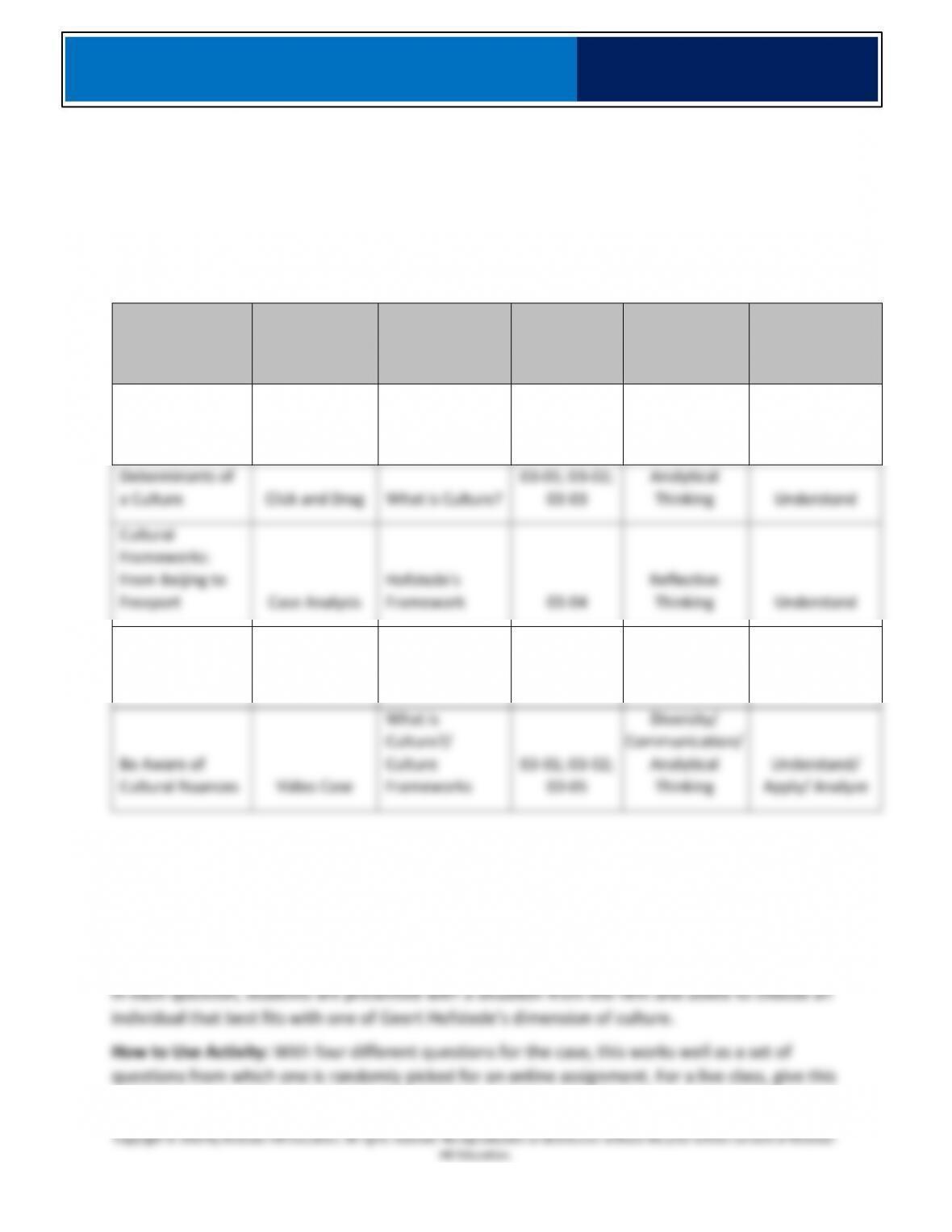
CONNECT CONTENT MATRIX
For every chapter, please refer to the Connect Content Matrix to see what application exercises
are available and what Learning Objectives they help reinforce/assess.
Title
Assignment
Type
Topic(s)
Learning
Objective(s)
AACSB
Accreditation
Tagging
Bloom’s
Taxonomy
Geert Hofstede’s
Big Idea
Case Analysis
Social Culture
03–06
Knowledge
Application
Remember/
Understand/
Apply/ Analyze
Determinants of
a Culture
Click and Drag
What is Culture?
03-01; 03-02;
03–03
Analytical
Thinking
Understand
Cultural
Frameworks:
From Beijing to
Freeport
Case Analysis
Hofstede’s
Framework
03–04
Reflective
Thinking
Understand
High and Low
Context
Click and Drag
Culture
Frameworks
03–04
Diversity/
Reflective
thinking
Understand/
Apply/ Diversity
Be Aware of
Cultural Nuances
Video Case
What is
Culture?/
Culture
Frameworks
03-01; 03-02;
03–05
Diversity/
Communication/
Analytical
Thinking
Understand/
Apply/ Analyze
CONNECT ACTIVITIES
1. Geert Hofstede’s Big Idea
Activity Summary: This case analysis describes several employees that work for a French firm.
Instructor Guide to Module 3
International Business, 2e
Instructor Guide to Module 3
03-26
Copyright © 2020 by McGraw-Hill Education. All rights reserved. No reproduction or distribution without the prior written consent of McGraw-
Hill Education.
assignment before or during class and ask small groups of students to discuss their answers
among themselves. Then ask students about any questions that were unclear or confusing. This
allows the instructor to tailor the class discussion to areas that are unclear to students in a way
that increase their interest in the topic.
2. Determinants of a Culture
Activity Summary: This click and drag activity asks students to match examples to the
3. Cultural Frameworks: From Beijing to Freeport
Activity Summary: This is a case analysis with three multiple-choice questions that relate to the
4. High and Low Context
Activity Summary: This click and drag activity provides a list of general characteristics that
contain either high context or low context characteristics.
5. Be Aware of Cultural Nuances

Instructor Guide to Module 3
International Business, 2e
Geringer, McNett, Ball
Instructor Guide to Module 3
Activity Summary: In this video case, an international lawyer discusses the need to be aware of