Chapter 9
Measuring and Managing Real Exchange
Risk
QUESTIONS
1. As the vice president of finance for a U.S. firm, what do you say to your production
manager when he states, “We shouldn’t let foreign exchange risk interfere with our
profitability. Let’s simply invoice all our foreign customers in dollars and be done with
it.”
2. What do economists mean by pricing-to-market?
3. Why does a monopolist not charge the same price for the same good in two different
countries?
4. What determines how much a foreign producer allows the dollar price of a product sold
in the United States to be affected by a change in the real exchange rate?
Chapter 9: Measuring and Managing Real Exchange Risk
2
5. Why is the pass-through from changes in exchange rates to changes in the prices of
products not one-for-one?
6. Given that real exchange rates fluctuate, when would be the best time to enter the
market of a foreign country as an exporter to that market?
7. You have been asked to evaluate possible sites for an Asian production facility that will
manufacture your firm’s products and sell them to the Asian market. What real
exchange rate considerations should you entertain in your evaluation?
8. Why is it important for an exporter to understand the distinction between a temporary
change in the exchange rate and a permanent change in determining whether to
Chapter 9: Measuring and Managing Real Exchange Risk
3
respond to a real depreciation of the home currency with increased production or sales
out of inventories?
Answer: Exporters benefit when their home currencies depreciate in real terms. If the
PROBLEMS
1. If there is 10% inflation in Brazil, 15% inflation in Argentina, and the Argentine peso
weakens by 21% relative to the Brazilian real, by how much has the peso strengthened
or weakened in real terms. What effect do you expect that this change in the real
exchange rate would have on trade between the two countries?
2. Suppose that you have one domestic production facility that supplies both the domestic
and foreign markets. Assume that the demand for your product in the domestic market
is Q = 2,000 – 3P and in the foreign market, demand is given by Q* = 2,000 – 2P*.
Assume that your domestic marginal cost of production is 600. If the initial real
exchange rate is 1, what are your optimal prices and quantities sold in the two markets?
By how much will you change the relative prices of your product if the foreign currency
appreciates in real terms by 10%? What will you do to production?
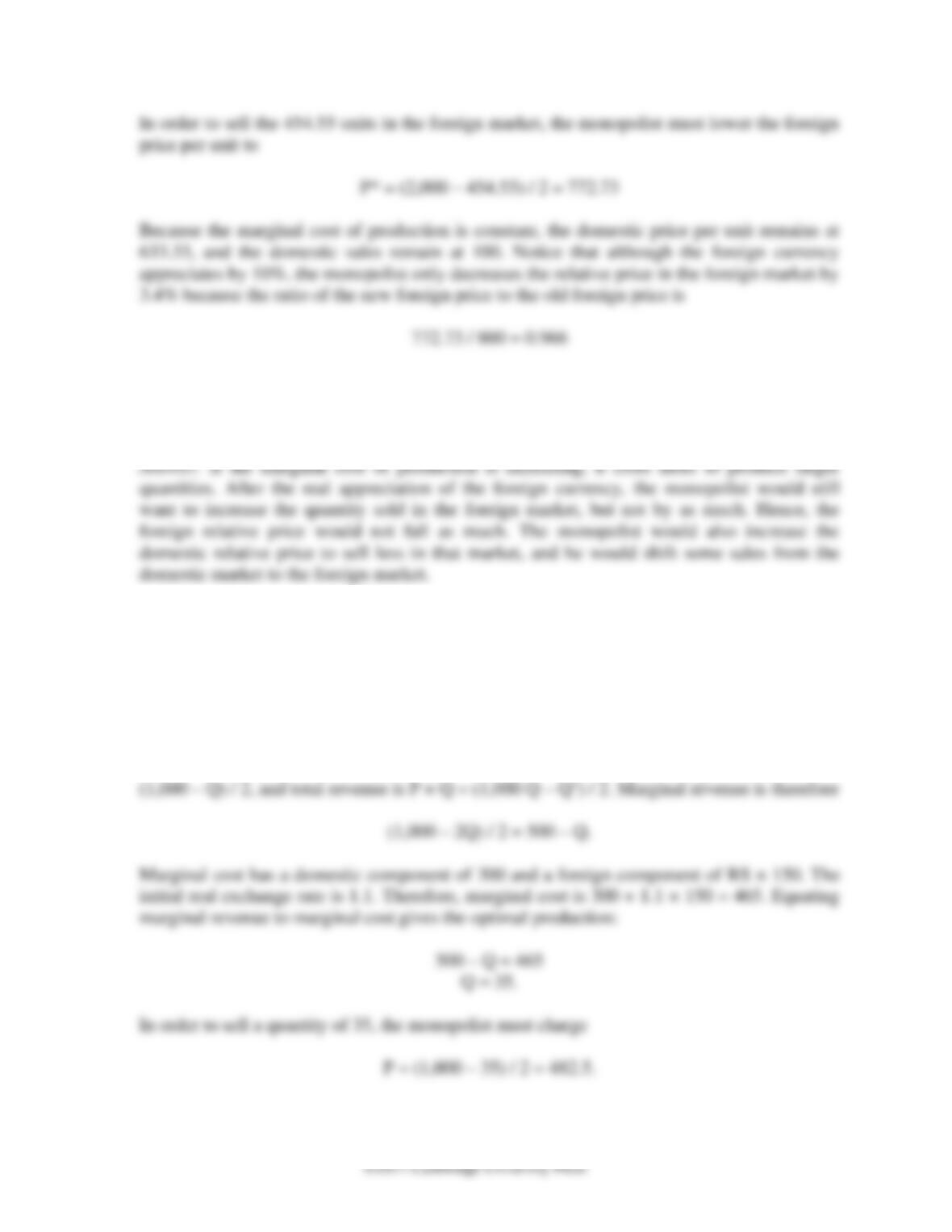
Answer: From the domestic demand curve, we find that P = (2,000 – Q) / 3, and revenue
from domestic sales is P × Q = [(2,000 × Q) – Q2] / 3
Chapter 9: Measuring and Managing Real Exchange Risk
4
Chapter 9: Measuring and Managing Real Exchange Risk
5
3. How would you respond in Problem 2 if the marginal cost of production were
increasing? Why?
4. Suppose you are a monopolist who faces a domestic demand curve given by Q = 1,000 –
2P. Your domestic cost of production involves domestic costs per unit of 300 and a
foreign cost per unit produced of 150. If the real exchange rate is 1.1, what would be the
price you would charge and the quantity you would sell? How do these variables change
when the real exchange rate increases by 10%?
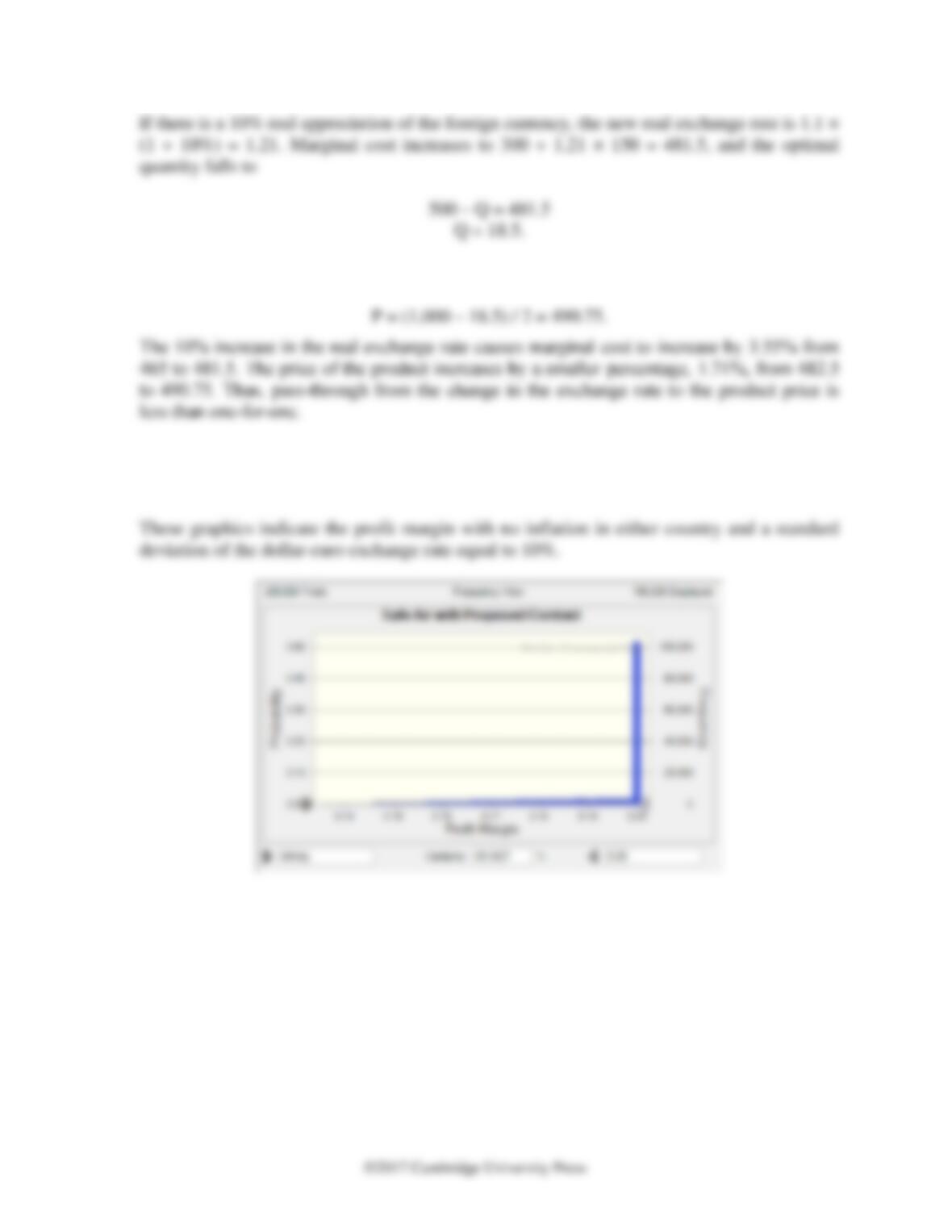
Answer: The monopolist will operate where marginal revenue equals marginal cost. Price is
Chapter 9: Measuring and Managing Real Exchange Risk
6
The relative price in the domestic market increases to
P = (1,000 – 18.5) / 2 = 490.75.
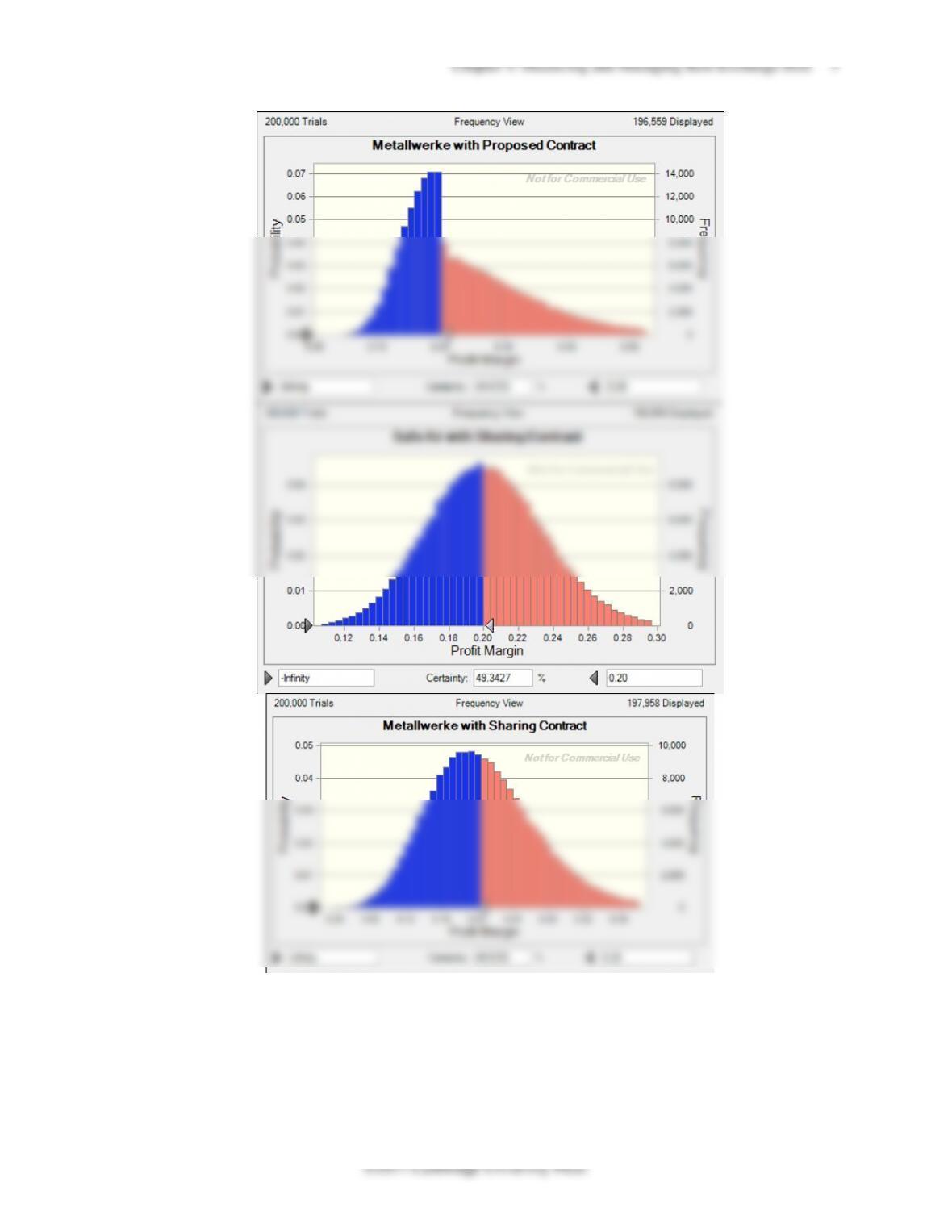
5. Use a program like Crystal Ball to generate Monte Carlo simulations of the profits of
Safe Air and Metallwerke under various contracting clauses.
©2017 Cambridge University Press
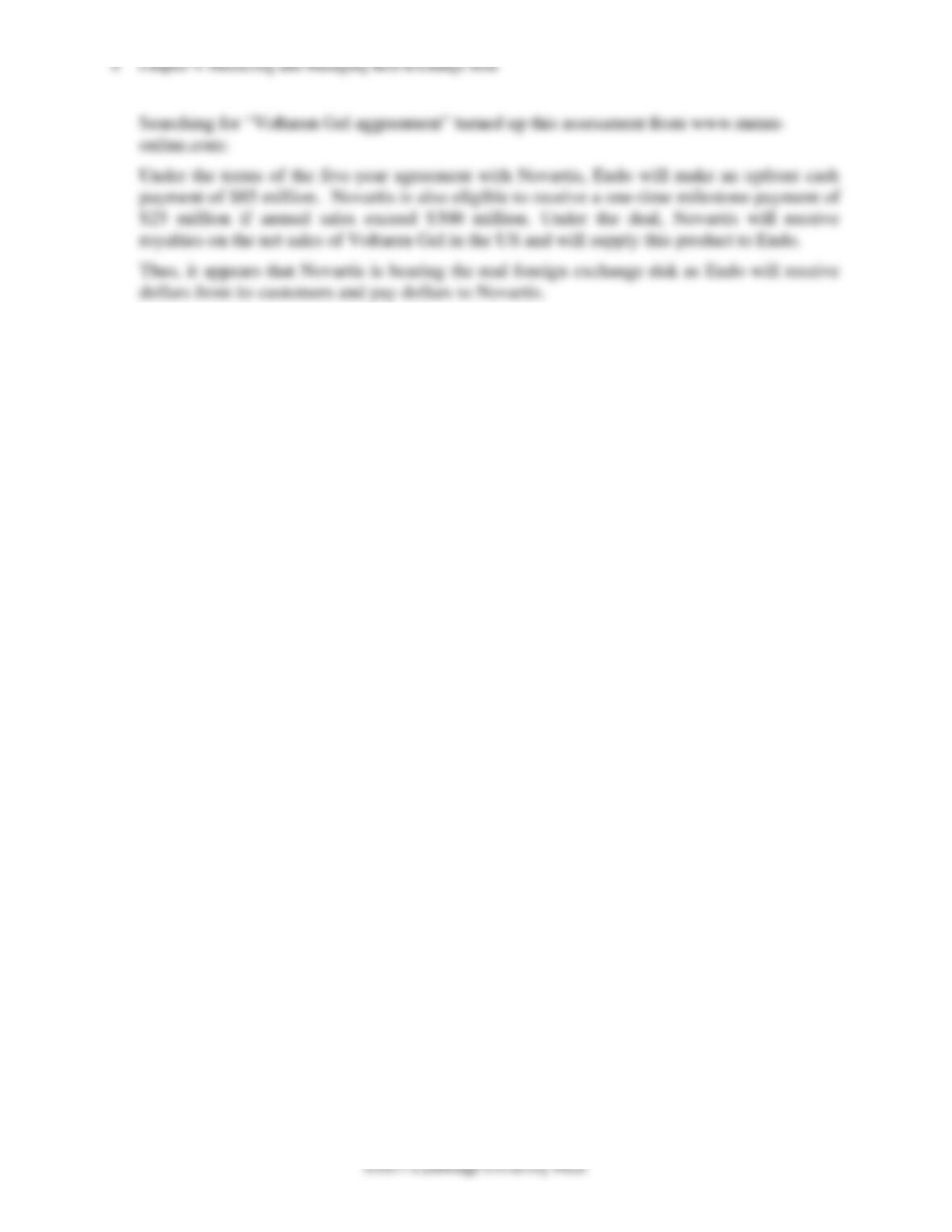
6. In 2008 Endo Pharmaceuticals, a U.S. firm, signed a five-year contracted with Novartis,
a Swiss firm, to obtain the exclusive U.S. marketing rights for Voltaren Gel, an anti–
inflammatory useful in treating osteoarthritis. Search the internet for information
about the contract. Who bore the real exchange risk?
©2017 Cambridge University Press