
CHAPTER 9
DIVERSIFYING, ACQUIRING, AND RESTRUCTURING
CHAPTER OUTLINE
I. OPENING CASE: Emerging Markets: Emerging Acquirers from China and India
A. Multinational enterprises (MNEs) from emerging economies, especially China and India,
have emerged as a new breed of acquirers around the world
1. What are the patterns of these new global acquirers?
2. How do they differ?
B. Overall, China’s stock of outward foreign direct investment (OFDI) (1.7% of the
worldwide total) is more than three times that of India (0.5%)
1. Both Chinese and Indian MNEs seem to use acquisitions as their primary mode of
OFDI
C. MNEs from China and India target industries to support and strengthen their own most
D. The geographic spread of these MNEs is indicative of the level of their capabilities
1. Chinese firms have undertaken most of their deals in Asia, with Hong Kong being
their most favorable location
2. Chinese acquisitions are quite regional due to a relative lack of managerial
capabilities in distant regions, especially in more-developed economies
E. From an institution-based view, the contrasts between the leading Chinese and Indian
acquirers are significant
F. Announcing high-profile deals is one thing, but completing them is another matter
1. Chinese multinationals have a particularly poor record in completing overseas
acquisition deals
a. Fewer than half (47%) of Chinese acquisitions were completed

Chapter 9 Diversifying, Acquiring, and Restructuring
G. Even assuming successful completion, integration is a leading challenge during the post-
acquisition phase
1. Acquirers from China and India have often taken the “high road” to acquisitions
2. “Low road” to acquisitions would be for acquirers to act quickly to impose their
systems and rules on acquired target companies
3. The “high road” sounds noble, but is a reflection of these acquirers’ lack of
international management experience and capabilities
H. From a resource-based view, few emerging acquirers can do a good job in integration and
deliver value
1. According to the Economist, Tata “worked wonders” at JLR by increasing sales
30% and keeping the factory at full capacity; this took place during a recession
II. PRODUCT DIVERSIFICATION
A. Product-related diversification
1. Refers to entries into new product market and/or activities that are related to a firm’s
existing markets and/or activities
2. Emphasis on operational synergy (economies of scale) results in increases in
competitiveness beyond what can be achieved by engaging in two product markets
and/or activities separately
B. Product-unrelated diversification
1. Refers to entries into industries that have no obvious product-related connections to
the firm’s current lines of business
2. Product-unrelated diversifiers are known as conglomerates
3. Conglomeration: strategy adopted by conglomerates

Chapter 9 Diversifying, Acquiring, and Restructuring
6. Diversification discount (or conglomerate disadvantage)—conglomerate units are
better off competing as stand-alone entities
C. Product diversification and firm performance
1. Inverted-U shaped linkage: Performance may increase as firms shift from single
business strategies to product-related diversification, but performance may decrease
III. GEOGRAPHIC DIVERSIFICATION
A. International diversification: The number and diversity of countries in which a firm
competes
B. Limited international scope
1. Geographically and culturally adjacent countries
2. Advantage: Reduces the liability of foreignness
D. Geographic diversification and firm performance
1. U-shaped relationship at low level of internationalization
a. Initially negative effect of international expansion on performance
b. Stems from hazard of liability of foreignness
2. Inverted-U shape at moderate to high levels of internationalization
3. Recent consensus acknowledges the validity of both perspectives and specifies
conditions under which each perspective is likely to hold
IV. COMBINING PRODUCT AND GEOGRAPHIC DIVERSIFICATION
A. Entertain both dimensions of diversification simultaneously
B. Four possible combinations
2. Multinational replicators: Focus on product-related diversification on the one hand
and far-flung multinational expansion on the other hand
4. Classic conglomerates: Focus on product-unrelated diversification within a small set
of countries centered on the home country
C. Migrating from one cell to another, although difficult, is possible
V. A COMPREHENSIVE MODEL OF DIVERSIFICATION
A. Industry-based considerations
1. Growth opportunity

Chapter 9 Diversifying, Acquiring, and Restructuring
2. Structural attractiveness of an industry (Porter’s five forces)
B. Resource-based considerations
1. Value: Diversification creates value only under certain conditions
2. Rarity: For diversification to add value, firms must have unique skills to execute
such a strategy
C. Institution-based considerations
1. Formal institutions
a. Conglomerations in developed countries are subject to antitrust laws
b. Conglomerations in emerging economies are often underpinned by their
D. The evolution of the scope of the firm
1. Economic benefits: Various forms of synergy (operational or financial)
2. Bureaucratic costs: Additional costs associated with a larger, more diversified
organization
VI. ACQUISITIONS
A. Setting the terms straight
1. Acquisition: The transfer of the control of assets, operations, and management from
one firm (target) to another (acquirer)
a. The former becomes a unit of the latter
2. Merger: The combination of assets , operations, and management of two firms to
establish a new legal entity
3. For practical purposes, we can use the two terms “M&As” and “acquisitions”
interchangeably
B. Motives for Mergers and Acquisitions
1. Synergistic

Chapter 9 Diversifying, Acquiring, and Restructuring
a. Industry-based rationale to enhance and consolidate market power
b. Resource-based rationale to leverage superior resources
c. Institution-based rationale to overcome formal institutional constraints
C. Performance of Mergers and Acquisitions
1. As many as 70% of M&As reportedly fail
2. Problems can be identified in both pre- and post-acquisition phases
3. At the pre-acquisition stage problems include
a. Executive hubris and/or managerial motives
b. Inadequate screening and failure to achieve strategic fit
c. Institutional and cultural distances can be huge; nationalist concerns may
erupt
4. During post-acquisition problems include
a. Integration problems or inability to achieve the organizational fit
b. Cultural differences
c. Vulnerability to attacks from rival firms
D. Restructuring
1. Refers to adjustments to firm size and scope through diversification, divestiture, or
both
3. Motives for restructuring
a. Industry-based perspective: Triggered by a rising level of competition within an
industry
VII. DEBATES AND EXTENSIONS
A. Product relatedness versus other forms of relatedness
1. Product relatedness has attracted three significant points of contention
a. Can product relatedness be measured?
B. Acquisitions versus alliances
1. Are acquisitions overused?
2. Strategic alliances are an alternative to acquisitions

Chapter 9 Diversifying, Acquiring, and Restructuring
3. Alliances cost less and allow for opportunities to learn from working with each
other
VIII. THE SAVVY STRATEGIST
A. First, understand the nature of your industry, which may call for diversification,
acquisitions, and restructuring
B. Second, you and your firm need to develop capabilities that facilitate successful
acquisitions and restructuring
C. Third, you need to master the rules of the game—both formal and informal—governing

Chapter 9 Diversifying, Acquiring, and Restructuring
CHAPTER NINE – LECTURE NOTES AND TEACHING TIPS
SUMMARY OF THE OPENING CASE: Emerging Markets: Emerging Acquirers from
China and India
The opening case looks at how MNEs from emerging economies are becoming acquirers in
world markets.
Teaching Tip: Ask students to return to the two questions posed at the beginning of the case:
What are the patterns of the new global acquirers and how do they differ? What limitations or
weaknesses do Chinese and Indian MNEs face in overseas acquisitions? Why do they have
different challenges?
PRODUCT DIVERSIFICATION
Teaching Tip: Some students may not be too familiar with the synergy concept. 2+2=5 is a good
way to convey the general idea initially. Then, it would be good to bring up the concept of
economies of scope, which is also discussed in the unrelated product diversification section.
Broadly, a scope economy is taking two separate activities, and after putting them together
(under the same divisional “roof”), the total cost is less than when they were separate. For
A company focusing on a single product or service (or a few of them) with little diversification is
known to use a single business strategy. Over time, they may increase their level of
diversification to use a product diversification strategy. There are mainly two categories under
this strategy, namely, product-related diversification and product-unrelated diversification.
Product-related diversification refers to entries into new product markets and/or business
activities that are related to a firm’s existing markets and/or activities. The emphasis is on
operational synergy (economies of scale), which is defined as increases in competitiveness
beyond what can be achieved by engaging in two product markets and/or business activities
separately. There are mainly three sources of operation synergy, which are technologies,
marketing, and manufacturing.

Chapter 9 Diversifying, Acquiring, and Restructuring
The relationship between product diversification and firm performance has received significant
attention. Research shows that the linkage seems to be inverted-U shaped.
GEOGRAPHIC DIVERSIFICATION
Geographic diversification has two broad categories: limited international scope and extensive
international scope.
Limited international scope emphasizes geographically and culturally adjacent countries. This
strategy helps to reduce the liability of foreignness.
Extensive international scope maintains a substantial presence beyond geographically and
culturally neighboring countries.
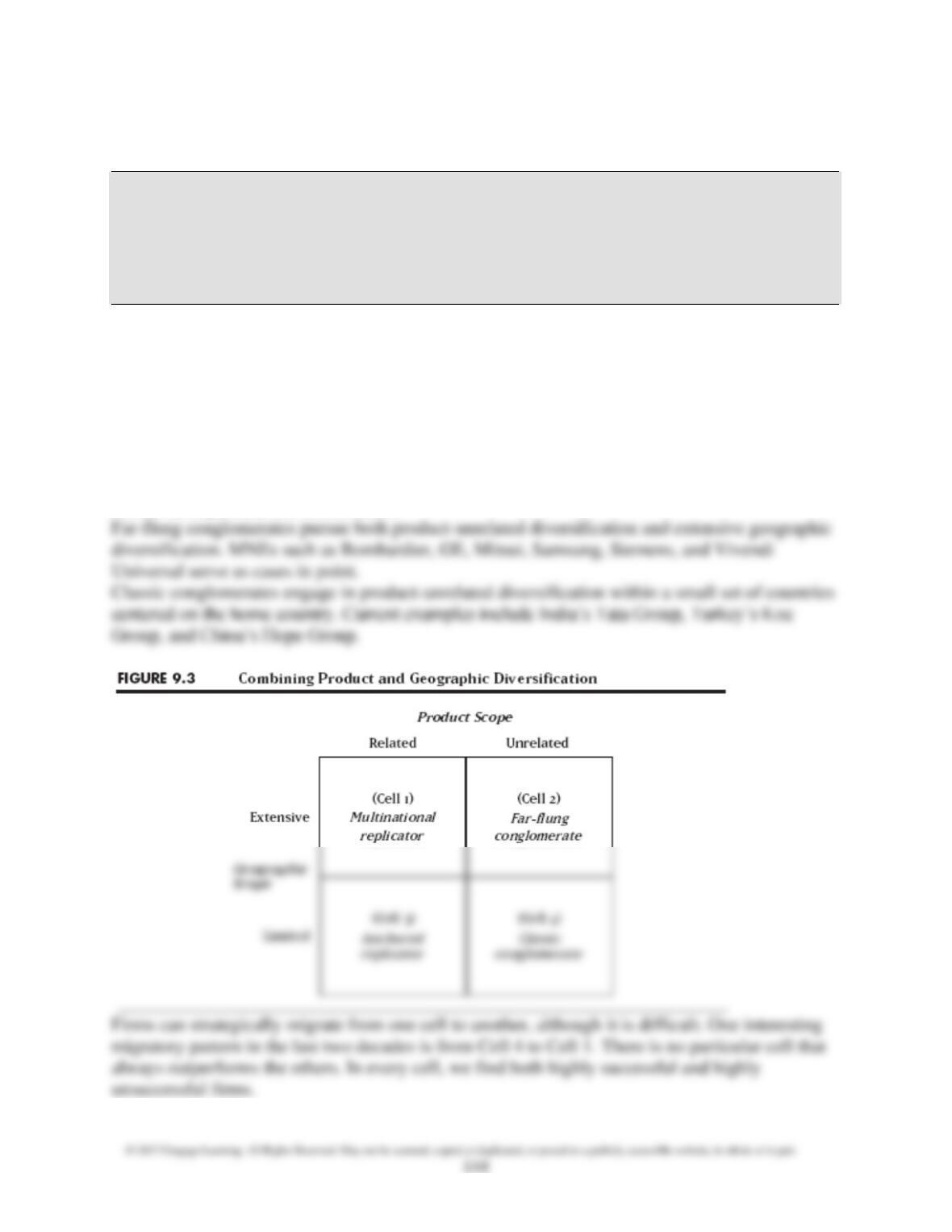
Figure 9.2. Geographic Diversification and Firm Performance: An S Curve
Performance
Chapter 9 Diversifying, Acquiring, and Restructuring
COMBINING PRODUCT AND GEOGRAPHIC DIVERSIFICATION
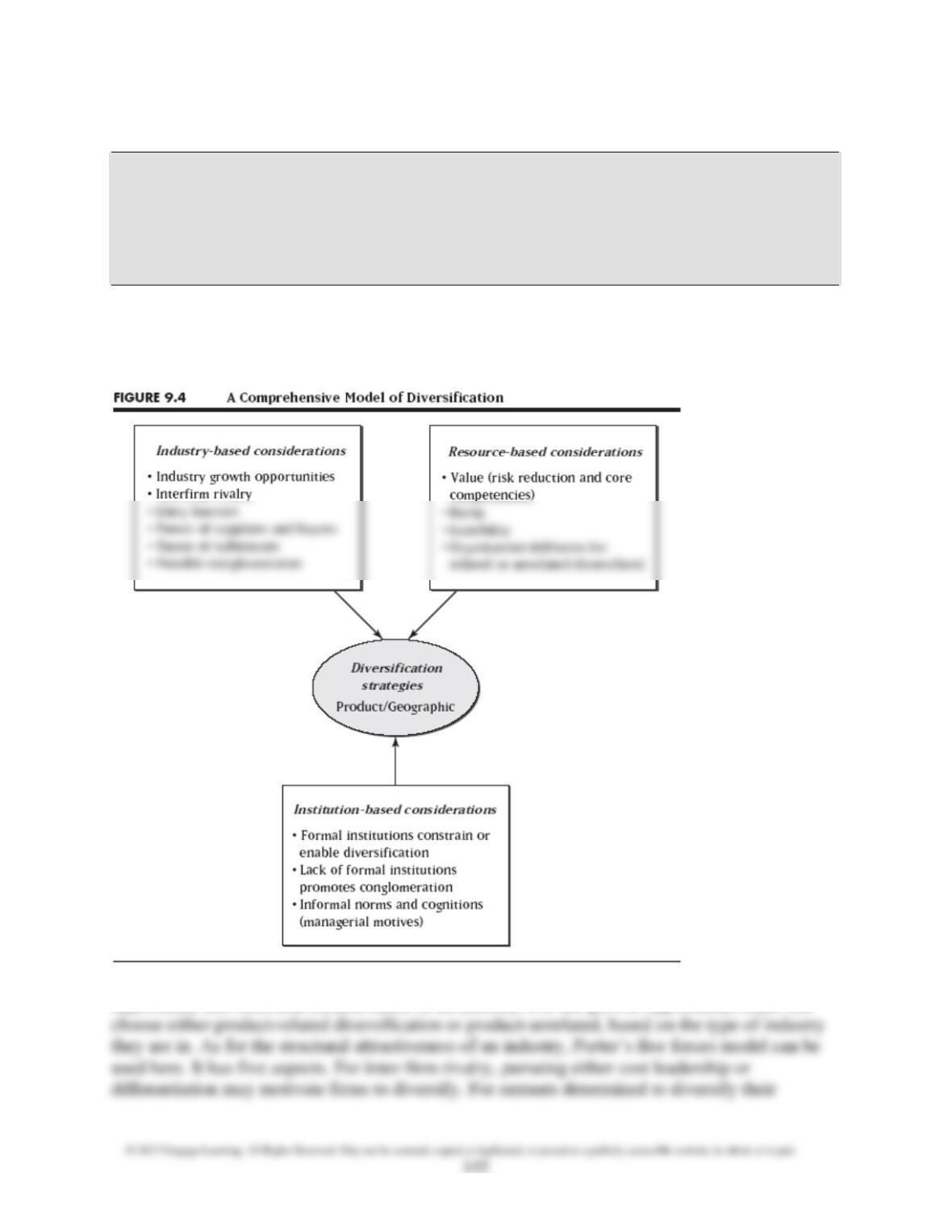
Teaching Tip: One interesting pattern in diversification is that in the last two decades many
classic conglomerates in developed economies, such as Denmark’s GN Great Northern and
Sweden’s Electrolux, which formerly dominated their home countries, have reduced their
product scope, but significantly expanded their geographic scope—in other words, migrating
from Cell 4 to Cell 1 in Figure 9.3. The students may be asked to consider why such seemingly
mixed actions may occur.
There are four possible combinations of different levels of geographic diversification and
different kinds of product diversification: anchored replicators, multinational replicators, far–
flung conglomerates, and classic conglomerates.
Anchored replicators focus on product-related diversification and a limited geographic scope.
They seek to replicate a set of activities in related industries in a small number of countries
anchored by the home country.
Multinational replicators engage in product-related diversification on the one hand and far-flung
multinational expansion on the other hand. Most automakers such as Volkswagen, Renault, and
Nissan have pursued this combination.
Chapter 9 Diversifying, Acquiring, and Restructuring
A COMPREHENSIVE MODEL OF DIVERSIFICATION
Teaching Tip: Diversification is often something that students find difficult. They tend to mix up
different types of diversification and confuse them with the conceptually vertical integration.
Thus ask students to think about why firms diversify. For example, why did Chinese computer
firm Lenovo buy out IBM’s PC division? The students can brainstorm about possible reasons for
this; the instructor might put up the three leading perspectives (industry-, resource-, and
institution-based views) and ask the students to put some ideas under each perspective.
The three leading perspectives—industry, resource, and institution-based views—lead to a
comprehensive model of diversification.
The Industry-Based considerations state that the motivations for diversification are growth
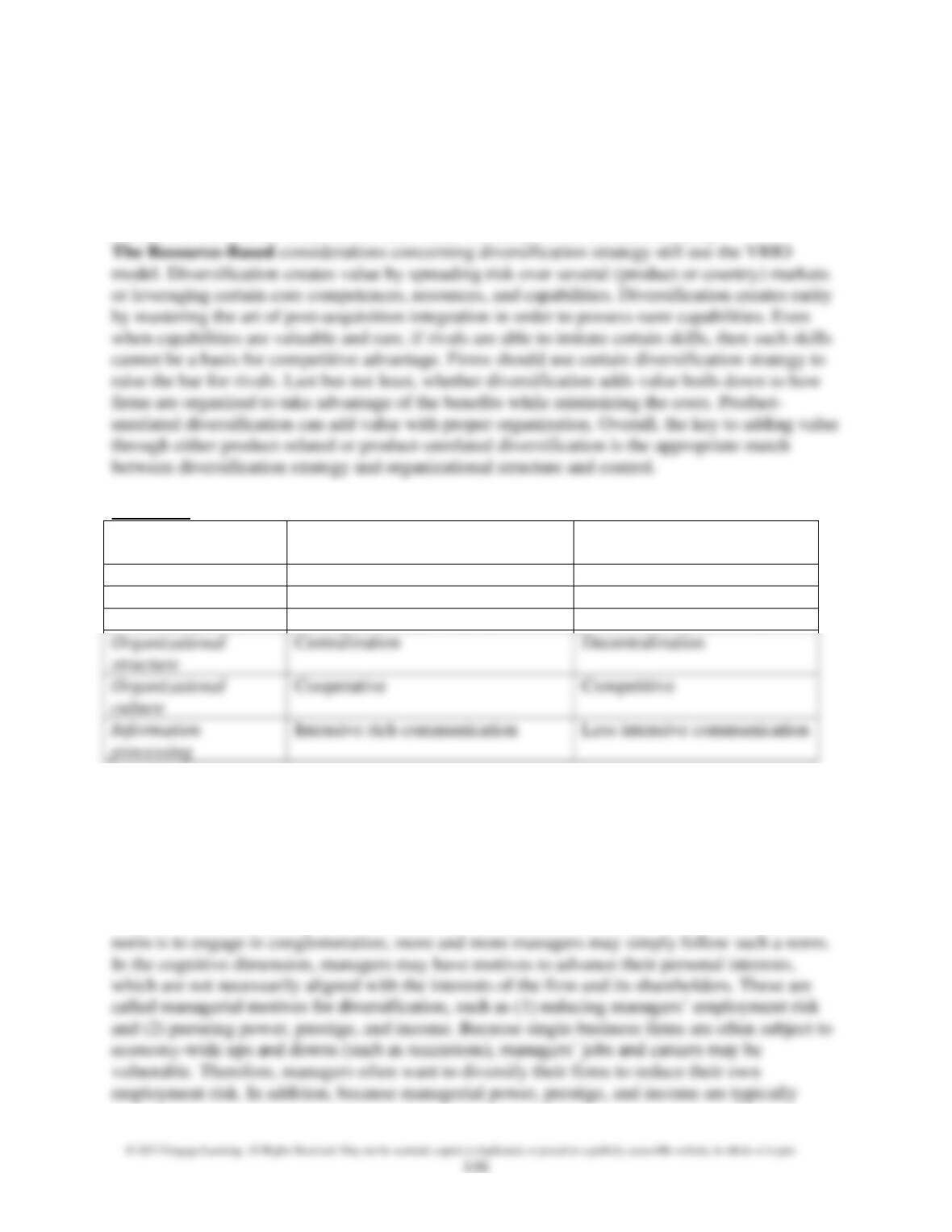
Chapter 9 Diversifying, Acquiring, and Restructuring
portfolio by entering the focal industry or country, high entry barriers often result in acquisitions
as opposed to green-field entries. Bargaining power of suppliers and buyers, respectively, may
prompt firms to broaden their scope by acquiring suppliers upstream and/or buyers downstream.
Such moves as part of product-related diversification are motivated by the quest for market
power. As for the threat of substitute products, an industry whose products can be easily
substituted faces more threats from other firms currently not in the same industry.
Table 9.1. Product-Related versus Product-Unrelated Diversification
Product-Related Diversification
Product-Unrelated
Diversification
Synergy
Operational synergy
Financial synergy
Economies
Economies of scale
Economies of scope
Control emphasis
Strategic (behavior) control
Financial (output) control
structure
culture
Cooperative
Competitive
processing
Intensive rich communication
Less intensive communication
The Institutional-Based considerations are also important. Formal institutions affect both
product and geographic diversification. The significant rise of diversification undertaken by
numerous firms can be attributed, at least in part, to the gradual opening of many economies
initiated by formal, market-supporting, and market-opening policy changes.
Informal institutions can be found along normative and cognitive dimensions. Normatively,
managers often try to behave in ways that will not be noticed as different and consequently
singled out for criticism by shareholders, board directors, and the media. Therefore, when the

Chapter 9 Diversifying, Acquiring, and Restructuring
associated with a larger firm size, some managers may have self-interested incentives to over-
diversify their firms, resulting in value destruction. Such excessive diversification is often called
empire building.
In summary, the institution-based view suggests that formal and informal institutional conditions
The Evolution of the Scope of the Firm: Benefits and Costs
At its core, diversification is essentially driven by economic benefits and bureaucratic costs.
Economic benefits are the various forms of synergy (operational or financial) discussed earlier.
Bureaucratic costs are the additional costs associated with a larger, more diversified
organization, such as more headcounts and more complicated information systems. Overall, it is
ACQUISITIONS
Teaching Tip: Ask the students why some of the more famous acquisitions have failed to
produce any benefits for the shareholders and the market (some of which have been mentioned in
Chapter 9 and Chapter 12). For example, the Daimler-Benz acquisition of Chrysler has been a
failure for virtually all parties involved. Why is this the case; why have there been no synergies
realized to date? Similarly, the instructor can ask about the HP–Compaq merger and why that has
proved problematic for HP and led to the ouster of the charismatic HP CEO, Carly Fiorina.
Although the term mergers and acquisitions (M&As) is often used, in reality, acquisitions
dominate the scene. There are many different kinds of M&As by looking at them from different
angles. They include cross-border (international) M&A, horizontal M&A, vertical M&A, and
conglomerate M&A.
Horizontal M&As refer to deals involving competing firms in the same industry (such as
Nomura’s acquisition of Lehman Brothers assets). Approximately 70% of the cross-border
M&As are horizontal. Vertical M&As, another form of product-related diversification, are deals
that allow the focal firms to acquire (upstream) suppliers and/or (downstream) buyers (such as

Chapter 9 Diversifying, Acquiring, and Restructuring
motives. Overall, synergistic motives add value, and hubris and managerial motives destroy
value. Both these positive and negative motives may simultaneously coexist.
Table 9.2. Motives behind Mergers and Acquisitions
Industry-Based
Issues
Resource-Based Issues
Institution-Based Issues
Synergistic
motives
• Enhance and
consolidate
market power
• Overcome
entry barriers
• Reduce risk
• Leverage
scope
economies
overconfidence in
their capabilities
• Herd behavior—
following norms
and chasing fads
guided by
informal norms
• Leverage superior
managerial
capabilities
• Access to
complementary
resources
• Learning and
developing new
skills
• Respond to
formal
institutional
constraints and
transitions
• Take advantage
of market
openings and
globalization
Despite the popularity of M&As, as many as 70 percent of M&As reportedly fail. On average,
the acquiring firms’ performance does not improve after acquisitions and is often negatively
affected. Target firms, after being acquired and becoming internal units, often perform worse

Chapter 9 Diversifying, Acquiring, and Restructuring
Table 9.3. Symptoms of Merger and Acquisition Failures
Problems for All M&As
Particular Problems for Cross-
Border M&As
Pre-
acquisition:
Overpayment
for targets
• Managers overestimate their
ability to create value
• Inadequate pre-acquisition
screening
• Poor strategic fit
• Lack of familiarity with
foreign cultures, institutions,
and business systems
• Inadequate number of worthy
targets
• Nationalistic concerns against
foreign takeovers (political
and media levels)
cultures compounded by
clashes of national cultures
• Nationalistic concerns against
foreign takeovers (firm and
employee levels)
In order to ensure the success of the M&A, at the very minimum, managers need to make sure (1)
that they do not pay too much for targets, avoid a bidding war, and are willing to walk out when
premiums are too high; (2) that they engage in adequate due diligence concerning both strategic
fit and organizational fit to avoid nasty surprises after the acquisition; and (3) that they
RESTRUCTURING
The most common definition for restructuring is the reduction of firm size and scope. Using this
definition, there are two primary ways of restructuring; namely, downsizing and down-scoping.
The flipside of down-scoping is refocusing.
We can draw on industry-, resource-, and institution-based views to understand the motives for
Teaching Tip: Organizational turnaround will be attempted, usually through restructuring, when
a firm has sustained a downturn, normally of three years or more. Apple’s return to profitability
upon Steve Jobs’ return as CEO has been one of the biggest turnarounds in the high-technology
business, and unprecedented in the microcomputer industry. Ask the students how Apple turned
itself around. It was not through a lot of cost cutting, rather it was through the creation of new
products, including a new Macintosh line, a new operating system, and entertainment software

Chapter 9 Diversifying, Acquiring, and Restructuring
(partly brought over by Jobs from his old company, NeXT) and the development of the first hot
consumer electronic product of the 21st century—the iPod.
DEBATES AND EXTENSIONS
The complexity of diversifying, acquiring, and restructuring has led to numerous debates. Two
leading debates are outlined here: (1) product relatedness versus other forms of relatedness, and
(2) acquisitions versus alliances.
The first debate centers on what exactly relatedness is. Three significant points of contention
exist. First, how to actually measure product relatedness remains debatable. A “product–related”
firm based on one particular measure may be considered “unrelated” if a different measure is
used. Second, beyond measurement issues, the dominant logic school argues that product
relatedness does not only refer to the visible product linkages. Rather, relatedness can be a
THE SAVVY STRATEGIST
In terms of the four most fundamental questions in strategy, this chapter directly answers
Question 3: What determines the scope of the firm? Industry conditions, firm capabilities, and
institutional constraints and opportunities in both developed and emerging economies all help
shape corporate scope. In addition, why firms differ (Question 1) and how firms behave
(Question 2) boils down to why they choose different diversification strategies and how they
carry out these strategies, respectively. Finally, what determines the international success and
failure of firms (the first half of Question 4) can be answered by whether appropriate product

Chapter 9 Diversifying, Acquiring, and Restructuring
POSSIBLE ANSWERS TO CRITICAL DISCUSSION QUESTIONS
1. M&As are a rare event for most firms. How can they enhance their capabilities for M&As?
While considering a merger or an acquisition, the important question that needs to be
answered concerns how the firm will generate value from the deal. During the prep-
acquisition stage, firms should ideally ask and acquire an answer for this question, “Will this
M&A fulfill the mission of the firm?”
The next question would be a “why” one—Is it to broaden the product line? Is it to gain new
customers? Is it the brand name that the company wants to acquire? Or is it gain access to
some cutting-edge strategic technology? Another important question deals with the
possibility of acquiring all this without an acquisition—maybe an alliance. The next issue
that needs to be resolved is about the integration of this new acquisition. Organizational
factors can either facilitate or prevent a successful integration. Firms can enhance their
capabilities by preparing for some of the challenges that they might confront.
• Is the acquisition a capability-based one? This will help you identify organizational areas
that will be impacted and the monetary savings or value that can be achieved by
2. ON ETHICS: As a CEO leading an acquisition of a foreign firm (think of Anheuser-Busch
or Cadbury), you are interviewed by a reporter from the host country. The reporter asks: “A
lot of people in our country are mad about this foreign takeover of this iconic company. How
would you alleviate their concerns?”
Answers might vary. For example, the last ten years have seen dozens of UK firms being
taken over by overseas buyers. In most cases, shareholders have profited immensely from the
3. ON ETHICS: CEOs’ pay is typically linked to the size of the firms they lead. Some argue
that CEOs have an inherent bias in favor of undertaking M&As using shareholders’ money.
Do you agree or disagree with this view?

Chapter 9 Diversifying, Acquiring, and Restructuring
Answers might vary. Ideally an M&A should be considered not merely to give the CEO a
huge pay hike, but also to enhance the capabilities of a firm. A CEO who would put himself
before the firm or the shareholders is certainly not behaving in the interests of the firm.
TOPICS FOR EXPANDED PROJECTS
1) Some argue that shareholders can diversify their stockholdings and that there is no need
for corporate diversification to reduce risk. The upshot is that any excess earnings
(known as “free cash flows”) should be returned to shareholders as dividends. Do you
agree or disagree with this statement? Why?
The value of corporate diversification depends partly on what industry the firm is in,
though, broadly speaking, investing in major acquisitions seems to be a futile, value-
2) Unrelated product diversification (conglomeration) is widely discredited in developed
economies. However, in some cases it still seems to add value in emerging economies—
think of Samsung and Tata. Is this interest in conglomeration likely to hold or decrease in
emerging economies over time? Why?
Research suggests that because of underdeveloped or inefficient capital markets and

Chapter 9 Diversifying, Acquiring, and Restructuring
3) ON ETHICS: As the executive team of a firm, you are trying to decide whether to
acquire a foreign firm. The size of your firm will double after this acquisition, and it will
become the largest in your industry. On the one hand, you are excited about the
opportunities to be a leading captain of industry and the associated power, prestige, and
income (you expect your incomes to double next year). On the other hand, you have just
read this chapter and are troubled by the 70% M&A failure rate. How would you
proceed?
Many would probably still proceed, believing that he or she can make the acquisition
work— succeeding where others failed in the past. And there is evidence to suggest that if
the acquisition were to be carefully planned—that is, the new product lines and