Chapter 9
Forecasting Exchange Rates
Lecture Outline
Why Firms Forecast Exchange Rates
Forecasting Techniques
Technical Forecasting
Fundamental Forecasting
Market-Based Forecasting
Mixed Forecasting
Assessment of Forecast Performance
Measurement of Forecast Error
Forecast Errors Among Time Horizons
Accounting for Uncertainty Surrounding Forecasts
Sensitivity Analysis Applied to Fundamental Forecasting
Interval Forecasts

Forecasting Exchange Rates ❖ 2
Chapter Theme
This chapter stresses the value of reliable forecasts but suggests that reliable forecasts can’t always be
obtained. Because no single forecast technique has been singled out as superior, various techniques are
mentioned. Whatever techniques the MNC chooses, it should monitor performance over time. This
chapter illustrates how this evaluation can be accomplished.
Topics to Stimulate Class Discussion
1. Which forecast technique would you use if you were hired by an MNC to forecast exchange rates?
2. Do you think there will ever be a published technical forecasting model that you could use in the
future to most accurately forecast exchange rates? Why or why not?
3. Recall the theories of purchasing power parity (PPP) and international Fisher effect (IFE) in Chapter
8. If these theories were used to forecast exchange rates, which techniques would they be classified
as? Why?
POINT/COUNTER-POINT:
Which Exchange Rate Forecast Technique Should MNCs Use?
POINT: Use the spot rate to forecast. When a U.S.-based MNC firm conducts financial budgeting, it
must estimate the values of its foreign currency cash flows that will be received by the parent. Since it is
well documented that firms can not accurately forecast future values, MNCs should use the spot rate for
budgeting. Changes in economic conditions are difficult to predict, and the spot rate reflects the best
guess of the future spot rate if there are no changes in economic conditions.
COUNTER-POINT: Use the forward rate to forecast. The spot rates of some currencies do not represent
accurate or even unbiased estimates of the future spot rates. Many currencies of developing countries
have generally declined over time. These currencies tend to be in countries that have high inflation rates.
If the spot rate had been used for budgeting, the dollar cash flows resulting from cash inflows in these
currencies would have been highly overestimated. The expected inflation in a country can be accounted
for by using the nominal interest rate. A high nominal interest rate implies a high level of expected
inflation. Based on interest rate parity, these currencies will have pronounced discounts. Thus, the
forward rate captures the expected inflation differential between countries because it is influenced by the
nominal interest rate differential. Since it captures the inflation differential, it should provide a more
accurate forecast of currencies, especially those currencies in high-inflation countries.
WHO IS CORRECT? Use the Internet to learn more about this issue. Which argument do you support?
Offer your own opinion on this issue.

Forecasting Exchange Rates ❖ 3
© 2021 Cengage Learning. All Rights Reserved. May not be copied, scanned, or duplicated, in whole or in part, except for use as
permitted in a license distributed with a certain product or service or otherwise on a password-protected website for classroom use.
ANSWER: To the extent that high expected inflation leads to weakness of a currency, the forward rate
should provide a more appropriate forecast. However, for some very short horizons, the inflation
expectations may not have much influence.
Answers to End of Chapter Questions
1. Motives for Forecasting. Explain corporate motives for forecasting exchange rates.
2. Technical Forecasting. Explain the technical approach forecasting exchange rates. What are some
limitations of using technical forecasting to predict these rates?
ANSWER: Technical forecasting involves the review of historical exchange rates to search for a
repetitive pattern that may occur in the future. This pattern would be the basis for future exchange
rate movements.
3. Fundamental Forecasting. Explain the fundamental approach to forecasting exchange rates. What
are some limitations of using a fundamental technique to forecast exchange rates?
4. Market-Based Forecasting. Explain the market-based technique for forecasting exchange rates.
What is the rationale for using market-based forecasts? If the euro appreciates substantially against
the dollar during a specific period, would market-based forecasts have overestimated or
underestimated the realized values over this period? Explain.
© 2021 Cengage Learning. All Rights Reserved. May not be copied, scanned, or duplicated, in whole or in part, except for use as
permitted in a license distributed with a certain product or service or otherwise on a password-protected website for classroom use.
5. Mixed Forecasting. Explain the mixed technique for forecasting exchange rates.
6. Detecting a Forecast Bias. Explain how to assess performance in forecasting exchange rates.
Explain how to detect a bias in forecasting exchange rates.
7. Measuring Forecast Accuracy. You are hired as a consultant to assess a firm’s ability to forecast.
The firm has developed a point forecast for two different currencies presented in the following table.
The firm asks you to determine which currency was forecasted with greater accuracy.
ANSWER:
Yen Actual Pound Actual
Period Forecast Yen Value Forecast Pound Value
1 $.0050 $.0051 $1.50 $1.51
Absolute Forecast Error as a Percentage of the Realized Value
Period Yen Forecast Pound Forecast
1 1.96% .66%
Mean 3.34% 1.63%
Forecasting Exchange Rates ❖ 6
develop their own forecasts of future exchange rates? That is, why wouldn’t they simply use today’s
quoted rates as indicators about future rates? After all, today’s quoted rates should reflect all relevant
information.
12. Forecast Error. The director of currency forecasting at Champaign-Urbana Corp. says, “The most
critical task of forecasting exchange rates is not to derive a point estimate of a future exchange rate
but rather to assess how wrong our estimate might be.” What does this statement mean?
13. Forecasting Exchange Rates of Currencies That Previously Were Fixed. When some countries in
Eastern Europe initially allowed their currencies to fluctuate against the dollar, would the
fundamental technique based on historical relationships have been useful for forecasting future
exchange rates of these currencies? Explain.
14. Forecast Error. Royce Co. is a U.S. firm with future receivables one year from now denominated in
Canadian dollars and British pounds. Its pound receivables are known with certainty, but its
estimated Canadian dollar receivables are subject to a 2 percent error in either direction. The dollar
values of both types of receivables are similar. There is no chance of default by the customers
involved. Royce’s treasurer says that the estimate of dollar cash flows to be generated from the
British pound receivables is subject to greater uncertainty than that of the Canadian dollar receivables.
Explain the rationale for the treasurer’s statement.
15. Forecasting the Euro. Cooper, Inc., a U.S.-based MNC, periodically obtains euros to purchase
German products. It assesses U.S. and German trade patterns and inflation rates to develop a
fundamental forecast for the euro. How could Cooper potentially improve its method of fundamental
forecasting as applied to the euro?
16. Forward Rate Forecast. Assume that you obtain a quote for a one-year forward rate on the Mexican
peso. Assume that Mexico’s one-year interest rate is 40 percent, whereas the U.S. one-year interest

Forecasting Exchange Rates ❖ 7
rate is 7 percent. Over the next year, the peso depreciates by 12 percent. Do you think the forward
rate overestimated the spot rate one year ahead in this case? Explain.
17. Forecasting Based on PPP versus the Forward Rate. You believe that the Singapore dollar’s
exchange rate movements are mostly attributable to purchasing power parity. Today, the nominal
annual interest rate in Singapore is 18%, compared to 3% in the U.S. You expect that annual inflation
will be approximately 4% in Singapore and 1% in the U.S. Assume that interest rate parity holds.
Today the spot rate of the Singapore dollar is $.63. Do you think the one-year forward rate would
underestimate, overestimate, or be an unbiased estimate of the future spot rate in one year? Explain.
18. Interpreting an Unbiased Forward Rate. Assume that the forward rate is an unbiased but not
necessarily accurate forecast of the future exchange rate of the yen over the next several years. Based
on this information, do you think Raven Co. should hedge its remittance of expected Japanese yen
profits to the U.S. parent by selling yen forward contracts? Why would this strategy be
advantageous? Under what conditions would this strategy backfire?
ANSWER: If the forward rate is an unbiased forecast, the amount of dollars received from
remittances when hedging should be the same (on average, over time) as the amount of dollars
Advanced Questions
19. Probability Distribution of Forecasts. Assume that the following regression model was applied to
historical quarterly data:
et = a0 + a1INTt + a2INFt-1 +
t
where et = percentage change in the exchange rate of the Japanese yen in period t
INTt = average real interest rate differential (U.S. interest rate minus Japanese interest rate)
over period t
INFt-1 = inflation differential (U.S. inflation rate minus Japanese inflation rate) in the previous
period
a0, a1, a2 = regression coefficients
t = error term
Assume that the regression coefficients were estimated as follows:
Forecasting Exchange Rates ❖ 8
a0 = 0.0
a1 = 0.9
a2 = 0.8
Also assume that the inflation differential in the most recent period was 3 percent. The real interest
rate differential in the upcoming period is forecasted as follows:
Interest Rate
Differential Probability
0% 30%
1 60
2 10
If Stillwater, Inc., uses this information to forecast the Japanese yen’s exchange rate, what will be the
probability distribution of the yen’s percentage change over the upcoming period?
ANSWER:
Forecast of Forecast of the
Interest Rate Percentage Change
Differential in the Japanese Yen Probability
20. Testing for a Forecast Bias. You must determine whether there is a forecast bias in the forward rate.
You apply regression analysis to test the relationship between the actual spot rate and the forward rate
forecast (F):
S = a0 + a1 (F)
The regression results are as follows:
Coefficient Standard error
a0 = .006 .011
a1 = .800 .05
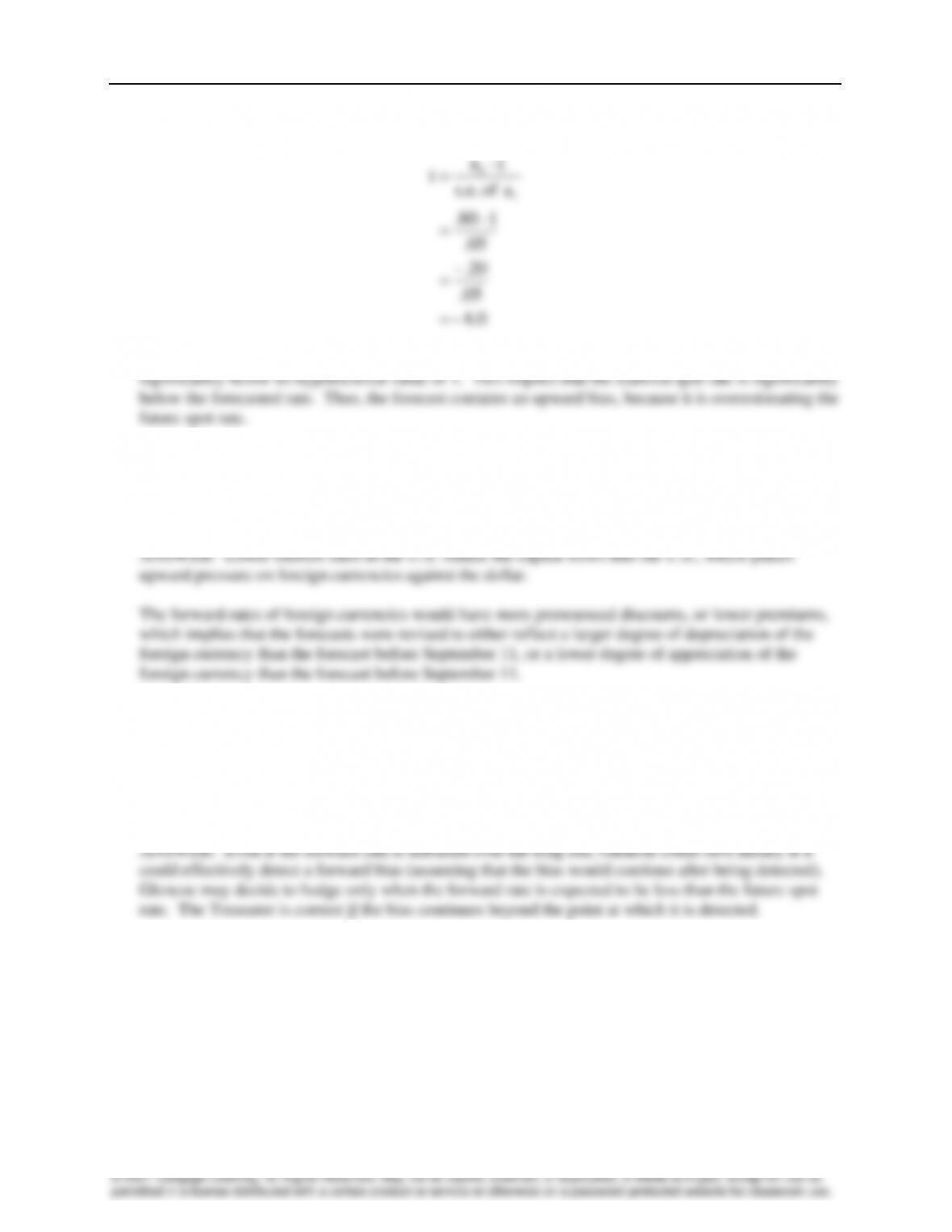
Based on these results, is there a bias in the forecast? Verify your conclusion. If there is a bias,
explain whether it is an overestimate or an underestimate.
Forecasting Exchange Rates ❖ 9
t-statistic for a1:
4.0–
.05
.20–
.05
1 – .80
a of s.e.
1 – a
=t
1
1
=
=
=
The results suggest that while a0 is not significantly different from its hypothesized value of zero, a1 is
21. Effect of September 11 on Forward Rate Forecasts. The September 11, 2001 terrorist attacks on
the U.S. were quickly followed by lower interest rates in the U.S. How would this affect a
fundamental forecast of foreign currencies? How would this affect the forward rate forecast of foreign
currencies?
22. Interpreting Forecast Bias Information. The treasurer of Glencoe, Inc., detected a forecast bias
when using the 30-day forward rate of the euro to forecast future spot rates of the euro over various
periods. He believes he can use this information to determine whether imports ordered every week
should be hedged (payment is made 30 days after each order). Glencoe’s president says that in the
long run the forward rate is unbiased, and that the treasurer should not waste time trying to “beat the
forward rate,” but should just hedge all orders. Who is correct?
23. Forecasting Latin American Currencies. The value of each Latin American currency relative to the
dollar is dictated by supply and demand conditions between that currency and the dollar. The values
of Latin American currencies have generally declined substantially against the dollar over time. Most
of these countries have high inflation rates and high interest rates. The data on inflation rates,
economic growth, and other economic indicators are subject to error, as limited resources are used to
compile the data.
a. If the forward rate is used as a market-based forecast, will this rate result in a forecast of
appreciation, depreciation, or no change in any particular Latin American currency? Explain.
Forecasting Exchange Rates ❖ 10
ANSWER: The forward rate of each Latin American currency would have a large discount, because
b. If technical forecasting is used, will this result in a forecast of appreciation, depreciation, or no
change in the value of a specific Latin American currency? Explain.
ANSWER: Technical forecasting would result in a forecast of depreciation, because the Latin
c. Do you think that U.S. firms can accurately forecast the future values of Latin American
currencies? Explain.
24. Selecting between Forecast Methods. Bolivia currently has a nominal one-year risk-free interest rate
of 40 percent, which is primarily due to the high level of expected inflation. The U.S. nominal one-
year risk-free interest rate is 8 percent. The spot rate of Bolivia’s currency (called the boliviano) is
$.14. The one-year forward rate of the boliviano is $.108. What is the forecasted percentage change in
the boliviano if the spot rate is used as a one-year forecast? What is the forecasted percentage change
in the boliviano if the one-year forward rate is used as a one-year forecast? Which forecast do you
think will be more accurate? Why?
25. Comparing Market-based Forecasts. For all parts of this question, assume that interest rate parity
exists, the prevailing one-year U.S. nominal interest rate is low, and that you expect the U.S. inflation
to be low this year.
a. Assume that the country Dinland engages in much trade with the U.S. and that this trade involves
many different products. Dinland has had a zero trade balance with the U.S. (the value of exports
and imports is about the same) in the past. Assume that you expect a high level of inflation
(perhaps about 40%) in Dinland over the next year because of a large increase in the prices of
many products that Dinland produces. Dinland presently has a one-year risk-free interest rate of
more than 40%. Do you think that the prevailing spot rate or the one-year forward rate would
result in a more accurate forecast of Dinland’s currency (the din) one year from now? Explain.
Forecasting Exchange Rates ❖ 11
b. Assume that the country Freeland engages in much trade with the U.S. and that this trade involves
many different products. Freeland has had a zero trade balance with the U.S. (the value of exports
and imports is about the same) in the past. You expect high inflation (perhaps about 40%) in
Freeland over the next year because of a large increase in the cost of land (and therefore housing)
in Freeland. You believe that the prices of products that Freeland produces will not be affected.
Freeland presently has a one-year risk-free interest rate of more than 40%. Do you think that the
prevailing one-year forward rate of Freeland’s currency (the fre) would overestimate,
underestimate, or be a reasonably accurate forecast of the spot rate one year from now? [Presume
a direct quotation of the exchange rate, so that if the forward rate underestimates the spoot rate, it
means that its value is less than the realized spot rate in one year. If the forward rate
overestimates the spot rate, it means that its value is more than the realized spot rate in one year.]
ANSWER: The inflation in Freeland does not affect the trade balance between the U.S. and Freeland.
26. IRP and Forecasting. New York Co. has agreed to pay 10 million Australian dollars (A$) in two
years for equipment that it is importing from Australia. The spot rate of the Australian dollar is $.60.
The annualized U.S. interest rate is 4%, regardless of the debt maturity. The annualized Australian
dollar interest rate is 12% regardless of the debt maturity. New York Co. plans to hedge its exposure
with a forward contract that it will arrange today. Assume that interest rate parity exists. Determine
the amount of U.S. dollars that New York Co. will need in 2 years to make its payment.
ANSWER: The 2-year forward premium is computed as:
2
2
27. Forecasting Based on the International Fisher Effect. Purdue Co. (based in the U.S.) exports
cable wire to Australian manufacturers. It invoices its product in U.S. dollars, and will not change its
price over the next year. There is intense competition between Purdue and the local cable wire
producers that are based there. Purdue’s competitors invoice their products in Australian dollars and
will not be changing their prices over the next year. The annualized risk-free interest rate is presently
8% in the U.S., versus 3% in Australia. Today the spot rate of the Australian dollar is $.55. Purdue
Co. uses this spot rate as a forecast of future exchange rate of the Australian dollar. Purdue expects
that revenue from its cable wire exports to Australia will be approximately $2 million over the next
year.
If Purdue decides to use the international Fisher effect rather than the spot rate to forecast the
exchange rate of the Australian dollar over the next year, will its expected revenue from its exports be
higher, lower, or unaffected? Explain.
ANSWER: If IFE exists, the forecasted change in the exchange rate is:

© 2021 Cengage Learning. All Rights Reserved. May not be copied, scanned, or duplicated, in whole or in part, except for use as
permitted in a license distributed with a certain product or service or otherwise on a password-protected website for classroom use.
28. IRP, Expectations, and Forecast Error. Assume that interest rate parity exists and that it will
continue to exist in the future. Assume that interest rates of the U.S. and the U.K. vary substantially in
many periods. You expect that interest rates at the beginning of each month will have a major effect
on the British pound’s exchange rate at the end of each month, because you believe that capital flows
between the U.S. and the U.K. influence the pound’s exchange rate. You expect that money will flow
to whichever country has the higher nominal interest rate. At the beginning of each month, you will
either use the spot rate or the one-month forward rate to forecast the future spot rate of the pound that
will exist at the end of the month. Will the use of the spot rate as a forecast result in smaller, larger or
the same mean absolute forecast error as the forward rate when forecasting the future spot rate of the
pound on a monthly basis? Explain.
29. Deriving Forecasts from Forward Rates. Assume that interest rate parity exists. Today, the one-
year U.S. interest rate is equal to 8%, whereas Mexico’s one-year interest rate is equal to 10%. Today,
the two-year annualized U.S. interest rate is equal to 11%, whereas the two-year annualized Mexican
interest rate is equal to 11%. West Virginia Co. uses the forward rate to predict the future spot rate.
Based on forward rates for one year ahead, and two years ahead, will the peso appreciate or
depreciate from the end of year 1 until the end of year 2?
30. Forecast Errors from Forward Rates. Assume that interest rate parity exists. One year ago, the spot
rate of the euro was $1.40 whereas the spot rate of the Japanese yen was $.01. At that time, the one-
year interest rate of the euro and Japanese yen was 3%, compared to 7% for the one-year U.S. interest
rate. One year ago, you used the one-year forward rate of the euro to derive a forecast of the future
spot rate of the euro and the yen one year ahead. Today, the spot rate of the euro is $1.39, and the spot
rate of the yen is $.009. Which currency did you forecast more accurately?
© 2021 Cengage Learning. All Rights Reserved. May not be copied, scanned, or duplicated, in whole or in part, except for use as
permitted in a license distributed with a certain product or service or otherwise on a password-protected website for classroom use.
31. Forward Versus Spot Rate Forecasts. Assume that interest rate parity exists and it will continue to
exist in the future. Kentucky Co. wants to forecast the value of the Japanese yen in one month. The
Japanese interest rate is lower than the U.S. interest rate. Kentucky Co. will use either the spot rate or
the one-month forward rate to forecast the future spot rate of the yen at the end of one month. Your
opinion is that net capital flows between countries tend to move toward whichever country has the
higher nominal interest rate, and that these capital flows are the primary factor that affects the value
of the currency. Will using the forward rate for forecasting result in a smaller, larger or the same
absolute forecast error when using today’s spot rate for forecasting the future spot rate of the yen in
one month? Briefly explain.
32. Forward Versus Spot Rate Forecast. Assume that interest rate parity exists. The one-year risk-free
interest rate in the U.S. is 3 percent, versus 16 percent in Singapore. You believe in purchasing power
parity, and you also believe that Singapore will experience a 2% inflation rate, and the U.S. will
experience a 2% inflation rate over the next year. If you wanted to forecast the Singapore dollar’s
spot rate for one year ahead, do you think that the forecast error would be smaller when using today’s
one-year forward rate of the Singapore dollar as the forecast or when using today’s spot rate as the
forecast? Briefly explain.
33. Forecasting Based on the IFE. The prevailing one-year risk-free interest rate in Argentina is higher
than in the U.S. and will continue to be higher over time. Sycamore Co. believes the international
Fisher effect (IFE) can be used to derive the best forecast of the peso’s exchange rate movement over
time. In contrast, you believe that the prevailing spot rate is the best forecast of the future spot rate.
Based on your opinion, will Sycamore Co. typically overestimate the future spot rate, underestimate
the future spot rate, or create an unbiased forecast (similar chance of overestimating or
underestimating the future spot rate) of the Argentine peso? Briefly explain.
CRITICAL THINKING
Forecasting Exchange Rates of Currencies in Developing Countries Some U.S.-based MNCs have
business in developing countries in which it is difficult to hedge their exposure to exchange rate risk.
Their forecasts of the currency’s future exchange rate is subject to much error because the currencies in
these countries tend to be very volatile, and could possibly depreciate by 20% or more in a given year..
Write a short essay on how MNCs that have receivables in these currencies might be able to use exchange
rate forecasts to prepare for possible weak currency scenarios, so that they can assess whether they will
have sufficient dollar cash inflows to cover their debt payments.
Forecasting Exchange Rates ❖ 14
ANSWER
While it is impossible to forecast exchange rates of these currencies accurately, the MNCs could at least
consider how various possible adverse exchange rate forecasts would affect their cash inflows. For
Solution to Continuing Case Problem: Blades, Inc.
1. Considering both Blades’ current practices and future plans, how can the company benefit from
forecasting the baht-dollar exchange rate?
ANSWER: Blades can benefit from forecasting the baht-dollar exchange rate in various ways. First,
Blades currently generates net cash inflows denominated in Thai baht. The dollar value of these cash
2. Which forecasting technique (i.e., technical, fundamental, or market-based) would be easiest to use in
forecasting the future value of the baht? Why?
3. Blades is considering using either current spot rates or available forward rates to forecast the future
value of the baht. Available forward rates currently exhibit a large discount. Do you think the spot or
the forward rate will yield a better market-based forecast? Why?
4. The current 90-day forward rate for the baht is $.021. By what percentage is the value of the baht
expected to change over the next quarter according to a market-based forecast using the forward rate?
What will be the value of the baht in 90 days according to this forecast?
© 2021 Cengage Learning. All Rights Reserved. May not be copied, scanned, or duplicated, in whole or in part, except for use as
permitted in a license distributed with a certain product or service or otherwise on a password-protected website for classroom use.
5. Assume that the technical forecast has been more accurate than the market-based forecast in recent
weeks. What does this indicate about market efficiency for the baht-dollar exchange rate? Do you
think it means that technical analysis will always be superior to other forecasting techniques in the
future? Why or why not?
6. What is the expected percentage change in the value of the baht during the next quarter based on the
fundamental forecast? What is the forecasted value of the baht using this forecast? If the value of the
baht 90 days from now turns out to be $.022, which forecasting technique is the most accurate? (Use the
absolute forecast error as a percentage of the realized value to answer the last part of this question.)
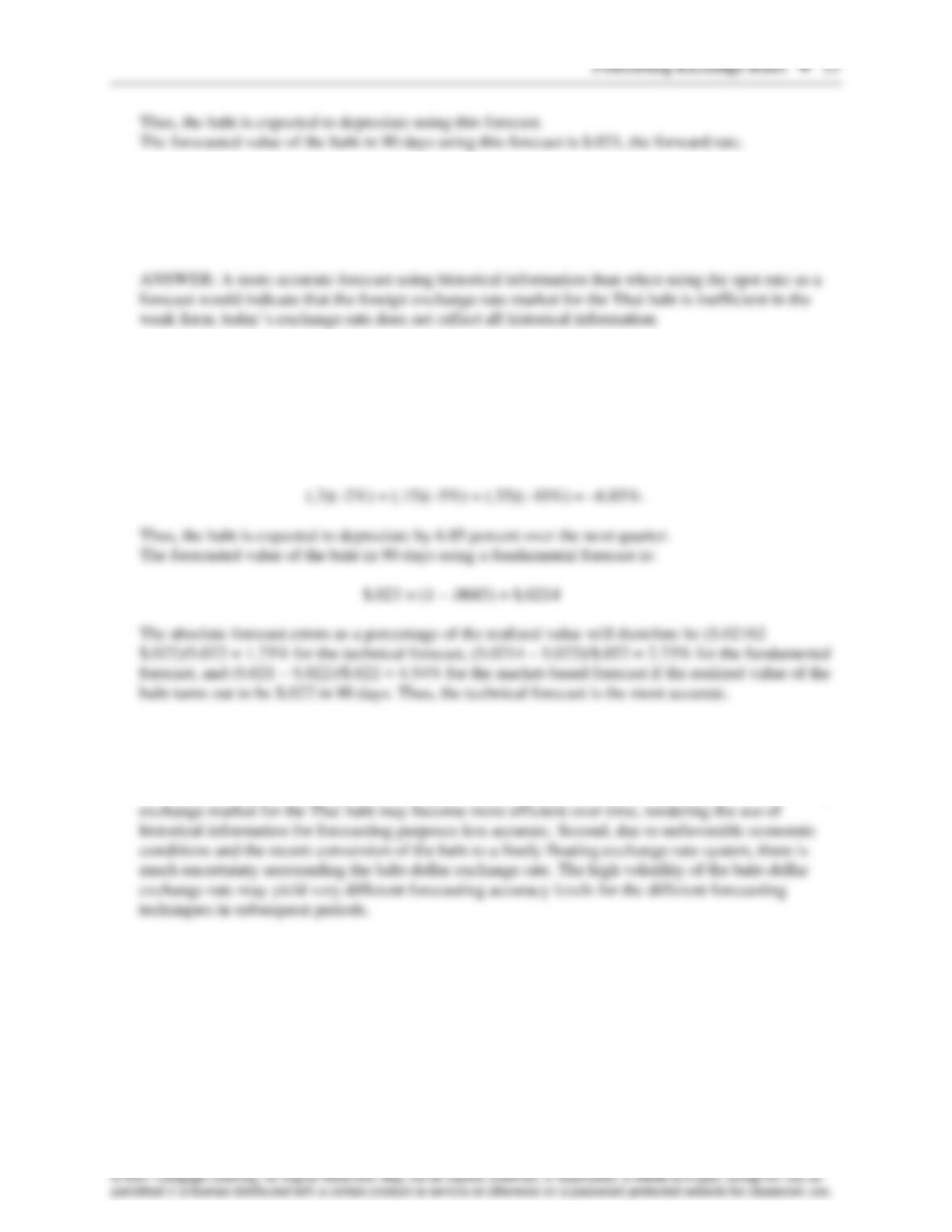
ANSWER: The expected change in the value of the baht according to the fundamental forecast is:
(.3)(–2%) + (.15)(–5%) + (.55)(–10%) = –6.85%.
7. Do you think the technique that you have identified in question 6 will always be the most accurate?
Why or why not?
ANSWER: No, the technical forecast will probably not always be the most accurate. First, the foreign
Solution to Supplemental Case: Whaler Publishing Co.
1. The first step is to measure the standard deviation of the percentage change in each exchange rate,
which can most easily be done with a spreadsheet. This information can then be used along with
today’s spot exchange rate to derive the confidence intervals for each exchange rate.
Approximate 68 Percent 95 Percent
Standard Confidence Confidence
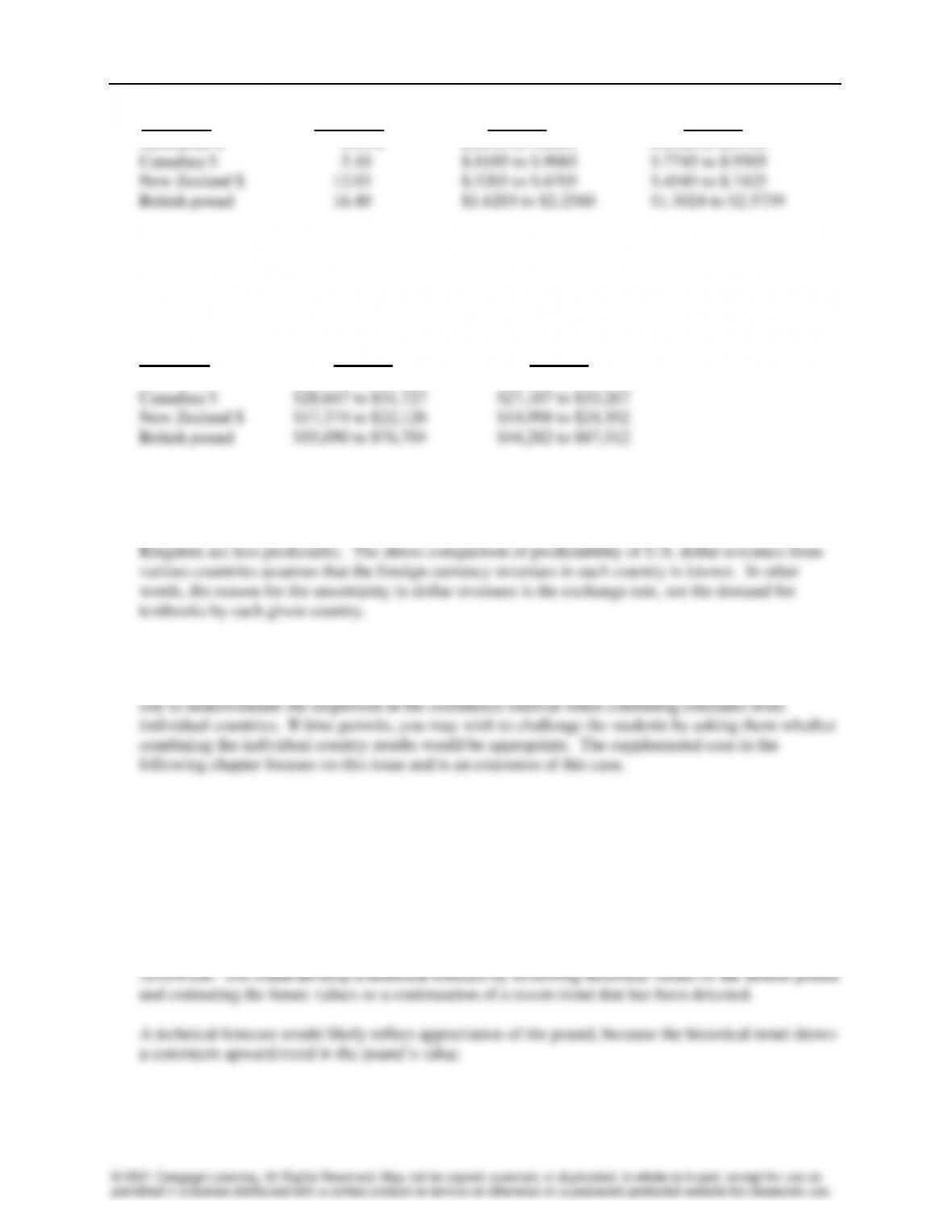
Forecasting Exchange Rates ❖ 16
Currency Deviation Interval Interval
Australian $ 9.59% $.6935 to $.8407 $.6200 to $.9142
Using the intervals described above and the number of foreign currency units to be received from
each country, the range of forecasted U.S. dollar revenues (in thousands) from each country is
disclosed below:
68 Percent 95 Percent
Confidence Confidence
Currency Interval Interval
Australian $ $26,353 to $31,946 $23,560 to $34,739
The numbers here may differ slightly from those the students compute due to rounding. The standard
deviations estimated above suggest that the Canadian dollar is the most stable currency so the U.S.
dollar revenues coming from Canada are more predictable. Conversely, the standard deviation of the
British pound has been most volatile, so that the U.S. dollar revenues coming from the United
Notice that the estimates were not pooled in any way to derive a confidence interval about the overall
dollar revenues. This would require an assumption that each exchange rate moves independently of
the others. If some of these currencies were positively correlated, such an assumption would cause
Small Business Dilemma
Exchange Rate Forecasting by the Sports Exports Company
1. Explain how Jim can use technical forecasting to forecast the future value of the pound. Based on the
information provided, do you think that a technical forecast will predict future appreciation or
depreciation in the pound?