1
Chapter 8: Culture and Leadership
Chapter Overview
Chapter 8: Culture and Leadership examines the work of the last 15 years regarding the GLOBE
Study and defines global leadership based upon new findings in cultural dimensions, leadership
scales, and organization of cultures according to society clusters. Questions that will be
addressed are: Are there global norms for leadership? How does leadership differ from one
cultural group to another? Are there best practices for certain leadership attributes?
LEARNING OBJECTIVE
Chapter 8: Culture and Leadership examines the work of the last 15 years regarding the GLOBE
Study and defines global leadership based upon new findings in cultural dimensions, leadership
KEY TAKEAWAYS
• There are certain universal global leadership norms; however, how these norms are carried
out depends on the context and situation across cultures. People in different societies have
LEADERSHIP APPLICATIONS
• Managers and leaders need to compare their own cultures with those of others in order to
understand what is different and what is similar. This can lead to more successful
interactions.
Introduction
• Case: What would you do?
• Cultural Myth #1
• Cultural Myth #2
2
• Cultural Myth #3
• Cultural Myth #4
Introduction
Why in a book about intercultural communication and leadership is leadership the last chapter?
• Every chapter IS about leadership because communication is the key to leadership.
• We can’t be leaders if we can’t communicate.
Scenario
In the following scenario, think about what you would do as a global leader if faced with the
challenge of managing a global team for a major international product launch.
Case: What would you do?
You have been assigned to lead a virtual team to launch a new product line overseas. Your
product has a cutting-edge manufacturing process and technological design elements that will
overtake your competitors in leaps and bounds. Naturally, your company leaders are pushing to
move the project forward and meet tight deadlines.

3
Exercise
List all of the key considerations that it will take in order to establish a cohesive and committed
team that will work together to produce a successful launch of the product.
• There are three considerations that you would need to immediately focus on:
Now discuss what these three considerations mean across culture.
There are four myths to being a global leader.
CULTURE MYTH #1: Customs may differ, but we’re all basically the same deep down inside.
• What are the fallacies of this statement?
• How would the culturally intelligent leader respond to this statement?
There are four myths to being a global leader.
CULTURE MYTH #2: My technical expertise will help me succeed—after all, that’s why they’ve
selected me.
• What are the fallacies of this statement?
• How would the culturally intelligent leader respond to this statement?
CULTURE MYTH #2 Continued…
Another common misconception is that successful leadership skills practiced in one’s own
culture are naturally transferable when applied in another cultural setting.
• What are the fallacies of this statement?
• How would the culturally intelligent leader respond to this statement?
There are four myths to being a global leader.
CULTURE MYTH #3: I lived abroad for a semester in college, it will be easy to adapt.
• What are the fallacies of this statement?
• How would the culturally intelligent leader respond to this statement?
4
There are four myths to being a global leader.
CULTURE MYTH #4: I’m the boss, so others will have to adapt to me.
Responses of the Culturally Intelligent Leader
• What are my core values, beliefs, and attitudes? How are these reflected in my
behavior?
The GLOBE Study of 62 Societies
• GLOBE Study leadership styles
The GLOBE Study of 62 Societies
GLOBE stands for “global leadership organizational behavior effectiveness.”
• Produced by a cross-cultural team of social scientists from around the world to study
leadership attributes.
The Study
5
The leader of the study was the late Robert House, professor of management at the Wharton
school.
• Using 170 social scientists from 62 countries from all regions of the world, surveyed
thousands of middle managers about leadership attributes.
What the Study Measured
The GLOBE Study measured cultural practices and values regarding leadership attributes, with
cultural practices being the way things are and values as the way people would like things to be.
• This makes it possible to capture the similarities and differences in the norms, values,
beliefs, and practices among societies.
GLOBE Study Leadership Styles
• Analyzed 17,300 employees from 951 organizations to determine the characteristics of a
global leader.
• From this data, derived 112 leader characteristics and with further analysis generated
Three classifications
Three distinct classifications emerged from both the quantitative and qualitative methods:
6
Six Leadership Scales
• Performance-oriented style
• Team-oriented style
Six Leadership Scales Explained
• Performance-oriented style: (charismatic/valued based) stresses high standards,
decisiveness, and innovation; seeks to inspire people around a vision; creates a passion
Six Leadership Scales Explained (Continued)
• Humane style: stresses compassion and generosity; it is patient, supportive, and
concerned with the well-being of others.
Nine Cultural Dimensions
• Power distance
• Uncertainty avoidance
• Humane orientation
7
Nine Cultural Dimensions Explained
• Power distance: degree to which members of a collective expect power to be
distributed equally.
• Uncertainty avoidance: extent to which a society, organization, or group relies on social
norms, rules, and procedures to alleviate unpredictability of future events.
• Humane orientation: degree to which a collective encourages and rewards individuals
for being fair, altruistic, generous, caring, and kind to others.
Six Leadership Styles
GLOBE Study Findings
Six Leadership Styles
Charismatic/Valued-Based:
Stresses high standards, decisiveness, and innovation;
seeks to inspire and motivate people around a vision;
creates a passion for performance centered on core
values.
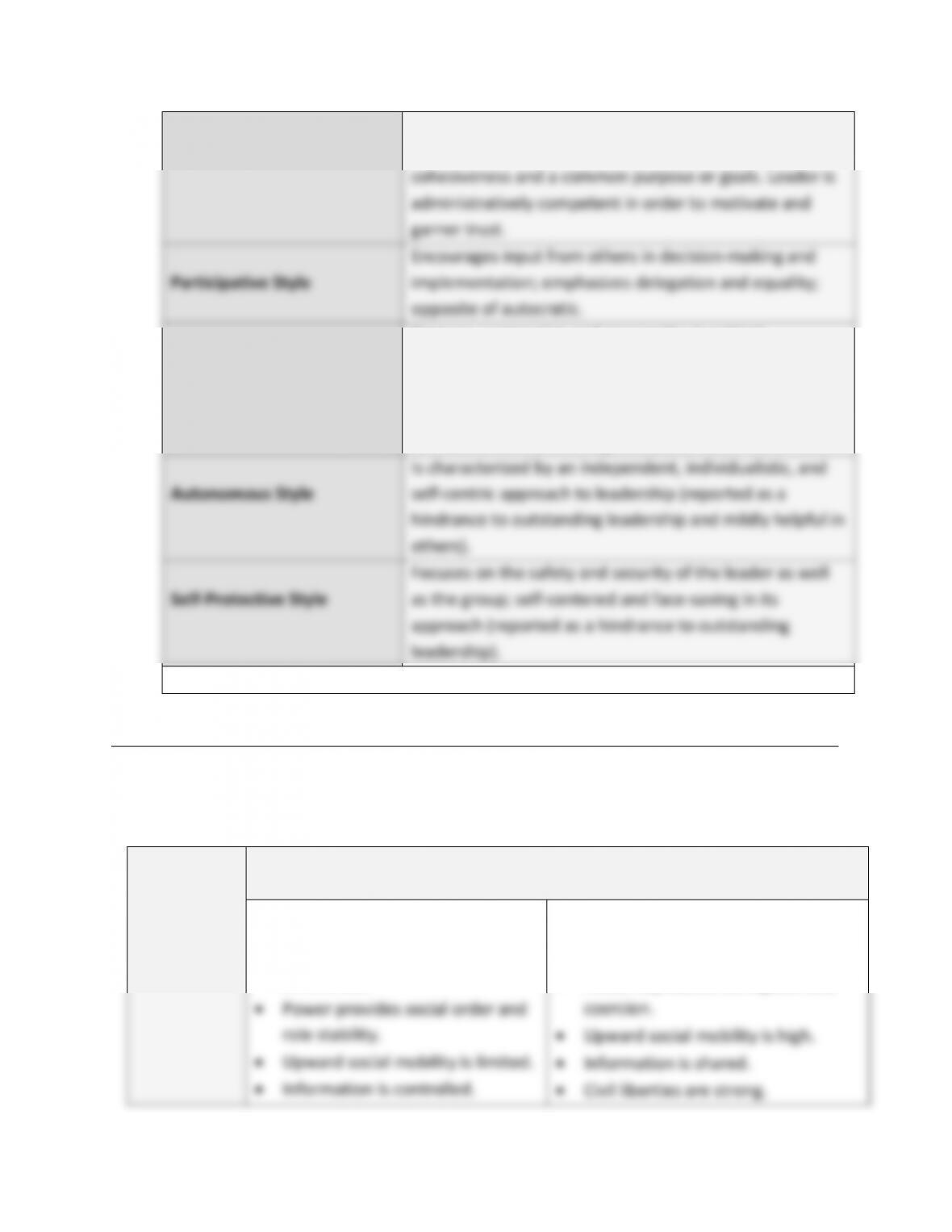
Team-Oriented Style
Instills pride, loyalty, and collaboration among
organizational members; highly values team
cohesiveness and a common purpose or goals. Leader is
administratively competent in order to motivate and
garner trust.
Participative Style
Encourages input from others in decision-making and
implementation; emphasizes delegation and equality;
opposite of autocratic.
Humane Style
Stresses compassion and generosity; is patient,
supportive, and concerned with the well-being of others.
The nature of communication aims to avoid conflict; the
process of communication focuses on supporting others
and therefore maintaining cohesion.
Autonomous Style
Is characterized by an independent, individualistic, and
self-centric approach to leadership (reported as a
hindrance to outstanding leadership and mildly helpful in
others).
Self-Protective Style
Focuses on the safety and security of the leader as well
as the group; self-centered and face-saving in its
approach (reported as a hindrance to outstanding
leadership).
Adapted from GLOBE Study, House, 2004.
Nine Cultural Dimensions
GLOBE Study Findings
Power Distance
Power
Distance
The degree to which members of a collective expect power to be distributed
equally. Therefore, societies tend to…
Higher
• Many social classes with certain
differences.
• Power provides social order and
role stability.
• Upward social mobility is limited.
• Information is controlled.
Lower
• Large middle class.
• Power represents corruption and
coercion.
• Upward social mobility is high.
• Information is shared.
• Civil liberties are strong.
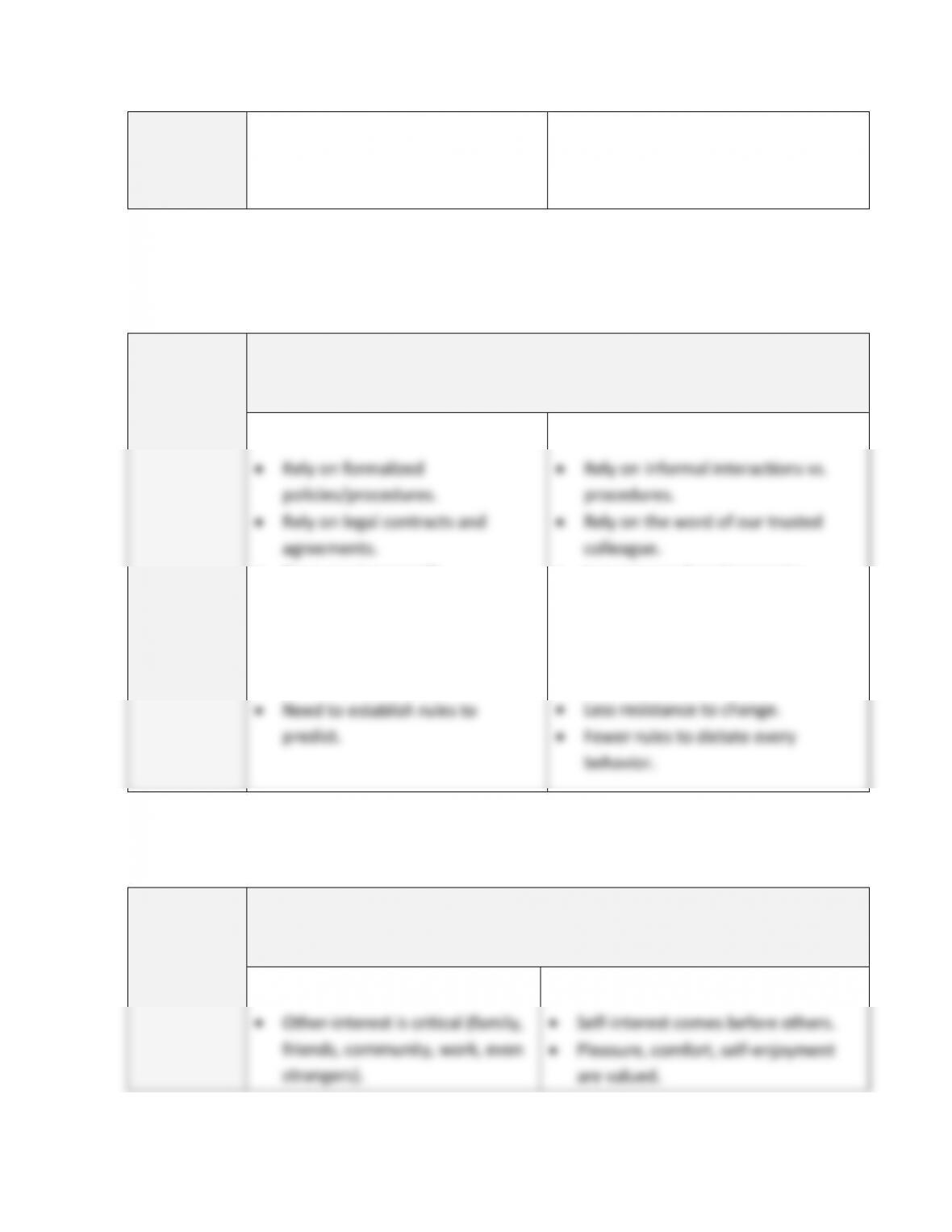
• Civil liberties are weak.
• Democracy doesn’t mean equal
opportunity.
• Democracy promotes opportunities
for all.
Nine Cultural Dimensions
GLOBE Study Findings
Uncertainty Avoidance
Uncertainty
Avoidance
The extent to which a society, organization, or group relies on social norms,
rules, and procedures to alleviate unpredictability of future events. Therefore,
these societies tend to…
Higher
• Rely on formalized
policies/procedures.
• Rely on legal contracts and
agreements.
• Keep precise records.
• Take moderate calculated risks.
• Tight control when developing
new idea.
• Resistant to change.
• Need to establish rules to
predict.
Lower
• Rely on informal interactions vs.
procedures.
• Rely on the word of our trusted
colleague.
• Less concern keeping precise
records.
• Take risks with less calculating.
• Lighten up on the controls to push
through.
• Less resistance to change.
• Fewer rules to dictate every
behavior.
Nine Cultural Dimensions
GLOBE Study Findings
Humane Orientation
Humane
tend to…
The degree to which a collective encourages and rewards individuals for being
• Other-interest is critical (family,
friends, community, work, even
strangers).
• Self-interest comes before others.
• Pleasure, comfort, self-enjoyment
are valued.
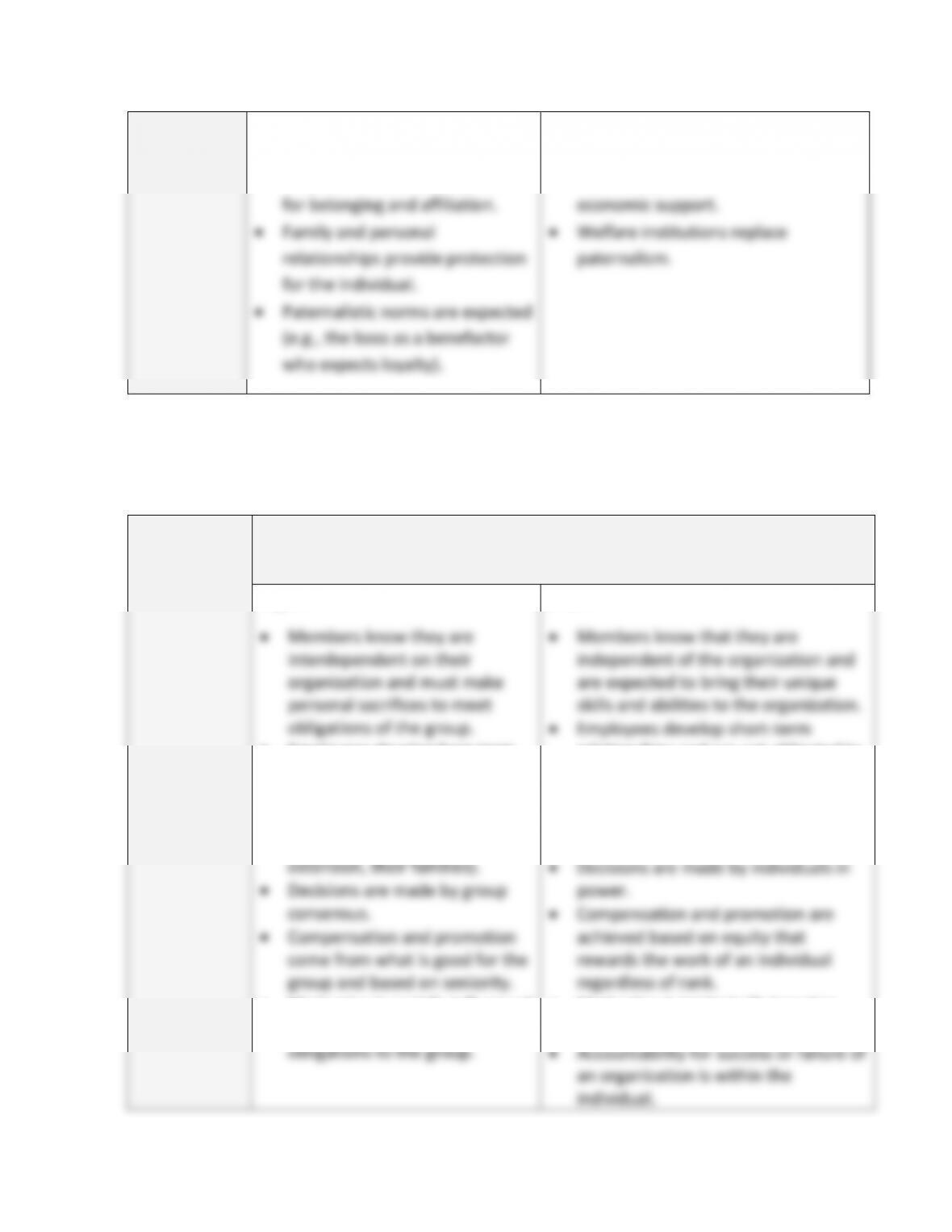
• Benevolence, kindness, and
generosity are valued.
• People are motivated by need
for belonging and affiliation.
• Family and personal
relationships provide protection
for the individual.
• Paternalistic norms are expected
(e.g., the boss as a benefactor
who expects loyalty).
• Material possessions and power
motivate people.
• The State provides social and
economic support.
• Welfare institutions replace
paternalism.
Nine Cultural Dimensions
GLOBE Study Findings
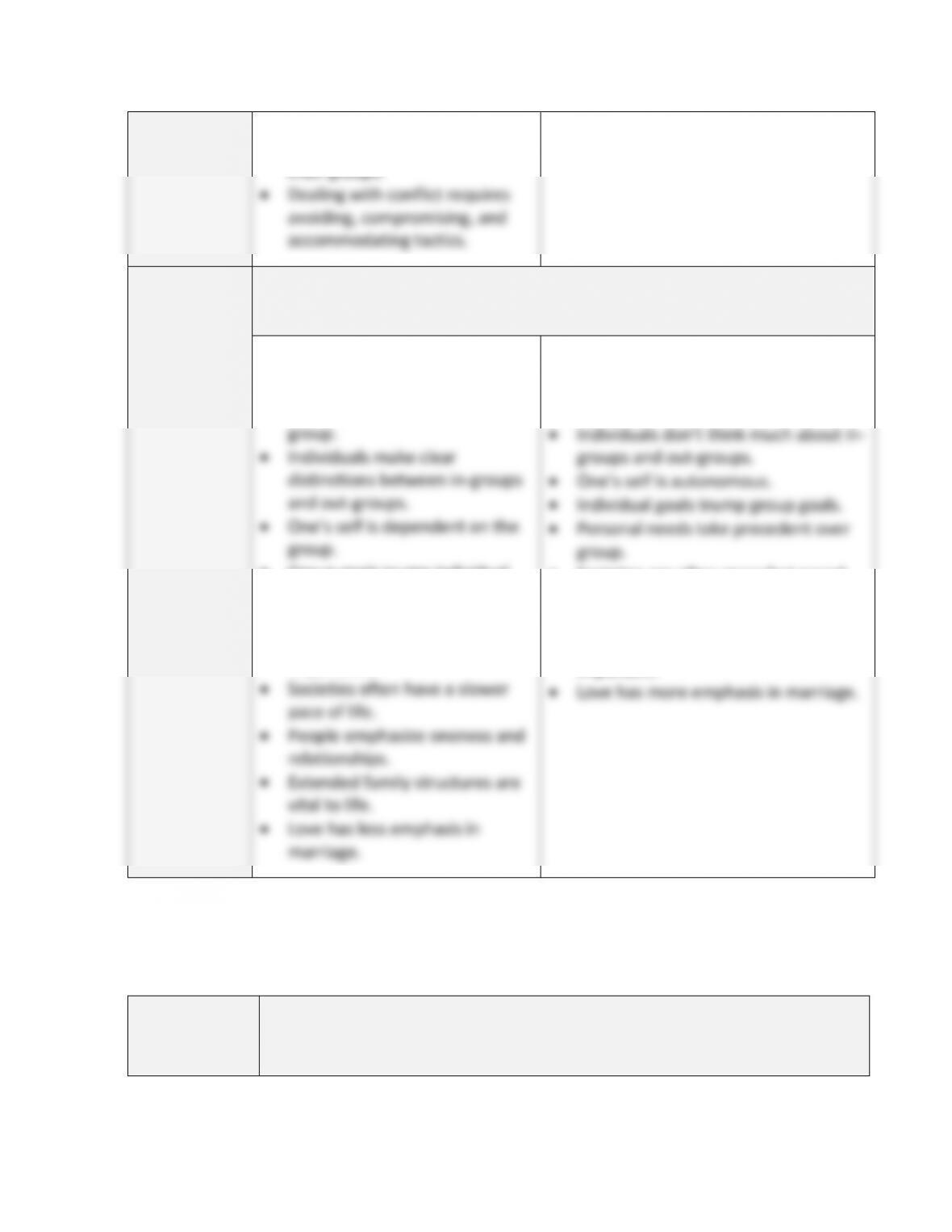
Collectivism I: Institutional & Collectivism II: In-Group
Collectivism
I:
Institutional
The degree to which organizational and societal institutional practices
encourage and reward collective distribution of resources and collective
action. Therefore, these societies tend to…
Higher
• Members know they are
interdependent on their
organization and must make
personal sacrifices to meet
obligations of the group.
• Employees develop long-term
extension, their families).
• Decisions are made by group
consensus.
• Compensation and promotion
come from what is good for the
group and based on seniority.
Lower
• Members know that they are
independent of the organization and
are expected to bring their unique
skills and abilities to the organization.
• Employees develop short-term
relationships and are not obligated to
• Decisions are made by individuals in
power.
• Compensation and promotion are
achieved based on equity that
rewards the work of an individual
regardless of rank.
• Employees are accountable for
the success or failure within
their groups.
• Dealing with conflict requires
avoiding, compromising, and
accommodating tactics.
• Dealing with conflict requires direct
and solution-based tactics.
Collectivism
II: In-group
The degree to which individuals express pride, loyalty, and cohesiveness in
their organizations or families. Therefore, these societies tend to…
Higher
• Individuals are first and
foremost part of a cohesive
group.
• Individuals make clear
distinctions between in-groups
and out-groups.
• One’s self is dependent on the
group.
• Group goals trump individual
goals.
• Duties and obligations to the
group are of utmost
importance.
• Societies often have a slower
pace of life.
• People emphasize oneness and
relationships.
• Extended family structures are
Lower
• Individuals look out for themselves
and their immediate families.
• Individuals don’t think much about in–
groups and out-groups.
• One’s self is autonomous.
• Individual goals trump group goals.
• Personal needs take precedent over
group.
• Societies are often more fast paced.
• People emphasize rational and
objective thought.
• Nuclear family structures are
important.
• Love has more emphasis in marriage.
Nine Cultural Dimensions
GLOBE Study Findings
Assertiveness
Assertiveness
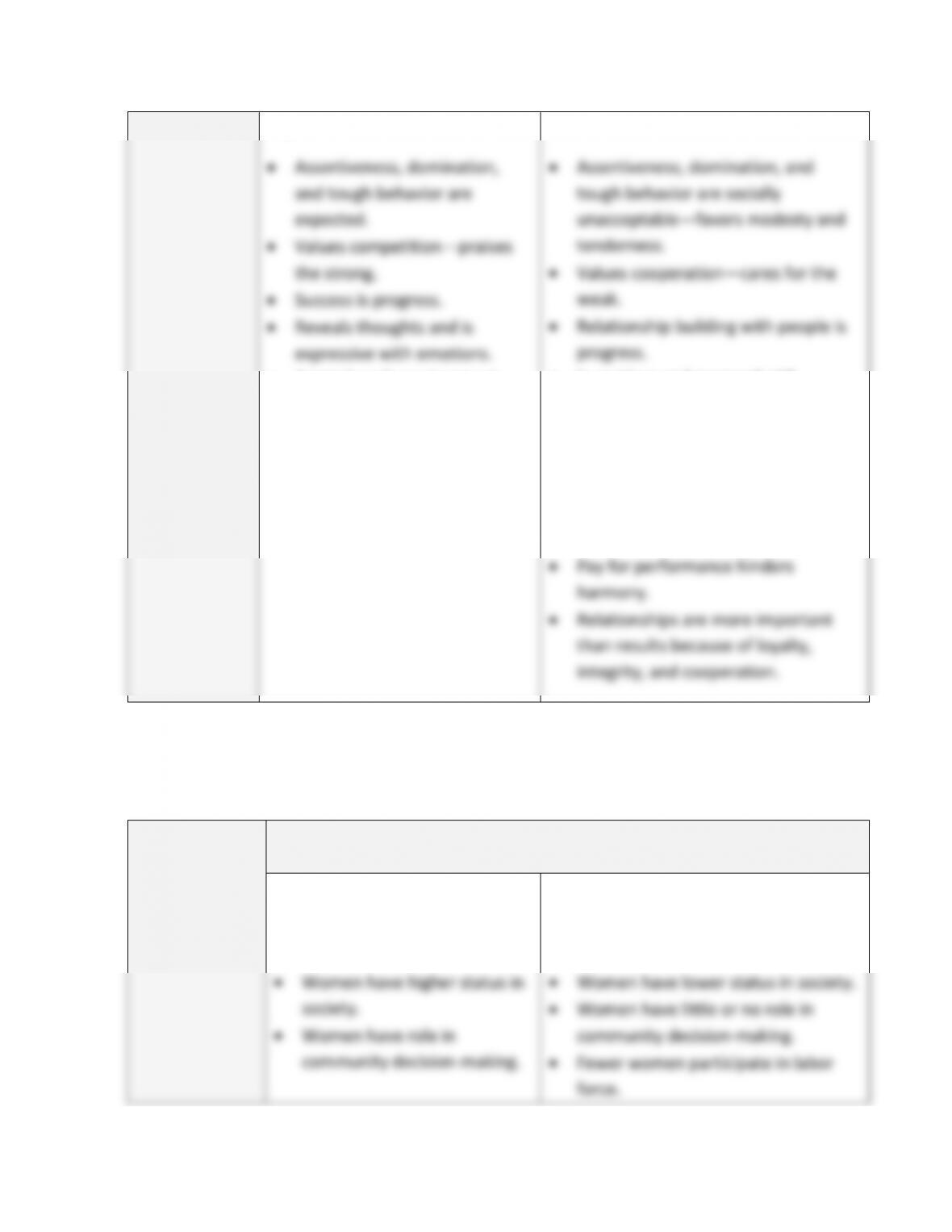
The degree to which individuals are assertive, confrontational, and
aggressive in their relationships with others. Therefore, these societies tend
Higher
• Assertiveness, domination,
and tough behavior are
expected.
• Values competition—praises
the strong.
• Success is progress.
• Reveals thoughts and is
expressive with emotions.
• Control one’s environment.
• Communicates directly and
explicitly.
• Pay for performance
motivates.
• Results are more important
than relationships.
Lower
• Assertiveness, domination, and
tough behavior are socially
unacceptable—favors modesty and
tenderness.
• Values cooperation—cares for the
weak.
• Relationship building with people is
progress.
• Is cautious and reserved with
personal emotions and thoughts.
• Live in harmony with one’s
environment.
• Communicates indirectly,
appreciates subtlety, and concerned
with saving face.
• Pay for performance hinders
harmony.
• Relationships are more important
than results because of loyalty,
integrity, and cooperation.
• Women are in positions of
authority and power.
• Women have higher status in
society.
• Women have role in
community decision-making.
• Few women are in positions of
authority and power.
• Women have lower status in society.
• Women have little or no role in
community decision-making.
• Fewer women participate in labor
force.
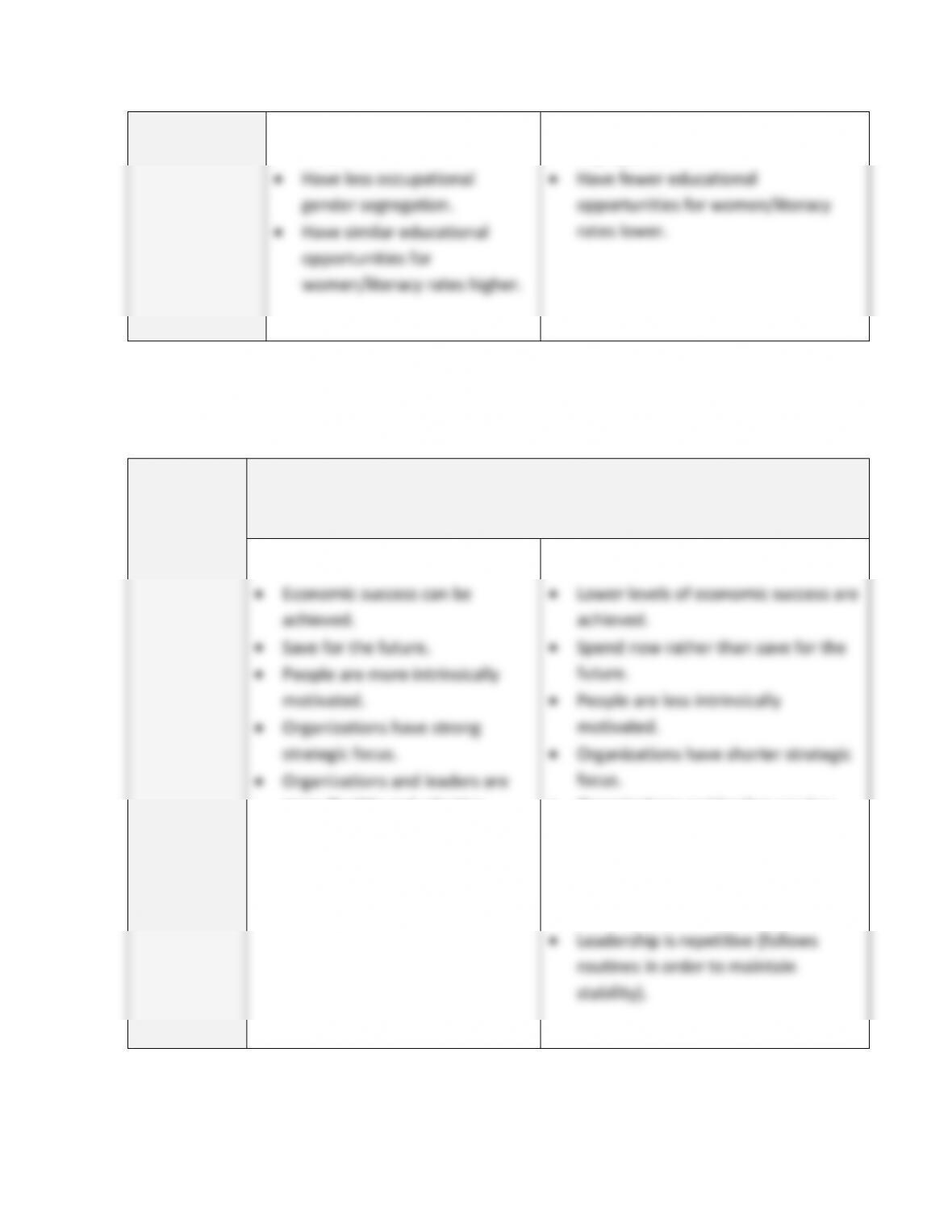
• Women participate in labor
force.
• Have less occupational
gender segregation.
• Have similar educational
opportunities for
women/literacy rates higher.
• Have more occupational gender
segregation.
• Have fewer educational
opportunities for women/literacy
rates lower.
Nine Cultural Dimensions
GLOBE Study Findings
Future Orientation
Future
Orientation
The extent to which individuals engage in future-oriented behaviors, such as
delaying gratification, planning, and investing in the future. Therefore, these
societies tend to…
Higher
• Economic success can be
achieved.
• Save for the future.
• People are more intrinsically
motivated.
• Organizations have strong
strategic focus.
trade-offs.
• Leadership is repetitive (follows
routines in order to maintain
Lower
• Lower levels of economic success are
achieved.
• Spend now rather than save for the
future.
• People are less intrinsically
motivated.
• Organizations have shorter strategic
stability).
Nine Cultural Dimensions
GLOBE Study Findings
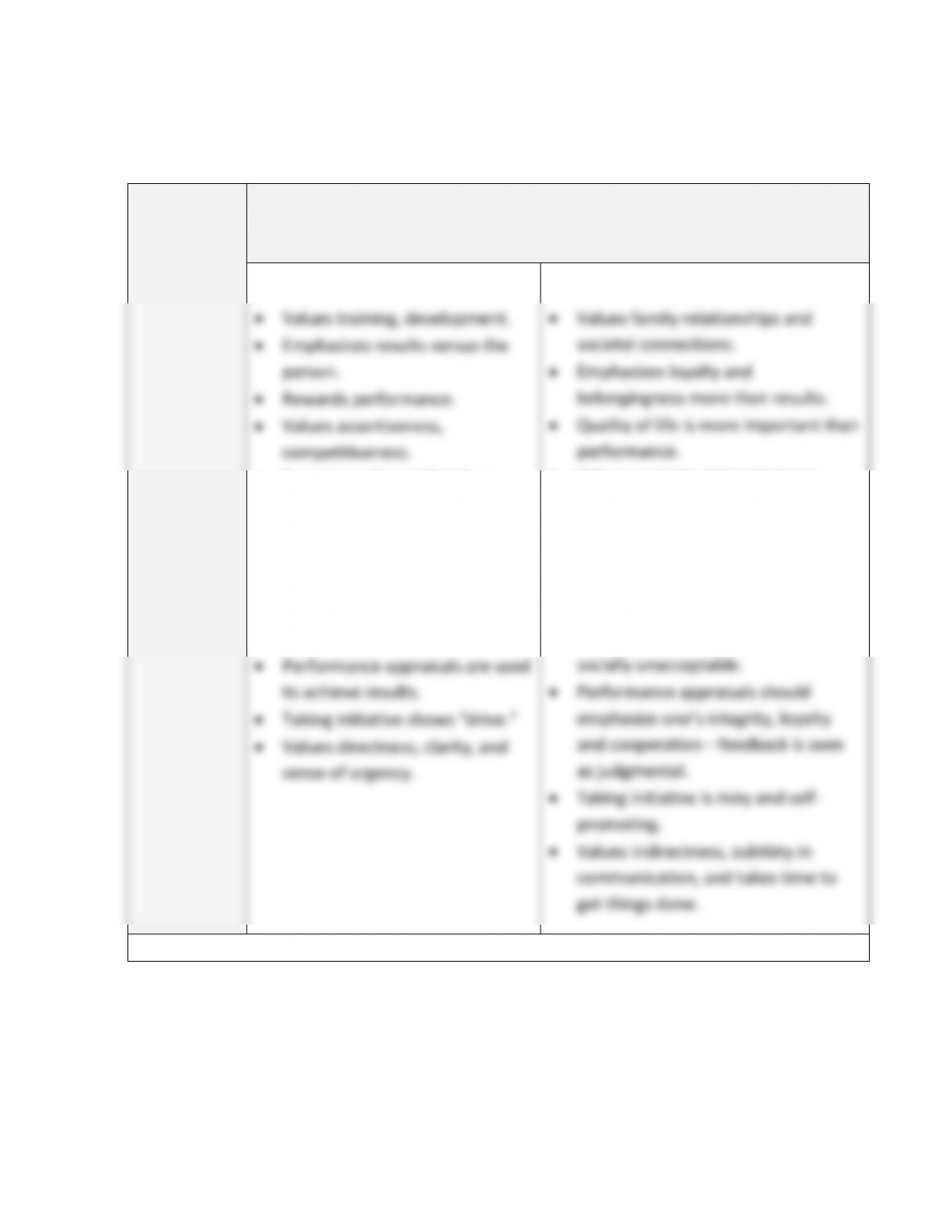
Performance Orientation
Performance
Orientation
The degree to which a collective encourages and rewards group members for
performance improvement and excellence. Therefore, these societies tend
to…
Higher
• Values training, development.
• Emphasizes results versus the
person.
• Rewards performance.
• Values assertiveness,
competitiveness.
• Expects work completed on
time.
• -he best employee is one who
has a “can do” attitude and is in
control.
sense of urgency.
Lower
• Values family relationships and
societal connections.
• Emphasizes loyalty and
belongingness more than results.
• Quality of life is more important than
performance.
• Values seniority and experience.
• Respects harmony with
environment.
• The best employee works for the
good of the group.
as judgmental.
• Taking initiative is risky and self-
promoting.
• Values indirectness, subtlety in
communication, and takes time to
get things done.
Adapted from GLOBE Study, House, et al., 2004, Excerpted from chapters 13–19.
15
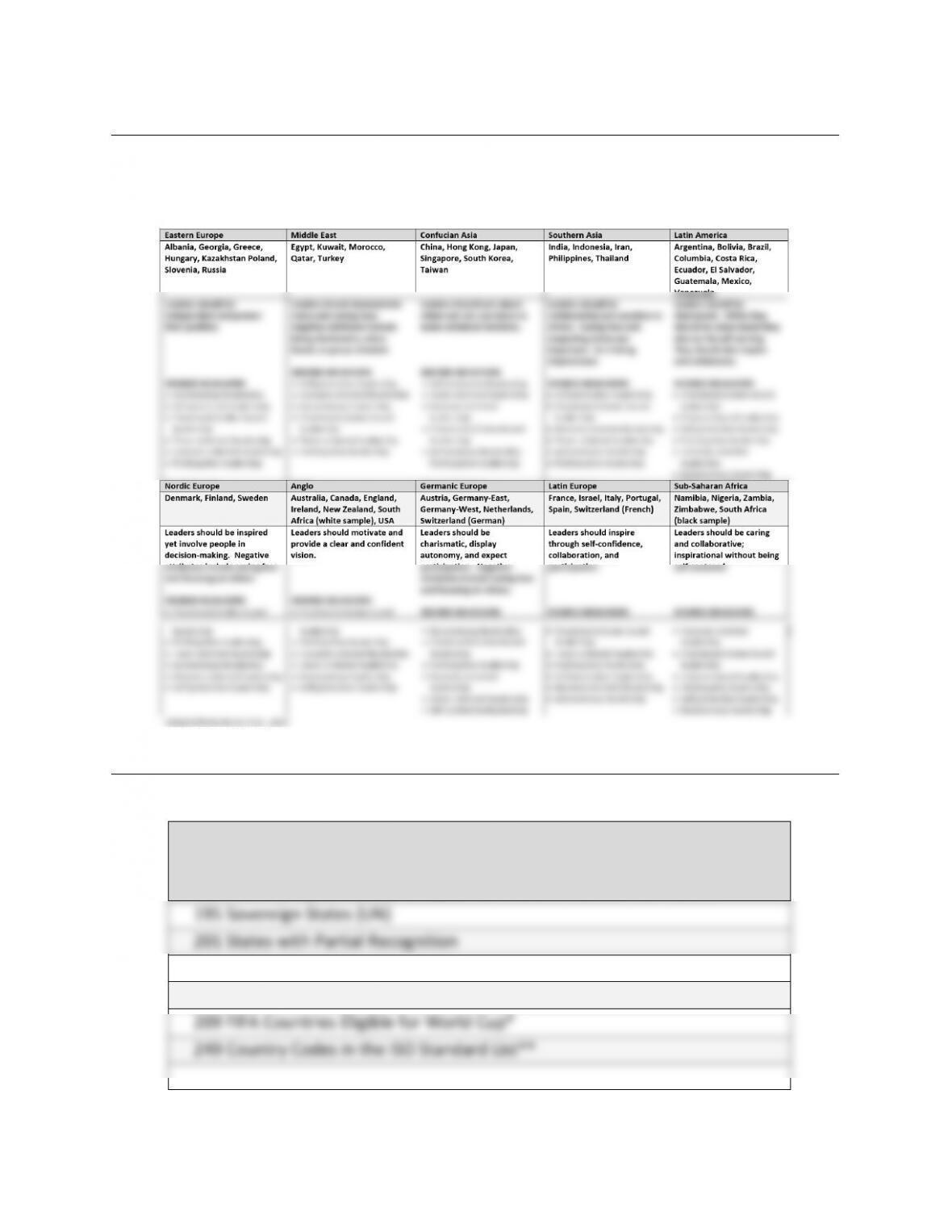
LEADERSHIP ATTRIBUTES
GLOBE STUDY WITH TEN COUNTRY (SOCIETY) CLUSTERS
Countries opposite each other (top and bottom) differ the most from each other.
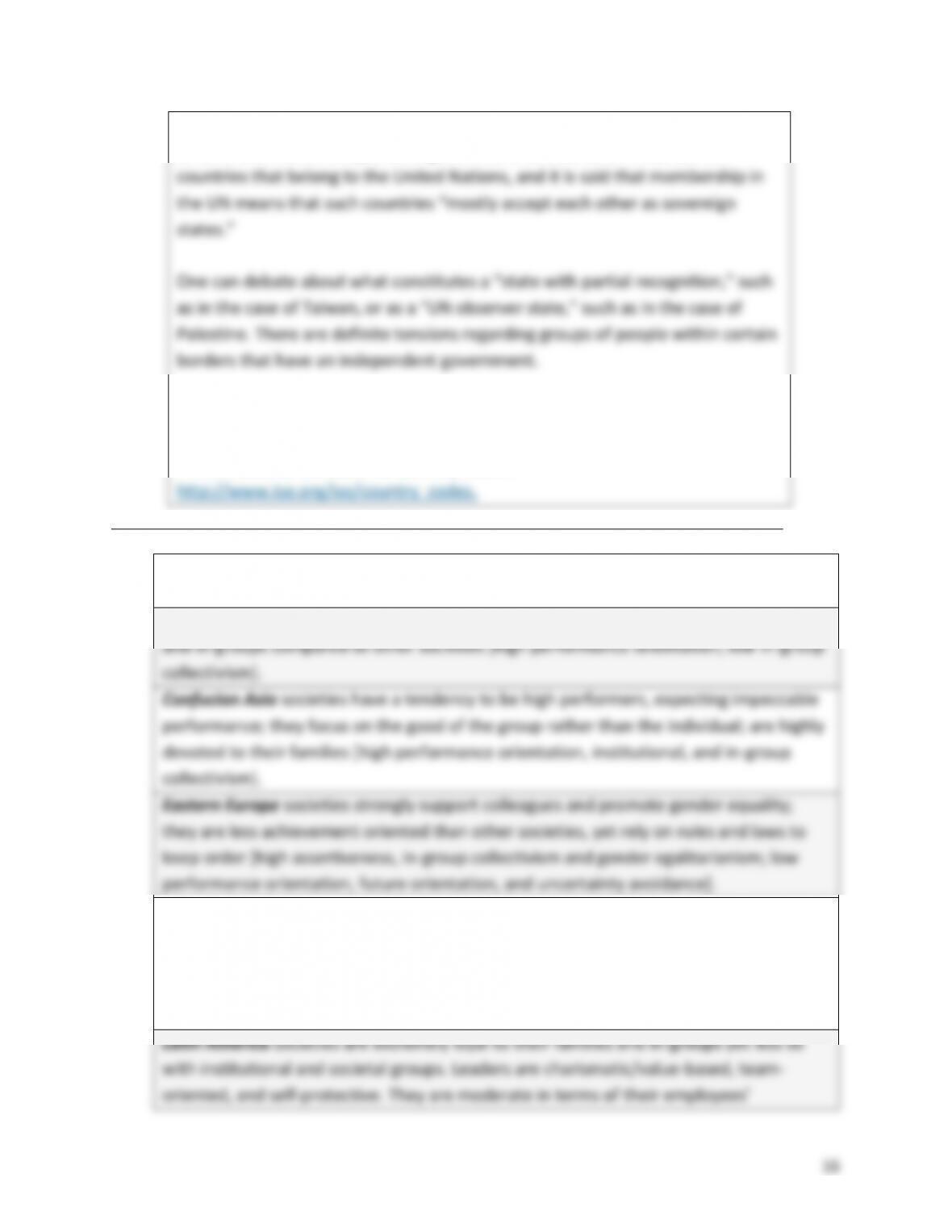
How many countries are in the world?
How do we define what a country or a nation is?
According to Political Geography Now, there are six definitions:
195 Sovereign States (UN)
201 States with Partial Recognition
204-207 De Facto Sovereign States
206 Olympic Nations
209 FIFA Countries Eligible for World Cup*
249 Country Codes in the ISO Standard List**
The most common definition of country or nation is a sovereign state, which is
an area that has an independent government and borders. These are the
countries that belong to the United Nations, and it is said that membership in
the UN means that such countries “mostly accept each other as sovereign
states.”
One can debate about what constitutes a “state with partial recognition,” such
as in the case of Taiwan, or as a “UN observer state,” such as in the case of
Palestine. There are definite tensions regarding groups of people within certain
borders that have an independent government.
The world is constantly changing.
*FIFA stands for Fédération Internationale de Football Association
**International Standard for Country Codes:
http://www.iso.org/iso/country_codes.
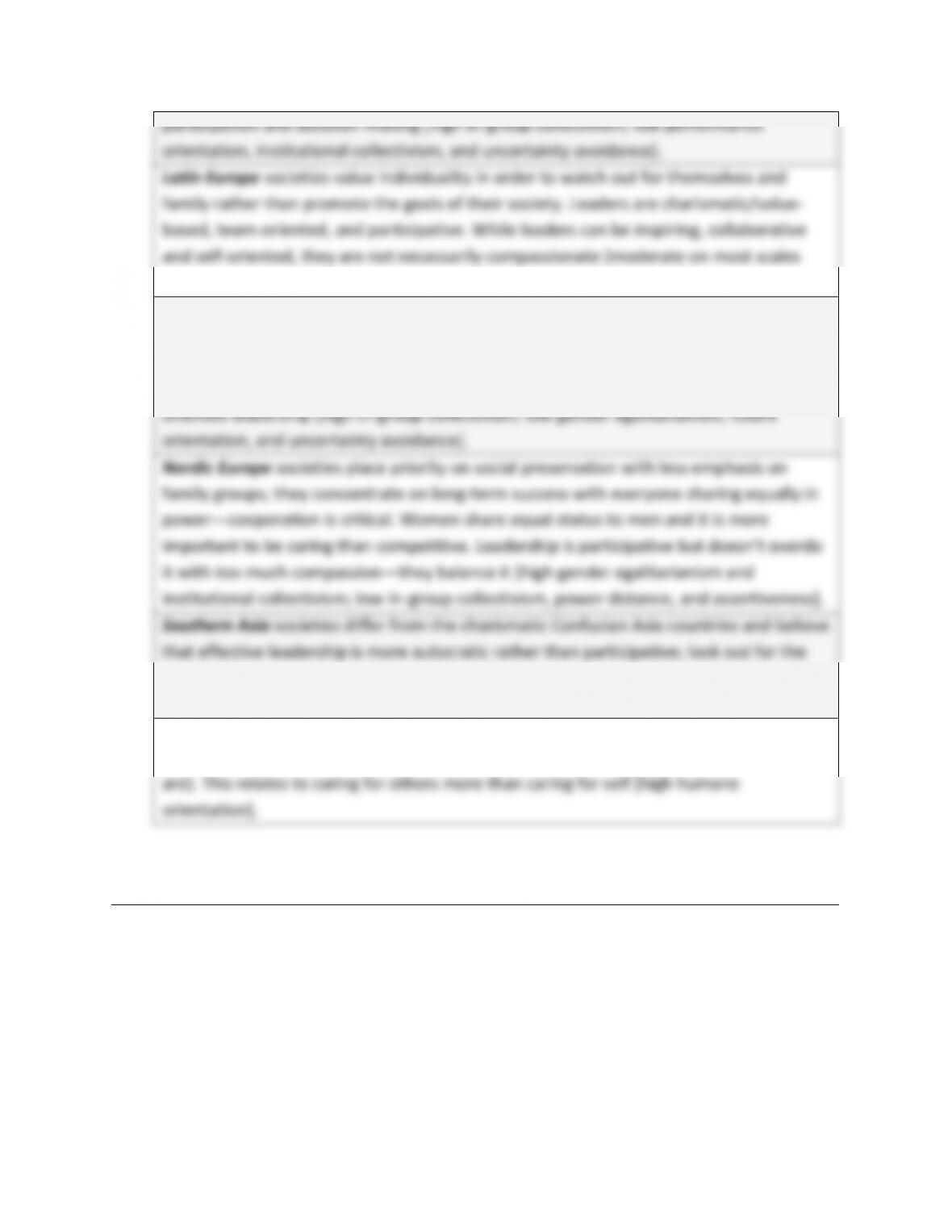
GLOBE Study Societal Clusters
Anglo societies are generally competitive and results oriented; less attached to families
and in-groups compared to other societies [high performance orientation; low in-group
collectivism].
Confucian Asia societies have a tendency to be high performers, expecting impeccable
performance; they focus on the good of the group rather than the individual; are highly
devoted to their families [high performance orientation, institutional, and in-group
collectivism].
Eastern Europe societies strongly support colleagues and promote gender equality;
they are less achievement oriented than other societies, yet rely on rules and laws to
keep order [high assertiveness, in-group collectivism and gender egalitarianism; low
performance orientation, future orientation, and uncertainty avoidance].
more individual oriented. Leaders are participative but can also be independent and
inspirational [high performance orientation, assertiveness, future orientation, and
uncertainty avoidance; low humane orientation, institutional and in-group collectivism].
oriented, and self-protective. They are moderate in terms of their employees’
participation and decision-making [high in-group collectivism; low performance
orientation, institutional collectivism, and uncertainty avoidance].
Latin Europe societies value individuality in order to watch out for themselves and
family rather than promote the goals of their society. Leaders are charismatic/value-
based, team-oriented, and participative. While leaders can be inspiring, collaborative
and self-oriented, they are not necessarily compassionate [moderate on most scales
and have low humane orientation and institutional collectivism].
Middle East societies are deeply devoted to their families and in-groups, yet women do
not have the same status as men. Orderliness and policies are relaxed in order to enjoy
the moment. While collective societies, the approach to leadership holds self-attributes
as status and saving face and does not respect charismatic/value based or group-
oriented leadership [high in-group collectivism; low gender egalitarianism, future
orientation, and uncertainty avoidance].
Nordic Europe societies place priority on social preservation with less emphasis on
family groups; they concentrate on long-term success with everyone sharing equally in
power—cooperation is critical. Women share equal status to men and it is more
important to be caring than competitive. Leadership is participative but doesn’t overdo
it with too much compassion—they balance it [high gender egalitarianism and
institutional collectivism; low in-group collectivism, power distance, and assertiveness].
Southern Asia societies differ from the charismatic Confucian Asia countries and believe
that effective leadership is more autocratic rather than participative; look out for the
welfare of the group and demonstrate strong loyalty to their families and in-groups
[high humane orientation and in-group collectivism].
Sub-Saharan Africa societies (Black sample) demonstrate sensitivity toward others and
strong humaneness deriving from the practice of Ubuntu (I am because of who you
are). This relates to caring for others more than caring for self [high humane
orientation].
Definition of Leadership:
An outstanding leader is a person in an organization or industry who is exceptionally skilled at
motivating, influencing, or enabling others or groups to contribute to the success of the
organization or task.
18
What People Want in A Leader
Across all 62 countries in the GLOBE Leadership Study, people want their leaders to be:
• Trustworthy
• Just
HOWEVER, how these traits are expressed and enacted may still noticeably differ from society
to society. For example…
Example
For a leader to be described as decisive in the US, s/he is expected to make quick and
approximate decisions.
Robert House
“My final conclusion is that we are in a position to make a major contribution to the
organizational behavior and leadership literature—to date more than 90% of the organizational
behavior literature reflects US—based research and theory. Hopefully GLOBE will be able to
liberate organizational behavior from the US hegemony.” (2004)
Conclusion
What We Learned from the GLOBE Study

19
• Based upon these endorsed attributes, the researchers drew a portrait of a leader
***
CASE: BrewTime
ACTIVITY: Examine countries from case in-depth using Hofstede’s website.