
Chapter 8
Relationships Among Inflation, Interest Rates, and Exchange Rates
Lecture Outline
Purchasing Power Parity (PPP)
Interpretations of PPP
Derivation of PPP
Using PPP to Estimate Exchange Rate Effects
Graphic Analysis of PPP
Testing the PPP Theory
Why Deviations from PPP Exist
International Fisher Effect (IFE)
Deriving a Country’s Inflation Rate
Estimating the Expected Exchange Rate Movement
Implications of the International Fisher Effect
Derivation of the International Fisher Effect
Relationships Among Inflation, Interest Rates, and Exchange Rates ❖ 2
Chapter Theme
This chapter discusses the relationship between inflation and exchange rates according to the purchasing
power parity (PPP) theory. Since this is one of the most popular subjects in international finance, it is
covered thoroughly. While PPP is a relevant theory, it should be emphasized that PPP will not always
Topics to Stimulate Class Discussion
1. Provide reasoning for why highly inflated countries tend to have weak home currencies.
2. Identify the inflation rate of your home country and some well-known foreign country. Then identify
the percentage change of your home currency with respect to that foreign country. Did the currency
change in the direction and by the magnitude that you would have expected according to PPP? If not,
3. Identify the quoted one-year interest rates in your home country and in a well-known foreign country
as of one year ago. Also determine how your home currency changed relative to this foreign currency
4. Provide a simple explanation of the difference between interest rate parity (from the previous
POINT/COUNTER-POINT:
Does PPP Eliminate Concerns about Long-Term Exchange Rate Risk?
POINT: Yes. Studies have shown that exchange rate movements are related to inflation differentials in
the long run. Based on PPP, the currency of a high-inflation country will depreciate against the dollar. A
subsidiary in that country should generate inflated revenue from the inflation, which will help offset the
adverse exchange effects when its earnings are remitted to the parent. If a firm is focused on long-term
performance, the deviations from PPP will offset over time. That is, in some years the exchange rate
effects may exceed the inflation effects, whereas in other years the inflation effects will exceed the
exchange rate effects.
COUNTER-POINT: No. Even if the relationship between inflation and exchange rate effects is
consistent, this does not guarantee that the effects on the firm will be offsetting. A subsidiary in a high-
inflation country will not necessarily be able to adjust its price level to keep up with the increased costs of
doing business there. The effects will vary with each MNC’s situation. Even if the subsidiary can raise its
prices to match the rising costs, short-term deviations from PPP may occur. The investors who invest in
an MNC’s stock may be concerned about short-term deviations from PPP, because they will not
necessarily hold the stock for the long term. Thus, investors may prefer that firms manage their operations
in a manner that reduces the volatility in their performance in short-run and long-run periods.
Relationships Among Inflation, Interest Rates, and Exchange Rates ❖ 3
WHO IS CORRECT? Use the Internet to learn more about this issue. Which argument do you support?
Offer your own opinion on this issue.
Answers to End of Chapter Questions
1. PPP. Explain the theory of purchasing power parity (PPP). Based on this theory, what is a general
forecast of the values of currencies in countries with high inflation?
2. Rationale of PPP. Explain the rationale underlying PPP theory.
3. Testing PPP. Explain how you could determine whether PPP exists. Describe a limitation in testing
whether PPP holds.
ANSWER: One method is to choose two countries and compare the inflation differential to the
exchange rate change for several different periods. Then, determine whether the exchange rate
4. Testing PPP. Inflation differentials between the U.S. and other industrialized countries have typically
been a few percentage points in any given year. Yet, in many years annual exchange rates between
the corresponding currencies have changed by 10 percent or more. What does this information
suggest about PPP?
Relationships Among Inflation, Interest Rates, and Exchange Rates ❖ 4
© 2021 Cengage Learning. All Rights Reserved. May not be copied, scanned, or duplicated, in whole or in part, except for use as
permitted in a license distributed with a certain product or service or otherwise on a password-protected website for classroom use.
ANSWER: The information suggests that there are other factors besides inflation differentials that
influence exchange rate movements. Thus, the exchange rate movements will not necessarily
conform to inflation differentials, and therefore PPP will not necessarily hold.
5. Limitations of PPP. Explain why PPP does not hold.
6. Implications of IFE. Explain the international Fisher effect (IFE). What is the rationale for the
existence of the IFE? What are the implications of the IFE for firms with excess cash that consis-
tently invest in foreign Treasury bills? Explain why the IFE may not hold.
ANSWER: The IFE suggests that a currency’s value will adjust in accordance with the differential in
interest rates between two countries.
7. Implications of IFE. Assume U.S. interest rates are generally above foreign interest rates. What
does this suggest about the future strength or weakness of the dollar based on the IFE? Should U.S.
investors invest in foreign securities if they believe in the IFE? Should foreign investors invest in U.S.
securities if they believe in the IFE?
8. Comparing Parity Theories. Compare and contrast interest rate parity (Chapter 7), PPP), and the
IFE.
ANSWER: Interest rate parity can be evaluated using data at any one point in time to determine the
9. Real Interest Rate. One assumption made in developing the IFE is that all investors in all countries
have the same real interest rate. What does this mean?
10. Interpreting Inflationary Expectations. If investors in the United States and Canada require the
same real interest rate, and the nominal rate of interest is 2 percent higher in Canada, what does this
imply about expectations of U.S. inflation and Canadian inflation? What do these inflationary
expectations suggest about future exchange rates?
11. PPP Applied to the Euro. Assume that several European countries that use the euro as their currency
experience higher inflation than the United States does, while two other European countries that use
the euro as their currency experience lower inflation than the United States does. According to PPP,
how will the euro’s value against the dollar be affected?
12. Source of Weak Currencies. The currencies of some Latin American countries, such as Brazil and
Venezuela, frequently weaken against most other currencies. What concept in this chapter explains
this occurrence? Why don’t all U.S.-based MNCs use forward contracts to hedge their future
remittances of funds from Latin American countries to the U.S. even if they expect depreciation of
the currencies against the dollar?
ANSWER: Latin American countries typically have very high inflation, as much as 200 percent or
more. PPP theory would suggest that currencies of these countries will depreciate against the U.S.
13. PPP. Japan has typically had lower inflation than the United States has. How would one expect this
to affect the Japanese yen’s value? Why does this expected relationship not always occur?
Relationships Among Inflation, Interest Rates, and Exchange Rates ❖ 6
© 2021 Cengage Learning. All Rights Reserved. May not be copied, scanned, or duplicated, in whole or in part, except for use as
permitted in a license distributed with a certain product or service or otherwise on a password-protected website for classroom use.
ANSWER: Japan’s low inflation should place upward pressure on the yen’s value. Yet, other factors
can sometimes offset this pressure. For example, Japan heavily invests in U.S. securities, which
places downward pressure on the yen’s value.
14. IFE. Assume that the nominal interest rate in Mexico is 48 percent and the interest rate in the United
States is 8 percent for one-year securities that are free from default risk. What does the IFE suggest
about the differential in expected inflation in these two countries? Using this information and PPP
theory, describe the expected nominal return to U.S. investors who invest in Mexico.
ANSWER: If investors from the U.S. and Mexico required the same real (inflation-adjusted) return,
then any difference in nominal interest rates is due to differences in expected inflation. Thus, the
15. IFE. Shouldn’t the IFE discourage investors from attempting to capitalize on higher foreign interest
rates? Why do some investors continue to invest overseas, even when they have no other transactions
overseas?
16. Changes in Inflation. Assume that the inflation rate in Brazil is expected to increase substantially.
How will this affect Brazil’s nominal interest rates and the value of its currency (the real)? If the IFE
holds, how will the nominal return to U.S. investors who invest in Brazil be affected by the higher
inflation in Brazil? Explain.
17. Comparing PPP and IFE. How is it possible for PPP to hold if the IFE does not?
ANSWER: For the IFE to hold, the following conditions are necessary:
© 2021 Cengage Learning. All Rights Reserved. May not be copied, scanned, or duplicated, in whole or in part, except for use as
permitted in a license distributed with a certain product or service or otherwise on a password-protected website for classroom use.
18. Estimating Depreciation Due to PPP. Assume that the spot exchange rate of the British pound is
$1.73. How will this spot rate adjust according to PPP if the United Kingdom experiences an
inflation rate of 7 percent while the United States experiences an inflation rate of 2 percent?
19. Forecasting the Future Spot Rate Based on IFE. Assume that the spot exchange rate of the
Singapore dollar is $.70. The one-year interest rate is 11 percent in the United States and 7 percent in
Singapore. What will the spot rate be in one year according to the IFE? Which force causes the spot
rate to change according to the IFE?
20. Deriving Forecasts of the Future Spot Rate. As of today, assume the following information is
available:
U.S. Mexico
Real rate of interest required by investors 2% 2%
Nominal interest rate 11% 15%
Spot rate — $.20
One-year forward rate — $.19
a. Use the forward rate to forecast the percentage change in the Mexican peso over the next year.
b. Use the differential in expected inflation to forecast the percentage change in the Mexican peso
over the next year.
c. Use the spot rate to forecast the percentage change in the Mexican peso over the next year.
21. a. Inflation Effects in Russia. Russia commonly experiences a high rate of inflation.
Explain why the high Russian inflation typically places severe downward pressure on the
value of the Russian ruble.
Relationships Among Inflation, Interest Rates, and Exchange Rates ❖ 8
b. In some periods, the Russian government intervenes in the foreign exchange market and imposes
some restrictions on international trade. Why might these conditions PPP?
ANSWER: The general relationship suggested by PPP is supported, but the ruble’s value will not
c. Will the effects of the high Russian inflation and the decline in the ruble offset each other for U.S.
importers? That is, how will U.S. importers of Russian products be affected by the conditions?
22. IFE Application to Brazil. Brazil commonly has a much higher nominal interest rate than the U.S.
Yet, some large institutional investors do not invest in Brazilian money market securities, even when
they believe the securities have no credit (default) risk. Use the IFE to explain why the Brazilian
money market securities may not be a good investment for U.S. investors.
23. IFE Applied to the Euro. Given the recent conversion of several European currencies to the euro,
explain what would cause the euro’s value to change against the dollar according to the IFE.
Advanced Questions
24. IFE. Beth Miller does not believe that the IFE holds. Current one-year interest rates in Europe are 5
percent, whereas one-year interest rates in the U.S. are 3 percent. Beth converts $100,000 to euros and
invests them in Germany. One year later, she converts the euros back to dollars. The current spot rate
of the euro is $1.10.
a. According to the IFE, what should the spot rate of the euro in one year be?
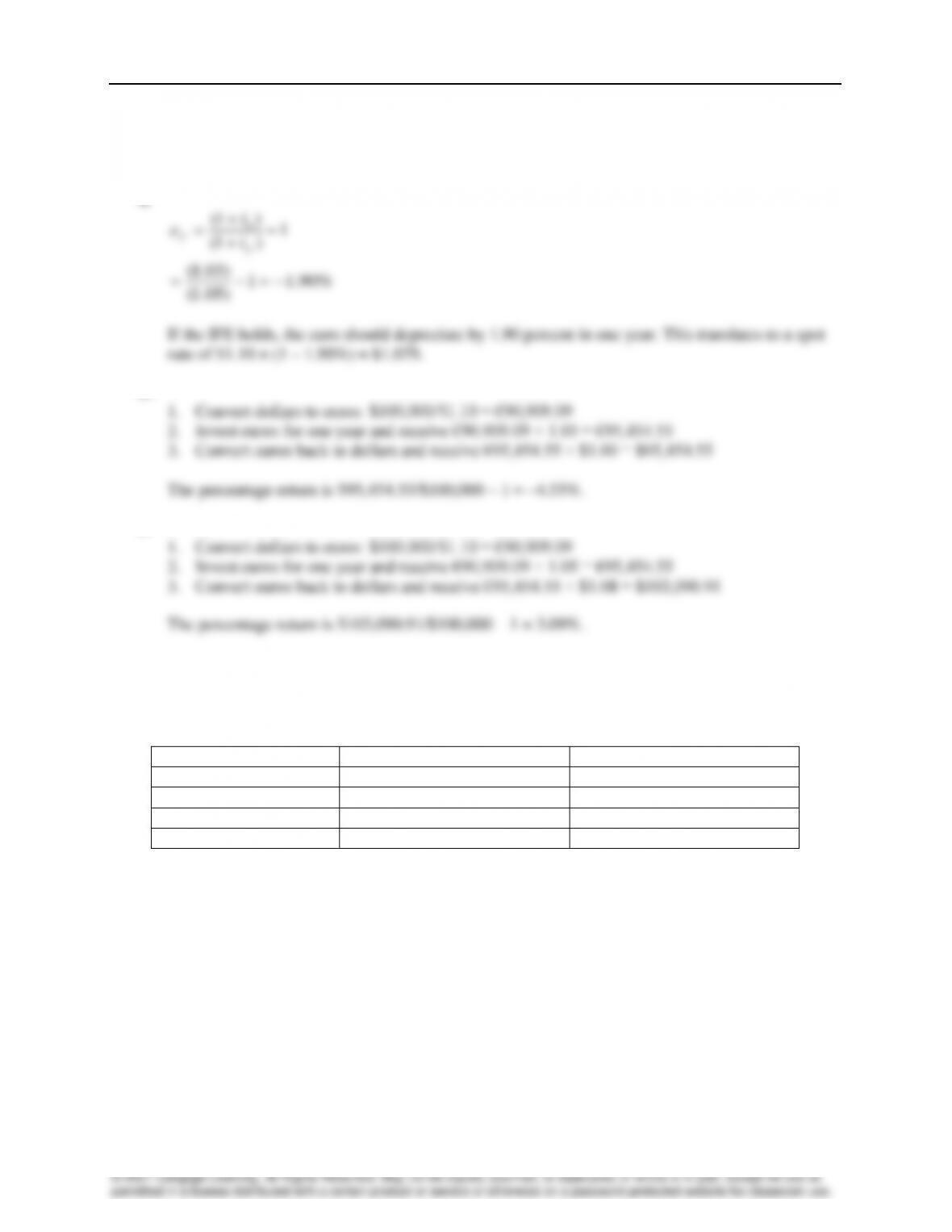
b. If the spot rate of the euro in one year is $1.00, what is Beth’s percentage return from her strategy?
c. If the spot rate of the euro in one year is $1.08, what is Beth’s percentage return from her
strategy?
Relationships Among Inflation, Interest Rates, and Exchange Rates ❖ 9
d. What must the spot rate of the euro be in one year for Beth’s strategy to be successful?
ANSWER:
a.
%90.11
)05.1(
)03.1(
1
)1(
)1(
−=−=
−
+
+
=
f
h
fi
i
e
If the IFE holds, the euro should depreciate by 1.90 percent in one year. This translates to a spot
rate of $1.10 × (1 – 1.90%) = $1.079.
b.
c.
d. Beth’s strategy would be successful if the spot rate of the euro in one year is greater than $1.079.
25. Integrating IRP and IFE. Assume the following information is available for the U.S. and the
eurozone:
U.S.
Europe
Nominal interest rate
4%
6%
Expected inflation
2%
5%
Spot rate
—–
$1.13
One-year forward rate
——
$1.10
a. Does IRP hold?
b. According to PPP, what is the expected spot rate of the euro in one year?
c. According to the IFE, what is the expected spot rate of the euro in one year?
d. Reconcile your answers to parts (a). and (c).
ANSWER:
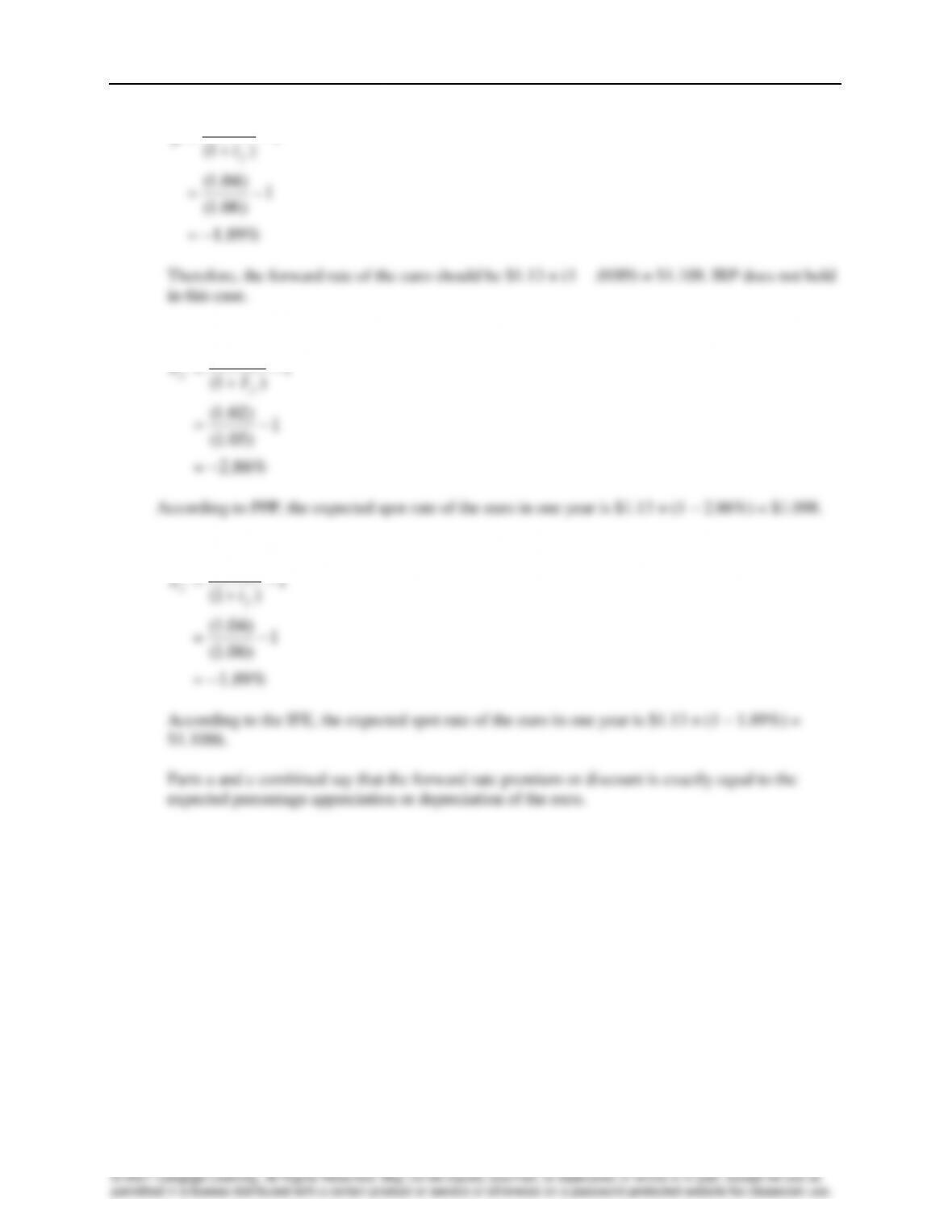
a.
Relationships Among Inflation, Interest Rates, and Exchange Rates ❖ 10
© 2021 Cengage Learning. All Rights Reserved. May not be copied, scanned, or duplicated, in whole or in part, except for use as
permitted in a license distributed with a certain product or service or otherwise on a password-protected website for classroom use.
)04.1(
1
)1(
)1(
−
+
+
=
f
h
i
i
p
b.
%86.2
1
)05.1(
)02.1(
1
)1(
)1(
−=
−=
−
+
+
=
f
h
fI
I
e
According to PPP, the expected spot rate of the euro in one year is $1.13 × (1 – 2.86%) = $1.098.
c.
%89.1
1
)06.1(
)04.1(
1
)1(
)1(
−=
−=
−
+
+
=
f
h
fi
i
e
According to the IFE, the expected spot rate of the euro in one year is $1.13 × (1 – 1.89%) =
$1.1086.
Parts a and c combined say that the forward rate premium or discount is exactly equal to the
expected percentage appreciation or depreciation of the euro.
26. IRP. The one-year risk-free interest rate in Mexico is 10%. The one-year risk-free rate in the U.S. is
2%. Assume that interest rate parity exists. The spot rate of the Mexican peso is $.14.
a. What is the forward rate premium?
b. What is the one-year forward rate of the peso?
c. Based on the IFE, what is the expected change in the spot rate over the next year?
d. If the spot rate changes as expected according to the IFE, what will be the spot rate in one year?
e. Compare your answers to (b) and (d) and explain the relationship.
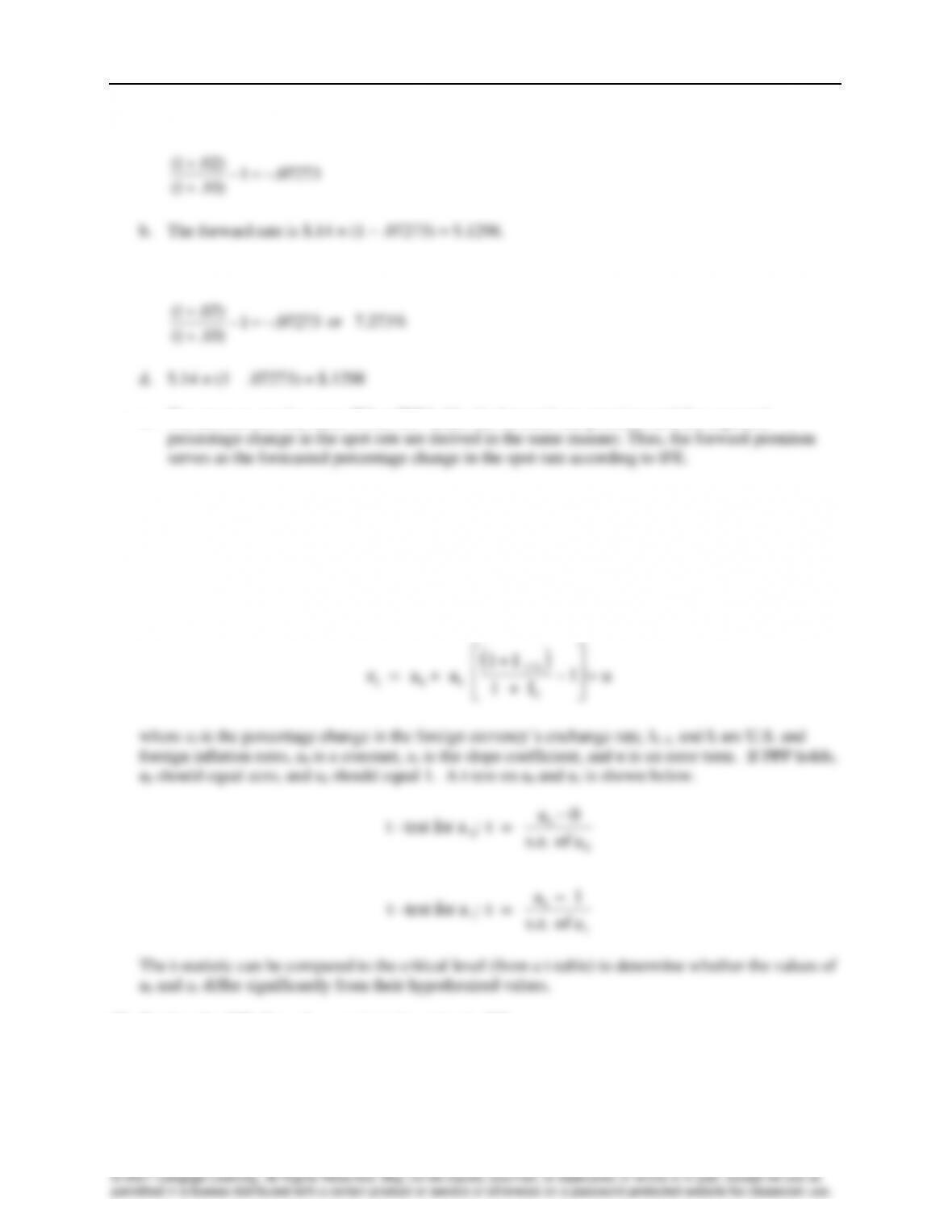
ANSWER:
Relationships Among Inflation, Interest Rates, and Exchange Rates ❖ 11
a. According to interest rate parity, the forward premium is
(1 .10)
+
c. According to the IFE, the expected change in the peso is:
e. The answers are the same. When IRP holds, the forward rate premium and the expected
27. Testing the PPP. How could you use regression analysis to determine whether the relationship
specified by PPP exists on average? Specify the model and describe how you would assess the
regression results to determine if there is a significant difference from the relationship suggested by
PPP.
ANSWER: A regression model could be applied to historical data to test PPP. The model is
specified as:
( )
e a a 1 + I
1 + I u
f 0 1
U.S.
f
= + −
+1
where ef is the percentage change in the foreign currency’s exchange rate, IU.S. and If are U.S. and
foreign inflation rates, a0 is a constant, a1 is the slope coefficient, and u is an error term. If PPP holds,
a0 should equal zero, and a1 should equal 1. A t-test on a0 and a1 is shown below.
t – test for a : t = a 0
s.e. of a
t – test for a : t = a 1
s.e. of a
0
0
0
1
1
1
−
−
The t-statistic can be compared to the critical level (from a t-table) to determine whether the values of
a0 and a1 differ significantly from their hypothesized values.
28. Testing the IFE. Describe a statistical test for the IFE.
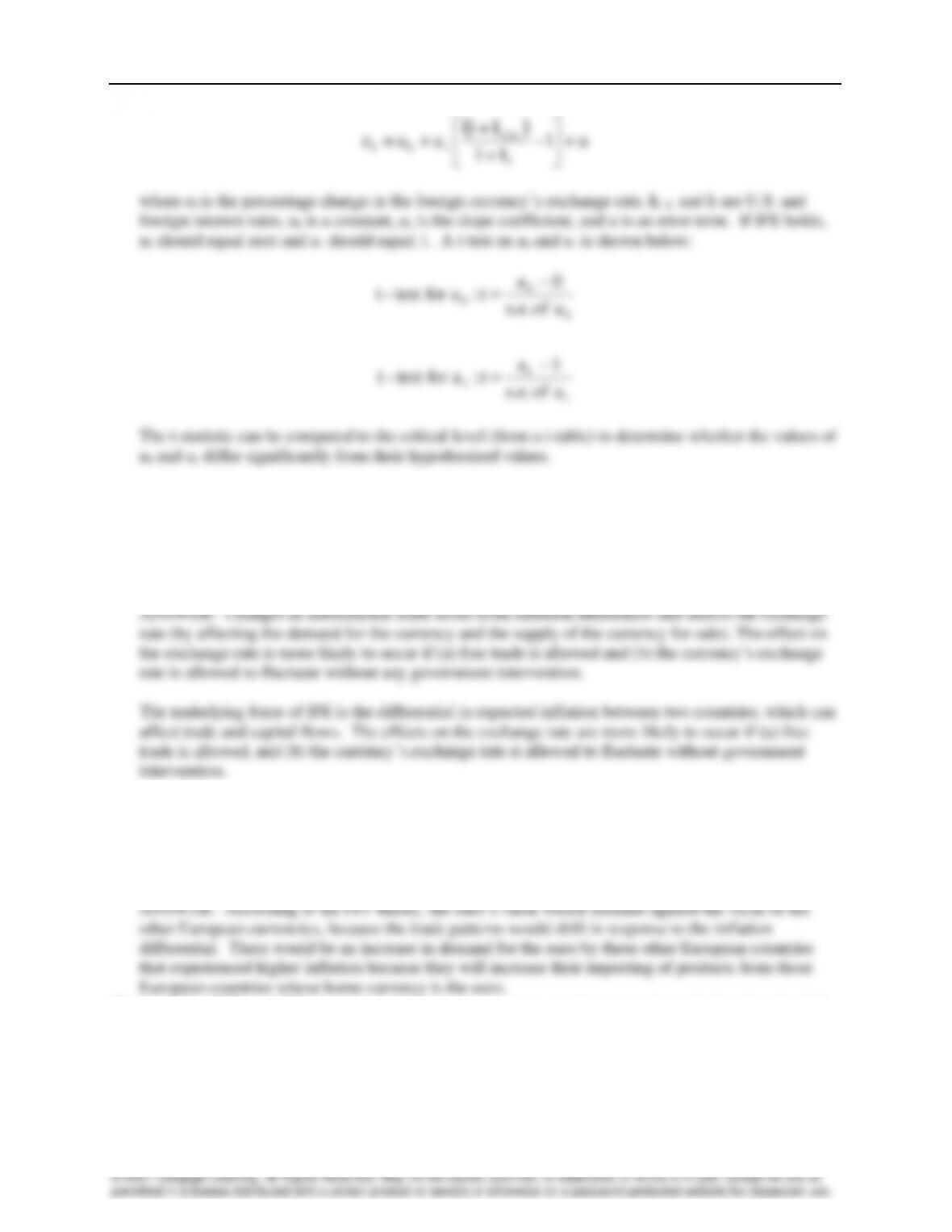
ANSWER: A regression model could be applied to historical data to test IFE. The model is specified
as:
Relationships Among Inflation, Interest Rates, and Exchange Rates ❖ 12
© 2021 Cengage Learning. All Rights Reserved. May not be copied, scanned, or duplicated, in whole or in part, except for use as
permitted in a license distributed with a certain product or service or otherwise on a password-protected website for classroom use.
( )
u + 1
I + 1
I + 1
a + a = e
f
U.S.
10f
−
where ef is the percentage change in the foreign currency’s exchange rate, IU.S. and If are U.S. and
foreign interest rates, a0 is a constant, a1 is the slope coefficient, and u is an error term. If IFE holds,
a0 should equal zero and a1 should equal 1. A t-test on a0 and a1 is shown below:
1
1
1
0
0
0
a of s.e.
1 a
= t :afor test –t
a of s.e.
0a
= t :afor test –t
−
−
The t-statistic can be compared to the critical level (from a t-table) to determine whether the values of
a0 and a1 differ significantly from their hypothesized values.
29. Impact of Trade Barriers on PPP and IFE. Would PPP be more likely to hold between the United
States and Hungary if trade barriers were completely removed and if Hungary’s currency were
allowed to float without any government intervention? Would the IFE be more likely to hold between
the United States and Hungary if trade barriers were completely removed and if Hungary’s currency
were allowed to float without any government intervention? Explain.
30. Interactive Effects of PPP. Assume that the inflation rates of the countries that use the euro are very
low, while other European countries that have their own currencies experience high inflation. Explain
how and why the euro’s value could be expected to change against these currencies according to the
PPP theory.
31. Applying IRP and IFE. Assume that Mexico has a one-year interest rate that is higher than the U.S.
one-year interest rate. Assume that you believe in the international Fisher effect (IFE), and interest
rate parity. Assume zero transactions costs.