Relationships Among Inflation, Interest Rates, and Exchange Rates ❖ 13
Ed is based in the U.S. and he attempts to speculate by purchasing Mexican pesos today, investing the
pesos in a risk-free asset for a year, and then converting the pesos to dollars at the end of one year. Ed
did not cover his position in the forward market.
Maria is based in Mexico and she attempts covered interest arbitrage by purchasing dollars today and
simultaneously selling dollars one year forward, investing the dollars in a risk-free asset for a year,
and then converting the dollars back to pesos at the end of one year.
Do you think the rate of return on Ed’s investment will be higher than, lower than, or the same as the
rate of return on Maria’s investment? Explain.
32. Arbitrage and PPP. Assume that locational arbitrage ensures that spot exchange rates are properly
aligned. Also assume that you believe in purchasing power parity. The spot rate of the British pound
is $1.80. The spot rate of the Swiss franc is .3 pounds. You expect that the one-year inflation rate is 7
percent in the U.K., 5 percent in Switzerland, and 1 percent in the U.S. The actual one-year interest
rate is 6% in the U.K., 2% in Switzerland, and 4% in the U.S. What is your expected spot rate of the
Swiss franc in one year with respect to the U.S. dollar? Show your work.
33. IRP Versus IFE. You believe that interest rate parity and the international Fisher effect hold.
Assume the U.S. interest rate is presently much higher than the New Zealand interest rate. You have
receivables of 1 million New Zealand dollars that you will receive in one year. You could hedge the
receivables with the one-year forward contract. Or you could decide to not hedge. Is your expected
U.S. dollar amount of the receivables in one year from hedging higher than, lower than, or the same
as your expected U.S. dollar amount of the receivables without hedging? Explain.
34. IRP, PPP, and Speculating in Currency Derivatives. The U.S. three-month interest rate
(unannualized) is 1%. The Canadian three-month interest rate (unannualized) is 4%. Interest rate
parity exists. The expected inflation over this period is 5% in the U.S. and 2% in Canada. A call
option with a three-month expiration date on Canadian dollars is available for a premium of $.02 and
a strike price of $.64. The spot rate of the Canadian dollar is $.65. Assume that you believe in
purchasing power parity.
a. Determine the dollar amount of your profit or loss from buying a call option contract specifying
C$100,000.
© 2021 Cengage Learning. All Rights Reserved. May not be copied, scanned, or duplicated, in whole or in part, except for use as
permitted in a license distributed with a certain product or service or otherwise on a password-protected website for classroom use.
b. Determine the dollar amount of your profit or loss from buying a futures contract specifying
C$100,000.
35. Implications of PPP. Today’s spot rate of the Mexican peso is $.10. Assume that purchasing power
parity holds. The U.S. inflation rate over this year is expected to be 7%, whereas Mexican inflation
over this year is expected to be 3%. Wake Forest Co. plans to import products from Mexico and will
need 20 million Mexican pesos in one year. Determine the expected amount of dollars to be paid by
Wake Forest Co. for the pesos in one year.
ANSWER:
36. Investment Implications of IRP and IFE. The Argentine one-year CD (deposit) rate is 13%, while
the Mexico one-year CD rate is 11% and the U.S. one-year CD rate is 6%. All CDs have zero default
risk. Interest rate parity holds, and you believe that the international Fisher effect holds.
Jamie (based in the U.S.) invests in a one-year CD in Argentina.
Ann (based in the U.S.) invests in a one-year CD in Mexico.
Ken (based in the U.S.) invests in a one-year CD in Argentina and sells Argentina pesos one year
forward to cover his position.
Juan (who lives in Argentina) invests in a one-year CD in the U.S.
Maria (who lives in Mexico) invests in a one-year CD in the U.S.
Nina (who lives in Mexico) invests in a one-year CD in Argentina.
Carmen (who lives in Argentina) invests in a one-year CD in Mexico and sells Mexican pesos one
year forward to cover her position.
Corio (who lives in Mexico) invests in a one-year CD in Argentina and sells Argentina pesos one year
forward to cover his position.
Based on this information, which person will be expected to earn the highest return on the funds
invested? If you believe that multiple persons will tie for the highest expected return, name each of
them. Explain.
37. Investment Implications of IRP and the IFE. Today, a U.S. dollar can be exchanged for 3 New
Zealand dollars. The one-year CD (deposit) in New Zealand is 7% and the one-year CD rate in the
Relationships Among Inflation, Interest Rates, and Exchange Rates ❖ 15
U.S. is 6%. Interest rate parity exists between the U.S. and New Zealand. The international Fisher
effect exists between the U.S. and New Zealand. Today a U.S. dollar can be exchanged for 2 Swiss
francs. The one-year CD rate in Switzerland is 5%. The spot rate of the Swiss franc is the same as the
one-year forward rate.
Karen (based in the U.S.) invests in a one-year CD in New Zealand and sells New Zealand dollars
one year forward to cover her position.
James (based in the U.S) invests in a one-year CD in New Zealand and does not cover his position.
Brian (based in the U.S.) invests in a one-year CD in Switzerland and sells Swiss francs one year
forward to cover his position.
Eric (who lives in Switzerland) invests in a one-year CD in Switzerland.
Tonya (who lives in New Zealand) invests in a one-year CD in the U.S. and sells U.S. dollars one
year forward to cover her position.
Based on this information, which person will be expected to earn the highest return on the funds
invested? If you believe that multiple persons will tie for the highest expected return, name each of
them. Explain.
38. Real Interest Rates, Expected Inflation, IRP, and the Spot Rate. The U.S. and the country of
Rueland have the same real interest rate of 3%. The expected inflation over the next year is 6 percent
in the U.S. versus 21% in Rueland. Interest rate parity exists. The one-year currency futures contract
on Rueland’s currency (called the ru) is priced at $.40 per ru. What is the spot rate of the ru?
ANSWER:
FR premium = (1.09)/(1.24) – 1 =-.12096
39. PPP and Real Interest Rates. The nominal (quoted) U.S. one-year interest rate is 6%, whereas the
nominal one-year interest rate in Canada is 5%. Assume you believe in purchasing power parity. You
believe the real one-year interest rate is 2% in the U.S, and that the real one-year interest rate is 3% in
Canada. Today the Canadian dollar spot rate at $.90. What do you think the spot rate of the Canadian
dollar will be in one year?
ANSWER: Expected inflation in the U.S. = 6% – 2%=4%.
40. IFE, Cross Exchange Rates, and Cash Flows. Assume the value of the Hong Kong dollar (HK$)
value is tied to the U.S. dollar and will remain tied to the U.S. dollar. Assume that interest rate parity
Relationships Among Inflation, Interest Rates, and Exchange Rates ❖ 16
exists. Today, an Australian dollar (A$) is worth $.50 and HK$3.9. The one-year interest rate on the
Australian dollar is 11%, whereas the one-year interest rate on the U.S. dollar is 7%. You believe in
the international Fisher effect.
You will receive A$1 million in one year from selling products to Australia and will convert these
proceeds into Hong Kong dollars in the spot market at that time to purchase imports from Hong
Kong. Forecast the amount of Hong Kong dollars that you will be able to purchase in the spot market
one year from now with A$1 million. Show your work.
ANSWER:
41. PPP and Cash Flows. Boston Co. will receive 1 million euros in one year from selling exports. It did
not hedge this future transaction. Boston believes that the future value of the euro will be determined
by purchasing power parity (PPP). It expects that inflation in countries using the euro will be 12%
next year, whereas inflation in the U.S. will be 7% next year. Today the spot rate of the euro is $1.46,
and the one-year forward rate is $1.50.
a. Estimate the amount of U.S. dollars that Boston will receive in one year when converting its euro
receivables into U.S. dollars.
b. Today, the spot rate of the Hong Kong dollar is pegged at $.13. Boston believes that the Hong
Kong dollar will remain pegged to the dollar for the next year. If Boston Co. decides to convert
its 1 million euros into Hong Kong dollars instead of U.S. dollars at the end of one year, estimate
the amount of Hong Kong dollars that Boston will receive in one year when converting its euro
receivables into Hong Kong dollars.
ANSWER:
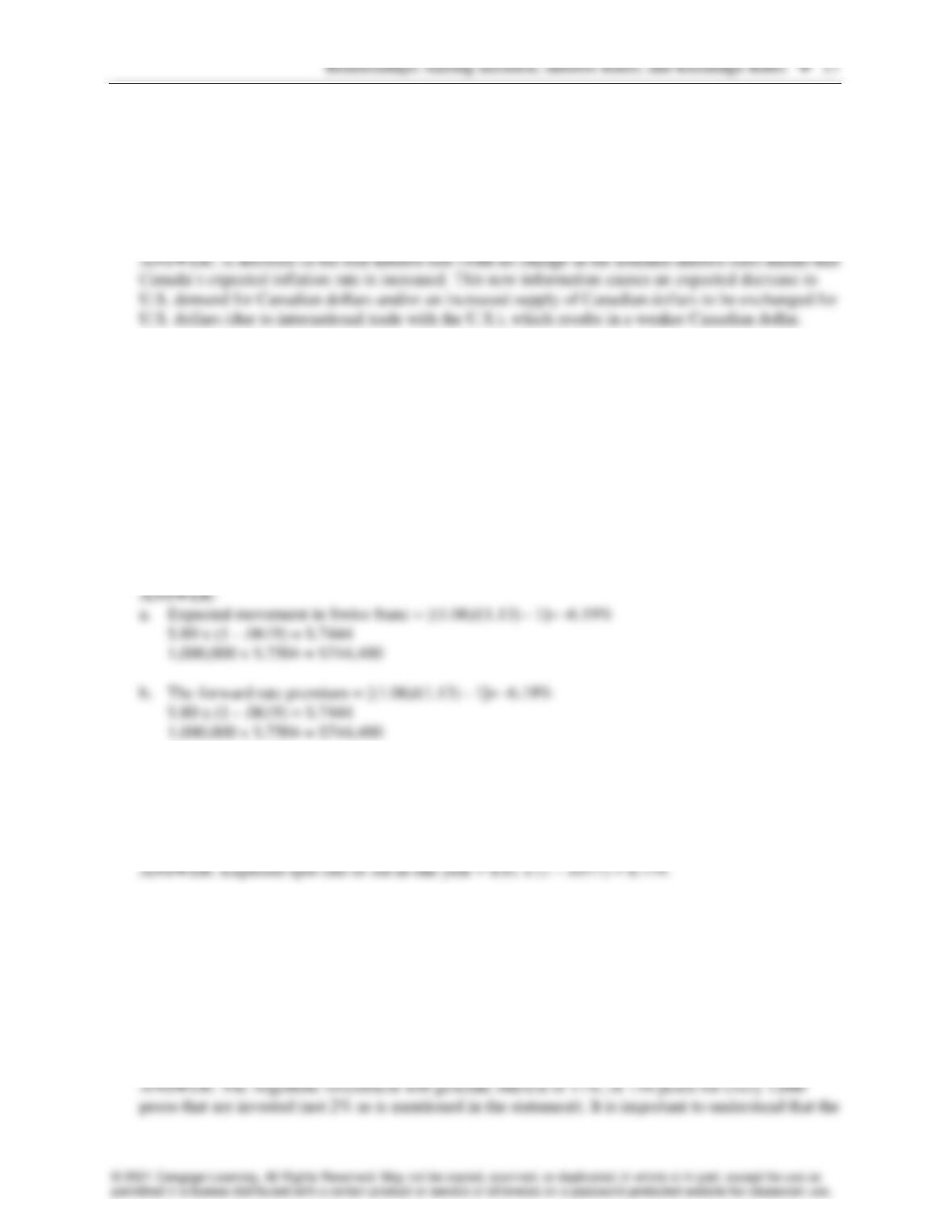
a. Expected appreciation of euro = (1+.07)/(1+.12) – 1= –.04464
42. PPP and Speculating with Currency Futures. Assume that you believe purchasing power parity
(PPP) exists. You expect that inflation in Canada during the next year will be 3%, and inflation in the
U.S. will be 8%. Today the spot rate of the Canadian dollar is $.90 and the one-year futures contract of
the Canadian dollar is priced at $.88. Estimate the expected profit or loss if an investor sold a one-year
futures contract today on one million Canadian dollars and settled this contract on the settlement date.
ANSWER:
43. PPP and Changes in the Real Interest Rate. Assume that you believe exchange rate movements are
mostly driven by purchasing power parity. The U.S. and Canada presently have the same nominal
(quoted) interest rate. The central bank of Canada just made an announcement that causes you to
revise your estimate of Canada’s real interest rate downward. Nominal interest rates were not affected
by the announcement. Do you expect that the Canadian dollar to appreciate, depreciate, or remain the
same against the dollar in response to the announcement? Briefly explain your answer.
44. IFE and Forward Rate. The one-year Treasury (risk-free) interest rate in the U.S. is presently 6%,
whereas the one-year Treasury interest rate in Switzerland is 13%. The spot rate of the Swiss franc is
$.80. Assume that you believe in the international Fisher effect. You will receive 1 million Swiss
francs in one year.
a. What is the estimated amount of dollars you will receive when converting the francs to U.S.
dollars in one year at the spot rate at that time?
b. Assume that interest rate parity exists. If you hedged your future receivables with a one-year
forward contract, how many dollars will you receive when converting the francs to U.S. dollars in
one year?
45. PPP. You believe that the future value of the Australian dollar will be determined by purchasing
power parity (PPP). You expect that inflation in Australia will be 6% next year, whereas inflation in
the U.S. will be 2% next year. Today the spot rate of the Australian dollar is $.81, and the one-year
forward rate is $.77. What is the expected spot rate of the Australian dollar in one year?
46. Logic Behind IFE. Investors based in the U.S. can earn 11% interest on a one-year bank deposit in
Argentina (with no default risk) or 2% on a one-year U.S. bank deposit in the U.S. (with no default
risk). Assess the following statement: “According to the international Fisher effect (IFE), if U.S.
investors invest 1000 Argentine pesos in an Argentine bank deposit, they are expected to receive only
20 pesos (2% x 1,000 pesos) as interest. ” Is this statement a correct explanation of why the
international Fisher effect would discourage U.S. investors from investing in Argentina? If not,
provide a more accurate explanation for why investors who believe in IFE would not pursue the
Argentine investment in this example.
© 2021 Cengage Learning. All Rights Reserved. May not be copied, scanned, or duplicated, in whole or in part, except for use as
permitted in a license distributed with a certain product or service or otherwise on a password-protected website for classroom use.
47. Influence of PPP. The U.S. has expected inflation of 2%, whereas Country A, Country B, and
Country C have expected inflation of 7%. Country A engages in much international trade with the
U.S. The products that are traded between Country A and the U.S. can easily be produced by either
country. Country B engages in much international trade with the U.S. The products that are traded
between Country B and the U.S. are important health products, and there are not substitutes for these
products that are exported from the U.S. to Country B or from Country B to the U.S. Country C
engages in considerable international financial flows with the U.S. but very little trade. If you were to
use purchasing power parity to predict the future exchange rate over the next year for the local
currency of each country against the dollar, do you think PPP would provide the most accurate
forecast for the currency of Country A, Country B, or Country C? Briefly explain.
ANSWER: PPP should provide the most accurate forecast for the currency of Country A, because
there is much international trade, so price changes can affect the volume of foreign exchange in each
CRITICAL THINKING
Integrating IRP and PPP Assume that interest rate parity exists. Also assume that you have payables in
Argentine pesos. You have noticed that historically, the forward rate of the Argentine peso quoted by the
banks exhibits a large discount. Write a short essay on the likely reason why the peso exhibits a discount
over time. Does the discount mean that the forward rate is underpriced (that is, the bank should quote a
higher forward rate)? Do you think that you may be more likely to hedge your payables when the
Argentine peso exhibits a more pronounced discount? Explain.
ANSWER
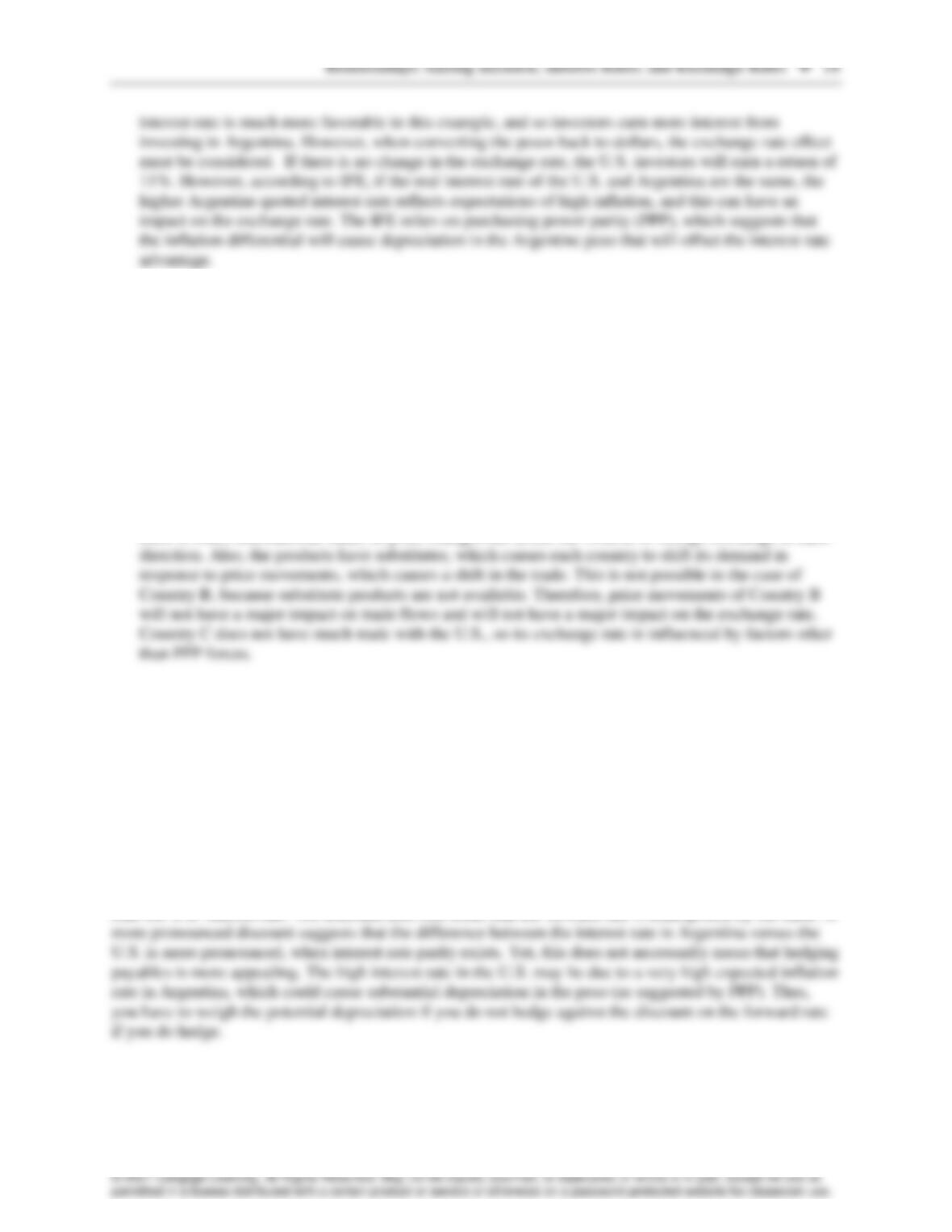
Based on interest rate parity, a forward discount occurs when the interest rate on the currency is higher
than the U.S. interest rate. The discount does not mean that the forward rate is underpriced by the bank. A
Solution to Continuing Case Problem: Blades, Inc.
1. What is the relationship between the exchange rates and the relative inflation levels of the two
countries? How will this relationship affect Blades’ Thai revenue and costs given that the baht is
freely floating? What is the net effect of this relationship on Blades?
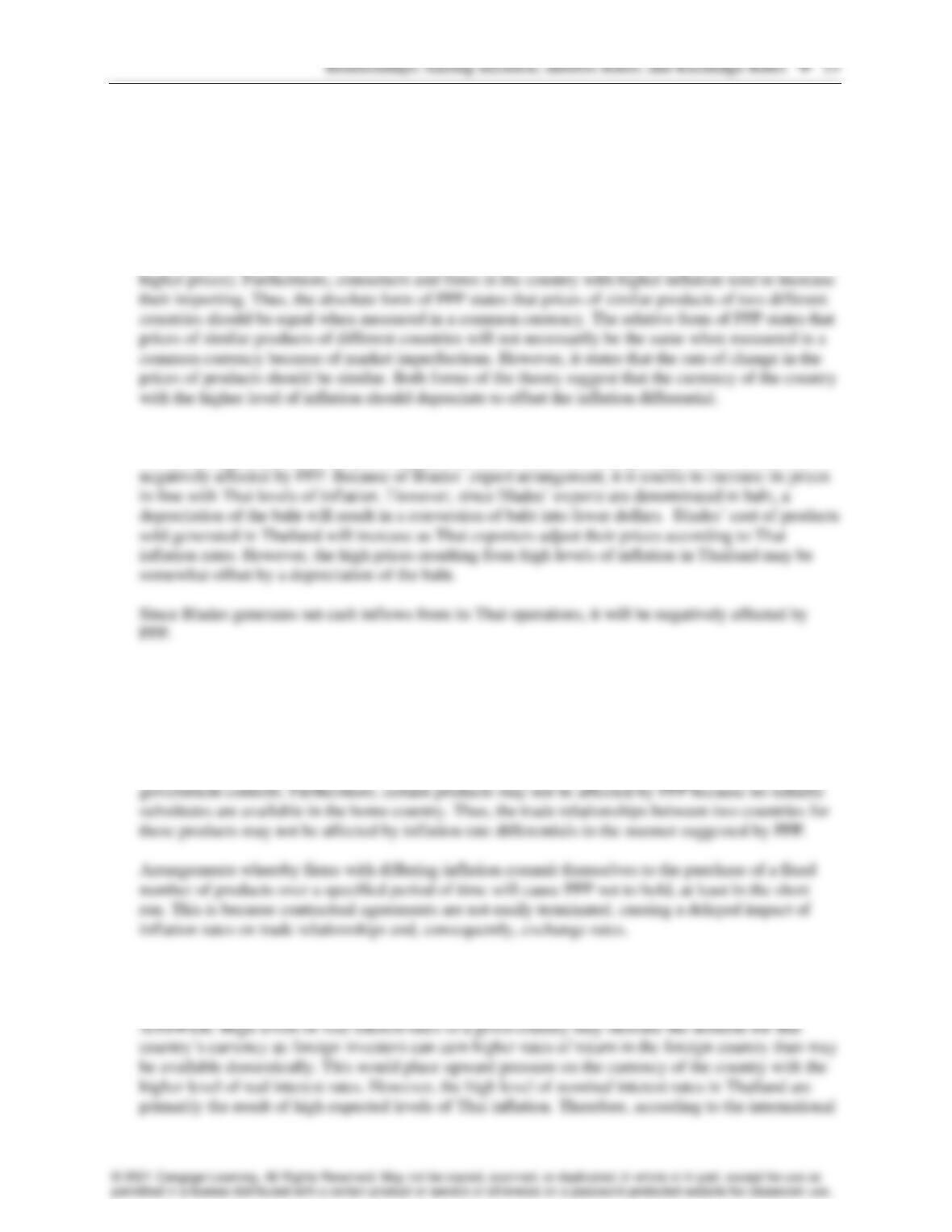
ANSWER: The relationship between exchange rates and relative inflation rates is summarized by the
purchasing power parity (PPP) theory. When one country’s inflation rate rises relative to that of
another, the demand for the former country’s currency declines as its exports decline (due to its
Since the baht has become a freely floating currency, the currency should be expected to depreciate
due to the high inflation levels prevailing in Thailand. Blades’ revenue generated in Thailand will be
2. What are some factors that might prevent PPP from occurring in the short run? Would you expect
PPP to hold better if countries negotiate trade arrangements under which they commit themselves to
the purchase or sale of a fixed number of products over a specified time period? Why or why not?
ANSWER: PPP may not hold because exchange rates are affected by other factors in addition to the
inflation differential between two countries, such as relative interest rates, national income levels, and
3. How do you reconcile the high level of interest rates in Thailand with the expected change of the
baht-dollar exchange rate according to PPP?
© 2021 Cengage Learning. All Rights Reserved. May not be copied, scanned, or duplicated, in whole or in part, except for use as
permitted in a license distributed with a certain product or service or otherwise on a password-protected website for classroom use.
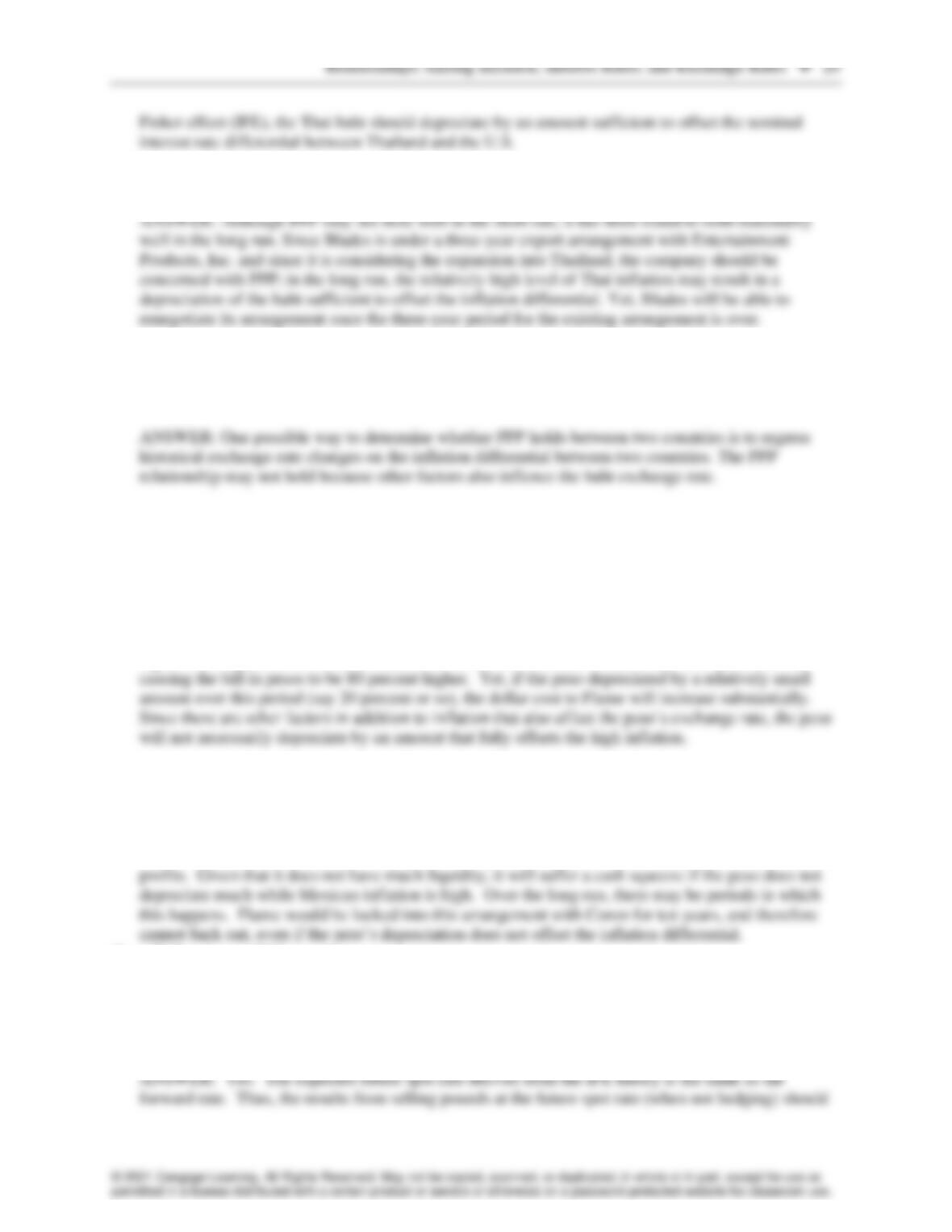
4. Given Blades’ future plans in Thailand, should the company be concerned with PPP? Why or why not?
5. PPP may hold better for some countries than for others. The Thai baht has been freely floating for
more than a decade. How do you think Blades can gain insight into whether PPP holds for Thailand?
Offer some logic to explain why the PPP relationship may not hold here.
Solution to Supplemental Case: Flame Fixtures, Inc.
a. If the peso depreciates by more than the inflation differential, then the dollar cost to Flame will be
even lower than expected.
b. If the peso depreciates by less than the inflation differential, then the dollar cost to Flame will be even
higher than expected. Consider a scenario in which the Mexican inflation rate is 80 percent or so,
c. Stable dollar payments would only occur if the peso depreciated by an amount that offset its high
inflation rate. It is unlikely that there will be a perfect offset in any given period. Therefore, Flame’s
dollar payments would be unstable, and so would its profits.
d. The risk would increase, because its payments for parts would now be more volatile, and so would its
Small Business Dilemma
Assessment of the IFE by the Sports Exports Company
1. Is Logan’s interpretation of the IFE theory correct?
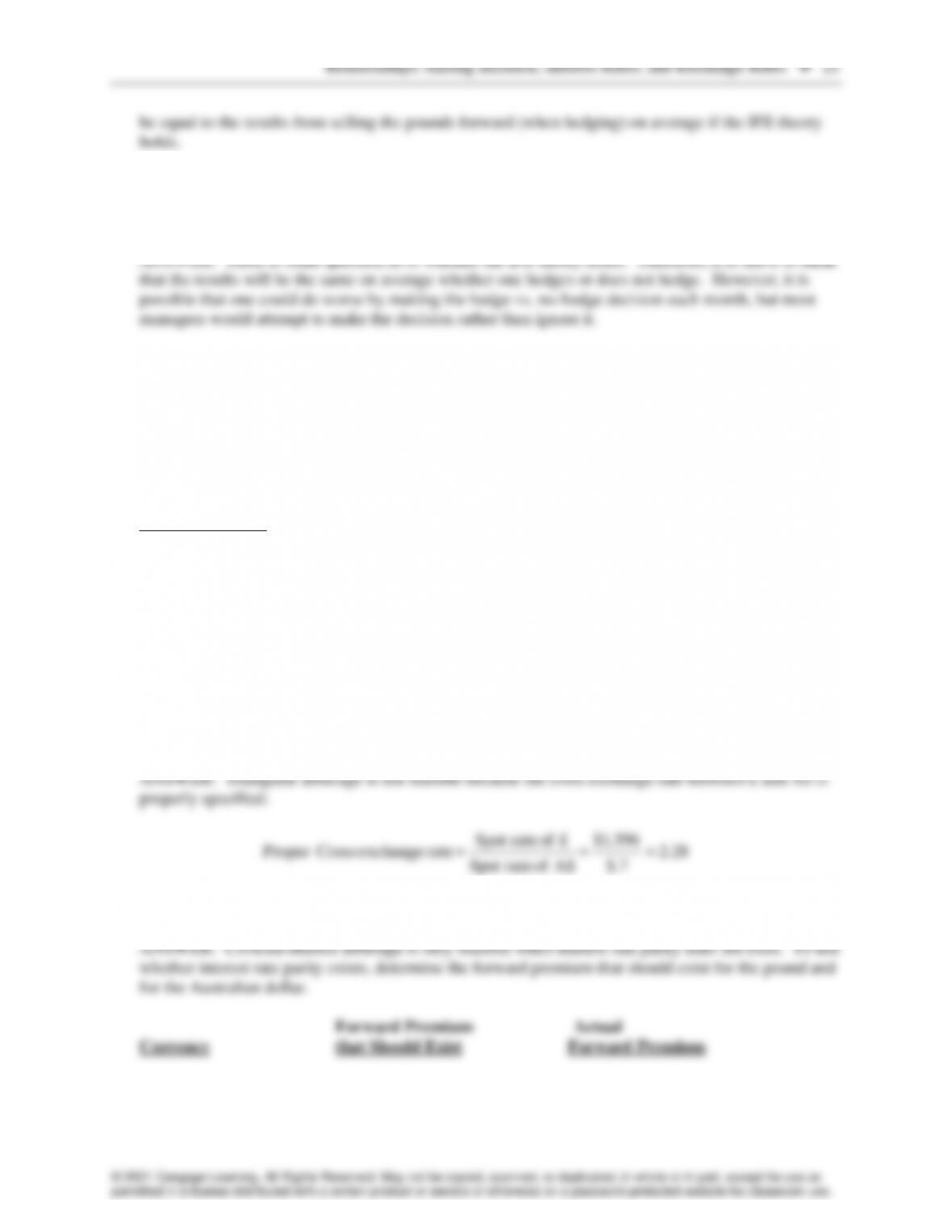
© 2021 Cengage Learning. All Rights Reserved. May not be copied, scanned, or duplicated, in whole or in part, except for use as
permitted in a license distributed with a certain product or service or otherwise on a password-protected website for classroom use.
2. If you were in Logan’s position, would you spend time trying to decide whether to hedge the
receivables each month, or do you believe that the results would be the same (on average) whether
you hedged or not?
Part 2—Integrative Problem
Exchange Rate Behavior
1. As an employee of the foreign exchange department for a large company, you have been given the
following information.
Beginning of Year
Spot rate of £ = $1.596
Spot rate of Australian dollar (A$) = $.70
Cross exchange rate: £1 = A$2.28
One-year forward rate of A$ = $.71
One-year forward rate of £ = $1.58004
One-year U.S. interest rate = 8.00%
One-year British interest rate = 9.09%
One-year Australian interest rate = 7.00%
Determine whether triangular arbitrage is feasible, and if so, how it should be conducted to make a
profit.
$.7
A$ of rateSpot
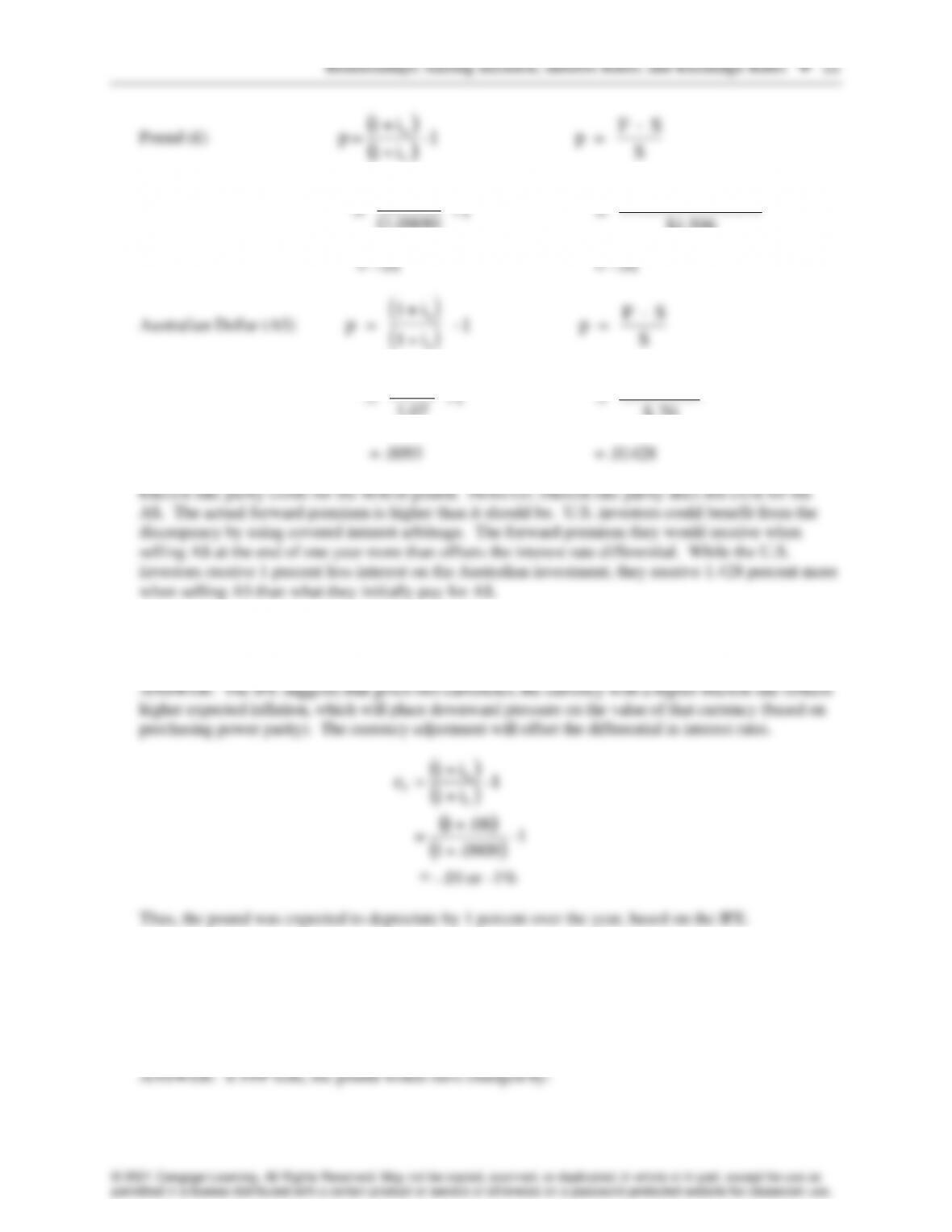
2. Using the information in question 1, determine whether covered interest arbitrage is feasible and, if
so, how it should be conducted to make a profit.
© 2021 Cengage Learning. All Rights Reserved. May not be copied, scanned, or duplicated, in whole or in part, except for use as
permitted in a license distributed with a certain product or service or otherwise on a password-protected website for classroom use.
1.89%–or .0189 –
~
1–
1.06
1.04
1–
I + 1
I + 1
=e
f
h
p
=
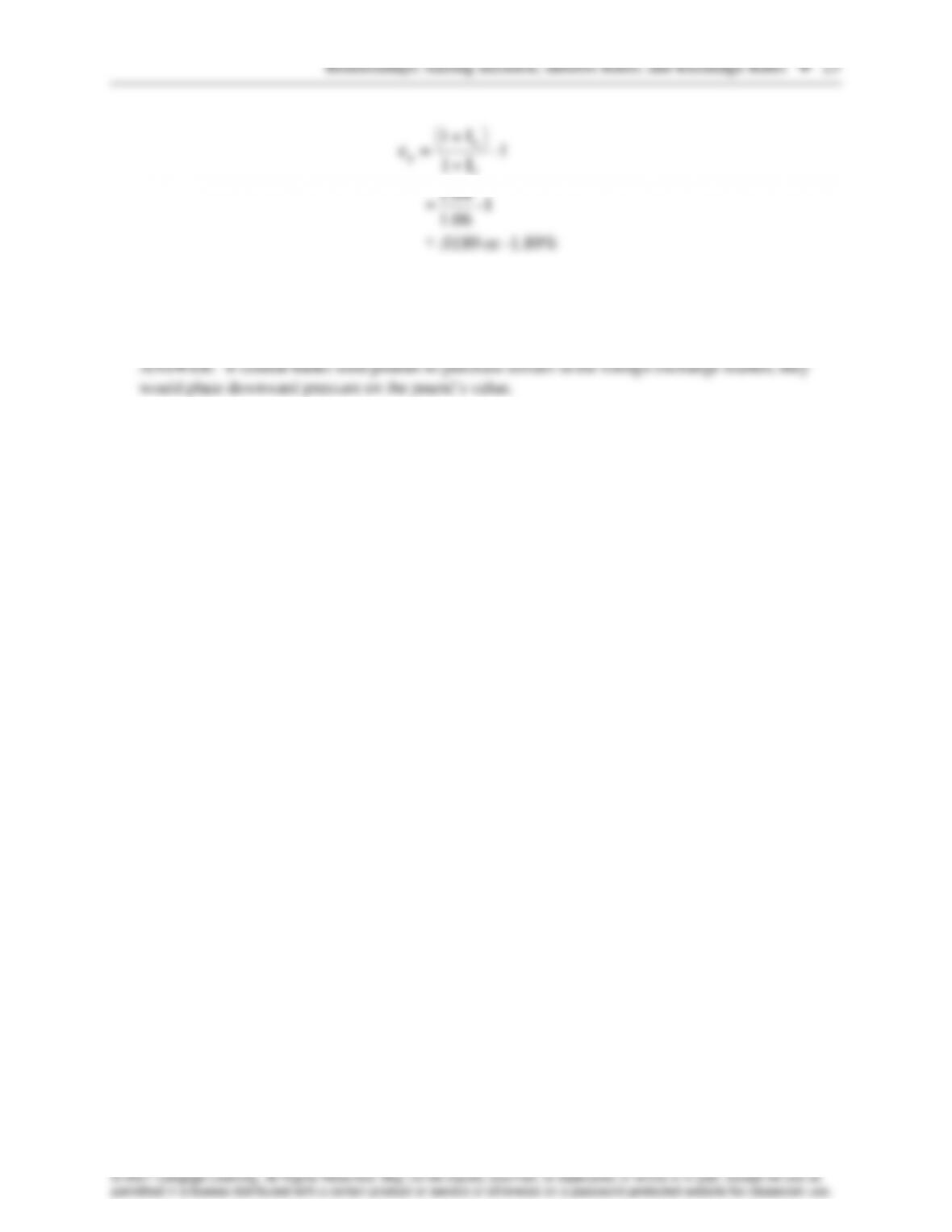
5. Assume that the pound’s depreciation over the year was attributed directly to central bank
intervention. Explain the type of direct intervention that would place downward pressure on the value
of the pound.