CHAPTER 8 MANAGEMENT OF TRANSACTION EXPOSURE
ANSWERS & SOLUTIONS TO END-OF-CHAPTER QUESTIONS AND PROBLEMS
QUESTIONS
1. How would you define transaction exposure? How is it different from economic exposure?
2. Discuss and compare hedging transaction exposure using the forward contract vs. money
market instruments. When do the alternative hedging approaches produce the same result?
3. Discuss and compare the costs of hedging via the forward contract and the options contract.
4. What are the advantages of a currency options contract as a hedging tool compared with the
forward contract?
5. Suppose your company has purchased a put option on the euro to manage exchange
exposure associated with an account receivable denominated in that currency. In this case, your
company can be said to have an ‘insurance’ policy on its receivable. Explain in what sense this
is so.
6. Recent surveys of corporate exchange risk management practices indicate that many U.S.
firms simply do not hedge. How would you explain this result?
7. Should a firm hedge? Why or why not?
Answer: In a perfect capital market, firms may not need to hedge exchange risk. But firms can
8. Using an example, discuss the possible effect of hedging on a firm’s tax obligations.
9. Explain contingent exposure and discuss the advantages of using currency options to
manage this type of currency exposure.
10. Explain cross-hedging and discuss the factors determining its effectiveness.
PROBLEMS
1. Cray Research sold a super computer to the Max Planck Institute in Germany on credit and
invoiced €10 million payable in six months. Currently, the six-month forward exchange rate is
$1.10/€ and the foreign exchange advisor for Cray Research predicts that the spot rate is likely to
be $1.05/€ in six months.
(a) What is the expected gain/loss from the forward hedging?
(b) If you were the financial manager of Cray Research, would you recommend hedging this
euro receivable? Why or why not?
(c) Suppose the foreign exchange advisor predicts that the future spot rate will be the same as
the forward exchange rate quoted today. Would you recommend hedging in this case? Why or
why not?
(d) Suppose now that the future spot exchange rate is forecast to be $1.17/€. Would you
recommend hedging? Why or why not?
Solution:
(a) Expected gain($) = 10,000,000(1.10 – 1.05)
2. IBM purchased computer chips from NEC, a Japanese electronics concern, and was billed ¥250
million payable in three months. Currently, the spot exchange rate is ¥105/$ and the three-month
forward rate is ¥100/$. The three-month money market interest rate is 8 percent per annum in the U.S.
and 7 percent per annum in Japan. The management of IBM decided to use the money market hedge
to deal with this yen account payable.
(a) Explain the process of a money market hedge and compute the dollar cost of meeting the
yen obligation.
(b) Conduct the cash flow analysis of the money market hedge.
Solution:
(a). Let’s first compute the PV of ¥250 million, i.e.,
(b)
__________________________________________________________________
Transaction CF0 CF1
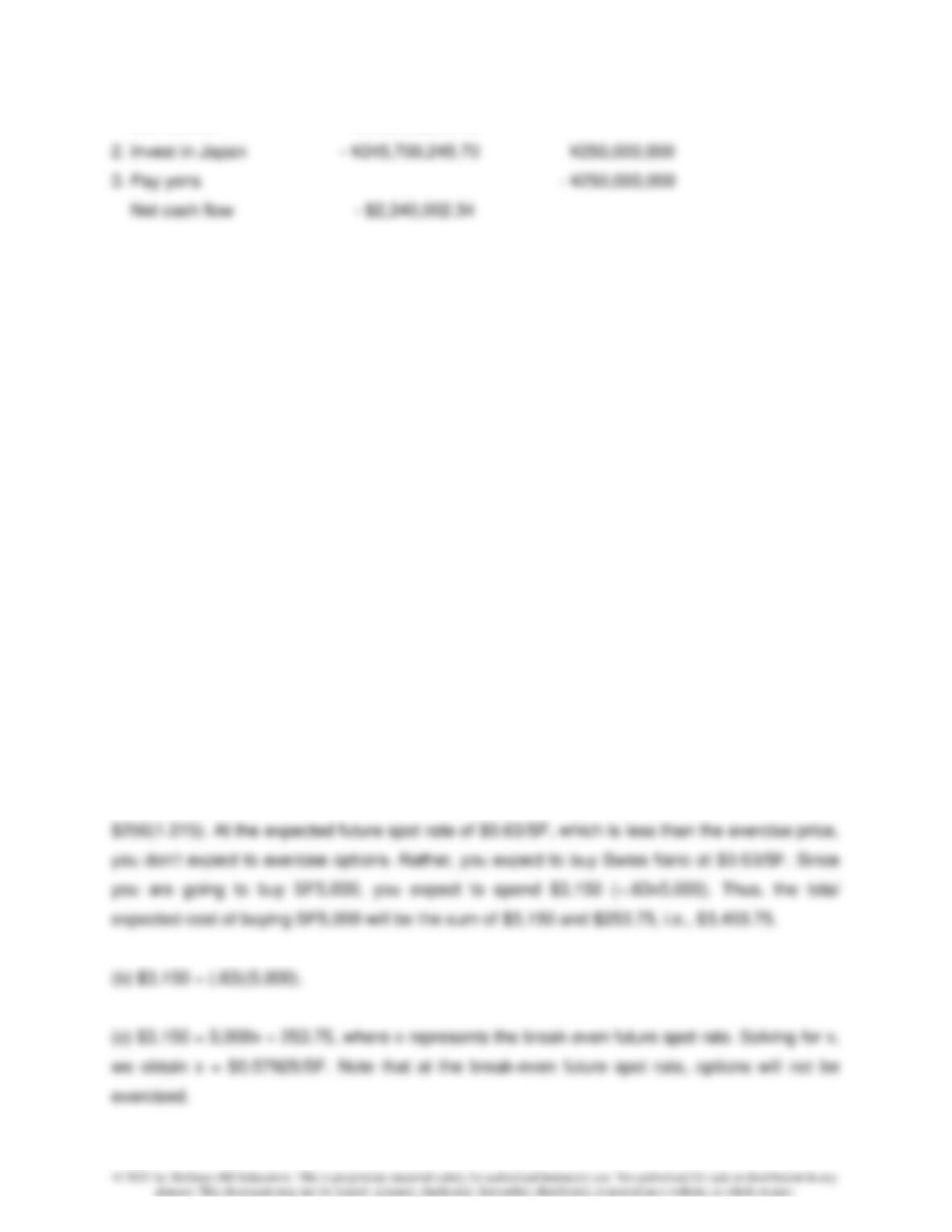
with dollars ¥245,700,245.70
__________________________________________________________________
3. You plan to visit Geneva, Switzerland in three months to attend an international business
conference. You expect to incur the total cost of SF 5,000 for lodging, meals and transportation
during your stay. As of today, the spot exchange rate is $0.60/SF and the three-month forward
rate is $0.63/SF. You can buy the three-month call option on SF with the exercise rate of
$0.64/SF for the premium of $0.05 per SF. Assume that your expected future spot exchange
rate is the same as the forward rate. The three-month interest rate is 6 percent per annum in the
United States and 4 percent per annum in Switzerland.
(a) Calculate your expected dollar cost of buying SF5,000 if you choose to hedge via call option
on SF.
(b) Calculate the future dollar cost of meeting this SF obligation if you decide to hedge using a
forward contract.
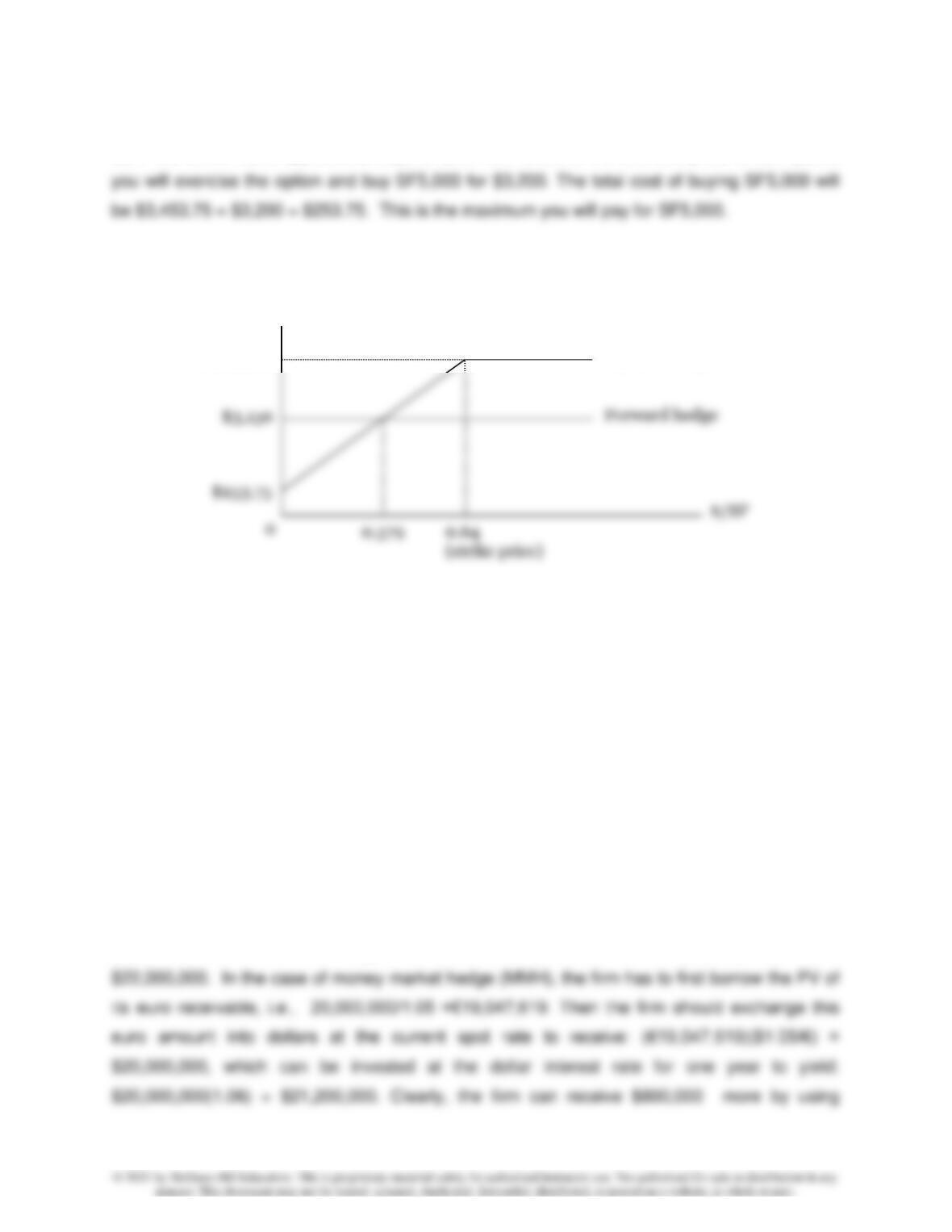
(c) At what future spot exchange rate will you be indifferent between the forward and option
market hedges?
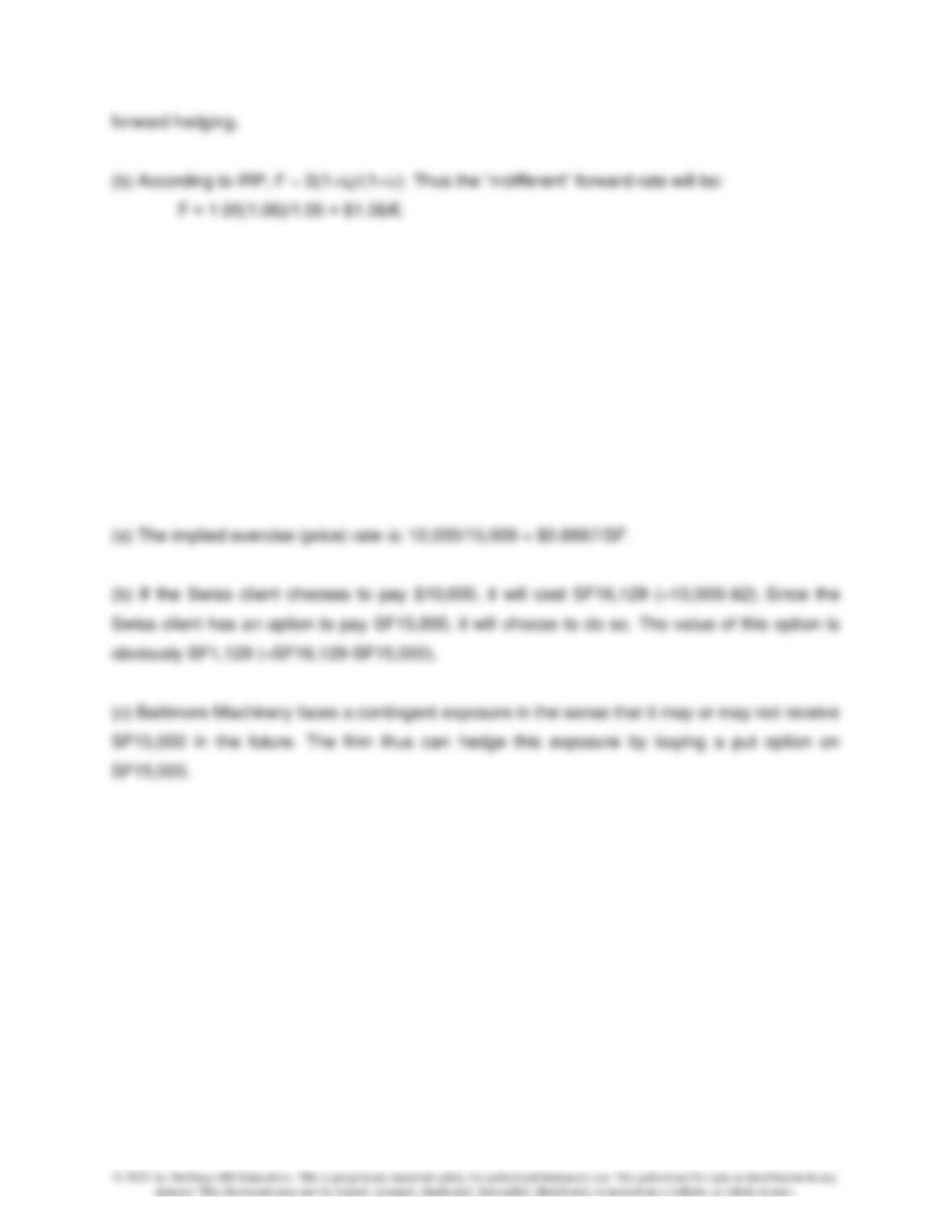
(d) Illustrate the future dollar costs of meeting the SF payable against the future spot exchange
rate under both the options and forward market hedges.
Solution:
(a) Total option premium = (.05)(5000) = $250. In three months, $250 is worth $253.75 =
$/SF
(d) If the Swiss franc appreciates beyond $0.64/SF, which is the exercise price of call option,
4. Boeing just signed a contract to sell a Boeing 737 aircraft to Air France. Air France will be
billed €20 million which is payable in one year. The current spot exchange rate is $1.05/€ and
the one-year forward rate is $1.10/€. The annual interest rate is 6.0% in the U.S. and 5.0% in
France. Boeing is concerned with the volatile exchange rate between the dollar and the euro
and would like to hedge exchange exposure.
(a) It is considering two hedging alternatives: sell the euro proceeds from the sale forward or
borrow euros from Credit Lyonnaise against the euro receivable. Which alternative would you
recommend? Why?
(b) Other things being equal, at what forward exchange rate would Boeing be indifferent
between the two hedging methods?
Solution:
(a) In the case of forward hedge, the future dollar proceeds will be (20,000,000)(1.10) =
$ Cost
Options hedge
$3,453.75
5. Suppose that Baltimore Machinery sold a drilling machine to a Swiss firm and gave the
Swiss client a choice of paying either $10,000 or SF 15,000 in three months.
(a) In the above example, Baltimore Machinery effectively gave the Swiss client a free option to
buy up to $10,000 dollars using Swiss franc. What is the ‘implied’ exercise exchange rate?
(b) If the spot exchange rate turns out to be $0.62/SF, which currency do you think the Swiss
client will choose to use for payment? What is the value of this free option for the Swiss client?
(c) What is the best way for Baltimore Machinery to deal with the exchange exposure?
Solution:
6. Princess Cruise Company (PCC) purchased a ship from Mitsubishi Heavy Industry. PCC
owes Mitsubishi Heavy Industry 500 million yen in one year. The current spot rate is 124 yen
per dollar and the one-year forward rate is 110 yen per dollar. The annual interest rate is 5% in
Japan and 8% in the U.S. PCC can also buy a one-year call option on yen at the strike price of
$.0081 per yen for a premium of .014 cents per yen.
(a) Compute the future dollar costs of meeting this obligation using the money market hedge
and the forward hedges.
(b) Assuming that the forward exchange rate is the best predictor of the future spot rate,
compute the expected future dollar cost of meeting this obligation when the option hedge is
used.
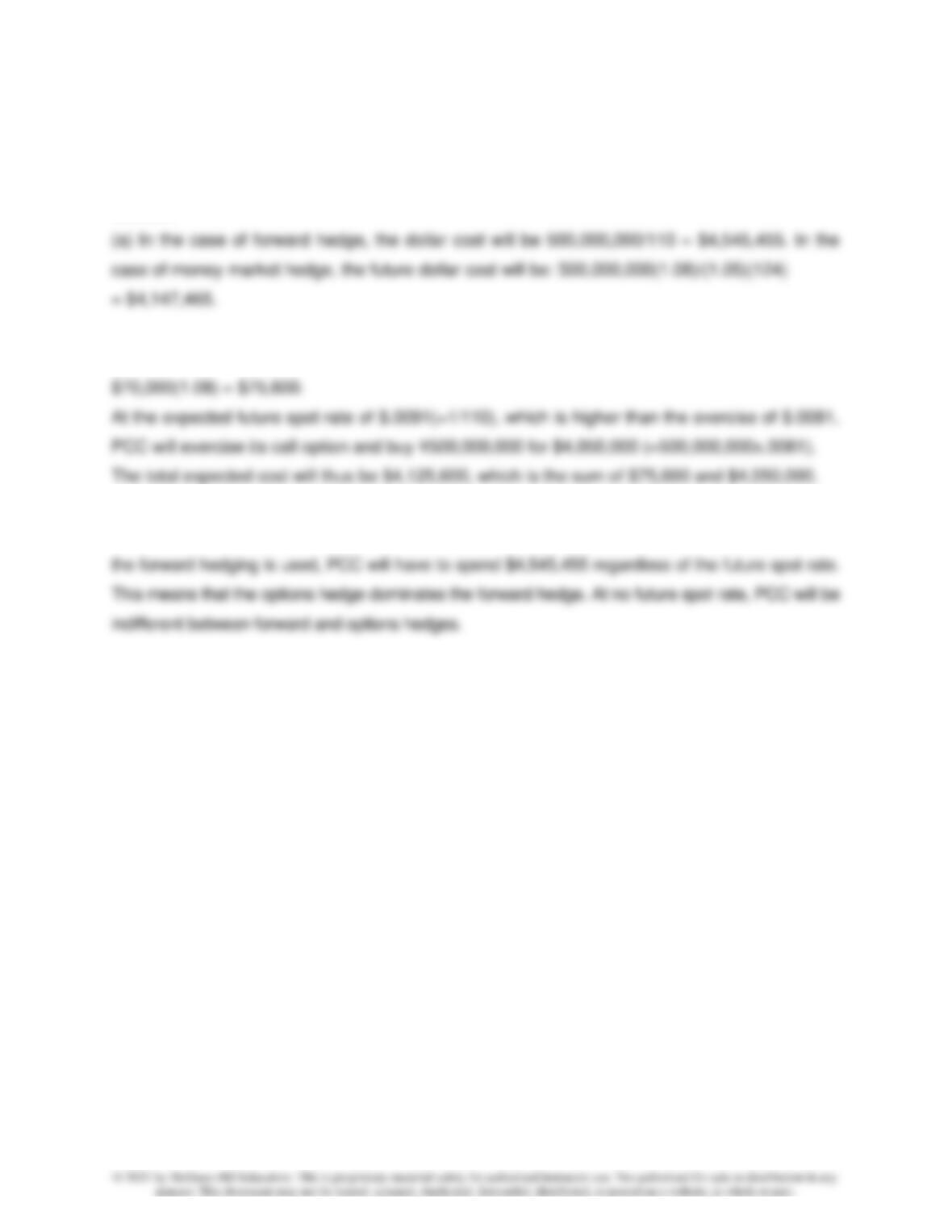
(c) At what future spot rate do you think PCC may be indifferent between the option and forward
hedge?
Solution:
(b) The option premium is: (.014/100)(500,000,000) = $70,000. Its future value will be
(c) When the option hedge is used, PCC will spend “at most” $4,125,000. On the other hand, when
7. Consider a U.S.-based company that exports goods to Switzerland. The U.S. Company
expects to receive payment on a shipment of goods in three months. Because the payment will
be in Swiss francs, the U.S. Company wants to hedge against a decline in the value of the
Swiss franc over the next three months. The U.S. risk-free rate is 2 percent, and the Swiss risk-
free rate is 5 percent. Assume that interest rates are expected to remain fixed over the next six
months. The current spot rate is $0.5974
a. Indicate whether the U.S. Company should use a long or short forward contract to hedge
currency risk.
b. Calculate the no-arbitrage price at which the U.S. Company could enter into a forward
contract that expires in three months.
c. It is now 30 days since the U.S. Company entered into the forward contract. The spot rate is
$0.55. Interest rates are the same as before. Calculate the value of the U.S. Company’s
forward position.
Solution:
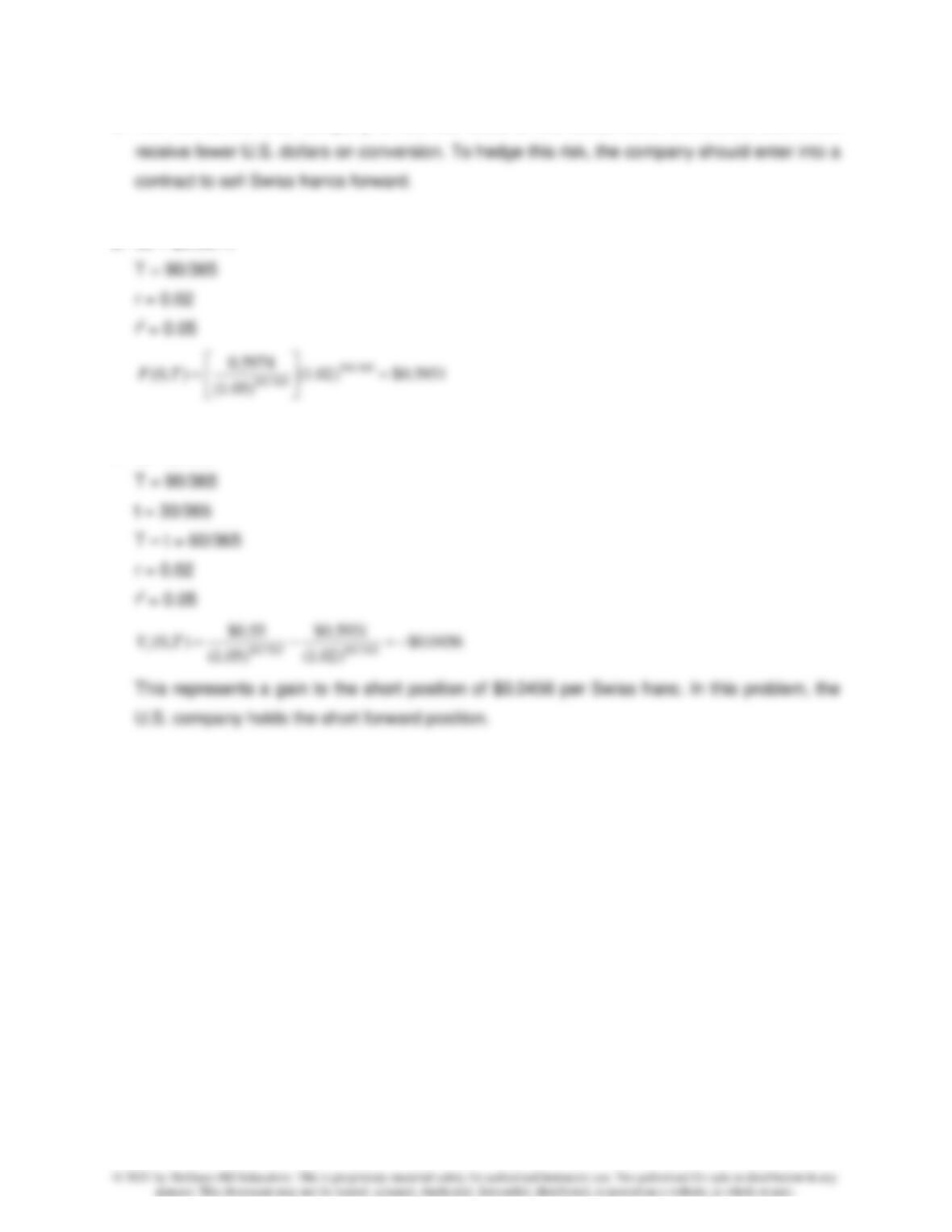
a. The risk to the U.S. company is that the value of the Swiss franc will decline and it will
b. S0 = $0.5974
c. St = $0.55
8. Suppose that you are a U.S.-based importer of goods from the United Kingdom. You expect
the value of the pound to increase against the U.S. dollar over the next 30 days. You will be
making payment on a shipment of imported goods in 30 days and want to hedge your currency
exposure. The U.S. risk-free rate is 5.5 percent, and the U.K. risk-free rate is 4.5 percent. These
rates are expected to remain unchanged over the next month. The current spot rate is $1.50.
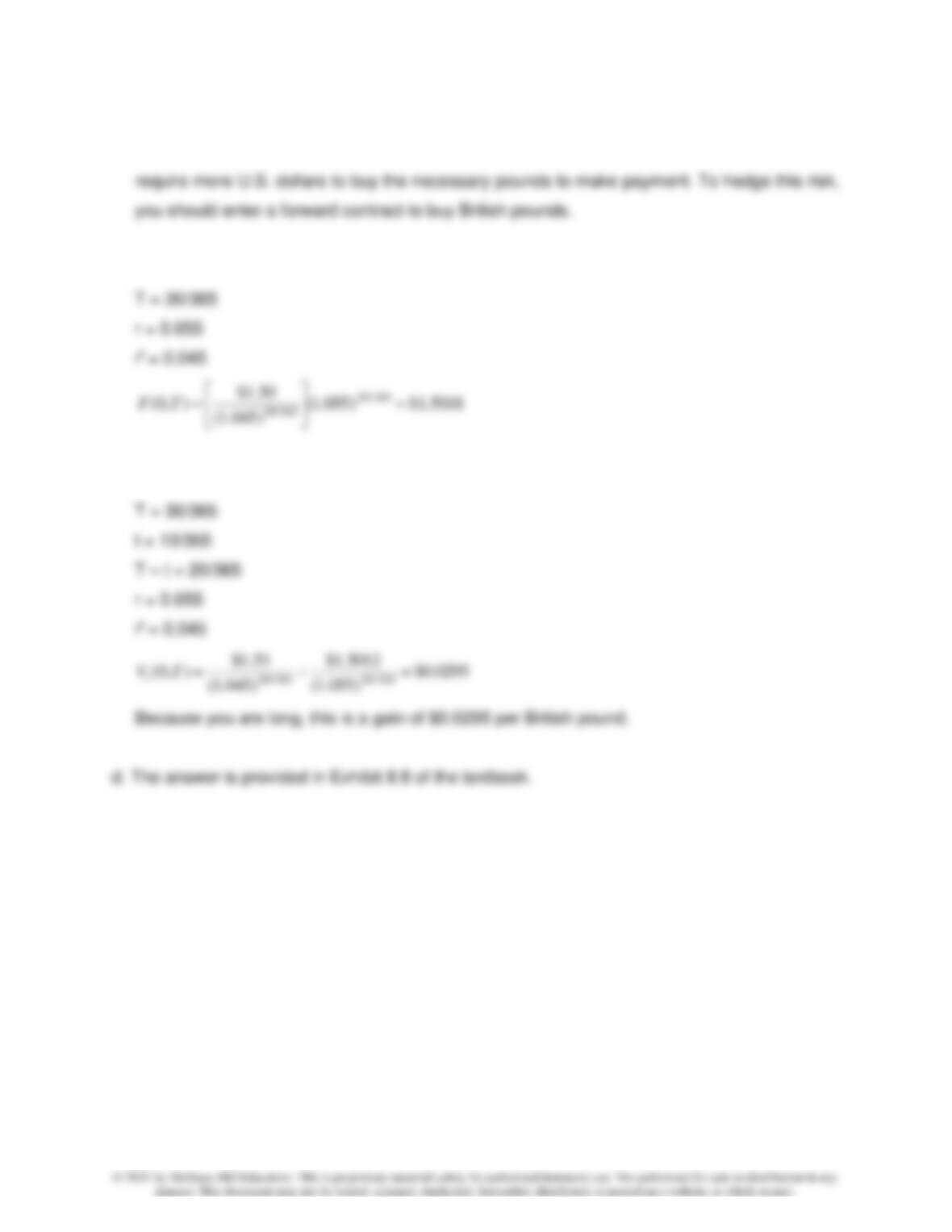
a. Indicate whether you should use a long or short forward contract to hedge currency risk.
b. Calculate the no-arbitrage price at which you could enter into a forward contract that expires
in three months.
c. Move forward 10 days. The spot rate is $1.53. Interest rates are unchanged. Calculate the
value of your forward position.
d. Using the text software spreadsheet TRANSEXP, replicate the analysis in Exhibit 8.8.
Solution:
a. The risk to you is that the value of the British pound will rise over the next 30 days and it will
b. S0 = $1.50
c. St = $1.53
MINICASE: AIRBUS’ DOLLAR EXPOSURE
Airbus sold an aircraft, A400, to Delta Airlines, a U.S. company, and billed $30 million payable in
six months. Airbus is concerned with the euro proceeds from international sales and would like
to control exchange risk. The current spot exchange rate is $1.05/€ and six-month forward
exchange rate is $1.10/€ at the moment. Airbus can buy a six-month put option on U.S. dollars
with a strike price of €0.95/$ for a premium of €0.02 per U.S. dollar. Currently, six-month interest
rate is 2.5% in the euro zone and 3.0% in the U.S.
a. Compute the guaranteed euro proceeds from the American sale if Airbus decides to hedge
using a forward contract.
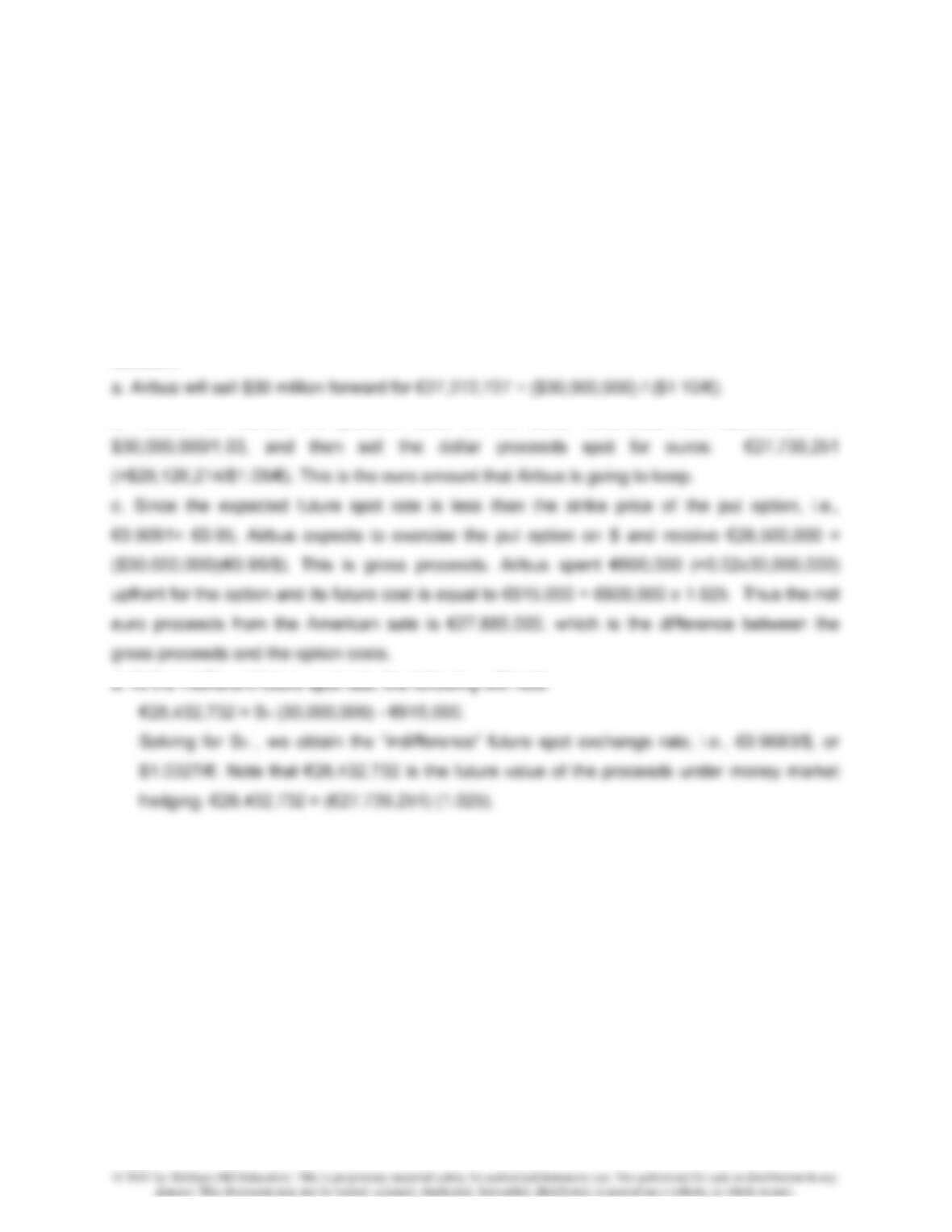
b. If Airbus decides to hedge using money market instruments, what action does Airbus need to
take? What would be the guaranteed euro proceeds from the American sale in this case?
c. If Airbus decides to hedge using put options on U.S. dollars, what would be the ‘expected’
euro proceeds from the American sale? Assume that Airbus regards the current forward
exchange rate as an unbiased predictor of the future spot exchange rate.
d. At what future spot exchange rate do you think Airbus will be indifferent between the option
and money market hedge?
Solution:
b. Airbus will borrow the present value of the dollar receivable, i.e., $29,126,214 =
Case Application: Richard May’s Options
It is Tuesday afternoon, February 14, 2012. Richard May, Assistant Treasurer at
American Digital Graphics (ADG), sits in his office on the thirty-fourth floor of the building that
dominates Rockefeller Plaza’s west perimeter. Its Valentine’s Day and Richard and his wife
have dinner reservations with another couple at Balthazar at 7:30. “I must get this hedging
memo done,” thinks May, “and get out of here. Foreign exchange options? I had better get the

story straight before someone in the Finance Committee starts asking questions. Let’s see,
there are two ways in which I can envisage us using options now. One is to hedge a dividend
due on September 15th from ADG Germany. The other is to hedge our upcoming payment to
Matsumerda for their spring RAM chip statement. With the yen at 78 and increasing I’m glad we
haven’t covered the payment so far, but now I’m getting nervous and I would like to protect my
posterior. An option to buy yen on June 10 might be just the thing.
Before we delve any further into Richard May’s musings, let us learn a bit about ADG,
and about foreign exchange options. American Digital Graphics is a $12 billion sales company
engaged in, among other things, the development, manufacture, and marketing of
microprocessor-based equipment. Although 30 percent of the firm’s sales are currently abroad,
the firm has full-fledged manufacturing facilities in only three foreign countries, Germany,
Canada, and Brazil. An assembly plant in Singapore exists primarily to solder Japanese
semiconductor chips onto circuit boards and to screw these into Brazilian-made boxes for
shipment to the United States, Canada, and Germany. The German subsidiary has developed
half of its sales to France, the Netherlands, and the United Kingdom, billing in euros. ADG
Germany has accumulated a cash reserve of €900,000, worth $1,178,100 at today’s exchange
rate. While the Hamburg office has automatic permission to repatriate €3 million, they have
been urged to seek authorization to convert another €1 million by September 15th. The firm has
an agreement to buy three hundred thousand RAM chips at ¥8000 each semi–annually, and it is
this payment that will fall due on June 10th.
The conventional means of hedging exchange risk are forward or future contracts.
These, however, are fixed and inviolable agreements. In many practical instances the hedger is
uncertain whether foreign currency cash inflow or outflow will materialize. In such cases, what
is needed is the right, but not the obligation, to buy or sell a designated quantity of a foreign

currency at a specified price (exchange rate). This is precisely what a foreign exchange option
provides.
A foreign exchange option gives the holder the right to buy or sell a designated quantity
of a foreign currency at a specified exchange rate up to or at a stipulated date.
The terminal date of the contract is called the expiration date (or maturity date). If the option
may be exercised before the expiration date, it is called an American option; if only at the
expiration date, a European option.
The party retaining the option is the option buyer; the party giving the option is the option
seller (or writer). The exchange rate at which the option can be exercised is called the exercise
price or strike price. The buyer of the option must pay the seller some amount, called the option
price or the premium, for the rights involved.
The important feature of a foreign exchange option is that the holder of the option has
the right, but not the obligation, to exercise it. He will only exercise it if the currency moves in a
favorable direction. Thus, once you have paid for an option you cannot lose, unlike a forward
contract, where you are obliged to exchange the currencies and therefore will lose if the
movement is unfavorable.
The disadvantage of an option contract, compared to a forward or futures contract is that
you have to pay a price for the option, and this price or premium tends to be quite high for
certain options. In general, the option’s price will be higher the greater the risk to the seller (and
the greater the value to the buyer because this is a zero-sum game). The risk of a call option
will be greater, and the premium higher, the higher the forward rate relative to the exercise
price; after all, one can always lock in a profit by buying at the exercise price and selling at the
forward rate. The chance that the option will be exercised profitably is also higher, the more
volatile is the currency, and the longer the option has to run before it expires.
Returning to Richard May in his Rockefeller Center office, we find that he has been
printing spot, forward and currency options and futures quotations from the company’s
Bloomberg terminal.
The option prices are quoted in U.S. cents per euro. Yen are quoted in hundredths of a
cent. Looking at these prices, Richard realizes that he can work out how much the euro or yen
would have to change to make the option worthwhile. Richard makes a mental note that ADG
can typically borrow in the Eurocurrency market at LIBOR + 1% and lend at LIBID.
“I’ll attach these numbers to my memo,” mutters May, but the truth is he has yet to come
to grips with the real question, which is when, if ever, are currency options a better means of
hedging exchange risk for an international firm than traditional forward exchange contracts or
future’s contracts. Please assist Mr. May in his analysis of currency hedging for his report to
ADG’s Finance Committee. In doing so, you may consult the highlighted market quotes in the
following attachments.
Solution
ADG’s euro receivable
ADG has a €3,000,000 receivable in 214 days on September 15th. To assess alternative
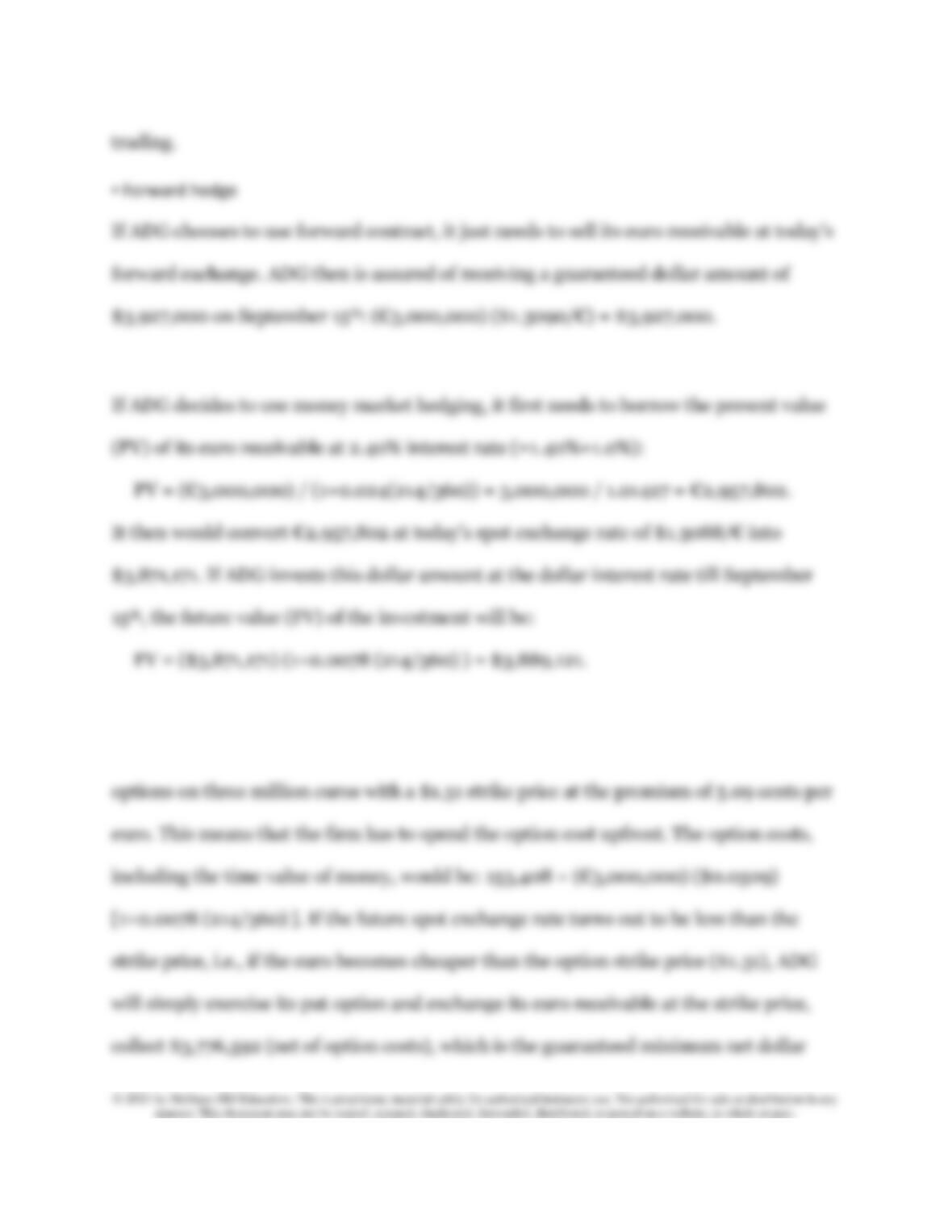
▪ Money market hedge
▪ Option hedge
If ADG chooses to hedge its euro receivable using currency options, it can purchase put
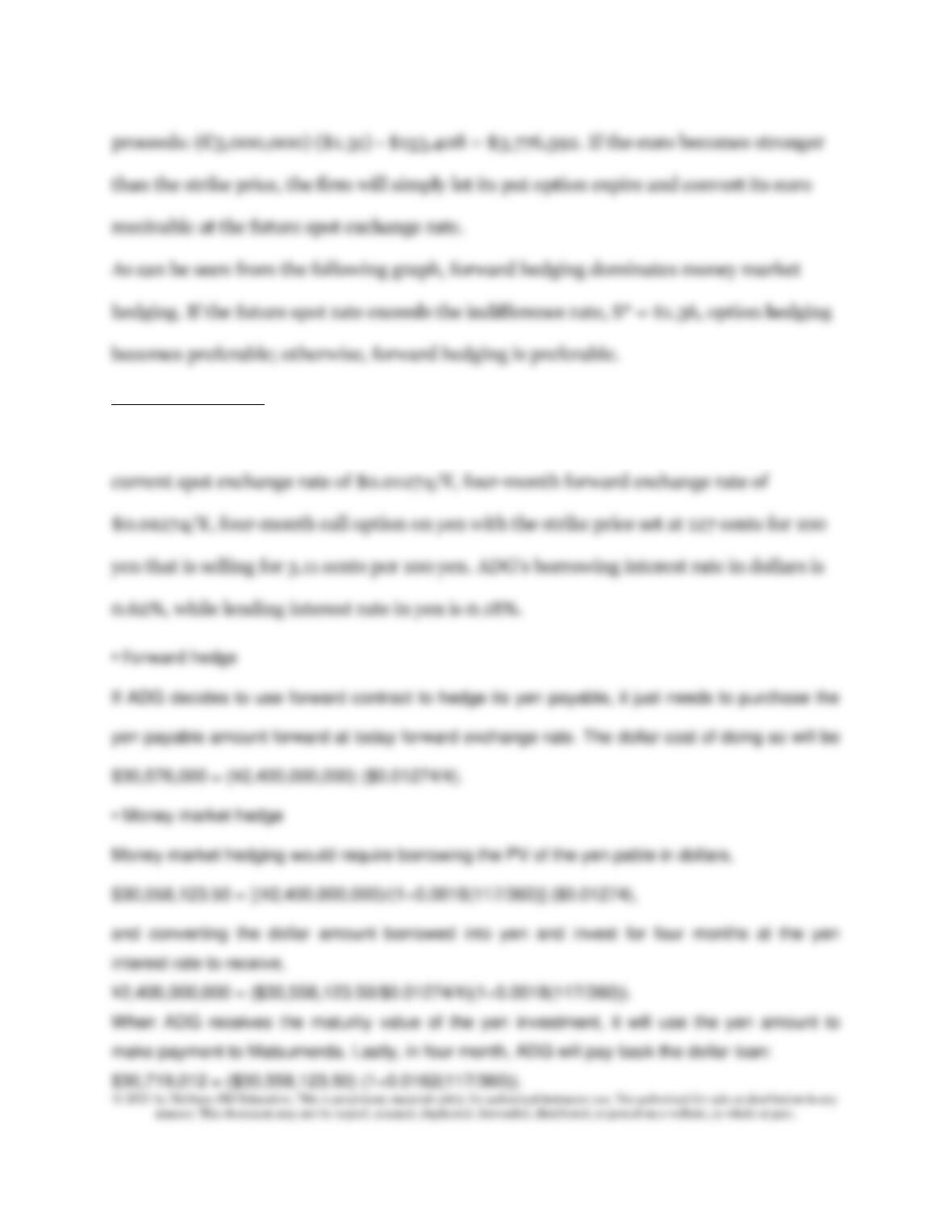
ADG’s yen payable
ADG has a ¥2,400 million payable in 4 months. The relevant market data include: The
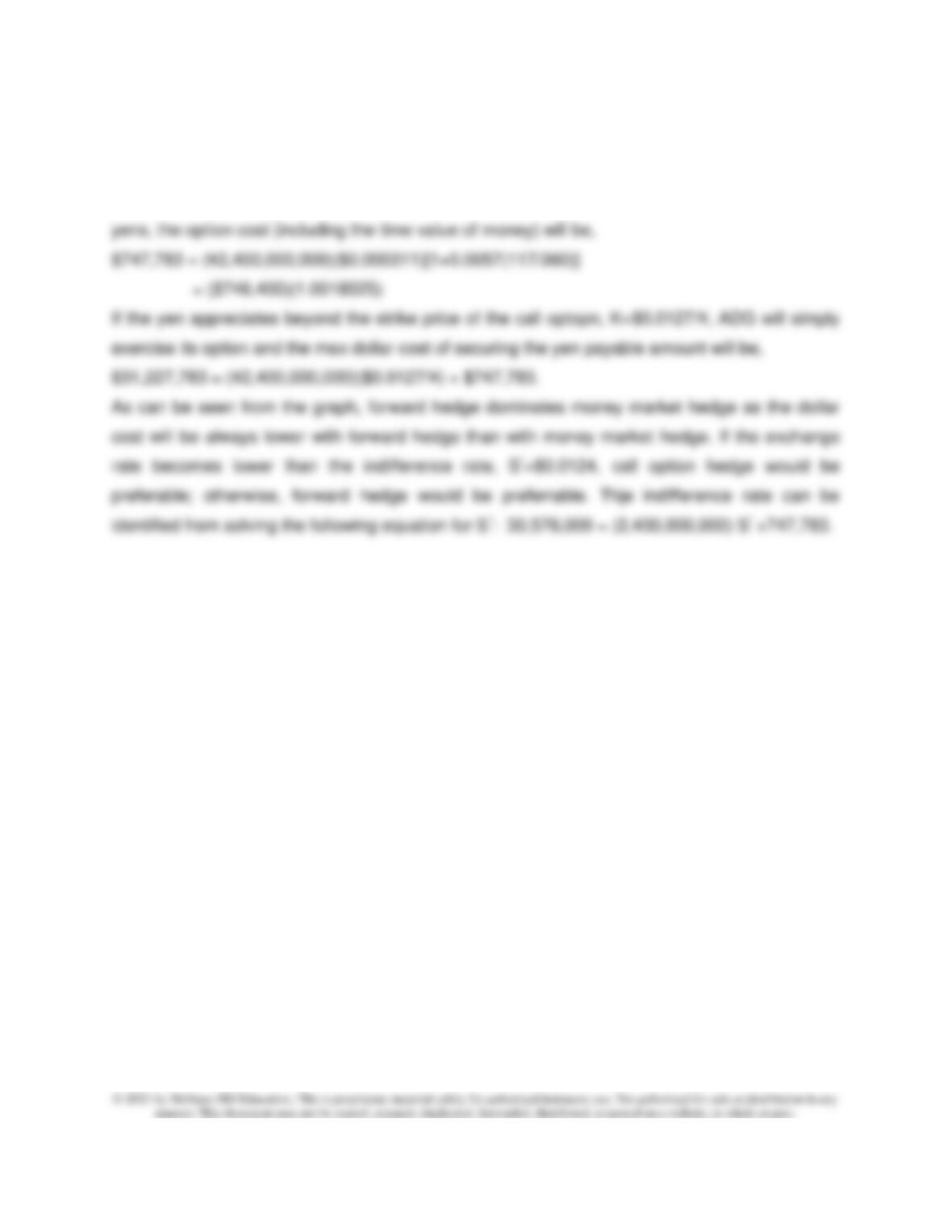
▪ Option hedge
In the case of hedging with option, ADG will need to buy call option on its yen payable. If ADG
decides to buy ontions with strike price set at $0.0127 per dollar trading for 3.11 cents per 100