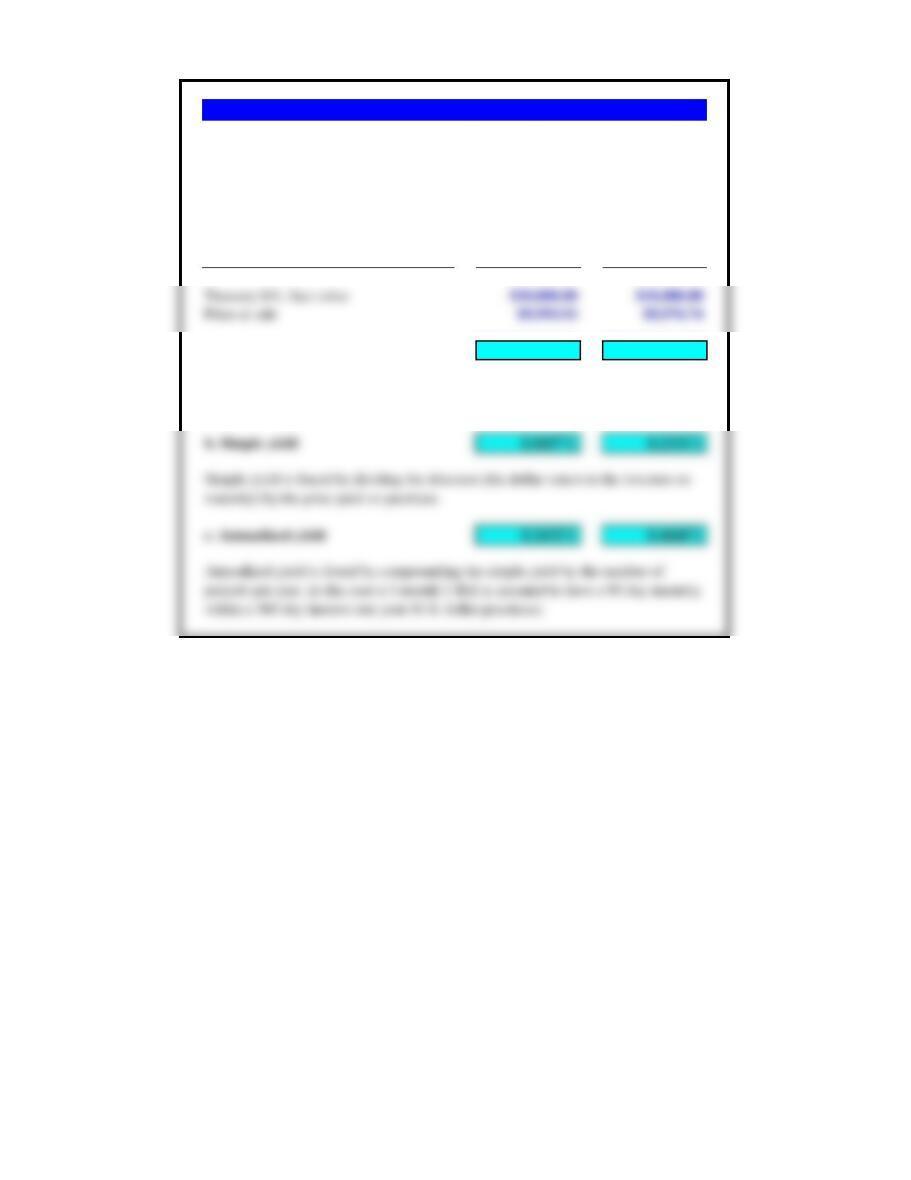
Assumptions 3-Month T-Bill 6-Month T-Bill
a. Discount on sale $6.07 $23.26
b. Simple yield 0.0607% 0.2331%
c. Annualized yield 0.2432% 0.4668%
Simple yield is found by dividing the discount (the dollar return to the investor on
maturity) by the price paid on purchase.
periods per year. In this case a 3-month T-Bill is assumed to have a 90 day maturity
within a 360 day interest rate year (U.S. dollar practices).
Problem 8.1 U.S. Treasury Bill Auction Rates
The interest yields on U.S. Treasury securities in early 2009 fell to very low levels
as a result of the combined events surrounding the global financial crisis. Calculate
the simple and annualized yields for the 3-month and 6-month Treasury bills
auctioned on March 9, 2009 listed here.
Discount on sale is the difference between the face value of the security and the
price it is sold at auction.
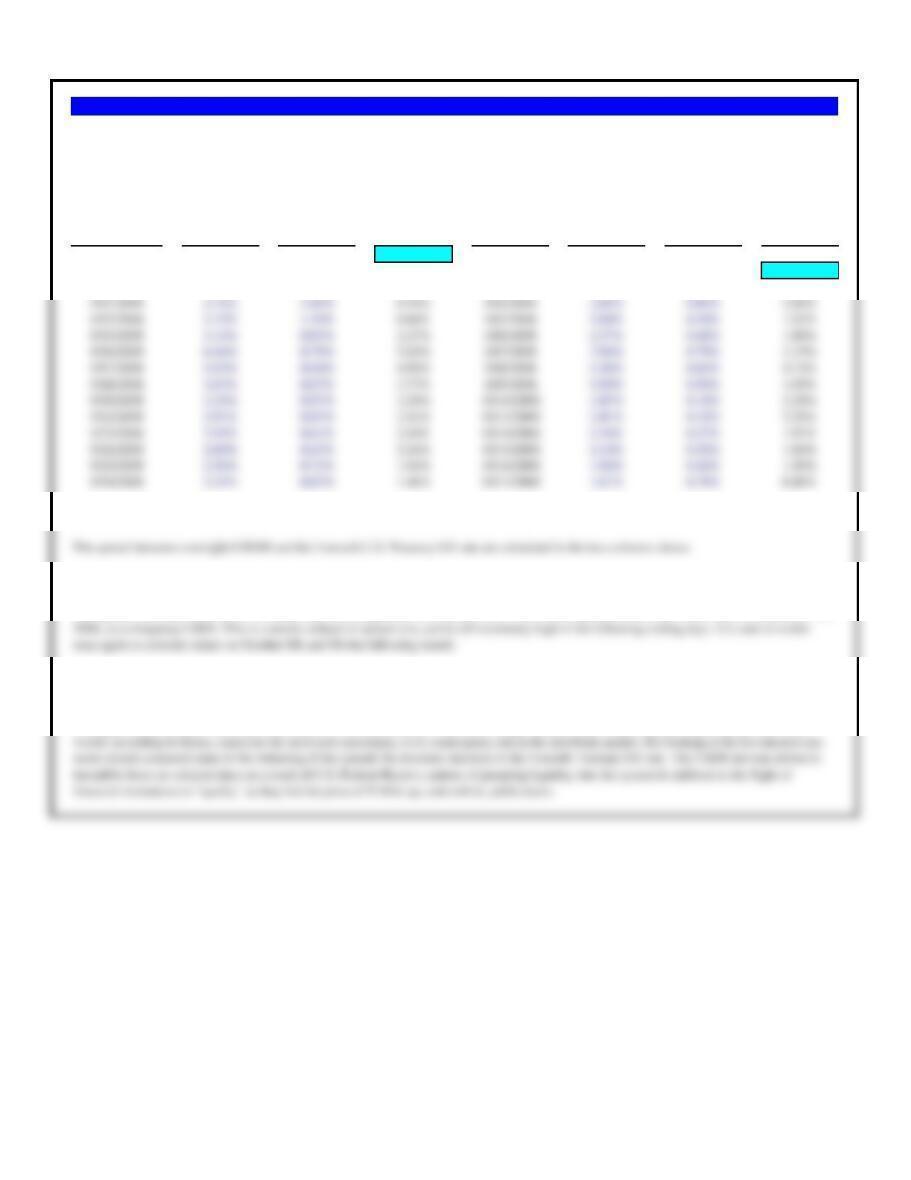
Overnight 3-Month TED Overnight 3-Month TED
Date USD LIBOR US Treasury Spread Date USD LIBOR US Treasury Spread
9/8/2008 2.15% 1.70% 0.45% 9/29/2008 2.57% 0.41% 2.16%
9/9/2008 2.14% 1.65% 0.49% 9/30/2008 6.88% 0.89% 5.98%
9/10/2008 2.13% 1.65% 0.48% 10/1/2008 3.79% 0.81% 2.98%
a. Calculate the spread between the two market rates shown here in September and October 2008.
b. On what date is the spread the narrowest? The widest?
Problem 8.2 Credit Crisis, 2008
The global credit crisis became globally visible in September 2007. Interest rates, particularly the extremely short-term interest rates, will often
change quickly (typically up) as indications that markets are under severe stress. The interest rates shown here are for selected dates in September
and October 2008. Different publications define the TED Spread different ways, but one measure is the differential between the overnight LIBOR
interest rate and the 3-month U.S. Treasury bill rate.
The spread is the narrowest on the first date shown, on September 8, 2008, at 0.45%. The widest spread occurs three weeks later on September 30,
c. When the spread widens dramatically, presumably demonstrating some form of financial anxiety or crisis, which of the rates moves
the most and why?
Although the theoretician would quickly respond — without looking — that the overnight LIBOR rate is what should be spiking upwards. This
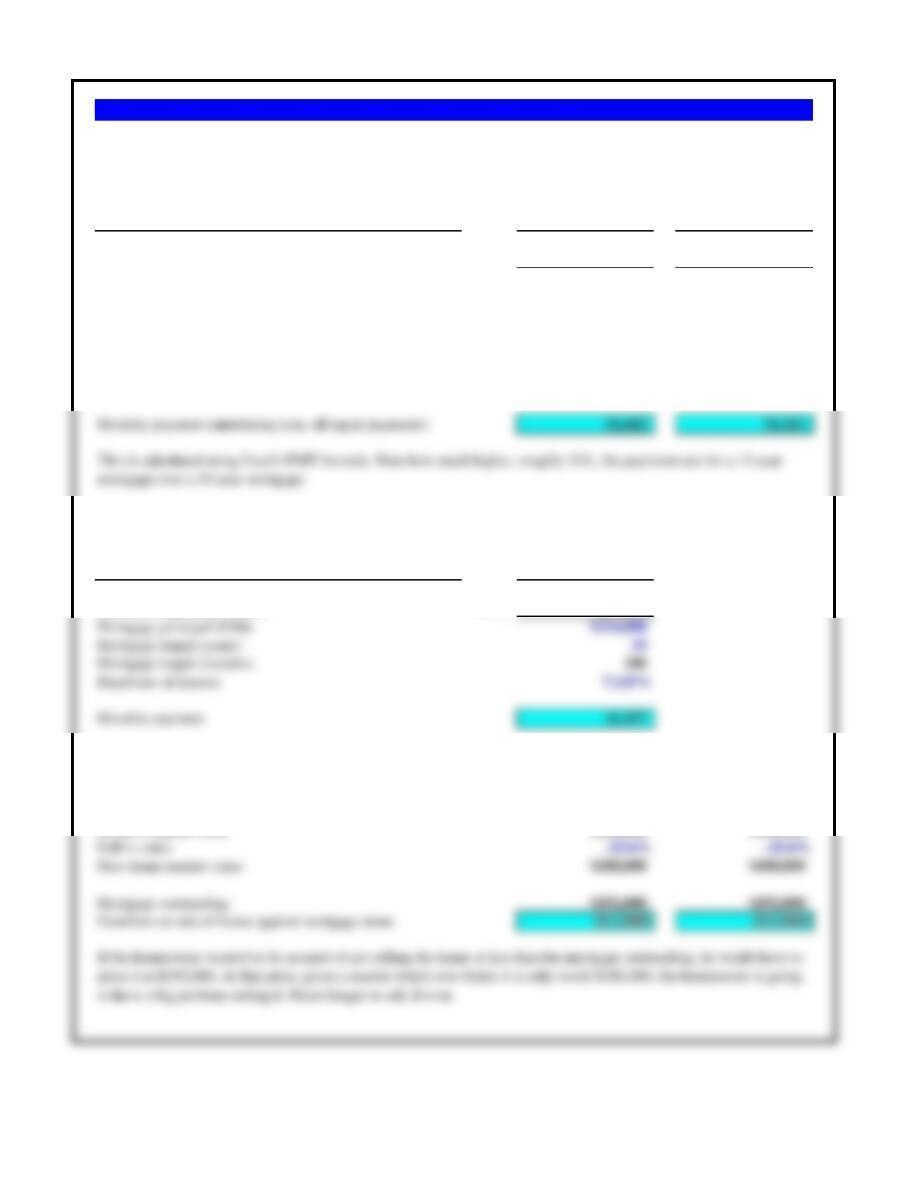
Assumptions 15-Year Mortgage 30-Year Mortgage
Price of house at purchase $240,000 $240,000
Less down-payment (20%) ($48,000) ($48,000)
Mortgage principal (US$)
$192,000 $192,000
Mortgage length (years)
15 30
Mortgage length (months)
180 360
Fixed rate of interest
6.400% 6.875%
Assumptions 15-Year Mortgage
Price of house at purchase $240,000
Less down-payment (10%) 10% ($24,000)
15
180
Home’s original value
$240,000 $240,000
$192,000 $192,000
Problem 8.3 Underwater Mortgages
Bernie Madeoff pays $240,000 for a new four bedroom 2400 square foot home outside of Tonopah, Nevada. He plans
to make a 20% downpayment, but is having trouble deciding whether he wants a 15-year fixed rate mortgage (6.400%)
or a 30-year fixed rate (6.875%).
a. What is the monthly payment, assuming a fully amortizing loan of equal payments for the life of the
mortgage?
b. Assume that instead of making a 20% downpayment, he makes a 10% downpayment, and finances the
remainder at 7.125% fixed interest for 15 years. What is his monthly payment?
c. Assume that the home’s total value falls by 25%. If the homeowner was able to now sell the house, but at the
new home value, what would be his gain or loss on the home and mortgage assuming all of the mortgage
principal remains? Use the same assumptions as under part a.
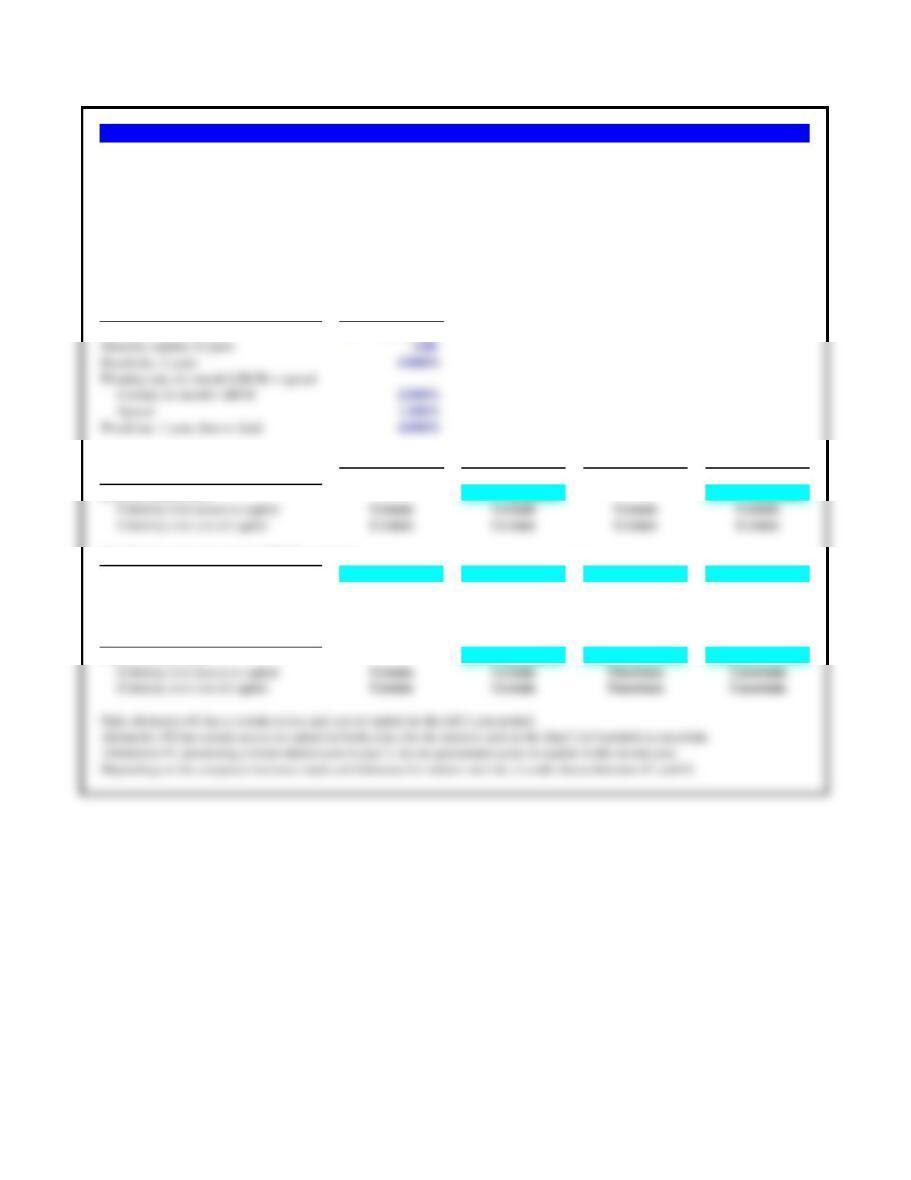
Assumptions Values
Principal borrowing need
30,000,000$
First 6-months Second 6-months Third 6-months Fourth 6-months
#1: Fixed rate, 2 years
Interest cost per year
1,500,000$ 1,500,000$
Certain Certain Certain Certain
Certain Certain Certain Certain
#2: Floating rate, six-month LIBOR + spread
Interest cost per year
750,000$ 750,000$ 750,000$ 750,000$
Certainty over access to capital
Certain Certain Certain Certain
Certainty over cost of capital
Certain Uncertain Uncertain Uncertain
#3: Fixed rate, 1 year, then re-fund
Interest cost per year
1,350,000$ ??? ???
#3. Botany Bay could borrow the US$30,000,000 for one year only at 4.5%. At the end of the first year Botany Bay would have to
negotiate for a new one-year loan.
Problem 8.4 Botany Bay Corporation
Botany Bay Corporation of Australia seeks to borrow US$30,000,000 in the Eurodollar market. Funding is needed for two years.
Investigation leads to three possibilities. Compare the alternatives and make a recommendation.
#1. Botany Bay could borrow the US$30,000,000 for two years at a fixed 5% rate of interest
#2. Botany Bay could borrow the US$30,000,000 at LIBOR + 1.5%. LIBOR is currently 3.5%, and the rate would be reset every six
months
Assumptions Values
Interest rate futures, closing price
93.07
Problem 8.5 Chrysler LLC
Chrysler LLC, the now privately held company sold-off by DaimlerChrysler, must pay floating rate interest
three months from now. It wants to lock in these interest payments by buying an interest rate futures
contract. Interest rate futures for three months from now settled at 93.07, for a yield of 6.93% per annum.
a. If the floating interest rate three months from now is 6.00%, what did Chrysler gain or lose?
b. If the floating interest rate is 8.00% three months from now, what did Chrysler gain or lose?
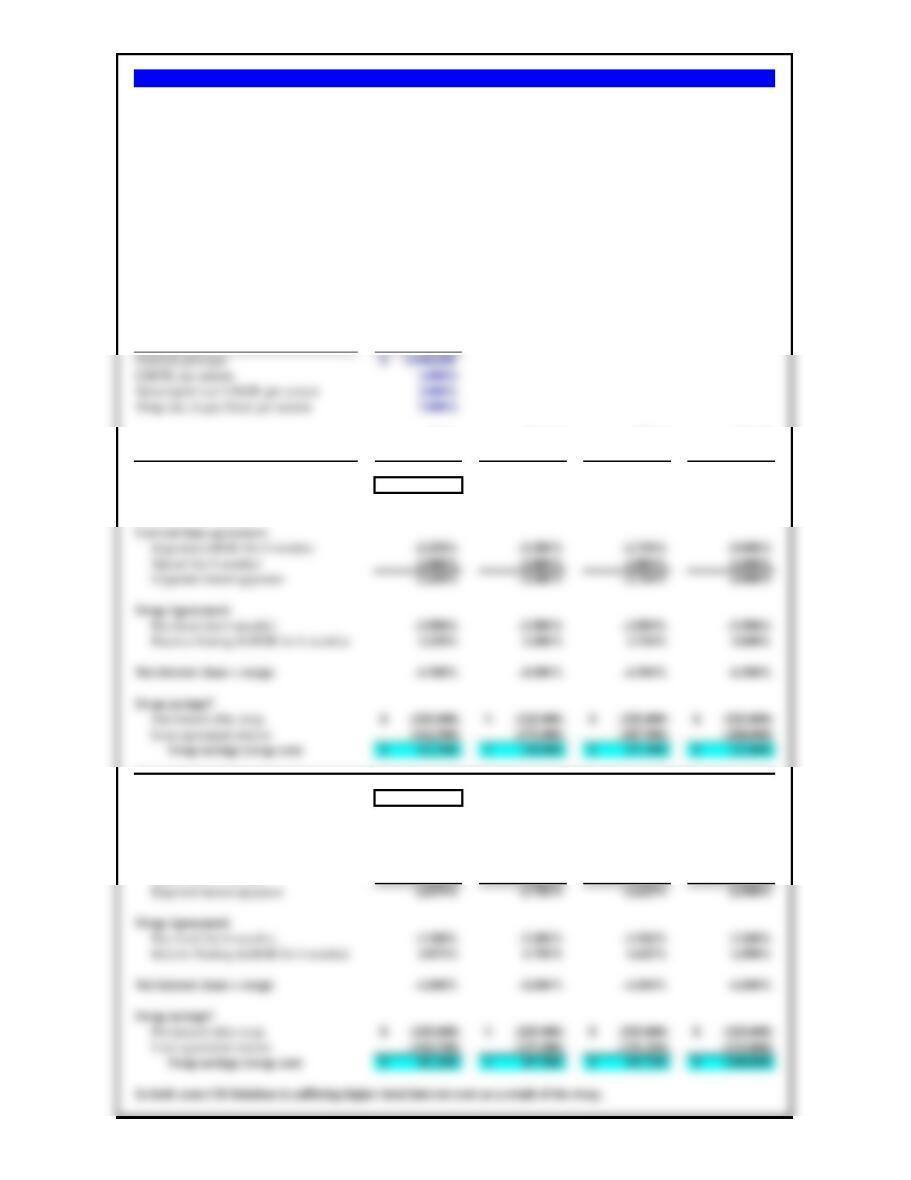
Assumptions Values
First Second Third Fourth
Interest & Swap Payments 6-months 6-months 6-months 6-months
a. LIBOR increases 50 basis pts/6 months 0.500%
Expected LIBOR
4.500% 5.000% 5.500% 6.000%
Current loan agreement:
-2.250% -2.500% -2.750% -3.000%
-1.000% -1.000% -1.000% -1.000%
-3.250% -3.500% -3.750% -4.000%
Swap Agreement:
-3.500% -3.500% -3.500% -3.500%
2.250% 2.500% 2.750% 3.000%
Net interest (loan + swap) -4.500% -4.500% -4.500% -4.500%
Swap savings?
b. LIBOR decreases 25 basis pts/6 months -0.250%
Expected LIBOR
3.750% 3.500% 3.250% 3.000%
Current loan agreement:
Expected LIBOR (for 6 months)
-1.875% -1.750% -1.625% -1.500%
Spread (for 6 months)
-1.000% -1.000% -1.000% -1.000%
-2.875% -2.750% -2.625% -2.500%
Swap Agreement:
-3.500% -3.500% -3.500% -3.500%
1.875% 1.750% 1.625% 1.500%
Net interest (loan + swap) -4.500% -4.500% -4.500% -4.500%
Swap savings?
In both cases CB Solutions is suffering higher total interest costs as a result of the swap.
a. If LIBOR rises at the rate of 50 basis points per six month period, starting tomorrow, how much does Ms. O’Reilly save or
cost her company by making this swap?
b. If LIBOR falls at the rate of 25 basis points per six month period, starting tomorrow, how much does Ms. O’Reilly save or
cost her company by making this swap?
Problem 8.6 CB Solutions
Heather O’Reilly, the treasurer of CB Solutions, believes interest rates are going to rise, so she wants to swap her future floating
rate interest payments for fixed rates. At present she is paying LIBOR + 2% per annum on $5,000,000 of debt for the next two
years, with payments due semiannually. LIBOR is currently 4.00% per annum. Ms. O’Reilly has just made an interest payment
today, so the next payment is due six months from today.
Ms. O’Reilly finds that she can swap her current floating rate payments for fixed payments of 7.00% per annum. (CB
Solution’s weighted average cost of capital is 12%, which Ms. O’Reilly calculates to be 6% per six month period, compounded
semiannually).
Loan Payments 1 2 3 4
Principal $100.00 Interest (10.00) (7.85) (5.48) (2.87)
Loan Payments 1 2 3 4
Principal $100.00 Interest (11.00) (8.66) (6.07) (3.19)
Interest rate 0.11 Principal (21.23) (23.57) (26.16) (29.04)
Maturity (years) 4.0 Total (32.23) (32.23) (32.23) (32.23)
Loan Payments 1 2 3 4
Principal $100.00 Interest (12.00) (8.66) (6.07) (3.19)
Interest rate 0.12 Principal (20.92) (23.57) (26.16) (29.04)
Maturity (years) 4.0 Total (32.92) (32.23) (32.23) (32.23)
Problem 8.7 Negotiating the Rate
A sovereign borrower is considering a $100 million loan for a four-year maturity. It will be an amortizing loan, meaning
that the interest and principal payments will total, annually, to a constant amount over the maturity of the loan. There is,
however, a debate over the appropriate interest rate. The borrower believes the appropriate rate for its creditstanding in the
market today is 10%, but a number of the international banks which it is negotiating with are arguing that it is most likely
12%, at the minimum 11%. What impact do these different interest rates have on the prospective annual payments?
The sovereign borrower believes the appropriate rate to be 10%, which would generate the following amortized (principal
and interest) payments, an annual payment of $31,550,000.
So ‘what impact’ do higher rates have? Well the obvious answer is only a marginal increase in the annual payment, given
the short maturity of the obligation. But if you are a borrower, every little bit matters. And if you are sovereign borrower
Interest rate 0.10 Principal (21.55) (23.70) (26.07) (28.68)
Maturity (years) 4.0 Total (31.55) (31.55) (31.55) (31.55)
Loan 0 Payments 1 2 3 4 5 6
Principal $220 Interest (26.950) (23.650) (19.946) (15.788) (11.120) (5.881)
a. What would the annual amortizing loan payments be for the bank consortium‘s proposal?
b. What would the annual amortizing loan payments be for Sahara’s loan preferences?
The country of Sahara is negotiating a new loan agreement with a consortium of international banks. Both sides have a tentative agreement on the
principal — $220 million. But there are still wide differences of opinion on the final interest rate and maturity. The banks would like a shorter loan,
4 years in length, while Sahara would prefer a long maturity of 6 years. The banks also believe the interest rate will need to be 12.250% per annum,
but Sahara believes that is too high, arguing for 11.750%.
c. How much would annual payments drop on the bank consortium’s proposal if the same loan was stretched out from 4 to 6 years?
Problems 8.8 Saharan Debt Negotiations
Interest rate 12.250% Principal (26.939) (30.239) (33.943) (38.101) (42.769) (48.008)
Maturity (years) 6.0 Total (53.889) (53.889) (53.889) (53.889) (53.889) (53.889)
Loan 0 Payments 1 2 3 4 5 6 7 8 9
Principal € 80.00 Interest (6.900) (5.974) (4.968) (3.876) (2.689) (1.400) – – –
a. What were Delos’s annual principal and interest payments under the original loan agreement?
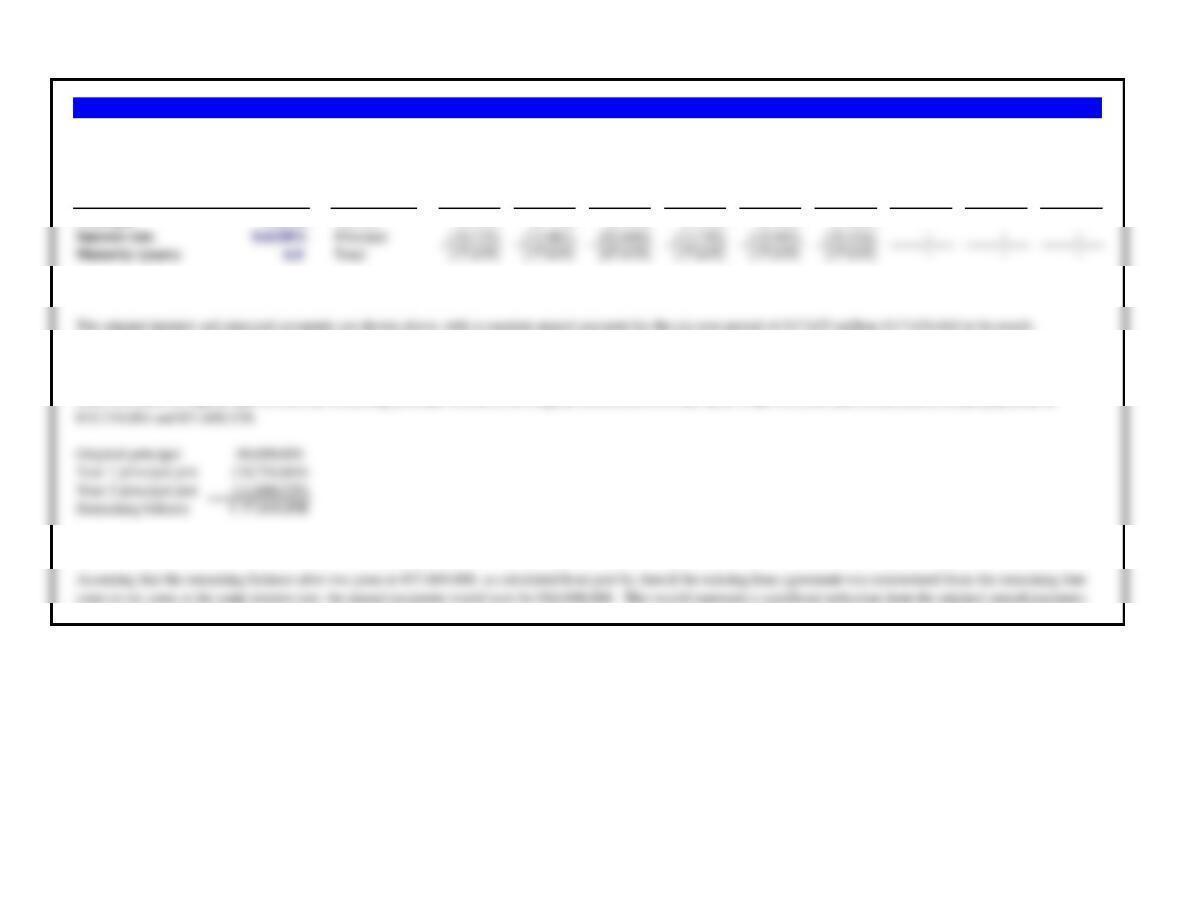
The original interest and principal payments are shown above, with a constant annual payment for the six-year period of €17.635 million (€17,634,664 to be exact).
b. After two years debt-service, how much of the principal is still outstanding?
c. If the loan was restructured to extend another two years, what would the annual payments — principal and interest — be?
Problems 8.9 Delos Debt Renegotiations (A)
Delos borrowed €80 million two years ago. The loan agreement, an amortizing loan, was for 6 years at 8.625% interest per annum. Delos has successfully completed two
years of debt-service, but now wishes to renegotiate the terms of the loan with the lender to reduce its annual payments.
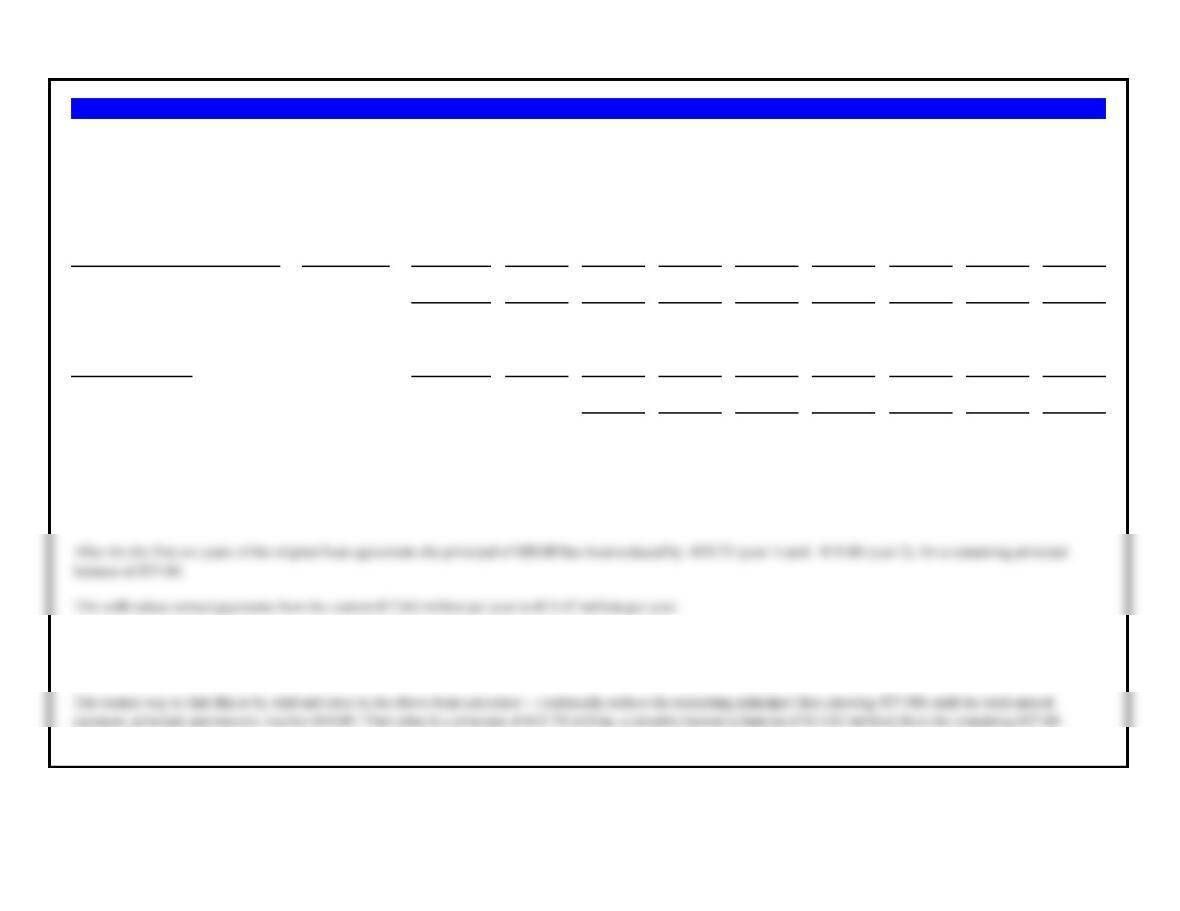
After two years of regular debt service, the remaining principal would be the original €80,000,000 less the sume of the first year and second year principal payments of
Assuming that the remaining balance after two years is €57,604,808, as calculated from part b), then if the existing loan agreement was restructured from the remaining four
Interest rate 8.6250% Principal (10.735) (11.661) (12.666) (13.759) (14.945) (16.234) – – –
Maturity (years) 6.0 Total (17.635) (17.635) (17.635) (17.635) (17.635) (17.635) – – –
Loan 0 Payments 1 2 3 4 5 6 7 8 9
Principal € 80.00 Interest (6.90) (5.97) (4.97) (3.88) (2.69) (1.40) – – –
Interest rate 8.6250% Principal (10.73) (11.66) (12.67) (13.76) (14.95) (16.23) – – –
Maturity (years) 6.0 Total (17.63) (17.63) (17.63) (17.63) (17.63) (17.63) – – –
Loan 0 Payments 1 2 3 4 5 6 7
Principal € 42.78 Interest (4.55) (3.97) (3.32) (2.61) (1.83) (0.96) –
Interest rate 10.6250% Principal (5.46) (6.04) (6.68) (7.39) (8.17) (9.04) –
Maturity (years) 6.0 Total (10.00) (10.00) (10.00) (10.00) (10.00) (10.00) –
Haircut 0.0%
Problem 8.10 Delos Debt Renegotiations (B)
Delos is continuing to renegotiate its prior loan agreement (€80 million for 6 years at 8.625% per annum), two years into the agreement. Delos is now facing serious tax
revenue shortfalls, and fears for its ability to service its debt obligations. So it has decided to get more aggressive, and has gone back to its lenders with a request for a
‘haircut’, a reduction in the the remaining loan amount. The banks have, so far, only agreed to restructure the loan agreement for another two years (new loan of 6 years on
the remaining principal balance) but at an interest rate a full 200 basis points higher, 10.625%.
a. If Delos accepts the current bank proposal of the remaining principal for 6 years (extending the loan an additional 2 years since 2 of the original 6 years have
already passed), but at the new interest rate, what are its annual payments going to be? How much relief does this provide Delos on annual debt-service?
b. Delos’s demands for a haircut are based on getting the new annual debt service payments down. If Delos does agree to the new loan terms, what size of haircut
should it try and get from its lenders to get its payments down to €10 million per year?
Expected Chg
Assumptions Values in LIBOR
Principal borrowing need € 20,000,000
Maturity needed, in years 4.00
Banque de Paris Loan Proposal Year 0 Year 1 Year 2 Year 3 Year 4
Expected interest rates & payments:
Expected euro-LIBOR 4.000% 4.500% 5.000% 5.500% 6.000%
Bank spread 2.000% 2.000% 2.000% 2.000% 2.000%
Interest rate 6.000% 6.500% 7.000% 7.500% 8.000%
Funds raised, net of fees € 19,640,000
Expected interest costs -€ 1,300,000 -€ 1,400,000 -€ 1,500,000 -€ 1,600,000
Repayment of principal -€ 20,000,000
Total cash flows € 19,640,000 -€ 1,300,000 -€ 1,400,000 -€ 1,500,000 -€ 21,600,000
All-in-cost of funds if:
euro-LIBOR rises 0.500% per year 7.7438%
euro-LIBOR rises 0.250% per year 7.1365% Found by plugging in .250% in expectations above.
Banque de Sorbonne Loan Proposal Year 0 Year 1 Year 2 Year 3 Year 4
Expected interest rates & payments:
Expected euro-LIBOR 4.000% 4.250% 4.500% 4.750% 5.000%
Bank spread 2.500% 2.500% 2.500% 2.500% 2.500%
Interest rate 6.500% 6.750% 7.000% 7.250% 7.500%
Funds raised, net of fees € 20,000,000
Expected interest costs -€ 1,350,000 -€ 1,400,000 -€ 1,450,000 -€ 1,500,000
Repayment of principal -€ 20,000,000
Total cash flows € 20,000,000 -€ 1,350,000 -€ 1,400,000 -€ 1,450,000 -€ 21,500,000
All-in-cost of funds if:
euro-LIBOR rises 0.500% per year 7.0370% Found by plugging in .500% in expectations above.
euro-LIBOR rises 0.250% per year 7.1036%
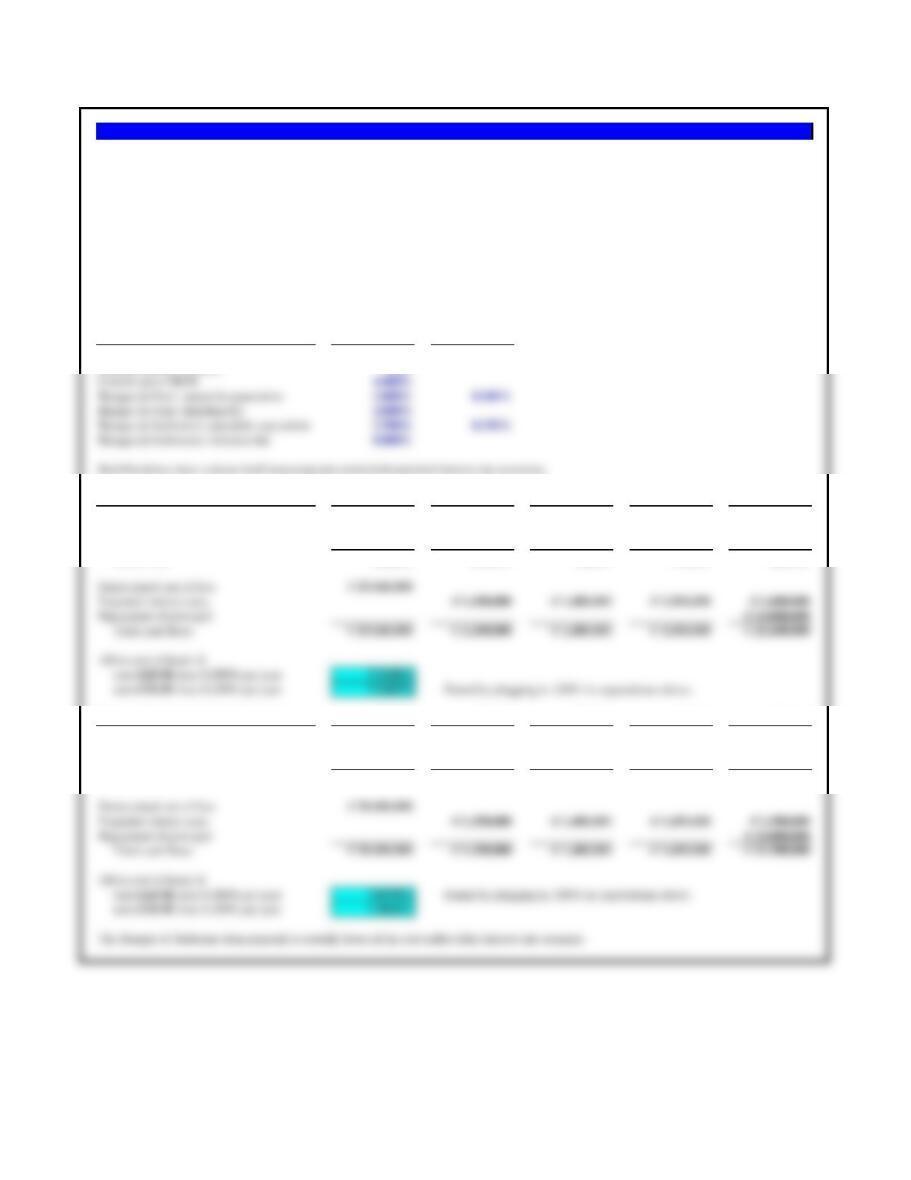
The Banque de Sorbonne loan proposal is actually lower all-in-cost under either interest rate scenario.
Euro-LIBOR is currently 4.00%. Raid’s economist forecasts that LIBOR will rise by 0.5 percentage points each year. Banque de Sorbonne,
however, officially forecasts euro-LIBOR to begin trending upward at the rate of 0.25 percentage points per year. Raid Gauloises’s cost of capital is
11%. Which loan proposal do you recommend for Raid Gauloises?
Raid Gauloises is a rapidly growing French sporting goods and adventure racing outfitter. The company has decided to borrow €20,000,000 via a
euro-euro floating rate loan for four years. Raid must decide between two competing loan offerings from two of its banks.
Problem 8.11 Raid Gauloises
Banque de Paris has offered the four-year debt at euro-LIBOR + 2.00% with an up-front initiation fee of 1.8%. Banque de Sorbonne, however,
has offered euro-LIBOR + 2.5%, a higher spread, but with no loan initiation fees up-front, for the same term and principal. Both banks reset the
interest rate at the end of each year.
Current euro-LIBOR 4.000%
Banque de Paris’ spread & expectation 2.000% 0.500%
Banque de Paris’ initiation fee 1.800%
Banque de Sorbonne’s spread & expectation 2.500% 0.250%
Banque de Sorbonne’s initiation fee 0.000%
Raid Gauloises must evaluate both loan proposals under both potential interest rate scenarios.
Assumptions Values
Principal borrowing need € 5,000,000
If LIBOR Falls 50 Basis Pts Per Year Year 0 Year 1 Year 2 Year 3 Year 4
Expected annual change in LIBOR -0.500%
LIBOR 4.000% 3.500% 3.000% 2.500% 2.000%
Bank spread 2.500% 2.500% 2.500% 2.500% 2.500%
Interest rate 6.500% 6.000% 5.500% 5.000% 4.500%
Funds raised, net of fees € 5,000,000
Repayment of principal -€ 5,000,000
Total cash flows € 4,900,000 -€ 325,000 -€ 325,000 -€ 325,000 -€ 5,325,000
All-in-cost of funds (IRR) 7.092%
If LIBOR Rises 50 Basis Pts Per Year Year 0 Year 1 Year 2 Year 3 Year 4
Expected annual change in LIBOR 0.500%
LIBOR 4.000% 4.500% 5.000% 5.500% 6.000%
Bank spread 2.500% 2.500% 2.500% 2.500% 2.500%
Interest rate 6.500% 7.000% 7.500% 8.000% 8.500%
Funds raised, net of fees € 5,000,000
Expected interest (interest rate x principal) -€ 350,000 -€ 375,000 -€ 400,000 -€ 425,000
Repayment of principal -€ 5,000,000
Total cash flows € 4,900,000 -€ 332,500 -€ 340,000 -€ 347,500 -€ 5,355,000
All-in-cost of funds (IRR) 7.458%
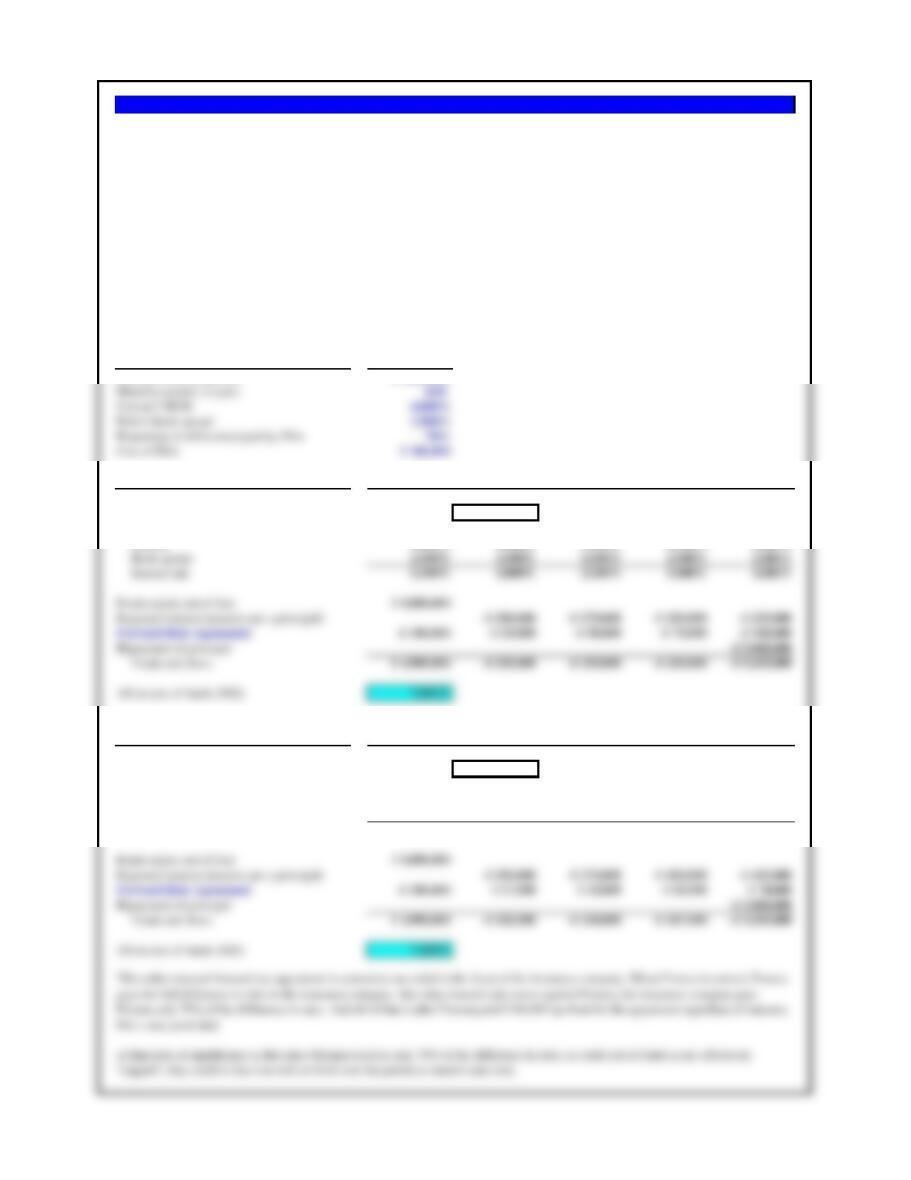
A final note of significance is that since Firenza receives only 70% of the difference in rates, its total cost of funds is not effectively
“capped”; they could in fact rise with no limit over the period as interest rates rose.
Purchase of the floating Rate Agreement will cost €100,000, paid at the time of the initial loan. What are Firenza’s annual financing
costs now if LIBOR rises and if LIBOR falls.? Firenza uses 12% as its weighted average cost of capital. Do you recommend that Firenza
purchase the FRA?
Problem 8.12 Firenza Motors
Firenza Motors of Italy recently took out a 4-year €5 million loan on a floating rate basis. It is now worried, however, about rising interest
costs. Although it had initially believed interest rates in the Euro-zone would be trending downward when taking out the loan, recent
economic indicators show growing inflationary pressures. Analysts are predicting that the European Central Bank will slow monetary
growth driving interest rates up.
Firenza is now considering whether to seek some protection against a rise in euro-LIBOR, and is considering a Forward Rate Agreement
(FRA) with an insurance company. According to the agreement, Firenza would pay to the insurance company at the end of each year the
difference between its initial interest cost at LIBOR + 2.50% (6.50%) and any fall in interest cost due to a fall in LIBOR. Conversely, the
insurance company would pay to Firenza 70% of the difference between Firenza’s initial interest cost and any increase in interest costs
caused by a rise in LIBOR.
Maturity needed, in years 4.00
Current LIBOR 4.000%
Felini’s bank spread 2.500%
Proportion of differential paid by FRA 70%
Cost of FRA € 100,000
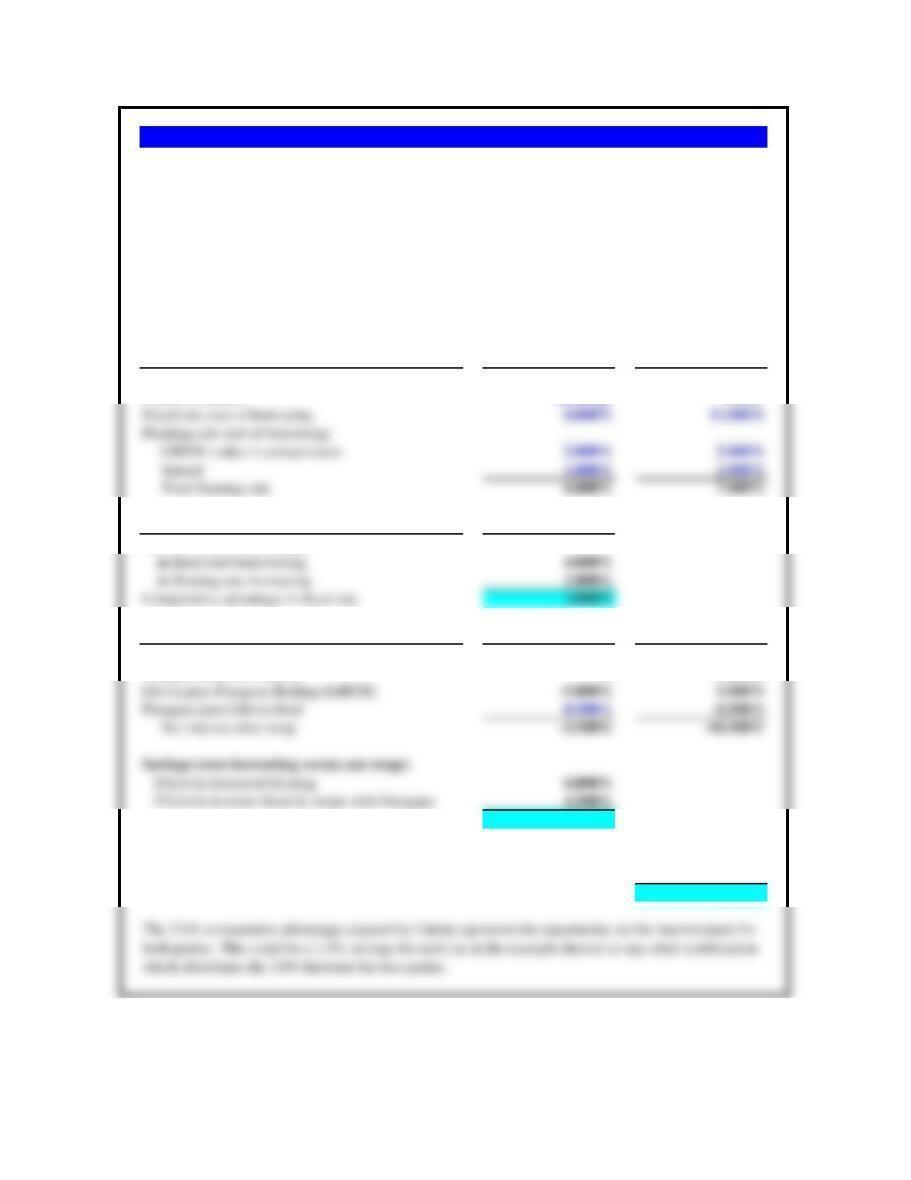
Assumptions Xavier Zulu
Credit rating
AAA BBB
Prefers to borrow
Floating Fixed
Comparative Advantage in Borrowing Values
4.000%
1.000%
3.000%
Lluvia’s absolute advantage:
One Possibility Xavier Zulu
Lluvia borrows fixed
-8.000% —
Paraguas borrows floating
— -7.000%
Savings (own borrowing versus net swap):
6.000%
4.500%
1.500%
If Paraguas borrowes fixed
12.000%
If Paraguas borrows floating & swaps with Lluvia
10.500%
1.500%
Problem 8.13 Lluvia and Paraguas
The 3.0% comparative advantage enjoyed by Lluvia represents the opportunity set for improvement for
both parties. This could be a 1.5% savings for each (as in the example shown) or any other combination
which distributes the 3.0% between the two parties.
Lluvia Manufacturing and Paraguas Products both seek funding at the lowest possible cost. Lluvia
would prefer the flexibility of floating rate borrowing, while Paraguas wants the security of fixed rate
borrowing. Lluvia is the more credit-worthy company. They face the following rate structure. Lluvia,
with the better credit rating, has lower borrowing costs in both types of borrowing.
Lluvia wants floating rate debt, so it could borrow at LIBOR+1%. However it could borrow fixed at
8% and swap for floating rate debt. Paraguas wants fixed rate, so it could borrow fixed at 12%. However
it could borrow floating at LIBOR+2% and swap for fixed rate debt. What should they do?
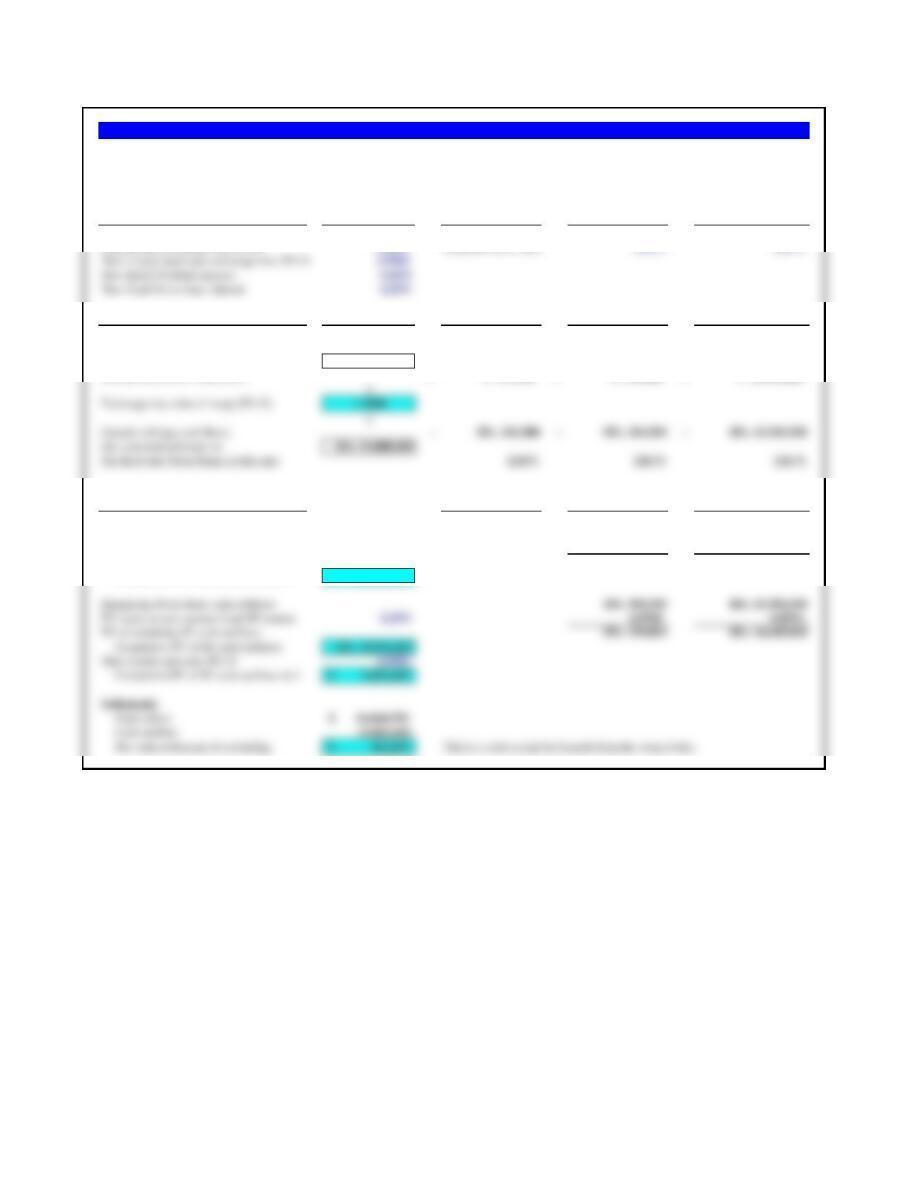
Assumptions Values Swap Rates 3- year bid 3-year ask
Notional principal 10,000,000$ Original: US dollar 5.56% 5.59%
Original spot exchange rate, SFr./$ 1.5000 Original: Swiss franc 1.93% 2.01%
a. Interest & Swap Payments Year 0 Year 1 Year 2 Year 3
Receive fixed rate dollars at this rate: 5.56% 5.56% 5.56%
On a notional principal of: 10,000,000$
Trident will receive cash flows: →556,000$ →556,000$ →10,556,000$
Ganado will pay cash flows: →SFr. 301,500 →SFr. 301,500 →SFr. 15,301,500
On a notional principal of: SFr. 15,000,000
Pay fixed rate Swiss francs at this rate: 2.01% 2.01% 2.01%
b. Unwinding the swap after one-year Year 1 Year 2 Year 3
Remaining dollar cash inflows 556,000$ 10,556,000$
PV factor at now current fixed $ interest 5.20% 0.9506 0.9036
PV of remaining dollar cash inflows 528,517$ 9,538,232$
Cumulative PV of dollar cash infllows 10,066,750$
Remaining Swiss franc cash outflows SFr. 301,500 SFr. 15,301,500
PV of remaining SF cash outflows SFr. 295,010 SFr. 14,649,818
Cumulative PV of SF cash outflows SFr. 14,944,827
New current spot rate, SFr./$ 1.5560
Cumulative PF of SF cash outflows in $ 9,604,645$
Cash inflow 10,066,750$
Cash outflow (9,604,645)
Net cash settlement of unwinding 462,105$ This is a cash receipt by Ganado from the swap dealer.
Problem 8.14 Ganado’s Cross Currency Swap: SFr for US$
Ganado Corporation entered into a three-year cross currency interest rate swap to receive U.S. dollars and pay Swiss francs. Ganado, however, decided
to unwind the swap after one year – thereby having two years left on the settlement costs of unwinding the swap after one year. Repeat the calculations
for unwinding, but assume that the following rates now apply:
New (1-year later) spot exchange rate, SFr./$ 1.5560
New fixed US dollar interest 5.20%
New fixed Swiss franc interest 2.20%
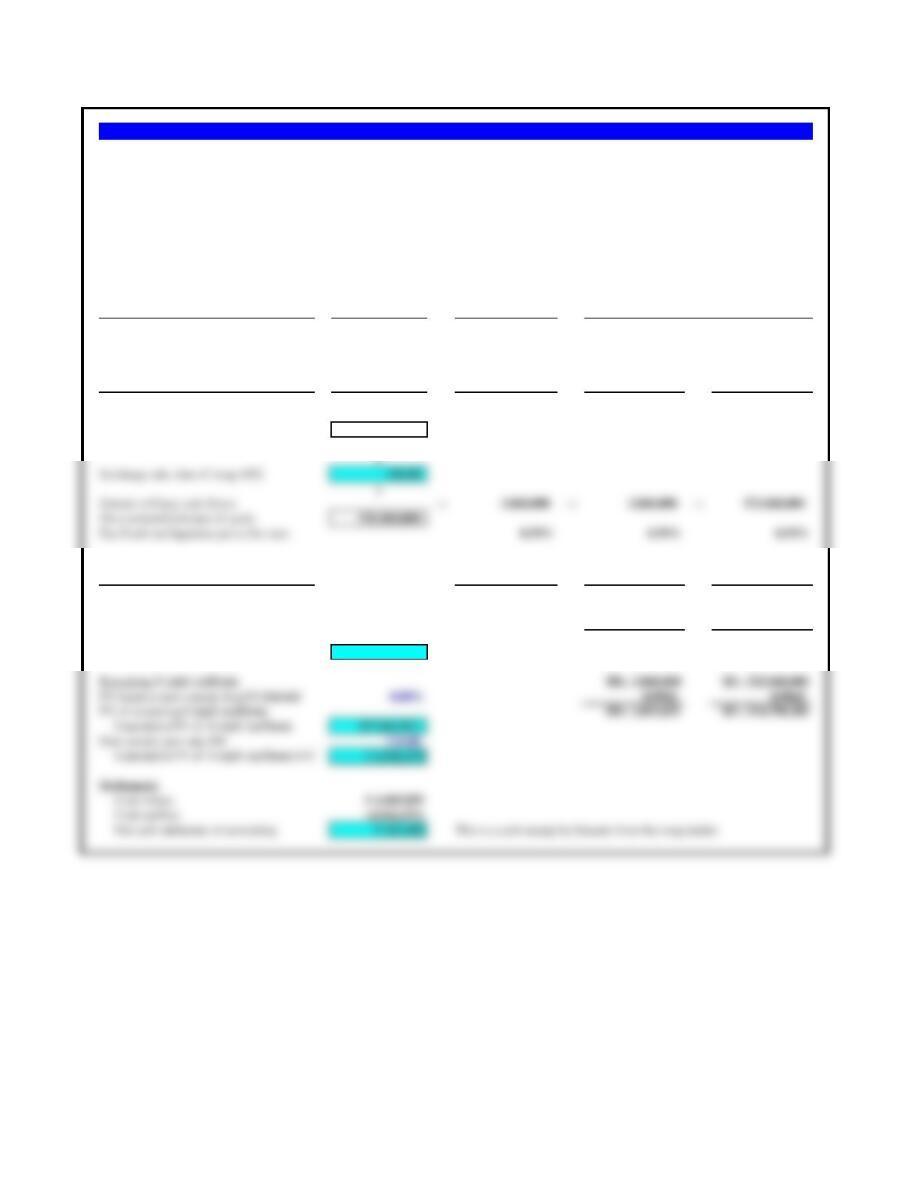
a. Calculate all principal and interest payments, in both euros and Swiss francs, for the life of the swap agreement.
Assumptions Values Swap Rates 3- year bid 3-year ask
Notional principal € 5,000,000 Euros — €3.24% 3.28%
Spot exchange rate, Yen/euro 104.00 Japanese yen 0.56% 0.59%
a) Interest & Swap Payments Year 0 Year 1 Year 2 Year 3
Receive fixed rate euros at this rate: 3.24% 3.24% 3.24%
On a notional principal of: € 5,000,000
Trident will receive cash flows: → € 162,000 → € 162,000 → € 5,162,000
b) Unwinding the swap after one-year Year 1 Year 2 Year 3
Remaining euro cash inflows € 162,000 € 5,162,000
PV factor at now current fixed € interest 3.60% 0.9653 0.9317
PV of remaining € cash inflows € 156,371 € 4,809,484
Cumulative PV of € cash infllows € 4,965,855
Remaining ¥ cash outflows SFr. 3,068,000 SFr. 523,068,000
PV factor at now current fixed ¥ interest 0.80% 0.9921 0.9842
PV of remaining ¥ cash outflows SFr. 3,043,651 SFr. 514,798,280
Cumulative PV of ¥ cash outflows 517,841,931
New current spot rate, ¥/€114.00
Cumulative PV of ¥ cash outflows in €€ 4,542,473
Cash inflow € 4,965,855
Cash outflow (4,542,473)
Net cash settlement of unwinding € 423,382 This is a cash receipt by Ganado from the swap dealer.
Problem 8.15 Ganado‘s Cross Currency Swap: Yen for Euros
Using the table of swap rates in the chapter (Exhibit 8.13), and assume Ganado enters into a swap agreement to receive euros and pay Japanese
yen, on a notional principal of €5,000,000. The spot exchange rate at the time of the swap is ¥104/€.
b. Assume that one year into the swap agreement Ganado decides it wishes to unwind the swap agreement and settle it in euros. Assuming that a
two-year fixed rate of interest on the Japanese yen is now 0.80%, and a two-year fixed rate of interest on the euro is now 3.60%, and the spot rate
of exchange is now ¥114/€, what is the net present value of the swap agreement? Who pays whom what?
Exchange rate, time of swap (¥/€)104.00
Ganado will pay cash flows: →3,068,000 →3,068,000 →523,068,000
On a notional principal of (yen): 520,000,000
Pay fixed rate Japanese yen at this rate: 0.59% 0.59% 0.59%
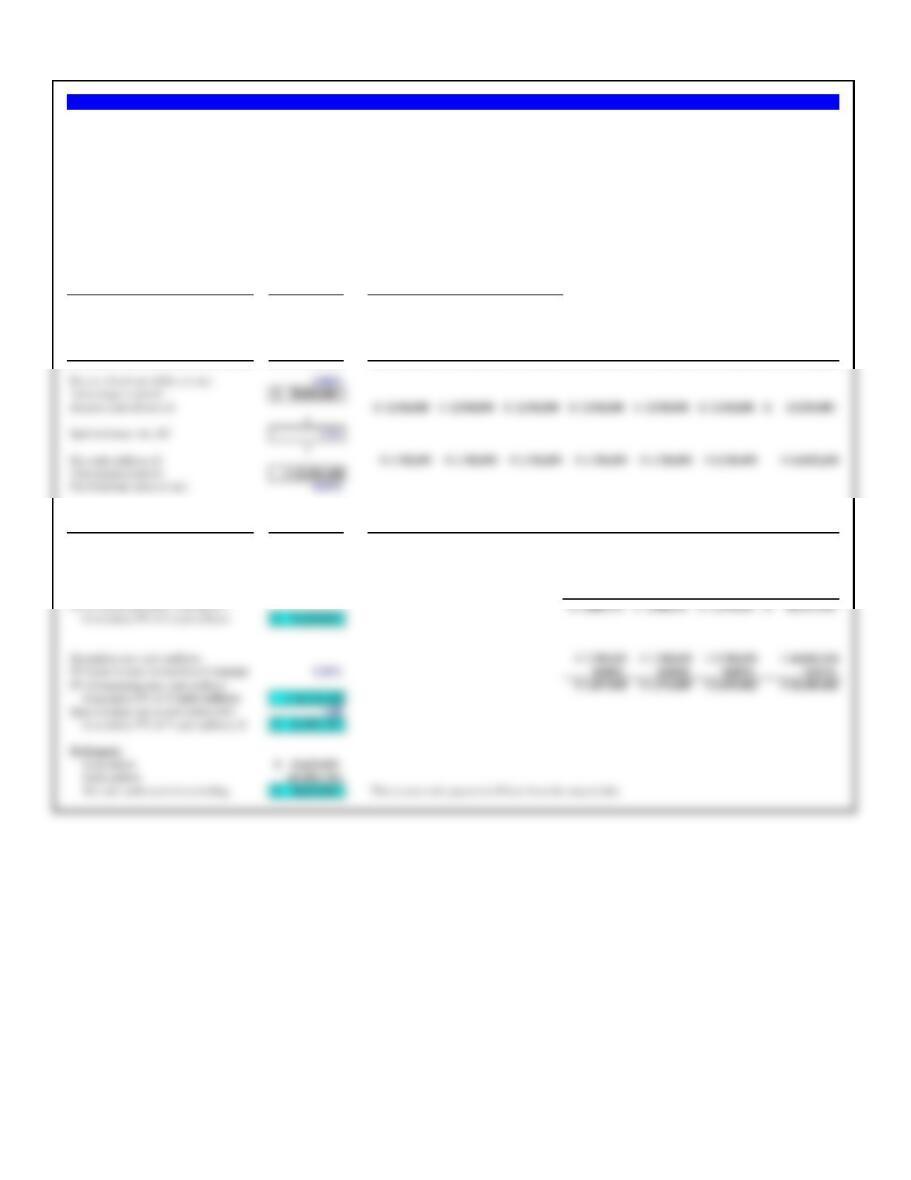
Assumptions Values Swap Rates 7- year bid 7-year ask
Notional principal 50,000,000$ US dollar 5.86% 5.89%
Spot exchange rate, $/€1.16 Euros 4.01% 4.05%
a. Interest & Swap Payments Year 0 Year 1 Year 2 Year 3 Year 4 Year 5 Year 6 Year 7
b. Unwindingthe Swap Year 0 Year 1 Year 2 Year 3 Year 4 Year 5 Year 6 Year 7
If the swap is unwound three years later, there are four years of cash flows remaining:
Remaining dollar cash inflows 2,930,000$ 2,930,000$ 2,930,000$ 52,930,000$
PV factor at now current fixed $ interest 4.40% 0.9579 0.9175 0.8788 0.8418
PV of remaining dollar cash inflows 2,806,513$ 2,688,231$ 2,574,934$ 44,555,354$
Remaining euro cash outflows € 1,745,690 € 1,745,690 € 1,745,690 € 44,849,138
PV factor at now current fixed € interest 5.35% 0.9492 0.9010 0.8553 0.8118
PV of remaining euro cash outflows € 1,657,038 € 1,572,889 € 1,493,012 € 36,409,603
Spot exchange rate at unwinding ($/€)1.02
Cash inflow 52,625,033$
Cash outflow (41,955,193)
Net cash settlement of unwinding 10,669,840$ This is a net cash payment to Falcor from the swap dealer.
Problem 8.16 Falcor
Falcor is the U.S.-based automotive parts supplier which was spun-off from General Motors in 2000. With annual sales of over $26 billion, the company has expanded its markets
far beyond the traditional automobile manufacturers in the pursuit of a more diversified sales base. As part of the general diversification effort, the company wishes to diversify
the currency of denomination of its debt portfolio as well. Assume Falcor enters into a $50 million 7-year cross currency interest rate swap to do just that – pay euro and receive
dollars. Using the data in Exhibit 8.12, solve the following:
a. Calculate all principal and interest payments in both currencies for the life of the swap.
b. Assume that three years later Falcor decides to unwind the swap agreement. If 4-year fixed rates of interest in euros have now risen to 5.35% and 4-year fixed rate dollars have
fallen to 4.40%, and the current spot exchange rate of $1.02/€, what is the net present value of the swap agreement? Explain the payment obligations of the two parties precisely.
Receive fixed rate dollars at rate: 5.86%
Notional principal of: 50,000,000$
Receive cash inflows of: 2,930,000$ 2,930,000$ 2,930,000$ 2,930,000$ 2,930,000$ 2,930,000$ 52,930,000$
Spot exchange rate, $/€1.16
Pay cash outflows of: € 1,745,690 € 1,745,690 € 1,745,690 € 1,745,690 € 1,745,690 € 1,745,690 € 44,849,138
Notional principal of: € 43,103,448
Pay fixed rate euros at rate: 4.05%