Chapter 8
Purchasing Power Parity and Real
Exchange Rates
QUESTIONS
1. What does the purchasing power of a money mean? How can it be measured?
2. Suppose the government releases information that causes people to expect that the
purchasing power of a money in the future will be less than they previously had expected.
What will happen to the exchange rate today? Why?
3. What is the difference between a price level and a price index?
4. What do economists mean by the law of one price? Why might the law of one price be
violated?
Chapter 8: Purchasing Power Parity and Real Exchange Rates
2
Answer: The law of one price says that the price of a good, when denominated in a particular
currency, is the same wherever in the world the good is being sold. The law of one price relies
on arbitrage in the goods market. If the good is being sold in one place at a low price and is
being sold in a different place at a high price, people have an incentive to arbitrage the two
5. What is the value of the exchange rate that satisfies absolute PPP?
Answer: Absolute purchasing power parity requires that the internal purchasing power of a
currency equals its external purchasing power. The internal purchasing power is calculated by
( )
6. If the actual exchange rate for the euro value of the British pound is less than the
exchange rate that would satisfy absolute PPP, which of the currencies is overvalued and
which is undervalued? Why?
©2017 Cambridge University Press
7. What market forces prevent absolute purchasing power parity from holding in real
economies? Which of these represent unexploited profit opportunities?
8. Why is it better to use a PPP exchange rate to compare incomes across countries than an
actual exchange rate?
Answer: When comparing incomes across countries, one is interested in comparing the quality
of life that occurs from earning such incomes and consuming in those countries. One way to
do such a comparison is to examine the real values of the nominal incomes, that is, to multiply
©2017 Cambridge University Press
9. What is relative PPP, and why does it represent a weaker relationship between exchange
rates and prices than absolute PPP?
10. What is the real exchange rate, and how are fluctuations in the real exchange rate related
to deviations from absolute PPP?
Chapter 8: Purchasing Power Parity and Real Exchange Rates
7
1+ 0.02 =
5. One of your colleagues at Deutsche Bank thinks that the dollar is severely undervalued
relative to the yen. He has calculated that the PPP exchange rate is ¥140/$, whereas the
current exchange rate is ¥105/$. Because interest rates are 3% p.a. lower in Japan than
in the United States, he thinks that this is a good time to speculate by borrowing yen and
lending dollars. What do you think?
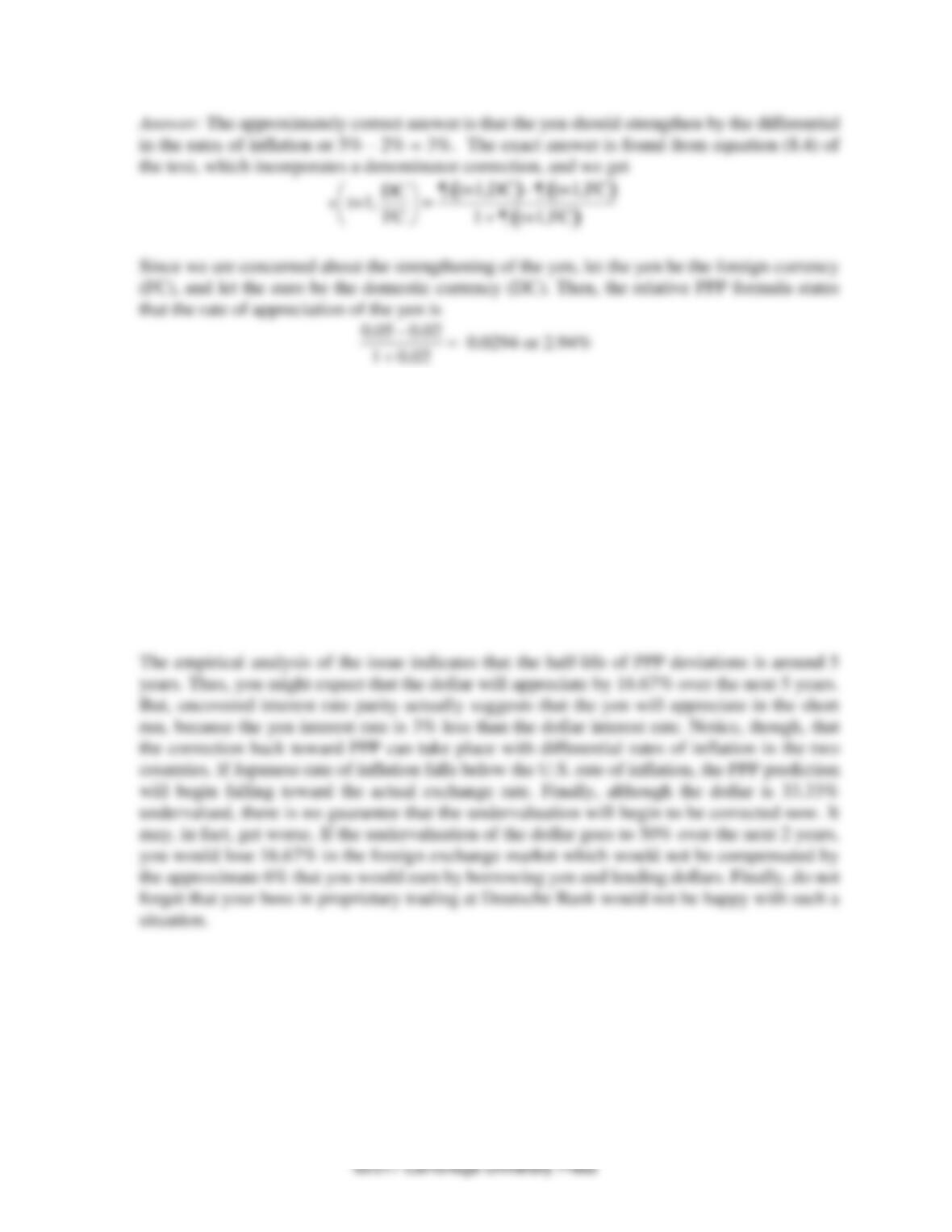
Answer: Deviations from PPP are a weak reason to engage in speculation. While the data in
the problem indicate that the dollar is 33.33% undervalued, because that is the amount of dollar
appreciation that would be required to take the actual exchange rate from ¥105/$ to the PPP
prediction of ¥140/$, we know that the return to PPP will not be an overnight event.
6. Suppose that you are trying to decide between two job offers. One consulting firm offers
you $150,000 per year to work out of its New York office. A second consulting firm wants
you to work out of its London office and offers you £100,000 per year. The current
exchange rate is $1.65/£. Which offer should you take, and why? Assume that the PPP
exchange rate is $1.40/£ and that you are indifferent between working in the two cities if
the purchasing power of your salary is the same.
Chapter 8: Purchasing Power Parity and Real Exchange Rates
8
7. Suppose that in 2017, the Japanese rate of inflation is 2%, and the German rate of inflation
is 5%. If the euro weakens relative to the yen by 10% during 2017, what would be the
magnitude of the real depreciation of the euro relative to the yen?
Answer: The real exchange rate is
/
/S(t, ) P(t, )
RS(t, ) = P(t, )
´ Û Û
´ Û
´
We also know that a real depreciation of the euro means that this real exchange rate decreases.
The new real exchange rate will be the old real exchange rate with each term multiplied by one
plus the respective percentage rate of change. Thus, one plus the percentage rate of change of
the real exchange rate is
/
/1 + s(t, ) 1 + (t, ) 1 – 0.10 1 + 0.05
1 + rs(t, ) = 0.9265
1 + (t, ) 1 + 0.02
= =
´ Û Û
´ Û
´
So, we conclude that the real depreciation of the euro is 7.35%.
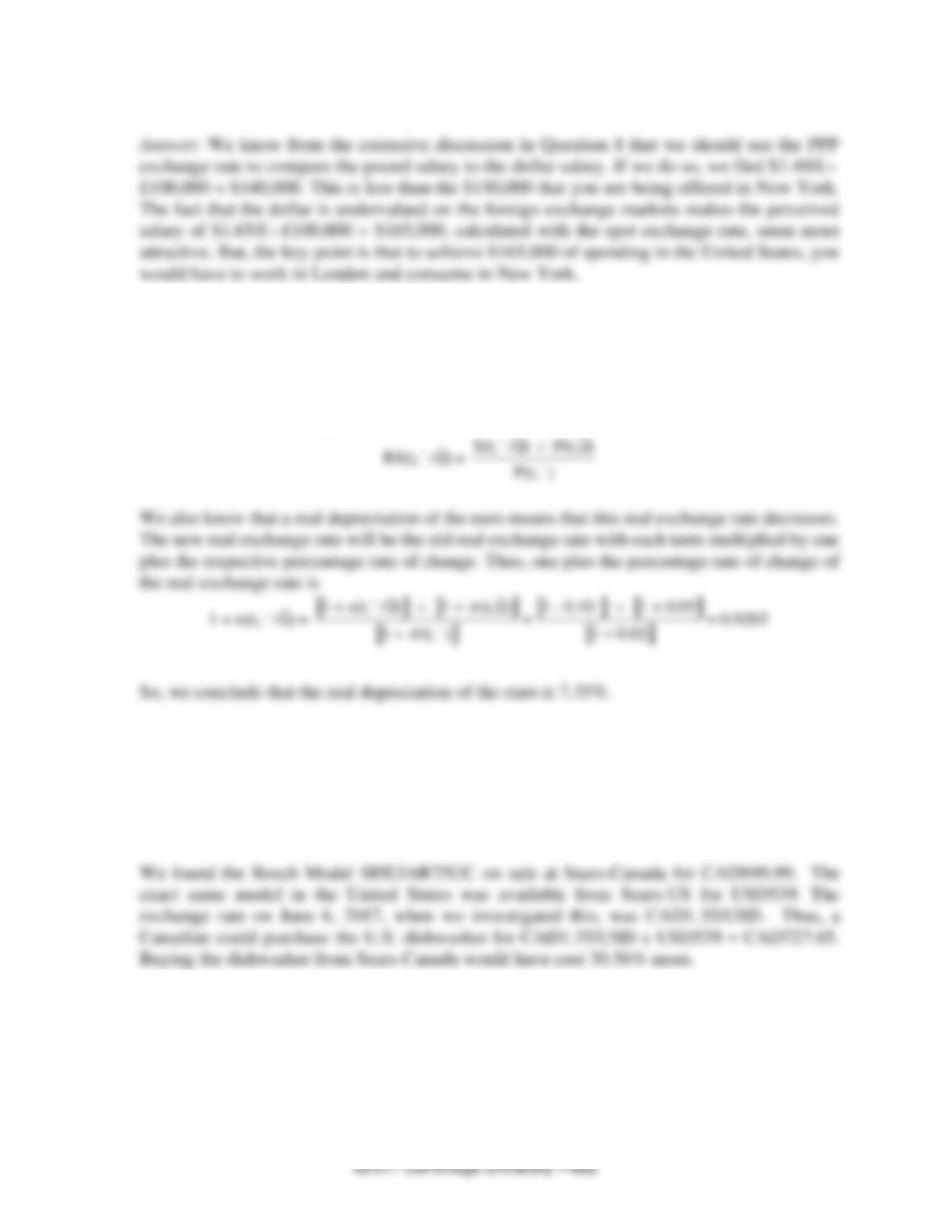
8. Pick a particular brand of appliance, like a Bosch dishwasher with certain features, and
use the internet to compare its prices across countries. Be sure to have exactly the same
style of appliance in each country. How different are the prices when expressed in a
common currency?
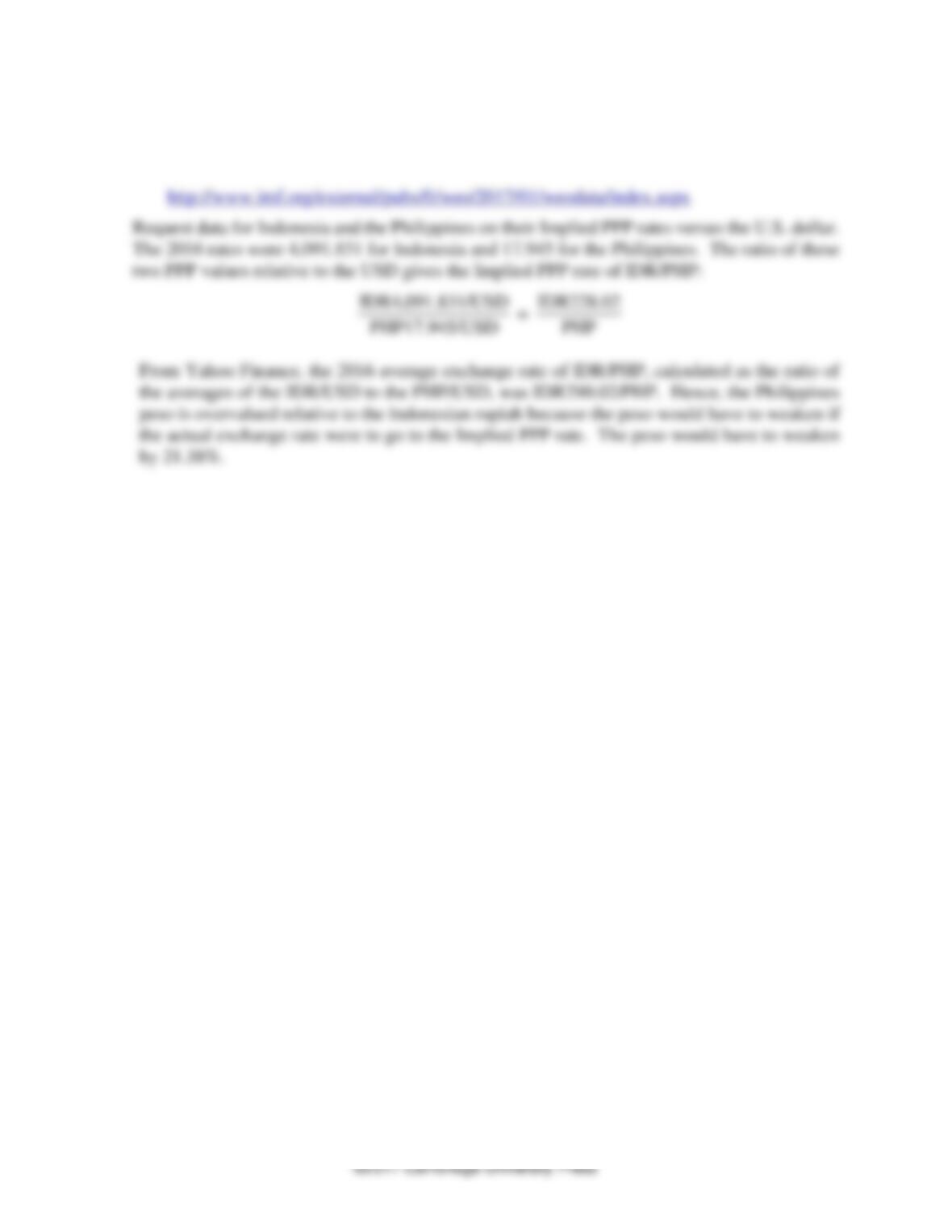
9. Go to the IMF’s web site at www.imf.org, find the Data and Statistics tab, locate World
Economic Outlook (WEO) data, and download the “Implied PPP conversion rate” for the
Indonesian rupiah and the Philippines peso versus the dollar. Calculate a rupiah per peso
PPP rate and compare it to the actual exchange rate. Which currency is overvalued, and
Chapter 8: Purchasing Power Parity and Real Exchange Rates
9
by how much?
Go to the IMF’s WEO site at