
INTERNATIONAL ECONOMICS, 7TH EDITION
Study Resources: Questions for Study & Review
Chapter 8
1. In what ways does an increase in factor mobility substitute for merchandise trade? At
the end of the nineteenth century when the world experienced more trade and more
factor mobility, explain what the effects were on the distribution of income
internationally.
2. How does a country gain from allowing an outflow of capital? Who gains and who
loses from that opportunity? How does tax policy in the host country affect your
answer?
3. Canada pursues a policy that encourages the immigration of skilled workers. What
circumstances explain the economic and political benefits from this approach?
4. Many industrialized countries have become concerned about a large inflow of illegal
immigrants. If those countries were successfully to impose a tax on the employers of
these immigrants, explain who would bear the burden of this tax, the employer or the
immigrant.
5. Under some conditions, a developing country can gain from allowing an outflow of its
educated citizens. Consider figures reported by Docquier and Marfouk for the
emigration rate of high-skilled workers from the following countries: Haiti 74%, Sierra
Leone 48%, Kenya 33%, Vietnam 15%, and Poland 11%. Explain whether any of
these countries is likely to experience a brain gain rather than a brain drain.
6. Given the model of horizontal integration presented in this chapter, how do you expect
the high transport costs and high trade barriers faced by U.S. businesses seeking to
sell in Australia to affect foreign direct investment in that country? If New Zealand
pursued the same policies as Australia, why would you expect the FDI response to be
different?
7. What kind of FDI do you expect a small island economy such as Mauritius to attract
successfully?
8. Host countries often have difficulty taxing MNCs. What strategies must they be
concerned about? What is an appropriate government response?

9. Latin American countries long preferred portfolio inflows of capital rather than FDI,
because it avoided foreign control over productive resources. Why has that attitude
changed in more recent years?
10. What advantages are gained by a home country when its MNCs claim a bigger share
of world markets? Are there groups in the home country that nevertheless would be
adversely affected? What happens to domestic employment and wages?
INTERNATIONAL ECONOMICS, 7TH EDITION
Study Resources: Questions for Study & Review
Chapter 8: Answers
1. In the 2-good H-O model with perfectly competitive markets and identical
technologies across countries, relaxing the assumption that fixed factor supplies
are immobile internationally will result in a reduction merchandise trade. Trade
2. 2. Consider the simple model with no taxation, where only one good is produced,
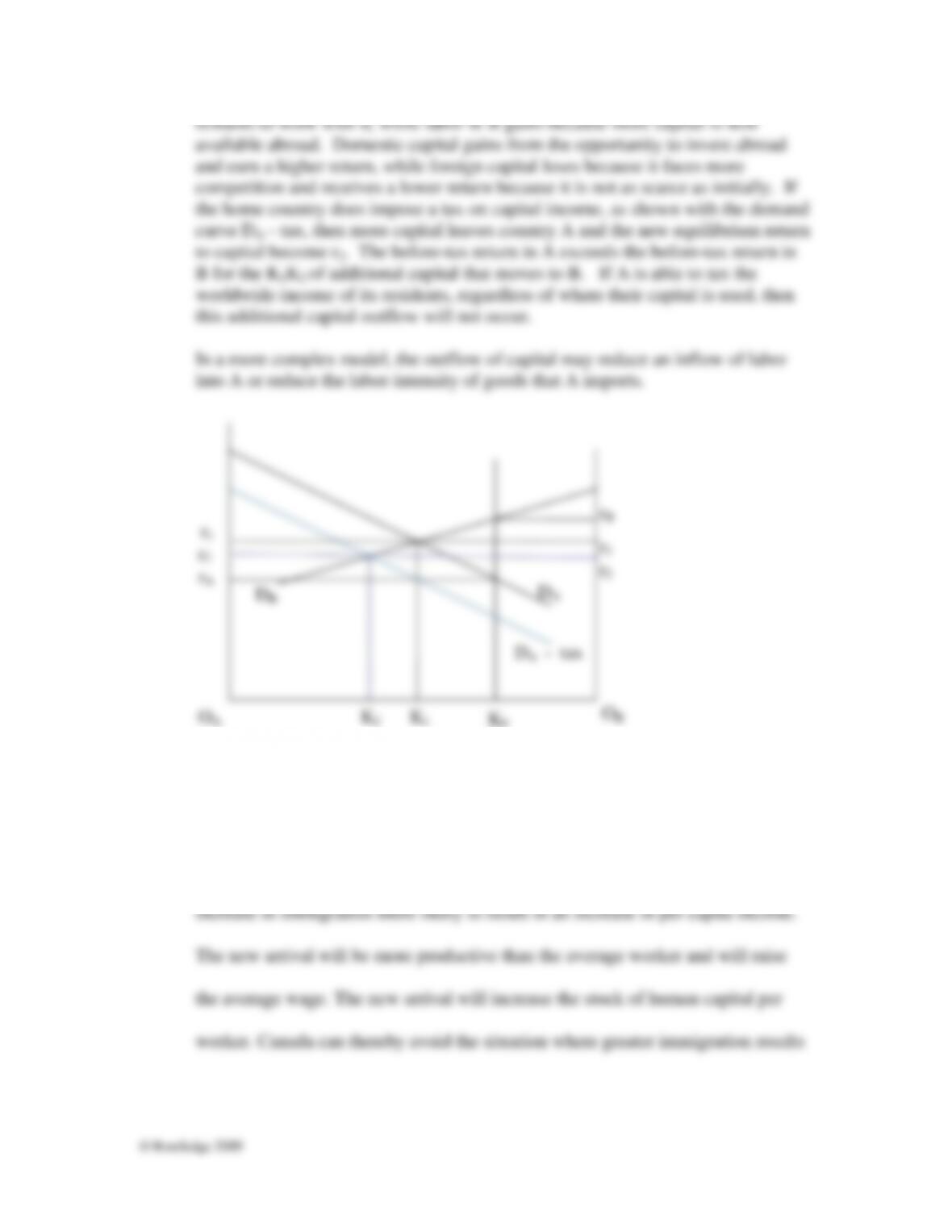
and only capital is mobile across countries. Country A gains from allowing a
capital outflow if the before-tax return domestically is less than the before-tax
return available abroad in B, as shown at the initial allocation K0. In that
situation, K1K0 of capital moves from A to B. The return to capital rises in A
3. Canada’s point system to determine which immigrants are allowed to enter the
country favors workers with more education or training. This strategy makes an
DA – tax
r1
DA
r2
r2
r1
DB
OA OB
K2
rA
rB
K1K0
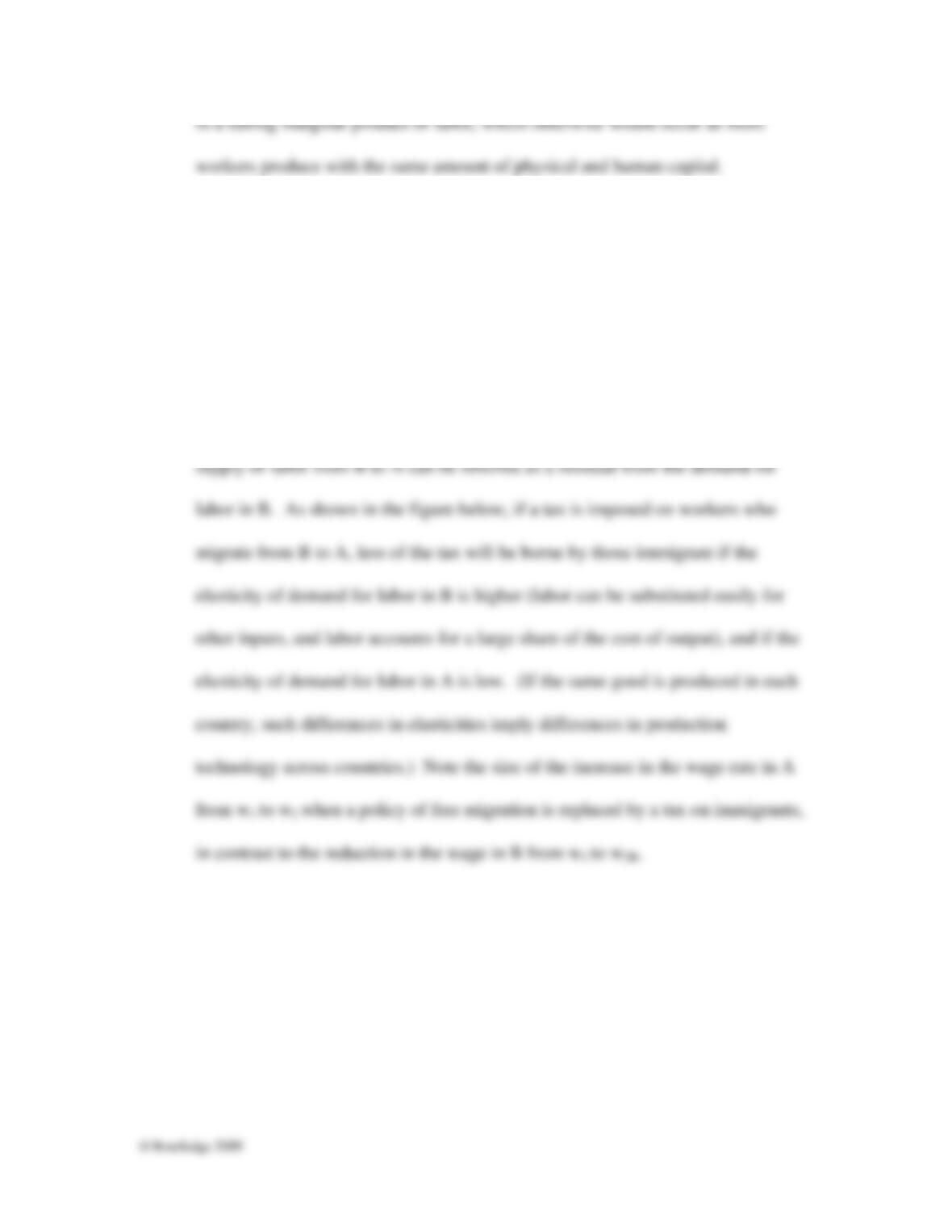
4. Consider the simple model with no taxation initially, where only one good is
produced, and only labor is mobile across countries. Who bears the burden of the
tax on employers of immigrant labor in A depends upon the elasticity of demand
for labor in A and the elasticity of supply of emigrant labor from B. In a world
where individuals have no preference over the country where they work, the
w2
DB + tax
wA
OA OB
L0 L1 L2
5. Countries such as Vietnam and Poland have relatively low rates of emigration of
the educated portions of their work forces. Therefore, they are more likely to
experience a brain gain, which may result from the return of their citizens who
6. U.S. businesses will compare the cost of producing in Australia to the cost of
exporting from the U.S. If Australia is well endowed with the factors needed to
produce this good, the marginal cost of production in Australia is likely to be less
7. A small island economy is most likely to attract vertical investment whose output
is intended to be exported. The lack of a large domestic market makes horizontal
8. Host countries must be concerned with MNC profit shifting strategies that result
in little income being declared in the host jurisdiction. One common MNC
strategy is to fund operations in high-tax locations by having the affiliate borrow
money rather than having the parent provide equity financing (i.e. the affiliate
9. Latin American countries preferred inflows of portfolio investment, especially
debt, rather than foreign direct investment, because they did not want their
economies to be dominated by foreign owners. That fear has become less
10. The home country owners of successful MNCs that claim a larger share of world
markets receive a higher return on the special expertise that the MNC has
developed. If the country of incorporation is also the country where the MNC’s