
Chapter 7
Speculation and Risk in the Foreign
Exchange Market
QUESTIONS
1. What are two ways to speculate in the currency markets without investing any money
up front?
2. What do financial economists mean when they discuss the conditional expectation of the
future spot exchange rate?
3. What is the main determinant of the variability of forward market returns?
4. Describe how you construct the uncertain yen-denominated return from investing 1 yen
in the Swiss franc money market.
©2017 Cambridge University Press
5. What is a hedged foreign currency investment? What happens if you hedge your return
in Question 4?
6. What does it mean for the 90-day forward exchange rate to be an unbiased predictor of
the future spot exchange rate?
7. Why is it true that the hypothesis that the forward exchange rate is an unbiased
predictor of the future spot exchange rate is equivalent to the hypothesis that the
forward premium (or discount) on a foreign currency is an unbiased predictor of the
rate of its appreciation (or depreciation)?
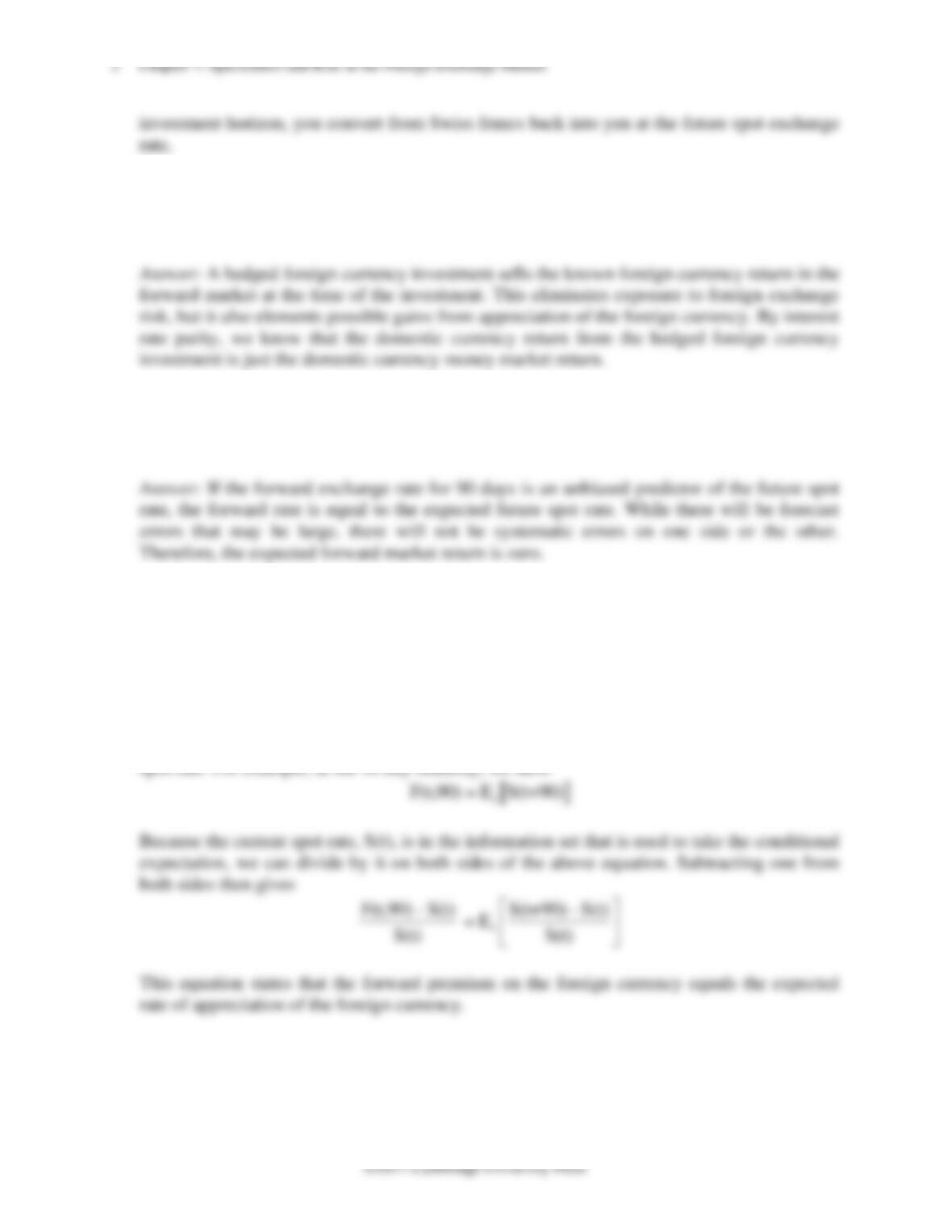
Answer: When the forward exchange rate is an unbiased predictor of the future spot
exchange rate, we know that the forward rate equals the conditional expectation of the future
spot rate. For example, at the 90 day maturity, we have
t
F(t,90) = E S(t+90)
Because the current spot rate, S(t), is in the information set that is used to take the conditional
expectation, we can divide by it on both sides of the above equation. Subtracting one from
both sides then gives
t
F(t,90) – S(t) S(t+90) – S(t)
= E
S(t) S(t)
This equation states that the forward premium on the foreign currency equals the expected
rate of appreciation of the foreign currency.
8. It is often claimed that the forward exchange rate is set by arbitrage to satisfy (covered)
interest rate parity. Explain how interest rate parity can be satisfied and how the

Chapter 7: Speculation and Risk in the Foreign Exchange Market
3
forward exchange rate can be set by speculators in reference to the expected future spot
exchange rate.
9. It is sometimes asserted that investors who hedge their foreign currency bond or stock
returns remove the foreign exchange risk associated with the investment, reduce the
volatility of their domestic currency returns, and thus get a “free lunch” because the
mean return in domestic currency remains the same as the mean return in the foreign
currency. Is this true or false? Why?
10. It is often argued that forward exchange rates should be unbiased predictors of future
spot exchange rates if the foreign exchange market is efficient. Is this true or false?
Why?
11. What is the prediction of the CAPM for the relationship between the forward exchange
rate and the expected future spot exchange rate?
©2017 Cambridge University Press
12. If the CAPM explains deviations of the forward exchange rate from the expected future
spot exchange rate, explain why one party involved in a forward contract would be
willing to enter into a contract with an expected loss.
13. Why is it only the covariance of an asset’s return with the return on the world market
portfolio that determines whether there is a risk premium associated with the asset’s
expected return?
14. What is the rational expectations hypothesis, and how is it applied to tests of hypotheses
about expected returns in financial markets?
©2017 Cambridge University Press
15. Suppose that the forward premium equals the conditional expectation of the future rate
of appreciation of the foreign currency relative to the domestic currency. If we form the
average realized rate of appreciation from a large sample of data and compare it to the
average forward premium, what should be true?
16. Explain how you would use a regression to test the unbiasedness hypothesis.
Answer: The unbiasedness hypothesis states that the forward premium on the foreign
currency at each moment in time equals the conditional expectation of the future rate of
17. Suppose you regress the realized rate of appreciation of a foreign currency on a
constant and the forward premium on the foreign currency. What interpretation can
you give to the estimated slope coefficient? If the slope coefficient is negative, is it true
that the forward premium is predicting the wrong sign for the rate of appreciation?
©2017 Cambridge University Press
18. What does a negative slope coefficient in an unbiasedness regression imply about the
variability of risk premiums relative to variability of expected rates of appreciation?
Answer: The volatilities of forward premiums on the major currencies are about 3% (on an
annualized basis). It turns out that the regression evidence presented in Exhibit 7.5 implies
that both the volatilities of expected exchange rate changes and risk premiums are often
(much) larger than the volatilities of forward premiums. The regression states that
( )
1t t t
E s a bfp
+=+
The variance of expected exchange rate changes is therefore
( ) ( ) ( )
2
VAR 1 VAR
t
E s t a b fp t b VAR fp t
+ = + =
Hence, if
21b
, which is the case for all pairs involving the yen, and the $/£ pair, expected
exchange rate changes are more variable than forward premiums. To find the variance of the
risk premium, recall that the risk premium is simply the expected forward market return.
Therefore,
( ) ( ) ( ) ( ) ( )
( ) fmr 1 1 1
tt
rp t E t E s t fp t a b fp t= + = + − = + −
Hence,
( ) ( )
2
VAR rp(t) 1 VARb fp t=−
Consequently, as long as b is negative, which is the case for all currencies, the implied
variance of the risk premium is not only larger than the variance of the forward premium, it is
also larger than the implied variance of the expected exchange rate changes.
19. What is a carry trade?
©2017 Cambridge University Press
20. What is a Sharpe ratio?
21. Do carry trades contain risks that may not be reflected in their Sharpe ratios?
22. What is a peso problem? Explain the term within the context of its original derivation.
Now, explain how peso problems can generally plague the study of financial market
returns.
Answer: A phenomenon called the peso problem arises when rational investors anticipate
events that do not occur during the sample or at least do not occur with the frequency the
investors expect. This invalidates statistical inferences conducted under the rational
t t peg t dev

Chapter 7: Speculation and Risk in the Foreign Exchange Market
8
23. How can you use interest rate differentials to understand the probability of devaluation
and the potential magnitude of the devaluation?
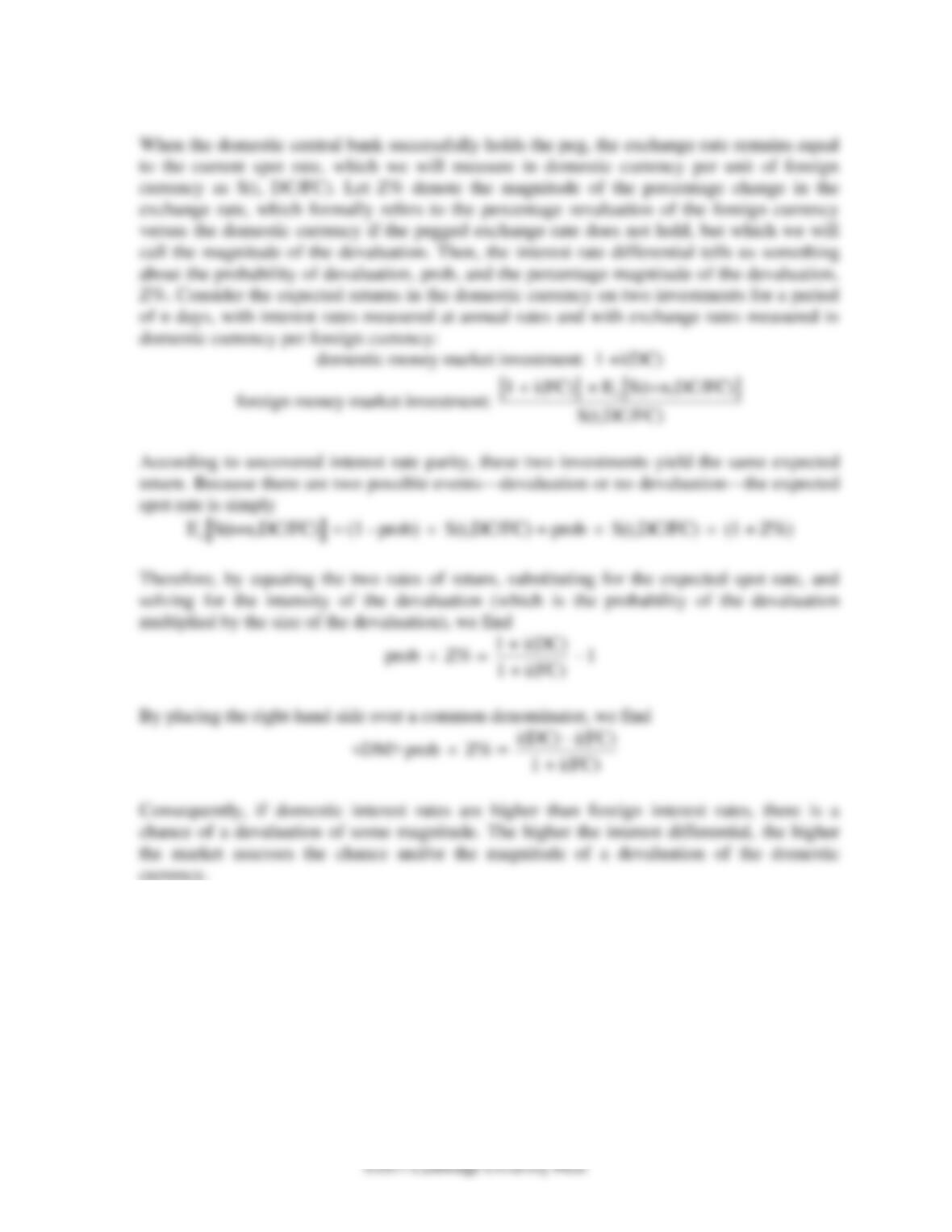
Answer: In a fixed exchange rate regime, the interest differential provides information about
the probability of the devaluation multiplied by the magnitude of the devaluation. To see this,
consider the situation of the domestic currency. There are two possible events:
1. A devaluation with probability of occurrence equal to prob
2. No devaluation with probability of occurrence equal to (1 – prob).
Chapter 7: Speculation and Risk in the Foreign Exchange Market
9
PROBLEMS
1. Over the next 30 days, economists forecast that the pound may weaken relative to the
dollar by as much as 6%, or it may strengthen by as much as 7%. The possible values
for the rate of change of the dollar–pound spot exchange rate are –7%, –5%, –3%, –
1%, 0%, 2%, 4%, and 6%. If these values are equally likely, what are the mean and
standard deviation of the future spot exchange rate if the current rate is $1.5845/£?
Chapter 7: Speculation and Risk in the Foreign Exchange Market
10
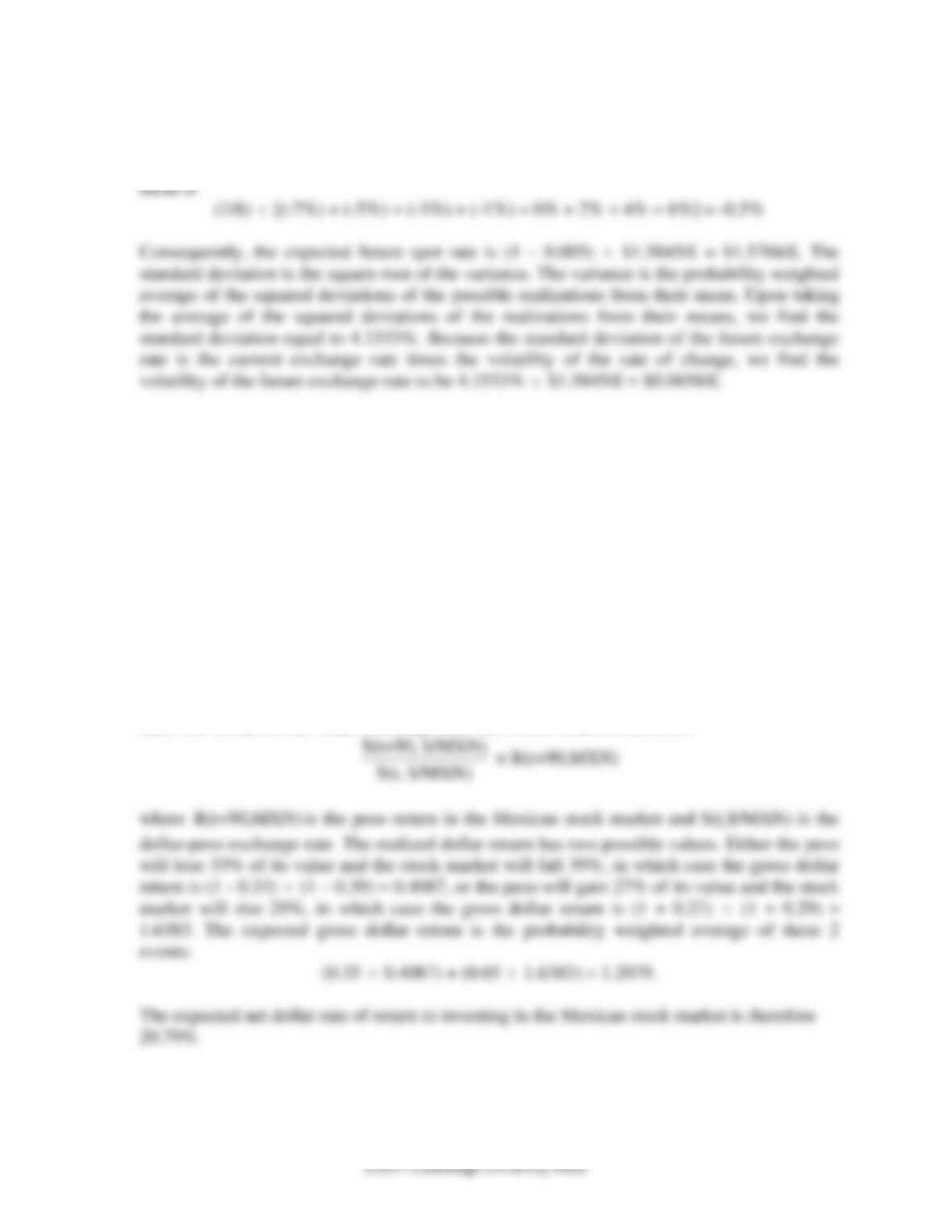
Answer: The mean is the probability weighted average of the future possibilities. Because the
events are equally likely and there are 8 events, each gets weight 1/8 in the average. Thus the
2. Consider the following hypothetical facts about Mexico: The peso recently lost over
40% of its value relative to the dollar. Over the course of the next 90 days, there is a
35% chance that the Mexican government will lose control of the economy. If it does,
the peso will lose 33% of its value relative to the dollar, and the Mexican stock market
will fall by 39%. Alternatively, the U.S. Congress may vote to help Mexico by offering
collateral for Mexican government loans. In that case, the peso will appreciate 27%
relative to the dollar, and the Mexican stock market will rise by 29%. As a U.S. investor
with no current assets or liabilities in Mexico, you have decided to speculate. Calculate
your expected dollar return from investing dollars in the Mexican stock market for the
next 90 days.
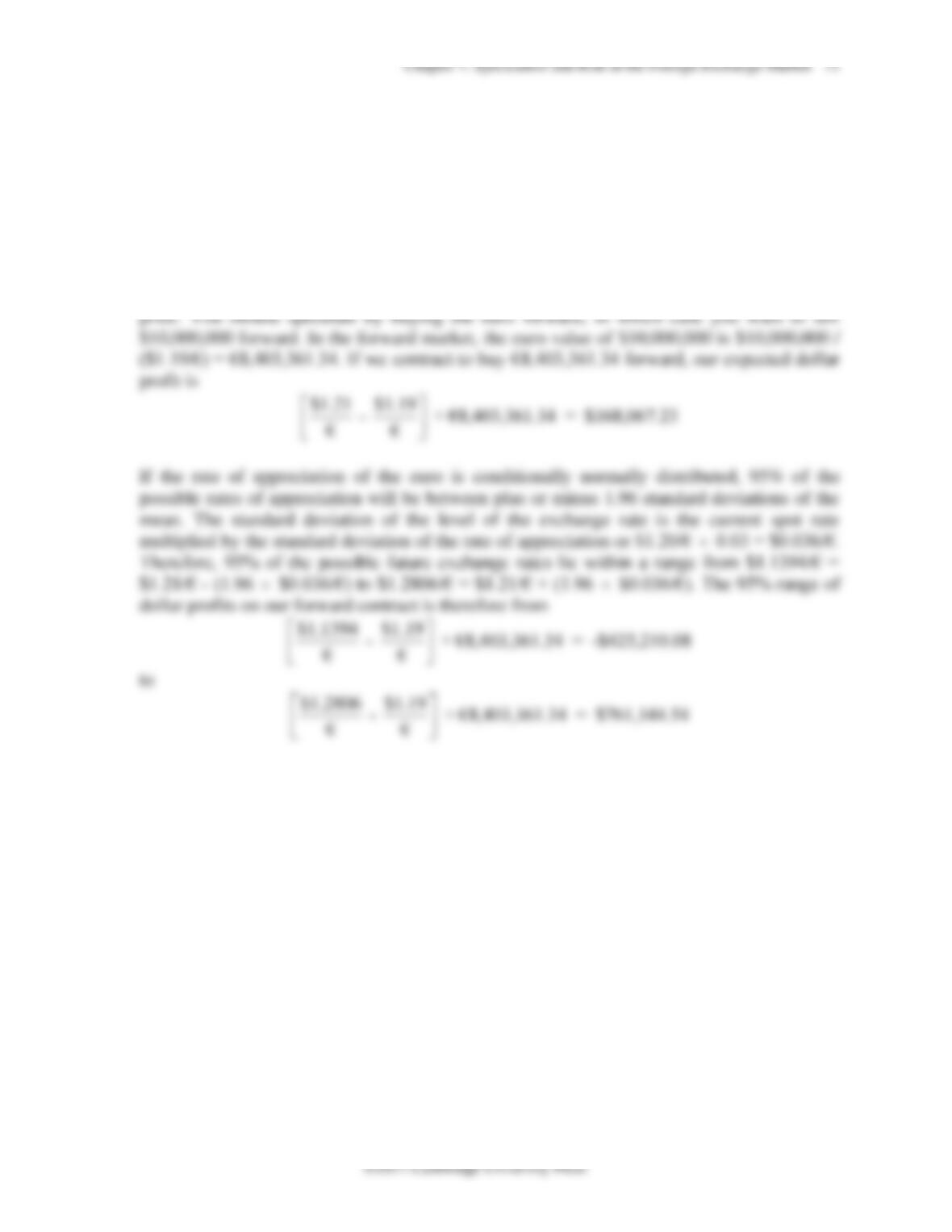
Answer: If you invest in the Mexican stock market, you must first convert dollars into pesos.
Then, you invest the pesos in the stock market. After receiving your stock return, you convert
back into dollars at the future exchange rate. The dollar return is therefore
S(t+90, $/MXN) × R(t+90,MXN)
S(t, $/MXN)
where
R(t+90,MXN)
is the peso return in the Mexican stock market and S(t,$/MXN) is the
dollar-peso exchange rate. The realized dollar return has two possible values. Either the peso
will lose 33% of its value and the stock market will fall 39%, in which case the gross dollar
return is (1 – 0.33)
(1 – 0.39) = 0.4087, or the peso will gain 27% of its value and the stock
market will rise 29%, in which case the gross dollar return is (1 + 0.27)
(1 + 0.29) =
1.6383. The expected gross dollar return is the probability weighted average of these 2
events: (0.35
0.4087) + (0.65
1.6383) = 1.2079.
The expected net dollar rate of return to investing in the Mexican stock market is therefore
20.79%.
3. Suppose that the 90–day forward rate is $1.19/€, the current spot rate is $1.20/€, and
you expect the future spot rate in 90 days to be $1.21/€. What contract would you make
to speculate in the forward market by either buying or selling €10,000,000? What is
your expected profit? If the standard deviation of the 90-day rate of appreciation of the
euro relative to the dollar is 3%, what range covers 95% of your possible profits and
losses?
Answer: The forward rate of $1.19/€ is less than your expected future spot rate of $1.21/€.
Therefore, if you buy the euro forward, you expect to be able to sell euros at a higher dollar
€€
4. Suppose the rate of appreciation of the dollar relative to the yen over the next 90 days
has a mean of –1% and a standard deviation of 3%. Use a spreadsheet program to
graph the distribution of the future yen–dollar exchange rate. If the current spot
exchange rate is ¥99/$, and the 90-day forward rate is ¥98.30/$, what is the expected
profit or loss in yen on a forward contract that sells $5,000,000 forward?
Answer: The graph should look like this:
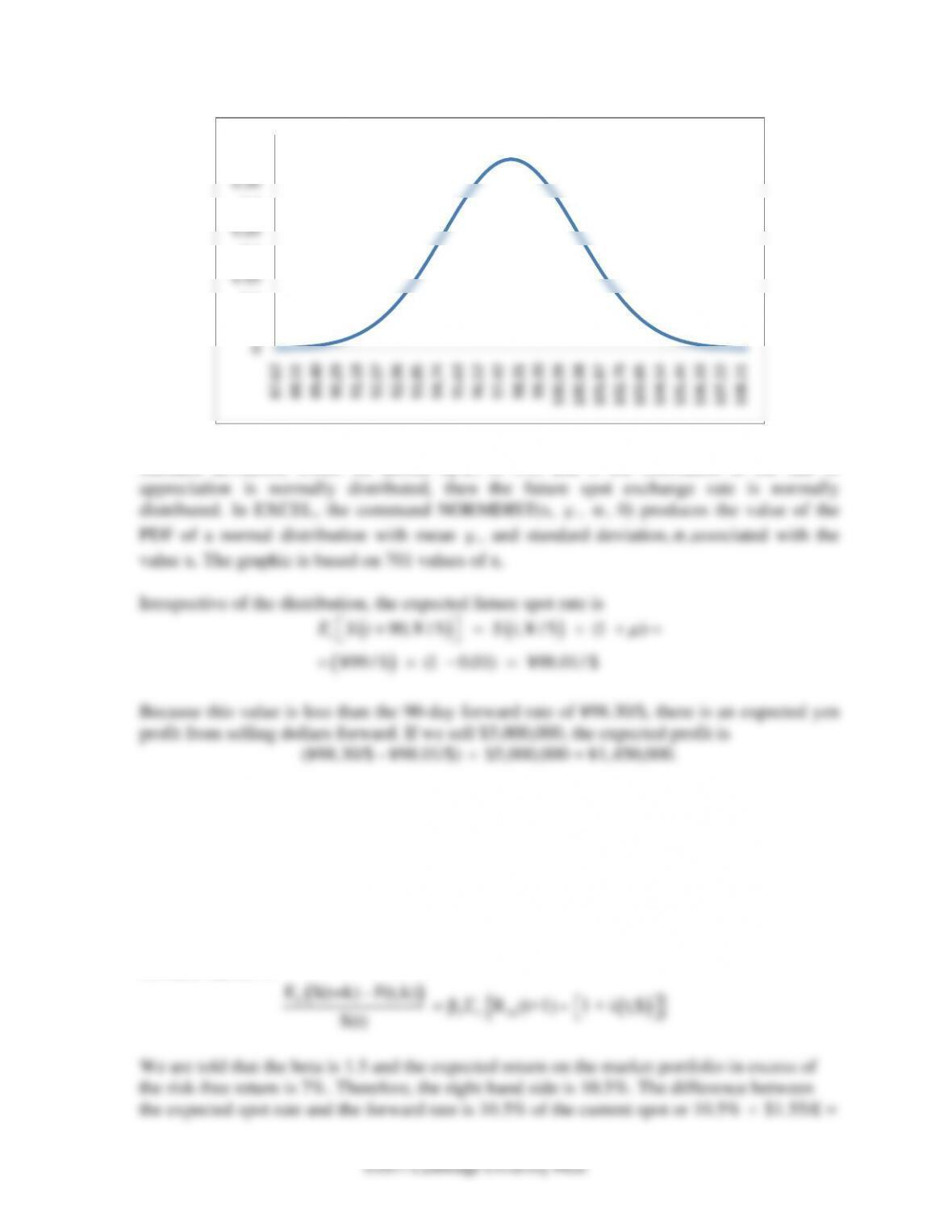
Chapter 7: Speculation and Risk in the Foreign Exchange Market
12
0
0.05
0.1
0.15
0.2
0.25
0.3
0.35
0.4
0.45
87.62
88.51
89.40
90.29
91.18
92.07
92.96
93.85
94.74
95.63
96.52
97.42
98.31
99.20
100.09
100.98
101.87
102.76
103.65
104.54
105.44
106.33
107.22
108.11
Probability of Yen-Dollar Exchange Rate
If the rate of appreciation of the dollar has a mean, which we denote by
μ
, of –1%, and a
standard deviation, which we denote by
σ
, of 3%, and if the innovation to the rate of
μ
μ
5. Suppose that the spot exchange rate is $1.55/£, that the beta on a forward contract to
buy pounds with dollars is 1.5, and that the expected dollar rate of return on the
market portfolio in excess of the dollar risk-free interest rate is 7%. What is the
expected profit or loss on a forward purchase of £1,000,000? Explain how this can be an
equilibrium.
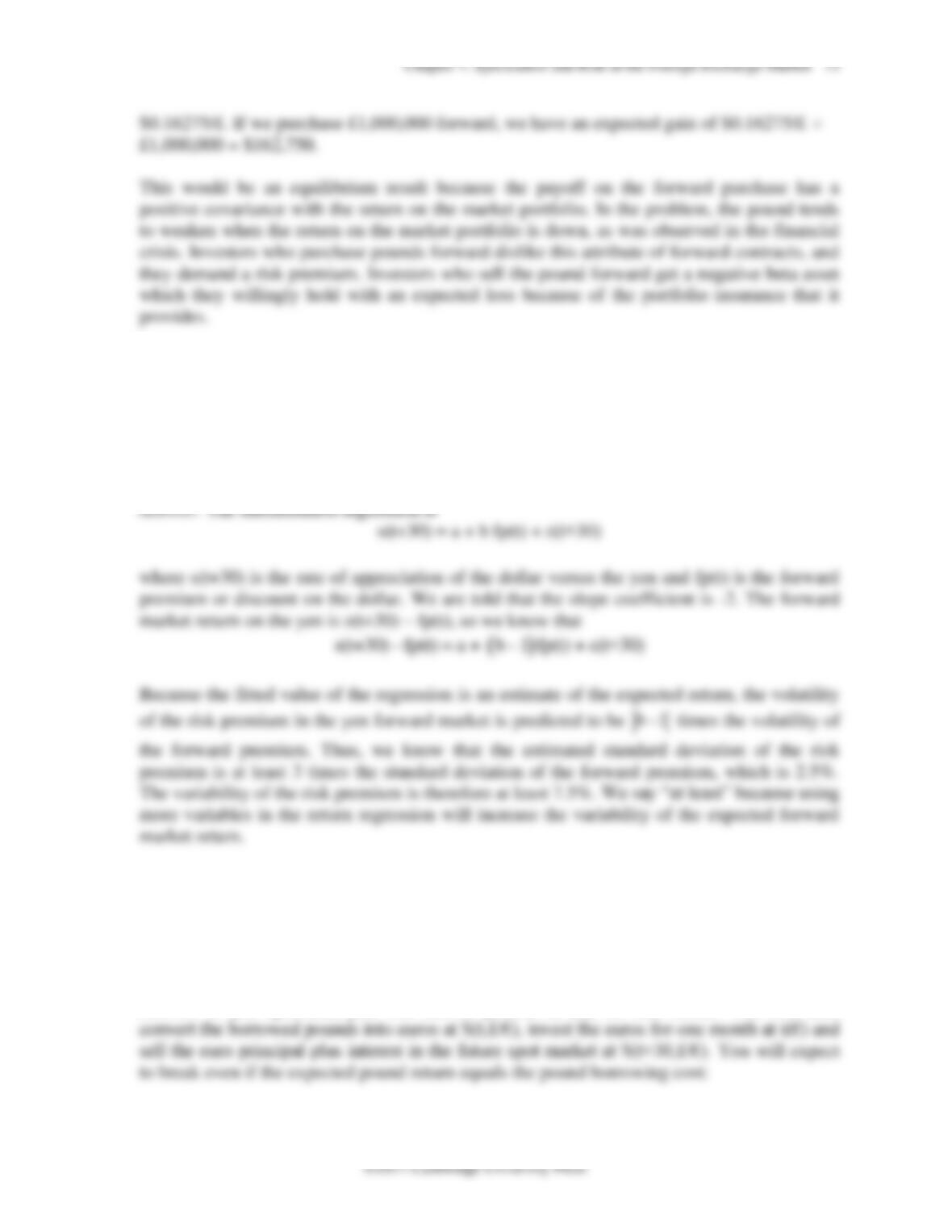
Answer: The CAPM predicts that the expected profit on a contract to purchase pounds in the
forward market is
( ) ( )
tF t M
©2017 Cambridge University Press
6. Suppose the estimated slope coefficient in a regression of the rate of depreciation of the
dollar relative to the yen on a constant and the forward discount on the dollar is –2, and
the standard deviation of the forward discount, measured on an annualized basis, is
2.5%. What is a lower bound for the variability of the risk premium in the yen–dollar
forward market?
Answer: The unbiasedness regression is
s(t+30) = a + b fp(t) + ε(t+30)
where s(t+30) is the rate of appreciation of the dollar versus the yen and fp(t) is the forward
premium or discount on the dollar. We are told that the slope coefficient is -2. The forward
market return on the yen is s(t+30) – fp(t), so we know that
( )
s(t+30) – fp(t) = a + b – 1 fp(t) + ε(t+30)
Because the fitted value of the regression is an estimate of the expected return, the volatility
of the risk premium in the yen forward market is predicted to be
1b−
times the volatility of
the forward premium. Thus, we know that the estimated standard deviation of the risk
premium is at least 3 times the standard deviation of the forward premium, which is 2.5%.
The variability of the risk premium is therefore at least 7.5%. We say “at least” because using
more variables in the return regression will increase the variability of the expected forward
market return.
7. Suppose the British pound (GBP) is pegged to the euro (EUR). You think there is a 5%
probability that the GBP will be devalued by 10% over the course of the next month.
What interest differential would prevent you from speculating by borrowing GBP and
lending EUR?
Answer: If you speculate, you will borrow pounds at i(£) for one month. You will then
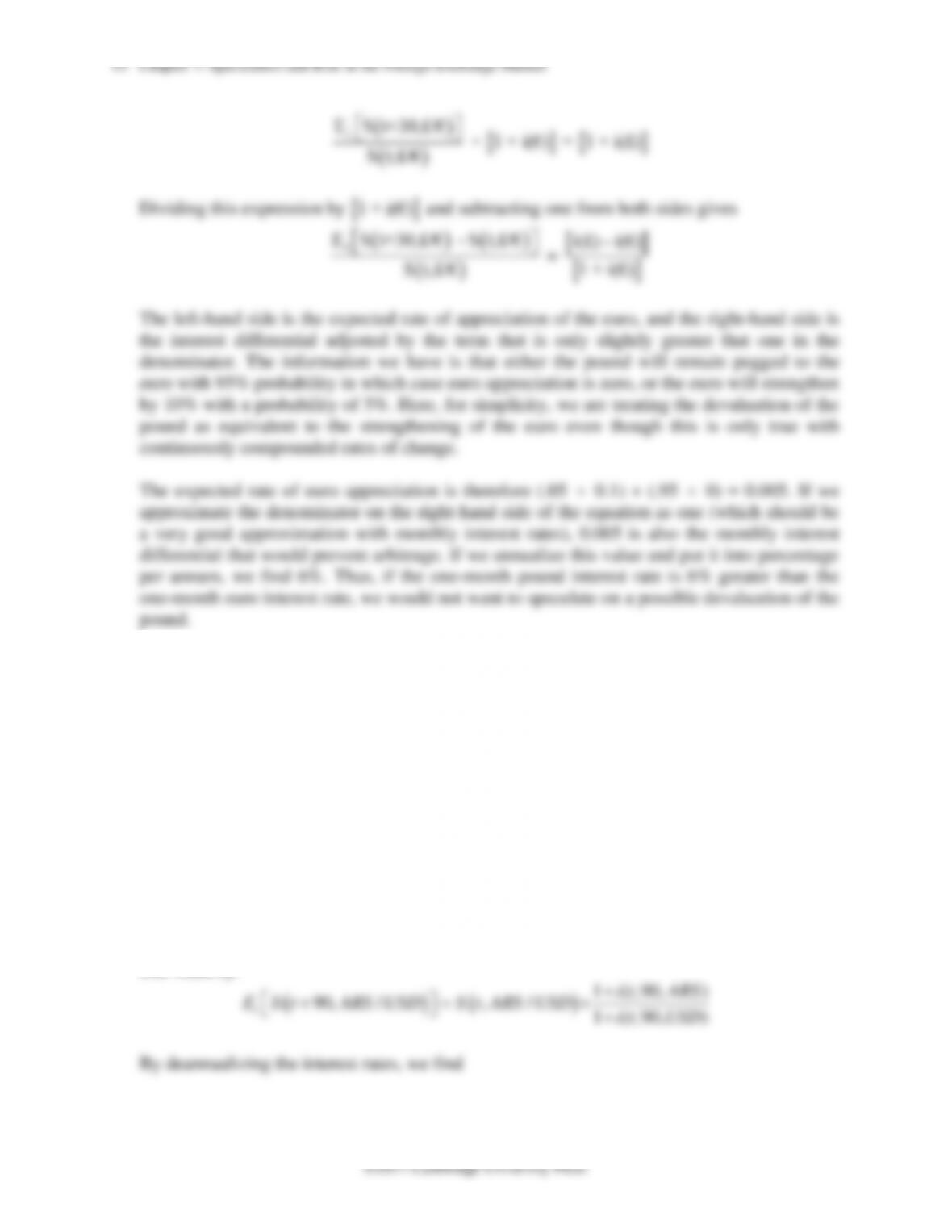
©2017 Cambridge University Press
8. Argentina’s monetary stabilization plan in 1991 included introducing a currency board
that tied the Argentine peso (ARS) to the U.S. dollar at an exchange rate of
ARS1/USD1. On June 21, 2000, the 3-month interest rates quoted by Argentine banks
were 6.71% in USD and 7.33% in ARS. Suppose the difference reflected some
probability that the currency board would be abandoned and the peso devalued, and
investors think a 10% devaluation to ARS1.10/USD is possible. What is the probability
of this happening if uncovered interest rate parity holds? In early 2001, confidence in
the currency board eroded and interest differential soared to well over 10%. What is
the possibility of a 10% devaluation if the 3-month interest rates are 20% in ARS and
6.0% in USD?
Answer: We are told that uncovered interest rate parity is satisfied. Therefore, the expected
future spot rate is the current spot rate times the ratio of one plus the nominal interest rate for
that maturity.
1 ( ,90, )
i t ARS
+

©2017 Cambridge University Press
( ) ( )
1 7.33/ 400
90, / 1/ 1.001524 /
1 6.71/ 400
t
E S t ARS USD ARS USD ARS USD
+
+ = =
+
If p is the probability of a 10% devaluation, then the expected future spot rate is
( ) ( )
90 1 1 1.1 1.001524
t
E S t p p+ = − + =
Solving this we find p = 0.015244. Doing the same set of equations for the new three-month
interest rates of 20% for ARS and 6% for USD gives p = 0.034483.
9. The British bank Barclays has developed an Exchange Traded Note that pays off the
The Barclays Capital Intelligent Carry Index™. Look up information on this index on
the web. Explain why you like or dislike its strategy.
Answer: Here is the information from the Barclays Capital web site,